Jeff Garrison
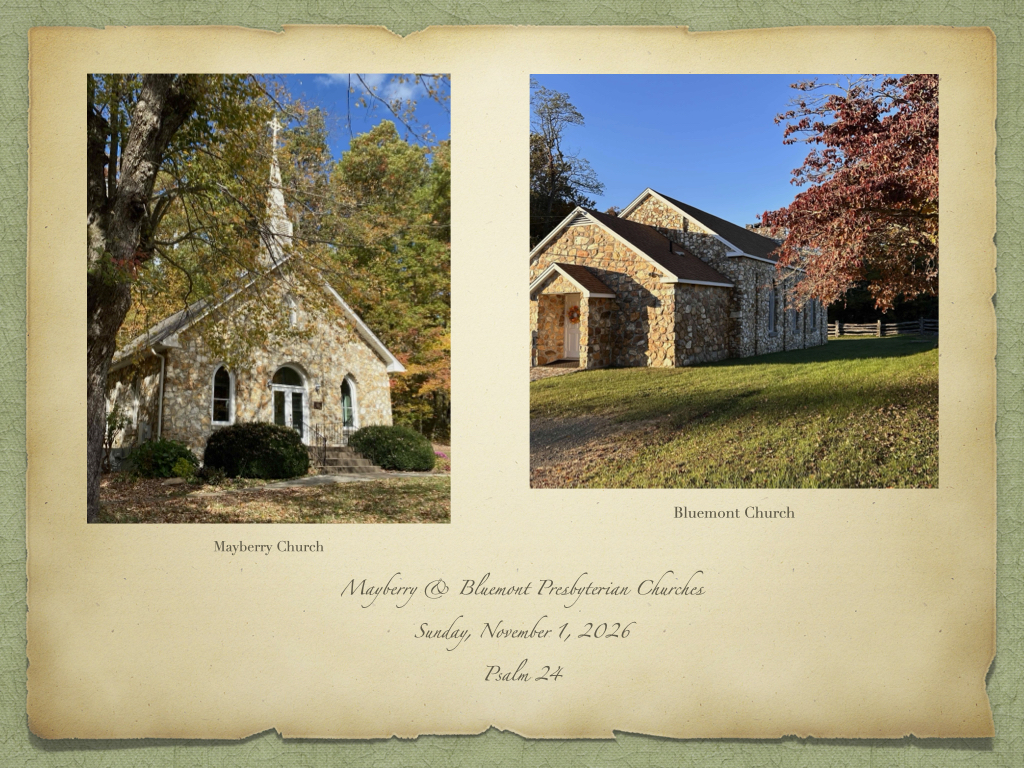
Bluemont & Mayberry Churches
November 1, 2026
Psalm 24
At the beginning of worship:
When was the last time you rented a car? Do you remember the drill. You sign a bunch of papers outlining your responsibilities. You’re not to smoke inside the car, and if you do, there’ll be an extra fine. And if you get a parking ticket or one of those electronic speeding tickets which have become so popular, you’re responsible. You might think they can’t track you down with the rental license plate, but the rental company has your information and your credit card number. If you get a ticket, you’ll be getting an additional charge on your bill. And then, before you take the car, you look it over because you are to bring it back just as it was when you drove it off the lot.
The rental car is not yours. It belongs to the rental company and they allow you, for a fee, the right to drive their car for a particular period of time.
God created this world and created us. And, for a period of time, like the rental company, God allows us to live on and care for this world. But as it is between us and the rental company, we have responsibilities. We’ll take more about this later this morning.
Before reading the Scripture:
As we continue to work through Psalms I’ve not yet preached upon, today we’ll look at Psalm 24. This is a Psalm informing us of God’s nature, and also some of our responsibilities for those of us who strive to know God. The final part of the Psalm speaks of God coming into our presence.
Last week, we looked at Psalm 124, which ends with a profound statement about God: “Our help is in the Lord, who made heaven and earth.” Psalm 24 reverses this. It begins with a profound statement about God, “The earth is the Lord’s and all that is in it, the world and those who live in it.” This statement impacts our stewardship. God owns the world. What small footprint of this planet we hold title to ultimately belongs to God, not us. Then it moves to informing us our responsibilities before God.
As with the ending statement of last week’s Psalm, the statement which begins our Psalm is a go-to statement for me. It reminds me of the proper order of our world. We are stewards of the creation for which God gives us dominion. But the dominion is not forever, just for our time on earth.
Also as in last week’s Psalm, today’s Psalm shows marks of having been used in worship. There are three questions asked. We can envision a priest asking the questions, as with a catechism, and the congregation then answering.
Read Psalm 24
Psalm 24 provides us with a view of God and also a reminder of our responsibilities. As with many Psalms, including 124, which we explored last week, there are three parts to this Psalm. Let’s start by exploring each part.
Psalm 24 begins with a proclamation. This world is not ours. It belongs to God. Not only does the world belong to God, the Almighty lays claim on us. We belong not to ourselves, but to God. As the beautiful opening question of the Heidelberg Catechism states:
What is your only comfort in life and in death?That I am not my own, but belong— body and soul, in life and in death to my faithful Savior, Jesus Christ…
God can make such claims on the earth and on us because God creates and conquers chaos. The Psalmist draws us back to the view of creation in Genesis 1, where the earth sits as an island upon a tamed sea and watered by rivers.
After establishing God’s dominion, the Psalm moves to our responsibility with the first of three questions: “Who can ascend the hill of the Lord, stand in God’s holy place?” The answer: those with clean hands, pure hearts, and who avoid falsehoods and deceitfulness. Many commentators on this passage note how this verse doesn’t refer to ritual purity of the Old Testament, that which is gained through sacrifices and such, but ethical and moral purity.
This passage parallels that well known Old Testament passage of Micah 6:8:
He has told you, O mortal, what is good, and what does the Lord require of you but to do justice and to love kindness and to walk humbly with your God?
Such are those who strive to live a life in a way which honors God by keeping the intent of God’s law. These are God-seekers, those whose hearts long for God.
Verse 7 begins the third and final section of the Psalm. The opening of the Psalm began with a proclamation of God’s ownership, but now we have a command. As God owns the world and those who live in it, we’re now ordered to open the gates so that the King of Glory may enter. The landlord visits. We are reminded here of the image of Jesus in the letter to Laodicean in the third chapter of Revelation. The rich people of Laodicea consider themselves self-sufficient. They don’t think they need anything else, but Jesus stands at their door knocking.
You may recall seeing the image captured in the well known painting by William Holman Hunt, and copied by other artists. In Hunt’s version, Jesus stands outside a door which has no handle and can be only open from the inside. He holds a lantern in one hand and knocks with his other. We’re reminded God doesn’t force himself on us, but stands willing to enter our lives if we only welcome him.
Scholars debate over the setting for this last section. Some think it may have been a separate Psalm tacked on to the first verses. If so, it’s not something unheard of. We saw the opposite of this a few weeks ago, how Psalm 9 and 10 originally went together and were later divided. Instead of dividing, here they were placed together to create something new.
Nor are we sure what is being depicted in this section, but it could have been David moving the Ark of the Covenant to Jerusalem. The ark, the representation of God’s presence, was taken by the Hebrew people through the wilderness and into battle. When David adopted Jerusalem as his capital, the ark was stationed there. It would later be established within the Temple built by David’s son, Solomon.
As Christians, this passage can also be interpreted as a reminder of Jesus’ coming, as in the Advent hymn, “Lift Up Your Heads, Ye Mighty Gates,” or even as a Palm Sunday passage celebrating Jesus coming into Jerusalem. The idea of opening up the gates remind us of our need to open our hearts up to Christ.
The movement of this Psalm goes like this. We proclaim God’s ownership of the world, then move to our responsibility toward God, who we acknowledge as our landlord. Then we end with a call to open ourselves up to God, to invite God to fill us with his Spirit and love. So while the Psalm makes claims about God, it also reminds us of our responsibilities toward such a God.
The landlord motif is appropriate for our relationship to God. When we rent property we are expected to do certain things. We pay the rent on time, we protect the property, keeping it clean and in good order. With God as our landlord, we have a responsibility. In our text, this responsibility is represented by clean hands and hearts, and by speaking the truth and avoiding deceit. We find such responsibilities in the 10 Commandments and in other parts of Scripture. And they don’t just apply to our relationship to God, who already knows all we do, but also to how we relate to other people who, like us, live on this earth. God wants us not only to worship and honor him, but also to honor others who, like us, have been created in God’s image.
God, as landlord, demands his tenants honor one another.
So, wherever you find yourself this week, look around. Remember it all belongs to God. But don’t begrudge the landlord, for God is gracious. After all, God trust us enough to make us stewards of this wonderful world. Amen.
Sources:
Alter, Robert. The Book of Psalms: A Translation and Commentary, New York: Norton & Company, 2007.
Kvam, Kristen E. And Don E. Saliers, Psalms: Belief, a Theological Commentary on the Bible. Louisville, KY: WJKP, 2026.
Mays, James L., Psalms: Interpretation, a Biblical Commentary for Teaching and Preaching, Louisville, KY: John Knox Press, 1994.
Weiser, Artur. The Psalms: Old Testament Library. Herbert Hartwell, translator. Philadelphia, Westminster Press, 1962.
Good reading.
Thank you.
That’s interesting how you compared renting a car to us being here. That’s an interesting insight. Happy November.
Thank you.
Thank you for sharing and reminding us all and it’s a topic we were just discussing over dinner last night reminding each other of the importance of contributing. Like the famous quote, “It takes a village to raise a child.” Happy November to you and have a great week ahead.
Happy November to you and your family, Karen. Thanks for reading.
We forget this all too often and I know I fail to be a good steward in many ways. I remember being told when I had children that they weren’t really mine, but they were given to me by God to raise.
That Hunt painting is a favorite of mine.
I, too, love that painting and all the symbolism, the door with no outside knob so it can only be opened from the inside, how the brambles grow up around it indicating that it is seldom open, but our Savior still reaching out to us.