
 Jeff Garrison
Skidaway Island Presbyterian Church
Matthew 17:1-8
February 23, 2020
Today, we’re coming to an end of this series on SAD (Spiritual Affection Disease). We’ve looked at several ordinary activities that can be used, beyond prayer and Bible study, to draw us closer to God. Today, we’re going to see that everything focuses on Jesus. Once we encounter the Savior, we need to fearlessly carry out his work.
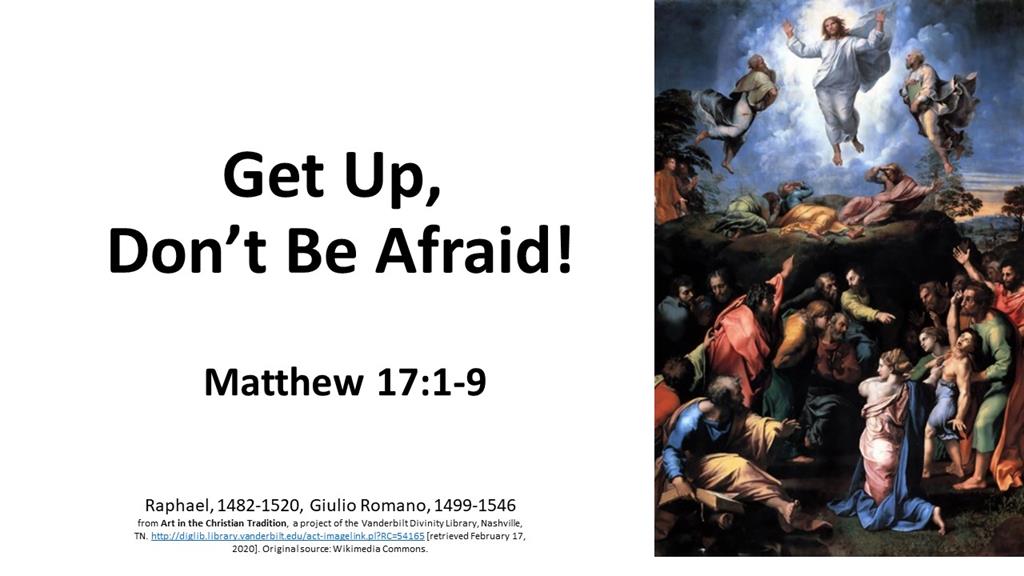
Our passage is the Transfiguration. These are some verses I’ve often wondered about. Why are they in Scripture?” I’ve asked. “Is this story needed?” This week, I thought about this passage while attending a two-day Theology Matter’s conference on Hilton Head.[1] We considered what it means for Jesus to be the “way and the truth and the life,” In that setting, I began to clearly understand the importance of this text. It points us to Jesus, and to our need to listen to his Word.
The Transfiguration is a mysterious event with which the western church has always struggled. The Eastern Church, the Orthodox tradition, from early in its history, celebrated the event with a feast. In the West, it wasn’t until the 15th Century, right before the Protestant Reformation, that the Roman Catholic Church set aside a special day to recall the Transfiguration.[2] And for Protestants, we came even later to the table. But it’s important that we deal with this passage for it appears in all three of the synoptic gospels—Matthew, Mark and Luke.[3] Let’s listen to Matthew’s account of this story. And as I read this, think about what your reaction to such an encounter might be. Read Matthew 17:1-8.
###
There are four questions I want us to explore from this mysterious text. Of course, many other questions may arise, but this morning, we’ll stick with these four:
Why did Jesus only take three of the twelve disciples up on the mountain?
What is the significance of Moses and Elijah’s appearance?
What do we learn about Jesus from this encounter?
And finally, what’s the implication of this text for our lives?
That’s more than we can chew on in one sermon, but let’s see where it takes us.
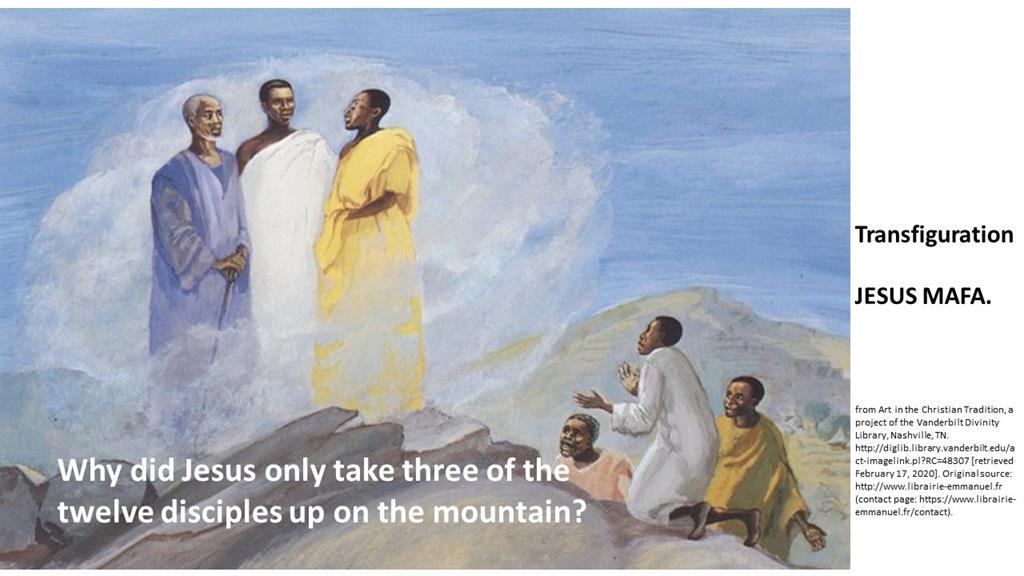
We’re told that Jesus took Peter, James and John up on the mountain. In Scripture, many things happen on mountaintops, going back to Abraham. So the reader is expecting something to happen up on the mountain, at a place that symbolically links the earth to heaven.[4] But why does Jesus only take three of the twelve disciples? Did the other nine feel left out? We’re not told, but we must admit that there are times it’s easier to have an experience with a few than with many. These three, in a way, form Jesus’ inner-core. Each of these become the major players in the early church.[5] So maybe Jesus had a tactical reason for allowing them to have this experience. Furthermore, mountaintop experiences in Scripture tend to happen only to individuals or small groups and it’s up to those having the experience to share what happened with others.[6]
What’s important here is not that those of us who follow Jesus have a mystical encounter, but that we learn from the experiences of others. Not all of us will have a Damascus moment like Paul, or witness a burning, non-burning bush like Moses, or the Transfiguration like the three disciples. After the resurrection, Jesus responded to Thomas (who wasn’t at the Transfiguration): “Have you believed because you have seen me? Blessed are those who have not seen and yet have come to believe.”[7] Most of us will fall in the latter category. We are those who have not seen and have yet, because of the testimony of others, believe.
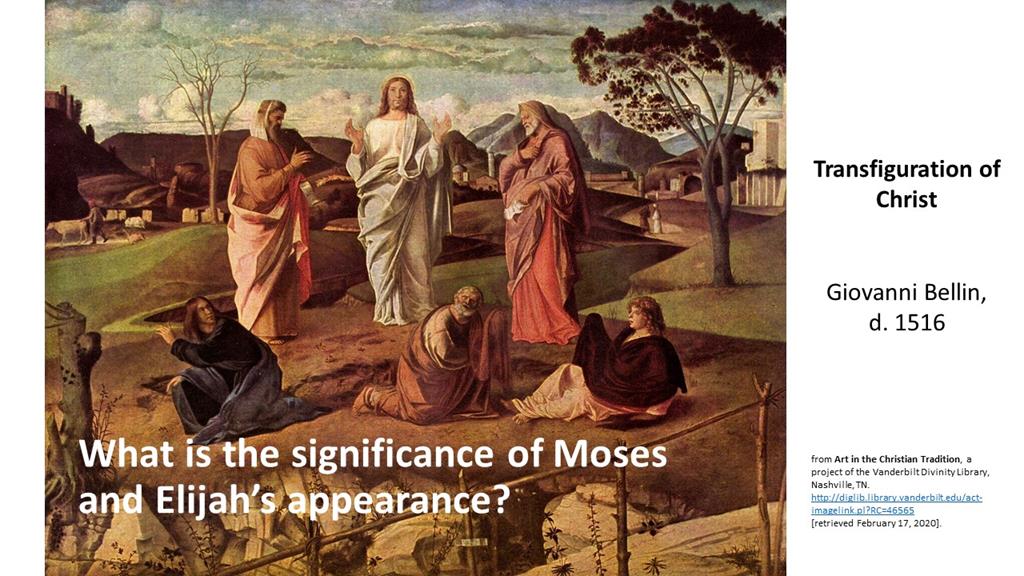
Once Jesus and the disciples make it to the top of the mountain they experience a vision.[8] Jesus begins to glow. His face was like the sun and his clothes became dazzling white. That in itself was amazing, but then there appeared Moses and Elijah, who were alive and talking to Jesus. We’re not told how the disciples knew it was Moses and Elijah. I’m pretty sure they weren’t wearing name tags. But how they knew is not as important as to who they are. These are the two great figures in the Old Testament. Moses brought God’s law down from the mountain to God’s people at Sinai. He represents a fulfillment of the covenant that began with Abraham. Elijah is the representative of the prophets, those individuals called by God to demand the Hebrew people’s faithfulness to their Lord.
The appearance of Moses and Elijah is a reminder of the importance of the Old Testament and how it points to Jesus. The Scriptures of the Old Testament are still valid, but they now take on a different dimension with Christ, the one who came to show us the way home, the way back to God. In their appearance, the past (or what we might call tradition) points to the way forward. This is especially true for those of us on this side of the crucifixion and resurrection.[9]
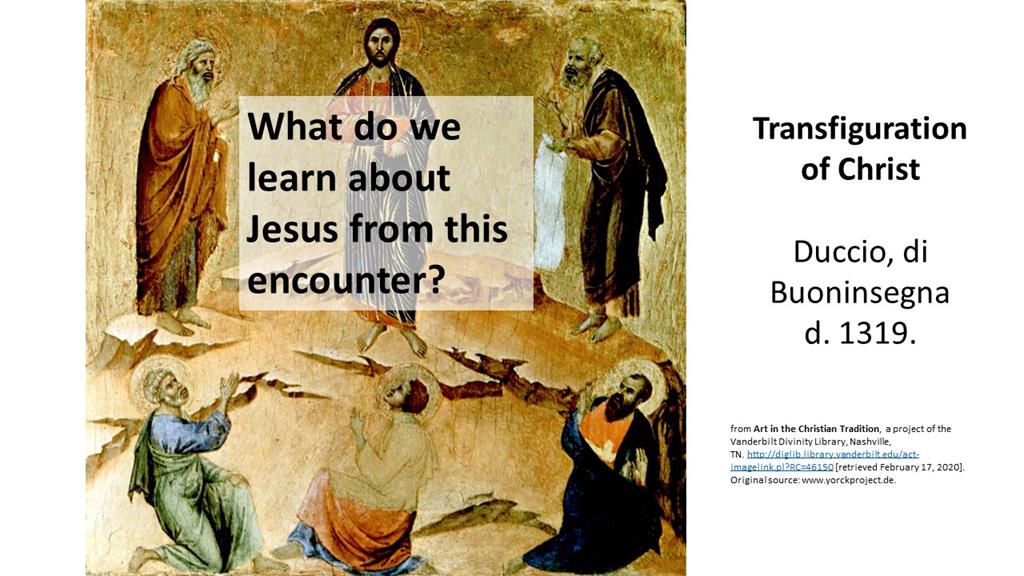 This all amazes the disciples and causes Peter to begin babble about building shelters, perhaps to prolong the event. But while Peter rambles, we’re told a bright cloud suddenly overshadowed them. Think about this, Jesus is already dazzling white, so this cloud must have been really amazing. And from the cloud, as it was at Jesus’ baptism, God speaks. “This is my Son, the Beloved; with him I am well pleased; listen to him.” The words are the same as at Jesus’ baptism except for the last three: “Listen to him.”[10] Again, God confirms Jesus’ identity and role, but now God commands the disciples to listen to him. God is saying that what Jesus says is important. As we learn in the prologue to John’s gospel, Jesus is God’s Word.[11]
Here, in this passage, we have God the Father, and the traditions of the past (Moses and Elijah), all pointing toward Jesus as the way forward. He’s the one whom we’re to follow, which is the core of the message within this passage.
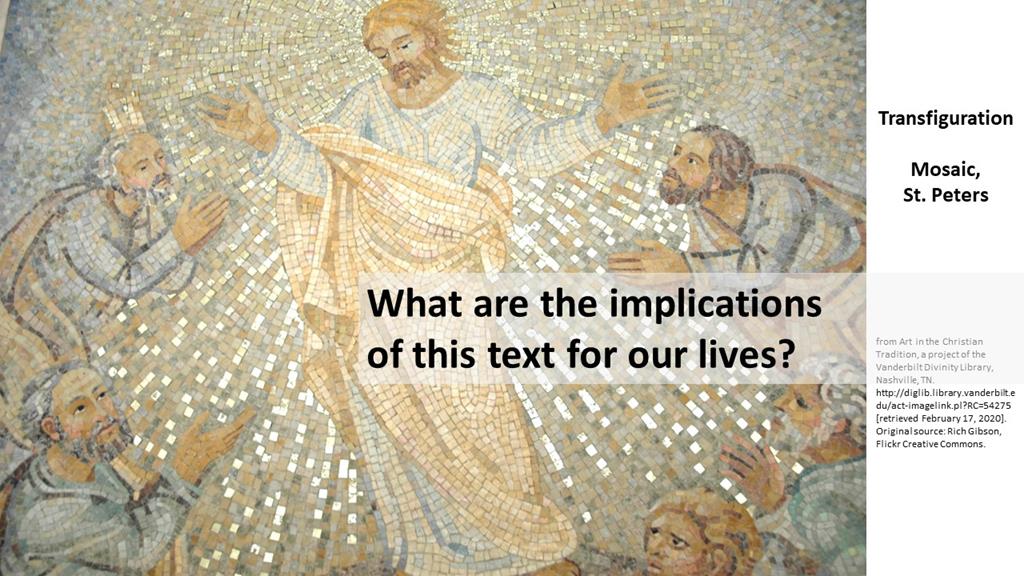
The disciples are overwhelmed and fearful. They fall to the ground. But it doesn’t last long. Jesus comes over and shakes them as they crouch on the dirt and says, “Get up and do not be afraid.” And as they look up, it’s all over and it’s time for them to leave the mountain and join the rest of the disciples at the base of the hill. 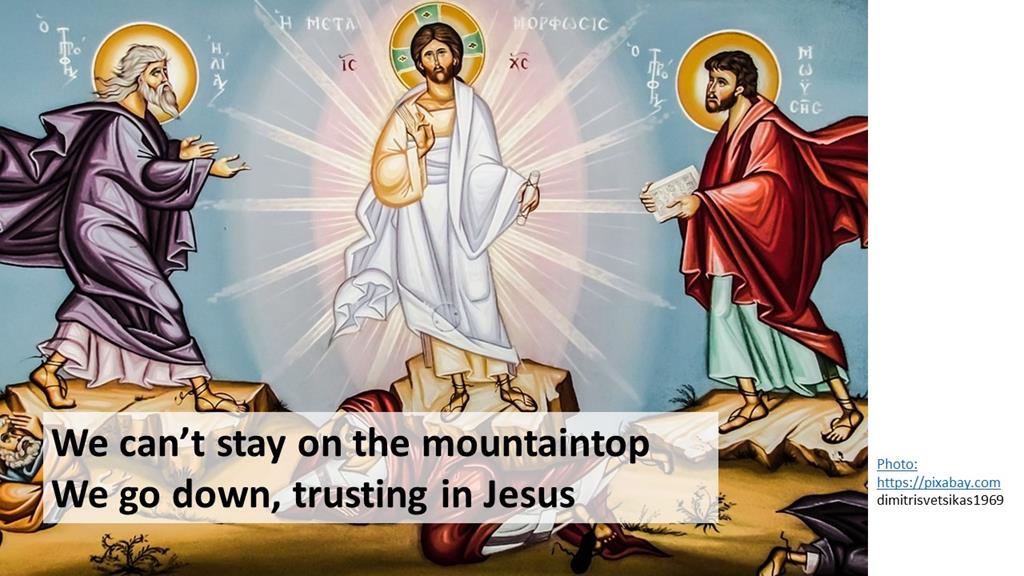
Two things we should take from Jesus’ words. We can’t stay on the mountain. As followers of Christ, we are called to live out our discipleship in the valleys, with the people, not up on the mountaintops away from problems. Yes, sometimes we need a break, we need time alone.[12] But ministry (and we’re all called into ministry) is among people, down the mountain, where things can be dirty and messy. And as scary as the mountaintops might be, going back down can even be scarier. But we’re not to be scared because Jesus is with us. Our lives are to focus on him, first and foremost. And if we focus on Jesus and trust that he has things under control, we shouldn’t be afraid of anything. Yes, in life some bad stuff can happen, just like it happened to the disciples, BUT Jesus has it all worked out. He’s secured our future so that we might live for him in this life.
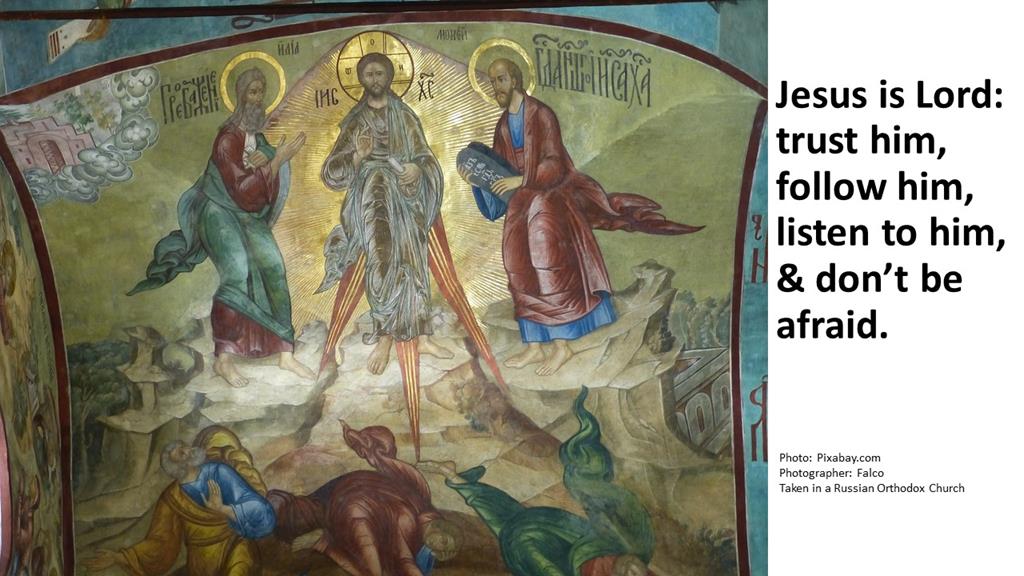 So what does the Transfiguration say to us today? Jesus is Lord, listen to him, obey him, trust him, follow him, and don’t be afraid. “Get up, don’t be afraid.” Good words for us to consider as we, as a congregation, prepare for our future. Amen.
©2020
[1] The theme of the conference was John 14:6 (Jesus as the way, the truth, and the life). See https://www.theologymatters.com/.
[2] R. F. Buxton, “Transfiguration,” The New Westminster Dictionary of Liturgy and Worship (Philadelphia: Westminster, 1986), 510. The Eastern Church celebrates this day on August. 6.
[3] See Mark 9:2-8 and Luke 9:28-36.
[4] Douglas R. A. Hare (Matthew: Interpretation, a Commentary for Teaching and Preaching, (Louisville, John Knox Press, 1993), 198.
[5] Jesus took this same group to Gethsemane to pray (Luke 26:37). Frederick Dale Bruner, The Churchbook: Matthew 12-28 (Grand Rapids: Eerdmans, 2004), 165.
[6] Think of Abraham and Isaac on the mountain (Genesis 22), Moses on the mountain (Exodus 3 and 19:20ff), Elijah on the mountain (I Kings 19:11ff), and Jesus in the wilderness during his temptation (Matthew 4:1-11). See also Bruner, 165. Bruner refers to J. A. Bengel’s 18th Century commentary. Bengel suggested the mountain may not have been named to avoid superstition. In light of this, I suggest it’s not the mountain that’s important, but the Jesus who is revealed on the mountain, therefore it’s more about what we do with this experience than the experience itself.
[7] John 20:29.
[8] While the story (verses 1-8) doesn’t say this is a vision, when they head down the mountain, Jesus describes it as a vision in verse 9.
[9] Bruner, 167.
[10] See Matthew 3:13-17.
[11] John 1:1-2.
[12] Even Jesus took time alone, away from the crowds. See Matthew 14:13.
 Jeff Garrison
  Today, we’re looking at walking. In a way, the ability to walk is what makes us human. In Genesis, we have that beautiful image of God walking in the garden and wanting the man and woman to join the stroll.
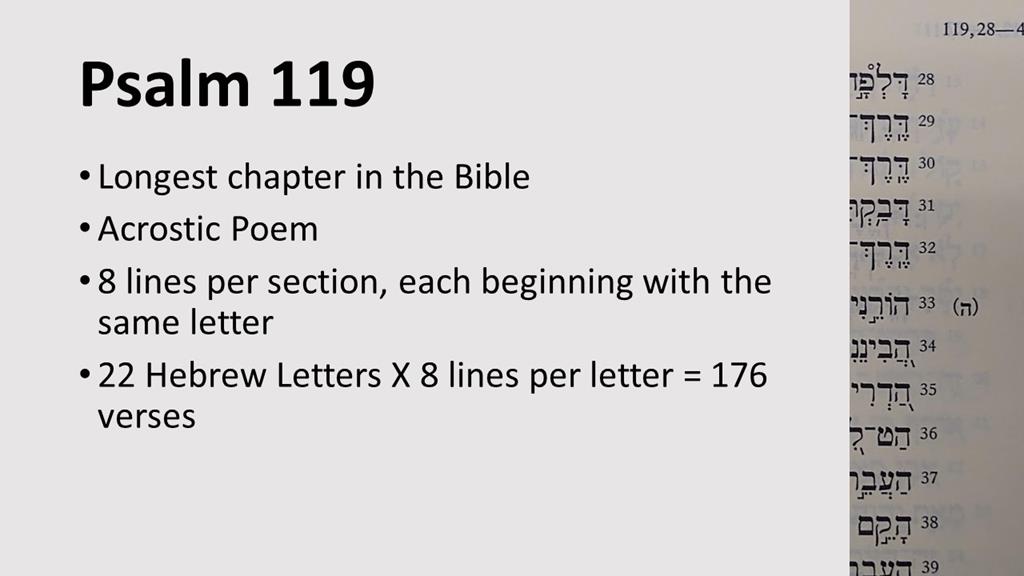 Before reading our last passage, from Psalm 119, let me share a bit about this mega-Psalm. You might know that this Psalm is the longest chapter in the Bible. There are 176 verses to the 119th Psalm. It’s way too much to preach on in one sermon! But it’s also a unique. I know you’ve heard me speak of acrostic Psalms… This is a type of poetry where every line begins with the next letter in the alphabet. In English, it would be like writing, “Apples are red, Berries are blue, Cats are cute… etc. Using an acrostic method helps in memorization. I’ll come back to this later in the sermon.


 Of course, we’re not just to walk for walking sake, even though it is good for our physical being. Scripture tells us repeatedly to walk in the ways of the Lord. Psalm 119 is a meditation on God’s law. Throughout this passage, we’re encouraged to walk in the law, to walk in the ways of God, to let God’s law light the path for our feet.
 But I also want you to join in on another walk, one that will involve all the congregation. As you know, next Sunday we’re going to lay out a new Strategic Plan for our congregation. We want to be a “joyful, thriving church reflecting the face of Jesus to the world!” Our mission is to “Love God, Love our Neighbors, and to Change the world.” We have set up core values (using an acrostic formation-kind of like Psalm 119-that spells out WORSHIP). These core values demonstrate God’s love by Welcoming, Offering, Respecting, Serving, Helping, Investing, and Praying. All this is supported by four pillars, which we as a church need to walk within. These pillars will require each of us to commit ourselves to excellence, and we if bind ourselves on this journey together, we will live into our Vision and Mission.

 David Sedaris, Thief by Finding (audiobooks, 1977) 13 hours 52 minutes.
  David Baker, Swift: New and Selected Poems (New York: Norton, 2019), 179 pages
 Chad Faries, Drive Me Out of My Mind: 24 Houses in 10 Years: A Memoir (Emergency Press, 2011), 280 pages.
  Jeff Garrison
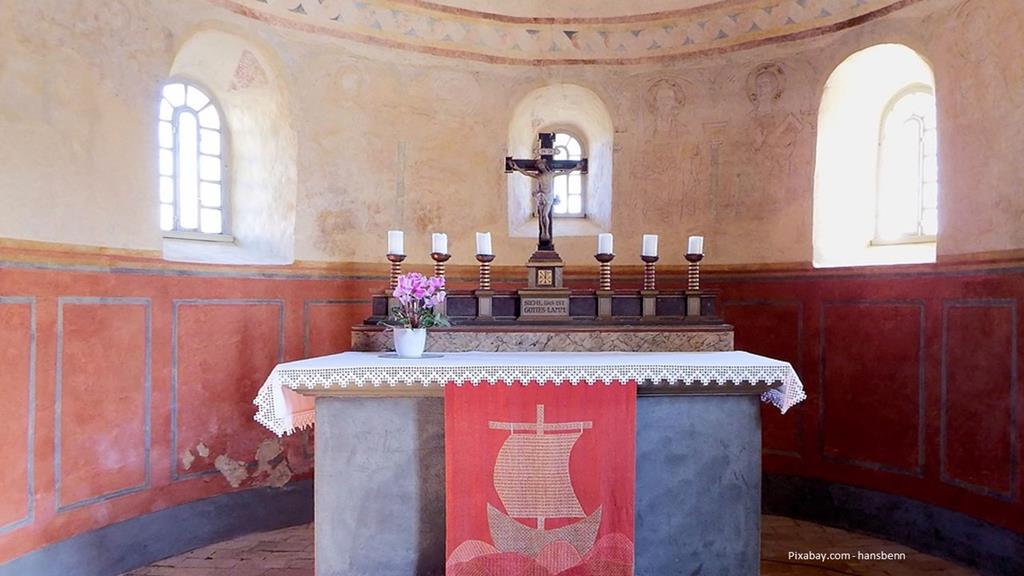 Today’s service is titled “Altars, Altars, Everywhere.” Let me point out that I’m using term “altar” for a place where we worship God. Biblically, an altar was a place for a sacrifice. The word comes to us from the Latin to describe a place where a sacrifice is made.
 Our text, Psalm 84, calls us to come into God’s dwelling place. Let me ask you what you think when you hear of such a place? Pearly gates and golden streets? Fluffy clouds inhabited by choirs of angels and accompanied by orchestras of strumming harps? Golden rays of sun highlighting a peaceful landscape?
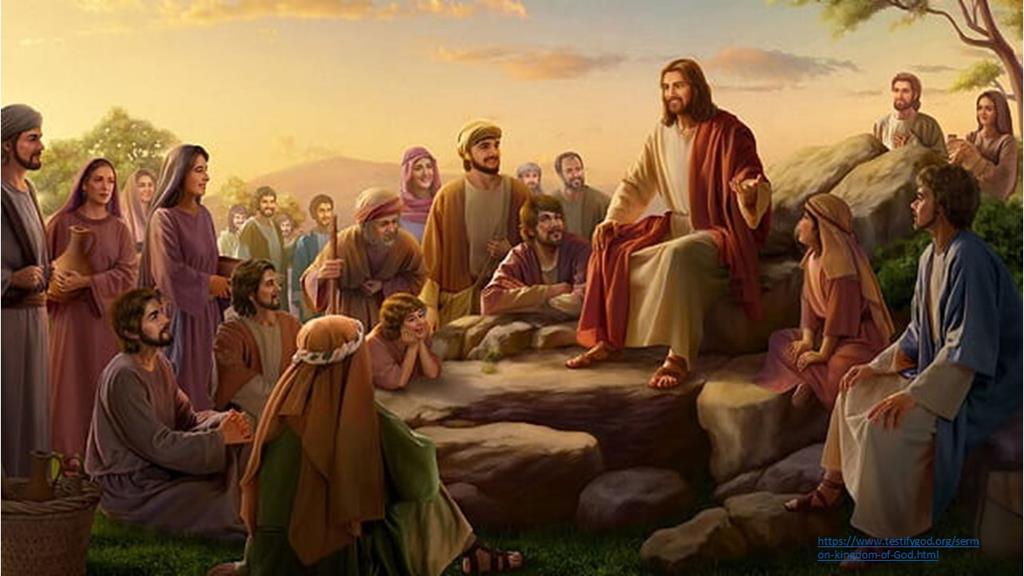 Another way of considering experiencing God’s dwelling place is to consider ourselves already there. After all, Jesus taught that the kingdom has come near.
 This is a crusader’s psalm. It’s one sung by pilgrims as they made their way from far off, perhaps even a foreign country, to the temple in Jerusalem.
 The Psalmist speaks as a pilgrim coming into sight of Mt. Zion, upon which sits the city of Jerusalem. And there in the middle of the city is the temple of God. “How lovely is your dwelling place, O Lord of hosts!” the Psalmist sings. Perhaps this is his first visit to the temple. He’s overcome with joy. Although singing, he’s almost faint from excitement. He observes the birds nesting high up along the roof and acknowledges the glory of God who takes care of all creation, from the greatest mammal to the smallest feathered friend.
 The Psalmist then turns his attention to the priests, those who work in the temple day in and day out. He ponders their happiness. This must be a great job, he thinks.
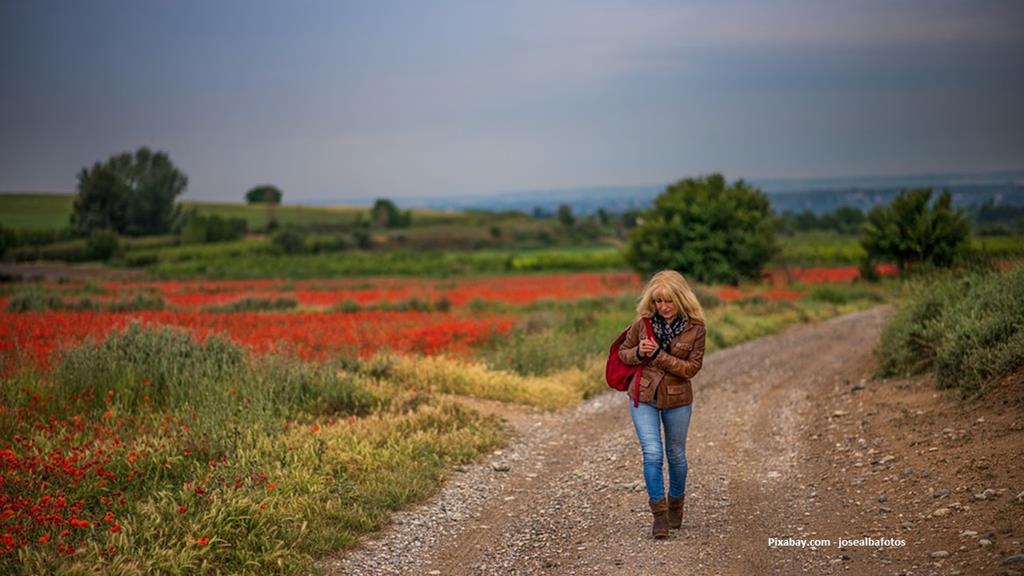 But then he realizes that he, too, is blessed by God. We see this in verse five, “Happy are those whose strength is in you, in whose heart are the highways of Zion. In other words, he and those who have travelled the road to Zion, the road to Jerusalem, can be glad that God has given them the strength needed for the journey. Then, in the next verse, he recalls his journey through the Valley of Baca, the unknown valley of tears he had to traverse in order to get to Jerusalem. Even that desolate land is blessed by God. A miracle is witnessed as the dry summer heat is replaced with cool rains leaving behind pools of water from which the pilgrim can quench his thirst. Notice, that as the Psalmist sings, he realizes God’s presence is all around, not just at the temple.
 Acknowledging God’s providence in his life, the Psalmist prays in verse 9 and 10 for God’s continual blessings upon those who seek to worship. In verse 11, he shifts to metaphorical language, conceding that a day in the temple is better than a thousand elsewhere, even while acknowledging God’s gifts and goodness extends far from the walls of the temple. God is both the sun, the giver of life for the earth, but also the shield, the one who protects us from the sun when it becomes overbearing in the desert. God is the source of all good, or as John Calvin liked to infer, “God is the fountain from which every good gift flow.”
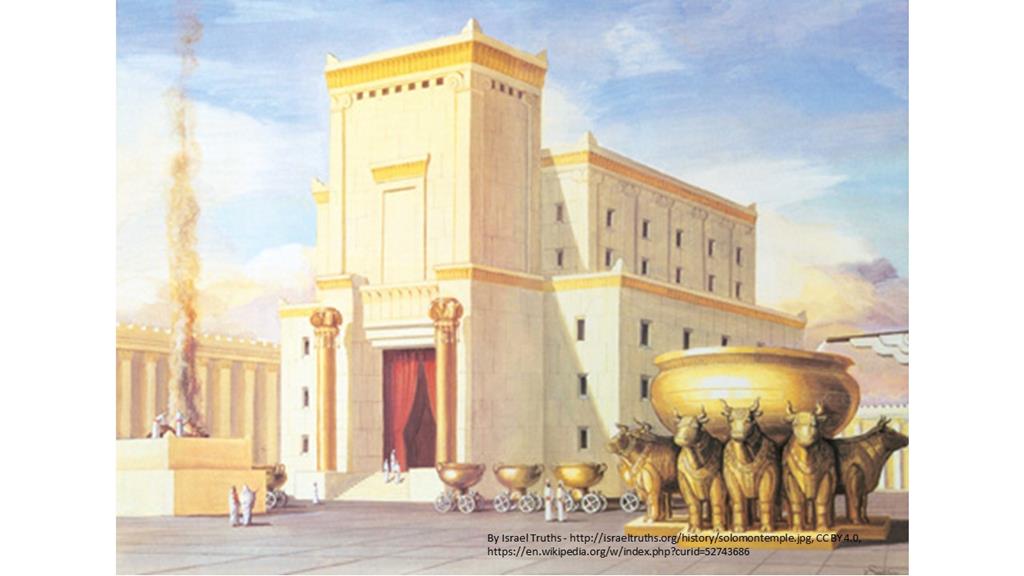 What does Psalm 84 teach us about worship? While the ultimate worship experience for the Psalmist was the temple, Solomon’s temple hasn’t existed for over 2,500 years. It was destroyed by Babylon. But that’s fine for there are now places of worship all over the world, and hopefully whether it’s here or somewhere else, you will find a home to worship.
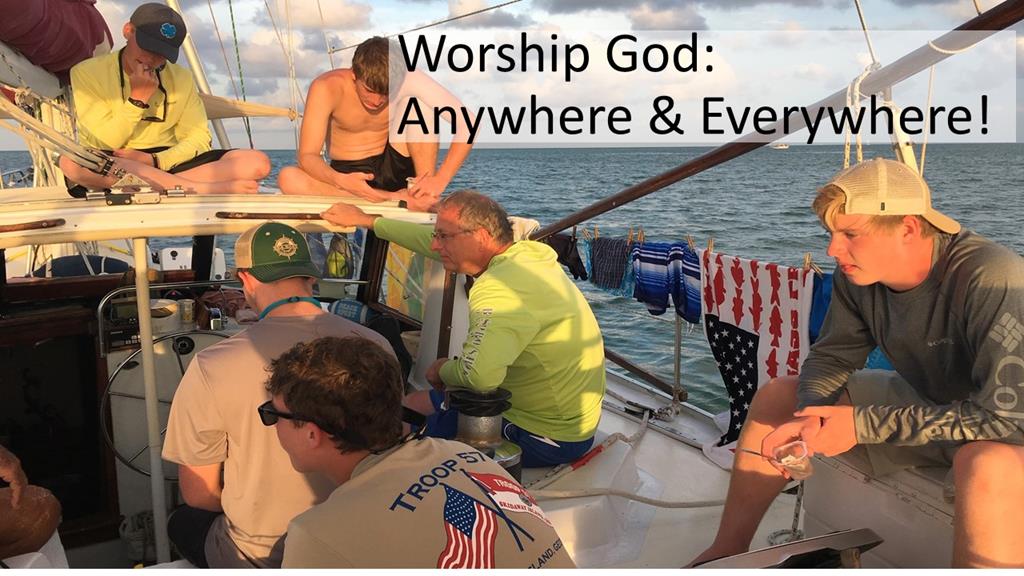 So, this week, stop frequently and meditate about being in God’s presence. You might even set up a special place to meditate and pray in your home, a reminder that God is with you. Think about bumping into God’s altars, for they are everywhere. Be on the lookout for them, and then give thanks to God for his faithfulness. Amen.