Two Houses, Two Builders, Jesus Conclusion to the Sermon on the Mount

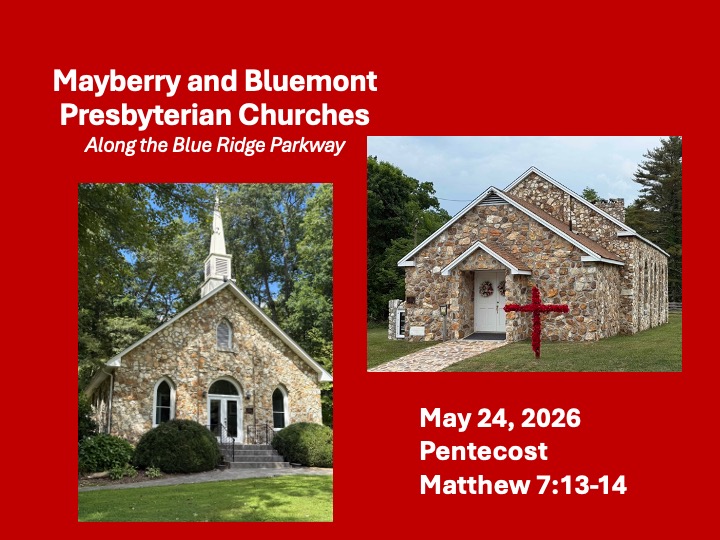
Title slide with photos of Mayberry and Bluemont Presbyterian Churches

Jeff Garrison
Mayberry and Bluemont Churches
June 14, 2026
Matthew 7:24-8:1

Sermon recorded at Bluemont on Friday, June 12, 2026

At the Beginning of Worship:  

Beginning next Sunday, we’ll start a journey through the Ten Commandments. Ever since the movie with Charlton Heston as Moses came out back when my parents were dating, there have been attempts to have the tablets displayed in courthouses and schools. But just knowing the 10 Commandments doesn’t make us better people.[1] Instead, we need to understand what they mean and integrate them into our lives. As the prophet Jeremiah suggests, we need God to write his law on our hearts.[2] It’s my hope we will gain some insight into how the law should be applied in our lives today. 

But before I jump back into the Old Testament, we’ll finish our review of Jesus’ greatest sermon, the Sermon on the Mount. In a way, this has been Jesus’ sermon on the 10 Commandments, as he reinterprets the law to a new standard. We all come up short. When Jesus finishes this sermon, we understand we can’t do it ourselves; we’re totally dependent upon God’s grace.   

Before reading the Scripture:

Today’s scripture completes the Sermon on the Mount. I’ll read from Matthew 7: 24 through 8:1. 

Let me give you a bit of insight into the Greek used by Matthew here. Jesus draws from both the Old Testament and the virtue tradition coming out of Greek philosophy.[3] In this passage Jesus contrasts the wise and foolish man. In the Greek, the wise man is one who is virtuous. The foolish one is a moros, from which we get the English word, “Moron.”[4] (You may remember that tidbit.) 

A second thing. The last word in the Greek within this sermon is “great.” Throughout the sermon, Jesus encouraged his listeners to strive for righteousness, not greatness. And the ending “great” refers not to an achievement, but to the fall of those who have not built a life with Christ as a foundation.[5] There is a warning here. As Jesus reminded us earlier in the sermon, we’re to first seek the kingdom of God and his righteousness.[6]

READ MATTHEW 7:24-8:1

Did you ever think we’d get to the end of Jesus’ Sermon on the Mount? We’ve been working our way through this passage since the first of February, with a break on Palm Sunday and Easter, and a few Sundays I’ve been away. For those counting, this is my 17th sermon on these three chapters!  

Let me say a bit about the Sermon on the Mount. It’s not a sermon in the fashion we typically think. Instead of standing at a pulpit or on a stage or up on a rock and waving his hands as he expounds upon scripture, Jesus sits. Most likely the crowd stood. Having your audience stand is an old trick which assures everyone stays awake. Sitting down while teaching and preaching was the preferred method for rabbis, as well as Greek philosophers of the time. So, Jesus sits as a rabbi, or a teacher, and instructs his disciples and those in the crowd how they should live.

As we have seen over the past few months, Jesus upsets the apple cart. In the Beatitudes, he speaks of a great reversal: of how the last will be first, of the meek inheriting the earth. He admonishes the crowd to strive for heavenly treasure instead of worldly wealth. He reminds them our valuables will increases our fears as we worry about theft, rust, and rot. 

Throughout this sermon, Jesus raises the bar. No longer can his followers take the Ten Commandments literally, checking off each item as having been observed, and patting themselves on their backs for getting a passing grade. For Jesus tells us that hate is equivalent to murder, lust can be as dangerous as adultery. Jesus also warns his followers about the danger of misleading new converts, how they must watch out for false teachers, and how they should pray privately and not for show. 

By this point in Jesus’ address, he’s managed to offend just about everyone. As they stand on that hill, surrounding Jesus while swatting flies and fanning themselves, they realize Jesus isn’t letting anyone off easily. The rich and powerful are offended. The religious and political leaders are offended. Even the pious, those who dedicated their lives to keeping the commandments are offended. You’d think the crowds would have thinned out, but that’s not the case. They stick around because Jesus teaches with authority. Matthew here drops a hint of what’s to come. At the end of Matthew’s gospel, Jesus proclaims, “All authority on heaven and on earth has been given to me.”[7] The crowds witnessed his authority on the mountain.

Yet, I expect most are unsure of their ability to meet the mark, and Jesus heightens their tension when he acknowledges that not everyone who calls his name will enter the kingdom of heaven. For Jesus, having a saving faith is more than just knowing the right religious language. As we saw two weeks ago, Jesus even warns, in words which send fear into the hearts of any preacher who listens, that some who do great things in his name will find the door to paradise closed. 

A saving faith requires action; a saving faith requires us to take his words to heart and strive to do God’s will. Yes, Jesus wants us to be good. Yes, Jesus wants us to bear fruit. But our good deeds and fruit bearing must be done in accordance with the will of God and not be based upon our egoistic desire to do something great… 

To explain this, Jesus tells a parable about the building of a house. Two guys set out to build a house and, from all we know, both are built equally well. We assume that from the outside, both houses appear solid. To find fault in the one house, you must look at the foundation. 

This isn’t the story of the three little pigs—where two of them become barbeque for the wolf because they use inferior building materials. We assume both builders employ the best construction practices. They select only good and straight lumber. They both use architectural grade shingles. But there’s a difference. One takes the time to set his foundation upon rock. The other guy builds on sand. Maybe he justified this as saving money on excavation. Or maybe he built on a beach to have a great view. Image both guys building equally nice homes. The only difference is that one can withstand the onslaught of a flood while the other crumbles as we’ve seen video in news reports of houses around Cape Hatteras tumbling into the sea.

This parable reminds us of the story of Noah. Noah, a faithful man, listened to God and followed instructions. He found himself safe during the storm in which all others drown.[8] Noah trusted in God, not in the long-term weather forecasts, or even in his ability to save himself. He listened to God. After all, it wasn’t his idea to build a boat. By listening to God, he accomplished far more than he could have on his own.

One thing we should gleam from this parable is the fact the storm came. Both the wise and the foolish experienced the onslaught of the storm. Jesus echoes what he said earlier about how God makes the sun rise and the rain fall on the just and unjust.[9]There is a message here for us. Matthew’s audience, as we see in the opening Beatitudes, probably faced persecution. By recalling this parable, he reminds his readers to be prepared, to have a good foundation in Christ so that when things become difficult, they will persevere. 

To do the will of God is not just hearing God call; to do the will of God is not just an understanding of our duty to our creator; to do God’s will requires that we internalize Jesus’ words. We must make Jesus and his teaching the rule of our lives. The question, “What would Jesus do?” which has become somewhat of a cliché, should become for us an internal compass, directing our lives in a manner that will bring him, and not us, glory.

To do the will of God is not necessarily to do what is popular. In fact, it’s likely to result in unpopular behavior. Think about old Noah—his wife and neighbors complain about that piece of junk he’s constructing out in the backyard. Doing God’s will is not going to help us be seen as “cool.” It may even mean going against what is considered politically correct from any perspective—conservative and progressive. Doing the will of God means we will not base our decision on what would make us popular with our peers, but on what kind of actions honor and glorify God…

So, why should we seek and do the will of God, especially if it’s going to force us to look beyond our self-interest and cost us in social standing? Why shouldn’t we just seek the easy way, to go along with the crowds and to do what is expedient? Why not just take the wide road, the interstate of popularity? It’s the sure way to success according to worldly standards. Why? Because in the end, what others think about us as well as what we’ve accomplished and accumulated on this planet will not manner. In the end, all that will matter is whether we’ll hear the words echoed from later in Matthew’s gospel, “Well done, good and faithful servant.”[10]

Peter was right when Jesus asked him and the other disciples if they wanted to join the crowds who were abandoning him. Peter said, “Lord, where else can we go? Only you have the words of eternal life.”[11]

There were two houses. One withstood the storm; the other fell and great was its fall. So ends Jesus’ Sermon on the Mount. Jesus presents a clear alternative. Follow me and seek to do God’s will and you will persevere through the storms of life and find the door to paradise open. Or don’t follow me and seek to fulfill your own desires and the storms will overwhelm you and the door to paradise will remain locked. Which will it be? Will we seek the kingdom of God? If so, we must seek to do and live in accordance with God’s will. Amen.   


[1] For my take on the 10 Commandments, see https://fromarockyhillside.com/2024/06/27/thoughts-on-the-ten-commandments/

[2] Jeremiah 31:33. 

[3] Most likely, Jesus did speak Greek, but Aramaic. But when translated into the Greek, Matthew uses key Greek terms. 

[4] Jonathan T. Pennington, The Sermon on the Mount and Human Flourishing: A Theological Commentary (Grand Rapids, MI: Baker Academic, 2017), 280.

[5] Fredrick Dale Buner, The Christbook: Matthew 1-12 (1990: Grand Rapids, MI Eerdmans, 2004), 361. 

[6] Matthew 6:33. See https://fromarockyhillside.com/2026/05/03/dont-worry/

[7] Matthew 28:18.

[8] Genesis 9. 

[9] Matthew 5:45. See https://fromarockyhillside.com/2026/03/22/turning-the-other-cheek-and-loving-our-enemies/

[10] Matthew 25:21, 23. 

[11] John 6:68-69

Wolves in Sheep Clothing

Title slide with photo of the two churches

Jeff Garrison
Mayberry and Bluemont Churches
May 31, 2026
Matthew 7:15-23

This sermon was recorded at Mayberry on May 28, 2026. I am sorry that I had previously posted the sermon from the previous week, but corrected it on June 19 when I was informed of my mistake.

At the beginning of worship: 

At the men’s breakfast and Bible study this week, the movie, The Apostle, came up. Some of us watched it one evening during a movie night at Mayberry a few years ago. Robert Devall plays Sonny. A high-flying Pentecostal preacher, Sonny jets around the country preaching revivals. In his absence, his youth pastor and his wife become a little too friendly. Sonny takes a baseball bat to the man who later dies. 

Now wanted by the law, Sonny flees. He heads to the bayous of Louisiana, where he reinvents himself. He starts a church which consists of outcasts and, slowly, it begins to flourish. We get a sense Sonny delights in the joy of working with these people, who are completely different from the affluence of his former suburban church. The church cares for one another and does great things which draws the attention of a local radio station. His ex-wife hears Sonny’s voice on air and reports him. Deputies show up to arrest Sonny. But even then, he continues to witness to the love of Jesus as he encourages his people to keep up the good work. The movie ends with Sonny, on a chain gain, working on a ditch bank, while continuing to witness for Jesus. 

Today we’re looking at a passage where Jesus warns us that even some who seem to do great things for God, are not on God’s side. This is a sobering passage. 

Before reading the Scripture:

We’re in the last section of Jesus Sermon on the Mount. Last week, we began this section looking at the narrow gate and the hard road to which Jesus calls us. This week, we’ll look at the false prophets, those who beckon us through the wrong gate and down the wide path to destruction. 

Here, we learn from Jesus that one of the great dangers of the church is not persecution, something the early church faced, but false teachers. Augustine, the great 4th Century Theologian, is to have said, “even in the very name of Christ we must be on our guard against heretics.”[1]

By the 4th Century, many heretics had come and gone such as the Marcionites and Docetites, along with the Pelagianists, Augustine’s nemeses.[2] But such heretical teaching wasn’t new. New Testaments writers express concern over “anti-Christs.”[3]Even in the Old Testament, concerned existed over false prophets and unscrupulous shepherds.[4]

A danger within religious traditions are those who use such traditions for their own benefit, instead of seeking God’s glory. One of the interesting things we find is that while such teachers are dangerous, God can still work through them and do great things through them, such as casting out demons. Jesus’ concern, as we’ll see here, isn’t in the work of these false prophets, but in how their hearts turn from God. They may do great things, but for the wrong reasons. They may be like the Pharisees who eat up their praise of the people with harden hearts. . 

This is another hard passage, especially for preachers. Maybe that’s why it doesn’t appear in the Revised Common Lectionary. 

Read Matthew 7:15-23

Here’s a question for you. Is Jesus addressing religious leaders in this passage? Or, does this text apply to all of us? If you believe he’s only addressing leaders, then you have my permission to take a nap, and I’ll preach to myself. But only if you’re not in a position of leadership or listen to those in leadership. 

Consider this, all of us, as I have pointed out numerous times, have a Christian vocation. We’re all a priest within the Priesthood of All Believers. So, listen up.

As we are Jesus’ hands and feet and mouths on earth, we have a responsibility as we saw last week, to enter the right or narrow gate and to walk the hard path which leads to life. The gate is our conversion; the walk is our ethics, how we live our lives as followers of Jesus. But, as this passage shows, we can be misled. We can get so excited about results that we fail to look for the rot inside. Results and success do not make us a Christian. This is an important distinction. Faithfulness, regardless of success, is how Christ judges.

In this passage, Jesus uses two different images for the false prophet. The disguised wolf, the enemy of the sheep (including the metaphorical sheep within the church) and a fruit tree. When the wolf removes his clothes, it’s too late. He’s already inside the herd, where he will destroy the sheep. The fruit tree is known by its fruit, but that takes a while. Unlike a wolf, the bad tree is only known after the harvest. 


Jesus then imagines these imposters coming before him at judgment. Despite all they’ve done, their hearts were not right and Jesus, quoting Psalm 8, sends them away.[5] Despite their good deeds, they are not saved.

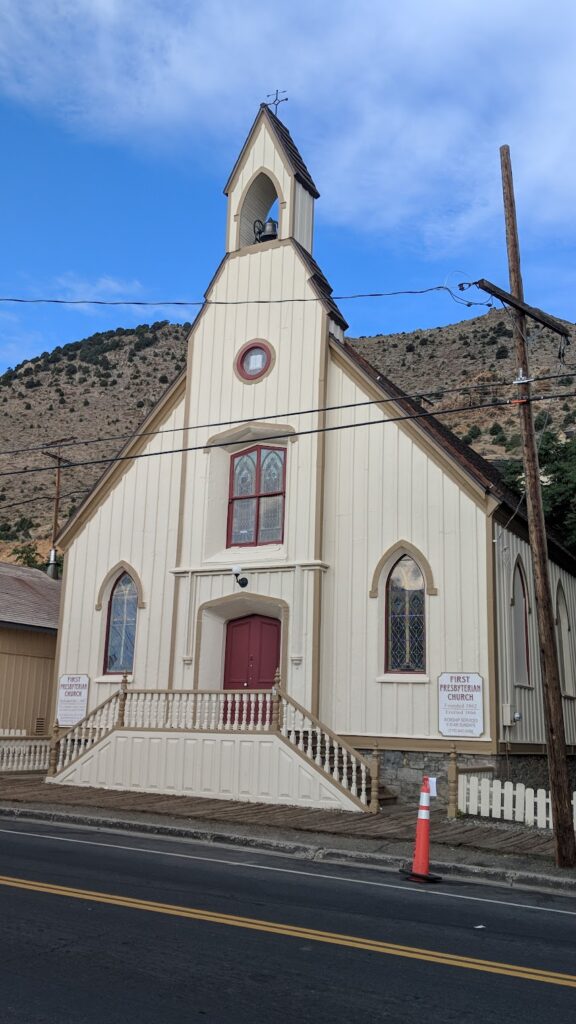
First Presbyterian Church of Virginia City, Nevada, 2018
First Presbyterian Church of Virginia City

In 1913, the Reverend William Laughlin assumed the pastorate of the First Presbyterian Church of Virginia City, Nevada. His story was that while he attended seminary, he didn’t feel ready for the ministry and taught school. He also appeared to have done some lecturing on the Lyceum and Chautauqua circuits of the day. An editor from a newspaper in Elko, Nevada, praised him as a “polished lecturer full of Celtic fire” who “would soon become recognized as one of the most profound pulpit orators in the West.”[6]

But by 1913, when he accepted the call to the church in Virginia City, the heyday of the Comstock Lode was thirty years in the past. The town continued to lose population. Only a few mines kept digging. The mills which processed the ore, mostly reworked old tailings with better technology to capture the silver and gold missed by previous generations. 

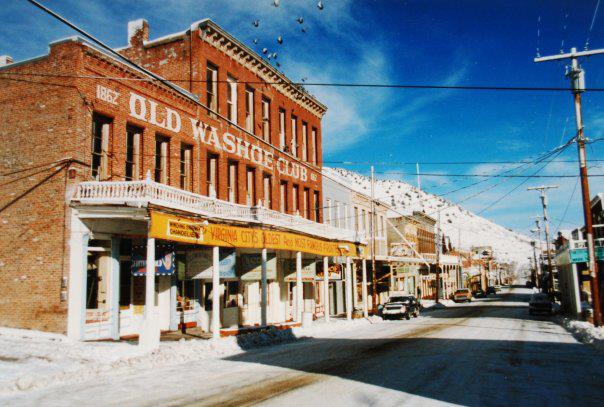
C Street, Virginia City, Winter 1988
Virginia City, 1988

Laughlin was a firebrand. He started new programs at the church including a Boy Scout troop. This was only 3 years after the Boy Scouts of America was organized. His preaching excited people and excerpts from his humorous sermons often appeared in the newspaper. The church started again holding socials and events for the Sunday School. At a time when the city declined, things happened at the Presbyterian Church. 

But then, the Rev. McCleery, Presbyterian pastor in Carson City, became suspicious. I’m not sure why. Maybe someone gave him a tip. He began to dig and found Laughlin had been in a Methodist minister in Franklinville, New York. After facing charges of immortality, he resigned and moved to Canada.

Laughlin later served Methodist Churches there, along with North Dakota and Idaho. In each place, across two countries, his past caught up with him, and he was exposed as an imposter. In Idaho, he abandoned his wife and kids and refused to support them, moving on. Kind of like Sonny in the movie The Apostle. In 1913, you didn’t have a social security number to help track people from one place to another. In June of 1915, to the shock of the congregation, Laughlin abruptly resigned. Then everyone learned the Presbytery were bringing charges against him. They found him guilty. He was defrocked. 

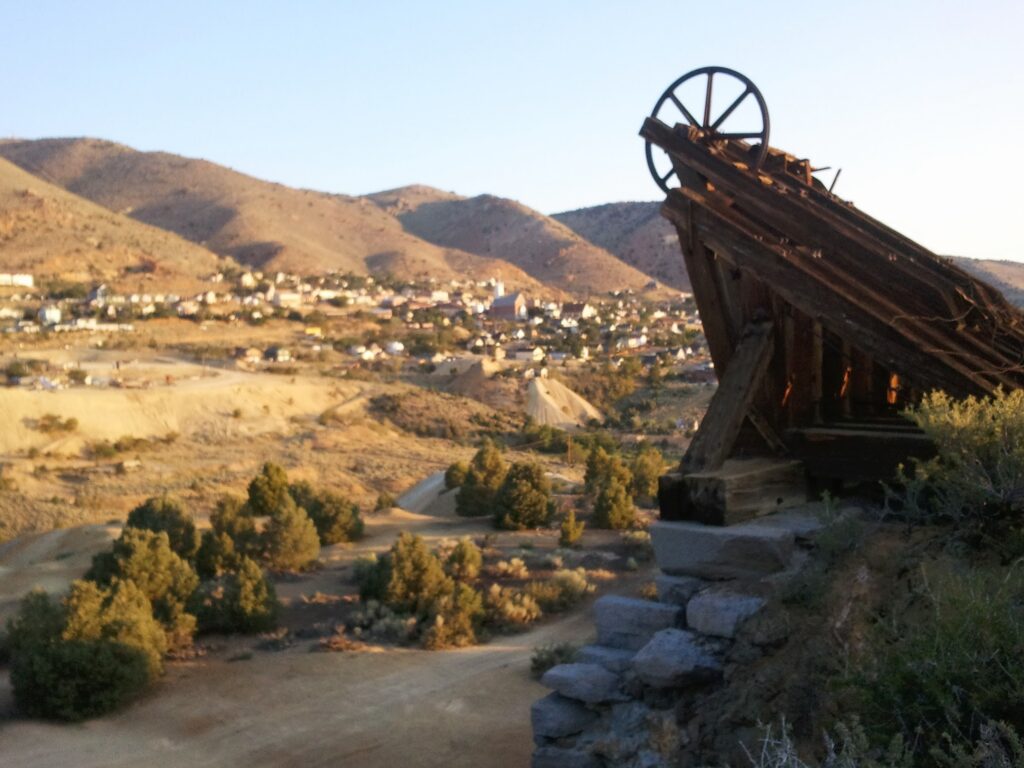
Virginia City with mine shaft hoisting in foreground
Virginia City, 2012

Did Laughlin do some good things in his time in Virginia City? Yes. At least from the newspaper reports, it certainly sounds like he did. The same is true with Sonny in the movie, “The Apostle.”  But both were morally flawed. That doesn’t mean that God can’t use them to achieve certain objectives, just as God used the Persian King Cyrus to allow the Israelites to return to Jerusalem after the Babylonian exile.[7]

What none of us know is whether either Laughlin or Sonny trusted in Jesus. Were their hearts ever cleansed by Jesus’ saving grace? Or were they just in it for their own benefit. While I would like to think they were in it for more than themselves, that’s between them and God.  

This passage warns those who serve the church to make sure we do God’s work and not work for our own glory own. But there is also a message here for others within the community of believers. Do not be astonished by the powers some portray. The Bible never hides the idea that others may have miraculous powers, so we are not to be lured by their strange abilities. Think of the Egyptian magicians who matched the first of Moses tricks before Pharoah.[8] For the first several plagues, the magicians went go toe-to-toe with Moses, except that the snake Moses turned his staff into who ate the snake Pharoah’s magicians conjured up. Only after the first few plagues did the magicians give up and say, this is from the hands of God. 

It’s easy for us to be astonished by others who seem to do great things, even those who collect great wealth, but we shouldn’t succumb to envy or covet their position in life. We are unable to know the condition of their hearts, nor can we know their relationship with God. We will all be judged by our hearts and our faithfulness, not our wealth or success. Beware of the wolves hiding in fleece or rotted trees. Instead, seek out those whose hearts are humble and whose lives are faithful. Amen. 


[1] Frederick Dale Bruner, The Christbook: Matthew 1-12 (1990, Grand Rapids, MI, 1990), 355. Bruner takes this quote of Augustine from the Catena Aurea: A Commentary of the Four Gospels: Collected out of the Works of the Fathers by St. Thomas Aquinas (13th Century).

[2] Marcionites (2nd Century) saw God as only love and no judgment, Docetism (3rd Century) thought Jesus only “seemed to be” human.” Pelagius (early 4th Century) seems to have denied Original Sin. 

[3] 1 John 2:18

[4] Deuteronomy 18:20-22 and Ezekiel 34 

[5] Psalm 6:8. Jesus quotes from the Psalm from the Greek Septuagint text. 

[6] My sources for Laughlin’s story come from a variety of newspapers and minutes of Session and the Presbytery of Nevada. I drew the story from my dissertation, “Presbyterians and Miners: The Church’s Response to the Comstock Lode), San Francisco Theological Seminary, 2002 (see pages 95-100). 

[7] 2 Chronicles 36:22-23. 

[8] The Egyptian magicians were able to turn a stick into a snake (Exodus 7:10-12), create dead fish in the Nile (Exodus 7::21-22), and bring forth frogs (Exodus 8:6-7). But they were unable to created gnats (8:19) and the boils Moses called down even fell on the magicians (Exodus 9:11). 

Pentecost, The Right Path, and a Paddle Down the Missinaibi

Title slide with photo of Mayberry and Bluemont Churches

Jeff Garrison
Mayberry & Bluemont Churches
May 24, 2026
Matthew 7:13-14

Sermon recorded at Bluemont on Thursday, May 21, 2026

Theology minute on “Pentecost” 

Bird nest in arms of a cross decorated for Pentecost
Bird nest in arms of a cross decorated for Pentecost at Bluemont Presbyterian Church.

Today is Pentecost. As a theology minute, and before we get to the sermon, let’s reflect on the meaning of Pentecost. The word comes from the Greek for 50. Depending on how you count it, Pentecost is 50 days after Easter. Most of us would count 49 days, so close enough. In some English traditions the day is also known as Whitsunday, referring to the white robes of baptism often performed on this day. 

Pentecost is the day the Holy Spirit descended as in a flame on the faithful who had gathered in Jerusalem, giving the disciples the spirit and the power to begin the church. From a standpoint of the church, the day is perhaps third in importance to our theology, behind Good Friday and Easter.[1] However, it often gets overlooked since many years it falls after Memorial Day, when people take off for vacations. 

Many people wear red on Pentecost as we recall the flames of the Spirit. In most Presbyterian Churches, and in our denominational seal, you’ll find two flames. They represent the flames of the Spirit in the Old and the New Testament. The Old Testament flame was God’s encounter with Moses at the Burning Bush which didn’t burn. In the New Testament, it’s the coming on the Spirit. 

In the Jewish world of the first century, this was a time for pilgrimages to Jerusalem. If you couldn’t make it for Passover, when the Mediterranean Sea was rougher, you’d come for Pentecost or, as it is known in the Old Testament, the Feast of Weeks, a harvest festival.  

As we heard earlier in our reading from Acts 2, Jews throughout the Roman World gathered in the holy city on this day. The empowering of the church encouraged incredible preaching in languages people understood, allowing them to carry back the good news to all corners of the empire. God works in mysterious yet incredible ways. 

Before reading the Scripture:

Today, we’ll begin the ending of Jesus’ Sermon on the Mount. Last week, we saw how Jesus provided those listening to the sermon how they might live a notable life which helped not only them, but the world around them, to flourish. Jesus now moves to his closing in which he gives three eschatology or “end times” warnings to insist those listening to him take his teachings seriously.[2]  All three of Jesus’ warnings contrast two different concepts: gates, prophets, and houses. We’ll look at each set individually, starting today and in my next two sermons.  

Jesus began the sermon with the beatitudes which sounds mellow. Then, in a way, the center of the sermon which we finished last week, focuses on expanding the beatitudes into helpful ways we might be more Christ-like.[3] Now, at the end, he warns us to be careful. A good life is not just obeying the law in a manner others may praise. A good life means we strive for righteous, not just in our deeds, but also in our hearts. That latter part is more difficult.


Read Matthew 7:13-14

Missinabi River canoe trip, 1992
On the Missinaibi

In the summer of 1992, I paddled the Missinaibi River in northern Ontario. The river ends at the James Bay in the sub-arctic region of Canada.  About halfway through the trip, the river slips off the Canadian Shield, a large granite base which stretches from just north of the Great Lakes to the sub-arctic. Where the river comes off the shield, a series of waterfalls and dangerous rapids requires two long portages. The first, at Thunderhouse Falls, is a mile long. The second, around some difficult rapids, is two and a quarter mile hike through a bog. It was a workout.  

Thunderhouse Falls is up there with Niagara. You don’t try to run it. The river, which has been two to three hundred yards wide narrows down into a slot between the rock that in places is less than ten yards across. If you hike up to the edge and to look down, it’s scary to see the force of the water. It’s also so noisy you must yell to talk to someone next to you. It’s so noisy you don’t even hear the buzz of mosquitoes feasting on your exposed skin. 

Thunderhouse Falls

Thankfully, during this trip, the guy who helped me arrange for shuttles and stuff, sat me down with a map and pointed out this rapid and a problem which existed on the map. The map showed the portage trail on the east side of the river, but it was on the west side. Making it even more dangerous for those who didn’t know this, they would have to ferry back across the river at a point where the flow accelerates. A little mistake could easily pull you past the point of no return and you’d be sweep down a mile long rock crushing gorge with a series of good-sized waterfalls. 

The guide suggested after we passed a small easily identified rapid a mile upstream, we hug the west or left bank and carefully look for the trail.[4] We did and didn’t have any problems other than sore shoulders from lugging the canoe and gear overland. I later learned that over a dozen years the misguided map was in circulation, ten paddlers died in the river. 

Had the guide not given us the clues needed, I don’t know what would have happened. Like with Jesus’ teachings in our text today, we must find the right gate and travel on the right path. Moses and a generation later, Joshua, called the Hebrew people to decide between life and death.[5] Jesus issues a similar challenge to those who listen to him preach. The passage today calls us to seek the narrow gate and the hard road. 

But it’s tempting to enter the wide gate and the easy road. But that journey will end in destruction. Think of getting caught in the current on the Missinaibi and drawn down the roaring river toward Thunderhouse Falls. Once the current catches you, it’s hard to make it out before it’s too late. 

With this warning from Jesus, we could be tempted to throw our hands up in resignation. After all, it appears Jesus suggests most people don’t take his path and are bound for damnation. But with these warnings, as he’s done throughout the Sermon on the Mount, Jesus offers practical and not dogmatic advice.[6] He’s not saying, look at all the people bound for perdition. Instead, he encourages us to take the right path. 

We don’t know who or how many are saved. Instead, this passage challenges the idea that we should make our determination on what is right or wrong based on an opinion poll. Don’t strive to be in the majority. Think about this. Jesus may be calling us to join the “moral minority.”[7] Just because everyone else is on a particular path doesn’t mean it’s the right way.

And, the right path isn’t easy. We’ve seen this throughout Jesus’ teachings here. Jesus wants us to follow him, and we know the direction of his travels. Jesus’ path led to Golgotha. His path took him to the cross. Jesus willingly gave up a life he loved for us. And we’re called to be willing to give up our own lives for others. As the hymn The Old Rugged Cross goes, to lay down the trophies of this life for a cross for which we, one day, can exchange for a crown. 

Jesus, at the end of the Sermon on the Mount, calls us to a conversion. We’re to make him our Lord,[8] and be willing to live for him. For, as Peter would later claim in John’s gospel, only Jesus has the words of eternal life.[9] The wide and easy road may look appealing, but that’s not where our Savior leads. Often, we want to take the easy way, along with everyone else, but such a path is not where we’re called as followers of Jesus. The life of discipleship requires us to make Jesus our Lord and to commitment ourselves, day after day, to follow him and not the crowd. 

One of the problems with an over emphasis on making the decision to follow Jesus is that it sounds as if all you must do is confess your sins and invite him into your heart and then your set. But that’s not scriptural. Think about the Hebrew people. When they crossed the Sea, they experienced salvation from the Egyptian army, but still had the wilderness to cross and would spend 40 years there. The Apostle Paul encourages us to work out our “own salvation with fear and trembling,” but Paul also goes on to remind us that God also works within us to make our own work possible.[10]

The gate represents our decision to accept Jesus as Lord. The road represents the ongoing journey, which we struggle throughout our lives as we move closer toward the eternal kingdom. This struggle, as we’ve seen throughout the Sermon on the Mount, involves not just external piety. Obeying the letter of the law, as demonstrated by the Pharisees of Jesus’ day, could be done. But Jesus desires a deeper change within our hearts, as he pointed out repeatedly in the Sermon on the Mount.[11] Our call and our only hope for salvation is to follow him through the tight gate and down the narrow and hard road. Amen.  

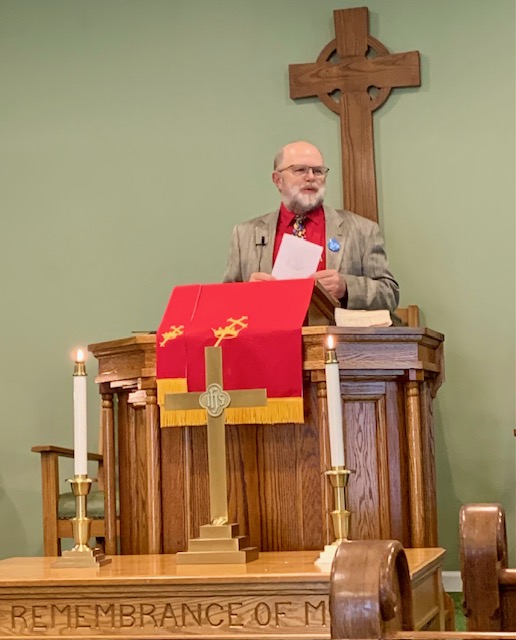
photo of Jeff Garrison in the pulpit at Mayberry Presbyterian Church
The video of the sermon shows me in something other than red, today I was wearing red!

[1] I place Pentecost before Christmas because without the church, we’d not even have a reason to celebrate Jesus’ birth. Besides, only two of the Gospels recall Jesus’ birth. Good Friday offers us salvation; Easter provides us with a future hope. These two realities, transmitted to the world through the church, starts on Pentecost.

[2] Douglas R. A. Hare, Matthew: Interpretation, a Commentary for Teaching and Preaching (Louisville, KY, JKP, 1993), 81. 

[3] See https://fromarockyhillside.com/2026/05/17/asking-god-and-the-golden-rule/

[4] There were no good guidebooks to the river in 1992.  Hap Wilson has since published Missinaibi: Journey to the Northern Sky (Erin, Ontario: Boston Mills Press, 2004). Wilson mentioned the deaths at Thunderhouse Falls due to the mistaken map. 

[5] Deuteronomy 30:15-20 and Joshua 24:15.

[6] Hare, 82.

[7] Frederick Dale Bruner, The Christbook: Matthew 1-12 (1990, Grand Rapids, MI: Eerdmans, 2004), 350

[8] Bruner, 349. 

[9] John 6:68.

[10] Philippians 2:3-4.

[11] Jonathan T. Pennington, The Sermon on the Mount and Human Flourishing: A Theological Commentary (Grand Rapids, Baker Academics, 2017), 274. 

Asking God and the Golden Rule

Title slide with photos of the two churches

Jeff Garrison
Mayberry and Bluemont Churches
May 17, 2026
Matthew 7:7-12

Sermon recorded at Mayberry on Thursday, May 14, 2026.

At the beginning of worship: 
How many of you remember the movie, Hoosiers?[1] I can’t believe it’s been 40 years since it was released. The movie starred the late Gene Hackman as Norman Dale, a former college basketball coach, banned from the NCAA. After a ten-year stint in the Navy, he’s given another chance to coach basketball, only this time for a small high school in rural Indiana. It’s 1951. A lot of the townsfolk question this new coach. Many want to fire him, but then he starts winning. The movie is about more than basketball. It’s about second chances. It’s about living out the Golden Rule. Coach Dale demonstrates this rule when he recruits Shooter, played by Dennis Hopper, to be his assistant. 

Shooter had been a basketball legend at the school. But that was twenty years earlier, back in the 1930s. Now, Shooter drinks heavily. Everyone thinks the coach is crazy to recruit him as his assistant, including Shooter’s own son, one of the team’s stars. But Coach Dale, who had been given a second chance, believes Shooter deserves one, too. 

The Christian Faith is about second chances. Through Jesus Christ, God gives us a second (and third and fourth and forty-ninth and four hundred and nineth) chance. God forgives us. We’re to forgive others. It’s that simple. We’re to offer second chances. 

Before reading the Scripture:
As we continue through Jesus’ Sermon on the Mount, we’re at the end of the main body of the sermon which began back in the middle of the 5th chapter. In 5:17, Jesus says he didn’t come to abolish the law and prophets but to fulfill them. In 7:12, after he gives the Gold Rule, he summaries what he’s been saying as containing all in the law and prophets. These two mentions of the law and prophet bookend the middle of the sermon.[2]

After this section, I’ll have two final sermons, to wrap up the closing of the Sermon on the Mount. In the ending of this chapter, Jesus provides warnings about what’s ahead. 

In our text today, Jesus begins on a hopeful note, encouraging the disciples to come to God for their needs.[3] Jesus has already spoken about prayer in the 6th chapter,[4] but he revisits it here. Then, he ends by empowering them to make decisions about how to live well, a passage we know as the Golden Rule 

Read Matthew 7:7-14

William Carey is considered the father of Protestant missionary movement. He left England for India early in the 19th Century, telling those seeing him off “to expect great things from God, and do great things for God.”[5] We depend on God for the strength we need to do God’s work in the world. In these six verses, we see both sides. We go to God for what we need, and then do God’s work through how we treat others. 

Jesus begins with Ask. We can create an acronym from this first word. ASK: “a” for ask, “s” for seek, and “k” for knock. In three different ways, Jesus encourages the disciples to bring their needs to God.[6]  

In the previous chapter, Jesus provides the Lord’s Prayer as a model. He also encourages us to make our prayers short and straight forward, without repetition. These guidelines still apply. We should know that God hears us. Prayer is not about our efforts, but about a gracious God who hears our needs and answers, giving us that which is good. It’s not about us laboring in prayer, but about God gracious giving.[7] That caveat of God giving good things provides a clue into those prayers not answered. God won’t give us that which is not good for us. 

As Jesus has been doing throughout the Sermon, after he presents an idea such as us coming to God, he provides examples to help us understand. Here, he draws on how parents care for their children. A normal parent will not give a child something harmful, likewise God will also look out for our needs. 

However, we learn something else about prayer. Not only should we bring our needs to God, but we also shouldn’t be ashamed for asking. Sometimes those who try to appear spiritual emphasize praising God over asking.[8] Or they suggest praising God is more godly or spiritual. But here, and throughout Jesus’ teachings, we’re invited to bring to God what we need. 

After this reprise on prayer, Jesus jumps to another topic, the Golden Rule. It may seem disconnected. After all, he moves from prayer to our conduct. But understand there is a link. Just as God has been gracious to us, we are to be gracious to others.[9]

“Do unto others as you’d have them do to you.” With this simple rule, Jesus frees his disciples from having to depend upon experts to direct our behavior. In Jesus’ day, Jews consulted their rabbis for guidance.[10] Those in other faith traditions consulted sages, wisemen, or even astrologers, for advice. Even today, we often consult others about decisions we make. And that’s okay. But with this little saying, Jesus provides us a way to decide for ourselves how we should live our lives and treat others. 

This teaching from Jesus isn’t anything new or novel. You find similar teachings in the Old Testament. Leviticus tells us to love our neighbor as ourselves.[11] But here, Jesus doesn’t say to love our neighbor or even our brothers or sisters. He says that we are to treat others (read all people) as we want to be treated.[12] In the Talmud, the Jewish rabbinical teachings of the day, we find: What is hateful to you, do not to your fellow man. This is the law. All the rest is commentary.”[13]

But the Golden Rule goes back even further. Confucius taught, “Do not do to others what you do not want them to do to you.” In the Buddhist scriptures, we have “a state that is not pleasing or delightful to me, how could I inflict that upon another?” And from the Hindu texts, “This is the sum of duty: Do not do to others what would cause pain if done to you.” Philosophers call the Golden Rule the Ethic of Reciprocity. Socrates taught five centuries before Jesus, “do not do to others that which would anger you if others did it to you.” [14]

And, of course, this saying has been reworded. Many prefer the parody, “Do to others before they do unto you.” Rest assured, such a saying has no scriptural basis in the New Testament.[15]Nor is it okay to investigate the past and do what others have done to you. That would be the ethic of revenge. Instead, Jesus draws on a principle already old, reminding his listeners what they should have already known. If you want to know how to act toward others, look inside yourself and think about how you want to be treated. 

Much of scripture is about divine generosity, what God has done for us. Verses 6 to 11 deal with this, as well the forgiveness offered by Jesus. But for our faith to be real, it needs a humanistic element. Our faith should impact our lives, change us, and that’s where this rule should come into play. The rule is not solely the domain of Christians, but that’s okay. 

Those of us within the Reformed Tradition, like Presbyterians, believe God gives two kinds of grace. There’s the saving grace of Jesus Christ, but there’s also common grace, given to all people to help us get along with one another.[16] With the Golden Rule being common across religious and philosophical lines, it would be an ideal place to begin a dialogue with those of different faiths. It’s a rule almost all people agree with, but do we live it? 

Living by the Golden Rule can bring a bit of heaven down to earth. It will not help us be saved, for Jesus did that for us on the cross. It’s not going to get us a better room in heaven, for we will all be equal there. But it will help the world be a better place. So, think about how you’d like to be treated. And treat others that way. And if that’s too hard, ask God to show you the way. In the end, we’ll all be better off.  Amen.


[1] The movie was released in 1986. The script was written by Angelo Pizzo and directed by David Anspaugh. The story was inspired by the Milan High School surprise win in the 1954 Indiana State Finals over Muncie, a much larger school. 

[2] Douglas R. A. Hare, Matthew: Interpretation, A Biblical Commentary for Teaching and Preaching (Louisville, KY: JKP, 1993), 81.

[3] Jonathan T. Pennington, The Sermon on the Mount and Human Flourishing: A Theological Commentary (Grand Rapids, Baker Academic, 2017), 264.

[4] See https://fromarockyhillside.com/2026/04/12/jesus-teachings-on-piety-and-prayer/

[5] Hare, 79. 

[6] Fredrick Dale Bruner, The Christbook: Matthew 1-12 (1990, Grand Rapids, Eerdmans, 204), 342.

[7] Bruner, 343.

[8] Bruner, 344. 

[9] Bruner, 346.

[10] Bruner, 346

[11] Leviticus 19:18. 

[12] Bruner, 347.

[13] Talmud, Sabbat 31a. 

[14] For a listing of various forms of the Golden Rule, see https://www.goldenruleproject.org/formulations

[15] While you have the “eye for eye philosophy in the Old Testament (Leviticus 24:20), Jesus has already reinterpreted that teaching in the Sermon on the Mount (Matthew 5:38-39. 

[16] See Richard J. Mouw, He Shines in All That’s Fair: Culture and Common Grace (2001).

Can we really avoid judging?

Title slide with photo of Bluemont and Mayberry Churches

Jeff Garrison
Mayberry & Bluemont Churches
May 10, 2026
Matthew 7:1-6

Sermon recorded at Bluemont on Thursday, May 7, 2026.

At the beginning of worship:
Are any of you Eeyore’s? You know who I am talking about, don’t you? The donkey with floppy ears in Winnie the Pooh. He’s always down and out. If the sun shines, he worries about a drought. If raining, he knows they’ll be a flood. 

You know, friends who are Eeyores, they drag us down. They take a lot out of us. It’s easy to judge such friends as unworthy of our attention. Yet, the Eeyore’s of the world need friends. And we all know this. All of us have at one time or another, found ourselves in a funk. At such times, friends help us get through the darkness. 

A suicide prevention article from years ago had this take on Eeyore: 

One awesome thing about Eeyore is that even though he is basically clinically depressed, he still gets invited to participate in adventures and shenanigans with all of his friends. And they never expect him to pretend to feel happy. They just love him anyway, and they never leave him behind or ask him to change.[1]

If you are an Eeyore, I hope you have the same experiences as Pooh’s flea-bitten friend. May you have all kinds of adventures and shenanigans. Who here wants to oversee shenanigans in the church? As a church, we should be willing to welcome all Eeyore’s and others who are easily left behind. We need to create a counterculture community, which pushes back against the common view of Christians as judgmental. We should strive to create a community which displays hospitality, one that not only welcomes the Poohs and Tiggers of the world, but also the Eeyore’s. 

Before reading the Scriptures:
We’re moving into the final chapter of Jesus’ Sermon on the Mount. Chapter 7, verses 1-12 are consider the last section within the meat or the main part of the sermon. Today, we’ll look at the first half of these verses. Next week, will finish the middle section. By splitting these in two, we can focus more in detail. After verse 12, Jesus ends with a few other topics as he brings this all-inclusive sermon to a close. 

Our passage begins with sharp words. “Don’t judge.” What does Jesus mean? 

Read Matthew 7:1-6

My mother in 1955

Today is Mother’s Day. So let me talk a bit about my mom as one of her traits applies to the broader meaning of this text. Mom had the capacity to always think first about the feelings of others. She also tried to instill such feelings in her children. As we’re talking about judging, I’ll let you be the judge of her success. However, I admit I fall short of what she taught. 

In the 5th grade at Bradley Creek Elementary School, during the winter when the weather was bad, we held PE on the stage of the auditorium. The school had no gym. There’s not a lot you can do up there on the stage, so our teacher decided we would learn to dance. This brought groans, especially from the guys in the class. And probably a few girls who didn’t want to dance with us. But I’m not sure about that. Among us guys, as we talked about the prospect of dancing, we realized this meant we had to dance with certain girls. One of the girls was the only African American in our class. Of course, that wasn’t how my friends referred to her.

That day, I came home from school, bragging as had my friends that I was not going to dance with her. My mother exploded. “Yes, you will!  You will not hurt that girl’s feelings.” She then picked up the phone and proceeded to call my teacher. She told him I better be willing to dance with her. 

I wonder if my mother’s concern for the feelings of others came from her own background. Her family struggled and she always had a bit of inferiority complex. Part of it may have come from her father, whom she adored, but who also spent time in the slammer for bootlegging. My great-grandmother had such disdain for her son-in-law; she left the land and house she owned to her daughter and granddaughters, to keep it out of his hands. While my father’s family wasn’t rich, they were certainly better off financially and didn’t have such baggage hiding in the closet. At least, not that I know of, for one of the things we see throughout the Sermon of the Mount is that we don’t always know the heart and secrets of others. This is a part of the reason we’re not too quickly judge others. 

Whatever reason, my mom was well tuned to the feelings of others. It’s a noble and Christ-like trait. 

In The Message paraphrase, our text today begins, “Don’t pick on people, jump on their failures, criticize their faults—unless, of course, you want the same treatment. That critical spirit has a way of boomeranging.”

I like the fresh way that Eugune Peterson translates this passage in this paraphrase, but I think he may have missed one point. We don’t judge to keep others from judging us. This is not a “tit-for-tat” suggestion. “I won’t judge you if you don’t judge me.”  That’s not even healthy for all of us need healthy criticism to grow and mature spiritually. Otherwise, with no guardrails, we can go astray.

The judgment Matthew speaks of us avoiding by not judging  is not the condemnation of others for our sin, but God’s judgment.[2] If we judge unfairly, God will judge us. In the Sermon on the Mount, Jesus envisions an accountable community which looks out for one another. 

Often, people cite this passage and use it to condemn all judgment. I recently heard this passage cited against challenging political behavior. This isn’t what Jesus means by not judging. 

Discernment is a Christian discipline which requires us to make judgments. Later in Matthew’s gospel, Jesus instructs the disciples on how to confront others guilty of sin.[3]  Paul, in his writings to the Corinthians, condemns then for not confronting one involved in a grievous sin which has the power to destroy the church.[4] Again, such a situation requires judgment. In a way, we can’t avoid some judgments.  

One commentary suggests a better translation of the opening verse might be, “Do not judge unfairly.”[5]  Jesus addresses here a social sin, “judgementalism.”  It’s the sin of constantly finding fault with what others say and do. And not only do we find fault in others, but we also overlook the faults we harbor. Judgmentalism indicates a disease within our spirit, for we assume we are superior to others.[6]  While there are times we are called to judge, we must do so honestly and with humility and mercy. 

To help clarify what he means, and perhaps to lighten things up with a bit of humor, Jesus tosses in a parable. Don’t go around trying to take a speck out of someone’s eye when you have a log in your own eyes. Try to imagine your optometrist looking at your eyes with a log in his. The verbal picture here is quite funny.

Jesus essentially says need of healing before we can heal someone else. Furthermore, Jesus’ command, “don’t judge,” doesn’t mean “don’t think.”[7] At times, discernment becomes necessary. But we must be merciful. As Bo Diddley asks in a classic blues tune which was later recorded by Eric Clapton, “Before you accuse me, take a look at yourself.” 

Another point to understand. In verse 5, Jesus uses the word “hypocrite.” We’ve heard this word before in the Sermon on the Mount, but this time is different.  Elsewhere in the Sermon, Jesus used it to refer to those outside the community of believers, generally the Pharasees and Sadducees, but here, Jesus refers to those inside the community, believers who don’t live up to their calling.[8] Yes, as we well know, there are even hypocrites inside the church. We must be careful of how we look at others, considering our own sin and also knowing we don’t know their hearts.  

After the parable, Jesus makes a strange statement in verse 6. “Do not give what is holy to dogs; and do not throw your pearls before swine.” This is one of the harder sayings of Jesus to understand. It certainly shows the culture of that time and that part of the worlds, where dogs and pigs were considered unclean, so you had to discern what to and not to give them. That which is holy and valuable have other uses.  

Perhaps Jesus adds this statement to remind his listeners we need to discern or make judgments. Otherwise, they might toss away valuables.  

So yes, despite a literal reading of verse 1, judgment may be necessary. But judgment must be done with justice in mind. We must be honest and fair with those we judge, so that we won’t do so prejudicially. Furthermore, we must be honest about our own faults which can prejudice our decisions. 

We all stand in need of forgiveness. We can’t use the sins of others to boost our standing. Instead, in humility, we accept our need of divine forgiveness and, as Jesus and my mom taught, be concerned about others. Amen. 


[1] This was from “Suicide Prevention Australia” and found on Facebook in 2014.

[2] Douglas R. A. Hare, Matthew: Interpretation, A Commentary for Teaching and Preaching (Louisville, KY: JKP, 1993), 7

[3] Matthew 18:15ff.

[4] 1 Corinthians 5:1-2. 

[5] Jonathan T. Pennington, The Sermon on the Mount and Human Flourishing: A Theological Commentary (Grand Rapids, MI: Baker Academic, 2017), 256.

[6] Hare, 76. 

[7] Frederick Dale Bruner, The Christbook: Matthew 1-12 (1990, Grand Rapids, MI: Eerdmans, 2004), 340. 

[8] Pennington, 260.

Don’t Worry

title slide

Jeff Garrison
Mayberry & Bluemont Churches
May 3, 2026
Matthew 6:25-34

Sermon taped on Thursday, April 30, 2026 at Mayberry Church

At the beginning of worship:
There’s a legend about Death visiting a city. At the city gates, an old man recognized Death and asked what business he had in the city. “I’ve come to take 1,000 people with me tonight,” Death said. 

The next day, Death reappears and the old man was again sitting by the city’s gate. “Yesterday, you said you were going to take a 1,000 people from our city,” the man cried. “This morning, the newspaper reported that 7,000 people died. Why did you do this?”

“I didn’t,” Death answered. “I took my 1,000. The rest succumbed to worry and anxiety.”

We worry a lot, don’t we? We like to have things under control, but Jesus tells us not to worry about the future. A preacher once addressed the problem of worry in our culture in a sermon which he titled, “Don’t let worry kill you, let the church help!” Yes, even churches can be filled with anxiety and worry. 

Before reading the Scripture:
Last week’s passage ended with a proverb. No one can serve two masters. We can’t serve God and wealth. Jesus continues his sermon on the Mount, drawing the attention of his audience to the nature which surrounded them as he begins to discuss anxiety or worry. 

This is one of the most beloved passages of Scripture, perhaps falling in behind Psalm 23 and John 3:16. The poetic words in this passage contain power, encouraging us to trust God. But I want you to listen to the passage closely and ponder what Jesus is really saying. If we take this passage too literally, it sounds like we shouldn’t worry about or plan for anything. But is that what Jesus says?  

Read Matthew 6:25-34

A Scarlett Tangier in my cherry tree, June 2025


Jesus is almost two thirds through his sermon. People may be getting hungry as he tells them not to worry about what they eat or drink or wear… He points a finger to the air and follows a few birds as they dart from one bush to another. “Look at ‘em,” Jesus says. “They don’t have a care in the world. You know, they don’t sow or reap. They don’t set out crops and then, like farmers, bite their nails and pray the crop will be plentiful. Can you imagine a bird planting a crop?” he might have asked. 

The thought of Joe Sparrow pushing a plow or storing grain might have brought laughter to the crowd. No one images a bird doing such a thing.

Then Jesus gets to the point. “You know, these birds don’t worry about tomorrow, but they get by. And think about it, Jesus says, “Are you not more valuable than they?” Here, Jesus reminds them of the teachings of the first two chapters in Genesis, where God crowned humankind as the pinnacle of creation.[1] God created us to work, to be gardeners in his world, to be his servants with dominion over creation. Certainly, if God cares for the lonely sparrow, God will care for us. 

When taken together on the heels of the previous passage, we’re again remained not to be fanatical about accumulating stuff. It’s something we have a hard time doing. But the disciples who abandoned their boats to follow this teacher from Galilee knew something about placing their trust in God. And so did the day laborers who did not own land and couldn’t count on having work from one day to the next. Of course, not everyone lives in such a manner. Some must plan for tomorrow and next month and next year. Even in Jesus’ day, those farmers who hired the laborers had to plan which fields to plant and so forth.

Perhaps this passage shouldn’t be taken too literally. After all, birds die in blizzards. Wildflowers wilt during a drought. Furthermore, a literal interpretation sounds like we should have no cares and should live a lazy life which isn’t at all what God placed on earth to do. “Don’t worry, be happy,” as the song goes. Some Christians have taken it this way. In Paul’s writings to the Thessalonians, he deals with such laziness and informed them if they don’t work, they don’t eat.[2] Wisdom literature within the Bible often condemns laziness and those who do not plan.

When you think about it, birds and lilies are not good models for human beings. Notice, Jesus doesn’t say we’re to be like them. Instead, he says, Look. Or, think of it this way, “consider or ponder” for a moment the birds of the air and the lilies of the field. They should remind us of what God can do for us. They are poetic symbols of God’s providential care.[3] Seeing the wonders of nature, we see the glory of the Creator reflected in his creation, the glory of a God who cares for the earth. 

In Dale Bruner’s commentary on the passage, he acknowledges the danger of misinterpreting this passage. Bruner, early in his career, before he became a New Testament scholar, worked as a missionary in the Philippines. He writes that he became convinced this text would be cruel to preach in such a context, among those who are so poor and who go around without proper clothing.

But then, Bruner continues and questions the wisdom of preaching such a passage to the well-to-do. He feared this passage could confirm a dangerous prejudice that spiritual values are to be placed over material needs. 

This sets up an opportunity for Bruner to clarify what the passage doesn’t teach. It doesn’t say we should be unconcerned whether others have enough to eat or wear. Certainly, Jesus’ ministry showed his concern for the poor. Instead, the passage commands us to take our eyes off ourselves, off our lives, away from our own selfish anxieties. Bruner concludes, “look around God’s world for a place where we can throw ourselves into the cause of God’s poor.”[4]

Our passage could be interpreted from a celebrative lens. Consider how the lilies and the birds all reflect the glory of God’s creation. Watching and listening to the birds or exploring the wildflowers give us a reason to reflect on God’s gracious care. We can delight in God’s creation and strive to care for it.[5]

In a way, this passage links with our text last Sunday where Jesus encourages us to save treasures in heaven and not on earth. If you remember, Jesus never said that earthly treasures are bad. He just said we can’t count on them. This ties into the climatic verses of this passage. Verse 33 reminds us of how our primary focus should be on God and God’s kingdom. And then, the passages end with verse 34, reminding us not to worry. We are not to worry about tomorrow (nor about those things we can not control). Jesus doesn’t say that planning is bad, we just shouldn’t worry about what is beyond our control and trust those things to God. 

This closing verse seals the meaning. Jesus doesn’t leave us thinking that because we belong to him that tomorrow will be wonderful. Yes, at some point, we’ll enter the kingdom, but until then there will hard days in which we have to trust God.[6]

Throughout this middle section of the Sermon on the Mount, Jesus attempts to focus his listeners on God’s goodness and love. Instead of trying to win earthly admiration with public prayers and acts of piety, we are to do such activities quietly and let God see and reward us. Instead of making the accumulation of stuff our primary purpose, our hearts should be first focused on God. 

Do you remember those bumper stickers popular back in the 1980s which read, “He who dies with most wins.” Jesus’ teachings point out such nonsense. Our purpose is not to accumulate, but to, as the Westminster catechism reminds us, “enjoy and glorify God forever.”[7]

May we so glorify God and enjoy his blessings. Amen. 


[1] Genesis 1:27, 2:4ff. 

[2] 2 Thessalonians 3:6-13. 

[3] Douglas R. A. Hare, Matthew: Interpretation, a Commentary for Teaching and Preaching (Louisville, KY, JKP, 1993), 74. 

[4] Fredrick Dale Bruner, The Christbook: Matthew 1-12 (1990, Grand Rapids, Eerdmans, 2004), 329. 

[5] Hare, 75. 

[6] Looking for things to soon be made good might be what we desire, but it’s not what we get. This idea comes from Scott Hoezee’s commentary on this passage.  https://cepreaching.org/commentary/2014-12-15/matthew-624-34/

[7] Westminster Shorter Catechism, Question 1.

Don’t Let Stuff Weigh Us Down

Title slide with photos of Mayberry and Bluemont Churches

Jeff Garrison
Mayberry and Bluemont Churches
April 26, 2026
Matthew 6:16-24

Sermon recorded at Bluemont on Friday, April 24, 2026

At the beginning of worship:

Appalachian Trail in Pennsylvania

When hiking the Appalachian Trail through Pennsylvania, I stopped late one day at a lovely campsite. Thinking I’d spend the evening by myself. Fixing dinner, as the light faded, a family of four trudged in. Dead tired—they set out that morning to hike ten or so miles and had only covered half that distance. The man asked if I would mind if they shared the campsite, as there was a spring for water nearby and plenty of room. “Not a problem,” I said, even though I wasn’t overly excited. 

Continuing with dinner, I glanced over amusingly at the family. The scene could easily have been out of National Lampoon Vacation movie, if they made a backpacking version. The father even resembled Chevy Chase. 

New at backpacking, they had not tried out their brand-new gear. Some of their gear remained in the original packaging. The family appeared to have stepped out of an L.L. Bean catalog. With my dirty and torn clothes and well used equipment, I looked a bit like a hobo. After a comedy of errors, they finally pitched their tent. Then came dinner.   

The dad became frustrated trying to use the stove. Finally, he came over and asked for my help. He had the same stove as mine, an MSR multi-fuel stove. This was preferred by long distance backpackers because it could burn regular gasoline. In 1987, I could top my fuel bottle up at a gas station for 25 cents-it’d be a dollar today. While a good stove, it wasn’t the type of stove most folks used on weekend trips. 

Next, he had the top of the line cook set that all nestled together and included a windscreen for the stove. Knowing this, he left behind the windscreen which came with his stove. But there was a problem. The cook set was designed for a different type of stove. They didn’t go together. No matter how hard he tried, it wasn’t going to work. I showed him how to set up some rocks upon which he could make a windscreen as he cooked. Soon, he was heating up dinner.

After they’d finished eating, his wife put their kids to bed, he came back over to talked. He was a physician. He’d hiked a few times with the Boy Scouts and now thought he’d like to get his family into it. He went to a backpacking store. I’m sure the guy selling gear had a nice dinner later that evening on the commission he earned. Everything this family had with them, and they had way more than they needed, was first class (even if some of it wasn’t designed to work with other pieces of gear). And the sheer volume of their gear was overwhelming. He confided in me that they were probably going to hike back to their car in the morning instead of continuing down the trail, for there was no way they’d make the distance planned.  

Talking with this guy, I realized a couple of things. In the woods, it didn’t matter he had the money to buy fancy gear. It didn’t do him any good. Backpacking is a great equalizer. When you have too many treasures, it weighs you down. This guy carried a pack weighing nearly eighty pounds, and his wife had another fifty. Each of their kids had a small knapsack. All this stuff was killing them. My pack weight was more like his wife’s and that was only when I was fully loaded with ten days of food, a liter of fuel, and two quarts of water. Thinking about this, I felt a tinge of pride.

Then I realized that I, too, was storing up treasures. These were in the form of memories and bragging rights. Idolatry is a sneaking temptation. I wanted to be able to say I hiked the whole trail and at this time had made it halfway to Maine, a goal which became an obsession.

Ultimately, however, whatever we do, God must come first. As we’ll see this morning, it’s not about what you or I can do. It’s about what God can do through us.

Before reading the Scripture: 

We’re continuing in Jesus’ Sermon on the Mount. Two weeks ago, we looked at what Jesus taught about almsgiving and prayer. Through out of this central part of Jesus’ sermon, he uses a similar style. He states a well-known practice or discipline, such as almsgiving, prayer, and fasting, Then, he explores how it can be abused. Finally, Jesus ends by encouraging how we might practice such disciplines by having our priorities right and drawing us closer to God.[1] Understand this. Jesus criticizes any attempt to use religion for earthly gain! Let’s hear what he has to say. 

Read Matthew 6:16-24

For most Protestant Christians, fasting went out of style centuries ago. We might give up something for Lent, an idea we borrowed from the Roman Catholics, but it never really caught on. There used to be calls for fasting during times of trouble, but that seems to have waned. 

Note that Jesus doesn’t condemn fasting.[2] He just wants us to do it for the right reasons. If we fast, it should be to draw us closer to God, not to gain the praise of admirers. When we start using religion for personal gain, we’ve fallen into temptation, as Jesus repeatedly shows. 

Next, Jesus moves to the dangers of treasures. He knew “stuff” wouldn’t satisfy us like a relationship with God. When it comes to stuff, be it money, the junk we collect, or our accomplishments, it’s never enough. We will always want more. Last season’s hero soon becomes a has-been.[3] Supposedly, John D. Rockefeller was asked how much more money he wanted. “Just a little more,” he said. If we try to satisfy our appetites with treasures, our stomachs will always feel empty.  

This passage encourages us to look deeply behind our motives and to get our priorities right. Jesus provides three connected proverbial thoughts for us to see where we place their trust. 

First, we’re not to trust worldly treasures for they have a way of disappearing. A fine wardrobe can be destroyed by nature (moths). Time takes care of objects crafted out of metal as they succumb to rust. And what’s to stop someone from stealing our stuff when we’re not looking? 

Notice, however, Jesus doesn’t say having nice things is bad. He just says we can’t trust them to always be there and that the problem with such niceties is that when we place too much trust in them, we risk not trusting God. Ultimately, our treasures fail us. 

The second proverbial thought is about a “healthy eye.” No, Jesus isn’t making a pitch for eye surgery. Jesus’ listeners would have known right away what he was talking about when he mentioned an unhealthy or evil eye. They understood an evil eye as an envious, grudging or miserly spirit. A good eye connotes a generous and compassionate attitude toward life. 

One of my professors, in his commentary on Matthew, said it’s as if Jesus’ says: “Just as a blind person’s life is darkened because of an eye malfunction, so the miser’s life is darkened by his failure to deal generously with others.”[4] Generosity brings light into the world; greed darkens it. 

The next statement by Jesus concerns serving two masters. A slave would run ragged if he had to answer to two masters. Likewise, if we try to serve both God and money, we find ourselves with two masters and the latter, money, makes a harsh master. There can never be enough. We need to place our priorities in order. We need to stick with God.

But then again, as I said, Jesus never says that treasures in and of themselves are wrong. He never says our desire to have treasure is wrong. We’re not Buddhists trying to remove desire in search of enlightenment.[5] Instead, Jesus knows we have desires. So, he encourages us to put our desires into the right channels. “Store your treasures in heaven.”     

It sounds too simple. “Store up your treasures in heaven; don’t worry about things here on earth.” Easier said than done, right? We all worry about having enough for tomorrow—and the day and the year and the decade that follows. We must admit that our prayers for daily bread seem unnecessary when we have a pantry full of food. When we have too much, it’s hard to depend upon God.    

But Jesus wants us to trust in God, which is why we’re to store treasures in heaven. On earth, we’re to be about doing the Father’s work. And when we do what God calls us to do, we store our treasures in heaven. But when we forget about what God wants us to do and focus only on our wants and desires, we lose our way.

How might we learn not to store up our treasures here on earth? First, “Enjoy things, but don’t cherish them.” God created this world good and wants us to enjoy life and the blessings provided, but God gets angry when we see such blessings as being ours. Then we easily serve or worship such stuff. We are given this world as a steward and one day we must give it all back. 

Second, “Share things joyfully, not reluctantly.” If it bugs you to share something you have with someone who needs it, you should then know that item has gotten a hold on you. It’s an earthly treasure, an idol. 

Finally, think of yourself as a pilgrim, not a settler. “The world is not my home, I’m just passin’ thru,” the old gospel song goes.[6]Store your treasures at your destination, then your journey will then be easier.

Look inside yourself and use these thoughts to evaluate what you have: Enjoy, Share, and think like a pilgrim. A pilgrim is like a backpacker. Remember, you don’t want your pack weighing you down and keeping you from enjoying the view along the way. Amen.  


[1] Jonathan T. Pennington, The Sermon on the Mount and Human Flourishing: A Theological Commentary (Grand Rapids, MI: Baker Academic, 2017), 230, 232.

[2] This is the only place where Jesus addresses fasting. Later in Matthew’s gospel (9:14) as well as Mark 2:18 and Luke 5:33, John’s disciples questioned why Jesus’ disciples don’t fast. There was some fasting in the early church. See Acts 13:2-3, 14:23. 

[3] Frederick Dale Bruner, The Christbook: Matthew 1-12 (1990, Grand Rapids: Eerdmans, 2004),, 320.

[4] Douglas R. A. Hare, Matthew: Interpretation: A Biblical Commentary for Teaching and Preaching (Louisville, KY: JKP, 1993), 72. 

[5] Bruner, 321.

[6]  Kirk Nowery, The Stewardship of Life (Camarillo, CA: Spire Resources, 2004), 122-123.

Jesus’ Teachings on Piety and Prayer

Jeff Garrison
Mayberry & Bluemont Churches
April 12, 2026
Matthew 6:1-15

Sermon recorded on Friday April 10, 2026 at Bluemont Church

At the beginning of worship:

Johnny prepared to go out on his first date with Cindy, a cute girl in his High School English class. He’d borrowed his dad’s car for the evening. That day, after school, he stopped by the local candy store, looking for a way to impress her. The owner of the store noticed Johnny’s difficulty at picking out a box of chocolates and asked if he could help. 

When Johnny told him he wanted to impress a girl on a date, the store owner suggested a one-pound box if he just wanted to shake her hand after the date. But he said, if you want to kiss her on her cheeks, I’d go with a two-pound box. And, if you want to kiss her on her lips, go with the five-pounder.

That night, Johnny showed up at Cindy’s home with a big five-pound box of chocolate candies under his right arm. This pleased Cindy. She invited Johnny in to meet her family. Sitting in the living room, he spied a Bible on the coffee table. He picked it up and asked if could read a few verses and pray before they left for their date. 

Later that night, Cindy slide across the seat of the car to be closer to Johnny. She whispered into his ear, saying. “Johnny, your wonderful. I never knew you were so religious.” 

Johnny responded. “I never knew your father owned a candy store.”  

We all know to whom Johnny directed his prayers that evening, don’t we? We’ll talk about the right use of prayer this morning.

Before reading the Scripture:

After breaking for Palm Sunday and Easter, we’re back to Jesus’ “Sermon on the Mount.” We’re in the heart of this sermon, where Jesus teaches about piety and prayer. The center of our text is the Lord’s Prayer.

I won’t spend too much time on that prayer. Several years ago, I gave six sermons dealing with the six petitions in the Lord’s Prayer, so if you want to dig deeper into the prayer, look up my older sermons.[1] I’ve footnoted them in this sermon, so you can find them easily on my website. But I still will discuss the Lord’s Prayer briefly. It’s important to see how the prayer fits within the larger sermon. In this text, Jesus continues with his concern raised with his re-interpretation of the law. While our behavior is important, what’s in our heart is also important. God and other people watch what we do. But God also knows the reason why we behave in such a manner. 

Why do we help others? Is it only to obtain recognition or some other reward? If that’s the case, God’s not impressed. 

I am also going to read our text this morning from The Messagetranslation. This paraphrase of the passage offers us a fresh way to hear Jesus’ message. Plus, I like how The Message draws upon the language of the theater in the opening of this passage. This seems to be closer to the Greek which use the language of the theater to express Jesus’ message.[2]

Read Matthew 6:1-15:

In Chapter 6, Jesus moves from reinterpreting the law to how we live out our faith through piety, prayer, and fasting. As with the commands in which Jesus raised the bar, here he also shows his concerned for what’s in our heart. 

Jesus assumes all religiously devoted people will practice these acts of devotion, especially the first two which we’ll look at today: almsgiving and prayer.[3] The first involves helping those in need. The second involves our relationship with God. Both are important. Jesus assumed everyone will give to those in need and pray. But Jesus wants us to respond for the right reasons. Why do we do such acts? Is it to earn praise from others? Or are our hearts truly moved to compassion and to a desire to connect with God? 

As we’ve seen, Jesus draws from the language of the theater. You know, an actor attempts to convincingly portray a character. Whether it’s a hero or a villain, when the actor brings the character to life, they earn the appreciation of the audience. But our lives are not lived out in the theater. We should play ourselves and not seek the approval of others. Instead, we need a generous heart, which is something only God can see. 

Jesus begins with almsgiving, the support of those who are in need. Think of it as slipping a dollar or two to a beggar sitting on a sidewalk. Or maybe helping someone have enough money to make their electric bill or to get their car fixed. Or dropping off some groceries to someone sick. All these are good things. 

But there is a catch to doing good. When others see us perform such acts, they praise us. So far, so good, right? But when we eat up the praise, our pride gets the best of us. Soon, we do such acts, not out of compassion and empathy for those in need, but because we like the boost it brings to our ego. At this point, we’re sliding down a slippery slope. Those of you involved in the study of The Screwtape Letters saw examples of this. Even good acts, if done for the wrong reason, will leads us in the wrong direction.

We worship a generous and gracious God. And while we should strive to be godly, we need to understand that praise is due to God, not us. Even if we are generous, it’s only because God’s generosity allows us the means to be generous. So, as a literal translation of this passage reads, don’t let your left hand know what your right hand is doing. In other words, perform deeds of mercy but don’t make a big deal out of it. 

Furthermore, when we perform acts of charity for our own benefit, we belittle the ones we help. It is much better to protect their dignity and help quietly instead of making a fuss about what we are doing and their needs. Using the misfortunate of others for our own praise is troublesome.

Jesus then moves into prayer, our conversation with God. Again, Jesus encourages us not to make a show of our prayers. We’re to pray simply in secluded places. 

You know, there are people who like to make prayer into an approved form of work. I’ve read in several places how the Reformation came about on the prayers of folks like Martin Luther, who supposedly prayed four hours a day. It sounds like Luther’s pious, right? But there is a problem. It’s a myth. Luther, himself, talked about how after a few minutes of praying, he struggled to stay awake.[4]

Furthermore, such a concept is a problematic to our theology. The idea of four hours of daily praying makes the Reformation more about Luther efforts than God’s faithfulness. Don’t think you have to pray long with elaborate words to pray successfully. 

In Jesus’ day, public prayer seems to have been popular. Jews as well as pagans strove to pray to be seen as faithful.[5] Remember the priests of Baal, who had elaborate prayers compared to Elijah’s simple prayer.[6] The idea is that if you prayed the right things, long and hard enough, you would encourage the gods to answer. Jesus strives to pull this bad theology up by its roots. God already knows our needs. Our prayers, which involves speaking and listening to God, draws us closer to the Almighty. It’s not about us tying to encourage God to fill our shopping list, but about us striving to become closer to God. 

This is why Jesus then gives his audience the Lord’s prayer. The corporate nature of the prayer stands out in the prayer. It’s not about me taking my own concerns to my God. It doesn’t begin with “My father,” or “give to me.” Instead of singular concerns, the prayer is plural. “Our father,” and “give us,” we pray. It’s not about God belonging to us, individually. Instead, all of us, collectively, belong to God. Good prayer comes from having our theology right. For our prayers are between us and God. 

Remember Johnny, whom I told you about at the beginning of worship. Who did he direct his prayer to? God or Cindy’s father? 

Now, I should say something about public prayer, as I am often expected to lead them. Jesus, here, isn’t addressing prayer in worship. Such prayers are necessary and expected. We see examples of such prayers in the Psalms. But again, like our personal prayers, such prayers need to be addressed to God, not to those in the congregation. I will be the first to acknowledge, this is hard. We want to please others. We like it when others praise us for our sermons and prayers and whatnot. But our piety isn’t about bringing glory to us, but to God. 

So do good and pray faithfully, but for the right reasons. Amen. 


[1] These six sermons were preached in the fall of 2022.  See:   

[2] In verse 1, Jesus’ warns not to be in “theater to them.”  Frederick Dale Bruner, The Christbook: Matthew 1-12 (1990, Grand Rapids, MI: Eerdmans, 2004), 283. 

[3] Douglas R. A. Hare, Matthew: Interpretation, a Commentary to Teaching and Preaching (Louisville, KY: JKP, 1993), 63; and Jonathan T. Pennington, The Sermon on the Mount and Human Flourishing: A Theological Commentary (Grand Rapids, MI: Baker Academic, 2017), 213.

[4] Frederick Dale Bruner, who studied Luther extensively, noted this in a lecture I once heard. He said that once he began to study Luther extensively, he looked for an affirmation of such prayer and never found it. Instead, it seems to be a story made up in the 19th Century to encourage prayer. 

[5] The Jews, who did pray in public, were encouraged to do so softly and not be boisterous. Bruner, 287.  Even this seems too much for Jesus, for they were praying to gain attention instead of connecting to God. 

[6] 1 Kings 18:22-39.

Easter Message 2026

Title slide with photos of Mayberry and Bluemont Presbyterian Churches

Jeff Garrison
Mayberry & Bluemont Churches
Easter Sunday, April 5, 2026
Matthew 28:1-15

Sermon recorded at Bluemont on Thursday, April 2, 2026

At the beginning of worship:
A man once had a lamb. He treated it like a pet, but when hard times came, he found himself forced to sell the lamb. Unfortunately, three thieves heard of his plans and plotted against him. 

Early in the morning on the day of the market, the man put the lamb on his shoulders and headed off. Along the way, the first thief came up to him and asked, “Why are you carrying that dog on your shoulders?” 

“This isn’t a dog,” the man said. “It’s a lamb and I’m taking it to market.”

Further along the way, the second thief crossed his path and said, “What a fine dog you have on your shoulders. Where are you taking it?”

“It’s a lamb,” the man insisted. “I’m taking it to market.”

As he approached the village walls, inside of which held the market, the third thief stopped him. “Sir, dogs are not allowed in the market.” 

This confused the man. If three people say this is a dog, it must be. He took the lamb off his shoulders and sat it down and went into the market. Had he looked back, he’d seen the thieves running away with his lamb.[1]

Those who make up Christ’s Christ are often like this confused man. We lose focus by allowing other people’s opinions shape our vision. To appease the world, some try to conform the gospel to science or popular opinion and end up not knowing what they believe. Or they end up with a hollow gospel. 

God raised Jesus from the dead. That’s the truth of the Christian faith, which we celebrate this day, and every Sunday. We can’t prove it. The Apostle Paul, in the first century, admitted the resurrection makes no sense outside of faith. To non-believers, it sounds like foolishness. But we proclaim Christ crucified![2] And that’s the Easter message in a nutshell.

Before reading the Scripture:
Again, this week, we’re looking at the end of Matthew’s gospel. Last week, we heard about Jesus’ entry into Jerusalem. Pilgrims packed the city. They’d made their way to the Holy City for Passover. The setting for today’s reading is more subdue. The day hasn’t fully awakened. Only a handful of people experience what happened. In fact, Matthew along with all the other gospels, doesn’t describe the resurrection. Instead, it’s presented as a fact. Jesus rose from the grave. We learn about the resurrection for the effect it has on the women and the disciples who met Jesus. And the power of the resurrection is confirmed by the effect it has had on others who believe, throughout history. 

Read Matthew 28:1-15
What do we celebrate today? For some, the idea Jesus laid in a tomb deader than a doornail and then rose from the grave is a scandal. It’s easier for them to believe the propaganda spread by the religious leaders 2,000 years ago who suggested Jesus’ followers stole his body from the grave. Of maybe, for us, it’s easier to believe in some silly bunny, a rabbit who should be the patron saint of all dentists, bringing chocolate to kids (and lucky adults). 

Or maybe we just celebrate Easter as a rite of Spring. As a child, it marked the time when we brought out our spring clothes. We always took pictures on Easter Sunday, generally in front of blooming azaleas or dogwoods. On Easter, my sister could once again wear white shoes, which she got to show off till Labor Day. My brother and I and our dad got to wear light colored jackets instead of the darker ones of winter. I’m not sure who the fashion police were back then, but I know my mother and many other mothers lived in mortal fear of them… It was all a part of Easter becoming a holiday in which marketers could sell more clothes. 

But none of that is what Easter is all about… Christ has risen and he has given the church two things to offer the world which no other organization has: forgiveness and hope!  Forgiveness is centered around the events of Good Friday, when Jesus died for our sin. As Peter wrote in his first epistle: “Christ bore our sins in his body on the cross, that we might die from sin and live for righteousness.”[3]  And the hope comes with the empty tomb. There, in the graveyard, when dawn began to break, the women and the disciples discover God’s power is greater than all the powers of evil combined. God’s power is greater than the grave. As Christ’s Church, we offer forgiveness and hope to the world, telling the gospel story repeatedly to each new generation. 

According to Matthew, it was a working day, the first day of the week. The resurrection didn’t occur on the Holy Day of the week.[4] Sabbath ended at sunset, the evening before and now, the day begins to break. It’s quiet. The crowds of a week ago must be sleeping, but they’ll soon pack up their stuff. The Passover has ended as has the Sabbath. They’ll head home soon. But at this hour, most people remain asleep, as the two Marys make their way to the tomb. 

While most of the disciples ran and hid when they crucified Jesus, the women stayed close by.[5]  And once the Sabbath ended, they return. Matthew doesn’t tell us that they want to wash or prepare the body for the grave.[6] Other gospel writers provide us those details. Instead, we might infer, after having been close to Jesus for so long, they want to be beside his tomb. They want to see it, maybe just to be sure that this wasn’t all just some bad nightmare. 

Then the quietness breaks as they experience what seems to be an earthquake with a angel descending and rolling back the stone covering the tomb. Sitting on the stone door, the soldiers who guarded the tomb faint. Matthew, I think, makes an ironic joke here. The guards who are supposed to be guarding the tomb appear dead while the man placed in the tomb dead, is alive and out wandering around. The women, we can also assume, are afraid, but the angel comforts them. The angel also knows who they are looking for. They’re told he’s not at the tomb, but they’re invited in to see for themselves. 

As with the other gospels, we’re not given a first-person account of the resurrection. Jesus rose beforehand. The stone door didn’t stop him. The angel, it seems, rolls away the door, not to let Jesus out but to let the women in to see for themselves that Jesus is no longer in the tomb. And the angel gives them a mission—go and tell the disciples that Jesus has been raised from the dead and will meet them in Galilee. 

And so, they leave the tomb, but before they get very far, they bump into Jesus. Greeting, our text reads. But it could also be translated as “Rejoice!”[7] And rejoicing we have done ever since. Jesus reiterates what the angel said about meeting up with the disciples in Galilee. 

In a way, we assume the climax of Matthew’s story occurs here with the resurrection. But the story is not over. There’s a mission. The gospel doesn’t end with Jesus rising from the grave, but with him sending the disciples to the ends of the earth to make more disciples, to baptize, and to teach what Jesus taught. While the resurrection is the center of the gospel, we end as with the women’s story this morning, with a mission.

But there’s also a counter-mission. As the old proverb goes, “Wherever God erects a house of prayer, the devil builds a chapel.”[8] On the Day of Resurrection, when the guards, shaking in their sandals, tell the Chief Priests what happened, a conspiracy hatches. The Jewish leaders make up a story about the disciples stealing the body and give the soldiers a large sum of money to buy their silence. For them, this is easy money. After all, who’d believe their story? But there are those who believe. I hope you came to church today because you believe, and to be reminded of the great truth of our faith. Jesus Christ lives and remains with his church to this day.  And we still march to the same orders given to the women at the t


[1] William R. White, Stories for the Journey, (Minneapolis: Augsburg, 1988), 26-27. 

[2] 1 Corinthians 1:18-25.  

[3] 1 Peter 2:24. 

[4] Frederick Dale Bruner, The Churchbook: Matthew 13-28 (1990, Grand Rapids, MI: Eerdmans, 2004), 780. 

[5] Matthew 27:55-56.

[6] Mark 16:1 and Luke 24:1. 

[7] Douglas R. A. Hare, Matthew: Interpretation, a Commentary for Teaching and Preaching (Louisville: JKP, 1993), 330. 

[8] Bruner, 799.

Palm Sunday 2026

Title slide with photos of the two churches in late winter

Jeff Garrison
Mayberry & Bluemont Churches
March 29, 2026
Matthew 21:1-11

Sermon recorded at Mayberry on March 27, 2029. Note, the opening in the text was not included in this recorded sermon.

At the beginning of worship: 
In “Palm Sunday,” a poem by Malcolm Guite, begins: 

Now to the gate of my Jerusalem,
The seething holy city of my heart,
The Saviour comes. But will I welcome him? 

It’s easy on Palm Sunday to make it about those who cheered Jesus on so many years ago. But for us the question remains personal, as Guite ends his poem. 

Jesus come
Break my resistance and make me your home.[1]

Before reading the Scriptures:
For Holy Week, I’m taking a two-week break from our in-depth study of Jesus’ Sermon on the Mount. We’ll stay in the Gospel of Matthew but move toward the end of the gospel. Today, we’ll look at Jesus’ entrance into Jerusalem on the day we know as Palm Sunday. This is a story that you find in all four gospels. They may have slight differences, as you have four different people from different perspectives writing it down. But they agree on the main points. Jesus comes into Jerusalem and stirs things up. Next Sunday, Easter, we’ll look at the Resurrection.

Read Matthew 21:1-11
It’s an exciting spring day in the imperial city of Jerusalem. Pilgrims pour in; Jews living throughout the Mediterranean gather at their ancestral city to celebrate the Passover. What a wonderful day for a parade…

Jesus and gang are also heading to Jerusalem to celebrate. When only a few miles from town, Jesus sends his disciples into the next village to procure a donkey and colt for his entry… He tells them where to find these animals. He instructs his disciples to respond to anyone who challenges them with, “the Lord needs it and will return it.” The disciples find the animal; some bystanders question their taking the colt, but they seem satisfied with the answer. Did Jesus work this out in advance or is this a sign of his divinity? The text lets allows us to ponder, providing no clear indication if this Jesus’ humanity at work (he arranged for the colt in advance) or his divinity at work (he knew where to send the disciples).[2]  

The disciples, without being asked, placed their cloaks on the animals as a saddle. Now, how Jesus rode two animals, as Matthew seems to suggest, we’re not told. We might humorously image him, holding the reigns in his teeth, with a foot on each animal, like a circus rider taking a victory lap, but that’s probably not the case. Most likely, he sat on the donkey, sidesaddle, as was the custom for riding such beasts. The colt followed along, staying close to its mother.[3]

Quickly, as he and the disciples approach the city’s walls, excitement builds. Followers start placing their cloaks on the ground—in Sir Walter Raleigh’s fashion—as the procession begins. Someone brings in branches—we’re not told here they’re palms. That detail comes from John’s gospel.[4] These branches wave, like the “Terrible Towels” of the Pittsburgh Steelers, making the parade more festive. They welcome Jesus as a general or a king returning home victorious… They chant Hosanna, “Save us,” as they quote from Psalm 118:  

Hosanna to the Son of David! 
Blessed is the one who comes in the name of the Lord!
Hosanna in the highest heaven
![5]

I image its mostly pilgrims making up the crowd. The people of Jerusalem have jobs, they’re busy providing hospitality to all the visitors. Many of these visitors would have been from the small towns and villages in Galilee, who’ve come to Jerusalem to celebrate the Passover. 

This is Spring Break, 30 AD. Just like today, most everyone makes a trek south—but instead of Florida, they head to Jerusalem. For many of the pilgrims, this is the highlight of their life—being in Jerusalem for the holiday. It’s like us celebrating New Year’s Eve on Times’ Square, Mardi Gras in New Orleans, or Christmas at Grandma Moses’ farm. A once in a lifetime chance. 

And as they come to Jerusalem, they recall God’s great acts of salvation in the past, of how God freed the Hebrew people from Egyptian slavery and saved them from Pharaoh’s army. Reminiscing about God’s past activity opens them up to the possibility God will act again and restore Israel to her former glory. They gather in hope.

Many of them hope Jesus is the one they’ve waited for, for so long. The man God will use to shake off the Roman shackles and allow Israel to once again be free. Jesus, however, doesn’t fulfill their expectations. He offers another kind of freedom. One from our sin.

We’re left to wonder what our response would have been if we were there? Where would we be in this story? Would we have been in the crowds shouting “Hosanna?” And if so, would we’ve also been in the crowds shouting “Crucify?” For you see, it’s hard to separate the parade at the beginning of Holy Week, with the crucifixion which comes five days later. 

What is it about our nature which allows us to get excited when our religion seems to support our expectations? And then, back away when things seem to move in a direction with which we disagree? We often forget that God’s ways are not ours.

Jesus takes a risk with this parade. Here, with the parade, Jesus mocks politicians who enter Jerusalem with pomp and circumstance. As Jesus comes into Jerusalem, there were two other significant political figures either already in the city (or if not, they were soon to be there): Pilate, the Roman governor, and Herod, the Roman puppet king from up north. 

They, too, probably experienced a parade, one involving fancy horses and soldiers with shiny brass and perhaps even a band. Pilate and Herod display the power of Empire; Jesus, humbly riding on a donkey, displays the power of a mysterious kingdom, one not of this world. Who do we follow? Are we lured by the fancy horses and war chariots of the kings and politicians? Or do we follow the man on a donkey.    

This is political, and church always has difficulty with politics. We walk a line between being prophetic in calling government to a higher standard (which is appropriate) and playing the court jester. With the later, we sometimes divert people’s attention from what’s important and thereby providing support for the status quo. In a way, with the decline of the mainline churches, we no longer play the role we once did in politics and that’s probably good.

I’ve heard Miroslav Volf, a theologian and the founder of the Yale Center for Faith and Culture, speak a couple of times. Having grown up in Eastern Europe, he knows something about the problems which exist between the faithful and government. On one occasion, when he was being interviewed by Neal Plantinga, who at the time was President of Calvin Seminary, Volf said: “Don’t look with nostalgia on the time when the church was in the center of everything, for then it was used and abused by those in power… instead, we must find the language and the confidence to cheerfully live our lives as followers of Jesus Christ.” The church can’t and shouldn’t depend on political power.[6] Jesus, riding on a humble donkey, demonstrates this. We depend on God’s power to carry out God’s purposes, and not on military or political might.

Many people think the reason the mainline church decline in influence is that we no longer reflect the values of the larger society. This may be so, but even if it is, we must remember we’re not called to reflect the values of society. We’re called to reflect the values of that man who rode into Jerusalem on a colt some 2000 years ago. And his values constantly challenge us as to who we are and to whom we belong. Do we conform to how others want us to be, or do we strive to conform ourselves to the example of our Savior Jesus Christ? Are we intoxicated by the crowds, or by a desire to stand by the one who is the way and the truth and the life?[7]

We should ponder what Jesus’ risked during Holy Week, and what we are willing to risk for the sake of the gospel. Here are some things we should consider. Do we only support our church when things go our way, or when we hear what we want to hear, or when the church does only the things we want to do? If that’s the case, are we taking risk? Are we being supportive? Are we being Christ-like, and are we being open to where God is calling? Or, to ask the question another way, if we only listen to what we want to hear from Jesus, are we really being faithful to him? It takes faith to stand alone when the crowds disappear; it takes faith to buck the trend. But look at Jesus. 

Granted, sometimes we, as individuals and as the church, are wrong, and when we are it takes faith to admit that we are wrong and to seek the new trail Jesus is blazing for us…

We hear the crowds… We’re drawn toward Jesus… Will we just hang around for the fun of the parade, or will we take a risk and continue to follow him as his journey moves toward the cross upon which we’ll be called to sacrifice our wills and desires for his? Amen


[1] Malcolm Guite, The Word in the Wilderness: A Poem a Day for Lent and Easter, (Norwich, UK: Canterbury Press, 2014), 153.

[2] Frederick Dale Bruner, The Churchbook: Matthew 13-28 (Grand Rapids: Eerdman, 2004), 353.

[3] For more on the two animals, see Douglas R. A. Hare, Matthew: Interpretation, a Biblical Commentary for Teaching and Preaching (Louisville: John Knox Press, 1993), 238-239.

[4] John 12:13.

[5] Psalm 118:25-26.

[6] Interview of Miroslav Volf by Cornelius Plantiga, Calvin College, April 12, 2014

[7] John 14:6