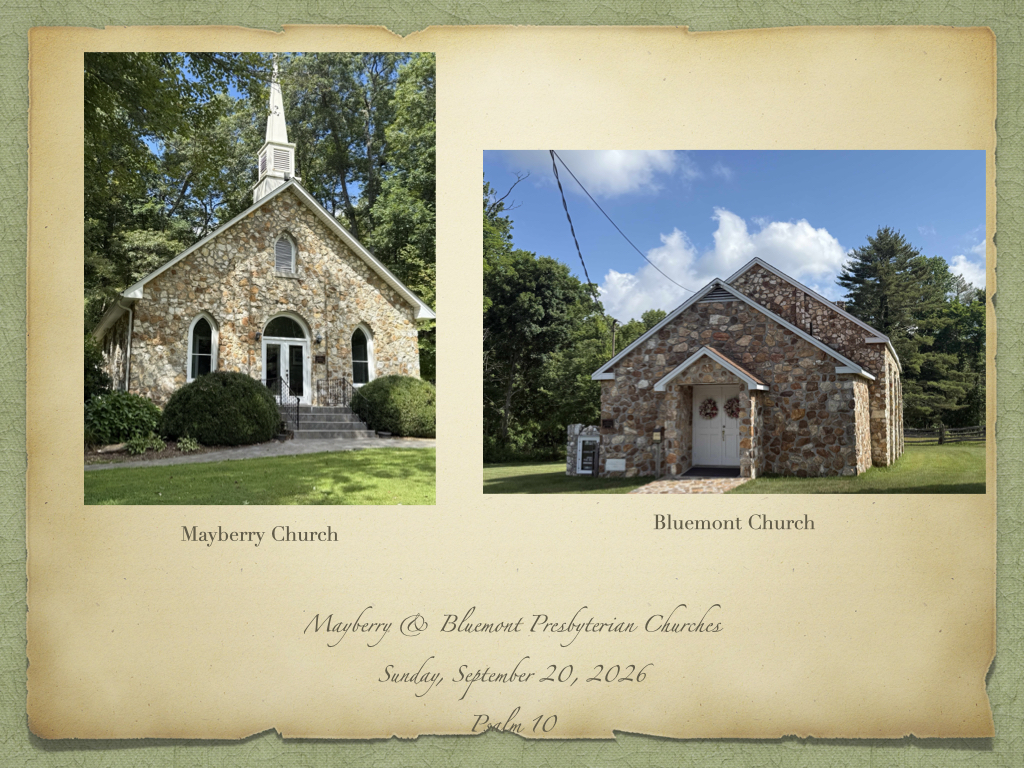
God’s knowledge of us

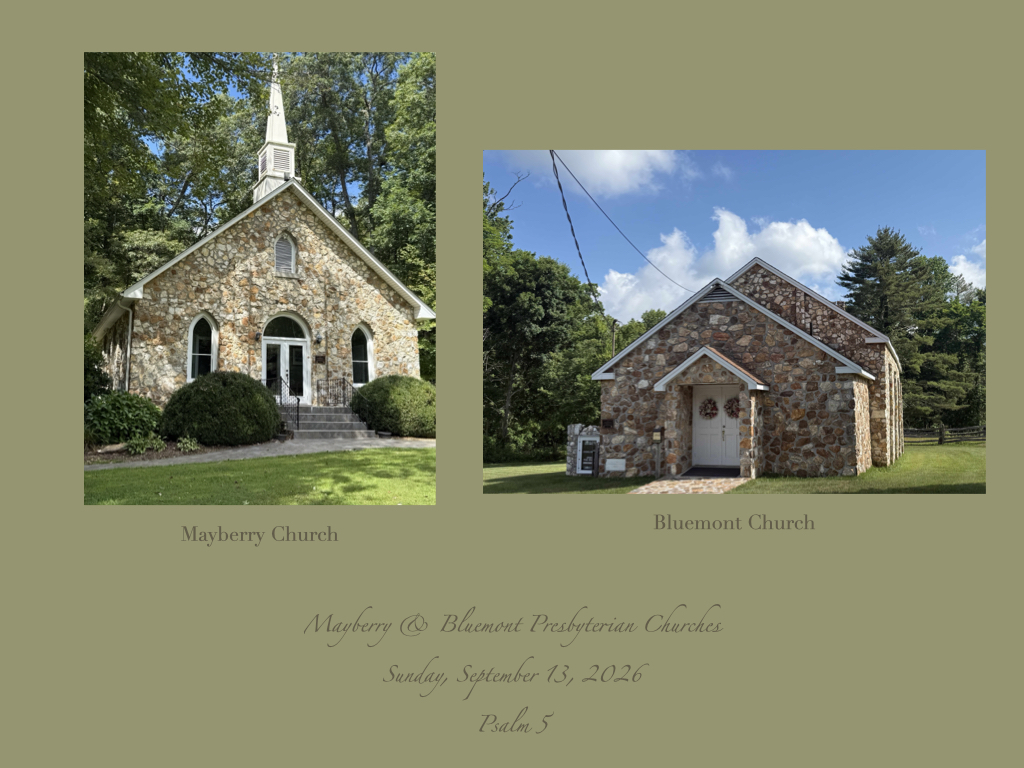
Title slide with fall photos of Mayberry and Bluemont Churches

Jeff Garrison
Mayberry & Bluemont Churches
Psalm 139
September 28, 2025

Sermon recorded at Mayberry on Friday, September 26, 2025

At the beginning of the service:

Anyone who has done much commercial traveling has a horror story. Mine came in Tallinn, Estonia. 

Having traveled overland from Singapore, I ran out of time for getting to Scotland and meeting up with Donna and Caroline. In Tallinn, I left the ground and flew to Edinburgh. Maybe I looked suspicious. Maybe it was because I only had a one-way ticket. Or maybe it was because my passport had most recently been stamped in Russia. The Estonians, who were forced into the Soviet Union, don’t look back fondly on those years as shown by their conversion of the old KGB headquarters into the “Museum of Russian Occupation.” 

As I was going through the security line, already without shoes and belt and everything dumped from my pockets into a bucket, a polite but stern woman motioned for me to stand in an x-ray machine, with my hands over my head. But that wasn’t enough. She then directed me to the side and motioned for me to raise my arms as she ran a metal detecting wand over me. Even that wasn’t enough! Then she and another man proceeded to thoroughly pat me down.

Then they went through everything in my carry-on, taking it all out and displaying it on a table as I stood silently watching. The whole time they remained polite but stern. The intimidation was enough to keep me from asking questions. Finally, they put everything back in my bag, smiled, thanked me and sent me on to my waiting plane.

I certainly understand the need for security, but that seemed over the top. I felt exposed. The idea of being so thoroughly explored by those who do not know me is disconcerting. We like our privacy; we like to keep our secrets, especially from strangers. But with God it’s not possible to keep secrets as we’ll see in today’s passage. And that can be comforting, for God wants what’s best for us.

Before reading the Scripture:  

We’re looking at Psalm 139 today. One Biblical scholar refers to this Psalm as a personal expression of radical monotheism. Monotheism means One God. From the Psalmist’s experience, he understands the knowledge, presence and power of God.[1]

The Psalm can be divided into four major parts. Verses 1-6 speak of how we are intimately known by our Creator. This captures God’s omniscience.[2] There is nothing we do that God doesn’t know! 

Verses 7-12 speak of how we cannot run away. God’s omnipresence is demonstrated in these verses. We’re like Jonah. We can’t escape from God. Day or night, up or down, or to the far ends of the earth, wherever we might try to hide from God, we’ll find God already there and waiting. 

Then, in verses 13-18 the Psalm shifts to God’s creative power as he links God’s knowledge with our creation. Having created everything, including us, God knows us better than ourselves. 

In verse 19, the Psalmist takes a completely new tack. In a way, he’d built up God’s ego, bragging about God’s knowledge, presence and power, and then lays out his concerns. He asks the Lord of Creation to handle his enemies. Because of his trust in God, the Psalmist feels comfortable in sharing his concerns which keeps him awake at night. These verses get left out of the lectionary selection for the Psalm because they don’t sound very Christian. But we’ll come back to that. 

Finally, in this last part of the Psalm, the Psalmist concludes his hymn encouraging God to search him and to purge from him any wickedness. He asks to be led into God’s future. Let’s now listen to the Psalm. You might want to pull out your Bible and see if you can identify the parts of this passage. 

Read Psalm 139

The Psalmist begins by reminding us of how thoroughly God knows us. God knows us better than we know ourselves. We’ve seen in other Psalms how God looks down on the earth.[3] Here the Psalmist understands God’s knowledge isn’t just from the distance like scientists studying distant stars looking for exoplanets. God knows us intimately. 

The Psalmist then insist God’s presence knows no boundaries. God doesn’t just look down on us from beyond the skies. God is with us. God’s presence includes Sheol, the place of the death. This place is where we totally ceased to exist. But thankfully, even there, God’s presence abides, which provides those of us on this side of the resurrection with hope in life everlasting. 

And finally, God created everything, which gives God insights into all that exist. Like a builder, God knows what’s behind every plastered and painted wall. I’ll come back to this in a bit. The first 18 verses of this Psalm praises God. It also reminds us that we’re not God. These traits only apply to the Almighty. 

Then our Psalm takes a shift. David, whom this Psalm is attributed, becomes personal. He calls on God to deal with his enemies. Perhaps this Psalm came from the time when David was hounded by Saul.[4] David tried to be loyal to the king God first placed over the Israelites, but Saul felt threatened by this young up and coming Israelite. Being falsely accused of something is hard. We might lash out, but maybe we should first take the accusation to God and ask the Almighty to vindicate us. 

This David does. Instead of seeking revenge and killing Saul, he takes his concerns to God. Like David, Jesus also didn’t strike back when he was falsely accused. He allowed God to vindicate him when he returned from the tomb. 

Verses 19 to 22 seem hard to reconcile with Jesus’ teachings of loving our enemies and praying for our persecutors. But if we are so close to God, as the Psalmist appears in these verses, we can trust God to hear our concerns, to remain with us in our troubles, and to vindicate us in the end.

We’re not in control; the Psalmist understands this.  Predestination wasn’t something Calvin or Augustine or even the Apostle Paul thought up. They all spoke of it, but the idea goes back into Hebraic thought. This Psalm has predestination written all over it! As verse 16 indicates, God maintains a calendar for each of us. God is in charge. God works things out for his purpose, which means that if we can dovetail our lives into God’s purposes, we’ll be a lot better off. Otherwise, we’ll be swimming upstream.

So instead of working against God’s purposes, the Psalmist shows total trust in God as he asks God to search him for any wickedness and to lead him in the way of life. 

Although he has shown from his experience the knowledge, presence and power of God, the Psalmist realizes as a creature, as a mere mortal, he can’t fully comprehend the nature of God. God’s thoughts are more numerous than grains of sand, yet because God is presence, the Psalmist is going to stick with God! It’s okay that he can’t fully understand the divine mystery; it’s enough that God understands him. And for the same reasons, God understands us. 

What might we learn from the 139th Psalm? Let me suggest two takeaways about God and two about us as human beings. As for God, we’re reminded of God’s awesome nature. God is almighty. God knows all. God’s presence can be found everywhere, even places beyond our ability to go. And God creates all. Furthermore, the second item, God’s concern with creation is such that God remains involved in the world and in our lives. 

Two things we learn about ourselves… First, we can be honest with God. We can appeal to God to care for us and even protect us from our enemies. And we can proclaim our innocence to God but also open ourselves us to be corrected. If so, we ask God to lead us into the way of life. 

As I close, let me go back to the 13th verse. The Psalmist uses the metaphor of knitting to explain how God knows us. God is like a knitter who has invested in every strand within a garment and knows the piece of fabric like no one else, even the person wearing the fabric. 


Likewise, God invests in us. God loves us. God has a purpose for us. And God wants us not only to live for him but to enjoy the relationship. We’re called to be in a relationship with the Creator who knows us and hasn’t abandoned us even when we turn away and attempt to live only for ourselves. God loves us as show through the coming of Jesus. When we live for God, God can do incredible things through us. Believe it. Amen. 


[1] James May, Psalms: Interpretation, A Biblical Commentary for Teaching and Preaching (Louisville; John Knox Press, 1994), 435.

[2] One commentator divides the opening three parts of this Psalm into three attributes of God: omniscience (all knowledge), omnipresence (all presence) and omnificence (all creation). See Athur Weiser, The Psalms: A Commentary (1959, Philadelphia: Westminster, 1962), 802-804. 

[3] We see this in Psalm 113 and 14, which I recently preached on. See https://fromarockyhillside.com/2025/09/21/8250/ and https://fromarockyhillside.com/2025/09/14/is-atheism-really-the-problem-what-does-psalm-14-say/

[4] This link to David comes from Stan Mast’s commentary on this passage. See https://cepresaching.org/commentary/2017-07-17/psalm -1391-12-23-24/

Is Atheism really the problem? What does Psalm 14 say?

Title slide with photos of Bluemont and Mayberry Churches

Jeff Garrison
Mayberry and Bluemont Churches
September 14, 2025
Psalm 14

Sermon recorded at Mayberry on Friday, September 12, 2025…

At the beginning of worship: 

There are many times I wonder what to say on a Sunday and this morning is one of them. We gather with the assassination of Charlie Kirk fresh in our minds as well as another school shooting in Colorado. Such events are too common. Just in the past few months we’ve witnessed the assassination of a Democratic legislator and the attempted assassinated of another in Minnesota. And there was the burning of the Governor of Pennsylvania’s home while he and his family slept. And a host of school shootings occurred. Outrage on social media seems to be at an all-time high.  

At times like this, as Christ’s followers, we should concern ourselves with how we reflect the love and the grace of Jesus Christ. How can we not enflame the rhetoric and be the peacemakers we’re called to be? How can we love, even our enemies, as we’re called? 

Psalm 1, which I’ll refer to later in my sermon this morning, speaks of the two paths before us.[1] Do we follow the path of the sinners and scoffers, or the path of the righteous who delight in the law and ways of the Lord? As we’ll see today, carrying and not abusing others for our personal benefit is imperative if we want to be with the godly. 

Before reading the scripture: 

Two weeks ago, in our journey around the Psalms, we looked at Psalm 112. I mentioned my dislike of the Psalm, as it proclaims blessings for righteousness. At times, that seems far-fetched.[2]At least, in the present world. Today, we’ll look at the opposite. 

Psalm 14 curses those who live as if God has no control over their lives. Both Psalms are tricky to peach.

A couple of things about this Psalm. Most Psalms address God. Instead of speaking to God, this Psalm is a prophetic statement by the Psalmist, directed at those whose actions go against God’s Word. While God is mentioned, the Psalm addresses the fools who think God won’t be concerned over their actions. 

Next, this Psalm is repeated almost word-for-word in Psalm 53. However, scholars generally preferred the 14th Psalm as the original seems better preserved here. As much as I would like to ignore this Psalm, when it’s repeated, I should realize God values these words and not disregard them. Repetition biblically emphasizes importance. 

This Psalm can be divided into three parts. It starts with a lament against the wicked who don’t believe in God. But it’s not really about atheism, as I’ll explain. Next, the Psalm serves as a warning against the wicked, followed by a hopeful wish of God intervening and bringing relief to those who suffer at their hands. [3]

Read Psalm 14

I’m going out on a limb and at the risk of oversimplification, suggest there are two kinds of atheists. The philosophical atheist doesn’t believe in God. This doesn’t necessarily make him or her a bad person. You don’t have to believe in God to be a decent human being. And all of us should strive to be decent human beings. 

The second type of atheist may say they believe in God. In fact, they may insist they’re not an atheist. However, their lives don’t act like they believe in God. They live as if they control their own destiny. Such atheists may even be a member of a church. They may proudly proclaim a profession of faith, which makes the second type of atheism more dangerous. And, I suggest, this is the type of atheism referred to in the Psalm. 

Philosophical atheism wasn’t really known in the biblical world. Of course, the Greeks discussed it. Socrates was even condemned to death for atheism. But Socrates denied the charge. He had challenged the leadership of Athens, and the trumped-up charge of atheism allowed the city’s leaders a way to silence him. Plato, from whom we learn much of what we know about Socrates, considered atheism foolish. But that all occurred in Greece, far from Israel.

In the Biblical world, instead of worrying about atheists, Israel’s larger concern were people who went after the gods of their neighbors, especially Baal. A second concern would have been people who lived as if they were God. Such a temptation reaches back to Eden and the Serpent’s promise that eating of the forbidden fruit would make our first parents like God.[4]

So, this opening line isn’t really about atheism as we know it. After all, modern philosophical atheism became popular in the 19thCentury with philosophers like Nietzsche and Marx and brought back into popularity more recently by the likes of Richard Dawkins. But this is not what the Psalmist refers to when he says, “fools say in their hearts there is no God.”  

Notice this Psalm isn’t directed toward those who proclaim out loud that God doesn’t exist. Instead, the Psalm makes such a claim against those who say such things in their hearts. In other words, those who at their very being live as if God doesn’t exist. All of us probably find ourselves tempted in such a manner at some point. And the temptation to want to be our own god is as old as humanity, reaching back to Adam and Eve. 

Let’s face it, those who act as if they are God or above God, or as if for some reason God gives them the right to do what they would like, are all around us. It’s to such people this Psalm speaks. For the Psalmist, these may have been the religious and political elite in Jerusalem, as John Calvin seems to have understood the passage. In his handling of this Psalm, he directs his message toward the clergy during the Reformation who failed to care for their flocks.[5]

Furthermore, this Psalm concerns itself with moral issues more than with theological ones. It’s not that the one doesn’t believe in God, but that one doesn’t act like they don’t have to answer to anyone.[6] The villain in this Psalm doesn’t believe in divine retribution, or that he or she will sooner or later have to atone for his or her sin.[7]

Psalm 14 has a countertheme, this is still God’s world.[8]  And the Psalmist has a message for such villains who think the world belongs to them. God’s watching. The wise aren’t those who act as if they’re almighty, but those who seek after God. The villain, who doesn’t concern him or herself with God, have gone astray or adrift from the truth. In verse four, we learn such individuals think they can use other people for their own enrichment. “They eat up God’s people as if they’re bread,” the Psalmist says. 

This Psalm is attributed to David, who, if you remember, had a righteous streak within him. Do you remember Nathan telling David about a rich man who, instead of taking from his own flock a lamb to feed a traveler, stole the only lamb a poor man owned. David was incensed. He wanted the rich man’s head for his crime, only to hear Nathan’s condemning words, “You are the man.” David had stolen Uriah’s wife and had set up Uriah’s death.[9]

In a way, with this Psalm, David proclaims such a prophecy as he heard from Nathan. But he’s also convicted by it. And in that manner, he’s no different than most humans. We have our good moments and our less than good moments. Our bad moments include trying to use other people for our own benefits without concern for their wellbeing. This Psalm speaks to such situations. That’s abusing and disregarding the needs of others for personal profit, especially the poor who have no means to protect themselves. 

In verses 5 and 6, the Psalm speaks of the terror those who abuse others face. God stands with the poor, with those who are abused by others. God remains a refuge for the righteous. The villains will find themselves, in their quest for ill-gotten gain, in a battle against God. 

Our Psalm ends with a wish and hope.[10] The promised reward, as we learned from Psalm 112 two weeks ago, may be off in the future. The ending of Psalm 14 reminds us that the accounts have not all been settled. Those “fools” who live and act as if God doesn’t exist may seem as if they’re winning in the short run, but judgment awaits. 

What the Psalm encourages the reader to do is to live in a manner which honors all people, especially those who are unable to care for themselves. Then, we won’t have to worry about God seeing what we’re up to and our conscience can be clean. Furthermore, the Psalm wants the readers to know that just because someone seems to live high on the hog while mistreating others, they’ll sooner or later experience the terror of a righteous God.  

Like Psalm 1, this is a wisdom psalm. There are two ways to live, we learn from the first Psalm. We have the path of the sinners, the wicked, and the path of those who delight in God. And as Psalm 14 reminds us, this includes carrying for others. The choice is ours. Amen. 


[1] For a sermon I preached on Psalm 1, see https://fromarockyhillside.com/2023/01/08/psalm-1-two-roads/

[2] See https://fromarockyhillside.com/2025/08/31/psalm-112-the-blessing-of-the-righteous/

[3] Artur Weiser, The Psalms: A Commentary (1959, Philadelphia: Westminster Press, 1962), 164. 

[4] Genesis 3:5.

[5] See Stan Mast’s commentary on this passage: https://cepreaching.org/commentary/2018-07-23/psalm-14/

[6] James L. Mays, Psalm: Interpretation, A Biblical Commentary for Teaching and Preaching (Louisville, KY: John Knox Press, 1994), 81.

[7] Robert Alter, The Book of Psalms: A Translation with Commentary (New York: Norton, 2007), 40. 

[8] Walter Brueggermann, The Message of the Psalms: A Theological Commentary (Minneapolis: Augsburg, 1984), 44. 

[9] 2 Samuel 12:1-15. 

[10] Brueggemann, 45. 

Psalm 112: The blessing of the righteous

Title slide with photos of the two churches where this sermon will be preached

Jeff Garrison
Mayberry & Bluemont Churches
August 31, 2025
Psalm 112

Sermon recorded at Bluemont on Friday, August 29, 2025

At the beginning of worship: 

Twenty years ago this month, I officiated Jodi’s funeral. An attractive and delightful woman, about my age, she moved back to Hastings where I was serving a church. She was in her late 40s. Her last year she lived with her elderly mother because of a terrible illness. I don’t remember the name, but the disease, which I think was hereditary, caused a stiffing of muscles. It eventually killed her because she could no longer breath, a terrible way to go. 

Jodi’s mother, Joan, was a saint. When Jodi moved back to town, it was all Joan could do help her move from the bed to a chair or go to the bathroom. Joan herself was frail, but she threw herself into the task at hand. Eventually, she had to have nursing help and Jodi remained mostly in bed. During this time, I visited her several times. Her mind was sharp, and she always expressed a joyful attitude despite being in pain. She was a lovely soul who never complained. I could only imagine how I would be if I was in her situation. 

I haven’t thought about Jodi for years, but as I started reading our morning’s Psalm in preparation for today’s sermon, she came to mind.

This morning I want you to ask yourself, “Why do we praise God?” Is it out of the hope to be rewarded? Or because of God’s nature? 

Before the reading of the Scripture: 

This week, as we explore the Psalms, we’re looking at Psalm 112. There are good reasons why I haven’t preached on this Psalm in my 36 years of preaching weekly. It sounds too simplistic. Obey God and you’ll be blessed. I expect most of us know godly people, like Jodi whom I introduced earlier, who in this life wasn’t blessed. At least not blessed in any recognizable fashion. 

There is a close connection between Psalm 111 and Psalm 112. Neither Psalm is attributed to a particular author, but most scholars think the same author wrote both. Nor do we have any hints as to the date or circumstance of either Psalm. Psalm 111 focuses on God’s praise and ends with a line from wisdom literature, “The fear of the Lord is the beginning of wisdom.”[1]This is followed in Psalm 112 with the blessings offered to those who fear God. [2]

Furthermore, both Psalms 111 and 112 are acrostic poems. Each “measure” within the poem begins with the next letter within the Hebrew alphabet.[3] Of course, it’s impossible to faithfully translated such a poem. After all, the Hebrew language has only 22 letters verses our 26 letters. And it’s impossible to have a word starting with the same letter in both languages. 

Let’s listen to this Psalm. You might want to keep your Bibles open afterwards, as we work through this poem. 

Read Psalm 112

At our Men’s Breakfast and Bible Study on Tuesday, we read this passage. Before I say anything, I generally begin by asking for everyone’s first thoughts. One person pointed that this passage challenged the concept of the inerrancy of scripture. 

Certainly, there are things in scripture which go against these words. Job, the faithful servant, who lost everything. Jesus, the faithful Son, who dies a horrible death. And even in our own lives, we all know people who are basically good, but don’t reap the benefits spoken of here. My mind went to Jodi, whom I introduced earlier. So, let’s take a few minutes and explore this Psalm, asking ourselves what we might learn from it. 

Psalm 112, like Jesus’ opening lines in the Sermon of the Mount which we used as our call to worship this morning, is a beatitude.[4] The Psalm promises blessings to the righteous. And who are the righteous? The first verse identities them as those who fear God and delight in God’s commandments. The fourth and fifth verse tells us they’re a light in darkness. Graciousness, mercy, righteous and justice characterizes them. The seventh verse tells us of their lack of fear of evil and in the ninth verse show they care for the poor. 

In other words, the blessed righteous in this Psalm don’t just have faith or trust in God. They haven’t just prayed the sinner’s prayer and then gone about their lives. They live out their faith by helping others. Their conscious is clear, and they trust God enough to know everything will be okay.

We’re not provided with much insight about the makeup of the wicked in this Psalm, only that they become angry at the blessings experienced by the righteous. Just like the blessings of the righteous, this seems paradoxical. After all, it often seems as if the wicked prosper. People who cheat and win are often applauded, but such actions do not find approval in scripture.

The movie Wall Street, which was released in 1987, shows this. The movie also provides hope that things might turn out differently. In the movie, Bud, played by Charlies Sheen, struggles as a young stockbroker. Trying to get ahead, he develops a relationship with Gordon Gekko, a shady character played by Michael Douglas. Gekko has lots of money to invest and likes sure things, which he usually obtains from illegal insider trading. I remember reading a few years after the movie who Douglas was shocked by people’s reaction. He thought they should be repulsed by his character, but too many wanted to be Gekko. 

Bud becomes fabulously rich, but when he learns Gekko plans to destroy the airlines where his father (played by his real father, Martin Sheen) works as a mechanic, he has a change of heart. He begins to plot against Gekko. As this plays out, the Security and Exchange Commission, who has been investigating Bud’s activities, step in and arrest him. It’s obvious, he’s bound for jail. 

The next scene involves a meeting with Gekko in a park. Gekko beats up Bud for turning against him and causing him to lose money. Bud takes the beating, refusing to fight back. As he cleans himself up afterwards in a rest room, we learn he wore a wire, provided by investigators who hope they can also take down Gekko’s illegal dealings. Bud goes to court expecting to go to jail, but also knows he’ll get a lighter sentence. Furthermore, he’s promised an honest job once he pays his dues. 

While the movie’s final scene shows Bud walking up the steps to the courthouse, we have some sense Gekko himself will experience the long arm of the law. 

Sadly, things are often not as clear cut as we’d like. Sometimes justice takes time, as the movie shows. Neither justice nor blessings move as fast as we’d like or as this Psalm indicates. Rotten and corrupt people often end up on top, at least in the present. 

Because of the condition of this world, the Psalms of Lament, where we cry out because of the injustice we experience or see, seem much more appropriate than a Psalm of blessings. 

Which leads me to ask how are the righteous blessed? In the present, their blessing might just be one thing. They don’t lose sleep over their sins, their dishonesty, and their crimes. They can relax and sleep well, knowing they’ve strived to live honorable and noble lives. That’s why the Psalm says they’re not afraid. On the other hand, the wicked who live with skeletons in their closets must always stay on top of their lies. They know that at any time, their house of cards might topple down.[5] They are like Bud in the movie Wall Street, knowing a knock on the door could bring the Security and Exchange Commission with handcuffs. 

And, of course, if the wicked are not caught in this life, like all of us they will have to stand before the throne of judgment one day and give account of their lives.[6] So even if the wicked appear to win, they will lose where it matters most. 

The Old Testament scholar Walter Brueggemann classified Psalm 112 as a “Psalm of Orientation.”  This Psalm shows how we should adapt our lives to live within God’s favor. We’re to focus on God and do what God desires from us. The Psalm shows that our contentment comes from how we relate to others.[7] Do we give generously, practice justice, care for poor, and remain faithful to God? Goodness isn’t just a state of being. It comes from our actions as we work for the wellbeing of others. 

This Psalm teaches us that our happiness is created within social relationships.[8] When we let greed or our desire to be self-sufficient get in the way of our relationship with others, we have missed the boat. 

One thing this Psalm demonstrate is that riches are not proof of one’s relationship to God. The Psalm does not support the heretical Prosperity Gospel, which teaches blessings come to the faithful. That goes against much of Scripture. After all, God sends rain upon the just and unjust.[9] Money and possessions are not signs of a blessed life in this Psalm. The blessed in this life (and the next) are those who follow God’s teachings and strive to help others. 

Use this Psalm as a guide for your life. You might not become rich, but you’ll be living in a godly manner. Amen. 


[1] See Job 28:28, Proverbs 1:7, 9:10, 15:3.  In the Apocrypha book of Sirach, the opening chapter is a praise of wisdom (see Sirach 1:14, 16, 18, 20). See also Sirach 15:11, 19:20 and 12:11. 

[2] Artur Weiser, The Psalms: A Commentary, Herbert Hartwell translator (1959, Philadelphia: Westminster Press, 1962), 703. 

[3] James L. Mays, Psalms: Interpretation, a Biblical Commentary for Teaching and Preaching (Louisville, KY: John Knox Press, 1994), 359. 

[4] See Matthew 5:3-12.

[5] Idea from a commentary on this passage by Scott Hoezee. See https://cepreaching.org/commentary/2019-08-26/psalm-112-2/

[6] While the concept of eternal judgment wasn’t fully developed as the Psalms were written, the Psalms are within a larger canon including the New Testament in which judgment exists. This doesn’t mean those who break such laws are unable to get into heaven, but for them to make it into heaven, they will have to be purified of their greed and injustice. 

[7] Walter Brueggemann, The Message of the Psalms (Minneapolis: Augsburg, 1984), 47. 

[8] Brueggemann, 46. 

[9] Matthew 5:45.

Psalm 103: Praising God

Title slide with photo of two rock churches along the Blue Ridge Parkway

Jeff Garrison
Mayberry & Bluemont Churches  
Psalm 103
August 24, 2025

Sermon recorded at Mayberry Church on Saturday, August 23, 2025

At the beginning of worship:

Johnny always wanted to take a ride in a balloon.  He’d heard about how quiet it was as you floated over the countryside. Finally, he had a chance. Johnny climbed into the basket with the balloon pilot. They dropped the weights as the pilot fired up the heater. In no time, the balloon rose above local buildings and barns. Then they were above trees. It kept going higher as the wind kicked up and whisked them away. Soon neither Johnny nor the pilot knew where they were atThe pilot dropped the balloon down in a safe area without trees and powerlines and Johnny called to a man walking along a sidewalk: ‘Excuse me, sir, can you tell me where I am?’

After looking Johnny up and down, the passer-by says: ‘You are in a red balloon, ten feet above ground.’ 

‘You must be a lawyer,’ Johnny mumbled.

‘How could you possible know that?’ asked the man. 

Because your answer is technically correct but useless. I am still lost’.

“You must be in management’, said the passer-by. 

‘That’s right” Johnny said.  “How did you know?’ 

‘You have such a good view from where you are,” the lawyer said, “and yet you don’t know where you are, and you don’t know where you are going. The fact is you are in the exact same position you were in before we met, but now your problem is somehow my fault!”[1]

One of the problems in life is that we often take credit for things when they go well and then blame someone or something else when they are not. Such an attitude is neither honest nor helpful.  

Before reading the Scripture:

Last week, we explored Psalm 80, a Psalm of Lament.[2] The author of that Psalm wondered if God had given up on the people of Israel. Honesty is a hallmark of the Psalms. These ancient hymns bring all kinds of emotions to the Lord. From the bitter feelings of abandonment, the fear of defeat, to the joy of praise, the Psalms have it all. The Psalms show it’s okay to be honest with God. We’re just not to give up on God. Consider your prayers. Are you honest about your feelings with God? 

Today, we’ll explore Psalm 103. Attributed to King David, instead of a lament full of complaints, David rejoices in God, acknowledging all God has done for himself and for his people. The Psalm begins by calling on himself to praise and ends by calling on all creation to praise God. 

Read Psalm 103

One of the delights of eating with my late friend and a theological mentor, Jack Stewart, was listening to him say grace.[3] At the table, once everyone sat down, he’d reach out and grab his wife’s hand and the hand of whoever sat to the other side of him.  Then he’d begin with a strong deep voice, “Bless the Lord, all my soul and all that is within in. Bless his holy name. Bless the Lord, all my soul, and do not forget all his benefits.” As soon as he began, everyone became quiet and listened.

Jack almost always said the same grace at meals, opening with the first two verses of this Psalm. Sometimes he’d add his own prayers after the opening, but not always. These two verses are sufficient. When in a restaurant, it’ll be the same prayer, only not quite as loud as at home. At home, the dishes might rattle from the booming sound of his voice as if even they joined in the praise of God. 

The opening verses of Psalm 103 is a fitting prayer. Like many of our prayers, it may be more for us than for God. These words remind us of our duty to praise God and to remember what God has done for us. God cares for us. God forgives us. The God who gave us the breath of life, heals us and offers us a second and third and forty-ninth opportunity to get it right.   

Part of what makes this Psalm so rich is how the Psalmist draws from his personal experiences and from the experiences of his people with God. Even though, like all of us, he has succumb to sin, which cut him off from God, he is able to, as one commentator writes, “enjoy the full sunlight of the grace of his God.”[4] Martin Luther called this Psalm the proper master and doctor of Scripture.”[5] He’s right as these words encapsulates much of our theology, which focuses on the praise of God.

Notice how the Psalm builds. In the opening verse, the Psalmist speaks to himself as he calls for his need to bless or praise the Lord. But then in verse seven, he brings in Israel, who experienced God’s mercy and grace. Then, in verse 15, he adds to the Hebrew voices all mortals, who live like grass and are frail. In verse twenty, he calls on the angels in the court of heaven. And then, at the end, he calls on all creation. All of God’s works and dominion joins in the song. 

Think about listening to a piece of music that begins with a single instrument, then the conductor calls in more instruments from a different section of the symphony, then brings in instruments from another section. Each time new instruments are added, the sound rises and becomes fuller. Finally, when all have joined in, the music reaches a crescendo. That’s what’s happening in this Psalm.

The Psalmist tells us why we should praise the Lord. God gives us abundant matter for praising him,” John Calvin wrote about this Psalm. If we could only remember God’s benefits, “we would be sufficiently inclined to perform our duty.”[6]

In verses 3 through 6, using a series of verbs, the Psalmists points out what God has done: forgives, heals, redeems, crowns, satisfies, renews, and works. There are two great themes of God’s work highlighted in this Psalm. First is forgiveness. The other combines the traits of the Almighty: love and compassion.[7]

From the vantage point of the present, looking back, the Psalmist sees where God intervened on his behalf. He knows the stories of how God has guided and protected Israel, going back to Moses and leading the people out of Egypt. He quotes from Exodus the line that God is merciful and gracious, slow to anger, and abounding in steadfast love and faithfulness.[8] As we saw in Psalm 33, which we explored a few weeks ago, David understands God’s enthronement in the heavens. God, with an overview of all the world, remains intimately connected in our lives.[9]

God is compassionate, like a father. And as Creator, God knows our beginning. Our lives, when measured against history, are short, but God’s love is everlasting.

Yes, we should praise God for all that God has done for us. The Psalmist, in bringing in all the voices that have experienced God’s providence, calls on you and me to join in this song of praise. Bless the Lord, O my soul. Be thankful and grateful so that all might know of God’s goodness.  

The message of this Psalm is one that we need to take to heart. Too often, these days, people look askew at the Christian faith. They see the church as judgmental, even hateful.[10] We must change that perspective! We need to reflect a faith grounded in this Psalm instead of one that just condemns all that we see wrong in the world. As one individual who gave up on church said: “The church should be a place where people are loved collectively rather than judged individually.”[11] Certainly, there are lots of things wrong with the world, but love (not condemnation) is the only thing that will redeem it.  

God loves the world. John 3:16 tells us he sent his only Son to save us. As followers of Jesus, we strive to live Christ-like lives. This Psalm shows us what God is about, reminding us of God’s loving care. We should be thankful. As we worship and praise God, we should humble ourselves while bringing God glory. Amen.  


[1] Adapted from http://fuertenews.com/fun-stuff/jokes-mainmenu-135/2929-may-day-traditions-and-jokes.

[2] https://fromarockyhillside.com/2025/08/17/a-desparate-plea-to-god/

[3] I wrote about Jack after his death here: https://fromarockyhillside.com/2023/10/12/remembering-jack/

[4]Artur Weiser, The Psalms, translated by Herbert Hartwell, (Philadelphia: Westminster, 1962), 657.

[5][5] James L. Mays, Psalms: Interpretation: A Bible Commentary for Teaching and Preaching (Louisville: John Knox Press,1994), 405.

[6] John Calvin, Commentary on the Psalms, viewed at https://www.studylight.org/commentaries/cal/psalms-103.html

[7] Stan Mast, “Notes on Psalm 103:1-8 for Proper 16C (August 15, 2016) for the Center of Excellence in Preaching at Calvin College.  See http://cep.calvinseminary.edu/sermon-starters/proper-16c/?type=the_lectionary_psalms

[8] Exodus 34:6

[9] https://fromarockyhillside.com/2025/08/10/psalm-33-trusting-in-a-merciful-god/

[10] There are a lot of books and articles that are making this case.  See Dan Kimball, They Like Jesus but Not the Church: insights from emerging generations (Grand Rapids: Zondervan, 2007). 

[11] Josh Packard, Ph.D and Ashleigh Hope, Church Refugees: Sociologists reveal why people are DONE with church but not their faith. (Loveland, CO: Group Publishing, 2015), 32.

A Desparate Plea to God

Title slide with photos of two rock churches where the sermon is to be preached

Jeff Garrison
Mayberry & Bluemont Churches
Psalm 80
August 17, 2025

Sermon recorded in the sanctuary of Bluemont Church on Friday, August 15, 2025

At the beginning of worship: 

Ernest Hemingway, when recovering from wounds received during World War I, noticed those who could patiently wait were strengthened during their recovery. Others, those who were impatient, struggled. From his experiences, Hemingway developed his basic story line. He placed good people into difficult situations and forced them to wait and then through the story enabled his readers to see his character’s true strength or weakness unfold. 

Hemingway’s characters often find themselves waiting. The Spanish republican lying in wait for his end in For Whom the Bells Toll. The matador anticipating the deadly bull in Death in the Afternoon. The old man spending all night fighting a giant fish, which in the end will only be eaten by a shark, in The Old Man and the Sea. And the threat of charging beast as big game hunters work the brush in his African short stories.[1]

When we are patient and willing to wait on God, we show character and resolve. But too often, we want to jump the gun. We want to get things started and prematurely set out to accomplish something, only to fail because we haven’t waited for the Lord to lead us. 

We have such great potential. The advances of science and technology continue to amaze us. And it makes us as members of humanity feel powerful. But in the end, we don’t have that much power. We’re weak and frail. We should bow before the power of a God who comes and willing dies for us. We should spend time in prayer and meditate upon the Scriptures in preparation for what is next. 

As in the Psalm we’ll explore today, we need to call upon and trust God to answer. We demonstrate our character by our willingness to trust in the Lord. Can we take our burdens to God? Can we rely on God to do something—accepting that God knows best—or do we try to go it alone and experience more disappointment and failures? 

Before the reading of Scripture:

We’ll explore Psalm 80 this morning. This is somewhat of a unique Psalm as it appears to have come from the Northern Kingdom of Israel. These are the ten “lost tribes” of Israel, who disappeared after Assyria conquered the Northern Kingdom in seven centuries before Christ. The writing of most of the Old Testament came through the eyes of the Southern Kingdom, who maintained a semblance of independence until the Babylonian exile. 

The Psalmist here expresses the desperation of his people. They are in danger and only God can help. Yet, it appears as if God has disappeared.[2] Let’s listen: 

Read Psalm 80

The Psalmist calls on God to save. Desperate, he cries out three times repeating the same phrase. “Restore us, O God; let your face shine, that we may be saved.” He’s so desperate he’ll risk looking at the face of the Almighty. We’re not supposed to do that. It’s dangerous; it can be fatal for God is so holy and we’re not. But the conditions are such the Psalmist sees no other way out of his situation. He hit bottom. He’ll will risk it! There’s no other hope. 

His willingness to call upon God to show his face demonstrates the intimate relationship possible between God and his children. To call upon God to show his face requires a relationship with the Almighty—one where the human party trusts God enough to risk it all.  

It’s also a plea for God to see our desperate condition. If you remember from last week, when we looked at Psalm 33, while God exists outside of creation, God remains concerned about what happens on earth.[3] Here, things are so desperate, the Psalmist fears God has turned away and calls God to again look at what’s happening. 

In his plea, the Psalmist uses two motifs to describe God.[4] “Give ear, O Shepherd of Israel.” God is seen as a shepherd who leads his sheep through the wilderness. This image arises from Exodus, when God took care of his people as a shepherd might care for his sheep. This is the image from David’s famous Psalm, “the Lord is my shepherd,” a God who leads his people by the still waters and to fields of green grass, the God who protects us in the shadow of death.[5] In times of peril, it’s comforting to know God as our shepherd.  

The second motif used to describe God is that of one who tends grapes, in other words a farmer. This description implies a more settled state. No longer are the Hebrew people wandering in the wilderness. They’re settled in the Promised Land. God has planted them as a vine. And as the vine grows, God nurtures the struggling plant with water and fertilizer, by pruning and building walls to protect his vineyard from wild animals and thieves. The Psalmist and the Hebrew people know God’s activity from how God cared for them, both in the wilderness and at their new home in the Promised Land.

But all that was in the past. For the Psalmist and those reciting this psalm in worship, God is absent. They know and recall all of God’s deeds of the past, of how God led their ancestors out of Egypt and settled them into Palestine. However, continuing with the view of the vine, they complain to God that the walls have been broken down and their fruit poached by those wandering by and ravaged by the animals of the forest. 

There struggles are kind of like my ongoing battle to keep the deer and beetles from eating my grapevines or the groundhog eating my cucumber vines. Only their struggle is worse. They call on God to once again look down from heaven and see their plight and save them from their enemies.

The Psalmist concludes with a vow: if God gives life, they promise to never turn their backs on God. We wonder if this is a type of a deathbed conversion promise, you know, the type we keep only during the dangerous hours. These types of prayers are more like bargaining with God— “God if you get me out of this mess, I’ll be good”. It’s the type of prayer I might have prayed while battling waves and wind in a kayak far offshore. I’ve called out for help this past June when a gale overtook me during my paddle around Drummond Island in Lake Huron.[6]

We’ve all been where the Psalmist is at. There are times God is distant. Mystics call it “the dark night of the soul.” In these situations, what do we do? We continue to pray.; we continue to bring our concerns to God. We continue to trust, for as Peter says to Jesus, “Lord, where can we go? Only you have the words that lead to life.”[7]

The request for God to fulfill these two motifs—the shepherd and farmer—is achieved in Jesus Christ. In the gospel of John, Jesus says: “I am the good shepherd.” The author of Hebrews calls Jesus the great shepherd of the sheep.[8] Jesus fulfills the call for God to be the shepherd of his people.

Likewise, Jesus is also likened to a farmer and is referred to in Luke’s gospel as the “Lord of the Harvest.” But this analogy is even more intimate than the Psalmist imaged, for Jesus tells us that he is the vine and we’re the branches.[9]  Baptism grafts us onto the vine of Jesus Christ, he is with us, and we are with him.

The Hebrew people probably gathered at the temple in times of peril and recited Psalm 80. Maybe they felt threatened by an enemy on their borders. Or it could be pestilence and disease spreading through the countryside, or drought and the fear of its corresponding hunger. Whatever the situation, they gather, hopeless, and seek God’s help. Asking God to show his face means they trust God to see their concerns and to provide relief. 

In time, God answers their prayers by coming in person, in the life of Jesus Christ.  They called upon God and God answers in a surprising way, coming to earth as an infant, growing up and living among his people, and then dying for their sins—and for our sins.

Of course, God didn’t answer their prayers right away. They had to wait. They waited for generations. Decades and centuries floated by. Unlike those of us who live in the 21st Century and expect immediate results, they had no concept of instant gratification. They prayed, they waited, they hoped, and they remained faithful to their God. Sometimes, we must do the same. Amen.


[1] Idea from M. Craig Barnes, Sacred Thirst: Meeting God in the Desert of our Longings (Grand Rapids: Zondervan, 2001), 112.  Examples from Hemingway’s writing are from my readings. 

[2] For background on the Psalm, see Artur Weiser, The Psalms: A Commentary (Philadelphia: Westminster Press, 1962) 545-551; James L. Mays, Psalms: Interpretation, A Biblical Commentary for Teaching and Preaching (Louisville KY: John Knox Press, 1994), 262-265; and Robert Alter, The Book of Psalms: A Translation with Commentary (New York: W. W. Norton, 2007), 284-287. 

[3] See https://fromarockyhillside.com/2025/08/10/psalm-33-trusting-in-a-merciful-god/

[4] The idea of two motifs from Claus Westermann, The Living Psalms (Grand Rapids: Eerdmans, 1989), 34.

[5] Psalm 23.

[6] I did pray for help, but I didn’t get to the point of bargaining with God by promising such things. After all, I’m in God’s hands and if God so desires, I’ll be saved.  See: https://fromarockyhillside.com/2025/07/24/completing-my-trip-around-drummond-island/

[7] John 6:68.

[8] John 10:11, Hebrews 13:20.

[9] Luke 10:2 (also Matthew 9:38), John 15:5.

A Psalm to Guide our Journeys

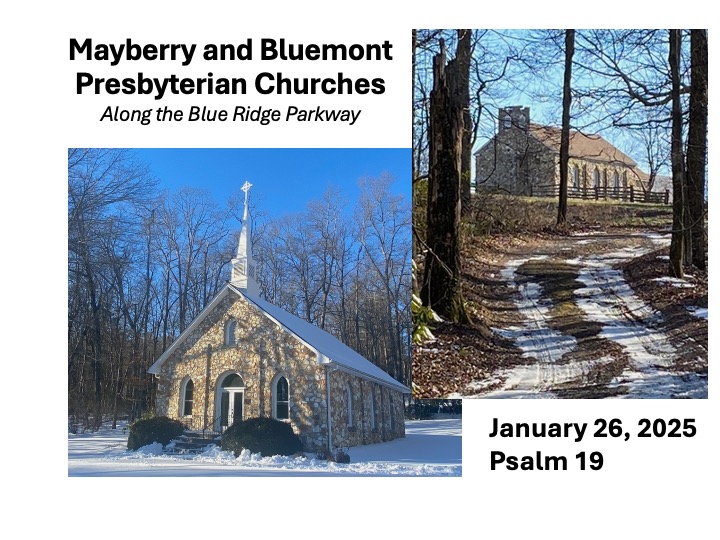
Title slide with photo of the two churches where this sermon is to be preached.

Jeff Garrison
Mayberry and Bluemont Churches
January 26, 2025
Psalm 19

Sermon recorded at Mayberry Church on Friday, January 24, 2025

We’re on a journey through life. Journeys are exciting and like most journeys, we should be amazed at the sights we see as we travel with Jesus. Ours is a sacred journey. Our ultimate goal of returning home to the Father, as the prodigal came back to his dad’s farm.[1]

Jesus prepares the way.[2] But there’s no need to rush down the road. Instead, we should saunter through God’s marvelous creation. As we’re on a spiritual journey, there may be things we can learn from other traditions. From Confucius philosophy out of China comes a list of practices for a spiritual journey. I recommend them to you:

  • Practice the arts of attention and listening.
  • Practice renewing yourself every day.
  • Practice meandering to the center of every place.
  • Practice the ritual of reading sacred texts (for us, that’s the Bible)
  • Practice gratitude and praise singing (to this we might add Paul’s advice to “pray without ceasing”[3]).[4]

Before reading the Scripture: 

This morning we’re looking at Psalm 19. As I have emphasized before, the Psalms served as Israel’s hymnal. This psalm, credited to David, had a liturgical function in worship. David draws from his experience at being outdoors where he’s amazed at the way God created order. 

Our psalm can be divided into three parts. The first section serves as a hymn of praise to the God of creation. Theologians call this natural theology, God’s revelation through creation.[5] The second part praises God’s law. The law as with all Scripture, is a part of God’s revelation.[6] Having been brought to enlightenment through the awe of creation and the wisdom of the law, the psalm ends with a plea for God’s help so that the Psalmist might be cleansed and remain pure. This is a Psalm which guides us on our journey home.

Read Psalm 19:

As I read the opening of this Psalm, I mumble to myself, “Amen.” I, too, have seen God’s glory in the sky. The winter sky at night is amazing. Thursday night, I got home from an amateur radio meeting in Galax about 10 PM. A friend had met me at my house and rode with me. We spent about ten minutes talking outside by our cars, in the cold, while looking up at the sky. 

I spotted Mars by the twins, in the constellation Gemini. Jupiter stood near the right horn of the bull, Taurus. Orion and his faithful dog had risen high in the sky as well as the dipper as it circles Polaris. But that’s only what the eye can see. Even as scientists bring us more understanding of the vastness of the universe, it’s not a reason for us to question our faith. Instead, there’s more to be in awe of God in the beauty and vastness of creation.  

And yet, we need to remember that although we might witness the glory of the Lord in creation, it’s because God’s creation is good. David, the psalmist, doesn’t slip into pantheism, praising creation itself as god, nor does he go off into worshipping nature.[7] We do not worship creation, only the Creator is worthy of our praise. But because it is a good creation, we stand in awe of the God who made the heavens and the earth. 

The opening six verses of this Psalm remind us of Psalm 8, which also praises the wonders of God as seen in creation. Scripture itself, in Genesis, begins with creation. Again, we don’t worship creation, only the Creator. But in creation, we come to understand an aspect of God’s majesty. Take the time to enjoy the night sky. Or watch in awe as a storm blows in, to appreciate distant mountain peak, or to watch the waves crash on a beach. These experiences should drive us to our knees in praise of the Creator. 

The appreciation of the world in which we live is only the first part of this Psalm. The change comes in verse 7. Some scholars suggest the Psalm is really two separate Psalms put together for some reason but originally separate.[8] I don’t buy into that line of thinking. Instead, the God who created the cosmos, has not abandoned it, but continues to be involved with creation, through the giving of the law and later the sending of a son.[9]

The second section of Psalm 19 is similar (but with a lot less words) to Psalm 119. The 119th Psalm, as you may know, goes on and on and on in praise of God’s law. If you have time, I encourage you to read it. But be warned, it’s the longest Psalm in scripture and longer than some books within the Bible. 

I believe the Psalmist intentionally links the parts of the Psalm to remind us of when we find ourselves in awe of God’s handwork, we should dive deeper into God’s heart. This is where the law comes into play. This section begins by calling the law perfect. We’re reminded the law’s purpose is to revive the soul. This may sound strange. We think of a particularly spectacular sunset as soul reviving, not laws. Laws sound, well, too legalistic. And we don’t want to be legalists. 

You know, at one point in my life, I thought I wanted to be a lawyer, but a college course in jurisprudence cured me of that idea. So how can the law restore our souls?

As I have often said, God’s law shouldn’t be viewed as restrictive. Instead, it sets boundaries in which we live in a way we honor God and others while having great freedom. If we stay within the boundaries, we enjoy life. If we move outside the boundaries, just as we move beyond the firmaments of the heavens, we’re not going to sustain life for long. 

Just as the Psalmist allowed the majesty of creation sweep over him as he watched the sun and stars make their way across the sky, he now looks inside of himself. He acknowledges how the law restores his soul, bring joy to his heart and light to his eyes. 

The law is even more desired than wealth. It’s sweeter than honey. The sweetness should remind of a practice in ancient days when Jewish children started to to study the law. The rabbi dropped a bit of honey on their tongues so they might come to understand that like honey, the law is also sweet. 

In verse 11, the Psalm takes another turn. It’s as if the Psalmist realizes the law brings consequences. He asks God to cleanse him. This is a prayer of confession and supplication. The Psalmist knows he needs forgiveness, which involves his confession. He also knows he can’t do everything by himself. In verse 12, he acknowledges the sins of which he’s unaware—and, as a warning, we all have such sins. He also knows others stand to lead him astray. To avoid the consequences of stepping out of the bound prescribed by the law, the Psalmist needs God’s help.  

The Psalm closes with a verse I’ve often pray silently before stepping into the pulpit: “Let the words of my mouth and the meditation of my heart be acceptable to thee, O Lord.” Here, at the end of this poem, the wonderings of his imagination focus. Having seen God’s glory in the heavens and experienced it in the law, he realizes he need not try to please anyone but God. God is his rock, his foundation; God, is his redeemer, his Savior.  

Psalm 19 is one of the more beloved Psalms, standing there with Psalm 23, 121, and 145. It’s a good Psalm to mediate upon and, if you’re into such, to memorize. We’re reminded of God’s amazing creation, of God’s care for us through the law, and of our need to seek refuge in God’s grace. This Psalm sets before us a way to appreciate God and to help steer our lives to align us to God’s purposes. It’s a Psalm which captures the Christian journey back home. Amen. 


[1] Luke 15:11-24.

[2] John 14:1-7.

[3] 1 Thessalonians 5:17.

[4] From the Analects of Confucius as quoted by Phil Cousineau, The Art of Pilgrimage: The Seeker’s Guide to Making Travel Sacred (New York: MJF Books, 1998), 126. 

[5] See Romans 1:20.

[6] Leonard Vander Zee, “Psalm 19 Commentary,” Center for Excellence in Preaching, https://cepreaching.org/commentary/2018-09-10/psalm-19-3/

[7] James L. May, Psalms: Interpretation: A Biblical Commentary for Teaching and Preaching (Louisville, KY: John Knox Press, 1994), 97. 

[8] Artur Weiser, The Psalms: Old Testament Library (Philadelphia: Westminster Press, 1962), 197 approaches the Psalm as two separate Psalms. Claus Westermann, The Living Psalms (1984, Grand Rapids, MI: Eerdmans, 1989), 253, both approach Psalm 19 as verses 1-6 being the original. Westermann sees the rest as a later addition. 

[9] Scott Hoezee, “Psalm 19 Commentary,” The Center for Excellence in Preaching, https://cepreaching.org/commentary/2025-01-20/psalm-19-11/

God keeps an eye on those with power

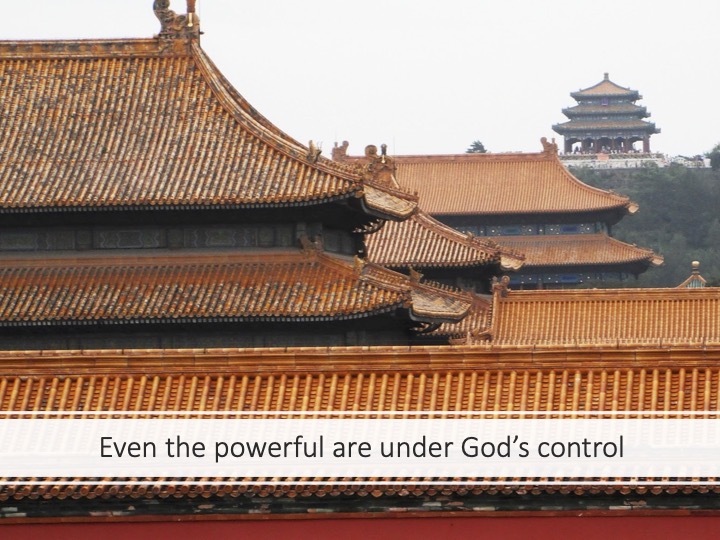
title slide for sermon on Psalm 21 featuring photo of Forbidden City with a temple on a hill overlooking it

Jeff Garrison
Bluemont and Mayberry Churches
May 21, 2023
Psalm 21

Sermon recorded at Mayberry on Friday, May 19, 2023

During this season of Easter, we’ve explored upbeat Psalms. After all, this is the season of hope. The resurrection of Jesus provides hope. And today, as we look at Psalm 21, it won’t be any different. We have hope because we’re in God’s hands.

But I’ve only scratched the surface of the Psalms. There wonderful thing about this book is that you find all kinds of emotions on display. The Psalmists don’t mind getting angry with God when things do not go their way. And that’s okay. Because even in the harsh Psalms of lament,[1] where the Psalmist expresses anger to God, he continues to engage God. The Psalmists even moves toward God where there is no evidence of God.[2] Such is his trust. Can we so trust God?

Before the reading of scripture:

Psalm 21, which we’re considering today, is one of a sequence of Psalms reminding the Hebrew people of their king’s dependence on God.[3] The king derives his strength from the Lord, which is also a reminder that human kings are always subordinate to Almighty God. When those in power think they earned it or have no one to which they’re to be accountable, we find ourselves heading down the wrong path. That’s more of a dictatorial or totalitarian system of government. According to this passage, the king is reminded not to get too big for his britches. He might have power, but there’s a limit to it, for he is not the source of his power. That comes from God. And God keeps his eyes on those with power.

Read Psalm 21:

Who here got up early on Saturday a few weeks ago to watch the coronation of Charles III?  I couldn’t watch it because I had a presbytery meeting that Saturday, north of Roanoke. I was up early, but on the road… However, I’ve seen the photos. Did you see the one of Charles all decked out on the throne, wearing the crown, and holding the scepter. Beside him was Prince William, the heir apparent, and his son, whom I assume is third in line to the throne. It’s quite a sight to see. They must have worn 25 pounds of metals each, and their clothes and robes must weigh almost as much as they do.  

I’m not sure what to make of Americans who seem to be more interested in the royal family that my friends in the UK. We declared our freedom from kings in the Revolutionary War. While their ceremonies are colorful and can be a pleasure to watch, I prefer our presidential inaugurations. There, everyone wears a dark suit and there are no crowns to be seen unless there happens to be a kid in the crowd who’d just came from Burger King. 

But I do like the fact that the British coronation includes a worship service. The leaders of the Church of England preach before and pray over the new king. However, in a parliamentary monarchy like the United Kingdom, the king or queen have little power. 

Some ancient cultures understood the limit of human power. I’ve shared with you before how, on a hill behind the Forbidden City in Beijing, is a temple. There, where the emperor and family lived for centuries, one of the more elaborate estates ever built for a royalty, is a temple. While we may understand God differently than those in Buddhist tradition, the idea is the same. The emperor needed to be reminded when he looked up on the hill that there was a higher authority. 

The same is true for the building of steeples in small towns and even large cities in North America and Europe. As such structures rose into the sky, they reminded people of a higher power. Throughout the nineteenth century, this was true for most cities in America. But with the development of steel technology and elevators, buildings started rising higher and higher. 

In cities like New York and Chicago commercial buildings began to cast a shadow on the church steeples. In Pittsburgh, you even have the Cathedral of Learning, which rises high above any church. And later someone had the idea to build a Cathedral of Glass, the headquarters of PPG. This building resembles a medieval cathedral but is covered in glass. 

I don’t think the answer to our problems is to go back to where the church steeples were the tallest thing around. Sadly, for too many Christians, competition to building the tallest or the most ornate structure was intense. This, by the way, is very un-Presbyterian (but I must confess there are even some Presbyterian Churches that strove to be the biggest or the more ornate).[4]

In this Psalm, which is written as a prayer, the people are reminded that the “splendor of the royal prom” only reflects the power and glory of God. The shouts of joy from the crowd comes, not just on the king, but on the joy which comes from knowing God.[5]

This Psalm, attributed to David, may have been used at a coronation for a new king. Maybe he wrote it for his son, Solomon. What the Psalm makes it clear that the king is totally under the authority of the divine king. Everything the earthly king is, has, and does comes from God.[6]

While we might think this Psalm doesn’t apply to us since we none of us are a king and we don’t have kings in our form of government, that’s not the case. We can apply this Psalm to ourselves whenever we find ourselves in position of authority. And we can also apply it to others who are in authority over us. This Psalm reminds us that we’re all subject to God’s authority.

But there is also a positive side to the Psalm. When we realize our dependance upon God, we open ourselves up to be blessed by the Almighty… God is gracious. The king is not just a puppet, doing God’s bidding. God blesses him beyond his prayers, giving him “his heart’s desire.” David, the king was said to have sought after the Lord’s heart, has it right.[7] He desires God’s heart and God gives him the desires of his own heart. 

But God’s blessings extend through the king to all in his kingdom. Their enemies, who are also God’s enemies, are kept at bay. With a king who trust the Lord, the kingdom can enjoy peace. Much of this Psalm has aspects that sound like a prayer given when a new king is crowned, during a coronation, or at a royal feast. 

There are two items here that I’d like to explore further. At such a time, those in presence of the king would have asked his life to be extended. The forever and ever in verse 4 doesn’t imply eternal life as we’d think.[8] Instead, it’s a way of saying “we want our king around a long time.” 

The second item deals with the king’s enemies. Verses 8 through 12 all deal with our enemies being subdued. Here we learn that within the covenant God created with Israel, the king’s enemies are God’s enemies.[9] Those who oppose God’s king will experience God’s wrath. To our ears, this sounds harsh. But then, as Americans, we’re a superpower. We think of ourselves as powerful. 

Israel was always just a small country with the superpowers of its day on the opposite ends of the Fertile Crescent: the Nile to their south, and the Tigress and Euphrates Rivers to the east. Israel never had the military might of her distant neighbors. She lived in fear and depended on alliances. In some way, we can think about Israel as the Ukraine of the ancient world, living in no-man’s land between superpowers. But according to the Psalm, if the king trusted God (which not all the kings did), then things would be okay.

Now let us go back to the idea of how we might apply this text to our lives. While we don’t have kings, we do have people in authority and at times, we find ourselves in positions of authority. This Psalm teaches us the need to trust God and to strive to live under God’s authority.  Such a life means we’re to be humble, for we know that we are not the source of our blessings. 

And while we don’t have an earthly king, we do have a King, Jesus Christ, to whom we belong and to whom we depend. We are called to trust his loving-kindness in this life and in the life to come.[10] A life of faith is a life of trust in the man from Galilee, who died at the hands of Roman soldiers, but rose from the grave and lives and rules for us. As the Israelites were called to trust their king, we’re called to trust ours. And unlike their kings, who were often sinful and made bad decisions, Jesus is sinless and deserving of our trust. Amen. 


[1] There are two types of Psalms of Lament: Personal and Communal. Personal lament examples: 13, 22, 35, 44, 86. Communal lament Psalms examples: 12, 74, 79, 88, 137. 

[2] Peter Ennis, The Sin of Certainty (New York: HarperOne, 2017), 70. 

[3] See Psalm 18 and 20.  James L. Mays, Psalms: Interpretation, a Biblical Commentary for Teaching and Preaching (Louisville, KY: John Knox Press, 1994), 104. 

[4] Bullinger, in the Second Helvetic Confession, Chapter XXII (Book of Confession, 5.216), encourages churches to avoid “luxurious attire, all pride, and everything unbecoming to Christian humility, discipline and modesty” to be “banished for the sanctuaries and places of prayer for Christians.” An example of an antithetical Presbyterian Church architecture is East Liberty Presbyterian Church in Pittsburgh.

[5] Artur Weiser, The Psalms: A Commentary, translated by Herbert Hartwell (1958 (German publication), Philadelphia: Westminster, 1962), 213.

[6] Mays, 103.

[7] 1 Samuel 13:14. 

[8] The Old Testament, in general, doesn’t speak of immortality or eternal life like the New Testament.  See Weiser, 213.

[9] Weiser, 216.

[10] May, 104. 

The Forbidden City with the temple on a hill behind it.
The Forbidden City in Beijing with a temple on the hill behind it.

Psalm 66: Praising God Together and Individually

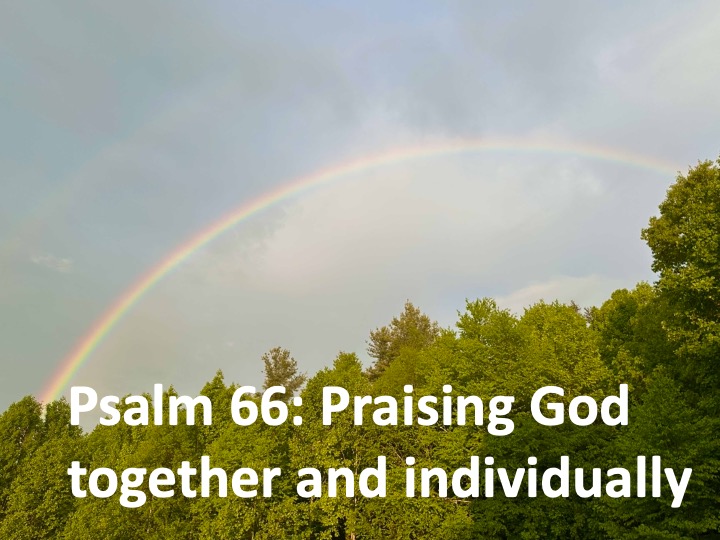
Title Slide: Psalm 66: Praising God together and individually

Jeff Garrison
Bluemont and Mayberry Churches
May 14, 2023
Psalm 66

At the beginning of worship:

We’re family here. Jesus calls us into the church, where we are adopted as children of God and given an inheritance. Doesn’t that sound good? While we may have different abilities, we all receive an eternal inheritance. We are blessed by God. 

But as it is in our earthly families, there are things we do together and things we do by ourselves. It’s no different in the church. We’re to experience God corporately and individually. We can’t just experience God one way or the other. Both are necessary for us to have abundant life. Never think that you can be a Christian without church, but always remember that a life of faith also requires individual time alone with God. Even Jesus had to get away on his own to pray.[1] Our Psalm this morning will show both sides of a life of faith. 

Before reading of Scripture:

Today we’re looking at the 66th Psalm, one that begins with a processional call to worship followed by an individual’s response. In the initial call, we’re reminded of what God has done in history. In response, the shift is from the community’s praise to an individual’s act of praise for something personal. God answered the Psalmist prayer. We’re not told what problems he faced, only that God helped him get through the difficult. Therefore, like Psalm 116 which we looked at a few weeks ago, he responds to God by paying his vow.[2] He offers sacrifices and praise to the Lord.

Two parts of the Psalm

There are some who want to separate this Psalm into two parts. You kind of see this division in the lectionary, which only uses the second half of the Psalm.[3] However, I don’t agree. Yes, there are two main parts to the Psalm, but they go together.

Our faith has a community aspect to it, as well as a personal one. We see both in this passage. With the community, the Psalmist and us are called into worship. Then, our faith should be such that we not only give God thanks for blessings in history, but also for the blessings we’ve personally experienced.[4]

As you listen to the Psalm, feel how the people are called into God’s presence and then how, as an individual, the Psalmist steps forward to offer thanks.  

Read Psalm 66

Growing up, my mother managed Sunday morning. She’d get up early, I think even before my dad, unless he had to be away for work. She’d fix a big breakfast: eggs, grits, bacon, toast, and coffee. Or maybe it would be pancakes stuffed with bananas or blue berries, although dad generally cooked them. 

I can assure you, there no better way to wake up than to the smell of frying bacon and perking coffee. When breakfast was almost ready, she woke us kids and started countdown for when we had to be ready to leave. We’d eat breakfast generally while watching some off-key gospel singers who seemed to be ubiquitous on Sunday morning TV in the South of my childhood. At least, after listening to them, I could never complain about the music in church. After breakfast, we dressed, grabbed our Bibles, and ran out the door to make it to Sunday School on time. 

Did our mom’s introduce us to Jesus?

I’m sure many of us credit our moms for making sure we attended church growing up. Of course, my dad was also there, but there were Sundays he had to work because that was when he could inspect boilers which had cooled down for the weekend. On those Sundays, my mom was totally in charge. And she got us to church on time (or close to it).  Happy Mother’s Day to all the moms who stepped up to help their children grow in the faith. We’re in debt to moms and for those women who stepped in to help other children grow in their faith. We need such people in our world to makes sure that everyone has a chance to learn about Jesus.

A Procession

Psalm 66 begins with a procession. As we saw in our Call to Worship this morning, there are three parts to the gathering of people.[5] As in Psalm 100, we’re called to join in the “joyful noise,” praising God as we’re led to the temple for worship. The first four verses are all focused on this praise of God. Such praise exists not just in the people’s cries, but in all the world. I’m reminded of Jesus telling those who complained of the ruckus his followers made as they entered Jerusalem, that if they weren’t praising God, the stones would cry out.[6] God created the world to reflect his creativity and to praise his glory. 

Selah

If you followed along with the Bible, you may have noticed a Selah (that I didn’t read), in the margin after the fourth verse. No one is really sure what this word means. Some think it is a symbol for music, like a clamp of a cymbal. That maybe. But here, it also marks the end of the first part of the gathering. 

First invitation: “Come and See”

After praising God, it’s time to invite others to join the crowd. In verse 5, we have the first of two invitations. “Come and See what God has done.” 

The Psalm then recalls the great events of the Exodus, the parting of the sea, and the Conquest, the crossing the Jordan. These were events of which the Hebrew people were familiar. But God is not just a God of the Hebrew people. God rules the nations and, as the end of verse 7 reminds us, won’t let the proud get too big for their britches by not letting the rebellious exalt themselves. 

Praising God even for the hard times

Then we come upon another Selah in the margins, as we move into the third section of the opening. This third section again issues a call for praise for God has kept us among the living. Ever thought of that? Without God, there would be no life. And then we’re reminded that God keeps our feet from slipping. God is our lamp for our feet and a light to our path, as the 119th Psalm proclaims.[7] But this third section also acknowledges that life is not always rosy. God places burdens on us. We are tested. People take advantage of us. Yet, God brings us through such troubles. 

Part 2: the personal praise

The second major section of the Psalm begins with verse 12 and is seen with the change of language. No longer is the focus on the plural, the community. Now an individual takes centered stage. The Psalmist comes into God’s house to pay his vows which he made when he was in trouble. 

Vows

Let me say a bit about vows. We must be careful with vows. We should not make them to manipulate God. There is a horrible story in the Book of Judges about a Jephthah, an Israelite warrior who vowed that if God would give him victory, he’d sacrifice the first thing that came out of his door to greet him. It was his own daughter.[8]

Vows made for the wrong reasons can be dangerous. John Calvin taught that the only purpose of a vow is to show gratitude to God. That appears to be the intent here and is the result of the Psalmists actions.[9] A mini lesson here: don’t try to force God to act to your benefit. God is not solely on our side. Instead, to be safe, we must be on God’s side.

Second call: Come and See

After testifying to how his actions show gratitude to God, the Psalm issues his own call. The community call people to “come and see.” The individual now calls them to “come and hear.” He tells his story of how he cried out in need to God and God listened. Because of God hearing and action, he now praises the Almighty. He blesses God for God’s faithfulness.

Movement from community to personal

This Psalm shows a movement from the community to the personal. It could also go the other way, from the individual to the community, for both aspects of our faith are important. The community helps us to know God’s work in the past, but when we experience such events firsthand, it’s often in our lives. 

What this Psalm also demonstrates is that for the individual and the community, the call needs to be issued for people to witness what God has done and is doing. If we don’t witness to the God of the Bible, who is also active in our lives, how will people know what God is capable of? 

MOther’s sharing the good news

Thankfully, many of us have had mothers that guided us. Others of us have been blessed in sharing the good news with friends and business associates and others who cross our lives. As it is with the Psalm, we should be praising God and giving thanks for the blessings we have received, today and always. Amen. 


[1] Matthew 23:36; Mark 14:32; Luke 6:12, 9:18, 22:39.

[2] https://fromarockyhillside.com/2023/04/23/psalm-116-giving-god-thanks/

[3] The lectionary doesn’t cleanly separate the Psalm, it only covers the second part, verses 8-20.

[4] The following commentaries support my thesis: James L. Mays, Psalms: Interpretation, A Bible Commentary for Teaching and Preaching (Louisville, KY: John Knox Press, 1994), 221; Artur Weiser, The Psalms: A Commentary, translated by Herbert Hartwell (1958 (German publication), Philadelphia: Westminster, 1962), 468; Claus Westermann, The Living Psalms, J. R. Porter, translator (Grand Rapids, MI: Eerdmans, 1989), 186-187,

[5] I adapted parts of Psalm 66 for today’s Call to Worship:
Pastor: Make a joyful noise to God, all the earth; 
People: sing the glory of his name; give to him glorious praise!
Pastor: Come and see what God has done;
People: he his awesome in his deeds among mortals.
Pastor: Bless our God, O peoples,
People: let the sound of his praise be heard!

[6] Luke 19:39-40.

[7] Psalm 119:105.

[8] Judges 11:29-40. 

[9] John Calvin, Institutes of the Christian Religion IV.13.1-7. See also Stan Mast’s commentary on this passage:  https://cepreaching.org/commentary/2017-05-15/psalm-668-20/

Rainbow over green trees
Rainbow over Laurel Fork, May 13, 2023

Psalm 119:9-32 In Praise of God’s Boundaries

Title slide with photo of hill in spring

Jeff Garrison
Bluemont and Mayberry Churches
May 7, 2023
Psalm 119:9-32

Sermon recorded at Mayberry Church on Friday, May 5, 2023

Before the beginning of worship:

What do you think about the law? Most of us, I’m sure, think some laws are silly. I, for one, am troubled by states who forbid driving barefooted. Yet, there are also good reasons for some laws. If we don’t stop at a stop sign, we risk our life and lives of others. If we think the speed limit is only a suggestion, we become a hazard on the highway. Laws protect us and within such a framework, we can enjoy life. 

Of course, if everyone thought about how our actions impact others before we act, we wouldn’t need laws. There would be no need for laws against littering, stealing, assault, or slander…. But since none of us live up to such high ideals, laws are needed. They set boundaries. 

Freedom without law is chaos

We’re freedom loving people, but freedom without law isn’t more freedom, its chaos. Its anarchy. We need boundaries to protect us and our neighbors. 

Today, we’re going to consider why a Psalmist felt such love the law that he wrote the longest Psalm in scripture.  

Before the reading of scripture:

Psalm 119 is an epic poem. It would have found a good home in the 19th Century, when epic poems by the likes of Longfellow and Tennyson were celebrated. Today, few poets attempt to write poems that go beyond two pages. But it has not always been that way. 

An acrostic poem

The 119 Psalm is an acrostic poem. You may know of these, if stayed awaked when they talked about poetry in English classes. An acrostic poem runs through the alphabet. Each new line starts with a word that begins with the next letter of the alphabet. There are eight or nine (depending on one’s definition) acrostic Psalms in the Bible.[1]

Unfortunately, it is impossible to capture the full meaning of an acrostic poem when translating it into another language. Part of the reason is that we have different alphabets. Hebrew only had 22 letters, all consonants. Even if we had the same alphabet, having a similar word that begins with the same letter would be nearly impossible. 

The longest Psalm in scripture

Psalm 119 strays from the other acrostic Psalms by its length. Instead of only having 22 verses, each beginning with the next letter in the alphabet, it consists of 8 lines for each letter. If it was in English, it would be like having 8 lines beginning with “A” words, then 8 lines of “B” words, down through the alphabet. This makes a very long poem, 176 verses. 

Interestingly, despite its size, Psalm 119 maintains focus on one theme: God’s law. But don’t think of the law as just ordnances, such as the general statues of the Commonwealth. God’s law is “The Torah,” which are also the first five books of the Bible. While they contain laws and the Ten Commandments, they’re also the essential Jewish teachings as to how we are to live together. Through the law, the Torah, God instructs God’s people.  

I’m sure it’s to your delight that I will only read a small section of Psalm 119, for the poem often repeats itself. Essentially, if this poem had been constructed in English, I’d be reading the B-C-D sections. Since it was written in Hebrew, I’ll be reading the Beth, Gimel and Daleth sections. 

Read Psalm 119:9

It is amazing to me the author of this Psalm didn’t have a thesaurus. I don’t think they’d yet been invented.[2] But like a good writer, he doesn’t repeatedly use the same word. In this section, instead of just using the word “law,” he also uses: your word, commandment, statutes, ordinances, decrees, precepts, and your works. And he mixes these words up, but they all refer to the word or law that comes from God. What can we learn from this “writing exercise” by the Psalmist?

The Psalmist desires more than knowledge

I suggest the Psalmist demonstrates to us that while knowing God’s word and law is important, we also need to mediation upon it. It’s not just enough to know the Bible, or believe the Bible, we must consider how Scripture should be understood and applied to our lives. 

That said, the process of taking the 22 letters of the Hebrew alphabet and writing 8 verses for each letter while reflecting on God’s word to us is an example of extreme mediation. I don’t know too many people who have that kind of patience. I know I don’t. However, I bet after the Psalmist compiled this poem, understood well what it meant to follow God’s way.  After all, he’d considered it from every angle.

Purpose behind the Psalm

Now let me ask another question. What is the purpose behind this Psalm? Walter Brueggemann, in his theological commentary on it suggests the author had three things in mind: 

  1. The first purpose is didactic. The Psalm instructs the young on the ABC’s of torah obedience. By using the acrostic method, the Psalmist created a memory device for young students to see the importance of God’s word and law. 
  2. The second reason for this Psalm is to make comprehensive statement of the adequacy of a torah-oriented life. In these 176 verses, the Psalmist seemingly covers all there is about why we should follow the torah or God’s law.
  3. And finally, Brueggemann suggests that Psalm shows us there can be a sense of reliability and order when we honor the torah, or God’s law.[3]
God’s law creates a boundary 

I have always suggested that we, as Christians, should see God’s law as a boundary instead of a list of things to do and not to do. As a boundary, God says that if we just stay within these lines, we can have wonderful freedom and enjoy life. 

Think of the Ten Commandments. Traditionally, we have understood the commandments as having two tables. The first table deals with how we relate to God. We are to have no other gods and we honor God by not creating images. We refuse to vainly use God’s name and keep the Sabbath. 

The later six commandments deal with our relationship with one another. We keep family relationships in tack by honoring our parents. We respect the lives, property, and spouses of others, we tell the truth especially in legal matters, and we don’t want what is not ours. 

The Ten Commandments provide us with boundaries. If we are content, we can have a good life.  Of course, we know that not everyone will obey them. That’s why we have governments who maintain laws. We see this in the middle part of our reading this morning. 

Psalmist as an alien

In verse 19, the Psalmist admits to being an alien in the land. I don’t think this means he’s from another country. Instead, he lives differently from others for he strives to keep God’s decrees while others have wandered away. He’s the odd-ball, for God’s word comes first in his life.

Let’s briefly consider the passages I read this morning. 

The “Beth” section of the poem

Verses 9 to 16 focus on praise and supplication. He begins by offering God’s word as a way the young can strive for purity. Then he focuses on his own life and asks God to supply him with what he needs to keep from straying. Look at the verbs he uses to describe his focus on what God has taught: seek, treasure, declare, meditate, and delight (which he uses twice). The Psalmist emphasizes his devotion to the Torah, for he knows that it’s from God who gives us life.

The “gimel” section of the poem

The second set of verses, 17 to 24, concentrates on intercession and devotion. Not everyone is like the Psalmist. There are many who ignore God’s word, and he (and we) must live with such people in our world. So, the Psalmist prays that God will open his eyes, won’t hid his commandments, and will keep him free of the scorn and contempt others bring onto themselves. Finally, he pledges to continue to meditate on God’s statues even when princes, the political leaders of his day, plot against him. He’s all in with God. 

The “Daleth” section of the poem

The final set of verses, 25-32, centers on his need of understanding God’s precepts. While this Psalm is not attributed to David, the Psalmist, whoever he was, like David, seeks God’s heart.[4] He desires God to help him understand his precepts, to strengthen him by the word, to teach him the law, to set God’s ordnances in front of him, and enlarge his understandings. The Psalmist knows life comes from God, and we can enjoy it fully only when we strive to listen to the Almighty. 

How we relate to God’s word

Our passage calls us to seek out God’s word and will for our lives. We are not to approach God’s law from a legalist perspective, nor should we see following God’s word as required work to obtain entrance into heaven. Instead, like the Psalmist, we need to meditate upon God’s word, seeking God and allowing God to draw us closer. 

In the Centered and Soaring Workshop held at Mayberry two Saturdays ago, Stan Ott discussed our need to dig into Scripture. We must be the people of God before we can do the work of God. We become the people of God by reading the Bible, but more importantly, by meditating upon what we read. We also pray for understanding. Finally, we discuss Scripture with others who are also on this journey so we might both be drawn closer to God. We can see the Psalmist fulfilling such efforts in this passage.  

Conclusion: Spending time with the Word

I encourage you to regularly spend time in God’s word and prayer, so that you might also grow closer to our Lord. Take time to read a chapter or two each day out of the Old and New Testaments. Spend time in examen, reflecting on your day before falling asleep, giving God thanks for blessings received. If you have any questions or need help growing deeper, let’s talk. Amen. 

For a sermon on the first 8 verses of Psalm 119, click here.


[1] See Psalms 9 & 10, 25; 34; 37; 111; 112; 119; 145. Acrostic structures also appear in Proverbs and Lamentations. 

[2] The first Thesaurus is credited to Philo who published On Synonyms in the late first or early second century A.D. The first modern thesaurus was published by Peter Mark Roget in the mid-19th Century. https://www.rd.com/article/how-the-first-thesaurus-got-started/

[3] Walter Brueggemann, The Message of the Psalms: A Theological Commentary (Minneapolis: Augsburg Publishing, 1984), 40. 

[4] 1 Samuel 13:14.

Hillside in spring,  covered with various shades of light green trees

Psalm 23: A Declaration of Confidence

Titled Slide "Psalm 23: A Declaration of Confidence" with a picture of the sunrise

Jeff Garrison
Bluemont and Mayberry Church
April 30, 2023
Psalm 23

Sermon recorded at Bluemont Church on Friday, April 28, 2023

At the beginning of worship:

What do we really need? As you know, when Jesus taught the disciples to pray, he didn’t teach them to pray for abundance. Instead, as I talked about in the fall when I preached on the Lord’s Prayer, Jesus had them to pray for their daily bread.[1]Life, at least the abundant life we can have in Jesus, is not about accumulation but about trusting God. We need God in our lives more than anything else.

Before reading the Scriptures:

The 23rd Psalm is the best known of all the Psalms, at least for Christians. While it’s also in the Jewish Scriptures, it doesn’t have the same meaning. This is probably because of Jesus’ use of the image of the Good Shepherd in the Gospel of John. 

However, we must be careful with the idyll feelings we bring to this passage. As one commentator on the passage notes, the Psalm is often seen as a picture of a cheerful, ideal relationship to God, but that’s not entirely accurate. Certainly, this doesn’t fit with other images of a shepherd’s work in the scriptures. He goes on to note that the aim of the Psalm is not to create a picture of a shepherd or even a little lamb. Instead, it places these actions side by side: the provisions a shepherd provides his flock, and the provisions God makes for those who trusts Him.” 

The shepherd is an example or a metaphor for God. It’s because the David has such trust in God that he can make this “declaration of confidence,” which makes it possible for him to compare a shepherd to God.[2]

This is such a familiar Psalm. Close your eyes and try to listen to it as I read the Psalm once again. 

Read Psalm 23

Augustine of Hippo, the great fourth century Christian theologian, answered the question I asked at the beginning of worship while reflecting on the 23rd Psalm. “Since my shepherd is the Lord Jesus Christ, I shall not lack anything.”[3]

I think he’s right. After all, this Psalm has something for us all. Whatever we need, we can find it here. When things go well for us, we appreciate the nurturing implied by the green grass and still waters. When things are not going so well, it’s nice to be comforted and not left alone when traveling through dangerous and deadly valleys. Augustine relates the waters in Psalm 23, to baptism, a place where the broken and weak gain new life.[4]

3 parts to the Psalm

I am going to parse this Psalm into three sections. The first deals with that which we need in this life. We need food and water. We also need protection, guidance, and when we’re beat, restoration. 

The Lord as shepherd provides this to his sheep. He leads them to places where they can get a drink of water. He takes them to new pastures. Sheep will eat the grass down to the nub and sooner or later they will not be anything to eat. So, they must move on to new pastures. This allows the sheep to continue to eat while the grass in the previous pasture is restored. And in their travels, the shepherd gives the sheep time to rest and to restore their bodies for what’s ahead. 

An individual within a herd

While this is an individual Psalm, no shepherd takes care of an individual lamb. A shepherd has charge of a herd of lambs. When I lived in Utah, where the sheep business still thrives, I once listened in on a discussion as to whether a group of sheep should be called a herd or a flock. The Bible and Christmas carols seems to be on the side of flocks.[5] But an old resident of the desert southwest ended the debate. “I’ve seen plenty of sheepherders in this country,” he said. “Now, I want you to show me as sheep flocker.”  

I have no desire to settle that debate between herds and flocks today.[6] But I want us to acknowledge that this is an individual Psalm. It is attributed to David, shepherd as a boy, he sought after God and felt cared for by the Almighty. But this does not mean he saw this close relationship exclusively between him and God. It was something all who seek out the Lord can experience. 

Perhaps, the Psalmist who wrote this Psalm as an individual knew what it was like to be the lost sheep whom the shepherd leaves the herd behind to find.[7] While we’re in a community, we are also important to God as an individual. 

Shepherds and leadership

And while the sheep business was considered a dirty business even in the ancient world, the idea of a good leader was also metaphorically understood as a shepherd. The idea of a shepherd implied royalty and the shepherd’s crook was often used as a symbol of leadership. As one commentator on this passage notes, the metaphor of the Lord as a shepherd refers to what the Lord (and kings) should do.[8] And the same should also apply to pastors and leaders in church. Of course, humans never live up to God’s ideal.

The second part of the Psalm begins with a shift in language. Now David, the Psalmist, speaks directly to God, drawing the Lord even closer.[9] “Even though I walk through the valley of the shadow of death, YOU are with me.” Those praying this psalm knows the shepherd’s presence. 

The rod and staff

We acknowledge that not all the paths we trod will be grassy or by still waters. There will be times we must be led through narrow canyons and along steep ledges, but the shepherd with his crook can guide us safely. The shepherd’s rod and staff are the same thing, it just depends on how they are used. As a staff, it can be used to catch a stray or falling animal by the neck and drag it to safety. But as a rod, it can be used beat off wolves attacking the sheep. 

Of course, the rod can also be used to chastise the sheep and keep them in line. The Hebrew scriptures speak of the rod for punishment.[10] Perhaps, because of this, Origen, another of the earlier theologians of the church, saw the rod as a warning filled with hope. “If you have sinned and see the rod of God threatening you, know that the mercy of God will not be far from you.”[11] The good shepherd wants to keep us together, less we stray and really get into trouble. 

The banquet

Then the Psalm slips from metaphor of the shepherd to one hosting a banquet. While the milk of the ewe is enough for a lamb, as they grow, they need more sustainable food. Likewise, as we mature as Christians, our diet changes. God strengthens us for what we must endure. [12]

Furthermore, the Psalm acknowledges that we have enemies in this world. There are those who would like to do us harm, but when we follow the shepherd, he watches over us. We are safe, feasting even when in danger. The oil pour out on our heads is an anointing, reminding us of God’s promises. Likewise, the cup overflowing reminds us of God’s abundance.

God in the Psalms and our enemies

An interesting insight into the Psalms is that they most often speak of weakening our enemies instead of fortifying us for battle![13] In other words, God does not prepare us to take over and be our own shepherd. We must always realize our dependence on our Lord. 

Part 3 ends the Psalm with hope, not just in the present but in the future. If God gives us life, we will experience goodness and mercy. This would have been David’s and the people of the Old Testament’s understanding of the Psalm. But because of Jesus, we have hope not just for life in this world, but in the world to come. 

For Christians reading the Psalm

For Christians, we cannot understand Psalm 23 without seeing the Lord as Jesus Christ, the good shepherd as we learn from the tenth chapter of John. There, we see that the true shepherd is one known by the sheep, unlike rustlers who attempt to drive the sheep away. If we hang close to the Good Shepherd, we’re promised everlasting life. Jesus also promises to lay his life down for those who follow him, which he did on the cross.

The Incarnation: Jesus as shepherd and sheep

Interestingly, Jesus is not just a shepherd.[14] The doctrine of the incarnation teaches us that Jesus is God and human. Likewise, Jesus is not just the Good Shepherd, he was also a faithful sheep, who came and gave his life for others. John the Baptist points this out before Jesus began his ministry, “Behold, the Lamb of God.”[15] In the book of Revelation, we find the lamb of God slain,[16] but also the resurrected lamb on the throne.[17]Having experienced both sides, Jesus knows what we endure in the world, even as he leads home to God the Father.[18]

Conclusion

When we pray the Psalms, the 23rd Psalm should be used regularly. In this short Psalm, we’re reminded of God’s abiding love. We are never alone in this world. That should give us courage and hope. May we always listen to and follow the Good Shepherd until that day when we are brought together under his rule in the life to come. Amen. 


[1] See https://fromarockyhillside.com/2022/11/06/give-us-this-day-our-daily-bread-the-lords-prayer-part-4/

[2] Claus Westermann, The Living Psalms, J. R. Porter, translator (1984, English translation: Grand Rapids, MI: Eerdmans, 1989), 134.

[3] Augustine, Exposition of the Psalms, quote from in the Ancient Christian Commentary on Scripture: Old Testament VII, Psalm 1-50 (Downers Grove, IL: Intervarsity Press, 2008), 178

[4] Augustine, 179.  

[5] Luke 2:8. See also Nahum Tate’s carol, “While Shepherds Watched Their Flocks”

[6] Maybe it has to do with the number of animals. A dozen ewes could be a flock, 1000 ewes (and most herds around Cedar City, UT had even more ewes) could be a herd.

[7] Luke 15:3-7.

[8] James L. Mays, Psalms: Interpretation, a Bible Commentary for Teaching and Preaching (Louisville: John Knox Press, 1994), 117.

[9] Artur Weiser, The Psalms: A Commentary, Herbert Hartwell, translator (1959 German translation, Philadelphia: Westminster Press, 1962), 229.

[10] Proverbs 13:24. 

[11] Origen, “Selections from the Psalms 23:4, quote from in the Ancient Christian Commentary on Scripture: Old Testament VII, Psalm 1-50 (Downers Grove, IL: Intervarsity Press, 2008), 180

[12] Augustine, 180.

[13] For this insight, I am indebted to a tweet by @CAHutch1990. “Has anyone done a count in the Psalms of how many verses are about God disarming the violent verses the strengthening the military might of his own people? Repeatedly, there are promises of God bringing justice, not by violence, but by the suppression of violence. 

[14] Scott Hoezee outlines this thought in his commentary on the passage. See https://cepreaching.org/commentary/2023-04-24/Psalm-23-14/  

[15] John 1:29, 36.

[16] Revelation 5:6, 7:17, 13:8

[17] The ending of Revelation begins with the “Marriage of the Lamb” and his rule. See Revelation 19:9; 21:22; and 22:1, 13, and 23.

[18] John 14:6.

Sunrise in the Blue Ridge Mountains, April 27, 2022
Sunrise, April 27, 2023