Butting Heads and History

Jeff Garrison
Bluemont and Mayberry Churches
January 23, 2022
Daniel 8

At the beginning of worship

It’s good to be with you this weekend. Last Sunday, we were facing a storm. Early in the morning I was worried if we’d done the right thing in cancelling the service. It hadn’t started to snow at sunrise. But by 9 AM, things changed. The snow was heavy and the wind blowing. I knew we had done the right thing. When such weather happens, remember that you can catch the message online! 

Similarity between Daniel 7 and 8

I hope many of you either read the sermon in my blog or watched it on YouTube last week. If you haven’t, I encourage you to go back and watch or read it, as our text last week from Daniel 7[1]is related to our text today. As a prophecy of the future, the two messages both involve kingdoms in the region between the fall of Babylon and the rise of Rome. But there’s also a difference, as the pervious chapter was a dream of weird beasts. In today’s reading the weirdness has to do with goats. 

Gentle and Lowly

But before getting to that reading, let me tell you about a book I’m reading by Dane Ortlund titled, Gentle and Lowly: The Heart of Christ for Sinners and Sufferers.[2] By the way, we’re all either or both a sinner and a sufferer. Drawing on Puritan writers and their insight into Scripture, Ortlund has us consider not what Christ has done for us (which is important) but what the heart of Christ is like. 

Too often we think of God being distant and away and all powerful, more like Zeus on Olympus, ready to crash lightning bolts in the direction of sinners. We’ll even get a sense of this in our text today, as the fierce horn takes on God and is, after a period of time, broken. And while God is holy and won’t be mocked, God as we see in Jesus, has a heart that reaches out to us in love. God reaches out to the sinner, the one suffering, the one troubled. We can’t forget this aspect of God even while we are considering the power of God to control history. 

Let’s now God to Scripture and read this long chapter. Listen for God’s word as I read from Daniel 8. 

Read Daniel 8

After the reading of Scripture

A frightful encounter with a butting goat

I spent my first three years of elementary school in Petersburg, Virginia. During this time, my father was a member of a hunting club on the Nottaway River. As a part of this club, he took his turn feeding the deer dogs. The dogs were penned way out in the woods, a mile or two off the payment, down across a two-track dirt road. Often, when tending the dogs, dad would take me along. 

On this day that I am recalling, the pump where they drew water for the dogs wasn’t working. I’m not sure what was wrong with it, but there were some five-gallon army-surplus containers there. We loaded them into the car and drove further back into the woods to where a family lived. 

The family’s homestead was eye-opening. I had never seen such poverty. It was an African American family and the shack in which they lived had gaps between the boards. Nothing about the shack was level. There were chickens running around and a few dogs and several kids. 

My dad, who had either been here before or had been told what to do, took the containers to the man of the house and they began to draw water from a hand pump. When done, my dad paid with a couple of dollar bills. While he was doing this, I walked around looking at things. 

Suddenly, I turned as a goat charged, his head down, appearing to have the power of a locomotive. I froze, knowing that in an instant I was going to be butted over the car and maybe into the next county. I couldn’t yell. I was speechless. Frozen in fear, I stood as things moved in slow motion. The goat moved closer. My time on earth was up. 

Then it happened. Just before the goat’s horns impaled my stomach, he came to the end of his chain. The goat did a summersault, falling over on his back. I had been saved. 

I was probably 7 or 8 years old when this happened. Since then, not only have understood that there are people incredibly poor in our world, I also have had no problem with the parable of the sheep and the goats.[3] Goats can be evil. I didn’t have to read the book of Daniel to understand this. 

Another goat story

A few years later, when I was in Jr. High, I was with my father and my brother in a small jon boat. Between these two events, we’d left Virginia and returned to North Carolina. We lived near the coast. The three of us poled the boat into the shallow marshy creeks on the backside of Masonboro Island on a pitch-black night. In the shallow water, we sought flounder. One of us stood in the front, like Queequeg, the harpooner in Moby Dick. Two lights were mounted underneath the bow, shinned onto the sandy bottom. This allowed you to spot a flounder laying in the sand so you could gig it. 

We had a cooler nearly full this evening, when we heard a weird sound coming from the bank, just 20 or 30 feet away. My dad shinned a flashlight over and there were two male goats butting heads. They would back away from each other, then crash at such speed that both had to be suffering from a headache. They paid us no attention. Obviously, their sexual drive was enough for them to keep at it and to ignore everything else. What other beasts, other than a stubborn goat, would be like that?  

Goats are interesting animals. The ancestors of these goats on Masonboro Island may have been there for centuries, as sailors of old released goats and hogs on such islands. This made sure there’d be some meat in their stew the next time they travelled that way.[4] Goat in the wild were especially adaptable. As you know they’ll eat anything. 

Another goat story

In our reading today, we met two of the beasts. Daniel, we’re told, has a vision. Two years have gone by since his dream of chapter seven. In this vision, he’s in Susa. While we’re not told why he was there or how he got there, it appears he may have remained in Babylon, but saw a vision set in the other city. It’s almost as if he’s watching himself. He stands by a river, reminding us of the the beginning of Ezekiel’s first vision, which was also by a river.[5]

The vision begins with a ram with two horns running around, kind of like the ones I experienced as a kid, looking for something to butt. But it was so powerful, other beasts fled in terror. Then came a male-goat (I’m not sure why it was not called a ram), which challenges and defeats the first ram. It had four horns and grew more and more powerful. From the four horns, grew another horn that was arrogant and powerful, and who does terrible things in the sanctuary where sacrifices to God were to be made.

Daniel’s inability to interpret the vision

Daniel, the one who had interpreted dreams and signs in Babylon, fails to understand the meaning of this vision. So, one of the Archangels, Gabriel, is summoned to help. 

Comparisons and contrasts between chapter 7 and 8

The vision in chapter 8 is often overlooked by the dream in chapter 7. It’s been pointed out that the whole structure of this vision lacks the poetry of the previous dream, possibility because in the original language, we’re back into Hebrew.[6] The previous chapter was written in Aramaic. One thought is that even this chapter was originally composed in Aramaic, then translated into Hebrew, but that doesn’t really matter to us. 

Both chapters involve the same storyline, at least to a point. They both point to the rise of the Medes and Persians (represented by the two horns) who ruled that part of the world after the fall of Babylon. The Persians were powerful, until an upstart Greek king known as Alexander, comes upon the scene. 

Alexander the Great

I recently listened to Anthony Everitt’s biography of Alexander the Great. He was an impressive man. Like many who become great, he also had many flaws. After the death of his father, Philip, Alexander began to unify the Greek states so that he could fulfill his father’s dream of taking revenge over the heathers. Greeks considered the Persians heathens. The revenge was for a Persian invasion of Greece, more than a century earlier. 

Alexander combined the powers of the Greek city states. He proved to be a brilliant military commander. In his thirty-two years, he conquered not only the Persian empire but well into India, a part of the world unknown at the time. He eventually had to stop conquering, not because of defeat, but because his men had had enough. They wanted to return home. 

While in Babylon, after the India campaigns, he became mysteriously ill and died. Some think he was murdered. Even Aristotle, his old tutor who was horrified at Alexander’s growing ego, has been suggested as a possible plotter. But Everitt suggests that Alexander’s death came probably from a mosquito. God can work in mysterious ways. His death sounds like a deadly type of malaria.[7]

Alexander, as he continued to win and to conquer, he sought to distance himself from his father’s memory. He promoted a story that his real father was Zeus, the Greek God of Mount Olympus thunderbolts. Of course, not everyone bought into this mythology, but it shows his arrogant attitude to the world. After his death, his empire fractured, as represented by the four horns for his generals that took over various parts of the empire. 

The little horn represents Antiochus, the ruler of Syria who desecrated the rebuilt temple in Jerusalem in 167 BC. 

Conclusion 

There is a minor point at the end of this vision that I want us to ponder for a moment. I think it has a lot to do with the message of Daniel. In verse 25, we’re told that he shall be broken but not by human hands. God is still God and will not be mocked.[8] The desecration of the temple, the holy place in Jerusalem, sets forth his downfall. God has the future under control. As we saw in the seventh chapter, kingdoms will rise and fall. This will continue to happen, even now. Only when God’s time is reached, will we enjoy the peaceful kingdom that will exist without end. But we can take comfort in that those who bring evil upon the world have a limited time for God controls the future, not them. 

While we might not, by ourselves, be capable of defeating one like Antiochus IV, or the many other evil rulers of the world, the book of Daniel reminds us that what is important is to remain true to God. As we’ve seen, it’s a theme reiterated repeatedly in Daniel.

If you set out to butt heads, you’ll eventually butt heads with God and it won’t end well. It may not sound like good news to the one butting, but it is to everyone everyone who has to endure the bullying. Amen. 


[1] https://fromarockyhillside.com/2022/01/daniel-dreams-of-the-future/

[2] Dane Ortlund, Gentle and Lowly: The Heart of Christ for Sinners and Sufferers (Wheaton, IL: Crossways, 2020).

[3] Matthew 25:32ff.

[4] I learned this from Amy Leach in “Goats and Bygone Goats,” Things That Are: Essays (Minneapolis, MN: Milkweed Editions, 2012), 13-19. 

[5] Ezekiel 1:1. Like Daniel, Ezekiel also provides a date for his vision. Daniel is in the third year of Belshazza; Ezekiel is in the fifth year of the exile of King Jehoiachin. 

[6] Robert Anderson, Signs and Wonders: Daniel (Grand Rapids, MI: Eerdmans, 1984), 91. 

[7] Anthony Everitt, Alexander the Great: His Life and His Mysterious Death (Audible books, 2019), Narrated by John Lee. 

[8] W. Sibley Towner, Daniel: Interpretation, A Biblical Commentary for Teaching and Preaching (Atlanta: John Knox Press, 1984), 126. 

The backside of Masonboro Island

Remembering Martin Luther King, Jr

As today is Martin Luther King, Jr. day (and a day of digging out of a heavy snow that had a layer of ice on top), I thought I would repost a review from a former blog of mine. This is a good biography of the first nine years of Dr. King’s professional life.

Taylor Branch, Parting the Waters: America in the King Years, 1954-63 (New York: Simon and Schuster, 1988)

This book is an enormous undertaking, for both the author and the reader. The author provides the reader a biography of the Reverend Martin Luther King’s work through 1963, a view into the early years of the Civil Rights movement, as well as showing how the movement was affected by national and international events. This is the first of three massive volumes by Taylor Branch that spans the years of King’s ministry, from his ordination in 1954 to his death in 1968. This volume also provides some detail about King’s family history and his earlier life through graduate school at Boston University. I decided to read this book after hearing Branch speak in Birmingham AL in June (2006). It’s like reading a Russian novel with a multitude of characters and over 900 pages of text. However, it was worth the effort as I got an inside look as to what was going on in the world during the first six years of my life.

Branch does not bestow sainthood nor does he throw stones. The greatness of Martin Luther King comes through as well as his shortcomings. He demonstrates King’s brilliance in the Montgomery Bus Campaign as well as in Birmingham. He also shows the times King struggled: his battles within his denomination, the National Baptist; King’s struggles with the NAACP; as well as his infidelities. The FBI also had mixed review. Agents are credited in standing up to Southern law enforcement officers, insisting that the rights of African Americans be protected. They often warned Civil Rights leaders of threats and dangers they faced. However, once King refused to heed the FBI’s warnings that two of his associates were communists, the agency at Hoover’s insistence, set out to break King. Hoover is shown as inflexible, a man who reprimanded an agent for suggesting that King’s associates are not communists. The Kennedy’s (John and Robert) also have mixed reviews. John Kennedy’s Civil Right’s Speech (and on the night that Medgar Evers would be killed in Mississippi) is brilliant. Kennedy drew upon Biblical themes, labeling Civil Rights struggle a moral issue “as old as the Scriptures.” Yet the Kennedy brothers appear to base most of their decisions based on political reasons and not moral ones. This allows King to sometimes push Kennedy at his weakness, hinting that he has or can get the support of Nelson Rockefeller (a Republican). Although we think today of the Democrat Party being the party of African Americans, this wasn’t necessarily the case in the 50s and early 60s. Many black leaders, especially within the National Baptist Convention leadership, identified themselves as Republicans, with Lincoln’s party.

Another interesting aspect in this book is the role many of the black entertainers played in the movement. King was regularly in contact with Harry Belafonte, but also gains connections to Sammy Davis Jr., Lena Horne, Jackie Robinson, James Baldwin and others. The author also goes to great lengths to put the Civil Rights movement into context based on the Cold War politics. Both Eisenhower and Kennedy found themselves in embarrassing positions as they spoke out for democracy overseas while blacks within the United States were being denied rights.

The book ends in 1963, a watershed year for Civil Rights. King leads the massive and peaceful March on Washington. Medgar Evans and John Kennedy are both assassinated. And before the year is out, King has an hour long chat with the President, Lyndon Johnson, a Southerner, who would see to it that the Voting Rights Acts become law. 

As a white boy from the South, this book was eye opening. I found myself laughing that the same people who today bemoan the lack of prayer in the public sphere were arresting blacks for praying on the courthouse steps. The treatment of peaceful protesters was often horrible. There were obvious constitutional violations such as Wallace and the Alabama legislature raising the minimum bail for minor crimes in Birmingham 10 fold (to $2500) as a way to punish those marching for Civil Rights. I was also pleasantly surprised at behind the scenes connections between King and Billy Graham. Graham’s staff even provided logistical suggestions for King. King’s commitment to non-violence and his dependence upon the methods of Gandhi are evident. Finally, I found myself wondering if the segregationists like Bull O’Conner of Birmingham shouldn’t be partly responsible for the rise in crime among African American youth. They relished throwing those fighting for basic rights into jail, breaking a fear and taboo of jail. The taboo of being in jail has long kept youth from getting into trouble and was something the movement had to overcome to get mass arrest in order to challenge the system. In doing so, jail no longer was an experience to be ashamed off and with Pandora’s Box open, jail was no longer a determent to other criminal behavior. 

I recommend this book if you have a commitment to digging deep into the Civil Rights movement. Branch is a wonderful researcher and his use of FBI tapes and other sources give us a behind the scene look at both what was happening within the Civil Rights movement as well as at the White House. However, there are so many details. For those wanting just an overview of the Civil Right’s movement, this book may be a bit much.

Daniel dreams of the future

Jeff Garrison
Mayberry and Bluemont Presbyterian Churches
January 16, 2022
Daniel 7 

Because of the winter storm in our area, neither church will be worshipping in person this morning. To help you in your worship times at home, I have added the bulletin and prayers for today after the sermon. The announcements for both churches are below the bulletin. Be safe in this cold and wintry weather!

At the Beginning of the Service:

Today, we’re back in the book of Daniel, working our way through the last half of the prophet’s book. As you remember from the fall, the first half of Daniel tells a series of stories about faithful Jews who were living in exile in Babylon. These stories demonstrate the possibility of remaining faithful to God even when everyone around you worships differently. 

You know, it would be easy to throw up your hands and go along with the crowd. But what if you believe your God reigns above all other gods, created the world and the universe, and sustains all life? Of course, it’s harder to believe this if your God’s temple has been destroyed along with the holy city. Many from Israel, I’m sure, gave in. But a few continued to hold tight to the God of their childhood, the God of their ancestors, the God and Father of our Lord Jesus Christ. 

Daniel described through the study of economics

Now, let me suggest a new way at looking at Daniel. I’m taking this concept from economics. If you studied economics in college, you had two basic classes that set the foundation. You took a class in micro-economics, which focuses on economic behavior of individuals and firms dealing with limited recourses. Then there was a class in macroeconomics, which looked at the larger economy and how things work on a national and international level

In first six chapters of Daniel is like microeconomics. We look at how individuals live out their faith when challenged with obstacles. In the second half, we take a step back and look at nations and how they relate to one another under God’s watchful eyes. A simple idea immediately comes to mind. Nations and societies, which is where we live out our faith, are always corrupt. Yes, some are worse than others, but then, as Paul says in Romans, “all have sinned and fallen short of the glory of God.”[1]

There is another different between the first and second half of Daniel. The first is based on stories. The second half moves into the apocalyptic, an entirely new genre. This is the world of strange beings, that represent kingdoms. These beasts are not individual sinners, but an example of how individuals can come together and create evil greater than would be possible by one person.[2]

I am not going to read the entire 7th Chapter today. It’s a bit long. But I will read enough for you to understand what’s said. As you watch this at home, you could pause your computer long enough to read the entirety of the chapter. This chapter involves three sections, all of which are encapsulated into a dream. First, there is a terrifying vision of beasts, then a vision of divine judgement. The dream concludes with Daniel asking an attendant of the court to interpret what the meaning of it all. When Daniel wakes up, he’s terrified.

Read Daniel 7:1-15, 23-28.  

After the reading of Scripture

My Dream

I still remember the dream 10 years later. At the time there was a small group in the church I served that wasn’t happy. I found myself, as pastors often do, in a conflict. There were several sides to it all. Most supported me, but a few didn’t. 

In a dream I had during this time. I was with one of those who wasn’t supportive of me. We’d had exchanged some harsh words. In the dream, we were down south in a backyard, where there was a woodpile. This man discovered a copperhead, a poisonous snake often found in woodpiles. By the way, I was in bed in Michigan, outside the snake’s geographic range for this dream. I supposed was why the dream was set in the South, where copperheads live. 

Daniel’s Dream

In the dream, this man grabbed the snake by its tail. Then he called my name and as I turned toward him, he slung the snake at me. While shocked, I remained calm. I caught the snake, quickly grabbed its head so it wouldn’t be able to bite, calmed it down for a minute, and walked into the woods behind the woodpile, where I released it.  

Obviously, at this point, I woke. Strangely, I felt everything would be okay. As troubling as the dream could have been, it wasn’t a nightmare. As I laid in bed, I was comforted in the realization I would be okay, that this guy couldn’t harm me.  

That said, I’m not sure why Daniel was so trouble by his dream, or perhaps dreams, as it sounds in verse 26 as if the dream or vision occurred in two parts, in the evening and in the morning. While the beasts sound terrifying, there is also good news here.

In this chapter, Daniel takes on a new role. In the opening part of the book, he’s been the one who interprets dreams and strange phenomenon. In the fifth chapter with Belshazzar, he’s even drawn out of retirement to interpret the strange events happening at a royal party.[3] But in Chapter 7, Daniel is the one dreaming and he must rely on others to help him understand the meaning. 

Daniel’s dream occurs by a trouble sea. The winds are whipping in all directions, whipping up the waters. And if that’s not frightening enough, beasts are rising out of the sea. These are not animals that exist… A lion with the wings of an eagle, a bear with tusks, a four headed leopard with wings, and a fourth with iron teeth and ten horns.

Then, his dream shifts to a judgment scene. The Ancient One, obviously a reference to God, sits on his throne, ready to pronounce judgment. But one of the horns in the last beast is so arrogant that receives an immediate verdict, assigning it to burning death. The other beast loses their dominions. But not their life. Their judgment is postponed. At this point, we see one coming as a man in the clouds. Dominion and kingship are conferred upon him. His kingdom shall never be destroyed.     

Interpretation of the Beasts in Daniel’s Dream

Lots of stuff has been made of the meaning of these beasts and what is going on Daniel’s dream. Of course, the vision stuns Daniel, as it would us. Daniel asks for an interpretation. Like it was with Nebuchadnezzar’s dream in the second chapter, these beasts represent different kingdoms coming upon the earth.[4] And while everyone agrees that the beasts represent different kingdoms, there are a number of interpretations of which kingdoms they represent. Most everyone agrees that the first beast represents Babylon. Beyond that, there’s wild speculation.

The one interpretation that, in my opinion, has the most validity, has the kingdoms lining up like this: Babylon, Medes, Persians, and the Greeks.[5] The ten horns that come from the last beast are those who assumed leadership over sections of the Greek empire after the early death of Alexander. And the one little horn that speaks so arrogantly that it quickly brings down God’s wrath is Antiochus IV, who ruthlessly ruled Syria and created a nightmare in Jerusalem when he desecrated the temple.[6]

What I think is important to understand from this dream isn’t necessary which beast goes with which kingdom, but the idea that all kingdoms built by humans are sinful. However, some are better than others. Perhaps this is why judgment was immediate upon the arrogant horn, and other horns were allowed to continue longer. My point is to remind you that the importance of each beast isn’t to provide us with a historical or future map. Again, as I reminded you last week, God’s word should not be used as a roadmap to the future. The Bible helps us live in the present.[7]

The problem with kings (and those with power)

Think back into the early history of Israel. The people demand a king. God didn’t want them to have a king and warned Israel about the dangers of a king. Desiring a king was a rejection of God[8] Of course, eventually Israel was given a king. Even the best of their kings was flawed.[9]

The seventh chapter of Daniel reminds us of human sinfulness and how our hope can only be in a kingdom that is divinely constituted. Again, this doesn’t mean that some kingdoms won’t be better than others.[10]Some kingdoms are better, just as our depraved state doesn’t mean we’re so bad that we can’t get worse. We can always become more wicked, especially when we collectively gather to further a particular idea that becomes as sacred as an idol. As Paul in our reading from Romans reminds us, when left to our own devices, we’re on a path to ruin.[11]

We should take from Daniel’s dream a healthy dose of cynicism, or at least suspicion, when it comes to politicians and governments. While I believe it is true that God can work through anyone, even those who are evil, none of them are worthy of our worship. First, our worship belongs only to God. Second, when we too heavily invest in human endeavors, we either set ourselves up to be disappointed, or we blind ourselves from reality. 

I came across a quote this week, that when I read it, I stopped and wrote it down. It goes: 

“It is always dangerous to be too devoted to a narrative. It can lead one to abandon reason in favor of the cause. I’ve seen it result in terribly wrong actions from partisans of both the right and left.”[12] 

What the seventh chapter tells us is that human institutions will, sooner or later, fail us. This doesn’t mean we don’t try to do things better. After all, in the first six chapters of Daniel, we’re given a glimpse into faithful Jews who were working for the well-being of those in the Babylonian empire. The key, however, is that they always placed God first. And that’s what is required of us. 

The hope in Daniel 7

Until that new world promised in verse 14 comes about, we should remember that we live in a sinful world. If we’re to have any hope, we must always place God foremost in our lives. Amen. 


[1] Romans 3:23. Of course, Paul is not referring to Jesus Christ here. 

[2] See Temper Longman III, Daniel: The NIV Application Commentary (Grand Rapids, MI: Zondervan, 1999), 196. 

[3] For my sermon on Daniel 5, go to https://fromarockyhillside.com/2021/09/the-writing-on-the-wall/.

[4] For my sermon on Daniel 2, go to https://fromarockyhillside.com/2021/08/gods-wisdom-vs-human-wisdom/

[5] Other lists have them as Babylon, Persian (including the Medes), Greek, and Romans. Some even have the final beast at the end of time and the 10 horns representing modern nations. 

[6] See Robert A. Anderson, Signs and Wonders: Daniel (Grand Rapids, MI: Eerdmans, 1984), 78-81.  

[7] For last week’s sermon, go to https://fromarockyhillside.com/2022/01/remain-at-your-post-stay-awake/

[8] See 1 Samuel 8, especially verse 7.

[9] The great king, David, who desired God’s heart, also had a man killed to cover up his adultery. Solomon took many wives, some of whom brought in their foreign gods. Josiah, the best of the kings in 1st and 2nd Kings; however, Jeremiah treats him in a more reserved manner. For Josiah, see Robert Althann, “Josiah,” Anchor Bible Dictionary, volume III (New York: Doubleday, 1992), 1016-1017.

[10] This was the thesis of Reinhold Niebuhr’s, Moral Man and Immoral Society. As people come together, we can bring about even more evil. 

[11] Romans 3:9-18, especially verse 16. 

[12] https://twitter.com/atticus59914029/status/1480876348591726592?s=27

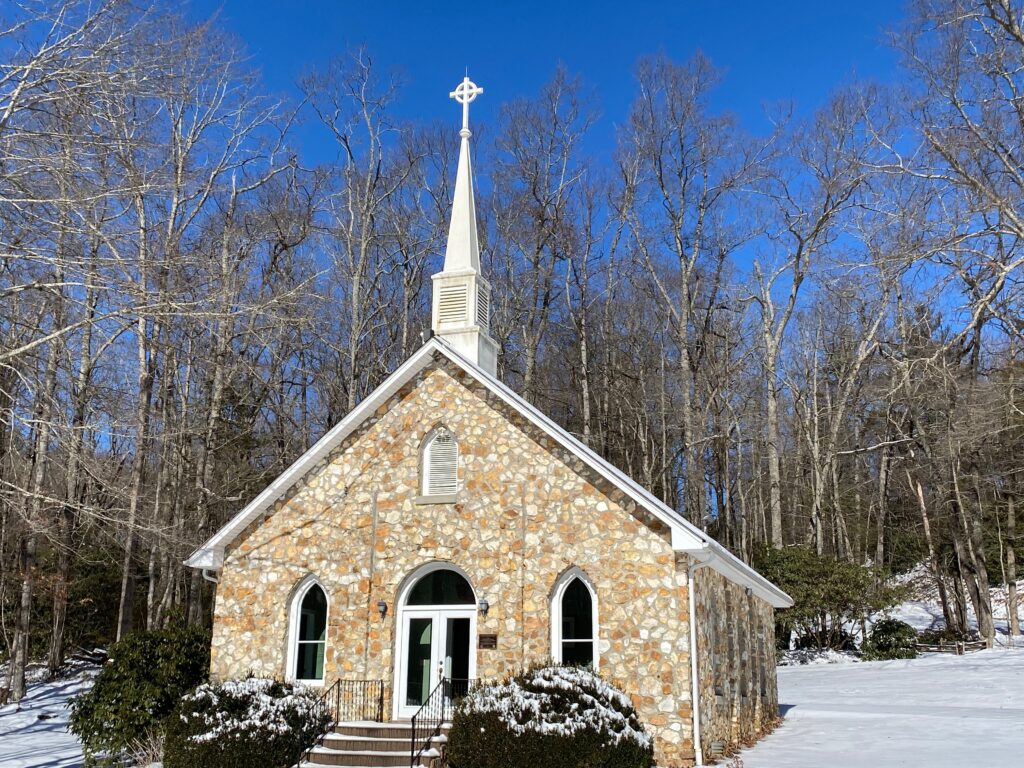
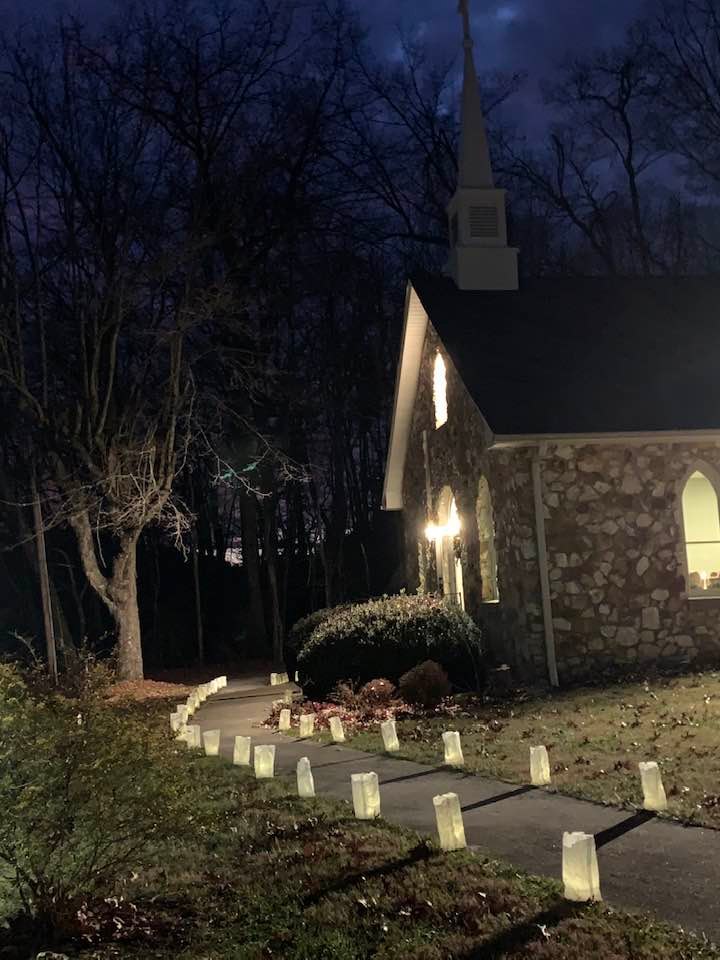
Mayberry Church in the winter of 2021

 20220116 Rough Bulletin 

The red sections would not appear in the bulletin but are for the liturgy 


Individual sinners are harmful, sometimes deeply. But sinners bound together behind a group cause can cause great devastation. Nationalism, racism, sexism, denominationalism, factionalism—great evil can arise when sinners come together with a common purpose against someone outside of the group, the “other.” We can depersonalize the other; they aren’t quite human, and so to harm the other is not quite the same as hurting on of our own.”
-Tremper Longman III, Daniel: The NIV Application Commentary (reflecting on Daniel 7)

Prelude

Welcome, Announcements, & Introductions

Call to Worship  (Psalm 104: 1-4, 31-35)

Pastor: Bless the Lord, O my soul.
People: O Lord my God, you are very great. You are clothed with honor and majesty, wrapped in light as with a garment.
Pastor: You stretch out the heavens like a tent, you set the beams of your[a] chambers on the waters, you make the clouds your chariot, you ride on the wings of the wind, you make the winds your messengers, fire and flame your ministers.

People: May the glory of the Lord endure forever; may the Lord rejoice in his works—who looks on the earth and it trembles, who touches the mountains and they smoke.
Pastor: I will sing to the Lord as long as I live; I will sing praise to my God while I have being.
People: May our meditation be pleasing to God, for we rejoice in the Lord.
Pastor: Let sinners be consumed from the earth, and let the wicked be no more.
People: Bless the Lord, O my soul.

Pastor: Praise the Lord! Let us pray. 

Prayer of Adoration 

God of light and truth, you are beyond our grasp or conceiving. Before the brightness of your presence the angels veil their faces. With lowly reverence and adoring love, we acclaim your glory and sing your praise, for you have shown us your truth and love in Jesus Christ, our Savior. Amen

*Opening Hymn #

Call to Confession  (referring to Daniel 7:10)

In the 7th Chapter of Daniel, we hear of the heavenly court in judgment, with the books open. Before then, we need to confess and sin and depend on the mercy shown us in Jesus Christ.

Prayer of Confession 

Gracious God, you have given us the law of Moses and the teachings of Jesus to direct our way of life. You offer us your Holy Spirit so that we can be born to new life as your children. Yet, O God, we confess that the ways of death have a strong attraction and that we often succumb to their lure. Give us the vision and courage to choose and nurture life, that we might receive your blessings. Hear now our personal confessions as we pray silently… 

Silent Prayer of Confession

*Assurance of Pardon  (1 Peter 2:24)

Jesus himself bore our sin in his body on the cross so that, free from sins, we might live for righteousness; by his wounds we have been healed. Amen.

New Testament Reading                  Romans 3:9-20

Presentation of our Gifts
Prayer of Dedication

Gracious God, we give our best, lest in gaining the world we lose life itself. As a covenant people, we seek to witness to your will and way. Help us to know more clearly what you would have us do with the wealth entrusted to our care. As we contribute to the needs of your people, we present ourselves as living sacrifices. Through Jesus Christ, our Lord, we pray. Amen. 

Sharing of Joys and Concerns 

Pastoral Prayer

The Lord’s Prayer 

*Hymn 

Sermon                       The Failure of Human Desire and our Hope in God

Daniel 7

*Affirmation of Faith           Apostles’ Creed

Hymn  

Benediction 

Announcements for Bluemont

¬ Sunday School is held every Sunday at 9:30 a.m. in the Fellowship Hall. (obviously cancelled)

Please remember to bring paper towels, toilet paper, and laundry detergent pods to church today, and January 23 and 30.   We are collecting these items for the Joy Ranch Children’s Home. Collection boxes will be in the narthex.

¬The Monday Pastor’s Bible Studies will be held on January 17 and 24 via Zoom at 1 p.m. If you are not on the email list, and would like to be, let our pastor know (parkwayrockchurches@gmail.com) and he will add you to the list. On the day of the study, he will send a Zoom link along with an outline of the study.

¬The Thursday Bible Study will be held on January 27 at 10:00 a.m. in Fellowship Hall.

¬Join us for a new women’s group meeting on Tuesday, January 25, at 10:00 a.m. in Fellowship Hall to discuss strategic and meaningful ways to better our church and our community.

¬We ask that everyone wear a mask and continue to socially distance with seating in both the Sanctuary and Fellowship. Hall. Be safe and watch out not just for yourself, but also for your family, friends, and neighbors. Thank you.

Announcements for Mayberry

THIS MORNING (Weather permitting)

Worship – 9:00 am … Today is the second Sunday after Epiphany. 

Fellowship – 9:45 am … Spend a few minutes in fellowship with your fellow believers in Christ enjoying each other and homemade casseroles, pastries, fruit, coffee, and tea!  

THIS WEEK

Monday – Pastor’s “Zoom” Bible Study – 1:00 pm … Chat about today’s sermon then discuss the scripture on which next Sunday’s will be based. To join in email Jeff at parkwayrockchurches@gmail.com. On Monday morning, he will email your Zoom link and “food for thought” questions that will drive the conversation.

Monday – Addictions Recovery Support Group – 7:00 pm …(weather permitting) Meetings are held in Mayberry’s Outreach Center.  For information, call the group’s leader, Deborah Reynolds, at 276-251-1389.  She’ll be glad to help! 

Tuesday – Presbyterian Men – Mayberry – 9:00 am.  

Tuesday – Fitness – 5:00 pm … Aerobic and light hand weight exercises (geared for folks of our ages), plus shared friendships, prayer concerns, and a brief devotion led by our “certified” fitness trainer, Mandy Nester. 

Thursday – Bible Study – Mayberry – 10:00 am.

Community

Saturday – Ruritan Breakfast – 7:00 – 12:00 am… Meadows of Dan Community Center

Saturday– Free Clothing Closet – 11:00 – 1:00 –Meadows of Dan Community Center     

Reading summary for 2021

Below is a list to books I read in 2021, along with links to books which I reviewed (Often, I reviewed several books in the same post, so you may have to look down to find the book in question). In 2021, I read 54 books. 41 were non-fiction, 8 were fiction, and 5 were books of poetry. 20 of the books I listed to on audible, the rest were read on paper. I reviewed 30 of the books. That’s one more book than 2020, and seven less reviews. To see my 2020 reading list, click here.

Last year I said I need to read more fiction and I read one more than 2020. Interestingly, when I looked at books by month, fiction often came out on top.

Here’s a breakdown of my non-fiction reading (Some books appear in more than one category).

History (Including Biographies). 13
Theology (Including devotions and commentaries). 16
Essays and Short Stories 8
Humor (I need to read more!) 4
Nature 6
Politics 3
Memoir 10
The Art of Writing 2

My reading list by month (with a photo of the book that I found most intriguing for each month):

January

Ronald W. Hall, The Carroll County Courthouse Tragedy (History)
Charles Simic, The Book of God and Devils: Poems (Poetry)
Lisa Deam, A World Transformed: Exploring the Spirituality of Medieval Maps (Theology, History)
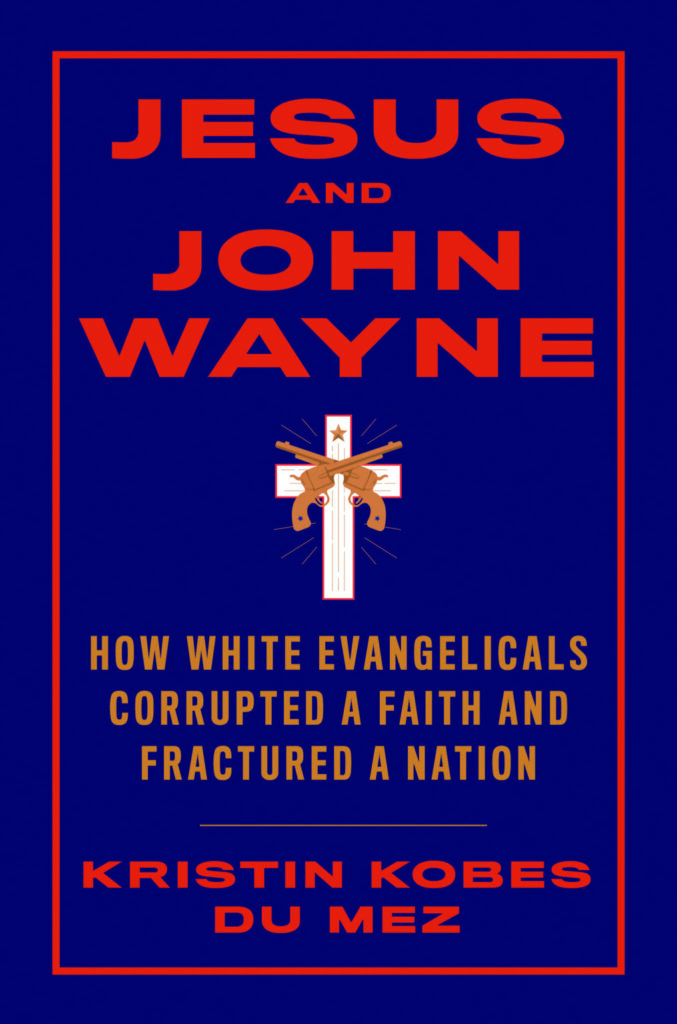
Kristin Kobes Du Mez, Jesus and John Wayne: How White Evangelicals Corrupted a Faith and Fractured a Nation (Theology, Politics, History, Audible)
David Sedaris, Let’s Explore Diabetes with Owls 
(Essays, Humor, Audible)
Amy Peterson, Where Goodness Still Grows: Reclaiming Virtue in an Age of Hypocrisy (Theology)

Hard to decide between Lopez and Nguyen!

February

Barry Lopez, About this Life (Memoir (Audible)
Viet Thanh Nguyen, The Sympathizer (Fiction, Audible)
Anne Melyn Cassabaum, Down Along the Haw: The History of a North Carolina River (History, Geography) 
Charles Simic, The Book of Gods and Devils (poetry)
Sarah Arthur, Light Upon Light: A Literary Guide to Prayer for Advent, Christmas, and Epiphany  (Devotion)

March

Lisa Deam, 3000 Miles to Jesus: Pilgrimage as a way of Life for Spiritual Seekers (Theology, History)
Tilar J. Mazzero, The Widow Clicquot: The Story of a Champagne Empire and the Woman Who Ruled It. (History, Creative Non-Fiction, Audible)
Nick Offerman, Gumption: Relighting the Torch of Freedom with America’s Gutsiest Troublemaker  (Essays, “History,” Audible)
Thomas Long, Hebrews (Biblical Commentary)
Ron Rash, Among the Believers: Poems (Poetry)
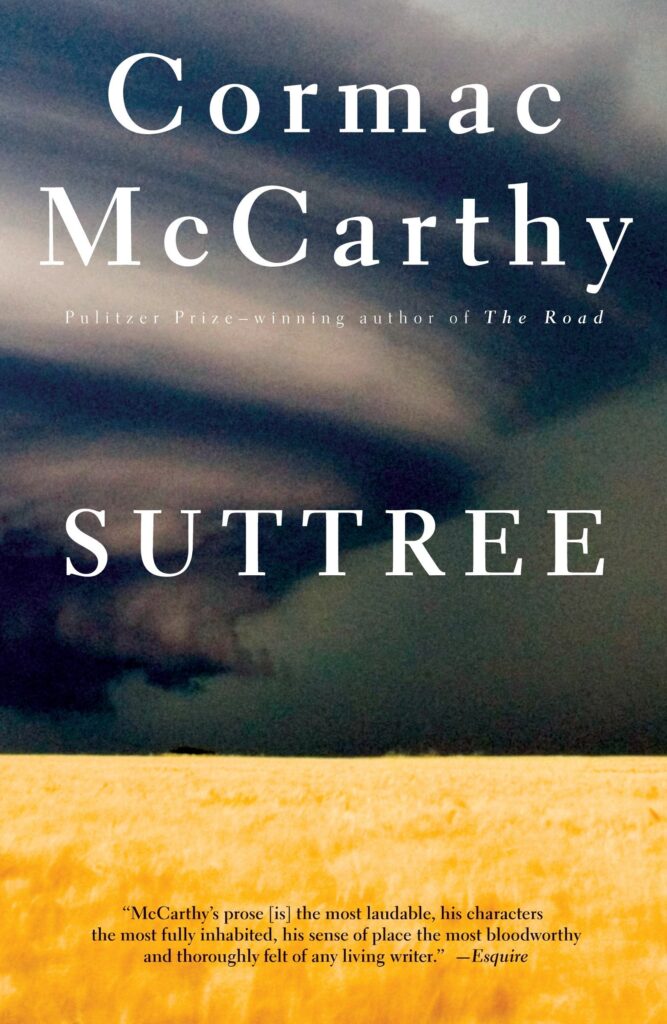
Cormac McCarthy, Suttree (Fiction, Audible) 
Karen Cecil Smith: Orlean Puckett: The Life of a Mountain Midwife (History) 
Julie Salamon, Rambar’s Ladder: A Mediation on Generosity and Why It is Necessary to Give (theology)

April

Robin Wall Kimmer, Gathering Moss: A Natural and Cultural History of Mosses (Nature, Memoir, Audible) 
Sarah Arthur, complier, Between Midnight and Dawn: A Literary Guide to Prayer for Lent, Holy Week, and Eastertide (Devotion)
Barry Dickson, Maybe Today: Poems  (Poetry)
Garrison Keillor: That Time of the Year: A Minnesota Life (Memoir)

May

Richard Flanagan, The Narrow Road to the Deep North  (Fiction, Audible)

Barbara Kingsolver, The Poisonwood Bible (Fiction, Audible)

June

Aaron McAlexander, Greasy Bend: Ode to a Mountain Road  (History, Essays)
Sinclair Lewis, It Can’t Happen Here  (Fiction, Politics, Audible)
Luke Timothy Johnson: Hebrews: A Commentary (Biblical Commentary) 

July

Gregory Orr, A Primer for Poets and Readers of Poetry (Writing)
Robert Macfarlane, The Old Ways: A Journey on Foot  (Nature, Essays, Audible) 
Erik Larson: Isaac’s Storm: A Man, A Time, and the Deadliest Hurricane in History (History, Audible) 
John Ketchmer, Sailing a Serious Ocean; Sailboats, Storms, Stories and Lessons Learned from 30 Years at Sea (Memoir, Audible) 
Howard Thurman, Jesus and the Disinherited (Theology, Race)
Casey Tygrett, As I Recall: Discovering the Place of Memories in our Spiritual Life (Writing)
Carl Hiassen, Tourist Season (Fiction, Humor, Audible) 
Robert Anderson, Daniel: Signs and Wonders, International Theological Commentary (Biblical Commentary)
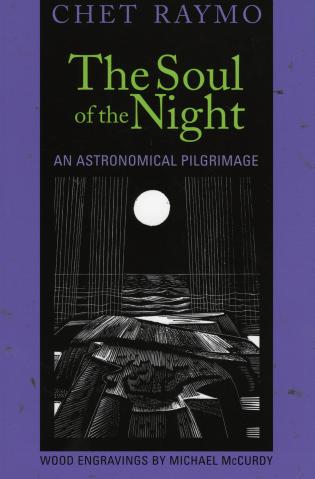
Chet Raymo, The Soul of Night: An Astronomical Pilgrimage (Nature, Essays) 

August

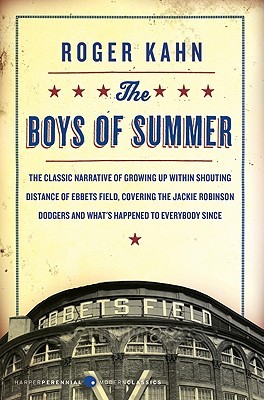
Roger Kahn, The Boys of Summer (Non-fiction, Baseball, Biographies, Audible)
Christiane Tietz, Karl Barth: A Life in Conflict (Biography, theology)
Admiral Eugene Fluckey, Thunder Below:  The USS Barb Revolutionizes Submarine Warfare (History, Memoir, Audible)
Richard Lischer, Open Secrets: A Memoir of Faith and Discovery (Memoir) 
Alistair Begg, Brave by Faith: God -sized Confidence in a Post-Christian World (Biblical Commentary) 

September

Karl Marlantes, Matterhorn (Fiction, Audible) 
George Saunders, Civil War Land in Bad Decline (Essays, Humor, Audible)

October

Karl Barth, Church Dogmatics 4.2 The Doctrine of Reconciliation  (Theology) 

Terry Tempest Williams, The Hour of Land: A Personal Topography of America’s National Parks (Memoir, Nature, Audible) 

November

Anton Chekhov, The Complete Stories of Anton Chekhov, 1882-1885 (Short Stories, Audible)

Peter Wehner, The Death of Politics (Non-fiction, Political)

Philip Yancey, Where the Light Fell (Faith, Memoir, Audible) 

John Hassell Yeatts, A Long and Winding Road (History, Memoir, Stories)

Gregory Orr, River Inside the River: Poems (Poetry) 

December

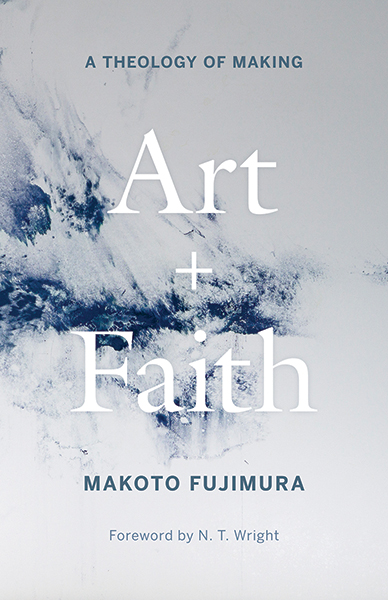
Makoto Fujimura, Art of Faith: A Theology of Making (Theology).

Philip Conner, A Song for the River (Memoir, Nature, Audible) 

Anthony Everitt, Alexander the Great: His lLfe and His Mysterious Death (History, Audible) 

I have two of these books on my reading list again, for 2022. I listened to Jesus and John Wayne, but I have the paper copy and I would like to read it and then write a review. I also want to reread and then write a review of Howard Thurman’s Jesus and the Disinherited.

What books did you read in 2021? What are your reading plans for 2022?

/

Remain at your post. Stay Awake!

Jeff Garrison
Bluemont and Mayberry Presbyterian Churches
Mark 13:24-37 (1 Samuel 28:3-16)
January 9, 2022

Comments at the beginning of worship:

I didn’t stay up to midnight on New Years Eve. I was in bed by 10:30. I woke briefly at midnight when some in my father’s neighborhood shot off fireworks, but quickly fell back asleep. Up before sunrise, I headed to the beach, enjoying the unseasonably warm weather before the sun’s arrival. 

Watching the sunrise over the ocean seemed a good way to start a new year. The sun was scheduled to rise at 7:17 AM. But as the skies lightened, a deep fog bank appeared offshore. A fair number of folks came out to witness the first sunrise of the year, some with fancy cameras on tripods, in the hope they’d capture the moment. But all we saw was fog. 

“That’s not a good omen for 2022,” I quipped sarcastically. The night before a friend remarked on Twitter that after the last two years, his expectation for 2022 was so low that as long as the zombie apocalypse doesn’t happen, he’s good. 

But there’s another way of looking at that morning’s fog. We can’t see through the fog, nor can we see what will happen in the new year. As Paul reminds the Corinthians, “we walk by faith and not by sight.”[1]Living by faith means we’re not given a road map for the future. Today, I want you to come away from this time of worship, understanding that there is much about the future we won’t know. We walk into it, trusting our Savior and accepting each day as a gift. 

A return to Daniel

Next week, I will resume my preaching from the Daniel. We’ll start with the seventh chapter, which begins the more apocalyptic section of the prophet. Many people attempt to use this part of Daniel to interpret the events leading to Christ’s return. Jesus makes it clear that’s beyond our understanding. Scripture teaches us that the future belongs, not to us, but to God. When attempting to understand Daniel, we need to interpret his prophecy through the lens of the rest of scripture. We don’t have a roadmap to the future, we only know that in the end, God will be victorious, and we will share in such victory.

Before the Old Testament Reading

Our Old Testament reading may seem strange for today’s focus in worship. But I picked it for a reason. Let me explain. We learn that Saul, Israel’s first king, worries about the future and so visits a medium or a witch (this text is often known as “the Witch of Endor”) to learn of his fate. And it’s not good. Living by faith and accepting God’s providence is hard. Saul wants to see if there is some way to understand events so that he can take some control. 

We’re told that Saul had removed the wizards and mediums in the land. God’s law is clear. One should not consult with witches, mediums, or practice sorcery.[2] One should not attempt to control the future, for it belongs to God. Later prophets would condemn Israel and her kings when they practiced divination.[3] Such practices become tied to evil spirits as we see with Paul in Philippi. If you remember, Paul got himself in trouble for castings out the demons from a slave girl. The girl was freed, but the demon allowed her owner to make money from her by telling people’s fortunes.[4]

What King Saul did was wrong. He knows it. Saul is a desperate politician, who will now try anything to stay in power.[5] Like too many politicians (along with the rest of us), he touts one thing and does another. Read 1 Samuel 28:3-16

Before the Gospel reading:

On the first Sunday of Advent, I preached from the parallel to this passage in Luke’s gospel. Both gospels tell of Jesus and the disciples being together on the temple grounds. Jesus points out the widow giving her mite, then he begins to talk about the future. First, Jesus covers things that will happen soon, such as the destruction of the temple. But then he continues, discussing the distant future, at the end of history, when he will return. While Jesus speaks of things happening, he emphasizes the futility of attempting to know the time of his return. Again, we’re not to know the future, we’re to live each day in faith, trusting that God has things under control.

Read Mark 13:24-37

After reading the gospel: Keep Awake

Keep awake… As a child, staying awake was hard. Sermons were the worse. My eyes grew heavy. School wasn’t much better, especially in a warm classroom in the days before air-conditioned schools. Keeping awake was hard, except for on Christmas Eve, when you were told to go to sleep. It was harder to fall asleep on Christmas Eve than it was when I planted a baby tooth under the pillow! You knew something magical was happening. The anticipation was high; too much was happening while we were asleep. I’d roll and roll and when my parents looked in on us, pretend to be asleep. The clocked ticked away.  

Keep awake, you don’t know when this is all going to happen and when the Son of Man might appear. It’s been almost 2000 years since Christ left—that must be the reason there’s a lot of insomnia going around. But we’re weary of waiting. It’s not something we’re good at doing. We fret when we are in the doctor’s office for too long. We stew when we get behind a slow driver. We brood if a waitress or waiter in a restaurant is inefficient. Waiting makes us feel out of control, unimportant, unwanted, and helpless. Yet, we must wait all the time. And the more we wait, the more our blood pressure rises. When is it going to all happen? 

Knowledge that exceeds what we can know

Sadly, Jesus doesn’t provide a road map. Mark 13 begins with the disciples asking for a sign. While Jesus gives some “signs,” he ends this discourse with a mystery. Knowledge about the end exceeds what we can know. It even exceeds what the angels and the Son of Man knows. The end isn’t something we prepare for, such as going on a trip. Instead, the only thing we can do is to watch and to remain faithful.[6] So we wait…

However, most people probably don’t mind waiting for Christ’s return. After all, we put off the important things in life, such as getting right with God, for another time. But that’s risky. Jesus is telling us that’s a gamble we shouldn’t take.

Losing our map

Our passage begins with a description of terrible days. The sun and moon will darken, and stars will be fall out of the sky… 

Have you read Cormac McCarty’s post-apocalyptic novel, The Road? The setting for the story is a horrible world, filled with smoke from a war long over. A nightmare has descended. A boy and his father try to make the way through this world without stars or a moon or even the sun, as they are all shielded from earth. Imagine, a sky without the sun or moon or stars… 

In the ancient world people believed that stars foretold things would happen (some people still believe this), so without the stars in the sky, they’re lost.[7] It’s as if their road map of the future has been destroyed.

A spotlight on the final drama of history

Perhaps we need to look at this passage in a less literal way. What’s happening is that the lights need to be lowered so that all light can be focused on the one coming—Jesus Christ. The removal of distractions helps everyone pay attention to what’s happening. The scene is scary and wonderful at the same time. It’s God’s great and final drama in history. 

Think about being in a theater. At the beginning of a play or concert, the house lights are dimmed so the audience can only see the performance. You’re not distracted by the guy to your left picking his nose or the teenagers making out two rows in front. Here, the lights are dimmed so that everyone will be focused on Christ. 

This return involves the gathering of the elect, the faithful, those chosen by God through Christ. The faithful are brought into Christ’s presence. 

The fig tree

Jesus then returns to the question that started this discourse, about when these things (such as the destruction of the temple) will occur. He uses a fig tree as a lesson. Just a day or two beforehand, Jesus had cursed a fig tree that was not providing fruit, and the tree shriveled up and died.[8]The fig tree was often used by the Prophets as a symbol of Israel.[9]

Now, instead of a fig tree withering, he speaks of when it blooms, which is later that most trees, in early summer. The budding of the fig tree is a sign of when this is happening, probably refers to Jesus the Messiah rising into prominence as the temple, which will soon be no more, fades from history. 

In the future, God will not be represented by the temple, With the temple gone, where does it leave God?  Of course, we know that in the world to come, as described in Revelation, there will be no temple. The temple isn’t needed, for God is present.[10] The one we trust in this world even though we do not see, will be present so that faith gives way to love.[11]We we’ll live in God’s visual presence. 

Parable of the Waiting Slaves

Our passage moves on to the final section where Jesus insists that what’s important isn’t that we know when all this will take place (much of which took place before the end of the first century). Yet, we are still waiting for his return. What’s important is that we are ready. “Keep awake,” this chapter ends, or as The Message translates the ending verse, “Stay at your post. Keep watch.”  As one commentator on this passage writes, “vigilance, not calculation, is required.”[12]

The use of the story about the slaves or servants waiting on the master implies that they have assignments and must be willing to fulfill their calling while the Master is away. Interestingly, with this section in Mark’s gospel, relating to the Master’s return, there are no signs given. The slaves don’t know, so they must continue with their tasks… Likewise, each member of the church has work to do. By the way, all of us have a calling. There’s something each of us need to be doing for the kingdom. This is how we fulfill our obligation to “watch.”[13]

Conclusion 

Christ has come, Christ will come again. But until he does, we are his hands and feet in the world, taking care of one another while telling his story so that others will catch a glimpse of the hope the world has in Jesus Christ and be ready. As The Message translation reminds us, “Stay at your post. Keep watch!” There is no map. We walk into 2022 by faith, not foresight.  Amen. 


[1] 2 Corinthians 5:7. 

[2] Leviticus 19:31, 20:6, Deuteronomy 18:10, 19:26.

[3] See Jeremiah 27:9, 50:36; Micah 5:12, 2 Chronicles 33:6.

[4] Acts 16:16.

[5] See Walter Brueggemann, Interpretation: A Bible Commentary for Teaching and Preaching, First and Second Samuel (Louisville: John Knox Press, 1990), 192-193. 

[6]  James R. Edwards, The Gospel According to Mark: The Pillar New Testament Commentary (Grand Rapids: Eerdmans, 2002), 406.

[7] Edwards, 403.

[8] Mark 11:12-14, 20-21.  Morna D. Hooker, Black’s New Testament Commentaries: The Gospel According to Saint Mark (London: A. C. Black Limited, 1991), 320. 

[9] See Jeremiah 8:13, Hosea 9:10, Joel 1:7, Micah 7:1.  See footnotes for Mark 11:12-14 in The New Interpreters Study Bible (Abingdon Press, 2003). 

[10] See Revelation 21:22ff. 

[11] 1 Corinthians 13:13.

[12] William L. Lane, The Gospel of Mark: The New International Commentary on the New Testament (Grand Rapids: Eerdmans, 1974), 482.

[13] Hooker 322. See also Lane, 484.

Kure Beach, North Carolina. New Year’s Day, 2022

I’ve been away (a mostly photo essay)

Two days after Christmas, I headed to Southeastern North Carolina. The 29th was my father’s 85th birthday, and my sister had planned a party that I didn’t want to miss.

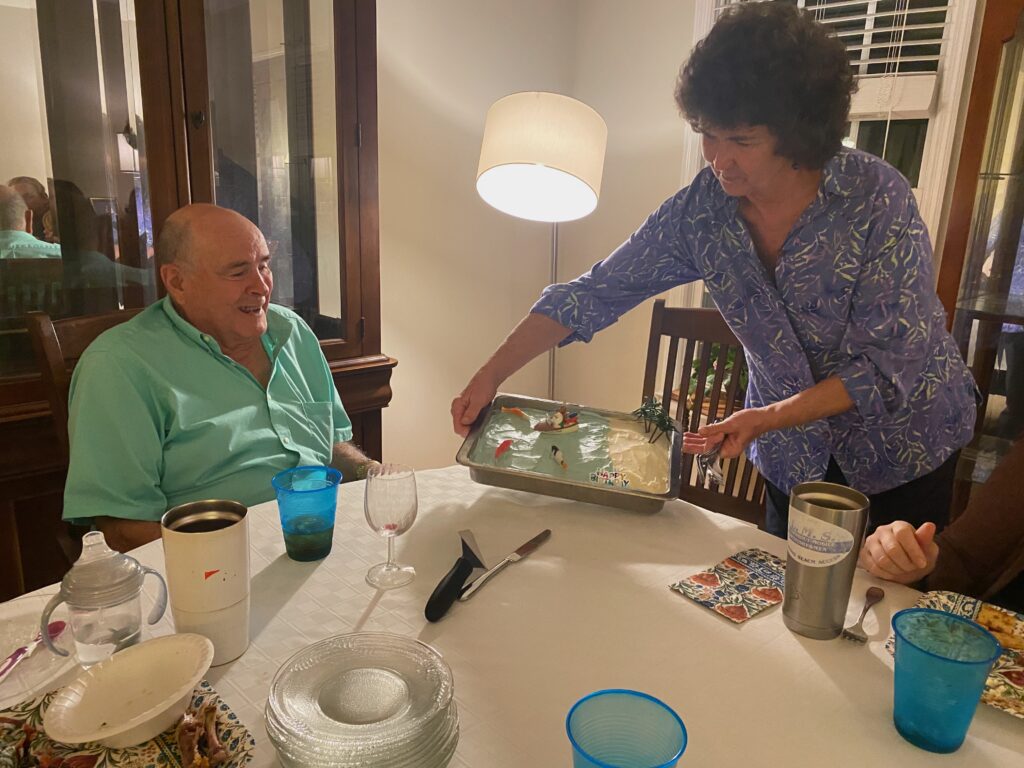
My sister presents her carrot cake to my father for his birthday

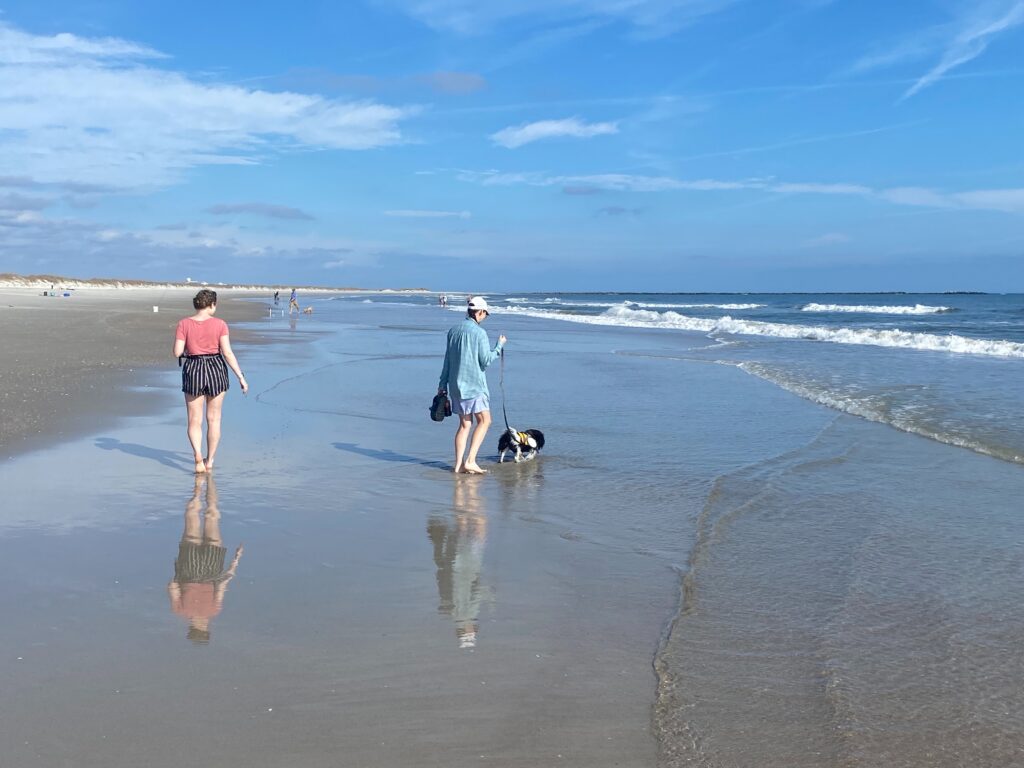
The weather for the first five days were incredible. On New Year’s Eve, my dad and I paddled from Trail’s End to the south end of Masonboro Island. My brother brought everyone else along in his boat, so that we might have lunch on the island. My daughter was introducing Apple, her new dog to the ocean (I even gave Apple a ride in the kayak).

Apple trying out the water (It’s hard to believe that it was warm enough to be in the water on New Year’s Eve!)

Not my typical paddling style. The high brace was to keep from hitting the dog in my lap.

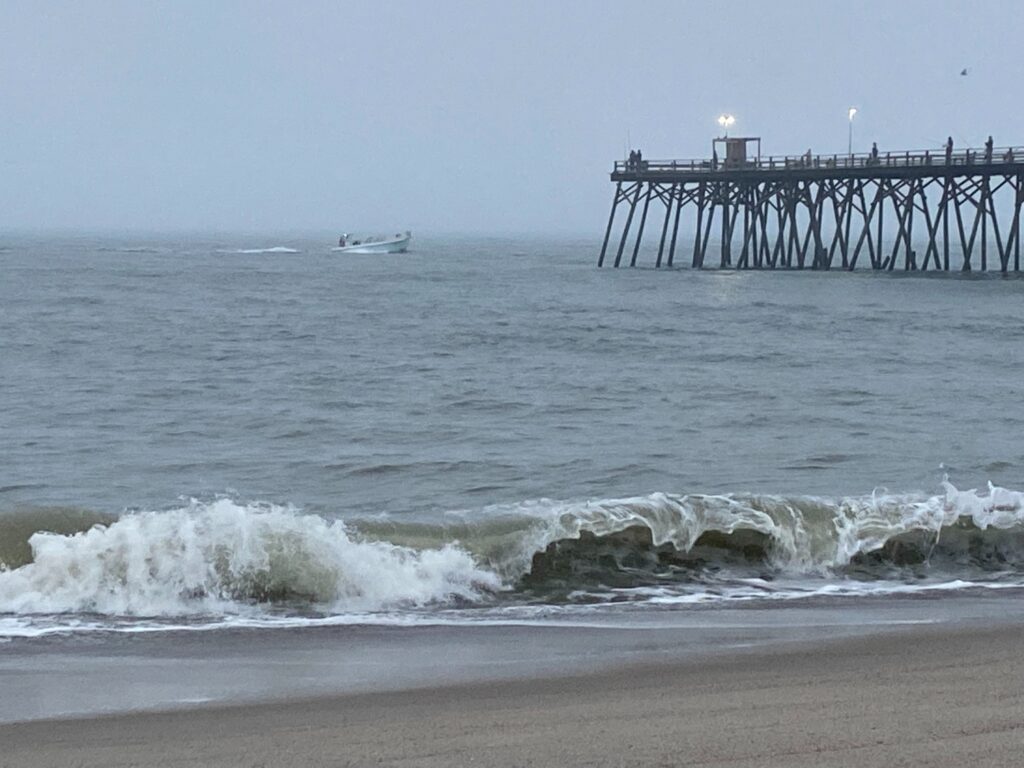
After an early night on New Year’s Eve, Donna and I headed out to the beach for a New Year’s Sunrise before she and Caroline headed back to the mountains (I was going to stay through January 5). The idea was to watch the first sunrise of the new year, but a fog bank offshore disappointed those waiting for the sunrise along the beach.

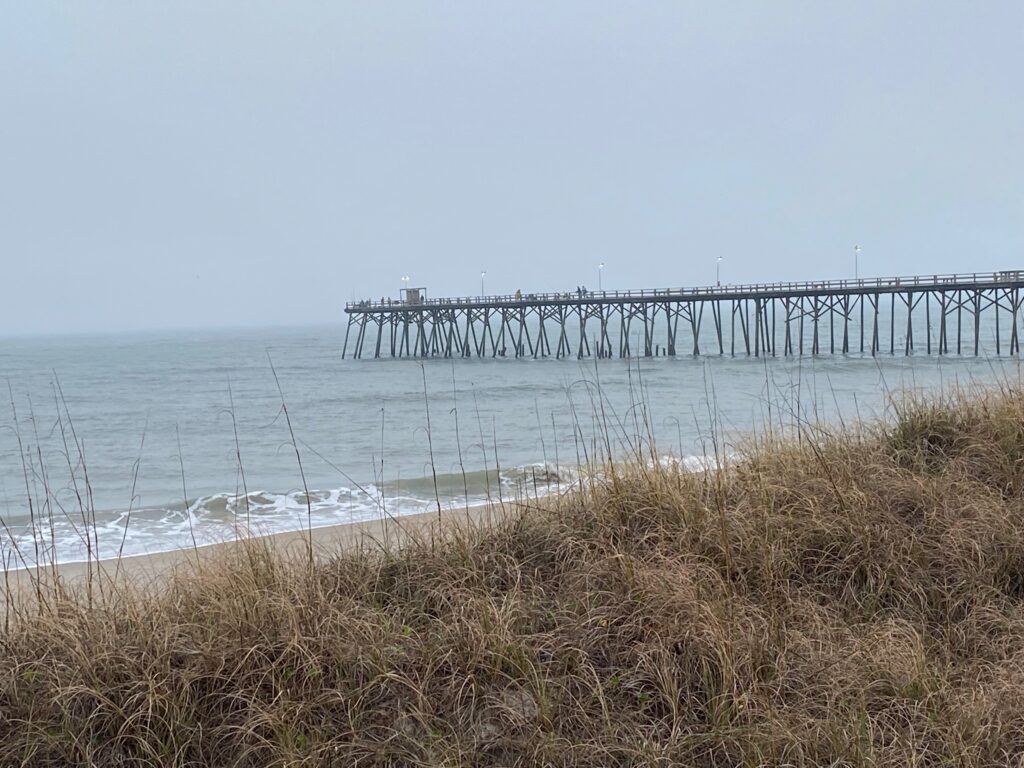
Sunrise at the Kure Beach pier

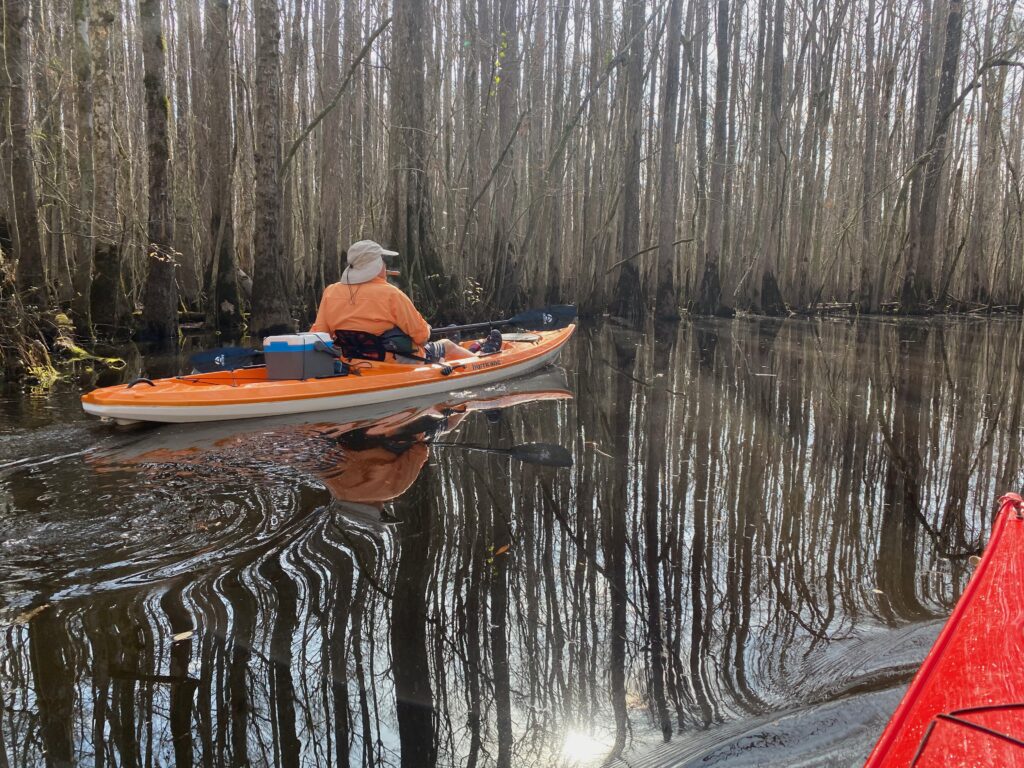
On New Year’s Day, the wind picked up, so Dad and I headed inland and did a black water paddle on Rice’s Creek. We paddled upstream several miles, to where the creek becomes just wider than a kayak. I left my sea kayak at home and used a boat of a friend of my dad (that was 12 feet long instead of 18 feet, making it easier to navigate).

Paddling on Rice’s Creek

A poem written on Rice’s Creek (I’m not sure who’s the one with dark eyes)

The whole world appears in the reflection of the dark waters:
Cypress, tupelo, clumps of mistletoe, puffy clouds and blue sky.
Yet, I cannot see the long just underneath the water,
just as your dark eyes reflect the world while hiding much.

I had planned to either go to Cape Lookout or Masonboro Island to camp for a night or two, but the weather turned rough. We had winds approaching fifty miles an hour on Monday, so we stayed home and I read. On Tuesday, my brother and I went down to scout out an area on the Waccamaw River that he wanted to see about paddling. The weather had turned cold and was freezing, but we dressed warm and covered about 13 miles of the river, starting at Conway, South Carolina to Peachtree Landing. When I lived in Whiteville, in the early 1980s, I had paddled on the Waccamaw several times, between Lake Waccamaw and Pireway. I’d never been on the river in South Carolina.

Running along the lower Waccamaw
Conway now has a nice waterfront
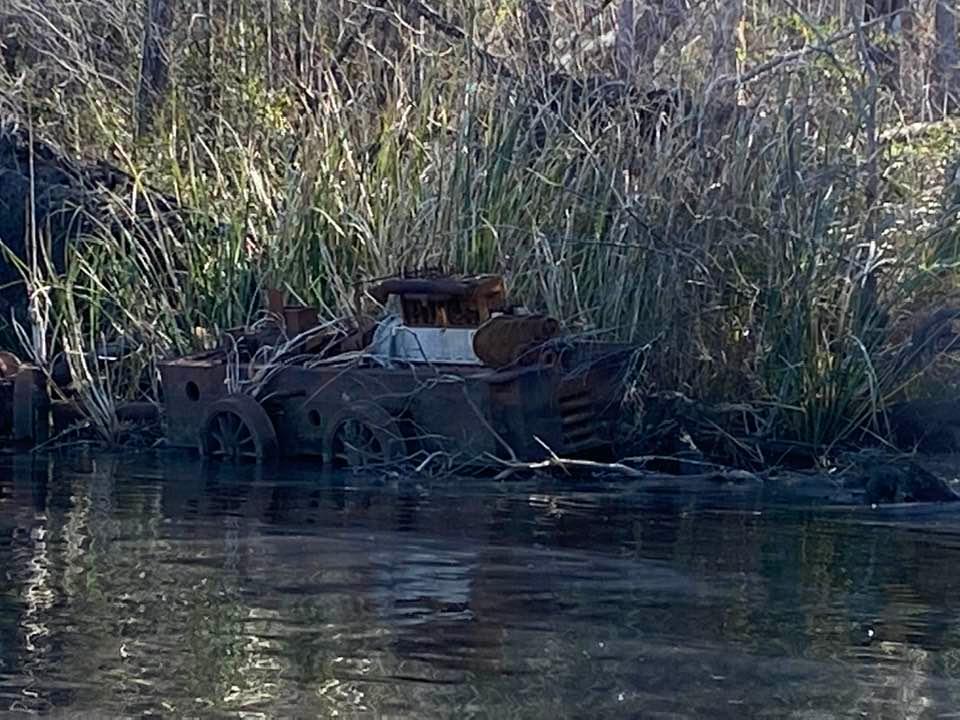
An old log hauler (designed to run on light rail track)
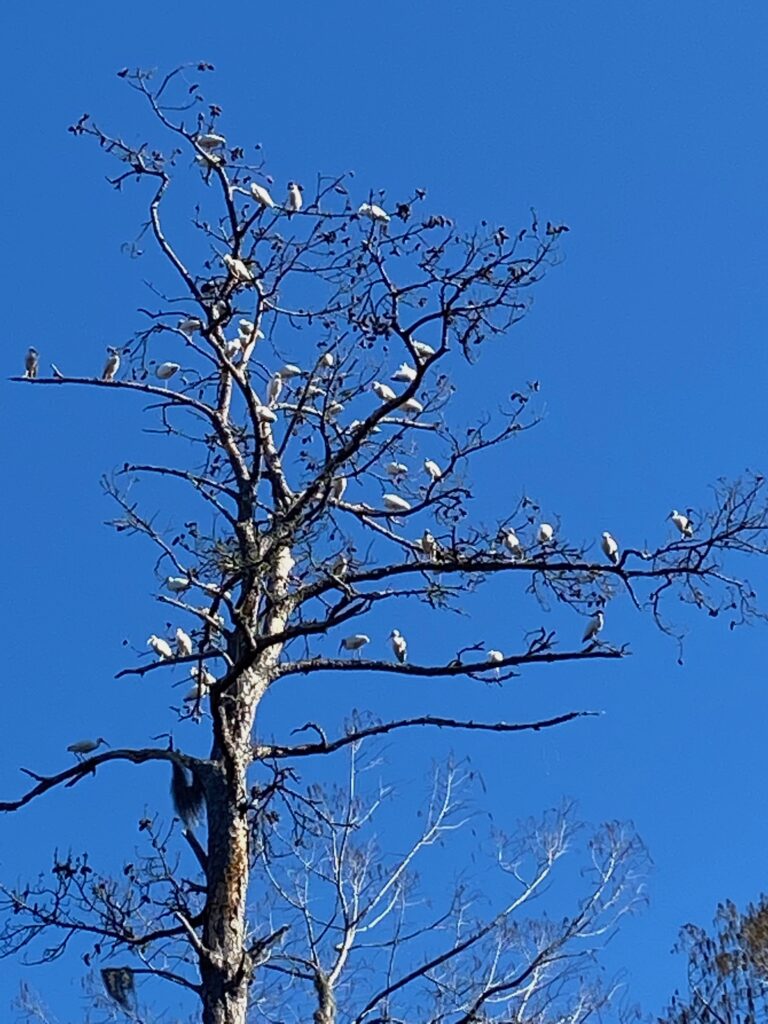
I think these are Ibis in this tree (Kingfishers were the most common birds seen along Rice’s Creek and the Waccamaw)

I came back to the mountains on Wednesday, between two winter storms (one was on Monday and the second on Thursday).

Back home, having missed the first snow of the season in the mountains

Jesus at 12

Jeff Garrison
Bluemont and Mayberry Presbyterian Churches
December 26, 2021
Luke 2:41-5
2

Sermon taped at Bluemont Presbyterian Church on Sunday, December 26, 2021.

A few years ago, one of our missionaries in South Korea shared a story about a boy named Amos (obviously, that’s not his Korean name and for obvious reasons, the missionary didn’t use real names). Amos’ father was from North Korea and spent ten years in a labor camp before escaping to Russia. 

He lived there illegally and fell in love with a Russian woman. But they couldn’t marry because of his status. If he’d been discovered, he would have been sent back to North Korea, so they lived together and they had a son, Amos. The mother died when Amos was small, but because he was not legally linked to the father, he was taken to an orphanage. The father moved to be near the orphanage where he could visit his son and keep an eye on him. Then came the day that he learned his son was to be adopted. Fearing he’d never see his son, the father gambled and called on the South Korean embassy. After some political wrangling, he was allowed to migrate with his son to South Korea. 

When we think things are difficult in our lives, we should remember Amos and his father.[1] The bond between a parent and a child is great and when threatened, it’s heartbreaking, as we’re going to find out in our text today.

Today, a day after we celebrated Jesus’ birth, we’re looking at his young life. We don’t know much about his upbringing. The teachings of the Apostles focused chiefly on Jesus’ public ministry—from his baptism through the resurrection. Only two of the four gospels give us any detail about Jesus’ birth, and they both provide only a fleeting glimpse of Jesus’ life between his birth in Bethlehem and his baptism by John.  Matthew tells us the holy family spent time in Egypt—as refugees. Luke tells us two things about Jesus’ early life—his circumcision on the 8th day and the family’s yearly visit to the temple with some more detail provided about this visit when Jesus was 12 years old. This is the passage I’m using for today’s message.

I wonder if Luke received his information about Jesus’ birth and childhood from Jesus’ mother Mary. Twice in the 2nd chapter, we’re told that Mary pondered or treasured what happened to Jesus in her heart.[2]It seems quite probably that by mentioning Mary’s pondering these thoughts, she was the source for Luke’s information.  

We have so little information about Jesus’ early life and are left wondering… At best, in Luke’s gospel, we can only account for a few weeks of Jesus’ first thirty years. In our age where people focus on childhood experiences and their psychological impact on the rest of our lives, we’re curious. And we’re not the only ones. Even in the early church there was much curiosity about Jesus’ upbringing, which led to the publication of many apocryphal and extra-biblical writings about what Jesus said and did as a child. But most of these accounts are so fantastic that they were easily dismissed.[3]

The Holy Spirit inspired what we have: the four gospels with their limited insight into Jesus’ early life. So, we must be satisfied with these glimpses of Jesus’ childhood. We can save any other questions for table talk at that great banquet in heaven. Let’s now look at today’s text.

READ LUKE 2:41-52.

Probably one of the worst nightmares for a parent comes from the fear of losing a child. I told you the story about the Korean boy at the beginning of the sermon. It came from an article titled “The Shepherd of North Korea,” written by a Presbyterian missionary in South Korea. 

The author recalls his real education on God’s shepherding. Shortly after he and his family moved to Seoul, they visited an open-air market. I’ve been in some of those crowed markets. You wind through alleyways, with way more people than space. He and his wife then realized that his daughter no longer had his hand. What happened next, he described, was “five minutes of hell” as they searched for the small girl in the crowds of people speaking a strange language.[4] Luckily, they found their daughter, crying and terrified, but safe. It’s a horrifying thought; it’s our worst nightmare, not knowing where a child is located and knowing there is no way you can help him or her. If we think about the emotions the thought of losing a child brings to us, we can empathize with Mary and Joseph.

Mary and Joseph are devoted Jews. In some ways, their actions go beyond the demands of the law, which required adult Jewish men to go to the temple for Passover. Those living around Jerusalem observed this requirement, but those living more than a day’s journey or roughly 20 miles from the city, were excused. For those living far away, the trip was made less frequently and, in some cases, was a once in a lifetime journey. The holy family, however, attended every year. That’s devotion for the hard journey would have taken then four days of walking, each way. Even more remarkable, both Joseph and Mary attend!  Mary wasn’t required. She could have stayed home. But Luke leaves us with a picture of devout parents raising Jesus.

The fact that this is Jesus’ twelfth year is also telling, as perhaps he has gone through his bar mitzvah. Now Jesus is, in Jewish eyes, a “son of the law.” At this point, he’s obeying the command to attend Passover.[5]

There is much speculation about what these journeys to and from Jerusalem were like. Most likely, the pilgrims traveled in caravans or groups of like-minded people. The men walked together and discuss theology briefly, before the talk switched to the World Series, Superbowl, business, how they are all hen-picked by their wives, or equivalent subjects of the first century. Likewise, women walked together. They talked about kids and school, celebrities, and the inattentiveness of their husbands. Children also gathered to play with each other, to sing, and keep each other company while complaining about their parents. Not much has changed. Since this was a male-dominated society, the children mostly hung out within sight of mom.

Perhaps this is how it happened. Leaving Jerusalem and heading north to their home, Joseph engaged in conversation with other men and thought that Jesus was with Mary. And Mary, knowing that Jesus is now 12, almost a man, assumed he was with his dad. And even if he wasn’t with dad, he could have been traveling with some of his cousins. Jesus himself is at the in-between age; he’s not quite an adult (that’ll happen according to their tradition on his next birthday), but he’s also no longer a child and he’s putting aside childish games. Being in this no-man’s land, Jesus falls through the crack and it’s not until that first night, when Mary and Joseph reunite, that they realize he’s missing. Unable to find him among the pilgrim’s camp, they worry. 

They’re now a day’s journey from Jerusalem. They immediately turn around and hike back to the city and look for him. Not only are they devoted to their religious teachings, but they are also devoted to their child. 

It’s on the third day (a day traveling from Jerusalem, a day traveling back to the city, and a day of looking) that they find Jesus. Luke may be foreshadowing or hinting at the time between Jesus’ death and his resurrection. Jesus is having an adult conversation with the intellectuals of the faith, but Mary isn’t impressed. “Why have you treated us like this?” she yells. “Your father and I have been worried.” Mary’s response is natural; all of us who have children have probably said this or something very similar at some point in their upbringing.  

Jesus replies, asking why they were searching, as if he didn’t know, and then, playing on words, asked if they didn’t know that he would be in his Father’s house. Mary and Jesus use the word Father, Jesus capitalizes his use, (or, it’s capitalized in the English version due to our grammar). Mary of course, uses father to refer to Joseph while Jesus is talking about our heavenly Father. But Jesus’ comments are not a rebuke of his parents, for we’re told that he returned home with them and that he remained obedient.  

There’s an unanswered question here. Had Mary forgotten about her pregnancy and Jesus’ miraculous birth complete with angels and strangers bringing gifts? Luke doesn’t say she had a brain lapse and suddenly snapped out of it, saying, “Oh silly me, I forget, we should have looked here first.” Luke is doing two things. First he’s showing that Jesus, even with his divine nature, was part of a normal family, one that cared for and worried about the kids.

Secondly, Luke sets up early in his gospel the tension that will later become more prominent in Jesus’ ministry—a tension between one’s family and God. Jesus himself faced this problem as we see here and later in his life as his brothers challenged his ministry.[6]  

Luke uses this story to illustrate Jesus’ growing awareness. As Jesus matures, he begins to understand his destiny, as Luke points out in verse 52. Luke also shows the human dynamics of a family struggling with such a calling. Jesus’ mother would stick by him, even being there at the cross. Certainly, Jesus’ ministry caused her much heartbreak, of which this little blip in his childhood is only the beginning. Yet, she knows he’s destined for something greater than she could ever imagine. She does her part, raising the child, but when the time comes, must let him go to do his Father’s work.

Looking at this story from this angle, we can see it affirms both the role of the parents (after all, when they found Jesus, he obeyed them and returned home) and the need for a growing boy who’s almost a man to spread his wings, so to speak. The family, as well as the larger community present at Passover, did their parts in preparing Jesus for his life and ministry. Could we ask for more? Is there anything more important a community or a family can give the young people with whom they are entrusted? Therefore, when we baptize children, we require parents as well as the congregation, the child’s worshipping family, to pledge their support.  

And when the parents and the community have faithfully raised a child, that child must then be given the freedom to follow his and her own path. Here, we see that ultimately the focus isn’t on the family; it’s on doing the work of the Heavenly Father. When this is kept in perspective, our priorities fall into place, just as they did for Joseph and Mary.  

Raising children is both a blessing and a responsibility that we share with Mary and all other parents. Like Mary and Joseph, it is easy for us to get busy about our own concerns and forget our role in preparing our children to be about the business of their Heavenly Father.  

As we end this year and begin the next, think about our responsibility to the children in our homes, our community and of the world. What might we do, in our homes and in our neighborhood, to help our children grow up wanting to serve their Heavenly Father? What might we do to support children around the globe? We have a responsibility and we’re all in this together. Amen. 


[1] Samuel Weddington, “The Shepherd of North Korea,” Presbyterian Outlook, 10 December 2012. See https://pres-outlook.org/2012/12/the-shepherd-of-north-korea/

[2] Luke 2:19 & 51.

[3] Norval Geldenhuys, The New International Commentary on the New Testament: The Gospel of Luke (Grand Rapids: Eerdmans, 1983), 125-126,

[4] Weddington, “The Shepherd of North Korea.”

[5] Fred B. Craddock, Luke: Interpretation, a Bible Commentary for Teaching and Preaching (Louisville: John Knox Press, 1990), 41.

[6] See John 7:1-5.

Mayberry Church on Christmas Eve (photo by Beth Ford)

Christmas Eve Homily

Jeff Garrison
Mayberry and Bluemont Presbyterian Churches
Christmas Eve 2021
Luke 2:1-20 (verse 19)

This video contains a whole service that includes music along with the homily

Growing up, I never felt like our Christmas tree was the real thing. Yeah, it was a live tree; we’d never go for the artificial variety. But it was store bought, purchased from the Optimist Club, which was logical since they supported the local Little League program.

On the night we put up the tree, we’d all wait patiently—or maybe not so patiently—for Dad to come home from work. When he arrived, we’d pile in the car and drive to the lot on Oleander Drive. It was a makeshift operation, some bare bulbs hanging from wires overhead illuminating the lot that in summer was a putt-putt golf course. Trees stood up against wires running between poles. We’d go through the lot looking at 100s of them. None ever seem perfect. And the ones I liked, my brother or sister wouldn’t like. Or it was too big. It was hard to get all of us to agree. After 15 minutes of this fruitless exercise, my parents assumed authority and picked out a tree. Dad paid for it. Then he tied it to the top of our car for the ride home. 

In some ways, it’s odd that my dad purchased a tree instead of finding a place to cut one. He’s the type of man who never brought anything he could make, and that included our tree stand. Had the bomb dropped on our house, something kids worried about in the 60s, I’m sure Dad’s tree stand would have been the only thing to survive. I was in Middle School before I could pick it up. It was constructed from a large flat piece of 3/8-inch plate steel with a four-inch steel tube welded to it. The trunk went into the tube. At the top of the tube, he’d drilled holes and tapped it so the bolts could be tightened to hold the tree in place. It was hard to get water into the tube, so after the first year, he drilled a bunch of holes in the side of the tube and then welded a shorter eight-inch pipe over it. We could pour water into the larger tube, and it would seep into the trunk. This tree stand was so solid that the tree’s trunk would have broken before it would have toppled. 

As a child, I wondered why we didn’t have one of those red stands with green legs made of tin, like all other families. I was envious of those flimsy tree stands sold at J. C. Fields. As an adult, before moving to an artificial tree, I found myself wishing for Dad’s old stand. The tree in that stand would have survived kids, dogs, cats, and rowdy guests, all of which have been known to topple a tree my living room.

My maternal grandparents still lived on a farm and never had a store-bought tree. For me, they had a real tree—an Eastern Cedar—thick and full and fragrant compared to the scrawny firs the Optimist Club imported from Canada. My mother, obviously trying to console us, said firs brought down from Canada were better because you had more room between branches on which to hang ornaments. She was trying to convince herself, I’m sure. Deep down, she knew that for a tree to be authentic, you had to select the one for the sacrifice, and cut it you’re your own hands.  

Of all the trees I’ve seen in my life, the one that stands out as the ideal tree was the one my grandmother and grandfather Faircloth had for Christmas 1966. It was a full, well-shaped cedar my grandfather had cut near the branch that ran behind his tobacco barn. Although I didn’t witness the harvesting of this tree, I imagine him, sitting on top of his orange Allis Chambers tractor, with the tree tied behind the seat, hauling it back home. This tree took up a quarter of their living room and its scent filled their home. Grandma decorated it simply: white lights, red bulbs, and silver icicles. And, of course, there were presents underneath along with boxes of nuts and fruit.

They gave me a Kodak Instamatic Camera, that year, the kind that used the drop-in 126-film cartridges and those square disposable flashes that mounted on top.  It was the closest thing to a foolproof camera ever built. I got good use out of that camera. It’d be nearly another decade before I replaced it with a 35 millimeter. My grandfather did not feel good that Christmas, but after some coaxing, I came outside so I could take a picture of him and my grandmother in front of the house. 

Even though I lost this picture years ago, I can still visualize the snapshot in my mind. Grandma and Granddad stood in front of their porch, by one of the large holly bushes that framed their steps. My slender grandmother, a bit taller than her husband, has her arm around him. They’re both smiling. Granddad sports his usual crew cut. In the picture, my grandparents are a bit off-center and crooked, for the camera in the hands of a kid wasn’t as foolproof as Kodak led everyone to believe. But the image was sharp. It still is, in my mind.

My granddad never raised another crop of tobacco. Although I don’t know for sure, he may have never even driven his tractor again, for early that January, his heart gave out. Perhaps that’s why the memory is so vivid.  

I’m sure my Christmas memories are normal. You probably have similar ones—some are good, and others are of Christmases that didn’t live up to expectation. And then there are those sad Christmases in which we lost loved ones. There’s nothing wrong with a normal Christmas, for if you look at the birth narrative in Luke’s gospel, that’s what the first one was all about. It was business as usual. Mary and Joseph have traveled to Bethlehem to do their civic duty, registering for the census. You have shepherds working the graveyard shift. Even birth itself is normal. It’s how we all came into this world. In this ordinary world God enters. Good news! God appears in an ordinary world, in an ordinary life, just like ours. We don’t have to do anything special to experience God. The Almighty finds us waiting in line to meet a government bureaucrat or while working the nightshift. God finds us where we are, that’s one of the messages of Christmas.

The Good Book tells us that after the shepherds left the Baby Jesus, rejoicing and praising God, Mary pondered in her heart all the things she’d heard and experienced. The late Raymond Brown, a well-known scholar who wrote the most detailed commentary on the birth narratives of the Gospels, says the word “pondered” literally means “thrown side by side.”[1] Mary brought together in her heart all the events occurring in Bethlehem and during her pregnancy and juggled them around in an attempt to understand. 

There must have been a variety of emotions of which we can only speculate. How much of her Son’s future did she really understand? Possibly not much. It would be thirty years before Jesus’ ministry would begin. And even after he started his ministry, there were times Mary and her family tried to talk Jesus out of it.[2] A normal mother, trying to protect her son. The birth of any child is miraculous to the mother, so maybe Mary just thought all that happened that night in Bethlehem was normal. As the years went by forgot about the angels and the prophecies concerning her son.  

Mary is important to the story, not only because she is the mother of our Savior. Mary’s the only person mentioned in the gospels whose presence bridge the life of Jesus. She gives birth, she’s at the cross with her heart heavy with sorry, probably still pondering and wondering, and on the first day of the week is there to experience the resurrection.[3]

Ever since that first Christmas some 2000 years ago in the small town of Bethlehem, the day has been one in which we ponder its meaning while creating our own memories. The picture etched in my mind of me photographing my grandparents reminds me of the family from which I sprung, a family who saw to it that I had a chance to know the Christ-child as someone more just a reason to receive gifts. 

Those trees I remember from my childhood, whose roots historically are pagan, have become a symbol for the life Christ brought into the world, the greatest gift we can receive. The impossibility of finding the perfect tree, a task so daunting for my family, always seemed so silly afterwards for even imperfect ones become perfect when decorated. And God works the same miracles in us, taking what is weak and imperfect and using it to carry out his mission in the world. And if I wanted to stretch it, I could even point to my Dad’s Christmas tree stand as a metaphor for the solid foundation we all need in our lives! The memories of Christmas that stay with me are not of receiving gifts. It is the assurance of being loved, by parents and grandparents, and ultimately by God.  

Tonight, ponder what this all means. I suppose for most of us, our fondest Christmas memories are as children or when we had children of our own. In a profound way, Christmas is about children. Think of the possibilities that rest in an infant.

The birth of a child in Bethlehem, the joy of a child tearing into wrapped presents and then hugging a parent, the twinkle of candlelight in our eyes as we sing Silent Night help remind us what it’s all about. And when we hear those words from Jesus’ adult ministry, that unless we come as a child, we will never enter the kingdom of God,[4] we can think about how we viewed things as a child. Perhaps this is what we should be pondering as we once again recall and celebrate God’s entry into our world. How might we become child-like and accept our Savior into our heart?  Amen.  

Recently, I came across another wonderful mediation about Christmas and children from “The Plough,” a devotional site for Christmas. Click here to read it.


[1]Raymond E. Brown, The Birth of the Messiah: A Commentary on the Infancy Narratives in the Gospels of Matthew and Luke (New York: Doubleday, 1993), 406.

[2] In John 7:5, we see that Jesus’ brothers did not believe in him.  Was this the reason his brothers and Mary were trying to see Jesus in Matthew 12:46 and Mark 3:31?

[3] Not only was Mary present at the death, she’s listed as being present with the early church.  See Acts 1:14.

[4] Luke 18:17.

Mary’s Song

Jeff Garrison
Bluemont and Mayberry Presbyterian Churches
December 18, 2021
Luke 1:39-56

At the beginning of worship

It’s the fourth Sunday of Advent. Out waiting is paying off. This week, we’ll celebrate the birth of Jesus. But what does Jesus’ coming mean? What will his return be like? Today, we hear from his mom. Jesus doesn’t just come to provide for about individual salvation. Instead, God is doing something incredibly new in the world. Will we want to participate? 

Before the reading of Scripture

When I lived in Michigan, there was always a time, generally in March, that I’d wake to birds singing while it was still dark. It was a sign winter was almost over. Spring was on its way and the birds had made their trip back from their winter home. I imaged them singing a song of thanksgiving. 

Luke’s gospel opens similarly. Everyone sings. We’ll almost everyone. Old Zechariah, John the Baptist’s father, was at a loss for words. That is, until he regained his speech. But I bet his heart sang. Joining in his heart’s song is his pregnant wife, Elizabeth. And then Mary, pregnant with Jesus, joins the song. And after Jesus’ birth, angels gather as a chorus. They all understand it’s a new day. God’s promises are about to be fulfilled.

The last two Sundays, we explored John the Baptist. The last of the prophets of the old age, John points the way to Jesus, the one who ushers this new age.[1] Today, we’re stepping back, to when John and Jesus were still in the womb. Our scripture tells of the two mothers, Elizabeth, and Mary, giving thanks to God. 

Read Luke 1:39-56  

Automobiles and control

I have a confession to make. I like to be in control. Didn’t come as a surprise, did it? I like to know what I’m doing and where I’m going and how I’m going to get there. I don’t like things I can’t control, which is probably why I don’t get excited over cars. I’m not impressed with how much horsepower one packs under the hood or the size of the tires. I just want the contraption to get me where I’m going.  

You see, with a car, you can be whizzing down the interstate at midnight with everything in order—cruise control set just a hair above the speed limit, the vehicle’s interior climate comfortable, and just the right tune blaring from the stereo when, suddenly, a water pump breaks. You sit in the middle of nowhere, reminded once again that you’re not in control. A little mechanical gadget that can only be found in an auto-parts store three counties over shatters any allusion of that. Moments before you were happy and content, now you’re cranky and angry. Know the feeling? (That said, I hope none of us have car problems if you’re travelling for the holidays.)

The desire for control is something instilled into our culture. We’re told to pull ourselves up by our bootlaces. We take care of ourselves, or at least we are under the mistaken belief we can take care of ourselves. But we didn’t build the car. Nor did we build the highway or refine the oil to make the car run. We should keep in mind that we always depend on others and ultimately, we depend on God. 

The fantasy of control

We need to get this control fantasy out of our heads. The tornadoes to our west over the past two weeks, at the wrong time of the year, certainly reminded folks in places like Mayfield, Kentucky they weren’t in control. That said, we need to accept ourselves for who we are. When we try to make ourselves out to be more than we are, we create an idol out of the self and set ourselves up for a fall. The higher we elevate ourselves, the further we fall.[2]

Yet, control is a desire we all share. But it’s dangerous because it is incompatible with our faith in God. We desire to be rich, famous, powerful, popular, the type of individual who controls his or her surroundings. But it’s a myth. As Christians, our desires should center on pleasing and fulfilling God’s will. If you question this, consider Mary, the women whom God chose to work through to bring about salvation to the world.  

Mary and women of the 1st Century

Mary wasn’t rich or famous or powerful or popular. According to worldly standards, she was the most unlikely candidate to be the mother of Jesus, the mother of God. She was young and unmarried, probably poor, from a second-rate town in an obscure corner of the world. As far as we know, she had no education and there was no royalty within her blood. She didn’t seek fame. 

Mary depends on others. As with other women of the age, she depends on her father to find her a husband. Then she’ll depend on her husband to provide for her and their children. Later in life, she’ll depend on her children to take care of her. She had no control over her life. Absolutely none. A poor woman, like 1000s of other poor women, in a dirt-poor town in an obscure providence of the Roman Empire. 

Mary’s troubles

Yes, Mary was like 1000s of other women, until she’s visited by the angel Gabriel. It almost sounds like a fairy tale story, does it, to be chosen as the mother of God?[3] Except Mary never inherits a castle. Her story goes downhill. She gives birth to her son in a stable, the family flees to Egypt where they live as political refugees, and three decades later she’s there by the cross watching her son die.[4] She is a woman of sorrow, but despite this her song is one of the most beautiful found in scripture as she praises God for what he has done and is doing.

Mary realizes her position. She’s a lowly servant. Her honor comes from God’s action within her life. Everything is God’s doing, not hers. She’s not the cause of redemption; she’s just a vessel God uses to bring the Savior into the world. Mary can’t boast of her accomplishments. She doesn’t line up book deals; she isn’t saying, “look at me, I’m the mother of God.” Instead, as Luke tells us at the end of the Christmas narrative, Mary ponders all that happens in her heart.[5] She’s the model of true humility. She directs her praise, as well as her life, toward God.

God’s operation

Mary’s song gives us an insight into how God operates. God chose her, an unlikely candidate, to be Jesus’ mother. God lifts the lowly while pronouncing judgment upon the powerful—upon those who think they are in control. We Americans should take notice. 

God’s blessings are given to those who understand they have no control in their lives; God’s blessings are for those who, in their humble state, fear the Lord. At the same time, those who are not willing to acknowledge God’s sovereignty will not find salvation in Jesus Christ. They’re too busy looking out for themselves and pretending their own resources will save them. Such folks may not even realize they need a Savior.

The poor and dependency 

Have you ever wondered why the poor appear to be special in Scripture? Think of the verses: Blessed are the poor.”[6] “It’s easier for a camel to get through the eye of a needle than a rich man to get into heaven.”[7] Why is it easier for the poor to accept Christ and find salvation?  

The poor are dependent. Those without money must depend upon others for food. Those without capital must depend upon others for jobs. And this doesn’t just go for the economically poor. “Blessed are the poor in spirit.”[8] Those who are depressed must depend upon others to cheer them up. The poor are dependent on others, they are not in control, and those who acknowledge their dependence have an easier time accepting God’s grace.  

All of us need to learn to depend upon God and, by doing so, we need to make Mary’s song our own. Can we prescribe all our praise to God? (Or, do we want to save a little for ourselves?) Can we acknowledge God’s power and sovereignty in this world? (Or, do we believe in our individual grandeur?)

Mary is in no position to help herself, yet she so totally trusts God and sings his praises. Mary accepts God’s call and gives God thanks for choosing her, which is why her song is remembered.  

Mary’s model of prayer

Mary’s song provides us a model of a prayer of thanksgiving. If Mary, a woman of sorrow, can sing such a song, if the songbirds who struggle day after day for food and survival and make long journeys across a continent can sing such praise, why can’t we? In all we do, we need to see how God is working in our lives and then give thanks.

We need to take Paul seriously when he says that we’re to be praying without ceasing.[9] And our prayers need to mostly be prayers of thanksgiving, as we praise God for all that he has done for us. When we search our lives for God’s blessings and realize our blessings. Humbled, we become even more dependent upon the loving arms of the Almighty God. 

During this festive season, don’t forget to give thanks. Take time to count your blessings. What has God given you to be thankful for? First off, he’s given your life; God’s given you a chance.  Secondly, you’re redeemed in Jesus Christ. That’s a lot! And what has God done for our church for which we should be thankful. He’s given us a rich heritage, a church that has served this community for a hundred years,[10] people who work hard in the community to make it a better place for all people. We’re not perfect; for that we’ll have to wait for the Second Advent. But God blesses us to be a part of Jesus’ family and in such a community as this.  

Blessedness in a troubled world

Of course, as the news reminds us daily, we live in a world of violence. But so did Mary and Elizabeth. They lived in a world where those who disagreed with the occupying army were crucified and where Roman soldiers enforced the will of Caesar by spear and sword. And yet, they both praised God for what was happening. Both knew what God had done in the past and understood that a new age was dawning. Even John, in his mother’s womb, knew and was excited about what God was doing.

Today, we can be cynical, when considering the violence and injustice in our world. Or we can realize the message of the cross, which is that violence and evil may have their day, but they are not the final answer. Be thankful, for the powers of death could not overcome God’s love for the world. Be thankful, for Jesus will return and establish his rule and every knee will bow in reverence and God will live among us in such an intimate way that he’ll wipe our tears from our cheeks.[11]

Blessings and Hope

And be hopeful. For God works with us to bring about a marvelous eternity. This past week, I listed to Tim Keller talk on hope in a troubling time. Keller is the founder of Redeemer Presbyterian Church in the heart of New York City. Keller also suffers from cancer. (In the footnotes of my written sermon, I posted the link to this YouTube podcast.[12]) Keller reminds us of the depth of our hope. We are not just hoping God will take away whatever trouble we experience today. That’s trivial hope. We place our hope in what God is doing in the world that will be eternal. And that starts with the coming of Christ. 

Conclusion

I encourage you in your prayers to be like Mary. Remember what God has done and what God is doing!  Paul tells us to rejoice always.  When we regularly give thanks to God, we live differently. Our lives will be more positive. We’ll be like the songbirds on a spring morning, sharing God’s hope to a hurting world. Come, Lord Jesus, Come!  Amen.  


[1] Fred B. Craddock, Luke: Interpretation, A Biblical Commentary for Teaching and Preaching (Louisville: JKP, 1990), 29.

[2] See Isaiah 14:12-14 and Luke 10:18

[3] Luke 1:26ff.

[4] See John 19:26.

[5] Luke 2:19

[6] Luke 6:20

[7] Matthew 19:24, Mark 10:25, and Luke 18:25

[8] Matthew 5:3

[9] 1 Thessalonians 5:17.

[10] Bluemont was 100 years old in 2019. While Mayberry will be a hundred in 2025, it existed as a Sunday School meeting in the school house before then. 

[11] Romans 14:11, Philippians 2:10, Isaiah 25:8, and Romans 21:4

[12] https://www.youtube.com/watch?v=iB2rS71FcUM

Another lighthouse ornament from my Christmas tree. Bald Head Light at the mouth of the Cape Fear River in North Carolina.

“Joy to the World” A History of a Carol

I wrote this article for in 2019, on the 300th anniversary of the hymn, for The Skinnie, a magazine for Skidaway Island. I have slightly altered the text for this blog post.

Issac Watt’s Role

This year, with a young puppy in the house, the tree is locked up

A little over three hundred years ago, in 1719, English hymn-writer Isaac Watts published the words we know today as “Joy to the World.” Today it’s one of the most popular Christmas carols in America, with its hopeful and joyful message. However, “Joy to the World” was not written as a Christmas carol. It would take nearly 120 years before the carol we know was first sung. 

Isaac Watts is perhaps the greatest author of hymns ever. Supposedly, when he was a boy, he complained to his father about church music. Like a good parent, his father suggested that instead of complaining, he should work to make it better. From this challenge Watts, set out to write hymns, a relatively new style of music for Protestant Churches in the early 17th Century. At this time, especially in the English world, the Psalms served as the main source of lyrics for music sung in churches. As a pastor in a dissenting English Church, Watts began writing hymns. While he often drew from the Psalms, upon which he would modernize the language and Christianize the content, he also wrote hymns that reflected a trust in an Almighty God and in a Savior who was willing to die for humanity. Churches in Britain and America quickly adopted Watts’ hymns. These hymns include “I Sing the Mighty Power of God,” “When I Survey the Wondrous Cross,” “From All that Dwell Below the Skies,” and of course, “Joy to the World.” 

Influence of Psalm 96

“Joy to the World” was based on Psalm 96, a royal Psalm of God’s enthronement as King. King David sings this Psalm, we learn in 1st Chronicles, as he moves the Ark of the Covenant to Jerusalem. At a time in history, nearly a millennia before Christ, most nations had their own gods. Psalm 94 proclaims the God of the Hebrews, the God of Abraham, as reigning not just over the Hebrew people, or just in Jerusalem, but over the world. The God of the Psalmist is supreme throughout the world. God will rule fairly. God will administer justice with equity. God’s deeds are such that all will stand in awe and, along with all that is in heaven and on earth, will sing out in joy. 

Watts took Psalm 96 and tweaked it in a manner that reflects Christ’s second coming. In addition to the three traditional stanzas of the Psalm, which he modified, he added a fourth (which he inserted between the second and third stanzas).

No more let sins and sorrows grow, nor thorns infest the ground;

He comes to make his blessings flow far as the curse is found, 
Far as the curse is found, far as, far as the curse is found.

This stanza reflects Watt’s eschatological hope based on Christ’s return. God reverses the curse of Eden. It was a wonderful poem of the Second Coming. Watt’s titled his piece, “The Messiah’s Coming and Kingdom.”

The words for the carol were written three hundred years ago. However, it required more creativity for this poem to became the beloved Christmas Carol we now know.

The Role of George Frederick Handel

The composer for the music who he combined with Watt’s poem was George Frederick Handel of Germany. Handel and Watts were contemporaries and were both living in England at the same time, but the two of them did not work on this carol. The music comes from Handel’s “Messiah,” a popular piece often sung by choirs and in concerts during the Christmas season.  But this adaptation of the two works did not occur for another century and on another continent, long after the deaths of Watts and Handel. 

The Role of Lowell Mason

 Lowell Mason was born in 1792, into a musically talented family in Medfield, Massachusetts. As a child and young man, he learned to play the clarinet, violin, cello, flute, piano and organ and became a choir director in his home town at the age of 17. A few years later, he moved to Savannah, where he worked in a dry-goods store and later in a bank. During this time, he studied under a Frederick Abel, a music teacher from Germany and began to serve as the choir director and organist at Independent Presbyterian Church. Mason helped create the first African-American Sunday School at Savannah’s First Bryan Baptist Church. This was at a time when the education of slaves was condemned throughout the South. 

After returning north, he later served as music director for the well-known abolitionist preacher Lyman Beecher. While working in Savannah, Mason became interested in musical composition and had to travel to Boston in 1922 to have his first collection of arrangements published as there were no publishers in the South with the capacity to print musical fonts. 

         Mason moved to Boston in 1827, where he served as organist and choirmaster for several prominent churches. He worked for a time as music director for the well-known abolitionist preacher, Lyman Beecher. During this era, he became an American proponent for European-styled music. At the time, adherents of the traditional American “shape-note” tradition satirized the European-style as the “Better Music Boys.” However, because of Lowell and others insisted on music education in schools, America eventually adopted the European styled music. 

         Mason was an important figure in music in early America who wrote, arranged, or composed music for hundreds of hymns including “Nearer, My God, to Thee.” He also wrote secular music including the popular nursery rhyme, “Mary Had a Little Lamb.”  

         Mason’s most popular tune, however, is “Joy to the World, in which he arranged the words of Isaac Watts’ poem with tunes of Handel to create the popular Christmas carol. “Joy to the World” is considered the most loved carol in America.  Almost every congregation will sing it during the Christmas season and just about every artist who has recorded Christmas Carols have included this hymn in their repertoire. The song is uplifting, as it reflects the Christian hope of a new and peaceful world in which Christ will reign as King.  

         This year, as you hear this song sung on the radio or perhaps in a Candlelight service on Christmas Eve, may you experience joy. 

         For Christmas Eve services along the Blue Ridge, Bluemont will hold its service at 4 PM and Mayberry at 6 PM. Both churches will be celebrating communion and invite you all to attend.