

Jeff Garrison
Mayberry and Bluemont Churches
John 14:15-31
November 23, 2025
At the beginning of worship:
Just before the battle of Palo Alto in the Mexican-American War, Captain Jack Hayes supposedly prayed:
O Lord, we are about to join battle with vastly superior numbers of the enemy, and Heavenly Father, we would mightily like you to be on our side and help us. But if you can’t do it, for Christ’s sake, don’t go over to the Mexicans, just lie low and keep in the dark, and you will see one the of the dangest fights you’ve ever seen on this earth. Amen.[1]
We should remember we’re called to be on God’s side, not to win God over to our side! And God is by our side (maybe not in the way Captain Hayes desired), but God is there as an advocate and friend. And God can remain on both sides.[2] The Almighty is larger than earthly conflicts.
Before reading the Scripture:
Today I’ll finish my series on the Nicene Creed. When the Council of Nicene broke up in 325 AD, the third article of the creed simply said, “We believe in the Holy Spirit.” As I have indicated, the primary conflict 1700 years ago centered around Jesus and if he was God. Future councils felt that just as Jesus Christ is God, so is the Spirit. They expanded the third article to indicate that the Spirit is also God.
God’s Spirit gives us life. We see this in the garden when Adam was created. The spirit gives us the breath of life. It also provides life to the church. In line with this, the third article of the Creed addresses the church as well as our hope in the future.
I have made a point through the sermons to highlight how the Creed serves as the unifying document of all Christianity: Protestants and Roman Catholics as well as Orthodox and Coptic Christians. However, there is one slight difference between those of us in the West (Protestant and Roman Catholics) and those in the East. It has to do with one line where we say that the Spirit descends from the Father and the Son. Eastern Churches say he only descends from the Father.
This change occurred in a Council in Toledo in the 6th Century. Unlike the Council of Nicaea and Constantinople in the 4thCentury, this Council didn’t include all Christendom, which is why it’s not accepted by the Eastern Churches.[3]
Today, we’re following the passage from which I preached on two weeks ago, which if you remember took place around the table on the last night Jesus was with his disciples before the crucifixion. Here, Jesus builds on what he has already covered. Two weeks ago, we learned of Christ’s co-eternal existence with the Father. Last week, we focused on God’s incarnation in Jesus Christ. In this week’s text, we see that Jesus sweetens the deal with the promise that he’ll also be with us, here, on earth
This week, we’ll learn that the disciples (and this includes all of us) are to be incarnational witnesses to the world as we too are brought into this relationship. God, through the Spirit, comes from the Father at the request of the Son, and resides in believers. This incarnation—God being with us—allows us to be about the work of Christ.
Finally, this passage that I’m about to read provides the underpinnings for the doctrine of the Trinity, with the teachings of the Spirit which proceeds from the Father and the Son.[4] Within this passage, we’ll also hear the first two of five teachings from Jesus on the coming on the Spirit as told by John in his gospel.[5]This is an important promise, as John emphasizes by quoting Jesus in numerous places speaking about it. Without God’s Spirit, we’d be lost!
Read John 14:15-31
A true friend is one who sticks with us, regardless of our hair-brained ideas. Most of us, at best, have only a few such friends. But thankfully, when others fail us, Jesus promises us his presence. The promise expands Jesus implies this mystical union in which God is with us, by us, and in us. This presence we’re promised is the kind of friend who will never abandon us. It is also the kind of presence which offers us advice if we are willing to ask and listen, which will hopefully keep us from participating in hair-brained ideas.
“I will not leave you orphaned,” Jesus says. In the ancient world (and in many places today without government safety nets), to be orphaned is to be extremely vulnerable. Orphaned children in places like Southeast Asia often end up in horrific situations such as prostitution. To be orphaned is a scary proposition. This is why the Old Testament repeatedly demands the nation of Israel to care for the orphan, widow, and foreigner in their midst.[6] And when they don’t care for the orphan, they’re condemned.[7] To be orphan leaves you with no advocate.
God insists his people watch out for those who are vulnerable. It is scary to be alone. Being an orphan isn’t just something experienced by children whose parents have died. Middle aged men who have lost their jobs as factories close and are too old to be retrained in a new field are like orphans. Those abandoned by their spouse or lover and left with young children are like orphans. The elderly, when their spouse dies and their children all live on the other side of the country or globe are like orphans.[8]
We identify with the pain of each situation. Thankfully, Jesus promises his presence. At the same time, we should befriend the orphans around us because we know what God has done for us!
Now let’s go to the beginning of our text today. Jesus starts out with a promise that if we keep his commandments, he will send us a companion. What commandment is he referring to, we might wonder? Is it the commandment to love? Or is it the Ten Commandments. Elsewhere in Scripture, the term translated as “to keep” or “to fulfill the commandments” is used for the Ten Commandments and the word here for commandment is plural, indicating there are more than one of them.[9]
However, Jesus spent this evening encouraging the disciples to let themselves be loved by God. If you remember, before dinner, Jesus washed the disciples’ feet as a visual example of his devotion and love.[10] Because they are loved by God, they should love one another and to share that love with those who do not yet know the Father.[11] Jesus isn’t saying we must follow a bunch of rules. Instead, he invites us into a community of love.
If we love Jesus, he promises the Father will send us an Advocate, a companion, a friend, someone to always be with us. The Greek word here, translated as the Advocate, literally means “the One Called Alongside.” Other translations use “the Helper,” the Counselor” or “the Comforter,” all which capture a part of the meaning. This one who comes alongside is like a true friend, who will be there in an emergency, who will help us and vouch for our character.[12]
In verse 17, Jesus identifies this companion as the “Spirit of Truth.” Earlier in this chapter, in verse 6, Jesus referred to himself as the “Truth.” This is an example of how this passage is referring to the interworking of the Trinity. The Father, the Son and the Spirit, works together in a unity beyond our comprehension.
We see this line of thought continue in verse 18, which we’ve already looked at when I referred to us not being orphaned. Jesus promises to come back, but not in the way the disciples (and we) may desire. This isn’t a passage about the end times, but about the ongoing life of a Christ’s followers. Instead, Jesus continues in verse 19 to hint that the world may not see him, but those who love him and keep his commandments will. This will result in our knowing for sure that he and the Father exist in each other. In addition, and in an incarnational way, they also remain within the faithful.
This is way too much for the good Judas… I wonder if he changed his name after the bad Judas betrayed Jesus? John distinguished the good Judas from Judas Iscariot. The latter had already left the table to arrange Jesus’ betrayal.[13] Understandably, this Judas doesn’t understand Jesus. Attempting to explain in detail, Jesus speaks of how we, through love, are brought into an intimate working relationship with God. God loves us and we receive such love by obeying Jesus and sharing his love.
We’re to be true to our Savior, to follow him. But let me go off a bit from our text and remind us that although we’re to obey Christ and to do Christ’s work in the world, we need to remember we’re not in charge of the world. If we forget this, we take on too much of a burden and will quickly burn ourselves out. Yes, we love the world, but we’re not here to save it. We’re here to follow Jesus and to show his love and be grateful. Saving the world is God’s business.
In The World is not Ours to Save, the author, who worked for nuclear disarmament, speaks about the time he heard God speak to him. He attended a major disarmament conference at a hotel in San Francisco. There was a lot going on and he stepped into a stairwell to escape, to think, and to catch his breath. There he heard God’s calming voice: “The world is not yours, not to save or to damn. Only serve the one whose it is.”[14] We, too, have such a calling.
Jesus closes our passage anxious about what will happen soon. He’s going to meet the “ruler of this world. And it’ll look like Jesus lost on Friday afternoon, but come resurrection Sunday, we learn of God’s true love for the world. Jesus’ words given on the night of his betrayal continue to provide us hope and encouragement. But more importantly, it’s through the promised Spirit, we experience God’s presence. Amen.
[1] This was from a speech by Marjorie Thompson as the Montreat Spirituality Conference, as retold by John Salmon of Portland, OR.
[2] Abraham Lincoln made this point in his second inaugural address: “The prayers of both could not be answered. That of neither has been answered fully. The Almighty has His own purposes.”
[3] There is more behind this “filioque” clause. See Phillip Cary, The Nicene Creed: An Introduction (Bellingham, WA: Lexham Press, 2023), 185f.
[4] Presbyterian Church (USA) Book of Confessions, “The Nicene Creed” 1.3
[5] See John 15:26, 16:7-11 and 16:12-15.
[6] Examples: Exodus 22:22; Deuteronomy 10:18, 24:17-21, 27:19; Psalm 10:18, 82:3, 146:9; Isaiah 1:17, 1:23; Jeremiah 5:28, 7:6, 22:3; Ezekiel 22:7; Zechariah 7:10; Malachi 3:5
[7] See Isiaah 1:23, 102 and Jeremiah 7:6.
[8]The expanded meaning of orphans came from a sermon by Less Griess, “Always With Us” from Sermons On the Gospel Readings, Series II, Cycle A, found at http://www.sermonsuite.com/freebk.php?i=788036753&key=shtqt1bmwEFq5zne in October 2014.
[9] Raymond E. Brown, The Gospel According to John XII-XXI (Garden City, NY: Doubleday, 1970), 638.
[10] John 13:1-11
[11] Frederick Dale Bruner, The Gospel of John: A Commentary (Grand Rapids: Eerdmans, 2012), 836
[12] Bruner, 834.
[13] John 13:30
[14] Tyler Wigg-Stevenson, The World is Not Ours to Save: Finding the Freedom to Do Good (Downers Grove, IL: Intervarsity Press, 2013), 18.





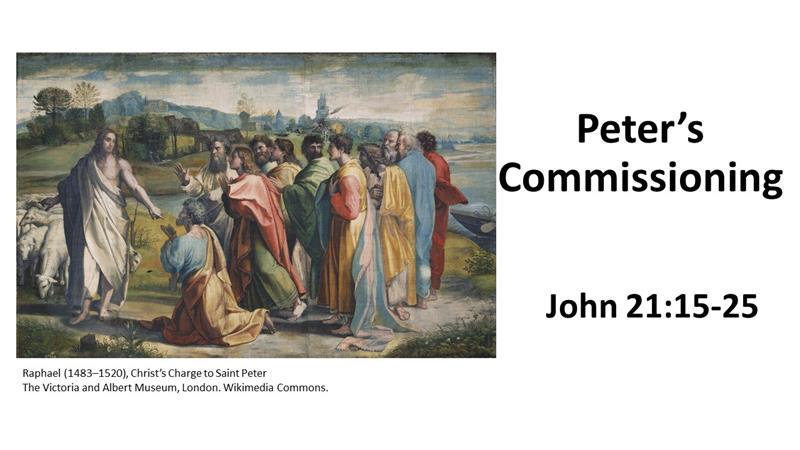
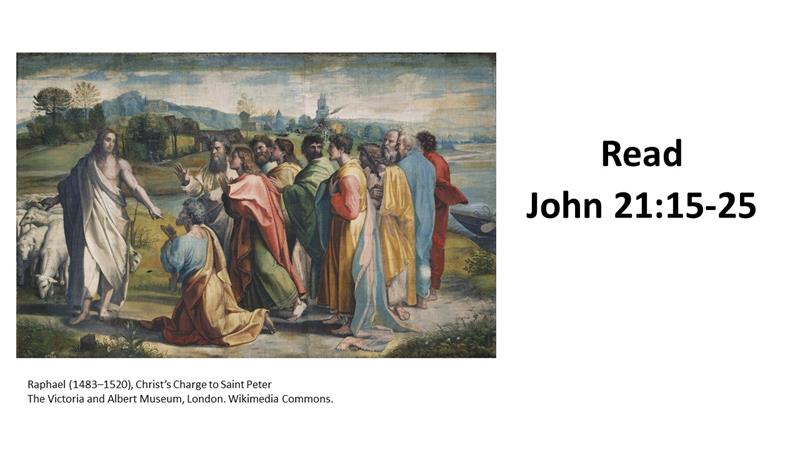
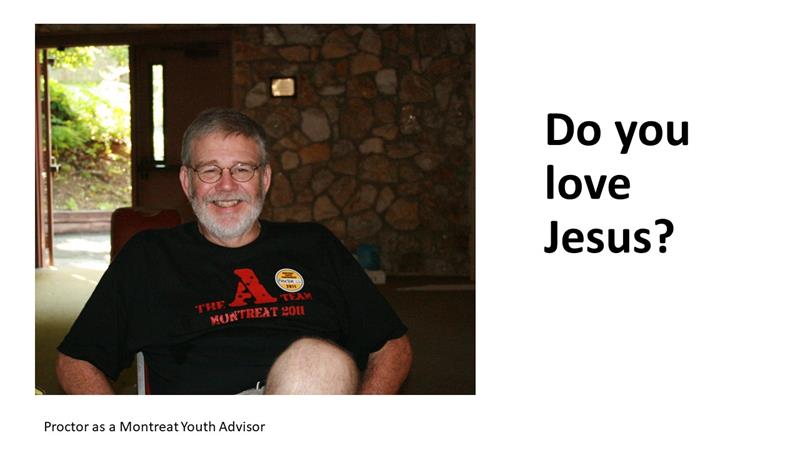 Some of you may know the Reverend Proctor Chambless. He’s a retired minister member of the Savannah Presbytery, and has served a number of congregations within our presbytery and across the South. When I came to this presbytery, Proctor was serving an interim position in another presbytery upstate. He wasn’t here. During the first person examined for ordination as a Minister of the Word and Sacrament at Presbytery, someone stood up and said that since Proctor wasn’t present, he was going to ask Proctor’s question. The question: “Do you love Jesus?” The presbytery, as a body, snickered. I realized I wasn’t in on the joke. I asked someone about this and was told that Proctor always asked that question. When Proctor returned, I figured out who he was before I met him. We had another candidate to examine and Proctor stood and asked this question. It’s kind of a fun thing. The rest of us are thinking probing questions to prod the examinee on the fine points of Reformed Theology, as Proctor, with his deep southern drawl, asks the essential question. “Do you love Jesus?” That’s the question Jesus asks Peter three times. And it’s a question we’re all to ask ourselves. Furthermore, as we’re going to see when we delve into this text, there is one way of knowing that we love Jesus. Do we care for others?
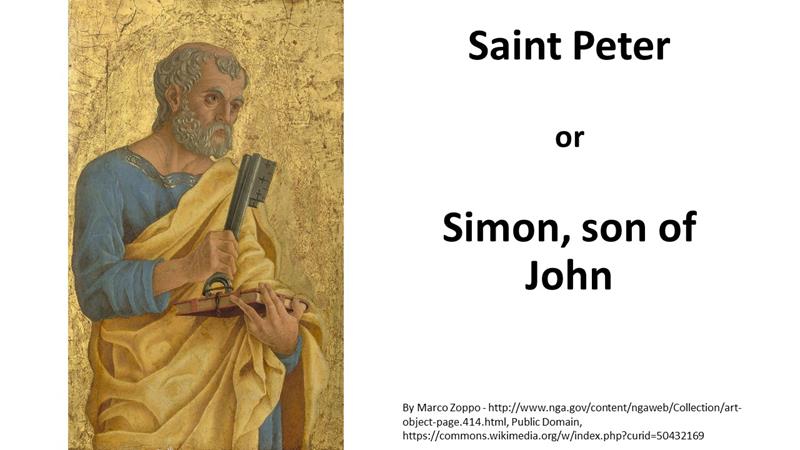 Jesus uses his full legal name. “Simon, son of John.” Did any of you have parents, or maybe a teacher, who when you were in trouble, would use your full name? “Charles Jeffrey!” I would hear that and immediately knew I had done something wrong. Was Peter in trouble? I don’t think so. But Jesus emphasizes the importance of his questioning. When someone uses your full name, it grabs your attention. Jesus asks Peter if he loves him more than these. We can assume Jesus is pointing over toward the other disciples. We’re told that Peter, in two of the gospels, brags at the Last Supper about how much more he loves Jesus than the others, so much so that he’ll never abandon Jesus.
 Now, after everything that has happened—the betrayal, the crucifixion, the resurrection—Jesus asks if Peter really does love him and, of course, Peter responds positively. “Yes, Lord, you know that I love you.” Jesus then tells Peter to feed his lambs. This questioning goes on for three times, with just slight variations.
 We’re not given a sense of just how this prediction of Peter’s death was received, but Peter must have pondered it, for he asks about another of the disciples. Jesus tells Peter a great truth. “Don’t worry about him and his death.” It’s almost as if Jesus is saying, “You have enough troubles. Don’t worry about what God seems to give someone else to worry over.” In other words, accept God’s gift as grace and be thankful.
 Here we are, fifty or so generations Peter.
 During these trying times, when we are hiding out in our homes, we might wonder how we can help anyone. There are ways. The Session, at the request of the Mission and Benevolence Committee, has called for a special offering to help care for the homeless in our community. Do what you can to help. The homeless ministries of Savannah are struggling to meet the needs of those who live under the bridges and on the streets.
 Jeff Garrison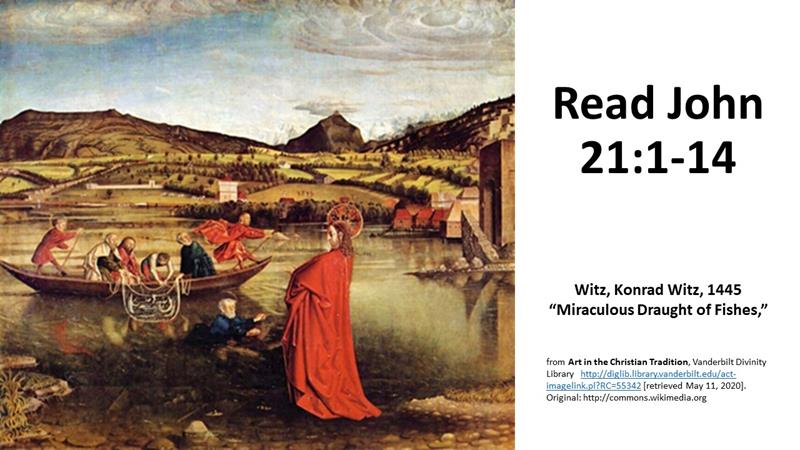
 The best fish are fresh from the water. Even greasy bluefish make a great breakfast when grilled over a charcoal fire on the beach. I was probably 10 or 11 when I first had such a treat. We were fishing on Masonboro Island. It was in the fall, when the bluefish run. We got up when it was still pitch dark and chilly. My dad started a charcoal fire, which helped us stay warm. But instead of sitting around the fire, we soon had lines in the dark water, casting out into surf. In darkness, we fished with bait. On the end of the line, we had a rig with a weight and two hooks, each containing a strip of mullet. When the fish hit, we’d yank the rod to set the hook, then reel hard. Soon, if lucky, a flapping fish could be made out from the distant light of the lantern. We’d have to bring the fish into the light in order to safely get out the hook.
 Leaving our fish on sand, we rebait our hooks and again cast out into the surf. Slowly, the sky changes. The stars began to extinguish themselves. A ribbon of light appears on the horizon, and it gradually growed. We began to be able to make out the beach and could see where the waves were breaking. Soon afterwards, the sun would slowly rise, its rays seemingly racing across the water toward me, as if they whose rays were destined just for me.
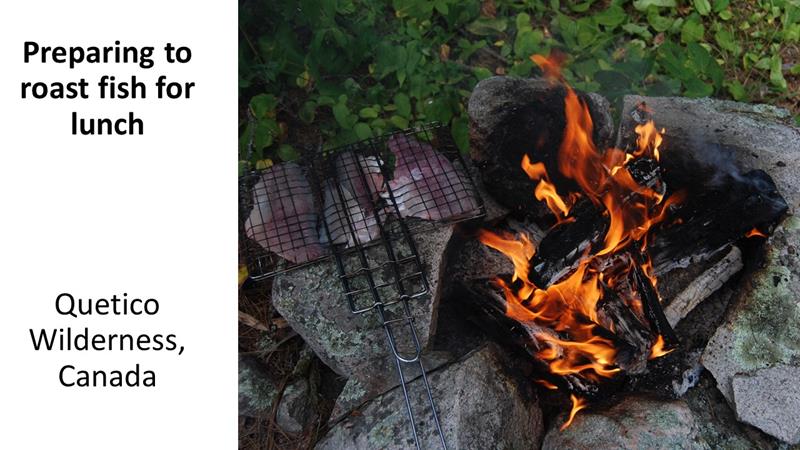 When there was a lull in the action, we’d stop and clean a few fish, washing them off in the surf, and then lay them on a grill over the coals. In a few minutes, we’d be “eatin’ good.” Afterwards, we’d change the rigging on our rods to plugs and spoons and head back to the water’s edge. Good memories of good times.
 Perhaps it was because I grew up in a home where fishing ranked just below church attendance in priority that Peter’s statement, “I’m going fishing” seems normal. And to the six disciples with him, it sounds like a plan. They head to the water and fished the night. They had terrible luck. That happens. Some mornings there are no bluefish for breakfast.
 As I’ve emphasized in these sermons on Jesus’ resurrection, the disciples learn a true lesson. They are not in control. Jesus is in control. We often have this image of going to Jesus, but in truth, Jesus first comes to us. In today’s story, Jesus knows where many of his disciples are. They’re by the lakeshore, fishing, because that’s what they know how to do. So, like when he first called them, he returns to call them again. Next week, we’ll look at how Jesus sends out Peter with a mission, but before we go there, I want us to spend some time in this story.
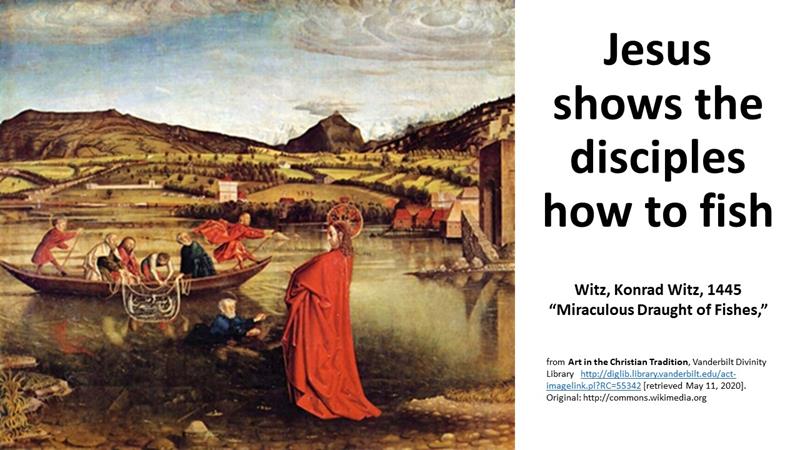
 On this night, the fishing hadn’t been good. Jesus then does something else that goes against fishermen etiquette. “Why don’t you fish from the other side?” That’s like suggesting a different lure or fly. “Take off that spinner and put on a jitterbug; or get rid of that wooly bugger and put on a popping bug.” But Jesus’ advice pays off as they catch so many fish the net is about to break. Only then does the Beloved Disciple realizes it’s Jesus. Before he can act, Peter throws on some clothes, jumps in and swims toward shore.
 Like the other post-resurrection appearances, there’s also bit of mystery. Why do we even have verse twelve? After Jesus calls them in for breakfast, we’re told that no one dared to ask, “Who are you?” They knew it was Jesus, but the text leaves us wondering what’s going on. Furthermore, they don’t recognize Jesus right off. It’s only when they follow his suggestion that they encounter him. There’s probably a lesson in that, too. When we listen to Jesus and do what he says, our relationship grows.
 There are three things that happen to the disciples in this passage that we should take to heart. First, Jesus comes to us. Jesus shows up at the most unexpected places. In these stories, he doesn’t show up at church or the synagogue or the temple. Instead, it’s at work, after or before visiting hours. Think about the post-resurrection appearances. Except for meeting the disciples on the road to Emmaus, Jesus always shows up on the shoulders of the day (at daybreak and in the evening). In this case, Jesus arrives as the disciples are finishing up their night shift at a job that wasn’t going to be paying much this day. As followers of Jesus, we must be ready for whenever our Savior decides to pop by. Jesus is not just Lord over Sunday or over religion, he is Lord of all, and can meet us wherever we find ourselves. This is good news in a time that many of us find ourselves prisoners in our own homes! Yes, Jesus can show up even there, you’ll just have to let him in.
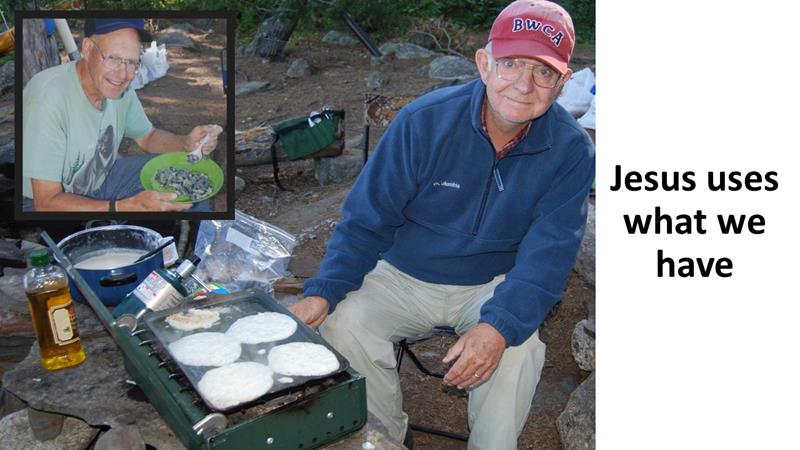 Let me tell you a story to illustrate this. Many of the photos I’ve using today came from a 2008 trip into the Quetico Wilderness in Western Ontario. The guy at the camp stove you see now is Doc Spindler. One morning, he was talking about having pancakes and so proud of himself for prepacking everything he needed. To be helpful, Jim Bruce (who visited us here at SIPC in February and seen in the picture with the full plate) and I went out early that morning, braving the bears as we picked a quart of so of blueberries. We brought them back and Doc was so happy to have blueberries to mix into pancakes. You use what you’re given. Doc knows this. Although a great guy, however, Doc isn’t Jesus. Instead of the baggie with pancake mix, he used a package of meal for frying fish and the blueberry pancakes ended up coming out like goulash. But with a little syrup and butter and an empty stomach, it was still good.
 Finally, Jesus feeds us. In this case, he fed the disciples a hearty breakfast of fish and bread. But Jesus, who calls all who are weary to accept his yoke, will restore our tired souls and feed our minds and bodies with his presence and comfort.
 Jeff Garrison
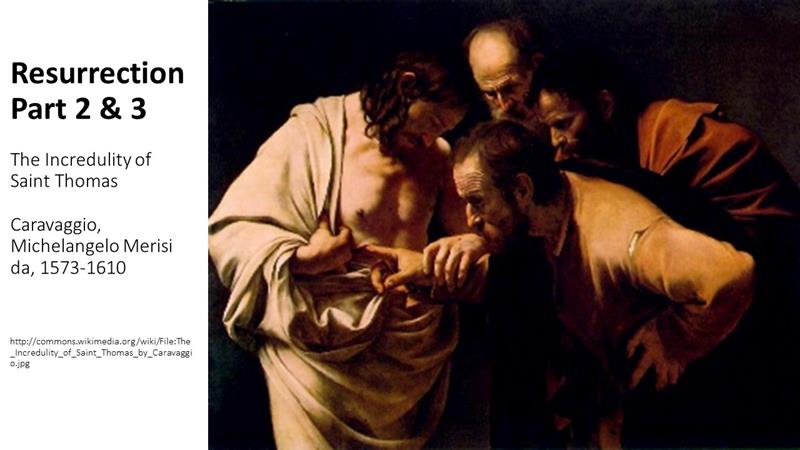
 Like Thomas, I also have doubts. I was just not willing to speak up. Can this really be Jesus? After all, his body was so broken when they pulled him off the cross. Yet, he’s now in front of us. Jesus insists that Thomas, who doubted when they said Jesus had risen from the dead, stick his finger into his wound. I’m watching. Thomas is reluctant, but Jesus grabs his wrist and pulls his hand toward the wound. Can this really be the same Jesus, that just a little over a week ago, hung on a cross? And is he the same Jesus we followed throughout Galilee? Will people believe us when we tell what we’ve experienced? I no longer understand what is happening, but I know that nothing will ever be the same.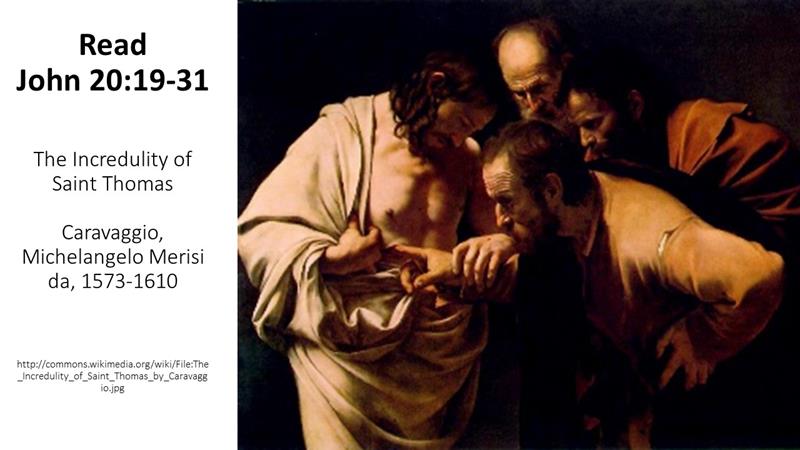
 What a week it. From the Parade to the cross and now on the evening of the first day of a new week, the disciples gather in secret. The doors are locked. Everyone is exhausted. Fright and fatigue show on their faces. After three years, they only have each other. And now there’s a rumor going around, started by Mary Magdalene, that Jesus is alive. Some think it possible, but others believe it’s just idle tale?”
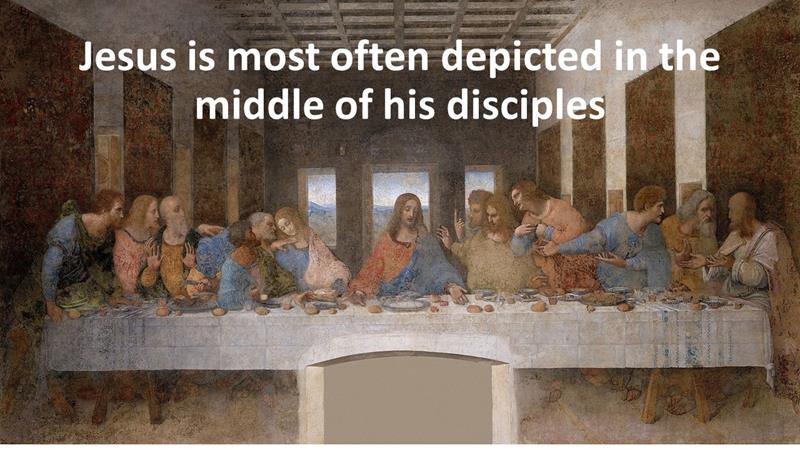 And then suddenly, as the sun sinks in the West, Jesus appears. How did he get through the locked doors? But here he is, when he belongs, in the middle of the middle of the gathered disciples. Jesus was the one who unites the disciples. He’s always in the middle. He was even in the middle of those crucified on Friday. The middle is where Jesus belongs.
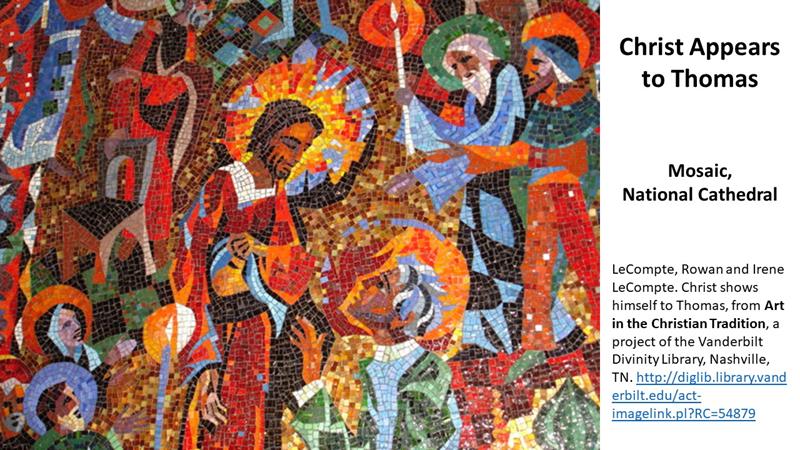 We could argue that this is the climax of John’s gospel. “My Lord and my God,” acknowledges that Jesus is more than the Messiah. We get a whiff of this in Matthew’s gospel where we’re told the women at the tomb worshipped Jesus.
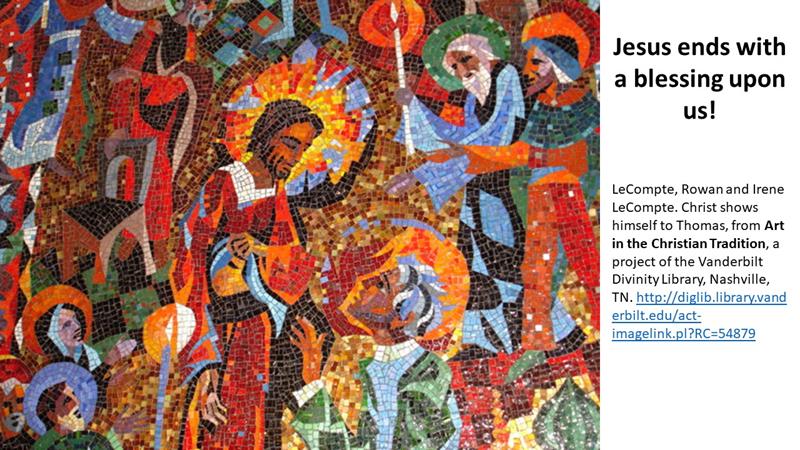 What all this means to us, today, two millenniums after the resurrection? Jesus’ last words in this passage are interesting. It’s a blessing on us. “Blessed are those who have not seen and yet have come to believe,” Jesus says. Did you hear that? He’s talking about you and me; he’s blessing those of us who have not had an opportunity to stick our fingers into his wounds. Instead of seeing, we believe due to the presence of the Holy Spirit and the testimony of others who have felt Jesus’ presence in their lives. And because we have faith in Jesus Christ, we’re to listen to his teachings and to live lives that strive to glorify him. That’s the challenge we have, as individuals, to listen to Jesus and to live faithful.
 Furthermore, as a community of believers, we’re able to offer forgive sins. That’s quite a task. You know, there are a lot of good things that the church does in the community that other groups can also do, and in some cases these groups can even do it better than the church. But there is one thing that no other group can do. The government can’t do it, civic clubs can’t do it, political parties can’t do it—and that’s forgive sins. As God, Jesus has this power and he grants it to his church. For this reason, the church is an essential business. But the church isn’t a building; the church is wherever God’s people are at, which now, hopefully, is in the safety of our homes.
 Jeff Garrison
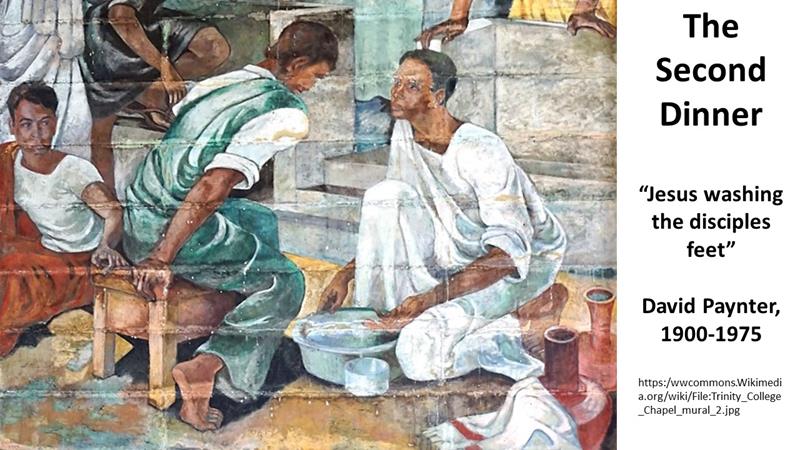
 Jesus and the disciples have booked my master’s banquet hall. I have prepared everything according to their wishes and am ready with the water and basin as I always am. Years ago, my parents gave me to the owner as collateral for the debt they owed. But things did not go well for them, and the debt was never repaid. And so, I work to pay it off. Roman law says that someday I could be a freed person, but I will never again have the full rights in society. I’m marked as a slave for life. I keep my head down and do what the master asks because legally he has the right to punish me.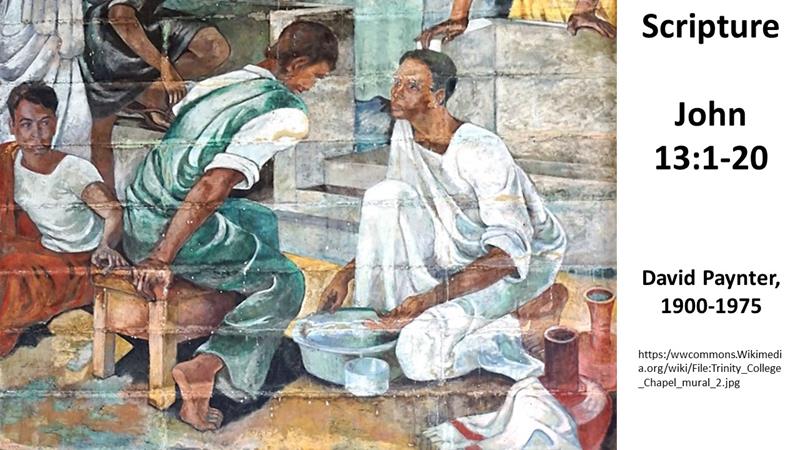
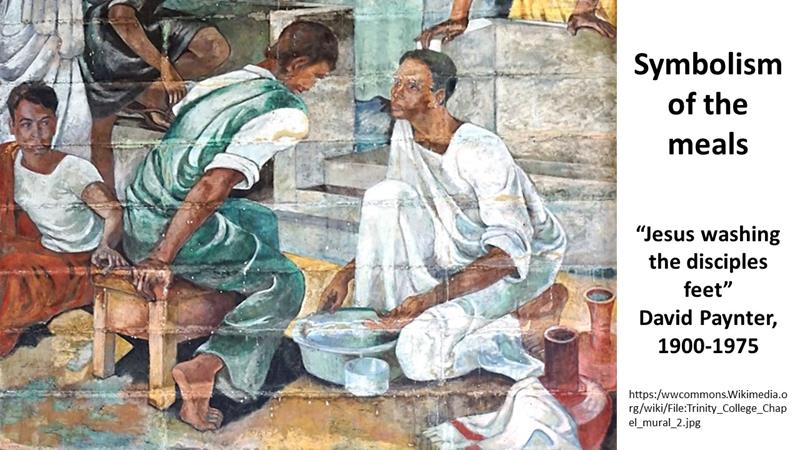 Last week we explored the first meal recorded during Jesus’ final week of earthly ministry. This is the dinner in Simon’s home interrupted by the woman with perfume anointing Jesus. Today, we’re looking at the second meal of this week. Of course, there weren’t just two meals eaten during these seven days. These are just the two recalled in the gospels. Both meals are rich with symbols. Last week, we could almost smell the expensive perfume being poured. This week, we have the bread and the wine, the foot washing, and the betrayal, all mixed in. We know this dinner as the “Last Supper” and there’s enough material here for two dozen sermons. I promise I won’t exhaust the passage.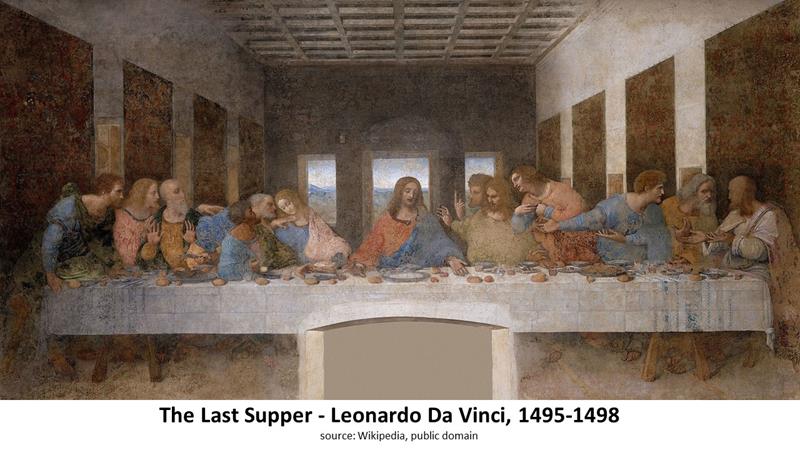
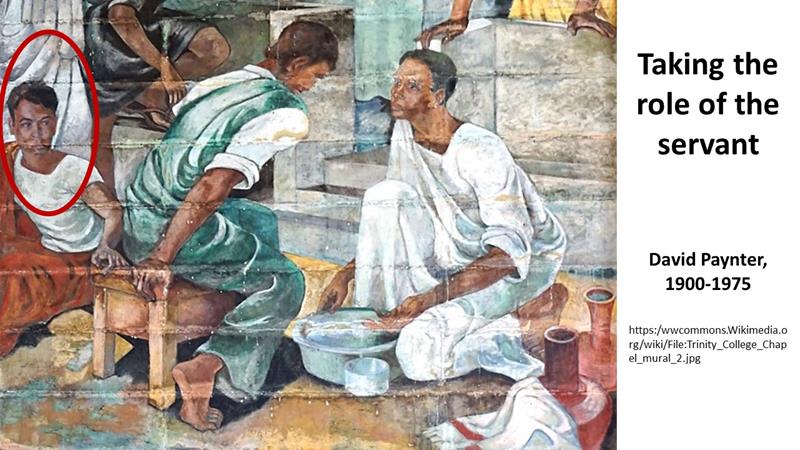

 The second implication of the foot washing is ethical. “I’ve done this for you,” Jesus says, “so you need to do it to one another.” Jesus has shown us how to live our lives. We are called to live in mutual service, showing submission to one another, being willing to forgive when we are wronged, and having patience. All these traits, Jesus demonstrated. We too must learn from the Master. We must be willing to follow his example.
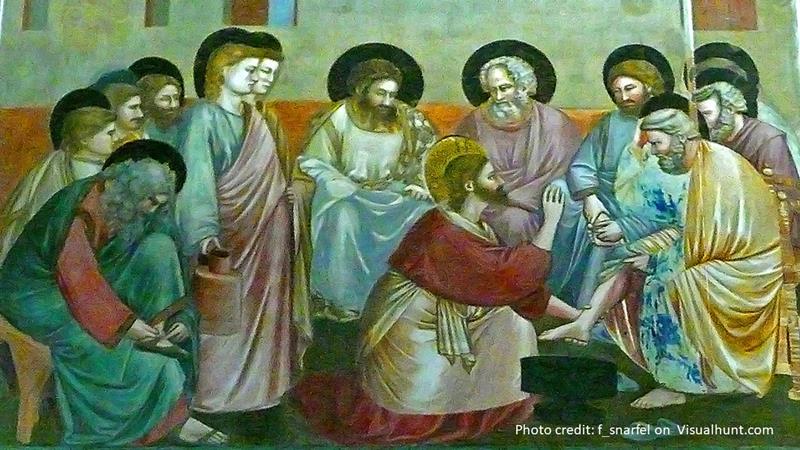 Jesus comes before us at the table, with a towel wrapped around his waist and a basin. He kneels. Do we let him wash our feet? And, if so, are we willing to humble ourselves and serve others in the manner that he has served us? These are questions we need to ask ourselves. Amen.
 Jeff Garrison
  Over a period of a few weeks, a minister listened to a parishioners tell the same fish story many times. Each time the fisherman told the story, the fish took on a different dimension. Sometimes he made the fish out to be a whale and other times it seemed to be just a lively bass. Finally, the minister felt he needed to confront this fisherman about his habitual lying… After worship one Sunday, he called the man aside and told him about hearing the same story told in different ways to different listeners… “Well you see,” the fisherman explained, “I have to be realistic. I never tell someone more than I think they will believe.”
 You know, we can only understand and comprehend so much and it seems that in the passage I just read, Jesus overloads his disciples. He attempts to teach them about the unique relationship between him and God the Father, and our relationship to them though the Holy Spirit. From this passage we learn that our knowledge of God comes from our knowledge of Jesus Christ. Through the life of Jesus, we are able to see God. Furthermore, we learn that through prayer, obedience, and the Holy Spirit we are empowered to carry on Jesus’ work and can experience his peace. This is a passage that deals with the work of the Trinity: God as Father, Son, and Spirit. It’s a lot to comprehend, but Jesus knows his time is short and he needs to prepare the disciples for what’s ahead.
 This passage starts off with Philip begging, “Show us the Father and we will be satisfied.” It’s a natural request. Philip’s descendants must have ended up in Missouri, the “Show Me State.” You know, Philip easily answered Jesus’ call at the beginning of his ministry, as John shows us in his first chapter.
 Jesus asked his disciples to believe that he was in the Father and the Father was in him, and that his words were the words of the Father. The disciples, being normal logical people, had a hard time understanding how the Father and the Son could be the same. As they wondered, Jesus tells them to just believe, and if they couldn’t believe because of what he said, to believe because of the works that he performed. In other words, there are two ways for them to engage with Jesus’ special relationship with God. They can accept his word or be moved by his work.
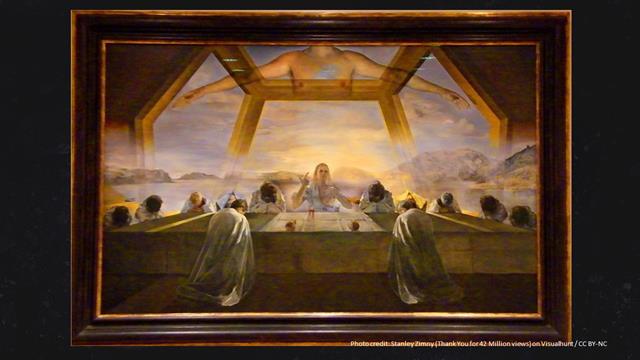 Jesus covers his relationship to God the Father because he wants to get on to what’s going to happen after he departs. After all, this is a conversation around the dinner table the night before the crucifixion. Jesus is preparing the disciples for when he’s no longer going to be present with them.
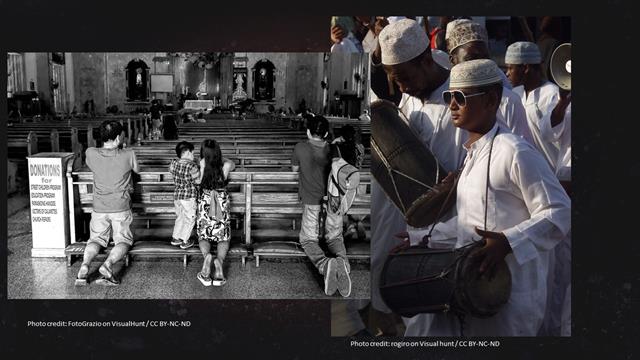 If we pray to Jesus, asking the power to do something that glorifies God, then, he promises, our prayers will be answered. Jesus also promises that God’s Spirit will be with us forever. In other words, we are not abandoned. We are not alone. God is with us. And think about how this has been fulfilled over the centuries. Jesus and his band of disciples made an impact on a small corner of the ancient world, between Galilee and Judea. But within a generation, his followers were planting seeds—from India, to Ethiopia, and to Europe—that would make a significant difference. In 300 years the church would be established all over the region and from there go out into the rest of the world.
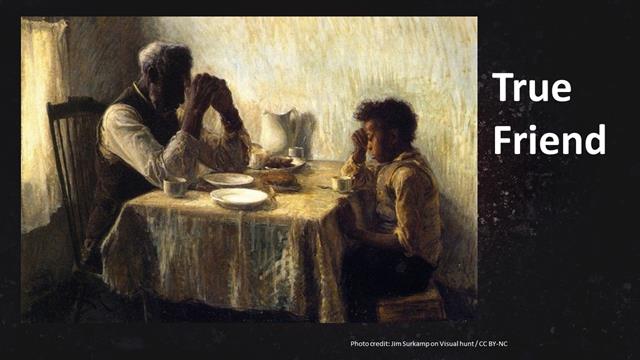 In the 17th verse, Jesus tells his disciples that they’ll be accompanied by a true friend that only they will know. It’s the Spirit that abided with the disciples after Pentecost and now abides with us. In other words, just as the Father is in Jesus and Jesus is in the Father, so we are in the Spirit and the Spirit in us. Knowing he’s not going to be around much longer, Jesus wants to assure the disciples (and us) that they (and we) will be taken care of. Through the Spirit he’ll continue to nourish our souls….
 Let me point out one interesting thing here. The Spirit, as spoken of in verse 17, isn’t to us as individuals. When Jesus says the Spirit abides in you, it’s plural, not singular. In other words, the access to the Spirit is found within the fellowship of the church. It’s within the fellowship that Jesus commands us to love one another, as we abide in God through the Spirit and abide in one another through love.
 The early disciples found comfort in Jesus’ words, and we can too. Though Jesus we can know God, and more importantly, we can be forgiven and found to be righteous so that we can enter God’s kingdom. Furthermore, it is comforting to know God’s Spirit, which was first manifested on Pentecost Day so many years ago, is still with us today, ready to lead the church into the 21st century. As a church, our life must be grounded in the Spirit that abides in us. For this reason, the church always has hope. Despite persecution or indifference from the world in which we live, we have something the world doesn’t. We have God’s Spirit, and we need to trust this gift, because it is all that matters. If we abide in the Spirit, we’ll be okay.
 Rejoice, today is Pentecost. Be bold, for God is with us. Amen.