Thankful for a childhood with plenty of room to wander

Title slide with a photo of the crown of longleaf pines

Happy Thanksgiving. Today I am thankful for a wonderful childhood.


Sheba, our English Setter, barked incessantly in the drainage ditch behind our house. Investigating, I found her moving around a pocket in the clay wall of the ditch. Draining water created these small caves which were common along the ditch bank. 

“What is it girl?” I asked. I rubbed the dog’s head and leaned down to peer inside the hole. A good-sized turtle appeared to be hiding inside. Its head barely stuck out of what seemed to be a black shell. “Good girl,” I said, grabbing a stick. I slid the stick underneath its shell and tried to drag the turtle out when all a sudden its head, fangs flashing, struck the stick just below my hand. Dropping the stick, I jumped back. The snake’s body recoiled. Sheba barked even more frantically. She knew danger lurked. 

I was ten years old and had come inches from being bitten by a water moccasin. Leaving the dog to guard the snake, I ran inside and told dad who came out, grabbing a hoe, and killed the snake. It was too dangerous for something that poisonous to be at the edge of our yard. A year or so later, a snake bit Sheba. Her snout swelling twice it’s normal size. The vet drained the poison and she convalesce a few days. Thankfully, she was soon back to normal. 

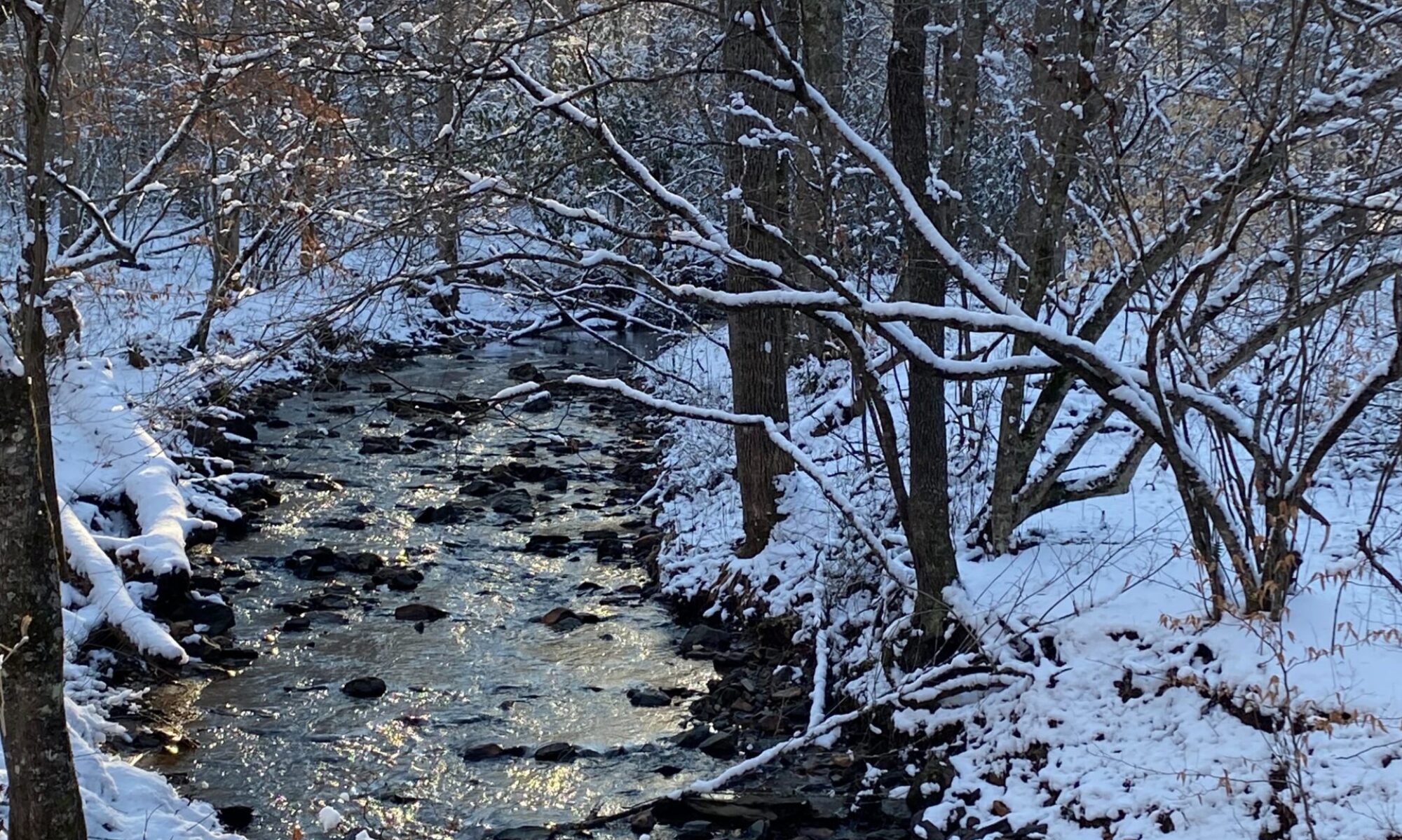
Longleaf forest. Photo taken in Carolina Beach State Park, about 8 miles from where the story took place
Longleaf Forest. This photo was taken in Carolina Beach State Forrest, about 8 miles from where my memoir is set. You can see wiregrass along with prickly pear cactus in bloom. I took this photo in May 2024.

We moved to into a neighborhood called Tanglewood in the Myrtle Grove Sound area when I was nine years old. This was before the big building boom in Wilmington, which started around 1970 and hasn’t yet let up. There were only seven houses on our street, each sitting on a half-acre. Ours was one of the few exceptions. My father brought two lots, not wanting to be “crowded in.” In addition to the woods behind the house, we could cross the street and ramble through more swamps and pine forest until we came to the headwaters of Whiskey Creek, which I thoroughly explored after I purchased my first canoe when I was sixteen. 

The woods across the street were the first to go. They built houses up and down the road. By the time I entered Roland Grice Junior High, all the lots had been sold I don’t remember just when the woods behind my parents succumbed to the great urban sprawl of the Southeast. My last trip exploring the bays and pine forest was during a break from college. A few years later, when visiting, I discovered the ditch filled in and houses standing where woods and bays once existed.

The drainage ditch behind our house was a wonderful place to play as a kid. When we first moved here, there was always water flowing. I didn’t realize this being an ominous sign as they were draining the swampy areas to the south of our house. As kids, we played in the ditch, hunting salamanders and turtles, and caught a few small, red-finned pike. 

Also exciting were the carnivorous plants, especially the Venus flytrap with trigger-hairs in its cupped hands which snapped shut, imprisoning an unlucky insect as it feasted on its decaying body. The ditch also served us as a trench for us to re-enact Civil War battles. Having moved here from Petersburg, Virginia, I knew trenches played a major role during the Civil War. We fought our battles with friends, unaware that just a mile or so away our ancestors skirmished with Union soldiers. This was early in 1865, in a last ditch effort to delay the fall of Wilmington. Lee’s troops, hunkered down in the trenches around Petersburg, needed the provisions blockade runners brought into the city. They held back the Union soldiers long enough for most of the stockpiles at the city’s wharfs to be transported north.

Behind the drainage ditch were several square miles of woods and swamps. These swamps, known as Carolina Bays, consisted of an oval shaped depression filled with peat moss. In all but extremely dry periods, water filled the mossy depressions. Ringing these oval depressions were thick undergrowth including live oaks bearded with Spanish moss, bay trees, and pond cypress. The rest of the land, which was only inches higher than the bays, consisted of white sandy soil in which grew long-leaf pines. Occasionally, one came upon a patch of winged sumac or blackjack oak. Wiregrass covered the ground.

In ages past, these pine forests of eastern North Carolina supported a thriving industry for naval stores and turpentine. Evidence remained of such industry. Slash marks on the trunks of mature trees indicated someone had drained sap from the tree. There were also mounds, which we at first thought were Indian burial grounds, only to later discover they had something to do with burning pines while extracting pitch. But that was all in the past. By the time I explored the woods and bay, they were waiting development. But for a few years, they made a great playground.
Soap Box Derby

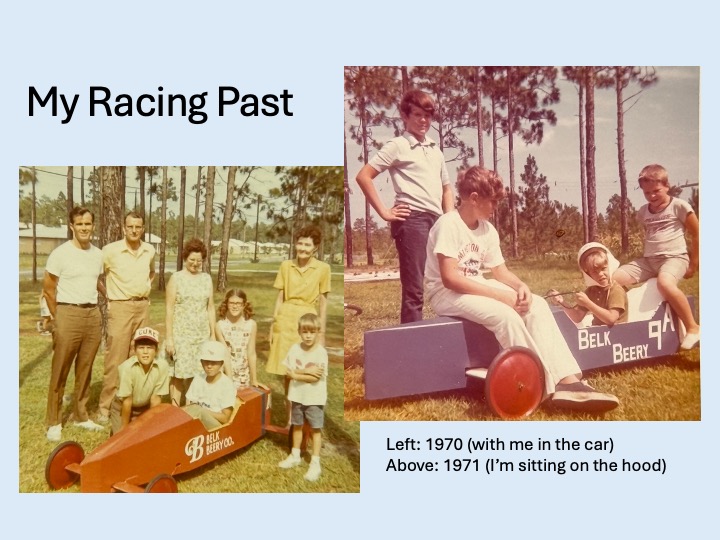
When I was in Wilmington two weeks ago, I spent a lot of time with my sister going through my parents photos and came up with these photos of my soap box derby cars. This is the story of building and racing these cars.

I sat in my car on the starting platform. The platform had been installed at the top of what might be the tallest hill in New Hanover County. They had closed a section of 16th Street for the Saturday running of the 1971 Soap Box Derby. Gripping the wheel and leaning back as far as possible to cut the drag, I glanced over at my opponent.  His car was sleek, constructed of fiberglass, but with lots of metal inside. I knew it would be fast, but I had registered good time during the practice trials and had easily won my first race. 

The starter, holding high the flag, let it fall. The gates dropped and the cars eased down the plywood ramp and onto the pavement. I concentrated on staying low and keeping my car straight in its lane. The cars began picked up speed. I saw the other car pull slightly ahead as we shot toward the finish line. The checker flag fell. He won and my days of racing had come to an end. Later that morning, the car which beat mine became the overall winner. He got to go to Akron, Ohio, for the nationals. 

Soap Box Derby Car
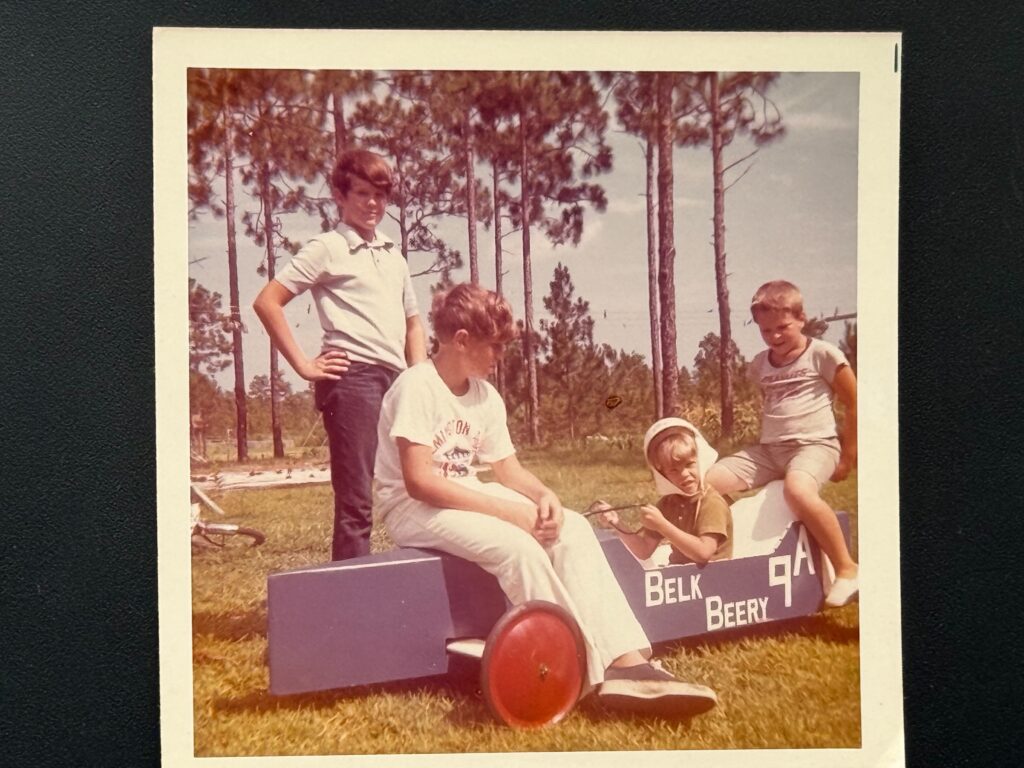
I’m sitting on the “hood” of the my second car with my younger brother sitting inside the car with a friend of his on the back. My other brother stands behind the car.

This was my second year of building a soap box derby. Both years I lost in the second round of a single elimination tournament.  

The Wilmington Jaycees held the event. They provided participants with a basic kit which included wheels and axles, a steering wheel, wire, and brake assembly. The sponsors of our event cover the cost and provided a small amount of funds (I think it was $35, which wouldn’t today purchase the plywood) for everything else. I used two sheets. I cut the floorboard and the bulkheads out of ¾ inch plywood. The body I fashioned out of ¼ inch plywood. The metal axles went inside a 1-inch board. Cutting a channel half way through the boards, I chiseled out a channel for the axle. Then I planed down the front side to make the axle cover streamlined. 

Those of us who were drivers were to build our own cars with only adult supervision.  The first year, I built my car under the carport at our house with David Hunter. David’s father had recently died, so my father served as both of our supervisors. We were to build our cars ourselves, which my father ensured except for the rough cutting of the ¾ inch plywood, which required a circular saw. My father insisted we were too young but allowed us to use jig saws to cut out the bulkheads. Each of these he had us file down to make smooth. I remember lots of stokes using a half-moon file. 

The floorboard also had a wooden cutout for a brake. The pedal was made of plywood left over from the center of the bulkheads. A wire ran from pedal to the break in the back, where a wooden 2×4 with a piece of tire on the bottom served as the brake.. When pressed, the brake descended to the road and slowed the car. 

Then I attached the bulkheads with angle braces. This was in the day before power drivers, so we drilled pilot holes and used screwdrivers to fix the screws and bolts. 

The rear axle and cover were attached with bolts to the back of the floorboard. The front axle was attached with a single bolt, allowing it to move two inches. This was for safety since we were running a straight course. If we could have steered any more, there would probably be cars running into each. This was just enough movement to allow us to make minor adjustments to our path. I then installed the steering wheel between the first two bulkheads in the front. A wire wound around the steering wheel shaft, threaded through pulleys, ran out to each side of the front axle. This allowed us, when racing, to turn the axle slightly to adjust for bumps in the pavement. 

At this point, we attached ¼ inch plywood over the bulkheads. The sides were rather simple, but the top required us to use a circular saw with the blade set about 1/8 of an inch to cut strips underneath the plywood, allowing it to bend. With barely any blade showing, my father decided to let us use the saw ourselves. 

Once all the plywood was attached, we installed a seat, covered screw holes with putty, and painted the car. My first year, I chose orange with a blue racing strip. For my second year, I used purple with a white stripe.  Since we could have a professional do the sponsors lettering on the car, my father volunteered to do it. 

family and soap box derby car
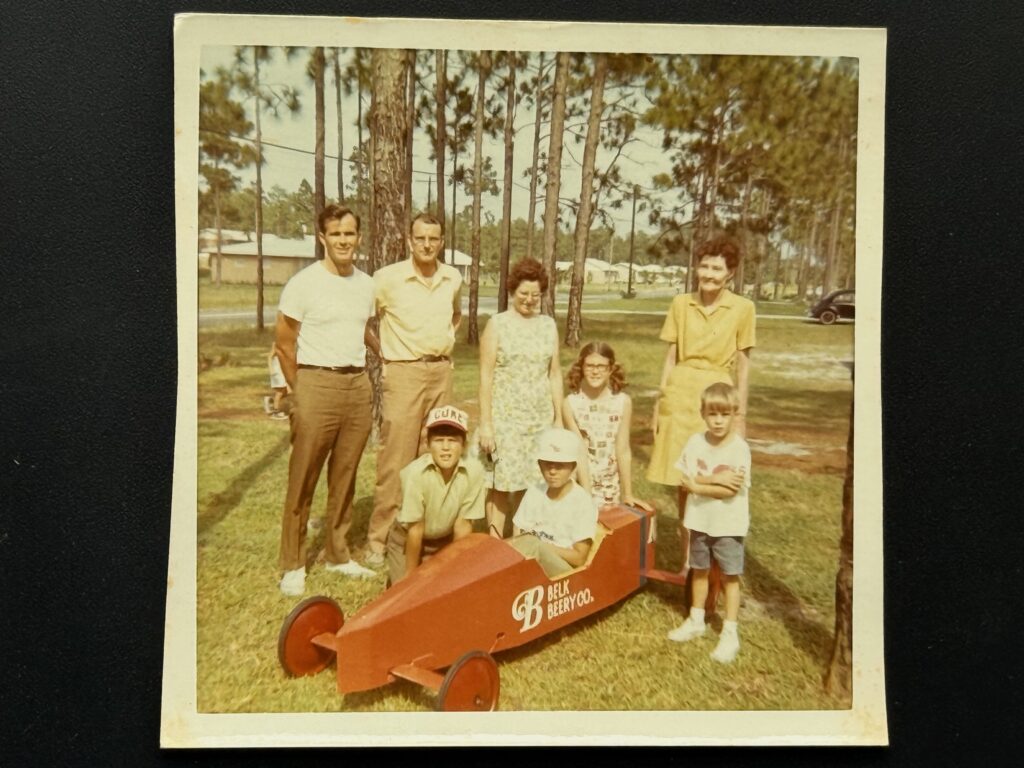
My first car. I’m sitting inside, flanked by my two brothers and sister. Behind is my father, my grandparents on my father’s side and my grandmother on my mother’s side.

When the car was done, we hauled them on a flatbed trailer the day before the race to a warehouse which had been reserved on 13th Street. There, they checked our cars to make sure they weren’t too heavy, and everything was safe and to regulation.  My car the first year was about 30 pounds lighter than it had to be. When they checked us in, they kept our cars impounded until race day. 

That evening, after the race, the Jaycees threw a banquet for us. We were presented with medals and endured motivation speeches by a couple of the Jaycees.

In building my second car, I mostly worked by myself since David didn’t sign up to build another car. Moving my radio out to the carport, I remember repeatedly hearing that summer Three Dog Night sing “Joy to the World” as I worked.  

I had learned a few things from my first car. I wanted the car to be more streamlined and heavier. Trying to figure out how to add weight, my father suggested that instead of buying lightweight angle braces, we use ¼” steel angle iron. Someone he knew cut them into 2-inch-long angles. At the front and back, I used six-inch-long angle iron. This was overkill, but it added weight. Drilling through the iron was difficult, but it was worth it for the weight. I also added more ¾ plywood in the bracing and using solid pieces at the front and back. By the time I completed the car, it was only about 2 pounds under the maximum. The added weight and the sleeker design created a faster car than my first traditional design.  In the end, it didn’t matter. The fastest car knocked me out in the second heat.