
Remembering George

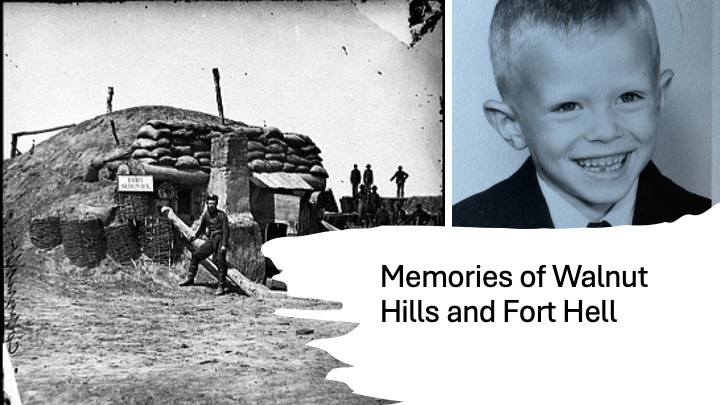
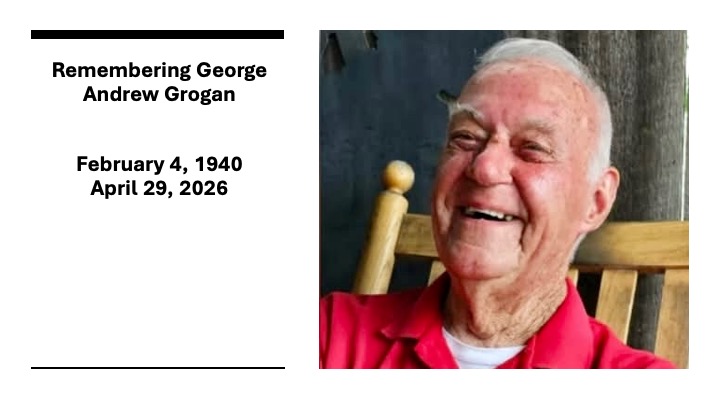
Title slide with photo of George Gorgan

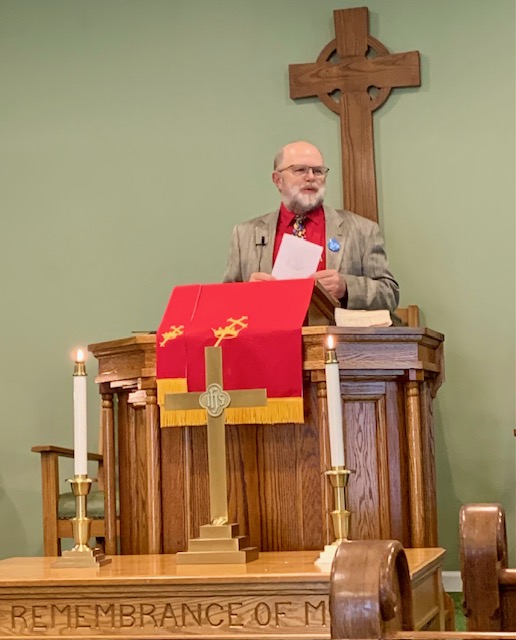
Last Wednesday we held the funeral for George Grogan at Norris Funeral Home in Stuart. His burial at the Oakwood Cemetery in Martinsville. I was asked if I would make my remarks available, so I’m posting them here. George grew up in Martinsville, where after a stint in the Army, worked for the Post Office. After retiring, he moved up on the mountain and became a beloved member or our community. The location of the funeral in Stuart made it easier for friends from both Martinsville and Meadows of Dan to attend.

The Eulogy: Memories of George

George Grogan
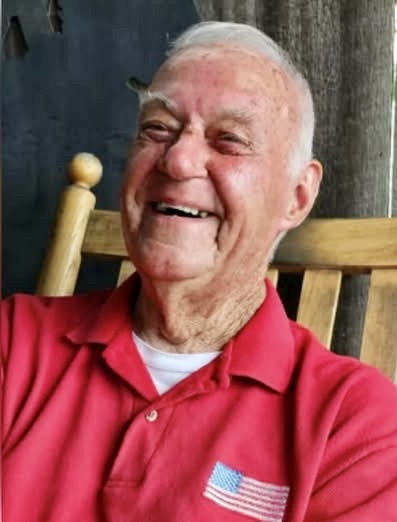
George obituary photo by Norris Funeral Homes

We lost a good man. George came from a small family. Having no children of his own, George Grogan loved and doted on his nephew and niece, Trip and Elizabeth. He gave them other names, “Dude” and “Sug.” He taught them to swim and ride a bike. George took the two of them to the beach and to the pool in the summer. In the winter, he took them sledding. Instead of building traditional snowmen they’d fashioned dinosaurs and dragons and use food coloring to make them more life-like. (There must have been a little bit of Calvin, as in Calvin and Hobbes, in George). He taught Elizabeth how to drive in Oakwood Cemetery, where we will intern his body this afternoon.

As Trip recalls, he was the best uncle anyone could ask for. After all, how could you go wrong with an uncle who joked his Christmas present for you made the list of the top ten most dangerous toys that year! Or when helping Liz with a leaf collection for school, they collected 32 instead of the minimum requirement of 10, far overachieving the rest of the class. Or who took you to all the top movies as they were released. 

George almost always arrived at Mayberry Presbyterian Church before or as I arrived on Sunday morning. He’d bring with him a delicious dish for the brunch after church—sometimes a sweet dish but often some kind of grits. I joked with him about the need to spice up his grits with jalapenos. “No,” he firmly insisted. But he did relent enough to make grits with pimentos the next week.   

One Sunday, I brought jalapenos poppers: peppers stuffed with cream cheese and wrapped in bacon. I planned to egg on George. The joke was on me. He wasn’t in church that Sunday. It turned out this was one of his stays at New River Valley Hospital. I wrapped up two of the poppers in foil and took them up to George at the hospital that afternoon. “Get those out of here,” he laughed as he rose up from bed and pointed to the door. A nurse gladly took them off George’s hands.   

While I couldn’t tease George into exploring spicy food, he was a wonderful cook. And while George may have seemed set in his ways, he was open to change. As a mail carrier who walked throughout the city of Martinsville, George had a great dislike of dogs. They were his nemeses. I don’t know what it is about dogs, but their DNA seems to contain a distrust of mail carriers. 

But after he retired, someone needed a volunteer to dog sit a Lab. George, wanting to be helpful, agreed, and fell in love with the dog. From then on, he always had a dog. The last, which also shows his humor, being Knucklehead. It took me a while to realize that was the dog’s name, not just what he was called. 

Another area in which George held firm was politics. As one friend said, George was one of five people in Patrick County who would admit to being a Democrat. And there was that bumper sticker which left no question as to where he stood. But that aside, Geoge was always civil even to those with whom he disagreed. He never condemned others. George showed us how to be respectful in a world filled with hate. We need more people like George in our world. 

Chicken George sign

George enjoyed joking around and having a good laugh. Who else would relish in nicknames like “Chicken George,” as the sign Mike Gillette made which he proudly displayed on his house. George always had a flock of chickens. Mike also made a sign that read “Chicken Crossings.” Motorist didn’t always abide by the sign as George lost several chickens to traffic on DeHart Road. 

Trinity, a longtime friend , confided to George about leaving a pot of water on the stove. The water boiled, leaving a ruined dry pot. Geroge reassured Trinity that it won’t get any better with age. Charlie runs the kitchen at Poor Farmers. George started his day with coffee and a sausage biscuit from there. Charlie shared a story about George making her an origami ring out of a dollar bill . Then he proposed with it. 

George enjoyed walking the hills around Marby Mill and Rocky Knob with his dog and always appreciated running into friends. Beth Ford tells about how she could never remember his dog’s name. They’d met up on a trail and she called the pooch, Bull Shirt, which bought laughter to George. 

Beth also told me about working the polls in Meadows of Dan and how George would always stop by mid-day on election day with a treat he’d whipped up in the kitchen. He acknowledged and thanked them for their hard work and a long day that starts before sunrise and ends long after sunset. 

This past election, just a few weeks ago, George came in to vote. Exhausted and not doing well, he still wanted to do his civic duty. Beth said they were willing to take a folder with a ballot inside to his car, but he insisted on coming in. He then sat down to catch his breath, smiling at everyone. He allowed her to bring over a ballot. After he voted, he said, “Thank you so much for this.” And those were the last words she heard from her friend. 

Bob Potter tells about running into George at the Dollar General. He was heading into the store with a plate of cream puffs he’d made to give to the cashier on her birthday. 

George was always present to help with Pancake Days and VFW spaghetti dinners. He was up early to grab coffee at Poor Farmer’s Market and to exercise with the morning stretch class. George was laid back and really wanted what is best for our community. 

He was also a caring and nurturing man. He loved his mother so much that on his birthday, he’d send her flowers to thank her for giving him life. And in her later years, after she was confined to a wheelchair, he took care of her. He also helped take care of his older sister during her last days. And even while he was sick during the last months of his life, George took things in stride. 

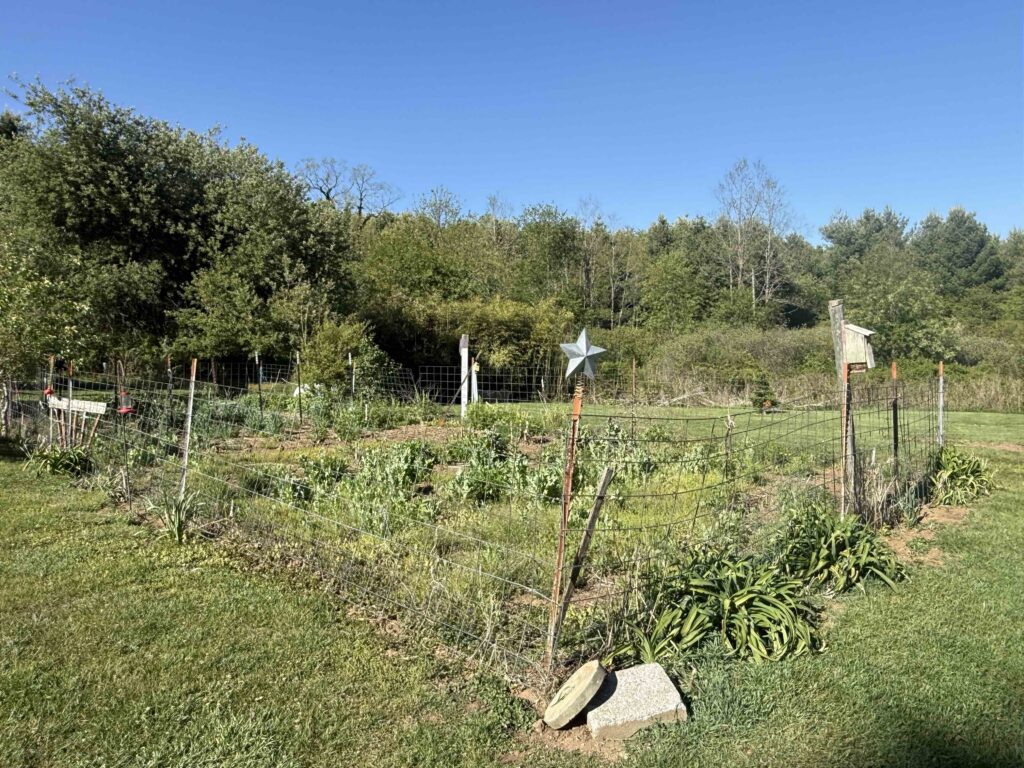
George's garden
George’s garden. George wasn’t up to doing work here this spring, but he did have his onions in.
George's home
George’s home seems quiet without the clucking of chickens

There’s a lot more that could be said about George. He was an incredible gardener and often supplied fresh flowers for Mayberry Church or brought extra produce to share. I encourage you to share your stories of George with each other today, to honor this gentle giant of a man. 

We will miss him. The best way we can honor George is to learn from his demeanor, to care for others, and to jump in and help our communities thrive. 


Be like George button
Through the effort of Barbara Wagoner, Be Like George buttons will soon be available at Mayberry Church and in the Meadows of Dan community.

Homily for George Gorgan’s Funeral

For my homily this afternoon, I want us to look at the 23rd Psalm, a hymn of confidence which acknowledges the hurt and the pain in our world. But it also reminds us of God’s presence in times of trouble. Listen, as I read the Psalm from the King James Version. 

The Lord is my shepherd; I shall not want. He maketh me to life down in green pastures: He leadeth me beside the still waters. he restoreth my soul: he leadeth me in the paths of righteousness for his name’s sake. Yea, though I walk through the valley of the shadow of death, I will fear no evil: for thou art with me; thy rod and thy staff they comfort me. Thou preparest a table before me in the presence of mine enemies: thou annointest my head with oil; my cup runneth over. Surely goodness and mercy shall follow me all the days of my life: and I will dwell in the house of the Lord forever. 

The author of the Psalm, credited to be the shepherd king David, knew from experience God supplied his needs. He experienced first-hand God’s mercy. Using rich metaphor’s, God is compared to a shepherd who leads his flock to fresh green grass and still waters where the sheep might be able to get a drink. George was a shepherd to his chickens, caring tenderly for them. 

Just as the grass and the water restores the bodies of the sheep after a long trek through the desert, the Psalmist experienced such nourishment from God after treks through the desert of life. The God who restored his soul is the same God who restores our souls. Like a good shepherd, God revitalizes our lives when everything seems hopelessly chaotic. God as our companion can transform every situation.

Now this does not mean there is no hurt to be felt in the world. The Psalmist recognizes the deep dark valleys we must cross. A shepherd, experienced at leading his flock up through canyons and gorges, knows of the importance of being there beside his sheep. Where the trail narrows and the cliffs rise steeply on both side, danger lurks behind every bend. But the sheep remember yesterday’s taste of fresh grass and clear water, and trusting the shepherd, move forward in the face of danger.

Likewise, George experienced much trouble over the last few years as his medical challenges grew. George knew his time was short. I saw him last Thursday. He remained in bed and acknowledged the end was near but was okay with it. He trusted his Savior. I saw him again on Monday. He seemed to be doing better. He remained at peace, Although his energy remained low, at times he laughed at something said. His dog, Knucklehead, remained at his feet. At this point the decision was made that he’d be moved into hospice, which happened later that evening. 

In the Psalm, an interesting stylistic shift occurs in the third verse. God is no longer spoken of in the third person as in the beginning of the Psalm. The author realizes during journeys through the valley of the shadow of death that God, like a shepherd, has become more real and more present. Instead of saying, “God is with me,” the Psalmist addresses God in the first-person present tense: “I fear no evil for you are with me.” The author admits, at times like this, he hurts and is afraid, but God is so close that he can address God intimately.

Having acknowledged God’s deeds in the past, the green grass and the still waters which provide of nourishment for our bodies and souls and having experienced God’s presence in a time of trouble, the Psalmist concluded this song with a statement of confidence in God’s future. “Surely goodness and mercy will follow me all the days of my life and I shall dwell in the house of the Lord forever.”

We can be comforted in God, not because of any myth which denies the existence of pain, but because God promises to be present with us when we suffer. God the Father, having experienced the death of his Son Jesus Christ, knows our pain and promises to be there with us. God the Son, as a man named Jesus, experienced death and knew what George experienced last week as he left this life. Jesus promised we would never be alone. God’s spirit is here with us, just as God’s spirit was present with George, as they moved him to hospice where he would die a day later.  

God’s presence can help us cherish our memories and come to terms with George’s death. Amen. 


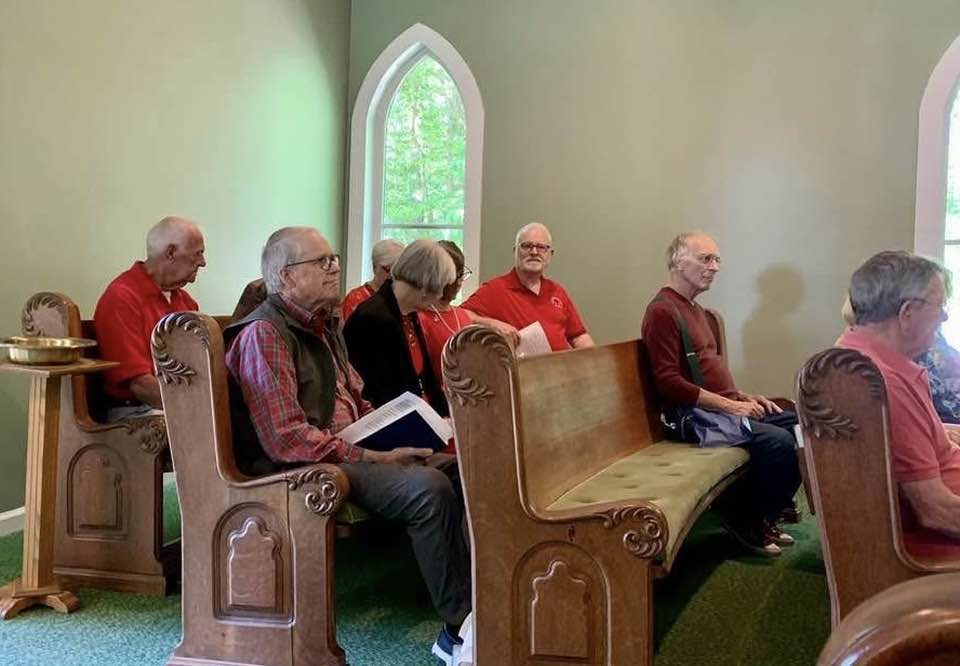
George on the back row on Pentecost 2025
George, at his place on the back row at Mayberry Church, Pentecost Sunday 2025. Thanks to Beth Almond Ford for sharing this photo.

To view George Grogan’s obituary at Norris Funeral Services, click here.

Can we really avoid judging?

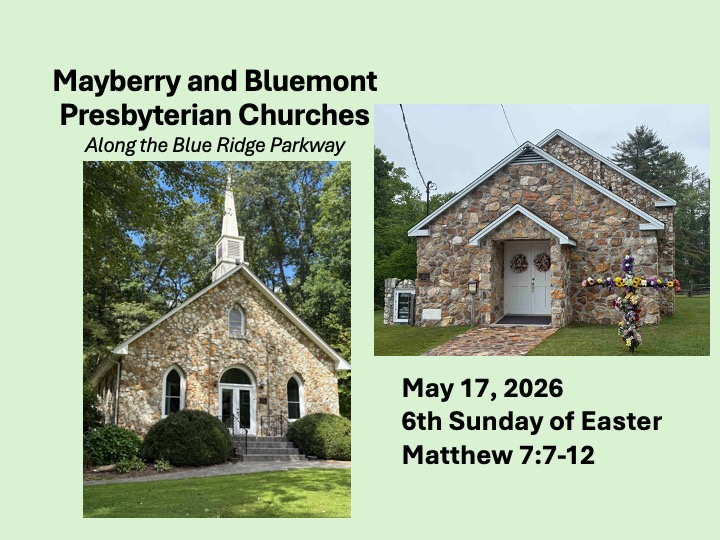
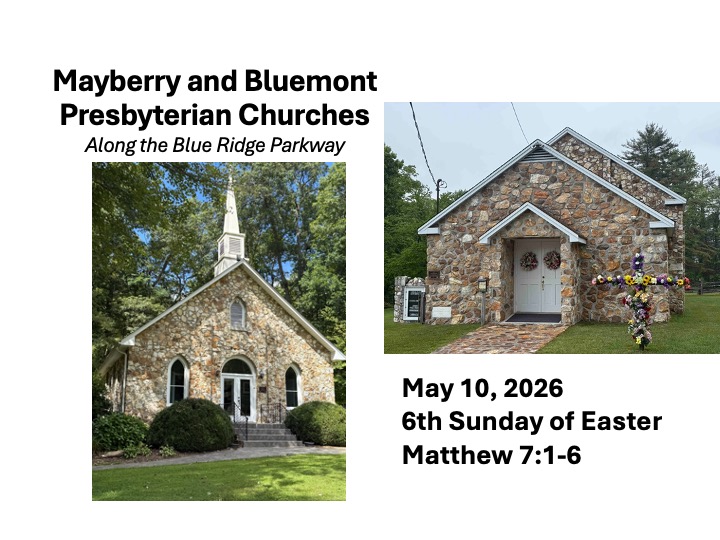
Title slide with photo of Bluemont and Mayberry Churches

Jeff Garrison
Mayberry & Bluemont Churches
May 10, 2026
Matthew 7:1-6

Sermon recorded at Bluemont on Thursday, May 7, 2026.

At the beginning of worship:
Are any of you Eeyore’s? You know who I am talking about, don’t you? The donkey with floppy ears in Winnie the Pooh. He’s always down and out. If the sun shines, he worries about a drought. If raining, he knows they’ll be a flood. 

You know, friends who are Eeyores, they drag us down. They take a lot out of us. It’s easy to judge such friends as unworthy of our attention. Yet, the Eeyore’s of the world need friends. And we all know this. All of us have at one time or another, found ourselves in a funk. At such times, friends help us get through the darkness. 

A suicide prevention article from years ago had this take on Eeyore: 

One awesome thing about Eeyore is that even though he is basically clinically depressed, he still gets invited to participate in adventures and shenanigans with all of his friends. And they never expect him to pretend to feel happy. They just love him anyway, and they never leave him behind or ask him to change.[1]

If you are an Eeyore, I hope you have the same experiences as Pooh’s flea-bitten friend. May you have all kinds of adventures and shenanigans. Who here wants to oversee shenanigans in the church? As a church, we should be willing to welcome all Eeyore’s and others who are easily left behind. We need to create a counterculture community, which pushes back against the common view of Christians as judgmental. We should strive to create a community which displays hospitality, one that not only welcomes the Poohs and Tiggers of the world, but also the Eeyore’s. 

Before reading the Scriptures:
We’re moving into the final chapter of Jesus’ Sermon on the Mount. Chapter 7, verses 1-12 are consider the last section within the meat or the main part of the sermon. Today, we’ll look at the first half of these verses. Next week, will finish the middle section. By splitting these in two, we can focus more in detail. After verse 12, Jesus ends with a few other topics as he brings this all-inclusive sermon to a close. 

Our passage begins with sharp words. “Don’t judge.” What does Jesus mean? 

Read Matthew 7:1-6

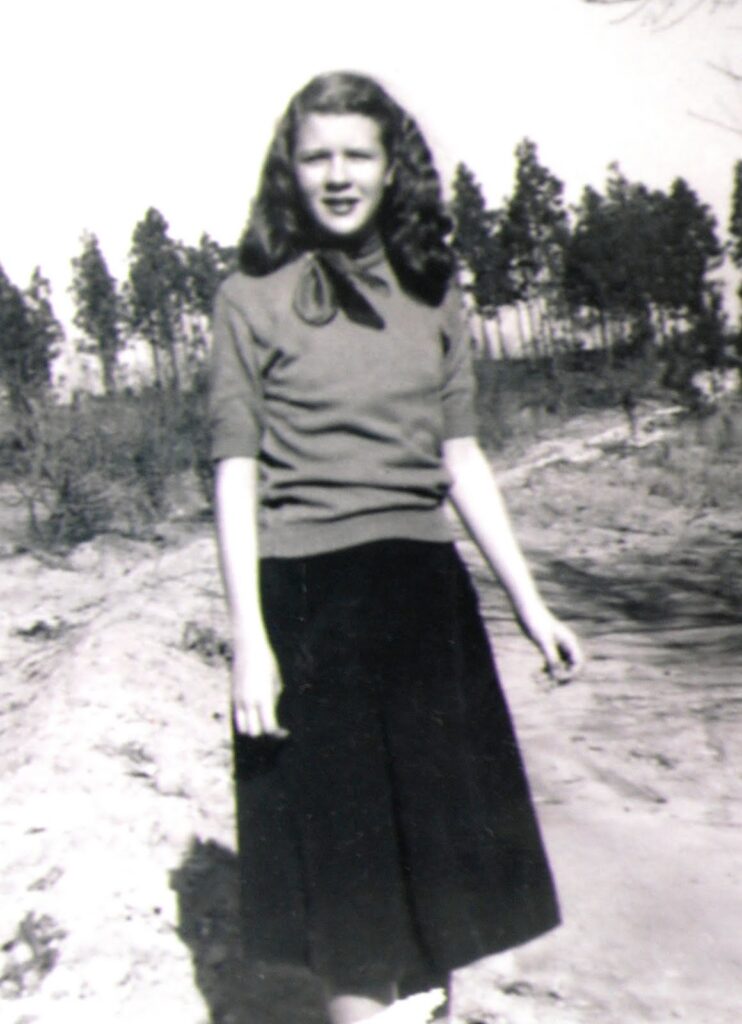
My mother in 1955

Today is Mother’s Day. So let me talk a bit about my mom as one of her traits applies to the broader meaning of this text. Mom had the capacity to always think first about the feelings of others. She also tried to instill such feelings in her children. As we’re talking about judging, I’ll let you be the judge of her success. However, I admit I fall short of what she taught. 

In the 5th grade at Bradley Creek Elementary School, during the winter when the weather was bad, we held PE on the stage of the auditorium. The school had no gym. There’s not a lot you can do up there on the stage, so our teacher decided we would learn to dance. This brought groans, especially from the guys in the class. And probably a few girls who didn’t want to dance with us. But I’m not sure about that. Among us guys, as we talked about the prospect of dancing, we realized this meant we had to dance with certain girls. One of the girls was the only African American in our class. Of course, that wasn’t how my friends referred to her.

That day, I came home from school, bragging as had my friends that I was not going to dance with her. My mother exploded. “Yes, you will!  You will not hurt that girl’s feelings.” She then picked up the phone and proceeded to call my teacher. She told him I better be willing to dance with her. 

I wonder if my mother’s concern for the feelings of others came from her own background. Her family struggled and she always had a bit of inferiority complex. Part of it may have come from her father, whom she adored, but who also spent time in the slammer for bootlegging. My great-grandmother had such disdain for her son-in-law; she left the land and house she owned to her daughter and granddaughters, to keep it out of his hands. While my father’s family wasn’t rich, they were certainly better off financially and didn’t have such baggage hiding in the closet. At least, not that I know of, for one of the things we see throughout the Sermon of the Mount is that we don’t always know the heart and secrets of others. This is a part of the reason we’re not too quickly judge others. 

Whatever reason, my mom was well tuned to the feelings of others. It’s a noble and Christ-like trait. 

In The Message paraphrase, our text today begins, “Don’t pick on people, jump on their failures, criticize their faults—unless, of course, you want the same treatment. That critical spirit has a way of boomeranging.”

I like the fresh way that Eugune Peterson translates this passage in this paraphrase, but I think he may have missed one point. We don’t judge to keep others from judging us. This is not a “tit-for-tat” suggestion. “I won’t judge you if you don’t judge me.”  That’s not even healthy for all of us need healthy criticism to grow and mature spiritually. Otherwise, with no guardrails, we can go astray.

The judgment Matthew speaks of us avoiding by not judging  is not the condemnation of others for our sin, but God’s judgment.[2] If we judge unfairly, God will judge us. In the Sermon on the Mount, Jesus envisions an accountable community which looks out for one another. 

Often, people cite this passage and use it to condemn all judgment. I recently heard this passage cited against challenging political behavior. This isn’t what Jesus means by not judging. 

Discernment is a Christian discipline which requires us to make judgments. Later in Matthew’s gospel, Jesus instructs the disciples on how to confront others guilty of sin.[3]  Paul, in his writings to the Corinthians, condemns then for not confronting one involved in a grievous sin which has the power to destroy the church.[4] Again, such a situation requires judgment. In a way, we can’t avoid some judgments.  

One commentary suggests a better translation of the opening verse might be, “Do not judge unfairly.”[5]  Jesus addresses here a social sin, “judgementalism.”  It’s the sin of constantly finding fault with what others say and do. And not only do we find fault in others, but we also overlook the faults we harbor. Judgmentalism indicates a disease within our spirit, for we assume we are superior to others.[6]  While there are times we are called to judge, we must do so honestly and with humility and mercy. 

To help clarify what he means, and perhaps to lighten things up with a bit of humor, Jesus tosses in a parable. Don’t go around trying to take a speck out of someone’s eye when you have a log in your own eyes. Try to imagine your optometrist looking at your eyes with a log in his. The verbal picture here is quite funny.

Jesus essentially says need of healing before we can heal someone else. Furthermore, Jesus’ command, “don’t judge,” doesn’t mean “don’t think.”[7] At times, discernment becomes necessary. But we must be merciful. As Bo Diddley asks in a classic blues tune which was later recorded by Eric Clapton, “Before you accuse me, take a look at yourself.” 

Another point to understand. In verse 5, Jesus uses the word “hypocrite.” We’ve heard this word before in the Sermon on the Mount, but this time is different.  Elsewhere in the Sermon, Jesus used it to refer to those outside the community of believers, generally the Pharasees and Sadducees, but here, Jesus refers to those inside the community, believers who don’t live up to their calling.[8] Yes, as we well know, there are even hypocrites inside the church. We must be careful of how we look at others, considering our own sin and also knowing we don’t know their hearts.  

After the parable, Jesus makes a strange statement in verse 6. “Do not give what is holy to dogs; and do not throw your pearls before swine.” This is one of the harder sayings of Jesus to understand. It certainly shows the culture of that time and that part of the worlds, where dogs and pigs were considered unclean, so you had to discern what to and not to give them. That which is holy and valuable have other uses.  

Perhaps Jesus adds this statement to remind his listeners we need to discern or make judgments. Otherwise, they might toss away valuables.  

So yes, despite a literal reading of verse 1, judgment may be necessary. But judgment must be done with justice in mind. We must be honest and fair with those we judge, so that we won’t do so prejudicially. Furthermore, we must be honest about our own faults which can prejudice our decisions. 

We all stand in need of forgiveness. We can’t use the sins of others to boost our standing. Instead, in humility, we accept our need of divine forgiveness and, as Jesus and my mom taught, be concerned about others. Amen. 


[1] This was from “Suicide Prevention Australia” and found on Facebook in 2014.

[2] Douglas R. A. Hare, Matthew: Interpretation, A Commentary for Teaching and Preaching (Louisville, KY: JKP, 1993), 7

[3] Matthew 18:15ff.

[4] 1 Corinthians 5:1-2. 

[5] Jonathan T. Pennington, The Sermon on the Mount and Human Flourishing: A Theological Commentary (Grand Rapids, MI: Baker Academic, 2017), 256.

[6] Hare, 76. 

[7] Frederick Dale Bruner, The Christbook: Matthew 1-12 (1990, Grand Rapids, MI: Eerdmans, 2004), 340. 

[8] Pennington, 260.

April Readings

Book covers for April readings

Edward Abbey, The Fool’s Progress: An Honest Novel

Cover of "The Fool's Progress"

 (1988, New York: Avon Books, 1990), 513 pages.  

This is my third time reading The Fool’s Progress, but it’s been 35 years since I last read it. I had felt it was Abbey’s best novel, but I am no longer sure. I do plan to reread The Monkey Wrench Gang. This time through The Fool’s Progress, I found myself repulsed by the narcissistic, misogynistic, xenophobic, and racist views of the protagonist, Henry Holyoak Lightcap. The harsh language, especially in the first 40 pages, turned me off. I almost quit, but glad I didn’t. The book, in my opinion, gets better and many of Henry’s extreme views seem to taper especially after his marriage to Claire.  Warning Spoilers: If you want to read this book, you might want to skip my review as it contains spoilers.

This novel is somewhat autobiographical. There are many parts of the novel which Abbey drew from his own life including military service at the end of World War 2, serving as a MP in post-war Italy, tramping around the country during a summer in high school, his time working seasonal jobs as a ranger and a fire lookout, and his relationship with a plethora of women. But it’s also fiction. After all, Abbey is from the coal country of Western Pennsylvania, not the coal country of West Virginia.

As the novel begins, Henry’s latest wife has left him. He goes into a rage and then decides to head across country, from his home in Arizona to Stump Creek, West Virginia.  He wants to see, one more time, his brother Will. Driving a dilapidated old truck with a dying dog riding shotgun, he heads across country. Henry mostly sticks to backroads. He stops along the way to see friends. To finance his trip, he sells a gun to one friend who is in the pawnshop business. But he’s also not above using his defunct credit card (in the days before the internet) to buy gas. And if that fails, he has another “gas credit card,” a long flexible rubber hose.  

As he travels, we learn more about Henry’s life and the country through which he drives. We sense his love for this country. Abbey often makes lists for his protagonist, of the trees, the flowers, the animals, music, books and authors, etc.  Henry is a lover of creation. About halfway through the book, Abbey begins to drop hints that the dog and the truck are not the only thing dying in this novel. But it’s only near the end that we learn of Henry’s serious illness. The end of the book leaves the reader wondering how much of what happens is real or is a vision in Henry’s mind as he dies. 

While Henry flunked at becoming an academic, he continues to read philosophy and poetry. His musical taste varies from “country” and “western” to classical. Henry also has a keen sense of vision of what goes on around him. We see bits of both of his parents in Henry. His mother, the Presbyterian organist, and his father, an agnostic anarchist. Henry carries on a debate with a deity he can’t seem to believe in. But also can’t cast away.  Henry could be modelled on Mark Twain. As Edgar Lee Masters said of Twain:: “he threw out the Bible, but it seemed to be attached to a rubber band and was likely to bounce back into his lap at any time.” 

Another character I found myself pondering in this story is Henry’s older brother, Will. Two years older, Will found himself fighting in Europe in the Second World War. When he came back to West Virginia, Will insisted on farming (and living) the old way. He shunned electricity and indoor plumbing and preferred to use horses for farming. I found myself comparing Will to the author Wendell Berry, who also prefer to live a simple farming life. Both Abbey and Berry studied under Wallace Stegner at Stanford University. 

The big change in the book comes with Henry meeting Claire. He’s a middle-aged seasonal ranger in Arches National Park and she is a 19-year-old music student. After Henry’s crazy courtship, they marry. In the story, both appear incredibly happy.

Then, a truck crash in the mountains, claims her life. While the grieving Henry recovers in the hospital, her monied family takes their newborn child. His mother-in-law protects the girl from Henry with an army of lawyers. Henry now lives knowing he has a daughter he will never see (except, perhaps, in dying visions).  This part of the book doesn’t seem to come from any real-life experiences of Abbey, but it does hint at his idealism. It also, too me, seems to draw his earlier novel, Black Sun. Love, for Abbey is fragile and can be easily lost. Often, he was to blame. At the death of Claire, I found myself wondering what would have happened if the two of them settled down as a family. In a way, her death was convenient for Abbey, an unconventional anarchist with a romantic streak. 

If you want to read this book, I encourage you to first read Desert Solitaire, which I reread last year. 

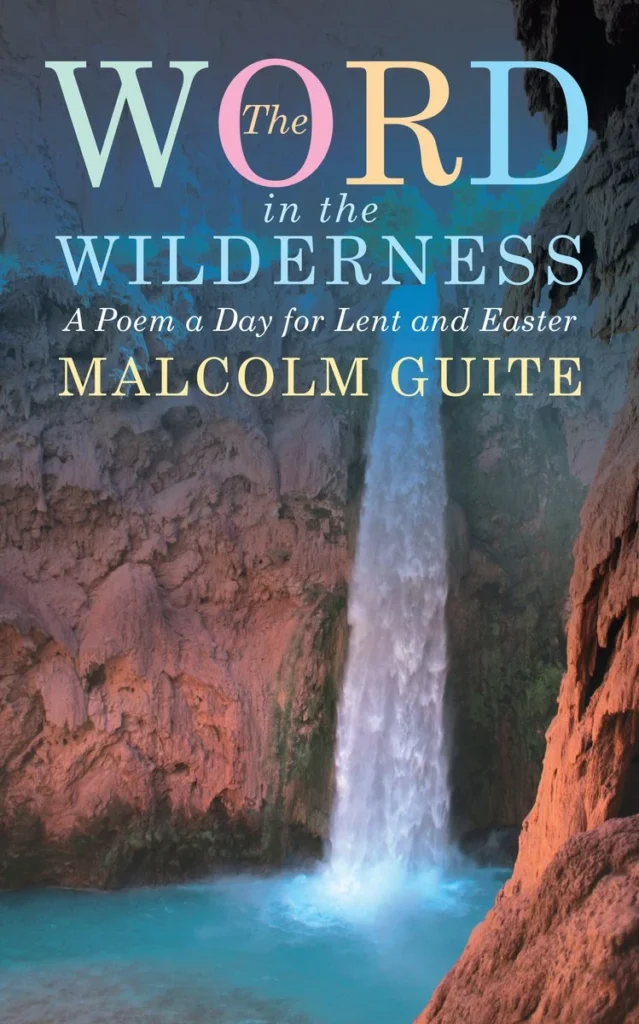
Malcolm Guite, The Word in the Wilderness: A Poem a Day for Lent and Easter 

Cover for "Word in the Wilderness"

(Norwich, UK: Canterbury Press, 2014), 192 pages. 

Every day through Lent to Easter (and the week after), Guite provides a poem along with a couple pages of reflection. The style is like a later book of poems he collected for Advent, Christmas, and Epiphany..  Guite wrote many, maybe half, of the poems. Other authors include George Herbert, John Donne, W. B. Yeats, S. T. Coleridge, Dante, Czeslaw Milosz, John Davies, G. M. Hopkins, among others. The commentary links the reader to scripture and theological understandings behind the poetry.  The commentary also provides insights into the style of poetry. I enjoyed these readings and recommend them for anyone looking to grow deeper in poetry and the meaning of Lent and Easter. 

Eric Goodman with Kaveh Zamanian, Mother of Bourbon: The Greatest Whiskey Story Never Told 

Cover for "Mother of Bourbon"

(New York: Post Hill Press, 2025), 298 pages

Mary Murphy married John Dowling when she was just 14 and he nineteen years her senior. Mary’s parents made the arrangements. John was a successful cooper (maker of barrels) and was beginning to invest in Kentucky’s infant bourbon business. Mary, who had finished the third grade, worked at her father’s store.  Both were children of Irish immigrants who had moved to America to escape the potato famine. In the pre-Civil War years, America wasn’t friendly to Irish Catholics.  

It shocked Mary, at first, that she didn’t have a say in the marriage. She also didn’t like the idea of moving away from her family but consented. In n time Mary and John become partners in an expanding whiskey industry.  Their main distillery was Waterfill and Frazier, but they also own part of a distillery with John’s brothers.  And their family began to grow.

John Dowling died in 1903. Upon his death, Mary inherits the business, but soon it’s in threatened. The bank refused to supply the credit and suggested they sell the business. Also, the broker for the business quit. Mary quickly reorganized, takes her business to another bank. She also found another broker, Henrich Hiensohn, a German Catholic who continued to work with Mary until prohibition. 

After the war (World War 1), the Midwest experienced the second rise of the Kul Klux Klan. This group not only went after African Americans, of which Mary was suspect as she employed and treated them fairly, but also Catholics.  Mary reached out to a relative of one of her employees whose son was lynched. Prior to the Klan’s rise, Mary’s namesake (Mary Bond, who had married a Protestant) became a prominent leader within women in Kentucky who attempted to get revisionist books on the Civil War into the school system. Mary and her daughter fell out, but with the rise of the Klan, her daughter admitted to being wrong. The Klan activity also played into Probation as many distillers were Catholic. 

Prohibition presented another challenge. Not being granted a medical exemption, Waterfill and Frazier ceased operations.  Working with Hiensohn, they sold most of their barrels before prohibition. She also had many barrels moved into the basement of her large home, paying taxes on the liquor before prohibition took effect so that it was legal. But this didn’t stop their troubles. After a few years, Mary’s youngest son, Emmett, came back from school at Harvard. He loved to party. He also, unknown to his mother, sold some bottled whiskey to a man in town who was a known for selling illegal liquor. The revenuers raided the family home one night and everyone who living there arrested. They were all released on a $5000 per person bond. 

Much of the book centers on the trials which took place. The book was hrown at the family, with charges not just of bootlegging but conspiracy. The first trial ended in a mistrial, with 10 jurors voting for conviction and two for acquittal. The second trial resulted in a conviction which was appealed but overruled. At this time, the sisters were fined $100. Mary Dowling’s received a fine of $10,000. But most troubling was her two boys living at home, Johnny and Emmett, who received a prison sentence. 

Mary certainly felt the revenue agents took advantage of her. While it later came out that Emmett had sold a few bottles of liquor, this didn’t rise to a conspiracy, nor did it involve the entire family. Everything had been done legally in her eyes. Furthermore, not only had the government confiscated her liquor, but the warehouse where they stored it burned. Rumors circulated that government agents sold the liquor. The fire covered their tracks. She couldn’t help but to feel that they were after her because she was a successful woman and Catholic. 

During this time, she decided to get back into the liquor business by setting up operations in Juarez, Mexico, across from El Paso. She could legally make liquor there.

Interestingly, Mexico didn’t allow its grain to be distilled. Mary had grain shipped in from the United States. Waterfill and Frazier used 50% corn with a mix of rye and barley.  She found a Mexican partner who provided the land and hired local workers. She hired a descendant of Jim Beam to oversee the running of her distillery.  While she went into prohibition financially well off, she made another fortune with Waterfill and Frazier, SA. This distillery did a large business around the border where bars which were filled with Americans (especially soldiers from Fort Bliss). She also allowed those running the business to sell booze to bootleggers who would bribe the border guards to transport the liquor to sell to speak-easies in the America. 

The employees of the Mexican distillery gave Mary Dowling the title, “Mother of Bourbon.”  That distillery continued to operate until 1984, but after Mary and Emmett’s death, the family ignored its operation.  Oddly enough, the American government had a hand in its demise as it outlawed the sale of bourbon made outside the United States. 

After prohibition took effect, Mary continued to experience sadness. Ida, a daughter who didn’t marry until she was almost 40, died. Then, the next year, John and Emmett died way too young, the same year in which Mary Dowling died.  

I enjoyed this book. The story flowed smoothly. Woven into the last half of the story was a rosary given to Mary by her liquor wholesaler,. Late in their business partnership, he expressed romantic interests. Mary wasn’t interested. The authors used the rosary beads to link to Mary’s own sorrows with her children. This nice touch displayed the importance of Mary’s faith. However, I found myself wondering if it happened or was it just a detail made up by the authors. While Mary Dowling was a real woman who achieved and endured much, with the book being a novel instead of non-fiction, I know the authors had to create a framework and dialogue to make the story more readable.  

I have now read three books by Goodman. In 2019, I read a baseball novel, Days of Awe. In 2020, I read his novel, based on his wife’s parents, Cuppy and Stew.

wBruce M. Metzger, Breaking the Code: Understanding the Book of Revelation 

(Nashville, TN: Abingdon Press, 1993), 144 pages. 

I first read this book in early 2004, when I last taught a class on the book of Revelation. Metzger, an outstanding Biblical Scholar from Princeton, spent part of my last year in seminary on Sabbatical at Pittsburgh. I got to know him a bit during this time as his apartment was next to mine.

Metzger approach is strictly Biblical. He shows how much of Revelation was written in response to was happening within the Roman Empire in the second half of the first century. Even the number of the beast (666) works out to a title of Nero.  A variant number (616) found in some ancient manuscripts matched a variation in Nero’s title.  I used this book as the base for my class, but also drew on a more detailed commentary by Robert Mounce along with Eugene Peterson’s literary commentary, Reversed Thunder: The Revelation of John and the Poetic Imaginaton. 

Alan Gurney, Compass: A Story of Exploration and Innovation

Cover for "Compass"

 (New Yor: W. W. Norton, 2004), 320 pages including index, notes, and bibliography.  

I’ve used and felt myself competent with a compass ever since my grandparents gave me one for my 11th birthday, when I was old enough to join the Boy Scouts. Taking the compass for granted, I had no idea one could write a history of the compass that stretched out to 272 pages of text! Gurney manages to do this by primarily focusing on the use of the compass by the British Royal Navy and commercial ships. I knew that even in the ancient world, it was known that a suspended lodestone was known to point north/south. But I was shocked that it was only recently (last 150 years) that the compass as we know it was perfected. 

The original compass was a dry one, often suspending a thin piece of metal that had been magnetized so that if was free to move and point to the north. Below the pointer, a papers stock which could be moved to correct the heading. This “dry compass” was the main compass of British mariners until early in the 20th Century. Such a compass had a difficult during rough weather or on a ship firing canons broadside.  This led to use of compasses with the lodestone floating on water (or alcohol). Another problem discussed is magnetic deviation. Interestingly, at one time, sailors hoped that correcting the deviation could help them know their latitude. Later problems arouse as ships used more iron in their construction. Earlier, such problems were noticed as the housing of the compass might use nails which affected the needle.  When the who ship was iron, the problem magnified. 

While this book primarily focuses on the British use of the compass, toward the end the author acknowledges the American Navy to be ahead of the British in the late 19th Century. American adopted the floating compass for its navy 30 years before Britain. Through this book, we learn of the various individuals whose work with compasses to increase their efficiency.  While there were interesting parts of this book, I realize it’s not everyone’s cup of tea. The book is only about the role of the compass while on water, nothing about its use on land as in orientating. A good companion to this book is Dava Sobel’s, Longitude, which I read in 2017. 

Don’t Worry

title slide

Jeff Garrison
Mayberry & Bluemont Churches
May 3, 2026
Matthew 6:25-34

Sermon taped on Thursday, April 30, 2026 at Mayberry Church

At the beginning of worship:
There’s a legend about Death visiting a city. At the city gates, an old man recognized Death and asked what business he had in the city. “I’ve come to take 1,000 people with me tonight,” Death said. 

The next day, Death reappears and the old man was again sitting by the city’s gate. “Yesterday, you said you were going to take a 1,000 people from our city,” the man cried. “This morning, the newspaper reported that 7,000 people died. Why did you do this?”

“I didn’t,” Death answered. “I took my 1,000. The rest succumbed to worry and anxiety.”

We worry a lot, don’t we? We like to have things under control, but Jesus tells us not to worry about the future. A preacher once addressed the problem of worry in our culture in a sermon which he titled, “Don’t let worry kill you, let the church help!” Yes, even churches can be filled with anxiety and worry. 

Before reading the Scripture:
Last week’s passage ended with a proverb. No one can serve two masters. We can’t serve God and wealth. Jesus continues his sermon on the Mount, drawing the attention of his audience to the nature which surrounded them as he begins to discuss anxiety or worry. 

This is one of the most beloved passages of Scripture, perhaps falling in behind Psalm 23 and John 3:16. The poetic words in this passage contain power, encouraging us to trust God. But I want you to listen to the passage closely and ponder what Jesus is really saying. If we take this passage too literally, it sounds like we shouldn’t worry about or plan for anything. But is that what Jesus says?  

Read Matthew 6:25-34

A Scarlett Tangier in my cherry tree, June 2025


Jesus is almost two thirds through his sermon. People may be getting hungry as he tells them not to worry about what they eat or drink or wear… He points a finger to the air and follows a few birds as they dart from one bush to another. “Look at ‘em,” Jesus says. “They don’t have a care in the world. You know, they don’t sow or reap. They don’t set out crops and then, like farmers, bite their nails and pray the crop will be plentiful. Can you imagine a bird planting a crop?” he might have asked. 

The thought of Joe Sparrow pushing a plow or storing grain might have brought laughter to the crowd. No one images a bird doing such a thing.

Then Jesus gets to the point. “You know, these birds don’t worry about tomorrow, but they get by. And think about it, Jesus says, “Are you not more valuable than they?” Here, Jesus reminds them of the teachings of the first two chapters in Genesis, where God crowned humankind as the pinnacle of creation.[1] God created us to work, to be gardeners in his world, to be his servants with dominion over creation. Certainly, if God cares for the lonely sparrow, God will care for us. 

When taken together on the heels of the previous passage, we’re again remained not to be fanatical about accumulating stuff. It’s something we have a hard time doing. But the disciples who abandoned their boats to follow this teacher from Galilee knew something about placing their trust in God. And so did the day laborers who did not own land and couldn’t count on having work from one day to the next. Of course, not everyone lives in such a manner. Some must plan for tomorrow and next month and next year. Even in Jesus’ day, those farmers who hired the laborers had to plan which fields to plant and so forth.

Perhaps this passage shouldn’t be taken too literally. After all, birds die in blizzards. Wildflowers wilt during a drought. Furthermore, a literal interpretation sounds like we should have no cares and should live a lazy life which isn’t at all what God placed on earth to do. “Don’t worry, be happy,” as the song goes. Some Christians have taken it this way. In Paul’s writings to the Thessalonians, he deals with such laziness and informed them if they don’t work, they don’t eat.[2] Wisdom literature within the Bible often condemns laziness and those who do not plan.

When you think about it, birds and lilies are not good models for human beings. Notice, Jesus doesn’t say we’re to be like them. Instead, he says, Look. Or, think of it this way, “consider or ponder” for a moment the birds of the air and the lilies of the field. They should remind us of what God can do for us. They are poetic symbols of God’s providential care.[3] Seeing the wonders of nature, we see the glory of the Creator reflected in his creation, the glory of a God who cares for the earth. 

In Dale Bruner’s commentary on the passage, he acknowledges the danger of misinterpreting this passage. Bruner, early in his career, before he became a New Testament scholar, worked as a missionary in the Philippines. He writes that he became convinced this text would be cruel to preach in such a context, among those who are so poor and who go around without proper clothing.

But then, Bruner continues and questions the wisdom of preaching such a passage to the well-to-do. He feared this passage could confirm a dangerous prejudice that spiritual values are to be placed over material needs. 

This sets up an opportunity for Bruner to clarify what the passage doesn’t teach. It doesn’t say we should be unconcerned whether others have enough to eat or wear. Certainly, Jesus’ ministry showed his concern for the poor. Instead, the passage commands us to take our eyes off ourselves, off our lives, away from our own selfish anxieties. Bruner concludes, “look around God’s world for a place where we can throw ourselves into the cause of God’s poor.”[4]

Our passage could be interpreted from a celebrative lens. Consider how the lilies and the birds all reflect the glory of God’s creation. Watching and listening to the birds or exploring the wildflowers give us a reason to reflect on God’s gracious care. We can delight in God’s creation and strive to care for it.[5]

In a way, this passage links with our text last Sunday where Jesus encourages us to save treasures in heaven and not on earth. If you remember, Jesus never said that earthly treasures are bad. He just said we can’t count on them. This ties into the climatic verses of this passage. Verse 33 reminds us of how our primary focus should be on God and God’s kingdom. And then, the passages end with verse 34, reminding us not to worry. We are not to worry about tomorrow (nor about those things we can not control). Jesus doesn’t say that planning is bad, we just shouldn’t worry about what is beyond our control and trust those things to God. 

This closing verse seals the meaning. Jesus doesn’t leave us thinking that because we belong to him that tomorrow will be wonderful. Yes, at some point, we’ll enter the kingdom, but until then there will hard days in which we have to trust God.[6]

Throughout this middle section of the Sermon on the Mount, Jesus attempts to focus his listeners on God’s goodness and love. Instead of trying to win earthly admiration with public prayers and acts of piety, we are to do such activities quietly and let God see and reward us. Instead of making the accumulation of stuff our primary purpose, our hearts should be first focused on God. 

Do you remember those bumper stickers popular back in the 1980s which read, “He who dies with most wins.” Jesus’ teachings point out such nonsense. Our purpose is not to accumulate, but to, as the Westminster catechism reminds us, “enjoy and glorify God forever.”[7]

May we so glorify God and enjoy his blessings. Amen. 


[1] Genesis 1:27, 2:4ff. 

[2] 2 Thessalonians 3:6-13. 

[3] Douglas R. A. Hare, Matthew: Interpretation, a Commentary for Teaching and Preaching (Louisville, KY, JKP, 1993), 74. 

[4] Fredrick Dale Bruner, The Christbook: Matthew 1-12 (1990, Grand Rapids, Eerdmans, 2004), 329. 

[5] Hare, 75. 

[6] Looking for things to soon be made good might be what we desire, but it’s not what we get. This idea comes from Scott Hoezee’s commentary on this passage.  https://cepreaching.org/commentary/2014-12-15/matthew-624-34/

[7] Westminster Shorter Catechism, Question 1.

Heading to Grand Rapids and Part 1 of the Festival of Faith and Writing

title slide
When I returned home, not only did I get a chair cut, I trimmed my beard!

On Tuesday morning, April 14, after filing an extension for my taxes, I boarded the northbound Crescent, in Danville, Virginia. At Union Station in Washington, DC, I had long enough a break to eat before catching another train bound for Chicago. My destination was South Bend, Indiana, a city I arrived in a little before 8 AM on Wednesday.  I had planned to get a sleeper. When I first looked at this trip, I could have done each leg for about 400 dollars, but after the debacle of airlines and unpaid TSA agents, train travel became more popular. Two weeks later the cost for a sleeper on each leg jumped to 900 dollars (over $1800 total) and I decided I could travel coach. 

The ride was smooth despite some bad storms which caused the train to slow down as it cut through the Alleghenies and through Pittsburgh and Cleveland. There were tornado warnings, but all I saw between naps was a lot of lightning and some heavy rain. Once in South Bend, I had to wait at the station till after 8 AM to call Enterprise Car Rental to come pick me up. They did. And by 8:30 AM, I was on the road. On Wednesday night, I planned to stay with Jerry and Janet, friends who go back to our seminary days, in Kalamazoo.  Knowing they had church duties that morning, I drove to Eckhart hoping to see the New York Central Museum which was beside the train station in the town. It was closed that day, so I drove north to Three River’s Michigan, and spent a few hours in Lowry ‘s Bookstore. 

Stairs inside Lowry’s

For such a small town, this is an amazing bookstore with both new and used books.At Lowry’s, I found a copy of Lucius Beebe’s classic, Mix Trains Daily: A Book of Short Line Railroads. This I will add to my growing collection of Beebe’s railroad books, published in the 1940s and 1950s. After Lowry’s Bookstore  I had a wonderful lunch at Rooster’s Wing Shack next door. Then I drove to Jerry and Janet’s. We spent the afternoon birding in a nature area in Portage, then fixed dinner and spent a lot of time talking.

The three of us are moving toward retirement. Jerry and Janet plan to retire this summer and I plan on retiring after Easter next year.  On Thursday morning, we said our goodbyes. I then headed to Grand Rapids for the Festival of Faith and Writing at Calvin University.  On the way north, taking backroads, I came across one area where a tornado had ripped through the area the night I was on the train.. While the main road was clear, the side roads were blocked and workers were repairing electrical lines. 

I have attended the Festival of Faith and Writing many times. It’s held every even year and Calvin brings in around 60 authors. They don’t have to be Christian, although most are. The one requirement is that the authors write seriously about faith. As with the other years, this year didn’t disappoint. As before, there those authors I wanted to hear and meet. In addition, there were other authors I didn’t know, whom I heard and are now interested in reading their works. 

The festival opened with its first plenary speaker, Laurie Halse Anderson, who writes historical fiction for young adults. I was not familiar with her work, but she has won the Nobel Prize in Children’s literature.  She has written some interesting books around the American Revolution. Her success, she credits, is with doing the research of a non-fiction writer to assure her stories are factual. She also focuses on the “ordinary.” Instead of writing about Washington or Franklin, she tries to bring in the common people, especially women, children, and minorities. Through their eyes, she shows how they perceive the events of the day. She also talked about how writing one book leads to another. Having written about the Revolutionary War, she became interested in a Yellow Fever epidemic in Philadelphia a few years later, which resulted in Fever 1793.  I plan to read that book. 

In addition to four plenary speakers, the Festival offers numerous concurrent sessions throughout the three-day period. The first afternoon, I attended a conversation by two young adult writers (Kate Albus and Dana VanderLugt) discussing the craft of writing fiction and how it can be used to draw younger readers into the past. 

Next, I attended a presentation by Carrie Fountain titled “About a Million Blessings a Day.”  Fountain is a poet who sets out every morning to write a poem. She acknowledges, most are not very good, but she feels the need to get something on paper and overtime has a collection of material with which to work. I enjoyed listening to the poems she recited and came away with an autographed copy of her book of poetry, The Life. Fountain charmed me by asking where I was from when I was having her book signed. She then complementing me on the sound of my voice. The next day a guy I was talking to during a break stopped me in mid-sentence to ask if I read Audible books. I thought he meant listening and I said I generally have one going all the time. Then he said, I don’t mean listening, I mean reading, you have the ideal voice.  I laughed and said it would be ideal until I butchered the punctuation of some word. 

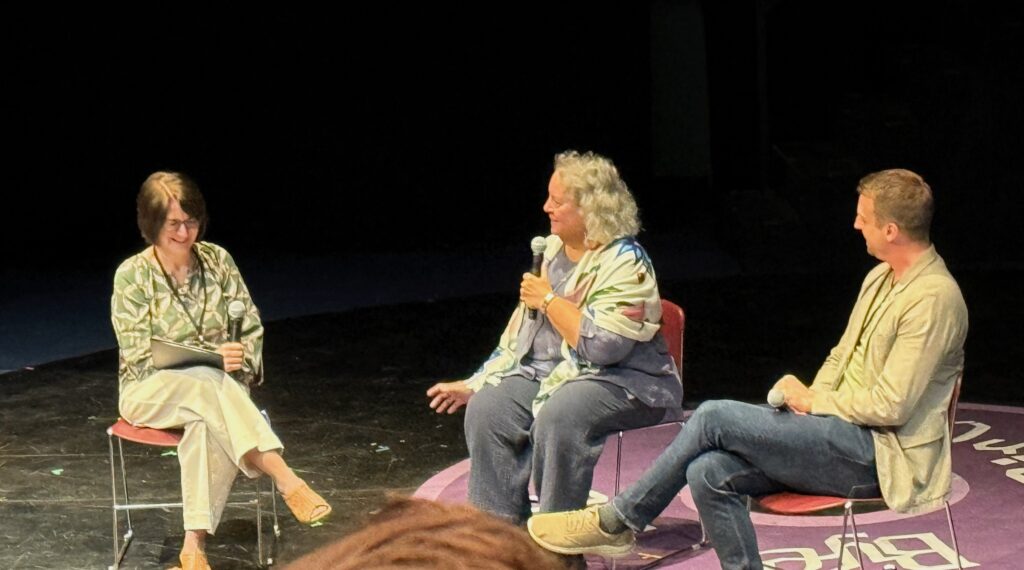
That night, the plenary speaker was Robin Wall Kimmer. The title of her talk “The Serviceberry: Abundance and Reciprocity in the Natural World” is also the title of her latest book which I read and reviewed (link above) in January. Of all those authors in attendance, Kimmerer was the one I really wanted to hear. She’s both a scientist and a Native American and draws on both in her books, of which I have read all three. I read Gathering Moss in 2021 and Braiding Sweetgrass (her most popular) in 2024. While Kimmerer titled her talk after her book, it wasn’t a recap of writing. Instead, she presented a thesis around what the writer can do to help heal the world. Her first rule: always begin with gratitude. She encourages writers to help people know their place on earth. For nature writers, she suggests we celebrate the living world, foster kinship, incite wonder, inform, sound the alarm on danger to the planet, seek justice, and defend wild places. She also peppered her talk with startling statistics such as the average American child can identity only 10 plants but knows around 100 cooperate logos.

Kimmerer (in the middle) talking to Debra Rienstra and Kyle Meyaard-Schaap

Kimmerer also spoke of the danger of linguistic materialism, moral exclusion, and how the colonial experiences around the world have damaged native languages which were more earth based. Of all the presenters over the three days, I took far more notes (4 whole pages) on Kimmerer’s talk. Most other talks I only took a single page of notes. After her talk, I checked into my hotel and then walked over to a nearby Olive Garden where I had dinner with a former colleague. MaryMartha served with me when I was the pastor in Hastings (2004-2014), serving as the church’s adult ministry coordinator. Several years ago, when her husband Larry began to decline in health, they moved to a continuing care center on the southside of Grand Rapids. Larry has since died. I enjoyed our late dinner and talk, but was ready to crash when I got back into my room.

  (look for part 2 in a couple weeks)