Jesus’ Teachings on Piety and Prayer

Jeff Garrison
Mayberry & Bluemont Churches
April 12, 2026
Matthew 6:1-15

Sermon recorded on Friday April 10, 2026 at Bluemont Church

At the beginning of worship:

Johnny prepared to go out on his first date with Cindy, a cute girl in his High School English class. He’d borrowed his dad’s car for the evening. That day, after school, he stopped by the local candy store, looking for a way to impress her. The owner of the store noticed Johnny’s difficulty at picking out a box of chocolates and asked if he could help. 

When Johnny told him he wanted to impress a girl on a date, the store owner suggested a one-pound box if he just wanted to shake her hand after the date. But he said, if you want to kiss her on her cheeks, I’d go with a two-pound box. And, if you want to kiss her on her lips, go with the five-pounder.

That night, Johnny showed up at Cindy’s home with a big five-pound box of chocolate candies under his right arm. This pleased Cindy. She invited Johnny in to meet her family. Sitting in the living room, he spied a Bible on the coffee table. He picked it up and asked if could read a few verses and pray before they left for their date. 

Later that night, Cindy slide across the seat of the car to be closer to Johnny. She whispered into his ear, saying. “Johnny, your wonderful. I never knew you were so religious.” 

Johnny responded. “I never knew your father owned a candy store.”  

We all know to whom Johnny directed his prayers that evening, don’t we? We’ll talk about the right use of prayer this morning.

Before reading the Scripture:

After breaking for Palm Sunday and Easter, we’re back to Jesus’ “Sermon on the Mount.” We’re in the heart of this sermon, where Jesus teaches about piety and prayer. The center of our text is the Lord’s Prayer.

I won’t spend too much time on that prayer. Several years ago, I gave six sermons dealing with the six petitions in the Lord’s Prayer, so if you want to dig deeper into the prayer, look up my older sermons.[1] I’ve footnoted them in this sermon, so you can find them easily on my website. But I still will discuss the Lord’s Prayer briefly. It’s important to see how the prayer fits within the larger sermon. In this text, Jesus continues with his concern raised with his re-interpretation of the law. While our behavior is important, what’s in our heart is also important. God and other people watch what we do. But God also knows the reason why we behave in such a manner. 

Why do we help others? Is it only to obtain recognition or some other reward? If that’s the case, God’s not impressed. 

I am also going to read our text this morning from The Messagetranslation. This paraphrase of the passage offers us a fresh way to hear Jesus’ message. Plus, I like how The Message draws upon the language of the theater in the opening of this passage. This seems to be closer to the Greek which use the language of the theater to express Jesus’ message.[2]

Read Matthew 6:1-15:

In Chapter 6, Jesus moves from reinterpreting the law to how we live out our faith through piety, prayer, and fasting. As with the commands in which Jesus raised the bar, here he also shows his concerned for what’s in our heart. 

Jesus assumes all religiously devoted people will practice these acts of devotion, especially the first two which we’ll look at today: almsgiving and prayer.[3] The first involves helping those in need. The second involves our relationship with God. Both are important. Jesus assumed everyone will give to those in need and pray. But Jesus wants us to respond for the right reasons. Why do we do such acts? Is it to earn praise from others? Or are our hearts truly moved to compassion and to a desire to connect with God? 

As we’ve seen, Jesus draws from the language of the theater. You know, an actor attempts to convincingly portray a character. Whether it’s a hero or a villain, when the actor brings the character to life, they earn the appreciation of the audience. But our lives are not lived out in the theater. We should play ourselves and not seek the approval of others. Instead, we need a generous heart, which is something only God can see. 

Jesus begins with almsgiving, the support of those who are in need. Think of it as slipping a dollar or two to a beggar sitting on a sidewalk. Or maybe helping someone have enough money to make their electric bill or to get their car fixed. Or dropping off some groceries to someone sick. All these are good things. 

But there is a catch to doing good. When others see us perform such acts, they praise us. So far, so good, right? But when we eat up the praise, our pride gets the best of us. Soon, we do such acts, not out of compassion and empathy for those in need, but because we like the boost it brings to our ego. At this point, we’re sliding down a slippery slope. Those of you involved in the study of The Screwtape Letters saw examples of this. Even good acts, if done for the wrong reason, will leads us in the wrong direction.

We worship a generous and gracious God. And while we should strive to be godly, we need to understand that praise is due to God, not us. Even if we are generous, it’s only because God’s generosity allows us the means to be generous. So, as a literal translation of this passage reads, don’t let your left hand know what your right hand is doing. In other words, perform deeds of mercy but don’t make a big deal out of it. 

Furthermore, when we perform acts of charity for our own benefit, we belittle the ones we help. It is much better to protect their dignity and help quietly instead of making a fuss about what we are doing and their needs. Using the misfortunate of others for our own praise is troublesome.

Jesus then moves into prayer, our conversation with God. Again, Jesus encourages us not to make a show of our prayers. We’re to pray simply in secluded places. 

You know, there are people who like to make prayer into an approved form of work. I’ve read in several places how the Reformation came about on the prayers of folks like Martin Luther, who supposedly prayed four hours a day. It sounds like Luther’s pious, right? But there is a problem. It’s a myth. Luther, himself, talked about how after a few minutes of praying, he struggled to stay awake.[4]

Furthermore, such a concept is a problematic to our theology. The idea of four hours of daily praying makes the Reformation more about Luther efforts than God’s faithfulness. Don’t think you have to pray long with elaborate words to pray successfully. 

In Jesus’ day, public prayer seems to have been popular. Jews as well as pagans strove to pray to be seen as faithful.[5] Remember the priests of Baal, who had elaborate prayers compared to Elijah’s simple prayer.[6] The idea is that if you prayed the right things, long and hard enough, you would encourage the gods to answer. Jesus strives to pull this bad theology up by its roots. God already knows our needs. Our prayers, which involves speaking and listening to God, draws us closer to the Almighty. It’s not about us tying to encourage God to fill our shopping list, but about us striving to become closer to God. 

This is why Jesus then gives his audience the Lord’s prayer. The corporate nature of the prayer stands out in the prayer. It’s not about me taking my own concerns to my God. It doesn’t begin with “My father,” or “give to me.” Instead of singular concerns, the prayer is plural. “Our father,” and “give us,” we pray. It’s not about God belonging to us, individually. Instead, all of us, collectively, belong to God. Good prayer comes from having our theology right. For our prayers are between us and God. 

Remember Johnny, whom I told you about at the beginning of worship. Who did he direct his prayer to? God or Cindy’s father? 

Now, I should say something about public prayer, as I am often expected to lead them. Jesus, here, isn’t addressing prayer in worship. Such prayers are necessary and expected. We see examples of such prayers in the Psalms. But again, like our personal prayers, such prayers need to be addressed to God, not to those in the congregation. I will be the first to acknowledge, this is hard. We want to please others. We like it when others praise us for our sermons and prayers and whatnot. But our piety isn’t about bringing glory to us, but to God. 

So do good and pray faithfully, but for the right reasons. Amen. 


[1] These six sermons were preached in the fall of 2022.  See:   

[2] In verse 1, Jesus’ warns not to be in “theater to them.”  Frederick Dale Bruner, The Christbook: Matthew 1-12 (1990, Grand Rapids, MI: Eerdmans, 2004), 283. 

[3] Douglas R. A. Hare, Matthew: Interpretation, a Commentary to Teaching and Preaching (Louisville, KY: JKP, 1993), 63; and Jonathan T. Pennington, The Sermon on the Mount and Human Flourishing: A Theological Commentary (Grand Rapids, MI: Baker Academic, 2017), 213.

[4] Frederick Dale Bruner, who studied Luther extensively, noted this in a lecture I once heard. He said that once he began to study Luther extensively, he looked for an affirmation of such prayer and never found it. Instead, it seems to be a story made up in the 19th Century to encourage prayer. 

[5] The Jews, who did pray in public, were encouraged to do so softly and not be boisterous. Bruner, 287.  Even this seems too much for Jesus, for they were praying to gain attention instead of connecting to God. 

[6] 1 Kings 18:22-39.

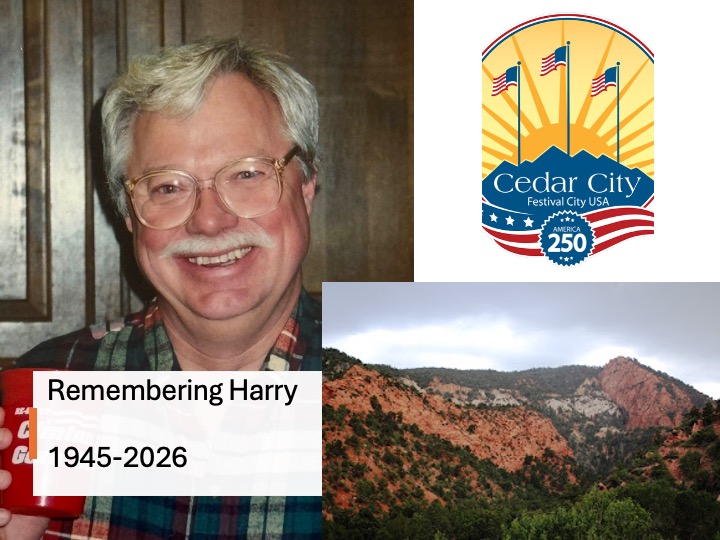
Remembering Harry

Title slide with a photo of Harry, Cedar City's logo, and a photo of Cedar Canyon

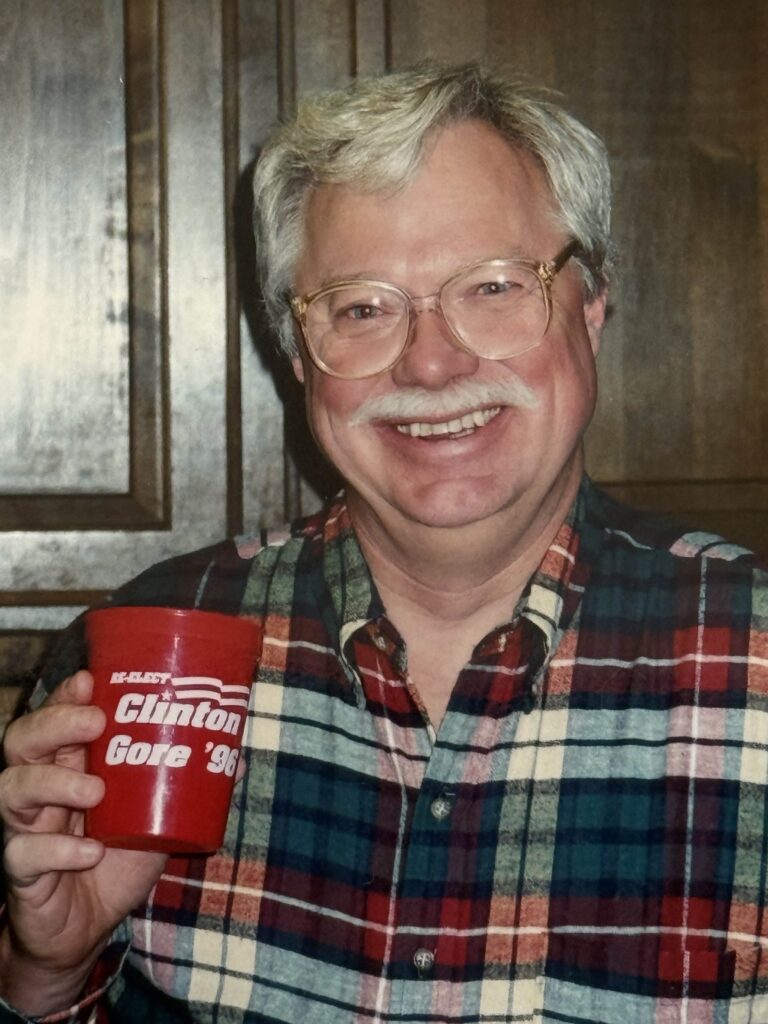
Note: Thanks to Lynne, I think I now have all of Harry’s titles correct. It is my hope you gain a sense of how wonderful Harry was. I know I have more photos of him, but could not find them quickly last night. The photo of Harry holding a Clinton/Gore cup was at a dinner. I’m not sure where the cup came from but someone thought it appropriate to serve Harry, a Republican, a drink in it. As you can see, he took the joke well and played along.


Sunday night I received word through a friend in Utah that Harry died. It wasn’t expected. I later learned his death was sudden. Walking down his front steps to greet friends, he collapsed. It was his time. They were unable to resituated him. So many people close to me during my decade of ministry in Utah are now gone. Harry joins a long list which includes the Armstrongs, the Pevelers, the Behrens, Marcia Beck, Des Penny, Jim Case, Christine Winterrose, Pam Burns, Harry’s son David, among others. 

I met Harry on a Monday in late September 1993. I probably met him the day before when I preached at Community Presbyterian Church, but don’t remember it. In a meeting following worship, they voted to called me as their pastor. That Monday, I went to First Security Bank (now Wells Fargo) to set up an account in preparation for my move. Harry, a commercial loan officer at the time, saw me enter. He came out of his office, greeted me like a long-lost friend. Then he introduced me to everyone as his new pastor. He also made sure I was well taken care of by the tellers. From that point, we were friends. But that’s not unusual. Harry was the type of person who became a friend to everyone he met. He also befriended every dog. .

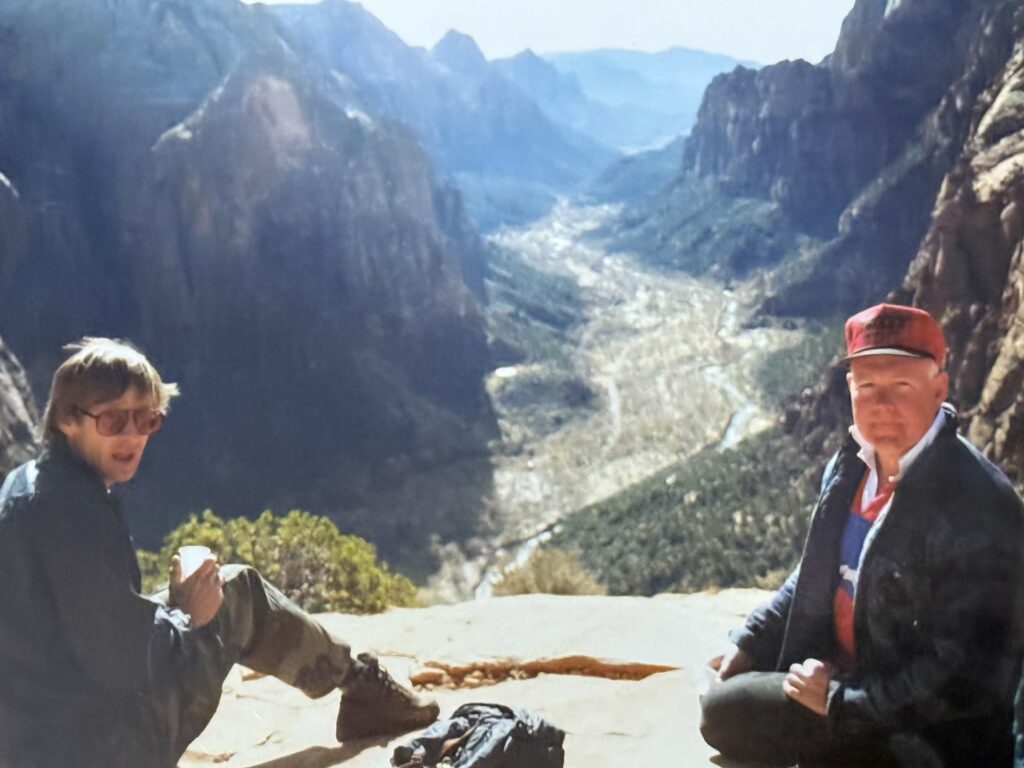
John and Scott on Angels Landing.

I moved to Utah that November.   A few Saturdays later, Scott, another member of the church, organized a climb of Angels Landing in Zion National Park. Harry, Brad, Craig, and John joined us. We made our way up Walters Wiggles to Scout Landing, where the Angels Landing trail breaks away from the West Rim Trail. Soon, we were on a knife edge, with a 1500 or so foot drop on each side. Heights, we discovered, terrified Harry. John and I led him down off the knife-edge and back to Scout Landing. Harry waited for us as we climbed to the top of Angels Landing, which hovers over the valley of Zion Canyon. When the day was over and we stopped for dinner and a beer on our way back. Harry expressed thanks that we had not abandoned him. 

Angels Landing from the Virgin River
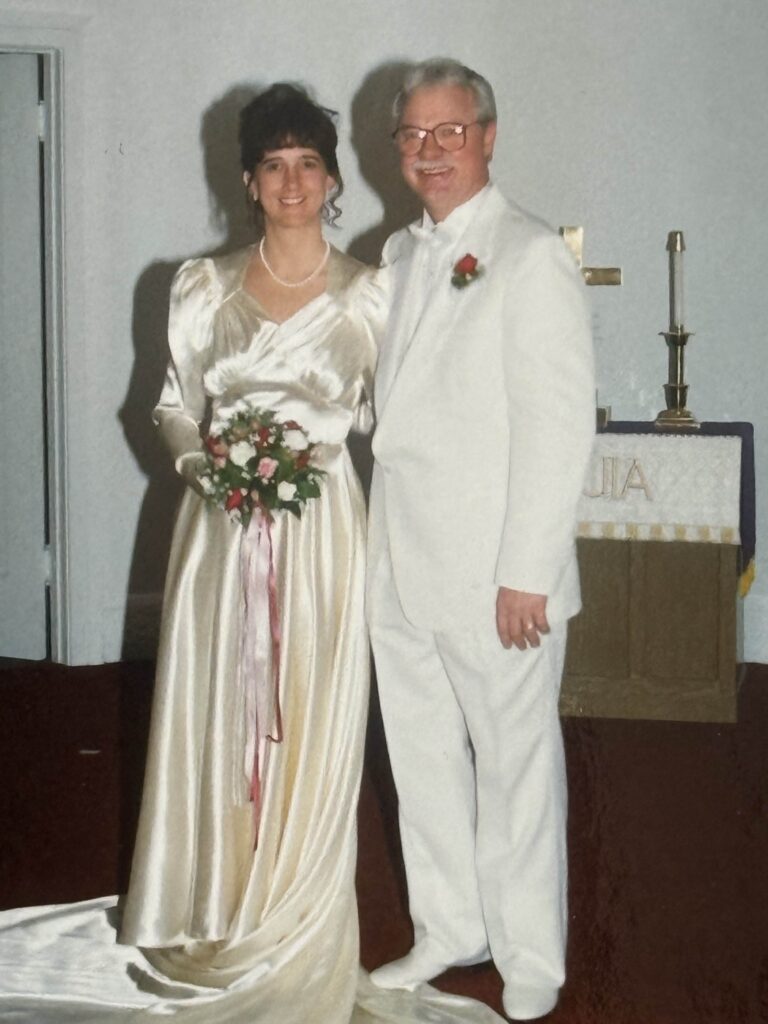
Harry and Lynne after their wedding

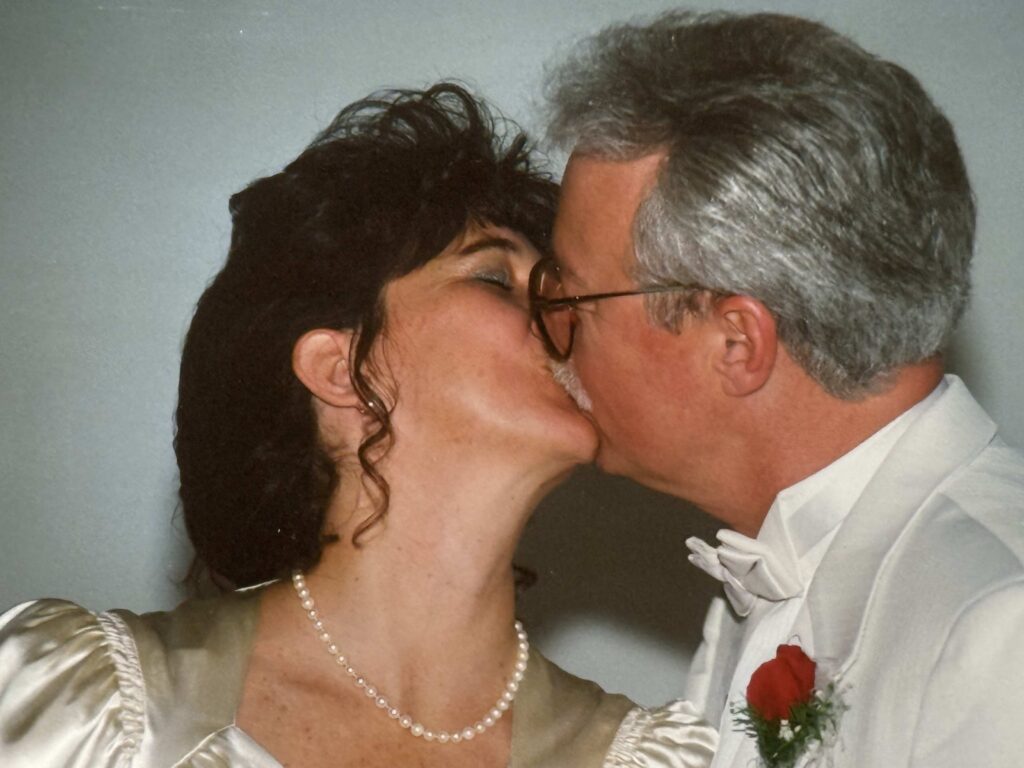
In February of the following year, I was honored along with the Reverend Ed Kicklighter, a retired Navy chaplain and the former intern pastor at Community Presbyterian, to officiate at the wedding of Harry and Lynne. Harry and Lynne would become close friends. 

In the fall of 1994, I began teaching a year and a half long class to train lay pastors. Harry signed up. We spent much of the class discussing theology and how to handle Biblical text in preparation of a sermon. Harry felt comfortable speaking in front of groups. His faith was strong, but quiet. He showed his faith in how he worked to better the lives of others.

Two years later, the Presbytery of Utah commissioned Harry as a lay pastor.  The presbytery meeting of the commissioning was held at the brand-new church in Layton, Utah. It had been raining hard for a few days. As I stood with Harry before the entire body, asking him the questions for his commissioning, a spot in the roof failed. Suddenly, a torrent of water poured from above, just behind Harry. I paused, then looked at Harry and asked, “Do you need to be baptized?”  Everyone laughed, as members of the congregation ran around grabbing buckets and mops. For the rest of my time in Utah, Harry would preach for me when I was gone and at Presbyterian Churches in Richfield, Delta, and the Methodist Church in Milford. 

Joking with Harry at a dinner in the mid-90s.

During my time in Utah, our families attended parades together and had cookouts and dinners. Harry could take a joke. At one party before the 1996 elections, Harry, a Republican, laughed when he was served a drink in a Clinton/Gore cup.  Around this time, Harry and I both begin to collect Dutch ovens. Soon, we hosted dinners for the congregation and other groups in town.  Harry and I also participated, in competition with each other, in local chili cookoffs.

A few years after I arrived in Utah, Harry left banking and became the director of the Chamber of Commerce. I believe he was instrumental in bringing the Rocky Mountain Oriental Express train to the city. This was the first time since the 1950s that passengers got off a train in Cedar City. This elegant train traveled across the West, stopping at various National Parks. The trains would spend two or three days in Cedar City. While in town, they made excursions to Bryce Canyon, Zion Canyon, and the North Rim of the Grand Canyon. Cedar City was also known for its summer Shakespearean and Renaissance Festivals. Working with the city’s mayor, Harry expanded the number of festivals so that every month had a celebration. The city lived up to its title, the Festival City. 

After working with the city for a few years, Harry became the hospital foundation and public relations director for Valley View Hospital. Exciting things were happening as the hospital built a new faculty. As I was on the hospital board, Harry and I got to work together on a project not related to the church.  After I left Cedar City, Harry helped raise funds for a new cancer center.

Toward the end of my time in Utah, I began reading a lot about the area in which I had grown up. My family had moved to Petersburg, Virginia when I was six and then moved outside of Wilmington, North Carolina when I was nine. My backyard in both places endured significant battles toward the end of the Civil War.  Harry was also interested in the Civil War and read the books I read on the fall of Petersburg and the fall of Fort Fisher and Wilmington. Even after I moved, when I would visit, we discussed the Civil War. 

I last saw Harry in the fall of 2018. We toured the congregation’s newest effort, a thrift store on the south end of town which sold furniture, household goods, and clothes. I could sense Harry’s pride at what the church had done and how it served those in the community he loved.  Harry wanted the best for his community and worked hard to serve others. 

Anyone who knew Harry also knew of his love for animals, especially dogs. He and Lynne adopted many dogs and gave them a wonderful home. Over the years, I mainly kept up with Harry and Lynne through Facebook. Seldom was there a post that didn’t include dogs in the pictures. 

Cedar Canyon east of Cedar City

Harry had moved to Cedar City from Las Vegas, where he had been in banking. Before that, he’d lived in Alaska and had served in the Air Force Intelligence Agency. He told stories of how, as a young man, he traveled first class in Japan to attempt to listen in on communications from Soviet leaders staying in adjacent hotel rooms. And before that, Harry, who grew up in the Philadelphia area, was one of the first “kids” to dance on American Bandstand. 

Sadness often broke into Harry’s life. Long after I left Utah, his son David, who had been in our our group died. Harry, I know, strove to maintain a positive outlook on the future and continued to help others. May he rest in peace and may God embrace Lynne, their dogs, Harry’s daughter, and his stepdaughter and their families in love. 

Harry and Lynne after their wedding

Easter Message 2026

Title slide with photos of Mayberry and Bluemont Presbyterian Churches

Jeff Garrison
Mayberry & Bluemont Churches
Easter Sunday, April 5, 2026
Matthew 28:1-15

Sermon recorded at Bluemont on Thursday, April 2, 2026

At the beginning of worship:
A man once had a lamb. He treated it like a pet, but when hard times came, he found himself forced to sell the lamb. Unfortunately, three thieves heard of his plans and plotted against him. 

Early in the morning on the day of the market, the man put the lamb on his shoulders and headed off. Along the way, the first thief came up to him and asked, “Why are you carrying that dog on your shoulders?” 

“This isn’t a dog,” the man said. “It’s a lamb and I’m taking it to market.”

Further along the way, the second thief crossed his path and said, “What a fine dog you have on your shoulders. Where are you taking it?”

“It’s a lamb,” the man insisted. “I’m taking it to market.”

As he approached the village walls, inside of which held the market, the third thief stopped him. “Sir, dogs are not allowed in the market.” 

This confused the man. If three people say this is a dog, it must be. He took the lamb off his shoulders and sat it down and went into the market. Had he looked back, he’d seen the thieves running away with his lamb.[1]

Those who make up Christ’s Christ are often like this confused man. We lose focus by allowing other people’s opinions shape our vision. To appease the world, some try to conform the gospel to science or popular opinion and end up not knowing what they believe. Or they end up with a hollow gospel. 

God raised Jesus from the dead. That’s the truth of the Christian faith, which we celebrate this day, and every Sunday. We can’t prove it. The Apostle Paul, in the first century, admitted the resurrection makes no sense outside of faith. To non-believers, it sounds like foolishness. But we proclaim Christ crucified![2] And that’s the Easter message in a nutshell.

Before reading the Scripture:
Again, this week, we’re looking at the end of Matthew’s gospel. Last week, we heard about Jesus’ entry into Jerusalem. Pilgrims packed the city. They’d made their way to the Holy City for Passover. The setting for today’s reading is more subdue. The day hasn’t fully awakened. Only a handful of people experience what happened. In fact, Matthew along with all the other gospels, doesn’t describe the resurrection. Instead, it’s presented as a fact. Jesus rose from the grave. We learn about the resurrection for the effect it has on the women and the disciples who met Jesus. And the power of the resurrection is confirmed by the effect it has had on others who believe, throughout history. 

Read Matthew 28:1-15
What do we celebrate today? For some, the idea Jesus laid in a tomb deader than a doornail and then rose from the grave is a scandal. It’s easier for them to believe the propaganda spread by the religious leaders 2,000 years ago who suggested Jesus’ followers stole his body from the grave. Of maybe, for us, it’s easier to believe in some silly bunny, a rabbit who should be the patron saint of all dentists, bringing chocolate to kids (and lucky adults). 

Or maybe we just celebrate Easter as a rite of Spring. As a child, it marked the time when we brought out our spring clothes. We always took pictures on Easter Sunday, generally in front of blooming azaleas or dogwoods. On Easter, my sister could once again wear white shoes, which she got to show off till Labor Day. My brother and I and our dad got to wear light colored jackets instead of the darker ones of winter. I’m not sure who the fashion police were back then, but I know my mother and many other mothers lived in mortal fear of them… It was all a part of Easter becoming a holiday in which marketers could sell more clothes. 

But none of that is what Easter is all about… Christ has risen and he has given the church two things to offer the world which no other organization has: forgiveness and hope!  Forgiveness is centered around the events of Good Friday, when Jesus died for our sin. As Peter wrote in his first epistle: “Christ bore our sins in his body on the cross, that we might die from sin and live for righteousness.”[3]  And the hope comes with the empty tomb. There, in the graveyard, when dawn began to break, the women and the disciples discover God’s power is greater than all the powers of evil combined. God’s power is greater than the grave. As Christ’s Church, we offer forgiveness and hope to the world, telling the gospel story repeatedly to each new generation. 

According to Matthew, it was a working day, the first day of the week. The resurrection didn’t occur on the Holy Day of the week.[4] Sabbath ended at sunset, the evening before and now, the day begins to break. It’s quiet. The crowds of a week ago must be sleeping, but they’ll soon pack up their stuff. The Passover has ended as has the Sabbath. They’ll head home soon. But at this hour, most people remain asleep, as the two Marys make their way to the tomb. 

While most of the disciples ran and hid when they crucified Jesus, the women stayed close by.[5]  And once the Sabbath ended, they return. Matthew doesn’t tell us that they want to wash or prepare the body for the grave.[6] Other gospel writers provide us those details. Instead, we might infer, after having been close to Jesus for so long, they want to be beside his tomb. They want to see it, maybe just to be sure that this wasn’t all just some bad nightmare. 

Then the quietness breaks as they experience what seems to be an earthquake with a angel descending and rolling back the stone covering the tomb. Sitting on the stone door, the soldiers who guarded the tomb faint. Matthew, I think, makes an ironic joke here. The guards who are supposed to be guarding the tomb appear dead while the man placed in the tomb dead, is alive and out wandering around. The women, we can also assume, are afraid, but the angel comforts them. The angel also knows who they are looking for. They’re told he’s not at the tomb, but they’re invited in to see for themselves. 

As with the other gospels, we’re not given a first-person account of the resurrection. Jesus rose beforehand. The stone door didn’t stop him. The angel, it seems, rolls away the door, not to let Jesus out but to let the women in to see for themselves that Jesus is no longer in the tomb. And the angel gives them a mission—go and tell the disciples that Jesus has been raised from the dead and will meet them in Galilee. 

And so, they leave the tomb, but before they get very far, they bump into Jesus. Greeting, our text reads. But it could also be translated as “Rejoice!”[7] And rejoicing we have done ever since. Jesus reiterates what the angel said about meeting up with the disciples in Galilee. 

In a way, we assume the climax of Matthew’s story occurs here with the resurrection. But the story is not over. There’s a mission. The gospel doesn’t end with Jesus rising from the grave, but with him sending the disciples to the ends of the earth to make more disciples, to baptize, and to teach what Jesus taught. While the resurrection is the center of the gospel, we end as with the women’s story this morning, with a mission.

But there’s also a counter-mission. As the old proverb goes, “Wherever God erects a house of prayer, the devil builds a chapel.”[8] On the Day of Resurrection, when the guards, shaking in their sandals, tell the Chief Priests what happened, a conspiracy hatches. The Jewish leaders make up a story about the disciples stealing the body and give the soldiers a large sum of money to buy their silence. For them, this is easy money. After all, who’d believe their story? But there are those who believe. I hope you came to church today because you believe, and to be reminded of the great truth of our faith. Jesus Christ lives and remains with his church to this day.  And we still march to the same orders given to the women at the t


[1] William R. White, Stories for the Journey, (Minneapolis: Augsburg, 1988), 26-27. 

[2] 1 Corinthians 1:18-25.  

[3] 1 Peter 2:24. 

[4] Frederick Dale Bruner, The Churchbook: Matthew 13-28 (1990, Grand Rapids, MI: Eerdmans, 2004), 780. 

[5] Matthew 27:55-56.

[6] Mark 16:1 and Luke 24:1. 

[7] Douglas R. A. Hare, Matthew: Interpretation, a Commentary for Teaching and Preaching (Louisville: JKP, 1993), 330. 

[8] Bruner, 799.

Reviews of My March Readings

Book covers for those books reviewed

Kiki Petrosing, Bright: A Memoir

(Louisville, KY: Sarabande Brooks, 2022), 106 pages. 

The term “Bright” implies, within an African American context, a mix-race individual. It describes Petrosing. Her mother is an African American and her father an Italian. This is the second book I’ve read by her in preparation to hearing her at this year’s Festival of Faith and Writing at Calvin University in Grand Rapids, Michigan. Click here to read a review of her book on Virginia. 

In this memoir, written as a poetic style, the author struggles with many issues. There’s her Italian grandfather’s suicide, the meaning of poetry, Catholic traditions, and the struggle between being grounded and a life of the spirit. As in the volume of her poetry I read earlier, she deals with Thomas Jefferson (whose slaves gave birth to other “Brights”). She draws in other poets, such as Dante, Shakespeare, and her mentor Gregory Orr. Learning that she teaches at the University of Virginia, I wondered if she knew Orr. Having read some of Orr’s poetry and his memoir, The Blessing, I was expecting this memoir to be prose. But Petrosing does it her way. As I read, I found myself drawn to the glimpses of her life.  

C. S. Lewis, The Screwtape Letters

Cover photo for The Screwtape Letters

(1942, New York: HarperCollins, 1996), 209 pages. 

The Screwtape Letters is a classic. In this book, Screwtape, an older demon, writes letters to his young nephew, Wormwood, providing advice as to how he might best tempt his “patient.” The book only consists of Screwtape’s letters, but we learn Wormwood regularly corresponds back through Screwtape’s reference to the letters. The world of Screwtape is different than ours. These are evil spirits and everything is upside down. The goal of the demons is to trap the patient into their world where he will become “food.” 

These letters show how even good things can be used for evil purposes. All is not lost to the demons when the patient joins a church. Other temptations appear. The tempters don’t have to encourage bad behavior. Instead, they just have to draw their “patients” away from God and force them to think highly of themselves and their abilities. 

This is my third time reading this book. I read it first in collage, and again maybe 20 years ago. This time, I read much of the book twice along with parts of a study book on the letters as I lead a discussion on it through Lent. 

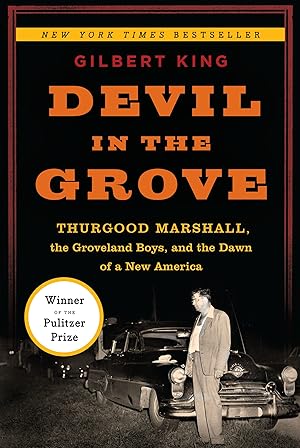
Gilbert King, Devil in the Grove: Thurgood Marshall, the Groveland Boys, and the Dawn of a New America.

Book cover for "Devil in the Grove"

narrated by Peter Frances James (Harpers, 2013), 17 hours and 53 minutes. 

While driving back and forth to Hilton Head and on to the Okefenokee this month, I listened to Gilbert King’s Pulitzer Prize winning history of a shameful event in American history. King winds together several stories, centering around a supposedly rape, to bring to life a tragedy which occurred in the post-World War years in rural Florida.  

At the center of the story is Thurgood Marshall, who led the NAACP’s legal defense fund. As a young lawyer working for the NAACP, Marshall rode trains south to defend African Americans in Jim Crow Courts. His main strategy was to win appeals and to take the case to the Supreme Court, where he had an envious record, winning 29 of his 32 cases before the highest court. Marshall also oversaw the Brown vs Topeka Board of Education which set the stage for the end of segregation. In 1967, long after the Groveland trials, President Johnson appointed Marshall to the Supreme Court where he became the first African American justice. In addition to Marshall’s work on the Groveland case (which came as they appealed), King provides a background into his early years as a Civil Rights lawyer. Like many individuals who seem larger than life, Marshall had his faults. King notes his problem within his marriage, his womanizing, and his love for bourbon. 

Another character at the center of the story in Lake County, where the rape supposedly took place, was Sheriff Willis McCall. He’s the “Devil in the Grove,” a man who ruled Lake County, Florida for decades. McCall protected gambling interests, low wages in the citrus groves, and segregation. He was not above taking the law in his own hands, as the recently opened FBI files showed. 

The case, known as the Groveland Boys, begins with a 17-year-old Norma Padgett and her estranged husband attempting to get back together. Going out for the evening and drinking a lot of liquor, the two found themselves broken down on a deserted road. Two young black men stop to help. When Padgett’s estranged husband disrespects them, a fight ensues. Norma takes off. What happens next is subject to speculation. Padgett’s husband made it back into town, telling the story that his wife’s kidnapping. This might have been to protect himself from Norma’s father, also a violent man with Klan ties. Norma shows up early that morning at a diner and doesn’t seem to have been in any kind of fight or rape. Those who saw her thought she was calm. It appears that at this point, she and her husband collaborate on their story, and a posse starts looking for four black men, even though only two were at the scene the evening before. 

A doctor who examined Norma could not positively say she’d been raped but challenged the idea she had been physically attacked. This information, questioned the legitimacy of the Norma’s story and was suppressed. The defense discovered it only after conviction. Another suppressed piece of information was the young man working at the diner who gave Norma a ride that morning. He noted, in the second trial, how she appeared as if nothing had happened. 

Three of the four charged with the crime were arrested. The fourth attempted to run and was later shot. The three who went to trial were found guilty, two of whom were sentenced to death. and moved to the Florida State Penitentiary. During the appeal, Thurgood Marshall became involved with the case and assisted local attorneys. They won a new trial for the two on death row. Sheriff McCall and a deputy, in separate cars, went to pick up the prisoners and move them back to Lake County for trial. Locking the prisoners together in his car, McCall then took a back road where he supposedly had a flat tire. He said that while he was changing, the two men attacked him and he shot them. The Sheriff called the deputy on the radio. He came, realized Walter Irvin remained alive and shot him again. Irvin, wounded, played dead. When the coroner arrived thinking both men were dead, he realized Irvin was alive and had him transported to the hospital. At this point, the FBI becomes involved. 

The second trial also resulted in a convection and a death sentence. But things were changing in Florida. A new governor, who wanted to protect the state’s booming tourist and agricultural interest, had an attorney friend examine the case. He concluded the men had been framed. The governor pardoned Irvin. The state later exonerated and freed him. Charles Greenlee, who had received a life sentence was also freed. At this point, even the prosector, Jesse Hunter, admitted an injustice occurred and the defendants had been framed. 

Harry T. Moore, another character in this story, headed the Florida NAACP.  On his twenty-fifth wedding anniversary, he and his wife were killed when Klansmen firebombed his home. Moore, who had his own battles with the NAACP along with segregationists like Sheriff McCall. He had been influential in bringing Thurgood Marshall in on the case.  In addition to this, Marshall had to be careful during his time in Lake County. And he also had threats and attempts on his life and safety. 

King had access to NAACP legal defense records as well as the recently opened FBI records pertaining to the case. Drawing on this information, the framing of the Groveland Boys can be easily seen.  I recommend this book, especially as today many in our nation desire to undo the gains America has made in Civil Rights over the past 75 years.  It should remind us that our nation’s hands are not as clean as people often imagine.