
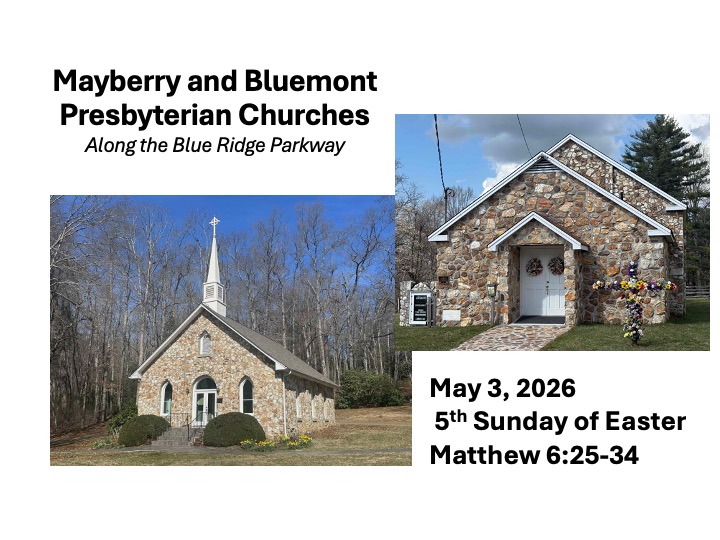
Jeff Garrison
Mayberry & Bluemont Churches
May 3, 2026
Matthew 6:25-34
At the beginning of worship:
There’s a legend about Death visiting a city. At the city gates, an old man recognized Death and asked what business he had in the city. “I’ve come to take 1,000 people with me tonight,” Death said.
The next day, Death reappears and the old man was again sitting by the city’s gate. “Yesterday, you said you were going to take a 1,000 people from our city,” the man cried. “This morning, the newspaper reported that 7,000 people died. Why did you do this?”
“I didn’t,” Death answered. “I took my 1,000. The rest succumbed to worry and anxiety.”
We worry a lot, don’t we? We like to have things under control, but Jesus tells us not to worry about the future. A preacher once addressed the problem of worry in our culture in a sermon which he titled, “Don’t let worry kill you, let the church help!” Yes, even churches can be filled with anxiety and worry.
Before reading the Scripture:
Last week’s passage ended with a proverb. No one can serve two masters. We can’t serve God and wealth. Jesus continues his sermon on the Mount, drawing the attention of his audience to the nature which surrounded them as he begins to discuss anxiety or worry.
This is one of the most beloved passages of Scripture, perhaps falling in behind Psalm 23 and John 3:16. The poetic words in this passage contain power, encouraging us to trust God. But I want you to listen to the passage closely and ponder what Jesus is really saying. If we take this passage too literally, it sounds like we shouldn’t worry about or plan for anything. But is that what Jesus says?
Read Matthew 6:25-34

Jesus is almost two thirds through his sermon. People may be getting hungry as he tells them not to worry about what they eat or drink or wear… He points a finger to the air and follows a few birds as they dart from one bush to another. “Look at ‘em,” Jesus says. “They don’t have a care in the world. You know, they don’t sow or reap. They don’t set out crops and then, like farmers, bite their nails and pray the crop will be plentiful. Can you imagine a bird planting a crop?” he might have asked.
The thought of Joe Sparrow pushing a plow or storing grain might have brought laughter to the crowd. No one images a bird doing such a thing.
Then Jesus gets to the point. “You know, these birds don’t worry about tomorrow, but they get by. And think about it, Jesus says, “Are you not more valuable than they?” Here, Jesus reminds them of the teachings of the first two chapters in Genesis, where God crowned humankind as the pinnacle of creation.[1] God created us to work, to be gardeners in his world, to be his servants with dominion over creation. Certainly, if God cares for the lonely sparrow, God will care for us.
When taken together on the heels of the previous passage, we’re again remained not to be fanatical about accumulating stuff. It’s something we have a hard time doing. But the disciples who abandoned their boats to follow this teacher from Galilee knew something about placing their trust in God. And so did the day laborers who did not own land and couldn’t count on having work from one day to the next. Of course, not everyone lives in such a manner. Some must plan for tomorrow and next month and next year. Even in Jesus’ day, those farmers who hired the laborers had to plan which fields to plant and so forth.
Perhaps this passage shouldn’t be taken too literally. After all, birds die in blizzards. Wildflowers wilt during a drought. Furthermore, a literal interpretation sounds like we should have no cares and should live a lazy life which isn’t at all what God placed on earth to do. “Don’t worry, be happy,” as the song goes. Some Christians have taken it this way. In Paul’s writings to the Thessalonians, he deals with such laziness and informed them if they don’t work, they don’t eat.[2] Wisdom literature within the Bible often condemns laziness and those who do not plan.
When you think about it, birds and lilies are not good models for human beings. Notice, Jesus doesn’t say we’re to be like them. Instead, he says, Look. Or, think of it this way, “consider or ponder” for a moment the birds of the air and the lilies of the field. They should remind us of what God can do for us. They are poetic symbols of God’s providential care.[3] Seeing the wonders of nature, we see the glory of the Creator reflected in his creation, the glory of a God who cares for the earth.
In Dale Bruner’s commentary on the passage, he acknowledges the danger of misinterpreting this passage. Bruner, early in his career, before he became a New Testament scholar, worked as a missionary in the Philippines. He writes that he became convinced this text would be cruel to preach in such a context, among those who are so poor and who go around without proper clothing.
But then, Bruner continues and questions the wisdom of preaching such a passage to the well-to-do. He feared this passage could confirm a dangerous prejudice that spiritual values are to be placed over material needs.
This sets up an opportunity for Bruner to clarify what the passage doesn’t teach. It doesn’t say we should be unconcerned whether others have enough to eat or wear. Certainly, Jesus’ ministry showed his concern for the poor. Instead, the passage commands us to take our eyes off ourselves, off our lives, away from our own selfish anxieties. Bruner concludes, “look around God’s world for a place where we can throw ourselves into the cause of God’s poor.”[4]
Our passage could be interpreted from a celebrative lens. Consider how the lilies and the birds all reflect the glory of God’s creation. Watching and listening to the birds or exploring the wildflowers give us a reason to reflect on God’s gracious care. We can delight in God’s creation and strive to care for it.[5]
In a way, this passage links with our text last Sunday where Jesus encourages us to save treasures in heaven and not on earth. If you remember, Jesus never said that earthly treasures are bad. He just said we can’t count on them. This ties into the climatic verses of this passage. Verse 33 reminds us of how our primary focus should be on God and God’s kingdom. And then, the passages end with verse 34, reminding us not to worry. We are not to worry about tomorrow (nor about those things we can not control). Jesus doesn’t say that planning is bad, we just shouldn’t worry about what is beyond our control and trust those things to God.
This closing verse seals the meaning. Jesus doesn’t leave us thinking that because we belong to him that tomorrow will be wonderful. Yes, at some point, we’ll enter the kingdom, but until then there will hard days in which we have to trust God.[6]
Throughout this middle section of the Sermon on the Mount, Jesus attempts to focus his listeners on God’s goodness and love. Instead of trying to win earthly admiration with public prayers and acts of piety, we are to do such activities quietly and let God see and reward us. Instead of making the accumulation of stuff our primary purpose, our hearts should be first focused on God.
Do you remember those bumper stickers popular back in the 1980s which read, “He who dies with most wins.” Jesus’ teachings point out such nonsense. Our purpose is not to accumulate, but to, as the Westminster catechism reminds us, “enjoy and glorify God forever.”[7]
May we so glorify God and enjoy his blessings. Amen.
[1] Genesis 1:27, 2:4ff.
[2] 2 Thessalonians 3:6-13.
[3] Douglas R. A. Hare, Matthew: Interpretation, a Commentary for Teaching and Preaching (Louisville, KY, JKP, 1993), 74.
[4] Fredrick Dale Bruner, The Christbook: Matthew 1-12 (1990, Grand Rapids, Eerdmans, 2004), 329.
[5] Hare, 75.
[6] Looking for things to soon be made good might be what we desire, but it’s not what we get. This idea comes from Scott Hoezee’s commentary on this passage. https://cepreaching.org/commentary/2014-12-15/matthew-624-34/
[7] Westminster Shorter Catechism, Question 1.
We do worry a lot. Anxiety is a big problem.
The world would be much nicer if people could chill out a bit!
I was just telling my daughter this morning that I’ve gotten much better about controlling my worrying. I’m not sure if it’s because I’m older and wiser (haha) or if I’m finally learning to trust God more. I prefer to think it’s the latter.
Your Scarlet Tanager is beautiful. We tend to get Summer Tanagers instead.
Some people mellow with age, but others don’t. Just be thankful!