Psalm 111: A Call to Contemplate God

Title slide with photos of Mayberry and Bluemont Churches.

Jeff Garrison
Mayberry & Bluemont Churches
October 14, 2025
Psalm 111

Sermon recorded at Mayberry on Friday, October 10, 2025

At the beginning of worship: 

Throughout September, I jotted down sightings from my deck and as I walked the backroads around Laurel Fork. Then, as I was driving back and forth from Wilmington last week, I tried to organize them into a poem which I titled “September from My Back Deck.” I’ll read it to you:

Queen Anne rolls up her lace early
as the chicory and black-eyed susans fade,
replaced by golden rods and the limby yellow wingstem 
growing along the ditch banks with an occasional bunch of purple  ironweed.

The leaves on the walnuts and hickories remain green
but much paler than at midsummer
Occasionally I jump, as if being shot at, when a hickory nut
pings off the barn’s metal roof. 

Only a handful of birds now sing at dawn,
and the sound of insects at night are softer than a month ago.
The lightning bugs disappeared and the last of the yellow finches’ head south
but wooly bear caterpillars show up, some say, forecasting a bad winter.

The bears are less active than in the spring, 
and it’s easier to see groundhogs now the hay has been cut a final time.
The deer move in large herds, as the fawns lose their spots
and the bucks grow antlers.

After dark, which comes earlier as the month progresses,
I watch Cygnus the swan fly higher 
followed by his fellow aviator, Pegasus, the flying horse,
and if I stay up late, I’ll see the fall constellations rise.

The days remain warm, but some mornings feel chilly,
the rain colder and the morning fog denser than just a month ago.
I catch a whiff of smoke from a burning field or brush pile, 
soon to be replaced by woodsmoke.

I posted the poem in my blog this week and didn’t think about this at the time. But Jacqui, a regular reader, quickly responded, “That catches all of God’s blessings.”[1] This was a good insight. Today, as we finish up this tour through the Psalms, I want us to consider how we think about God. Do we spend time contemplating what God has done for us?  

You know, most of us know how to go to God in prayer when we are in need. Many of us also know how to pray and give thanks to God for the blessings we’ve enjoyed. We know how to pray for the needs of others. But probably fewer of us are as competent when it comes to praising God for just being God. But such praised is called for throughout scripture.  And I hope today you’ll consider all of God’s blessings and how they should draw you into praise. 

Before reading the scripture:

We’re concluding out time with the Psalms as we look at Psalm 111. As I’ve done through this series, I used Psalms suggested by the lectionary. If I had already preached on that Psalm, then I went to another lectionary.[2] Though such madness, I find that I’m preaching on Psalm 111 six weeks after preaching on Psalm 112. I now realize this wis unfortunate. The two passages are linked together, which I alluded to when I preached on the latter Psalm.[3]

Psalm 111 is in the wisdom tradition. Parts of the Psalm sounds like Proverbs. Also, like Psalm 112, the poetic structure of this Psalm is acrostic. Each line within the passage begins with the next letter of the Hebrew alphabet.  Finally, the Psalm focuses on God. But the Psalm doesn’t deal with God in the esoteric, such as the wonder of creation.[4] Instead, the Psalmist focuses on what God has done for his people. 

The voice of the Psalm is an individual, but his or her concern is of community interest as the Psalmist announces at the end of the first verse.[5] He will praise the Lord, but he’s going to do it in the company of God’s people. Praising God when we are alone doesn’t provide the glory the Almighty deserves. In our call to worship this morning, I adapted the opening to make the Psalm reflect such community participation.[6] Let’s listen to this Psalm.

Read Psalm 111

As I indicated earlier, back at the end of August I preached on Psalm 112. In that passage, the Psalmist encourages us to strive to live righteous lives with a promise of great blessing. Psalm 111 also focuses on righteousness, but here it’s about the righteousness of God. Maybe I should have reversed the two sermons, but it’s too late for that. In addition, it’s probably good for us to end this tour through some of the Psalms with one that encourages contemplation. This Psalm invites us to ponder the nature of God. 

One of the purposes of the Psalms is to model honest prayer. I hope you have come to an understanding how we might use the Psalms for our own prayers. Or at least, we can use them as a starting point to kick off our prayers. I often do this when writing pastoral prayers.  And because there are so many Psalms, which address all forms of emotions and needs, we shouldn’t be without words to help us convey our thoughts to God. 

Like Psalm 112, this is another Halleluiah psalms. Our version of scripture translates Halleluiah as “Praise the Lord.” As I said with the other Psalm, Halleluiah, is a transliteration of the Hebrew. And it’s an imperative. In other words, the Psalm begins with a command for us to praise God. 

The Psalmist then models such praise. She or he gives thanks to God with his or her whole heart, and with everyone else who believes in God. The Psalmist has spent time studying or pondering the works of the Lord. From his or her study, the works of God are found to be great, honorable, majestic, and righteous. The Lord endures forever. We find this key understanding throughout the Hebrew scriptures, which equate our lives with that of a flower, that blooms beautifully and then fade away. God, however, is eternal.[7]

The Psalmist then recalls God’s wonderful deeds. Providing food for those who fear God would immediately make the Hebrew people recall God nourishing those fleeing Egypt during the Exodus with manna. God being mindful of his covenant reminds the people of Sinai, where God gave the law and formally established a covenant which went back to Abraham. Giving God’s people the heritage of the nation links to Joshua’s conquest and the establishment of a nation. 

The praise continues, moving from deeds completed to God’s integrity: faithfulness, just, trustworthy, and righteous. Then, the Psalmists returns to God’s action, the redemption of his people. Here, those of us on this side of the resurrection, immediately think of the coming of Jesus, who redeems us of our sin. 

Finally, the Psalm ends by repeating a common saying found in wisdom literature, “The fear of the Lord is the beginning of wisdom.”[8] Of course, fear here doesn’t mean being afraid of God. After all, if the Lord is everything the Psalmist confesses—faithful, just, trustworthy, and willing to redeem—then there should be little to fear for those who seek to live righteous lives. Instead, fear here is more like “awe.” We stand in awe before God and all of God’s works. 

As I have indicated, this is a wisdom psalm, but one which is also linked to our redemption as we see in verse 9.  We should understand that wisdom is different that knowledge. As one commentator notes, “Knowledge is book learning.” Wisdom is more like street smarts. You don’t learn it from school. It comes from having been around the block a few times.[9] In the case of our relationship with God, wisdom comes from contemplating what God has done and standing in awe as we say, “Thank You.”  

Psalm 111 invites us to pause for a moment and consider God’s nature. God directs us in Psalm 46 to “be still and know that I am God! I am exalted among the nations. I am exalted in the earth.”[10]   

When we spend time thinking about God’s nature, we build ourselves a solid spiritual foundation from which we can continue to grow in Christ. So, take time as did the Psalmist to contemplate what God has done for you, for us, and for the world. And let such knowledge draw you into praise. Amen. 


[1] https://fromarockyhillside.com/2025/10/09/september-from-my-back-deck/

[2] The one exception was the sermon on September 28, which I adapted a former sermon as I spent much of that week on a mission trip.  Mostly I drew the Psalms from the Revised Common Lectionary. 

[3] https://fromarockyhillside.com/2025/08/31/psalm-112-the-blessing-of-the-righteous/

[4] Psalm 8 is an example of a creation psalm. 

[5] James L. Mays, Psalms: Interpretation, A Bible Commentary for Teaching and Preaching (Louisville, KY: JKP, 1994), 335.  (other individual Psalms include 8,103, 104, 145, 146).

[6] I used the Message translation for the opening line which I adapted: “Hallelujah! We give thanks to God with everything we’ve got.”

[7] See Isaiah 40:7-8.

[8] See Job 28:28 and Proverbs 1:7 and 9:10. For similar ideas, see Proverbs 15:33, Isaiah 11:2 and 33:6. 

[9] Scott Hoezee,  https://cepreaching.org/commentary/2025-10-06/psalm-111-10/

[10] Psalm 46:10.

Psalm 137: A Difficult Passage

Title slide with photos of the two churches where the sermon will be preached

Jeff Garrison
Mayberry & Bluemont Churches
October 5, 2025
Psalm 137

The sermon was recorded at Bluemont Church on Friday, October 3, 2025

At the beginning of worship:

All of us have probably harbored feelings of revenge. But it’s not healthy. The desire for revenge also makes reconciliation an impossibility. 

Philip Yancey wrote a valuable book, which I highly recommend, titled, What’s So Amazing About Grace? In it he writes: “The strongest argument for grace is the alternative, a permanent state of ungrace. The strongest argument for forgiveness is the alternative, a permanent state of unforgiveness.”[1] We wouldn’t want to live in such a state, would we? But many people do live their lives in such a fashion. 

Yancey went on to quote Lance Morrow who linked unforgiveness to Newtonian physics. “For every atrocity there must be an equal and opposite atrocity.”[2] And then there was Ghandi who said, “An eye for an eye makes the whole world blind.”[3]

Today, we’ll look at a passage of scripture which seems void of grace. But before we go there, I want you to not forget that message of grace and love and forgiveness which runs through 95% of the Bible. And to understand the passage, we must place it in context, which I’ll try to do. 

Before reading the scripture:

Many of the Psalms are void of any direct historical connection. We understand the feelings of the Psalmist without a knowledge of what led to such emotions. Some Psalms are joyous, other sad. At times, the Psalmist feels threatened or angry. But we often don’t know what actions led to such feelings. Was it because of an abundant crop or military victory? Or did the feelings come from a war or pestilence in the lands or being double-crossed? 

The Psalms don’t generally provide a clue as to what led the Psalmist to have a particular feeling to bring forth to God. And this okay, for it means we can apply the same Psalm for many situations. 

Today, we’re looking at the 137th Psalm and this one is different. We are given a setting. This Psalm was written after Jerusalem fell to Babylon. Her people, now in exile, attempts to maintain their identity. This becomes a hard task, because the Babylonians taunt them.

An important step in interpretation of any scripture is to place ourselves in the position of those who first read or heard the passage. This step is especially needed to understand this Psalm, for it seems to go against teachings of much of the Bible. 

The people of Jerusalem exiled to Babylon after the city’s fall in 587 BC had lived through terrible times. Not only had their army been beaten and the city destroyed, but the defeat also involved a long siege in which the people locked behind the city walls experienced starvation. Hungry, they lived through the dread of what might happen when the Babylonians breach the walls. 

And when the unthinkable happened, things got worse. Babylonians and their allied armies raped, pillaged, looted, and killed the Hebrew people. Furthermore, the people felt abandoned by their God. Why were they not saved, they wondered, as the attacking armies tore down and burned Solomon’s temple. Those who survived the attack were hauled away to Babylon as captivities, where they lived with the shame of defeat and a feeling of abandonment. 

But the people for whom the Psalmist’s speaks in today’s text, the pain goes deeper. Think of how the Armenians felt after the Turkish genocide at the fall of the Ottoman Empire. Or how the people of Gaza feel today, after the ongoing assault on the whole society, not just those responsible for attacking Israel in October 2023. And we can see such feelings in Ukraine for how Russia and the Soviets treated them in the 1930s, when up to four million Ukrainians starved. 

We even see this in our own country, with a race of people having been slaves. And after “freedom,” found themselves continuing to live in a society stacked against them, as was the Jim Crow South.  If we want to understand this Psalm, we must place ourselves in such situations. The Psalm, which sounds harsh to our ears, desperately pleas to God for redress.

Read Psalm 137

One of the themes we’ve seen in the Psalms we’ve explored over the past few months is how honest the Psalmists can be toward God. Today, the honesty seems almost obscene. Would we talk with God like this? This is a painfully difficult passage to handle, which is partly why I have avoided preaching it until now. 

The late Old Testament scholar, Walter Brueggemann, wrote, “I am not sure how such a psalm fits with Christian faith.”[4] He’s honest. The Jewish scholar, Robert Alter, wrote “no moral justification can be offered for this notorious concluding line.”[5]There you have it. A Jewish and Christian scholar admitting to the difficulty of this psalm.

So how might we understand these harsh words. One way is to avoid the Psalm, but that is not being truthful to the entirety of scripture. We’re given the 66 books of the Old and New Testament. And if you study these books closely, you’ll find things with which to struggle and Psalm 137 will probably be near the top of your list. But because life can be difficult, we shouldn’t just skip over such passages. 

We can divide this psalm into three parts. The first part deals with Babylon. The second part recalls the people’s the memory of Jerusalem. And the final section addresses God.[6]  

The Psalm begins with an idyllic setting of Babylon, where people gather around the rivers (or maybe the canals running off the river), in the city.[7] We are not told why they gather at the river, but we know that without a synagogue, the Jewish people would often gather by water for worship. 

When the Apostle Paul found himself on the Sabbath in Philippi, with the absence of a synagogue, he headed to the river where he found Lydia and a group of women believers who gathered on the Sabbath.[8] Perhaps this is why the people  gather around the river. 

Although this is a desert city, the water provide growth to trees. Most versions refer to the trees as willows, but the word might be better translated as “poplar.”[9] What’s important is the shade provided on a hot summer day. We can add to this image the cooling breeze coming off the water. 

But the moaning and crying disturbs the idyllic setting. While they have instruments for music, no one wants to sing. Instead, they hang up their harps in the trees. Furthermore, the Babylonians demand they sing a “Song of Zion,” not out of worship or respect but for entertainment. This the people won’t do. They won’t sing the joyous songs of their past for the listening pleasure of their captors. 

The mention of Zion brings to their minds Jerusalem, God’s holy city. In verses 4-6, the Psalm focuses on the Jerusalem, as the people declare their loyalty to it. They are exiled in Babylon. They have seen their city destroyed and their friends and family slaughtered by the Babylonians. But now, in a strange and foreign land, they will remain loyal to their former home. 

Bringing up Jerusalem and the past causes the blood of the Psalmist to boil. Starting in verse 7, the Psalm now addresses God. They recall the taunting of their neighboring enemies from Edom, who supported the Babylonians as their city fell. Their neighbors shouted, “tear it down” and the people of Jerusalem want God to remember these cries and to punish them. 

Those reciting the Psalm save their most heinous hopes for the Babylonians, who devasted the city. Two blessings (or beatitudes) are sought for those who pay Babylonian back including the horrific closing line, those who dash the heads of the infants of the Babylonians against rocks. 


We only understand this last line if we can grasp that it’s cited by those whose grief is so great they’re out of their minds. This cry comes from those who have lost everything including hope. But note this, they cry out such pain, but don’t instigate such action. They leave any action up to God. They don’t rile up the crowds into a frenzy so they might take it upon themselves to carry out such an attack. Perhaps they recall the Old Testament law which restrains revenge by proclaiming “vengeance belongs to the Lord.”[10]

As Christians, who strive to follow the Prince of Peace, we must understand Psalm 137 as an extreme cry of pain. We shouldn’t take the Psalm as an endorsement of how to handle enemies. For that, we must go to the words of our Savior, who calls us to bless and love our enemies. But we should also understand that at times the pain can be so strong that we cry out uncontrollable. This Psalm reminds us of such times and shows it’s okay to bring such cries to God. Hopefully, when the grief subsides, we can then, as another Psalm calls us, sing a new song to the Lord.[11]

As followers of Jesus, this passage not only encourages us to be honest with God, but it also warns us of what happens when we refuse to see the image of God in others. When people, like the Psalmist find themselves in such a situation, they have nothing to lose. Such treatment leaves those we see as enemies with feelings which prevents the possibility of peace. Such situation benefits no one. May we be better. Amen.


[1] Philip Yancey, What’s So Amazing About Grace? (Grand Rapids, MI: Zondervan, 1997), 114. 

[2] Ibid.

[3] I’m quoting for memory. The first time I heard this quote was in the movie, “Ghandi.”

[4] Walter Brueggemann, The Message of the Psalms (Minneapolis: Augsburg, 1984), 75.

[5] Robert Alter, The Book of Psalms:  Translation with Commentary (New York: Norton, 2007), 475.

[6] James L. May, Psalms: Interpretation, A Bible Commentary for Teaching and Preaching (Louisville, KY: JKP, 1994), 422-423.

[7] Alter, 473. 

[8] Acts 16:13.

[9] Most translations use “willow” as a translation. See ESV, KJV, ESV, and NRSV. A few use “trees” as in the CEB and NLB. The CSB and NIV translates it as “poplar.” 

[10] Deuteronomy 32:35. See also Leviticus 26:25, Romans 12:19, and Hebrews 10:30. 

[11] Psalm 96. 

Praising God

Title. slide with photo of Mayberry and Bluemont Churches

Jeff Garrison
Mayberry & Bluemont Churches
September 21, 2025
Psalm 113

At the beginning of worship:

I’m sure most of you remember the long running TV show, MASH, which lasted three times as long as the Korean War, which it portrayed. One of the more compelling characters in the show was Father Mulcahy, the Catholic priest who served as field hospital’s chaplain. 

In one episode, Father Mulcahy had the blues. Observing the hard work of the surgeons, nurses, and medics to save lives, he complained that all he could do was pray. But then a man on the operating room table took a turn for the worse. Nothing the surgeons did stopped the man’s decline. Mulcahy was brought over. He prayed. Suddenly, the man began to improve. 

“You’re sure you’re not useful,” Hawkeye asked. The shy and humble chaplain said, “It’s not supposed to work that way.”[1]

Of course, it is supposed to work that way. Only it often doesn’t. We pray and someone still dies. But we’re still called to pray and to hope and to do what we can to help. Maybe we should remember to include in our prayers the caveat from Jesus who prayed, “Thy will be done on earth as it is in heaven.”[2]

Before reading the Scripture:
As we jump around the Psalms, today we’ll look at Psalm 113. Like Psalm 112[3], which we explored a few weeks ago, Psalm 113 is a positive Psalm which makes two points. First, we’re called to praise God. The second point is the reason why we praise God, and it has to do with the nature of God to help those overlooked by society. Just like Psalm 112, which seems a little unrealistic in its promise of riches descending on the righteous, this Psalm also has an unrealistic theme. It promises blessings to the poor blessings and children to barren women. We’ll need to think about what this means because we know it doesn’t always work that way. 

The language and the poetry of this Psalm is beautiful. It begins and ends with a Hallelujah, often translated as “Praise the Lord!” Faithful Jews who gathered with family and friends at Passover would recite these words. Perhaps even Jesus used this Psalm during the last supper, celebrating Passover with the disciples.

In the Hebrew, the Psalm consist of three stanzas. Verses 1-3 calls us to praise God, verses 4-6 reminds of God’s majesty and why God should be praised. The final three verses illustrate God’s mercy.[4] Let’s look at the Psalm and see what we might learn about God and why all of us should praise God. 

Read Psalm 113


Our Psalm begins with an imperative. The opening “Hallelujah,” translated as “Praise the Lord” in our reading, isn’t a suggestion. It’s a command with two components.  First, we begin now to praise God, and we continue as long as we have breath. And God’s people are always to be praising the Lord. For those of us exploring this Psalm from this side of the Jesus’ resurrection, as we see in the book of Revelation, this task continues into eternity.[5]

Second, we learn God is to be praised continually, throughout our waking hours. From the rising of the sun to its setting, the Psalm commands. In a world without electrical lights, people slept when it was dark. During the daylight hours, people were awake and going about their work, but they were also to praise God. As the lamp in the temple burned continually, reminding the people that their prayers of praise should continually rise to God. Or as the Apostle Paul said, “Pray without ceasing.”[6]  

In other words, our lives are to be a witness, a prayer. This doesn’t mean we are to be on our knees all day. Nor should Hallelujahs come out of our mouths continually. We praise God by how we live and how we relate to others. 

After the command to praise, the Psalm provides the reasons behind such instruction. First, we’re given a theology of praise. We praise God because nothing is greater. God stands above everything. Nations, the earth, even the heavens. The cosmology of the Psalmist places God outside of everything that’s created. This includes the heavens and the earth. We think of God in heaven, but the Psalmist doesn’t pin God down even there. Instead, God the creator stands free from even the heavens. God stands above all, and no one can compare to God. Our minds cannot understand the grandeur and splendor of God. Yet, we are to praise.

The second set of reasons for praise has to do with God not abandoning creation. Our God is not the God envisioned by the Deists, like some of our nation’s founding fathers, who saw God as the watchmaker. God creates, winds up the watch, then stands back and observes the ticking, not intervening. But the Psalmist doesn’t see God in such a manner. The God of the Hebrew people, the God and Father of our Lord Jesus Christ, isn’t like this. God continues to be involved in creation. 

We’re given two examples. First, God remains concern for the least of us. The poor and the needy, those often overlooked by others, remain on God’s heart. We also saw this last week when we looked at Psalm 14. In that Psalm, God stands against those who think they control the world and don’t have to answer anyone as they abuse the poor. God provides a refuge for the poor and the righteous. Those who think they can get away with “eating the poor” will experience the terror of a righteous and just deity.

In today’s Psalm, we learn that God looks out for the poor. God raises up the poor from the dust, which should remind us of Genesis, where God created the first man out of the ground and gave him breath.[7] In other words, God gives new life to the poor. 

During the Passover celebration, this Psalm is paired with Psalm 114, which recalls God’s wonders during the Exodus. In this case, the people are reminded that they were once poor, whether slaves in Egypt or the dust of the ground.  

The second half of verse seven recalls the image of the needy being lifted from the ash heap. We can imagine the lepers and others forced to live outside the city walls literally on the dung heap, as the “ash heap” can also be translated.

God not only lifts the poor and needy but seats them on the podium with princes. The poor and the needy will become people of honor. 

The final example of God’s faithfulness is how God looks upon barren women. The translation is that God provides her a home, but the root meaning goes deeper. God seats such women in a happy home, just as God places the poor and needy on the throne with princes.[8] Finally, God makes such women the joyful mother of children.

For the Hebrew faithful reciting this Psalm in the temple or in their homes during Passover, they would be immediately drawn to consider Abraham’s wife Sarah, and Hannah, the mother of Samuel. Both women were without children until late in life. Other women who might be recalled were Rebekah and Rachel.[9]Barren woman in the ancient world were particularly vulnerable, which is why God looks out for them. 

Of course, there is a problem with this. We’ve all known those who are poor and needy, some who have been faithful and have cried out to God. Yet, not many of them ever sat on the podium with highfalutin folk. Even worse, we hear of malnourished children dying in the Gaza and in the Sudan and Congo. And we’re left to question why God didn’t answer their prayers.  And most preachers know of women who avoid church on Mother’s Day, for their prayers haven’t been answered in the manner they’d like. 

None of us should assume we know better than God, but why does God act sometimes and not in others. Had Hannah been the only barren women in Israel when Samuel was born? Probably not. Yet, there are times when God interrupts in history, which gives us hope and the second reason to praise God.

Today’s Psalm demands us to praise of God and gives us reasons to so. At the very least, we should praise God when the sun rises or when we awake. And again, when it sets or as we fall asleep. While it is okay to ask God for what we need, we should never forget to give God thanks with praise. Will we listen?” Amen.


[1] I was reminded of this episode in Scott Hoezee’s commentary on the text. See https://cepreaching.org/commentary/2025-09-15/psalm-113-4/

[2] Matthew 6:10.

[3] See https://fromarockyhillside.com/2025/08/31/psalm-112-the-blessing-of-the-righteous/

[4] Stan Mast, commentary on Psalm 113. See https://cepreaching.org/commentary/2016-09-12/psalm-113/

[5] See Revelation 4, 7:15.

[6] 1 Thessalonians 5:17. 

[7] Genesis 2:7.

[8] Robert Alter, The Book of Psalms: A Translation and Commentary (New York, Norton, 2007), 404, 9.

[9] See Genesis 11:30, 25:21,29:31, and 1 Samuel 1. See Walter Brueggemann, The Message of the Psalms: A Theological Commentary (Minneapolis: Augsburg, 1984),162.  See also Athur Weiser, The Psalms: A Commentary (1958, Philadelphia: Westminster, 1962), 707-708,

Psalm 33: Trusting in a Merciful God

Title slide for sermon showing the two churches where the sermon is to be preached

Jeff Garrison
Mayberry & Bluemont Churches
Psalm 33
August 10, 2025

Sermon recorded at Mayberry on Friday, August 8, 2025

At the beginning of worship:

A burglar broken into a house when the occupants were away. As he started casing out the place, looking for silver and jewelry and other things of value which he could easily hock, he heard a voice. “Jesus is watching you.” The burglar decided his conscience was bothering him. He quickly put his fear aside. 

Then, he heard the distinctive voice again. “Jesus is watching you.” He looked around. He saw a parrot in a bird cage. Then the bird spoke again. “Jesus is watching you.” The burglar relaxed. “Just a stupid bird,” he thought. He went about his work, tossing valuables into his bag. 

Then he heard the bird change his tune, “Sic ‘em, Jesus.” He turns around just in time to see the exposed fangs of a charging rottweiler. 

Of course, Jesus watches. And I’m not talking about a dog named Jesus. We believe this truth: our God is all-knowing and all-seeing. God sees our actions. But more important and perhaps more damning, God knows what we think and what’s in our hearts. Thankfully, we also worship a God of grace. Otherwise, there would be no hope for any of us. 

Before the reading of Scripture:

For the next few weeks, I plan to spend time in the Psalms, ancient Israel’s hymnal. I’m going to draw on the lectionary for many of these, but not exclusively. I will mostly pick Psalms which I have not yet preached. This way I can dig deeper into this book. 

Think of the great hymns of our tradition and how they express our theology. Hymns are often constructed around the Trinity, such as “Holy, Holy, Holy.” Others express the truth of the incarnation, that God came to us in the flesh in the life of Jesus, as in “Joy to the World, the Lord is come.” Others remind us of how we can trust God, such as “Great is Thy Faithfulness.” “I Sing the Mighty Power of God,” expresses the power of the Almighty and “A Mighty Fortress is Our God,” expresses how we should take refuge in God’s power. 

Likewise, the Psalms express the theology of ancient Israel. Today, we’re looking at Psalm 33. This piece conveys the Almighty nature of God as well as God’s goodness. Because of God’s nature, we should praise him. Think of the hymn, “God of Grace and God of Glory,” which we sang this morning.  

A festival hymn, this Psalm was sung in worship; it may have been used during New Year celebrations as it looks back and forth.[1] Let’s listen to the Psalm.

Read Psalm 33:

“When you gathered with people who are righteous and upright, sing with them Psalm 33,” suggested Athanasius. He was the Bishop of Alexander in the 4th Century.[2] This Psalm was important for the early church. It provided them and us with reasons for and benefits of trusting God.

Let’s work through the Psalm. You might want to keep your Bibles open. Verse 1 through 3 serves as a call to worship. This is the first Psalm to mention musical instruments: the lyre, the harp, strings.[3] If you want to support the use of a guitar or banjo in worship, look no further than the opening of this Psalm. However, the Psalm excludes many of us for in verse three we’re told to “play skillfully on the strings.” Some of us can’t do that! At least not the skillful part. Including yours truly. 

Along with instrumental music, we’re called to sing and to use our voices to make “loud shouts.” That’s the joyful noise which Psalm 100 calls us to make.  

These opening verses center us in worship. Our focus, in worship, isn’t to be internal, on ourselves and our needs. Instead, worship centers on God. 

We’re then given two reasons why we should worship God. First, God is faithful and upright. God created the heavens and earth by his word and holds back the waters. Remember, to desert people like Israel, large bodies of water were scary. Holding back the waters was seen as grace.

The second reason has to do with God’s control. We’re to fear God for what God says will be. Our Lord stands above all nations and peoples. Next to God, we’re powerless, for God can thwart any of our plans. God is eternal, we’re not!

In verse 12, there’s a shift to how God’s power relates to the earth. It begins with “Happy is the nation whose God is the Lord.” This quote has been used on billboards and bumper stickers to promote a nationalistic agenda.[4] But that’s a misuse. It only makes sense by leaving off the second half of the verse, “the people whom God has chosen.”[5] This reminds us of a key concept in our theology. It’s not about us choosing God, it’s about God choosing us. If God doesn’t make the first move, which he does in Jesus Christ, we’d be lost. 

Of course, the nation referred to here is ancient Israel, through whom God worked to bring salvation to the world. 

But as the Psalm continues, we’re reminded repeatedly that this really isn’t about a nationalistic religion of a powerful nation. God watches over all the earth. While God stands apart from the world, God remains interested in what happens to his creation.[6]

Furthermore, in verse 16, we realize this can’t be a nation who takes comfort in its military prowess. The king cannot be saved by his great army, nor the warrior by his great strength. Even the strength of a war horse is vain. Instead, salvation can only be found in the God who watches over us all. Pacifism isn’t the intent of this Psalm. Nationally, there remains a need to protect oneself. But we shouldn’t trust just in the military. We must trust, first and foremost, in God, not in our own abilities.

Remember, Jesus watches us.  Idolatry exists when we place our trust in anything other than God, and that includes military might. Hedging our bets is a dangerous strategy, according to this Psalm, for God wants our total allegiance.  

We’re called to fear God but should remember this fear isn’t about being afraid. Because of God’s power, we want to be on God’s side. When we try to ignore God and do our own things, we may quickly find ourselves in trouble. 

So, the Psalm closes with the promise to wait on God, for we find in him help and protection. Our hearts should be glad because of our trust in God. Then, the Psalmist addresses the Almighty, asking for the Lord to be with us. 

What can we take away from this Psalm?  As the 130th Psalm proclaims, we’re to hope in the Lord.[7]

Another thing this Psalm reminds us of is the inability to separate our lives into the religious and the secular. Or the “church and everything else.” For God sees all, not just what happens in church. This is God’s world and we’re to live for the Lord.[8]

Augustine, writing in the 4th Century on this Psalm suggested: “Let the unjust dance for joy in this world, by all means; but when this world comes to an end, there will be an end to their dancing. Let the just dance for joy in the Lord, for the Lord abides forever, and so will the exultation of the just.[9]

We’re to dance for joy in the Lord! That’s good advice. Keep focused on God and worry less about the things of this world. Amen. 


[1]  Artur Weiser, The Psalms: A Commentary (Philadelphia: Westminster Press, 1962), 289.

[2] Athanasius, On the Interpretation of the Psalms, as quoted in Ancient Christian Commentary on Scripture: Old Testament VII, Psalms 1-50, edited by Craig A. Blaising and Carmen S. Hardin (Downers Grove, IL: Intervarsity Press, 2008), 244. 

[3] James L. Mays, Psalms: Interpretation, A Biblical Commentary for Teaching and Preaching (Louisville KY: John Knox Press, 1994), 149. This is based on the current canonical ordering of the Psalms as found in the Christian Bible. 

[4] It’s been a while, but I have seen this as a bumper sticker. For billboards, see Stan Masts Commentary on the Psalm at https://cepreaching.org/commentary/2016-07-31/psalm-3312-22/

[5]Scott Hoezee, Sermon Commentary for Sunday, August 7, 2022, Psalm 33:12-22,” in https://cepreaching.org/commentary/2022-08-01/psalm-3312-22-3/

[6] Walter Brueggemann, The Message of the Psalms: A Theological Commentary (Minneapolis: Augsburg, 1984), 35. 

[7] Psalm 130:5

[8] May, 151.

[9] Augustine, Expositions of the Psalms, as quoted in Ancient Christian Commentary on Scripture: Old Testament VII, Psalms 1-50, edited by Craig A. Blaising and Carmen S. Hardin (Downers Grove, IL: Intervarsity Press, 2008), 246

Psalm 115: Don’t covet your neighbor’s gods

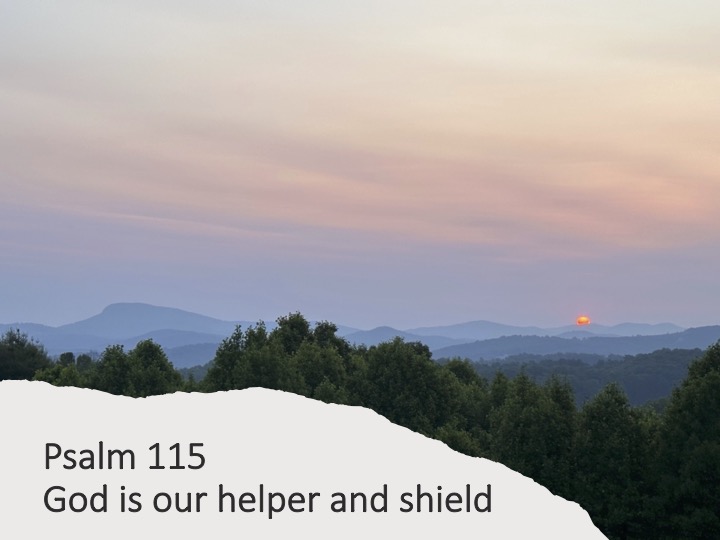
Sermon cover slide featuring a sunrise

Jeff Garrison
Bluemont and Mayberry Churches
June 11, 2023
Psalm 115

Sermon recorded at Bluemont on June 9, 2023

At the beginning of worship

When your neighbor is successful, do you ask him or her about their secret? You know, as humans, we’re often curious. That can be a good thing. It may help us become a better person. I’ve seen articles on the books Oprah, Warren Buffett, Elon Musk, Bill Gates, and other financially successful individuals read. Maybe it will work for us, we think as we read the same books. Let me suggest that’s okay, up to a point.

Now comes the warning. Don’t ever think that just because of someone is successful, they are closer to God. Nor should we take religious advice from someone based solely on their bank account. We must remember our God delights working with the underdog. Jesus repeatedly speaks of reversing the economic order, where the last are first, the servant and the poor are elevated to positions of power and glory.[1] This morning, think about what this means for us?

Before the reading of scripture

During the season of Easter, I based my preaching on a series of praise Psalms I thought reflected the joy and hope fitting the season. But there was another Psalm I thought about trying to work into the series. I couldn’t fit in. Yet Psalm 115 kept coming back to me. I decided to preach on it today. Next Sunday, I plan to move to the New Testament and begin to work our way through 2nd Corinthians. 

If your Bible has textual notes, you may learn that in many older manuscripts, this Psalm was connected to the previous Psalm, 114. That Psalm doesn’t seem to have as much meaning as 115. It recalls the wonders of what God did for the Israelites during the Exodus. Of course, we need to know God’s work, but that’s all you get in 114. You don’t even have a call for the people to praise, just a recounting of God’s action and a warning to fear the Lord. Psalm 114 reminds Israel of what they’re not to claim credit.

Psalm 115 begins with a reminder for Israel to give God the credit. In other words, be humble and don’t think you’re responsible for your good fortune. Such humility is a sign of one who trust in God. 

Read Psalm 115. 

Think about the times you’ve felt pride swell up in you. How did you feel when you first mastered riding a bike? Or swimming? Or building your first birdhouse. You know those things you showed off to your friends during show-and-tell. 

Speaking of show-in-tell… I don’t remember much about shop in Junior High, except for one thing. I designed and built a desktop bookcase. It’s simple. I probably worked on it for two class periods, maybe four with the staining and varnishing. But it was mine. For years, it sat on my desk and held dictionaries and a Thesaurus. Then computers came along, and the monitor replaced it. I moved it to the top of a file cabinets. Today, fifty-some years later, it’s on a shelf in my office at Bluemont. It holds books I’m waiting to read. 

What are you proud of?  Maybe turning a double play in Little League or throwing a touchdown pass when playing high school football. Or, for the studious among us, it might have been making the honor roll. I wouldn’t know anything about that (it wasn’t until college that I made the Dean’s list). 

Or our pride can be puffed up with a reward at work. I know my ego about burst when we moved into new church campuses in the congregations I served in Utah and Michigan. 

Tempering our pride

But with all these examples, if we think about how they were accomplished, it should temper our pride. After all, where would we have been without a parent to teach us to ride a bike? Or teachers to show us how to swim or build something from wood? Or coaches to encourage us? And for the big stuff, we seldom do it alone. We depend on others to do their part. 

And we must ask, who gave us the abilities we need to do accomplish what we do? If we were born without arms, there would have been no double plays or even woodworking. If no one joined in helping us, there would be no new buildings or other major accomplishments. And finally, for everything we do, we owe a debt to God. Very few things we can claim for our own. This is why our Psalm begins with a negation. Let’s not praise ourselves. Let’s give credit to God, whose love and faithfulness allows us success. 

The concern of the Psalmist

But then, in the second verse, we understand the reason behind the Psalmist concern. The nations taunt Israel. “Let us see your God,” they ask. This was a real problem for a small nation like Israel who worshipped an unseen God. There more powerful neighbors pushed them around. Now they want to see the God Israel worships. A problem in Israel’s history is her own citizens looked to their neighbors and their gods and wondered if they are worshipping the wrong God. It’s kind of like us trying to find the secret for success from someone else, as I suggested at the beginning of worship.

The psalmist tries to nip this tendency to look with envy upon their neighbors in the bud. He provides a statement of faith. “Our God is in the heavens; he does whatever he pleases.” Israel has no control over their God. There is a profound truth here. If we can control God, we are not worshipping the true God; for we are creatures, created by the Almighty. We worship the God who created heaven and earth and who is active in the affairs on earth,[2] especially with the powerless and the weak.

A satirical caricature

At this point, the psalmist creates a satirical caricature of the gods of the nations who have been created by human hands.[3]In a poetic yet humorous way, he describes these gods who some mistakenly believe give their neighboring countries such strength and power. The idols of other nations depict gods with human attributes—mouths, eyes, ears, noses, hands, feet, throats. Of course, none of these attribute’s work! While we can see an idol, it can’t do anything else for us. As humans, if we can control or make a god, it’s not the Lord Almighty.

You’re no better than that which you worship

In verse 8, after describing such idols, the psalmist polemic turns to those who worship them. Those who trust idols are not better than the statues they worship. I suggest this is true for the idols we worship. 

A three-fold call and blessing

Then, in the next verse, the psalmist issues a call to the Hebrew people to trust in their Lord, their help and shield. He issues a three-fold call: for Israel, for the house of Aaron or the priesthood, and for all (great and small) who fear the Lord. Here, it appears the Psalm includes not just those who are children of Abraham, but others who also worship the Lord.[4]

The psalmist follows his three-fold call to trust in God with a three-fold blessing from God. The God who created heaven and earth is faithful to those who honor him.

God created two domains

In verse 16, we learn that God has created two domains. Heaven is for the Lord; the earth is for us. Of course, this does not mean that God is not present on earth, for it all belongs to God. And God can reveal himself at any time, as he did over and over in Scripture[5] and more fully in Jesus Christ. 

A hint of resurrection?

Verse 16 sounds obvious but also negative. “The dead do not praise the Lord.” Yet it is followed by a statement that we will bless the Lord from here on out. Obviously, if we are to continue to bless the Lord after we die, God’s must intervene. This is beyond the Old Testament view of God but is the truth we discover in Jesus Christ.[6] God, through Jesus, defeated death and promises us eternal life.  

Do not covet 

This Psalm reminds us to be content and to trust God. We shouldn’t crave what we think makes our neighbors successful. Perhaps this is a reason for the 10th Commandment: “You shall not covet your neighbor’s house…”[7] Instead of finding ourselves by comparing us to others, we find ourselves in God’s family. While God may reside in heaven, God is also all around us. God came to us in Jesus Christ who shows us the face of God.[8] Jesus promises to be with us, whenever we gather in his name.[9] And God’s Spirit is always present in our lives, drawing us back to our true home with Christ. 

Let us bless the Lord from this time on and forevermore. Praise the Lord. Amen. 


[1] See Matthew 5:1-12, 19:27-30, 20:16; Mark 9:25, 10:31; and Luke 6:20-26, 13:30. 

[2] Artur Weiser, The Psalms: A Commentary, translated by Herbert Hartwell (1959, Philadelphia, Westminster Press, 1962), 716. 

[3] James L. Mays, Psalms: Interpretation, A Biblical Commentary for Teaching and Preaching (Louisville, KY: John Knox Press, 1994), 366. 

[4] Some date this Psalm late in Israel’s history, after the exile, when Judaism accepted converts from other traditions, but this may not be the case for even before there were always a few who were not ethnically Jewish but worshipped the same God.  See Weiser, 315.  

[5] Consider the call of Abram (Genesis 12), the call of Moses (Exodus 3), and the call of the prophets (examples include Samuel—1 Samuel 3, Isaiah—Isaiah 6, Ezekiel—Ezekiel 1). 

[6] Weiser, 717-718.

[7] Exodus 20:17 and Deuteronomy 5:21.

[8] John 14:8-11.

[9] Matthew 18:20.

Another photo of a smoky morning creating a beautiful sunrise