The Second Commandment

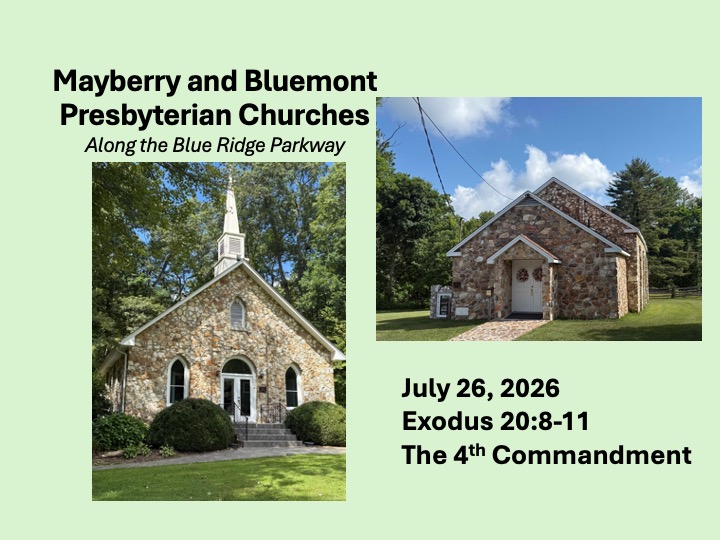
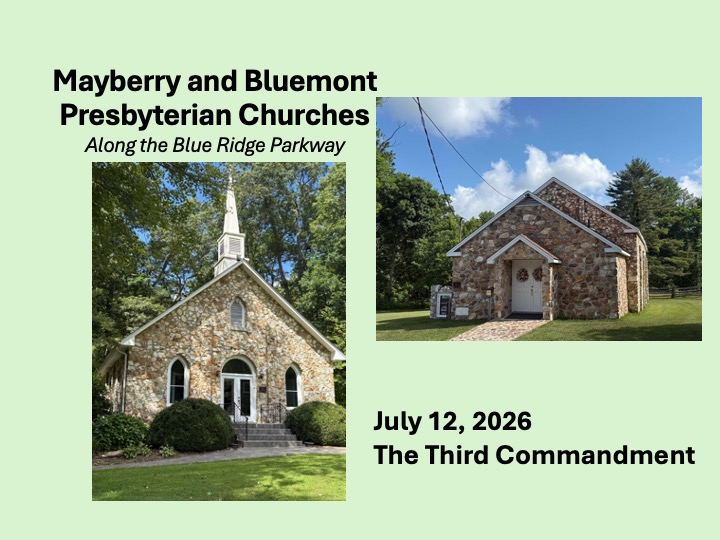
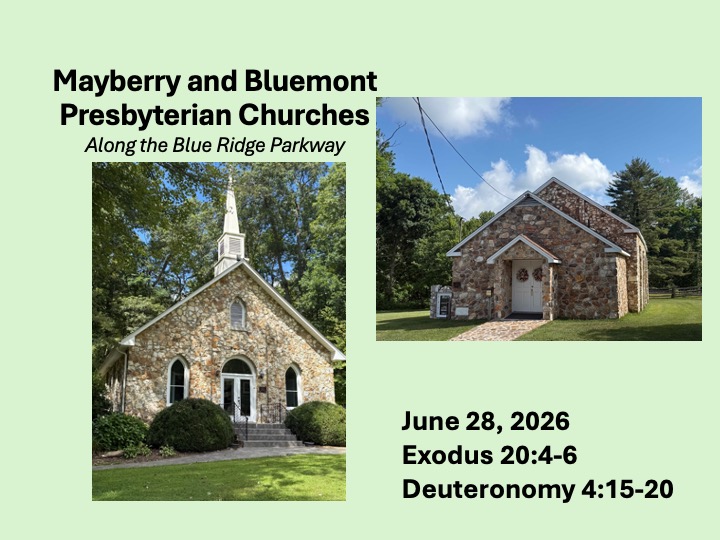
Title slide with photos of Mayberry & Bluemont Churches

Jeff Garrison
Mayberry & Bluemont Churches
Exodus 20:4-6, Deuteronomy 4
June 28, 2026

This version of the sermon recorded on Friday, June 26, 2026 at Bluemont.

At the beginning of worship:

This has been a long and hard week. Thursday, I had an all-Commissioner meeting of Presbytery in Roanoke. I arose up early to get the trash out before driving up to the Star City. When I opened my email, I learned that Loren, the interim pastor between Stewart’s retirement and my coming, lost her husband. 


While in Roanoke, I planned to visit Peggy Slate in the hospital. Peggy ran the Higher Ground Retreat Center, just north of Bluemont. She also kept Wild Goose on track. I texted her daughter to let her and her father know my plans. In the middle of my meeting, I received a text saying Peggy’s kidneys failed and was moving to hospice at noon. 

Then about 2:30, I received another text saying she died, not long after arriving at hospice. I left the meeting and spent time with her husband Guydell and children.

Then, after I got home, Barbara Wagonner texted that Mel Condit, a recent new member at Mayberry, died. For the past several months, Mel battled cancer. He was released from the hospital just a few days earlier. A wonderful addition to our church and community, Mel will be missed. 

I’m older than Loren’s husband, the same age as Peggy, and a bit younger than Mel. Thursday, it hit hard. Our time on earth is short; life is precious. We should make the best of it, and should comfort one another during times of grief. 

Before reading the Scripture:

Last week, we looked at the first commandment which excludes all other gods. Today, we’ll look at the second commandment which forbids any physical representation of either another god or the one true God. At Sinai, the idea of no idols showed a radical departure from the norm. At this time, everyone used art to depict deities. Israel stood alone and offered a new way of looking at God. 

There is only one holy God who must not be depicted in artwork. This doesn’t mean that art is bad; it’s just not to be used to depict the one beyond our comprehension. Instead of knowing God through paintings or sculpture, we meet God in scripture. Even objects in church—from the Bible on the pulpit to fancy windows—must not be worshipped.[1]

In their deliverance from Egypt, Israel encountered the living God, whose reality can be described, and then only partially, with language.[2]  

Today’s text is from Exodus 20, verses 4-6, and Deuteronomy 4:15-20, where we’re given more reasons to have no idols. 

Read Exodus 20:4-6, Deuteronomy 4:15-20

A salty old sailor sat through a sermon at the Seaman’s mission. The preacher went on and on with the dos and don’ts of the Ten Commandments, visibly shaking the old seaman. “What’s the matter,” his buddy asked. “Well,” he said pondering, “at least I ain’t made no graven images.”

God, in the Second Commandment, goes to great lengths to stress the importance of not having idol in any form. Whether it comes from the heavens, the earth or the waters, idols are off-limits. God is creator, not a creature. God is the artist, not the subject of art and therefore is not to be portrayed in artwork, which draws upon the created world. The Almighty refuses to be objectified. If we objectify God, we then assume we can handle God. 

We might wonder why God gets so upset over idols. After all, why would a a great and powerful God be threaten by us worship of something less than himself? Yet, idolatry is always more a reflection on us than upon God; God isn’t threatened by our misguided actions. God has the power over all other make-believe gods and there is no danger of him losing his position as the Creator and the Sustainer of the world. Instead of God taking this personally and being upset, God’s concern is our well-being. 

As Bob Dylan sings, “you’re gonna have to serve somebody.”[3] In a study on the Ten Commandments, the authors note: 

“modernity did not succeed in killing the gods, rather it succeeded in fostering rampant superstition. Modern people like to think that as we become more educated, liberal, enlightened, the less we need to worship gods. No. We appear to have been created to worship…[4]  

We’re created restless, with a longing, an emptiness. We’re created with this desire that we try to fill. God created us this way so that we might see the need to have him fill our restless desire to worship something beyond ourselves. But God wants us to come freely, which means that we will also be tempted to create our own substitute for God. All of us have this desire for fulfillment; idolatry is when we try to satisfy it with something that is less than God.[5]   

Joy Davidson, who would later marry C. S. Lewis, wrote a commentary on the Ten Commandments titled, Smoke on the Mountain. Addressing this commandment, she said“idolatry lies not in the idol, but in the worshipper.” 

The horror of idols is that they’re impotent, they’re without power, and they can give us nothing. Instead, idols rob us of the power we have within ourselves and from God through the Holy Spirit.[6]Certainly our idolatry have become more sophisticated. We gave up on Aaron’s golden calf and miniature statues of Artemis which endeared the Ephesians.[7] But are we putting our trust in God, or in something else? What is it that we worship? What do we do with our desire to connect to something beyond ourselves? Do we go to God or to something less that has only enough power to rob us of a relationship to the living God?

Let’s ask ourselves? What are our Golden Calves today? What keeps us from fully enjoying God? When I look at the walls in my office, I see the various token representations of my accomplishments. I feel proud and might think to myself, “I’ve done some neat things.” Some of you have accomplished a lot more. But when I think, “Gee Jeff, you’re good,” those mementos become first cousins to that sacred cow of Sinai. What is it that we value the most? 

Our accomplishments, our diplomas, our homes, our jobs, our cars and boats and motorcycles, our families? These good things can also be substitutes for God. God wants us to enjoy the finer things in creation, but he alone should be the object of our devotion. Akin to how one spouse will covet a devoted relationship from the other, so God desires our devotion. 

God provides a reason for such a relationship. If we, who have been chosen by God, worship something else, we’re cursed. Yet God offers even more abundant blessings if we keep it.

Let’s talk about this curse. We may think it unfair God’s wrath is not only experienced by the idolater. It extends to his or her offspring for three to four generations. Yet, if idolaters share the wrong message with their children, how will they hear? The message of the idol will be carried on within the family for generations and the barrier they built between them and God will continue. 

Psychologically, this curse plays out in the family systems of alcoholics and drug addicts. There are books written about the phenomena, such as Adult Children of Alcoholics.[8] Someone who is a dependent upon some substance is essentially an idolater. The substance becomes their God. And within their family, because of how people live with and around them, the abuser’s family carries the curse with them. 

John Calvin suggests the curse is not so much the result of God inflicting it, as the absence of God, which allows it to continue.[9]The curse continues until someone says “enough” and invites God back into their life. 

Now, consider the promised blessings. Idolatry brings a curse, but the blessing of faithfulness stands in sharp contrast. The curse continues for three or four generations, the blessing to the thousandth generation. God’s mercy overwhelms his wrath. Surely the Psalmists got it right when he proclaimed, “the Lord is gracious and merciful, slow to anger and abounding in steadfast love.”[10] As human beings, we tend to be overly concerned with the wrath of God and the possibility of punishment. We forget how much greater God’s capacity to love is when compared to his anger. John Calvin, in his sermon on the Second Commandment proclaimed that it is “almost against God’s nature” to punish.[11]

God’s love is much greater than we can imagine, hence the reference to a 1000 blessed generations. Think about this. Biblical standards set a generation at 40 years. A 1000 generations would be 40,000 years, which would mean that we’re not yet at the 10% mark for the blessings bestowed on those like Joshua and Caleb who were faithful during the Exodus. The blessings from that era continue!

Surely this commandment means that we are not to depict God in any creaturely way.  But as Christians, we acknowledge that 1400 years after the commandments, God came to us as a man. In other words, God himself chose to relate to us in a way we can understand. Yet, interestingly, we’re not given a physical description of Jesus. The mystery of what God looks like continues! Instead, we’re told that we will meet him when we reach out to someone in need and that we’ll feel his presence when two or more are gathered in his name.[12] God’s incarnation in Jesus Christ doesn’t mean we are allowed to worship a picture of Jesus, even if we had one. But the incarnation gives us a better understanding of the nature of the God we worship and adore. 

Through Christ, we can have even a more personal relationship with God, which is what God longs for and we need. We can’t have this relationship with a piece of art; nor can we have such relationship with a god who’s nothing more than a projection of our own wants and needs. We can only have such a relationship with the living God. Only such a God can offer us salvation and ever lasting life.   

Let me now say something about religious art. This is one of the areas we live out our faith in tension. Our devotion is to be to God, revealed through Jesus Christ. We all have crosses, Bibles, pictures supposedly representing Jesus, but none of these are to be worshipped even though sometimes, if used right, can help us focus more on God. 

In Reformed Churches, if you go back in history 150 years, you’d be surprised to find no pictures of Jesus and no crosses. If the sanctuary had stained glass, it was only decorative; they’d be no pictures of anyone in it. Over the past century and a half, we’ve back off such a strong prohibition against these types of art. However, we should remember no picture representing Jesus is accurate and be on guard that such art does not become a focus of our worship. For the God we worship transcends our abilities to create. And only a God who transcends our limited view has the power to be useful.

Think seriously about how you depict God. Make sure the God you worship isn’t some false god, but the God revealed in his Word, who has the power to create and to save. Amen.

This sermon was edited from a sermon preached in Hastings, Michigan in 2007.


[1] Daniel D. Patrick, The Ten Commandments: Interpretation, Resources for the Use of Scripture in the Church Louisville, KY: WJKP, 2000), 56. 

[2] Duane L. Christensen, Deuteronomy 1:1-21:9, Word Biblical Commentary (Nashville: Thomas Nelson, 2001), 114.

[3] Bob Dylan, “Gotta Serve Somebody” (1979)

[4] Stanley Hauerwas and William Willimon, The Truth about God: The Ten Commandments in Christian Life (Nashville: Abingdon, 1999), 36.

[5] cf, Ronald Rolheiser, The Holy Longing: The Search for A Christian Spirituality (NY: Doubleday, 1999), 3-5.

[6] Joy Davidman, Smoke on the Mountain: An Interpretation of the Ten Commandments in terms of today (London: Hodder and Stoughton, 1963), 38-39.

[7] Acts 19:23ff.

[8] Janet Geringer Woititz, Ed.D., Adult Children of Alcoholics (Deerfield Beach, FL: Health Communications, 1983, 1990).

[9] cf, John Calvin, Institutes, II, vii, 18-20.

[10] Psalm 145:8.  Variations of this theme is found throughout the Old Testament.

[11] John Calvin, Sermons on the Ten Commandments, Benjamin W. Farley, translator. (Grand Rapids, Baker, 1980), 78.

[12] See Matthew 18:20, 25:40.

Thoughts on the Ten Commandments

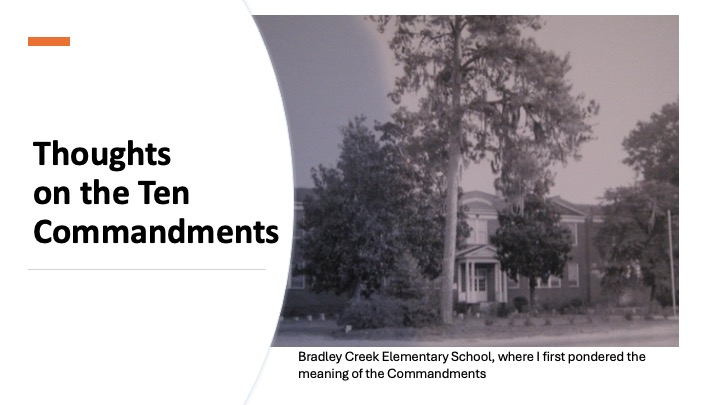
Title slide with photo of my elementary school

In early June 1969, I graduated from the sixth grade. We even had a graduation banquet. The principal of Roland Grice Junior High, Mr. Mason, spoke. He told us there were two laws in the Bible that if we obeyed, we could slide through our next few years of schooling without an intimate meeting with his “Board of Education.” He had constructed this “board” from solid oak. Corporal punishment was still in vogue back in those days. 

Then Mr. Mason asked if any of us knew which laws he was referring. Some girl’s hand, one who sat up front, shot up. Mr. Mason called on her. 

“Do unto other’s as you’d have them do to you,” she answered. 

Very good,” the principal said. “Anyone know the other law?”

At first no one answered, so he offered a clue. “It’s in the 10 Commandments.” 

At this point, Jerry’s hand shot up. Mr. Mason called on him and he said, “Thou shall not commit adultery.” 

The whole room erupted in laughter. Even though most of us only had a vague idea about what breaking the commandment meant, we were pretty sure it was the one commandment we’d probably not break during our seventh year of schooling. 

Now, the state of Louisiana requires schools to display the 10 Commandments in classrooms. Some think this violates the separation of church and state. Maybe so, but it might also be an opportunity. Let me offer a suggestion for how teachers might engage their students using the commandments to learn about current events and human depravity. 

An educational tool:

Each day, have the students to read a newspaper. Encouraging them to look for examples of how politicians and public officials break each of the commandments. This could be made into games using bingo-like cards. The class strives to find examples of broken commandment as the students individually compete to complete a straight row on their cards.

Think of the possibilities. It’d be easy to fill in the blank for the seventh commandment with the number of politicians sleeping around.  But the eighth commandment would also be easy. Plenty of public servants have their hand in the government’s till. The ninth would also be a gimme for I know of no politician who doesn’t stretch the truth. And how about the politician who covets his neighbor’s house (or office) and breaks the tenth? Or the one who desires a graven image of someone or something they worship and breaks the second. The possibilities are endless.

Let’s encourage the students to let their imagination run wild.  They’ll learn a lot! And in no time, politicians will clamber to the schoolhouses to pull down the commandments.  But before then, the students will learn that the oratory ability has nothing to do with the truth, that we all fall short and should be humble, and that without God’s grace, we’re doomed.

The value of the Big Ten

Now don’t get me wrong. The 10 Commandments have great value. They provide us with a boundary in which we might enjoy the life God offers. I’ve done a lot of thinking about the commandments throughout my ministry. Below is an article of mine that appeared (in slightly different forms) in a newspaper and magazine back in 2003.  But more important than the Big Ten, are the ultimate two commandments: love God and love your neighbor. And let’s not forget the Christian principle of humility. Bragging about keeping the commandments either breaks the ninth or trivializes them as we think higher of ourselves than we should. The Commandments should be humbling to us all. 

And, if you are wondering, the answer to Mr. Mason’s question was the fifth commandment, “honor your father and mother.” It should also be easy to find examples of politicians breaking this commandment.

The Ten Commandments (2003) 

A variation of article appeared in The Presbyterian Outlook, September 29, 2003, along with an opinion column in The Daily Spectrum, a newspaper published in St. George, Utah. 

They’re marching in Alabama again. This time the destination is Montgomery and those who march support Judge Roy Moore’s fight to keep a granite monument of the Ten Commandments on the courthouse lawn. They removed the statue on August 27. It appears Moore and his supporters have lost, but they promise to keep fighting. Sooner or later, the United States Supreme Court will have to step up and rule, but so far, they’ve refused to handle this hot potato. 

I’d sleep better if the Supreme Court decided such symbols acknowledge a foundation of Western law and are thereby an appropriate symbol that doesn’t violate the separation of church and state. Or maybe not. Of course, there are a variety of interpretations to what the founders of the Republic meant by such separation. As one who swore off the study of jurisprudence for theology, like the Supreme Court, I’ll pass on that potato.

Instead, let’s consider what the commandments are all about. The Big Ten provide a boundary by which we live as God intends, outlining that which enhances and destroys relationships. Theologians distinguish between two tables of the law, the first deal with how we relate to God and the second addressing our relationship with others. Put together, the two tables set the context for a society that honors God and other members of the human family. 

In ancient times, Jewish rabbis supposedly placed a drop of honey on the tongues of those studying the law to remind them that God’s law is sweet, not bitter. Theologically, the law is understood as life-giving.

A few generations, Presbyterians and most all Christians spent more time studying the Ten Commandments. Preparatory lectures, focusing on the commandments, were held a few days before Communion so members could prepare themselves for the sacrament. The catechisms of our denominations as well as those of other denominations go into detail of the fuller meaning of each commandment. If you read the Heidelberg Catechism, you’ll discover “Thou shall not steal” includes no deceptive advertisings. And in the new Catholic catechism, acts leading to the enslavement of another human violates the commandment. In other words, we should be careful about misrepresenting a used car or purchasing Goods produced in a sweatshop. 

“Thou shall not kill” also means more than not murdering someone. Martin Luther equated failure to feed the hungry, when you had the ability, with murder. Likewise, “bearing false witness” is more than just telling lies. The Westminster Catechism extended the commandment to exclude backbiting and vainglorious boastings, sins prevalent throughout society. 

I could go on with examples of how we ignore each of the Ten Commandments, but I won’t. Every generation has a problem with lawlessness. Instead, we should understand that even if we have monuments by all courthouses or on every street corner, we wouldn’t necessarily become better citizens. It’s odd that about the time many churches de-emphasized the study of the catechism, granite and bronze memorials started popping up around the country. 

In the 1950s, thousands of monuments were dedicated in the aftermath of Cecil B. DeMille’s’ blockbuster flick, “The Ten Commandments.” Today, we’ve lost the fuller understanding of the law while trivializing it into something chiseled on a rock. With the law publicly displayed, we prat ourselves on the back and brag about our piety while forgetting what the law is all about. Perhaps we should thank the ACLU. Maybe the publicity generated by these lawsuits will force us to understand that the commandments are not an image to be viewed. Instead, the law is to be studied. As both Moses and the prophets insist, written on our hearts (Deuteronomy 6:6, Isaiah 51:7, and Jeremiah 31:33). 

Before marching off to Montgomery, take time to study the commandments. In the larger scheme of things, having a granite slab out in front of the courthouse won’t make a bit of difference. What will matter is who we apply the commandments. If we write them on our hearts as the Hebrew Scriptures encourage, rest assured they’ll be safe from an ACLU lawsuit. 

Update on my 2003 opinion column:

The 10 Commandments for Mr. Moore, a former judge and politician, appears not to have weathered well. It was only for looks, as he had a problem with the seventh, which led to his downfall.

Old photo of Bradley Creek School Building
Bradley Creek Elementary School from where I graduated from the 6th Grade.
This school building burned down in 1982, long after I had moved on, which is a good thing for if it burned while I was a student, I may have been a prime suspect since we sang a little ditty about burning the school down.