The Second Commandment

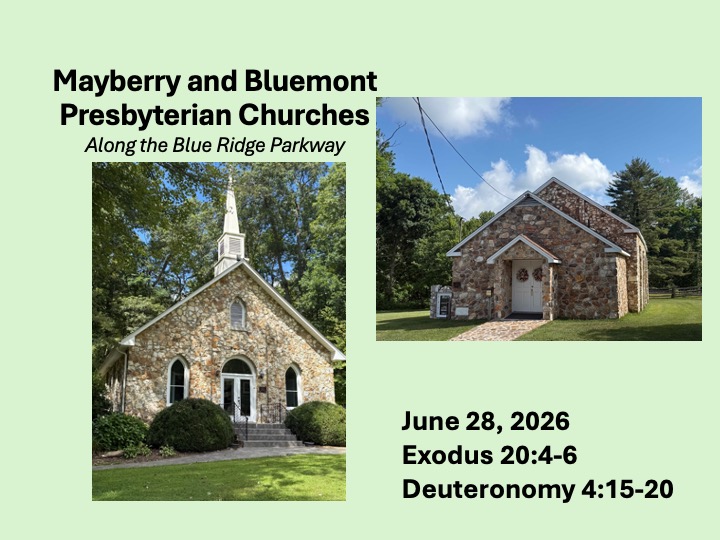
Title slide with photos of Mayberry & Bluemont Churches

Jeff Garrison
Mayberry & Bluemont Churches
Exodus 20:4-6, Deuteronomy 4
June 28, 2026

This version of the sermon recorded on Friday, June 26, 2026 at Bluemont.

At the beginning of worship:

This has been a long and hard week. Thursday, I had an all-Commissioner meeting of Presbytery in Roanoke. I arose up early to get the trash out before driving up to the Star City. When I opened my email, I learned that Loren, the interim pastor between Stewart’s retirement and my coming, lost her husband. 


While in Roanoke, I planned to visit Peggy Slate in the hospital. Peggy ran the Higher Ground Retreat Center, just north of Bluemont. She also kept Wild Goose on track. I texted her daughter to let her and her father know my plans. In the middle of my meeting, I received a text saying Peggy’s kidneys failed and was moving to hospice at noon. 

Then about 2:30, I received another text saying she died, not long after arriving at hospice. I left the meeting and spent time with her husband Guydell and children.

Then, after I got home, Barbara Wagonner texted that Mel Condit, a recent new member at Mayberry, died. For the past several months, Mel battled cancer. He was released from the hospital just a few days earlier. A wonderful addition to our church and community, Mel will be missed. 

I’m older than Loren’s husband, the same age as Peggy, and a bit younger than Mel. Thursday, it hit hard. Our time on earth is short; life is precious. We should make the best of it, and should comfort one another during times of grief. 

Before reading the Scripture:

Last week, we looked at the first commandment which excludes all other gods. Today, we’ll look at the second commandment which forbids any physical representation of either another god or the one true God. At Sinai, the idea of no idols showed a radical departure from the norm. At this time, everyone used art to depict deities. Israel stood alone and offered a new way of looking at God. 

There is only one holy God who must not be depicted in artwork. This doesn’t mean that art is bad; it’s just not to be used to depict the one beyond our comprehension. Instead of knowing God through paintings or sculpture, we meet God in scripture. Even objects in church—from the Bible on the pulpit to fancy windows—must not be worshipped.[1]

In their deliverance from Egypt, Israel encountered the living God, whose reality can be described, and then only partially, with language.[2]  

Today’s text is from Exodus 20, verses 4-6, and Deuteronomy 4:15-20, where we’re given more reasons to have no idols. 

Read Exodus 20:4-6, Deuteronomy 4:15-20

A salty old sailor sat through a sermon at the Seaman’s mission. The preacher went on and on with the dos and don’ts of the Ten Commandments, visibly shaking the old seaman. “What’s the matter,” his buddy asked. “Well,” he said pondering, “at least I ain’t made no graven images.”

God, in the Second Commandment, goes to great lengths to stress the importance of not having idol in any form. Whether it comes from the heavens, the earth or the waters, idols are off-limits. God is creator, not a creature. God is the artist, not the subject of art and therefore is not to be portrayed in artwork, which draws upon the created world. The Almighty refuses to be objectified. If we objectify God, we then assume we can handle God. 

We might wonder why God gets so upset over idols. After all, why would a a great and powerful God be threaten by us worship of something less than himself? Yet, idolatry is always more a reflection on us than upon God; God isn’t threatened by our misguided actions. God has the power over all other make-believe gods and there is no danger of him losing his position as the Creator and the Sustainer of the world. Instead of God taking this personally and being upset, God’s concern is our well-being. 

As Bob Dylan sings, “you’re gonna have to serve somebody.”[3] In a study on the Ten Commandments, the authors note: 

“modernity did not succeed in killing the gods, rather it succeeded in fostering rampant superstition. Modern people like to think that as we become more educated, liberal, enlightened, the less we need to worship gods. No. We appear to have been created to worship…[4]  

We’re created restless, with a longing, an emptiness. We’re created with this desire that we try to fill. God created us this way so that we might see the need to have him fill our restless desire to worship something beyond ourselves. But God wants us to come freely, which means that we will also be tempted to create our own substitute for God. All of us have this desire for fulfillment; idolatry is when we try to satisfy it with something that is less than God.[5]   

Joy Davidson, who would later marry C. S. Lewis, wrote a commentary on the Ten Commandments titled, Smoke on the Mountain. Addressing this commandment, she said“idolatry lies not in the idol, but in the worshipper.” 

The horror of idols is that they’re impotent, they’re without power, and they can give us nothing. Instead, idols rob us of the power we have within ourselves and from God through the Holy Spirit.[6]Certainly our idolatry have become more sophisticated. We gave up on Aaron’s golden calf and miniature statues of Artemis which endeared the Ephesians.[7] But are we putting our trust in God, or in something else? What is it that we worship? What do we do with our desire to connect to something beyond ourselves? Do we go to God or to something less that has only enough power to rob us of a relationship to the living God?

Let’s ask ourselves? What are our Golden Calves today? What keeps us from fully enjoying God? When I look at the walls in my office, I see the various token representations of my accomplishments. I feel proud and might think to myself, “I’ve done some neat things.” Some of you have accomplished a lot more. But when I think, “Gee Jeff, you’re good,” those mementos become first cousins to that sacred cow of Sinai. What is it that we value the most? 

Our accomplishments, our diplomas, our homes, our jobs, our cars and boats and motorcycles, our families? These good things can also be substitutes for God. God wants us to enjoy the finer things in creation, but he alone should be the object of our devotion. Akin to how one spouse will covet a devoted relationship from the other, so God desires our devotion. 

God provides a reason for such a relationship. If we, who have been chosen by God, worship something else, we’re cursed. Yet God offers even more abundant blessings if we keep it.

Let’s talk about this curse. We may think it unfair God’s wrath is not only experienced by the idolater. It extends to his or her offspring for three to four generations. Yet, if idolaters share the wrong message with their children, how will they hear? The message of the idol will be carried on within the family for generations and the barrier they built between them and God will continue. 

Psychologically, this curse plays out in the family systems of alcoholics and drug addicts. There are books written about the phenomena, such as Adult Children of Alcoholics.[8] Someone who is a dependent upon some substance is essentially an idolater. The substance becomes their God. And within their family, because of how people live with and around them, the abuser’s family carries the curse with them. 

John Calvin suggests the curse is not so much the result of God inflicting it, as the absence of God, which allows it to continue.[9]The curse continues until someone says “enough” and invites God back into their life. 

Now, consider the promised blessings. Idolatry brings a curse, but the blessing of faithfulness stands in sharp contrast. The curse continues for three or four generations, the blessing to the thousandth generation. God’s mercy overwhelms his wrath. Surely the Psalmists got it right when he proclaimed, “the Lord is gracious and merciful, slow to anger and abounding in steadfast love.”[10] As human beings, we tend to be overly concerned with the wrath of God and the possibility of punishment. We forget how much greater God’s capacity to love is when compared to his anger. John Calvin, in his sermon on the Second Commandment proclaimed that it is “almost against God’s nature” to punish.[11]

God’s love is much greater than we can imagine, hence the reference to a 1000 blessed generations. Think about this. Biblical standards set a generation at 40 years. A 1000 generations would be 40,000 years, which would mean that we’re not yet at the 10% mark for the blessings bestowed on those like Joshua and Caleb who were faithful during the Exodus. The blessings from that era continue!

Surely this commandment means that we are not to depict God in any creaturely way.  But as Christians, we acknowledge that 1400 years after the commandments, God came to us as a man. In other words, God himself chose to relate to us in a way we can understand. Yet, interestingly, we’re not given a physical description of Jesus. The mystery of what God looks like continues! Instead, we’re told that we will meet him when we reach out to someone in need and that we’ll feel his presence when two or more are gathered in his name.[12] God’s incarnation in Jesus Christ doesn’t mean we are allowed to worship a picture of Jesus, even if we had one. But the incarnation gives us a better understanding of the nature of the God we worship and adore. 

Through Christ, we can have even a more personal relationship with God, which is what God longs for and we need. We can’t have this relationship with a piece of art; nor can we have such relationship with a god who’s nothing more than a projection of our own wants and needs. We can only have such a relationship with the living God. Only such a God can offer us salvation and ever lasting life.   

Let me now say something about religious art. This is one of the areas we live out our faith in tension. Our devotion is to be to God, revealed through Jesus Christ. We all have crosses, Bibles, pictures supposedly representing Jesus, but none of these are to be worshipped even though sometimes, if used right, can help us focus more on God. 

In Reformed Churches, if you go back in history 150 years, you’d be surprised to find no pictures of Jesus and no crosses. If the sanctuary had stained glass, it was only decorative; they’d be no pictures of anyone in it. Over the past century and a half, we’ve back off such a strong prohibition against these types of art. However, we should remember no picture representing Jesus is accurate and be on guard that such art does not become a focus of our worship. For the God we worship transcends our abilities to create. And only a God who transcends our limited view has the power to be useful.

Think seriously about how you depict God. Make sure the God you worship isn’t some false god, but the God revealed in his Word, who has the power to create and to save. Amen.

This sermon was edited from a sermon preached in Hastings, Michigan in 2007.


[1] Daniel D. Patrick, The Ten Commandments: Interpretation, Resources for the Use of Scripture in the Church Louisville, KY: WJKP, 2000), 56. 

[2] Duane L. Christensen, Deuteronomy 1:1-21:9, Word Biblical Commentary (Nashville: Thomas Nelson, 2001), 114.

[3] Bob Dylan, “Gotta Serve Somebody” (1979)

[4] Stanley Hauerwas and William Willimon, The Truth about God: The Ten Commandments in Christian Life (Nashville: Abingdon, 1999), 36.

[5] cf, Ronald Rolheiser, The Holy Longing: The Search for A Christian Spirituality (NY: Doubleday, 1999), 3-5.

[6] Joy Davidman, Smoke on the Mountain: An Interpretation of the Ten Commandments in terms of today (London: Hodder and Stoughton, 1963), 38-39.

[7] Acts 19:23ff.

[8] Janet Geringer Woititz, Ed.D., Adult Children of Alcoholics (Deerfield Beach, FL: Health Communications, 1983, 1990).

[9] cf, John Calvin, Institutes, II, vii, 18-20.

[10] Psalm 145:8.  Variations of this theme is found throughout the Old Testament.

[11] John Calvin, Sermons on the Ten Commandments, Benjamin W. Farley, translator. (Grand Rapids, Baker, 1980), 78.

[12] See Matthew 18:20, 25:40.
The First Commandment

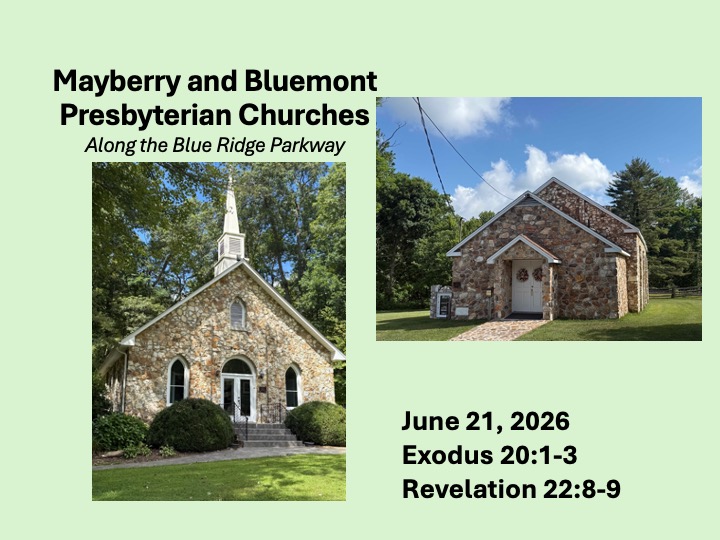
Title slide with photo of Mayberry and Bluemont Presbyterian Churches.

Jeff Garrison
First Presbyterian Church
Exodus 20:1-4, Revelation 22:8-9
June 21, 2026

The sermon was recorded at Mayberry on Thursday, June 18, 2026

At the beginning of worship:

Happy Father’s Day to all who are fathers and all who have fathers. We begin today working through the Ten Commandments, We start with the first commandments which is to have no other gods before the one true God. As Jesus teaches us in the Lord’s Prayer to address God as “Father,” it’s a good day to begin this series. 

Throughout this summer, I plan to focus my sermons  on one of the Ten Commandments. By the time we’re done, I hope none of you will be under the illusion they’re the Ten Suggestions. Instead, consider the commandments as God’s gift; the boundaries in which we can have abundant life on earth. Envision the law as being fence posts staking out our territory. Within the boundaries, we have lots of freedom, but when we move beyond the fence, we damage our relationships with God and with others in the human family.  

The commandments were important for Martin Luther.  We think of Luther being so focused on grace, but he wrote that to know the commandments is to know the Bible. As a modern commentator writes, “to understand them properly, we must know the great overarching story—Creation, Exodus, kingship, prophets, exile, Jesus, death, resurrection and ascension.”[1]

Before reading the Scripture: 

As I focus on the Ten Commandments for this summer, I plan to draw from the commandments as presented in the book of Exodus. The Commandments can be found in two places in the Old Testament: Exodus and Deuteronomy. The same list, but they have some slight differences as the reason for obeying the commandments.  

Let me go over one additional thing about the Commandments. There are two ways of numbering them, both come up to ten. The traditional way, used by Jews use as well as those of us in the Reformed tradition, has the first commandment as having no other gods and the second as the probation against idols. However, some churches, notably the Roman Catholics and Lutherans, combine these two commandments then split what we think of as the tenth commandment, the probation against coveting, into two parts. 

Read Exodus 20:1-3, Revelation 22:8-9

We’re given a three-fold proof of why we are to have no other gods before the One True God—the Creator of heaven and earth. 

First, it’s the Lord who gives this commandment to us. “I am the Lord,” the fifth chapter beings. As Americans, we don’t tend to like titles like Lord and King and as we’ll celebrate in two weeks, we fought a revolution against such. But to understand what’s being said here, we should recall that in ancient times a “Lord” controlled lands and those who lived on it. This text implies that God, as Creator, rightful holds the title for the earth. As the Psalmist proclaims, the world and they that dwell therein” belong to God.[2]   

And just who is this God? The Confessions of the Presbyterian Church bring together many of the attributes of God found in Scripture. We speak of God as: “a Spirit, infinite in being, glory, blessedness and perfection.” God is “all-sufficient, eternal, unchangeable, incomprehensible, all present, almighty, all knowing, most wise, most holy, most just, most merciful and gracious, long-suffering and abundant in goodness and truth.”[3]That’s a mouthful.

Furthermore, we should remember on this Father’s Day that while we speak of God as “Father,” it’s metaphorical. Jesus uses such language in the Lord’s Prayer as a way for us to understand the relationship God desires. The same is true when Isaiah speaks of God as a caring mother.[4] God cares for us like parents care for children.

In addition, the male pronoun often used for God shows a limitation with the English language. Using the pronoun “He” or “Him” doesn’t mean God is a man. To think of God as a man puts God in a human category, which breaks this commandment. God exist beyond human sexual categories. 

When we think about God, it’s easy to be overwhelmed. As mere creatures, God exists beyond our imaginations. It’s easy when contemplating God to give up and resign ourselves to be unable to understand God and therefore drop our quest to know God. But God, as he lays out the commandments, encourages us. We’re reminded that not only is he Lord, he’s also our God. “I am the Lord, your God,” he says. God, the all-powerful creator, who rightfully claims ownership of Creation, is also “our God.” There is an intimacy expressed here. God isn’t just a Creator with no interest in us. God calls us and wants us to be a part of his family.. And God takes the initiative to enter a relationship with us, to be personally involved with us.

Abraham Heschel, the great Jewish philosopher of the 20thCentury titled one of his books, God in Search of Man. Even before we know God exists, God seeks us out. Think about how God works: God reached out to Noah, to Abraham, to Moses. God came in the life of Jesus Christ. God wants to be in a relationship with us and therefore calls us back to himself. And God could demand our allegiance based solely upon his rightful position as Creator. But God isn’t petty. By entering a relationship with us, by being OUR GOD, God earns our respect and allegiance. 

The second reason given to us to encourage our compliance with the first commandment is that God led our spiritual ancestors out of Egypt. Our Great God, the Creator of all, heard the cries of the Hebrew people as they labored, building pyramids and other sorts of monuments to the rulers of Egypt. Today we marvel over their work. We shouldn’t forget that the construction of these ancient wonders was done by the backbreaking labor of an enslaved people. But God heard their prayers. Over the sound of cracking whips, God heard their cries, just as he hears ours. Through the leadership of Moses and a host of special effects, God rescued his people. God is not a distant Creator, uninterested in what goes on in the world. Our God listens and answers prayers.

The third reason given for our obeying this commandment is that we were brought out of the house of slavery. Certainly, in the wilderness, as Moses recalled the Commandments, he was referring to Egypt and the 400-year period of bondage.  

Paralleling the land of Egypt and the house of slavery gives this sentence a nice ring. It’s balanced. But let’s take a bit of liberty with its original meaning and see if we can come up with a meaning for us today. The Exodus event provides a model of how God rescues his people. It’s an archetype which reminds us how our God works in the world. With this understanding, we can make this third reason to obey the commandment apply to us personally. We obey because we’ve experienced release from bondage, whatever the form of slavery it might have been.

Has God helped you kick the smoking habit, beat drugs, get control over alcohol abuse, recover from an accident, a job loss, a divorce, or regain self-esteem? Regardless of what it was, if God helps us regain control, we are indebted in him. Therefore, we should desire not to break the commandments.  

We’re given three reasons not to break this first commandment:  

1. God as Creator desires a relationship with us.  

2.  God shows his faithfulness by delivering our spiritual ancestors from bondage in Egypt.  

3. God has or can deliver us from whatever enslaves us, from whatever holds us back from being who he has created us to be.

These are three good reasons not to have any false gods. Now let’s consider for a few minutes what it means to have no other gods before our One True God. It is interesting the way this commandment reads: NO OTHER GODS BEFORE ME. If God is, as we proclaim, all-knowing and all-powerful, then having any other gods would be to have them in front of God. So, we’re not to have any other gods. 

In Israel’s time, the Hebrew people found themselves constantly lured into worshipping their neighbor’s gods. This was especially true if their neighbor had a better harvest in a particular year. They’d want to do whatever they could to get a competitive advantage, so if they thought their neighbor’s gods looked favorably upon them, they’d in turn pray to these false gods and end up experiencing the rage of the Living God.

Having no other gods goes beyond the command to make no idols—we’ll discuss that one next week.  It means not elevating ourselves too high or not putting what should be our trust in God into some form of superstitious behavior. Think of the angel John wanted to worship in the book of Revelation. The angel quickly corrected John. We don’t lift any other being to be equivalent or even closely equivalent to God. 

Having no other gods mean we let God be God and we trust and depend upon him. God gives life. We need to remember this for whenever we put something between God and us, we find our lifeline compromised. If you have difficulty breathing and are on oxygen, you want to be careful not to stand on the tubing between you and the oxygen tank. Otherwise, you won’t get the air you need and might pass out or even die. It’s the same way with God. God desires for us to draw our life from him and to live abundantly. We don’t want to cut off our supply of his life-giving breath, but we do this anytime we place something between God and us.  

Examine yourself. Take an inventory; see where you do not completely trust God. Are there areas in your life where you’ve relegated God to second or third place and made something else more important? If so, and we’re all guilty at one time or another, confess your sins. Work toward cleaning up those areas in your life so you can live life to its fullness, as God intends.  Let us pray: 

Almighty God, you are the source of life. Through Jesus Christ, you save us from your wrath and our sinfulness. You call us to be your people and command us not to have any other gods before you. That’s easier said than done. We don’t always fully trust you and find ourselves placing other things in front of you: families, occupations, wealth, accomplishments, abilities, intellect, nation, even our church. Forgive us and fill us with your vision so we may grow into a deeper relationship with you.  Amen. 


[1] Stanley Hauerwas and William Willimon, The Truth About God; The Ten Commandments in Christian Life (Nashville: Abingdon, 1999), 30.

[2] Psalm 98:7, KJV.

[3] Westminster Larger Catechism, Question 7.

[4] Isaiah 66:13.

My Thoughts on Christian Nationalism

Christian Nationalism title slide with two photos: of a cross and a flag

This year we have added a new item to worship titled “A Minute for Theology.”  The congregation gets to ask me questions about theology or the church, and I try to provide a brief explanation. This past week, I tackled a couple questions on Christian Nationalism. What it is, they they’ve only recently heard of it, and if we’re a part of such a movement. Expanding from the notes I made, this is my answer. 

My answer:  Let me answer the last phrase of the question first. No, I do not consider us a part of the Christian Nationalist movement. Speaking for myself, I certainly don’t consider myself a Chrisitan Nationalist. Personally, I think the movement verges on heresy. I see it as an attempt to usurp the Christian faith for political agenda. The Christian faith is built upon a vision from Jesus to bring people of all nations and races together.  As Paul writes, there is no longer Greek or Jew, slave or free, male or female, for we are all to be one in Christ Jesus.[1]

America has often held contrasting ideals. Think of the wonderful words of the Declaration of Independence about freedom and equality. Those elegant words were written by a slaveholder and signed by slaveholders. 

In religion, there is the enlightenment belief which acknowledges the importance of religion. But the Founders of our nation shunned the European notion of a state religion. Enshrined in our Constitution is a clause that the government shall not infringe on our right to worship as we choose and there shall be a separation between church and state. The second ideal in contrast to the first comes from John’s gospel. In America, this became prominent during the First and Second Great Awakening. It’s that Jesus is the only way.[2]  As a nation, we’ve tried to hold these two ideals in tension. But there have always been dissenters who insists they are right while other views have no value.  Such people fail to show the grace a graceful God calls us to show to others.

Let me give you an example. Around the nation’s centennial in 1876, a movement arose to enshrine within the constitution an amendment declaring America as a Christian nation. It didn’t pass. While some Christians supported it, others saw the problem with the amendment and rose up in opposition. 

As followers of Jesus, our ultimate loyalty is to always remains with him and not with a nation, which is a human construct.  Nations come and go.  This doesn’t mean we should not strive to be good citizens of the earthly nation in which we live. However, our first loyalty, our primary citizenship, is to God’s Kingdom. We’re still called to work hard within our nation so that it and the people within it may prosper.  As Jeremiah told those in Jerusalem who were exiled to Babylon,” seek the welfare of the city in which you live.”[3]

Those who claim to be Christian Nationalist see our nation as exclusively Christian. Those who are not Christians are pushed to the side. To find support for such a ideal, they must go back to the Old Testament model of Israel as God’s chosen people. But such a nation ceased to exist in 587 BC, when Babylon defeated them and took many of them off into exile. After exile, the nation seldom lived independently but generally existed under the authority of foreign powers. Even modern Israel is not a nation as set forth by Moses and the prophets, but a secular construct.  While we can learn from the Old Testament, there is nothing in the New Testament about Christians running the government. Instead, in places like Romans 13, you find a lot about us living under the government of a foreign power. 

The New Covenant, established by Christ, expands this idea of the chosen people to include people of every nation and race. This goes back to God’s intention as all people are created in God’s image.[4] As followers of the man for Galilee, we must resist movements like Christian Nationalist who attempt to divide the world up into the chosen (their nation or those who believe like them) and all others. 

While we are to work hard for our nation and those who live within it, we also live with a vision of a new kingdom,. This kingdom began with Jesus, And we’ll belong to this kingdom long after the nations of earth cease to exist. 

Jimmy Hendrix said, “When the power of love overcomes the love of power, we will have peace.” That may be a little simplistic, but we also find truth here. The power of love is to what Jesus calls us. The love of power seems to me to be what Christian nationalist desire. Jesus warns us about desiring earthly power.  That’s a key tenet of the Sermon on the Mount, from which I’ve recently preached 17 sermons. The state has the power of the sword. Jesus also told the disciples that those who live by the sword shall die by the sword.[5]

While the church shouldn’t take a prominent role in the government, as individual followers of Christ we should use our faith to make decisions at the ballot box. And if elected, by serving in the government. But even then, we are called to work for the benefit of all Americans regardless of their faith or lack of faith..  The idea our nation primary  serves a particular religious sect goes against the founding principles of our country. And for Christians, it goes against the teachings of Jesus. 


[1] Galatians 3:29.

[2] John 14:6.

[3] Jeremiah 29:7. 

[4] Genesis 1:27. 

[5]h Matthew 26:52.

Two Houses, Two Builders, Jesus Conclusion to the Sermon on the Mount

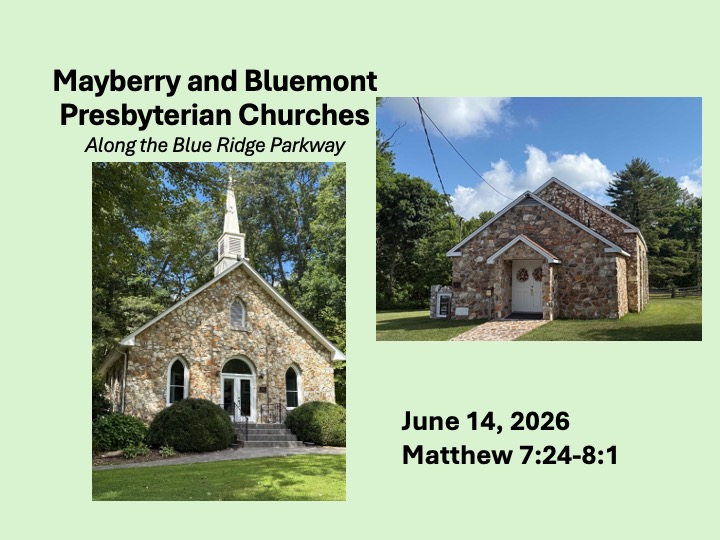
Title slide with photos of Mayberry and Bluemont Presbyterian Churches

Jeff Garrison
Mayberry and Bluemont Churches
June 14, 2026
Matthew 7:24-8:1

Sermon recorded at Bluemont on Friday, June 12, 2026

At the Beginning of Worship:  

Beginning next Sunday, we’ll start a journey through the Ten Commandments. Ever since the movie with Charlton Heston as Moses came out back when my parents were dating, there have been attempts to have the tablets displayed in courthouses and schools. But just knowing the 10 Commandments doesn’t make us better people.[1] Instead, we need to understand what they mean and integrate them into our lives. As the prophet Jeremiah suggests, we need God to write his law on our hearts.[2] It’s my hope we will gain some insight into how the law should be applied in our lives today. 

But before I jump back into the Old Testament, we’ll finish our review of Jesus’ greatest sermon, the Sermon on the Mount. In a way, this has been Jesus’ sermon on the 10 Commandments, as he reinterprets the law to a new standard. We all come up short. When Jesus finishes this sermon, we understand we can’t do it ourselves; we’re totally dependent upon God’s grace.   

Before reading the Scripture:

Today’s scripture completes the Sermon on the Mount. I’ll read from Matthew 7: 24 through 8:1. 

Let me give you a bit of insight into the Greek used by Matthew here. Jesus draws from both the Old Testament and the virtue tradition coming out of Greek philosophy.[3] In this passage Jesus contrasts the wise and foolish man. In the Greek, the wise man is one who is virtuous. The foolish one is a moros, from which we get the English word, “Moron.”[4] (You may remember that tidbit.) 

A second thing. The last word in the Greek within this sermon is “great.” Throughout the sermon, Jesus encouraged his listeners to strive for righteousness, not greatness. And the ending “great” refers not to an achievement, but to the fall of those who have not built a life with Christ as a foundation.[5] There is a warning here. As Jesus reminded us earlier in the sermon, we’re to first seek the kingdom of God and his righteousness.[6]

READ MATTHEW 7:24-8:1

Did you ever think we’d get to the end of Jesus’ Sermon on the Mount? We’ve been working our way through this passage since the first of February, with a break on Palm Sunday and Easter, and a few Sundays I’ve been away. For those counting, this is my 17th sermon on these three chapters!  

Let me say a bit about the Sermon on the Mount. It’s not a sermon in the fashion we typically think. Instead of standing at a pulpit or on a stage or up on a rock and waving his hands as he expounds upon scripture, Jesus sits. Most likely the crowd stood. Having your audience stand is an old trick which assures everyone stays awake. Sitting down while teaching and preaching was the preferred method for rabbis, as well as Greek philosophers of the time. So, Jesus sits as a rabbi, or a teacher, and instructs his disciples and those in the crowd how they should live.

As we have seen over the past few months, Jesus upsets the apple cart. In the Beatitudes, he speaks of a great reversal: of how the last will be first, of the meek inheriting the earth. He admonishes the crowd to strive for heavenly treasure instead of worldly wealth. He reminds them our valuables will increases our fears as we worry about theft, rust, and rot. 

Throughout this sermon, Jesus raises the bar. No longer can his followers take the Ten Commandments literally, checking off each item as having been observed, and patting themselves on their backs for getting a passing grade. For Jesus tells us that hate is equivalent to murder, lust can be as dangerous as adultery. Jesus also warns his followers about the danger of misleading new converts, how they must watch out for false teachers, and how they should pray privately and not for show. 

By this point in Jesus’ address, he’s managed to offend just about everyone. As they stand on that hill, surrounding Jesus while swatting flies and fanning themselves, they realize Jesus isn’t letting anyone off easily. The rich and powerful are offended. The religious and political leaders are offended. Even the pious, those who dedicated their lives to keeping the commandments are offended. You’d think the crowds would have thinned out, but that’s not the case. They stick around because Jesus teaches with authority. Matthew here drops a hint of what’s to come. At the end of Matthew’s gospel, Jesus proclaims, “All authority on heaven and on earth has been given to me.”[7] The crowds witnessed his authority on the mountain.

Yet, I expect most are unsure of their ability to meet the mark, and Jesus heightens their tension when he acknowledges that not everyone who calls his name will enter the kingdom of heaven. For Jesus, having a saving faith is more than just knowing the right religious language. As we saw two weeks ago, Jesus even warns, in words which send fear into the hearts of any preacher who listens, that some who do great things in his name will find the door to paradise closed. 

A saving faith requires action; a saving faith requires us to take his words to heart and strive to do God’s will. Yes, Jesus wants us to be good. Yes, Jesus wants us to bear fruit. But our good deeds and fruit bearing must be done in accordance with the will of God and not be based upon our egoistic desire to do something great… 

To explain this, Jesus tells a parable about the building of a house. Two guys set out to build a house and, from all we know, both are built equally well. We assume that from the outside, both houses appear solid. To find fault in the one house, you must look at the foundation. 

This isn’t the story of the three little pigs—where two of them become barbeque for the wolf because they use inferior building materials. We assume both builders employ the best construction practices. They select only good and straight lumber. They both use architectural grade shingles. But there’s a difference. One takes the time to set his foundation upon rock. The other guy builds on sand. Maybe he justified this as saving money on excavation. Or maybe he built on a beach to have a great view. Image both guys building equally nice homes. The only difference is that one can withstand the onslaught of a flood while the other crumbles as we’ve seen video in news reports of houses around Cape Hatteras tumbling into the sea.

This parable reminds us of the story of Noah. Noah, a faithful man, listened to God and followed instructions. He found himself safe during the storm in which all others drown.[8] Noah trusted in God, not in the long-term weather forecasts, or even in his ability to save himself. He listened to God. After all, it wasn’t his idea to build a boat. By listening to God, he accomplished far more than he could have on his own.

One thing we should gleam from this parable is the fact the storm came. Both the wise and the foolish experienced the onslaught of the storm. Jesus echoes what he said earlier about how God makes the sun rise and the rain fall on the just and unjust.[9]There is a message here for us. Matthew’s audience, as we see in the opening Beatitudes, probably faced persecution. By recalling this parable, he reminds his readers to be prepared, to have a good foundation in Christ so that when things become difficult, they will persevere. 

To do the will of God is not just hearing God call; to do the will of God is not just an understanding of our duty to our creator; to do God’s will requires that we internalize Jesus’ words. We must make Jesus and his teaching the rule of our lives. The question, “What would Jesus do?” which has become somewhat of a cliché, should become for us an internal compass, directing our lives in a manner that will bring him, and not us, glory.

To do the will of God is not necessarily to do what is popular. In fact, it’s likely to result in unpopular behavior. Think about old Noah—his wife and neighbors complain about that piece of junk he’s constructing out in the backyard. Doing God’s will is not going to help us be seen as “cool.” It may even mean going against what is considered politically correct from any perspective—conservative and progressive. Doing the will of God means we will not base our decision on what would make us popular with our peers, but on what kind of actions honor and glorify God…

So, why should we seek and do the will of God, especially if it’s going to force us to look beyond our self-interest and cost us in social standing? Why shouldn’t we just seek the easy way, to go along with the crowds and to do what is expedient? Why not just take the wide road, the interstate of popularity? It’s the sure way to success according to worldly standards. Why? Because in the end, what others think about us as well as what we’ve accomplished and accumulated on this planet will not manner. In the end, all that will matter is whether we’ll hear the words echoed from later in Matthew’s gospel, “Well done, good and faithful servant.”[10]

Peter was right when Jesus asked him and the other disciples if they wanted to join the crowds who were abandoning him. Peter said, “Lord, where else can we go? Only you have the words of eternal life.”[11]

There were two houses. One withstood the storm; the other fell and great was its fall. So ends Jesus’ Sermon on the Mount. Jesus presents a clear alternative. Follow me and seek to do God’s will and you will persevere through the storms of life and find the door to paradise open. Or don’t follow me and seek to fulfill your own desires and the storms will overwhelm you and the door to paradise will remain locked. Which will it be? Will we seek the kingdom of God? If so, we must seek to do and live in accordance with God’s will. Amen.   


[1] For my take on the 10 Commandments, see https://fromarockyhillside.com/2024/06/27/thoughts-on-the-ten-commandments/

[2] Jeremiah 31:33. 

[3] Most likely, Jesus did speak Greek, but Aramaic. But when translated into the Greek, Matthew uses key Greek terms. 

[4] Jonathan T. Pennington, The Sermon on the Mount and Human Flourishing: A Theological Commentary (Grand Rapids, MI: Baker Academic, 2017), 280.

[5] Fredrick Dale Buner, The Christbook: Matthew 1-12 (1990: Grand Rapids, MI Eerdmans, 2004), 361. 

[6] Matthew 6:33. See https://fromarockyhillside.com/2026/05/03/dont-worry/

[7] Matthew 28:18.

[8] Genesis 9. 

[9] Matthew 5:45. See https://fromarockyhillside.com/2026/03/22/turning-the-other-cheek-and-loving-our-enemies/

[10] Matthew 25:21, 23. 

[11] John 6:68-69

Review of May Readings

title slide with photos of the books reviewed in the post

I have been away on vacation and will try to get back around soon and catch up with folks. I’ll tell you more about my travels later, but let me catch up on my readings…

Karen Russell, The Antidote A Novel 

Cover photo of the Antidote

(New York: Alfred P. Knopf, 2025), 422 pages, some photos and notes. (Audible, 16 hours and 55 minutes). 

This novel is set in Uz, Nebraska in 1935, at the height of the Dust Bowl. The story takes place between two well-known events, the Black Sunday dust storm and the flooding of the Republican River. The town of Uz is fictional, borrowed from the home of Job in the Bible. The book of Job comes up frequently in the novel as the people in this town struggle and many leave in response to the drought and dust. Job ends with God speaking through a whirlwind. In The Antidote, near the end, a tornado sweeps through Oletsky’s property. While God doesn’t speak from the storm, the message is clear. 

Russell tells the story of Uz through several characters. There is Harp Oletsky, a bachelor farmer whose crop seems immune to the dust storm destroying everyone else’s fields. Harp lives with his niece, Asphodel Oletsky, an orphan high schooler, who loves basketball.   In town, there is a Prairie Witch, later identified as Antonina Rossi. She can take memories from people, saving them from their unpleasant past. The Sheriff uses her skills at the jail, which in time we learn is a means to cover up misconduct. Her talents allow people to forget the past and avoid being haunted by their deeds.  Another important character is Cleo Allfrey, an African American woman sent by the government to photograph the disaster on the plains. When her camera is stolen, she buys another which has special abilities she only learns after the film is developed. The camera captures views from the past. And finally, we have Harp’s scarecrow and the Sheriff’s cat. Both observe and become involve in that which happens

During the months in which the novel takes place, the Uz girls’ basketball team, even after their coach leaves, wins the state championship.  The sheriff is in a political race. He thinks he has the election in hand because he solved a serial killing of women in Nebraska, one in which the killer places a rabbit foot on the victim’s body. But then, the killings continue and the man convicted of the murders sits on death row with people wondering if he was guilty. 

When circumstances bring together Harp, the prairie witch, the photographer, and his niece, things come to a head. They learn not only the truth of the evil sheriff, but also of their past. Harp retrieves his father’s memories, long stored with an old witch of another town. Learning the truth of his past bothers him. He knows how his family who were forced out of Poland by the Germans in the late 19th Century, But now he’s haunted for they did the same thing, taking land from Native Americans. They also learn of modern racial tensions with African Americans.  Harp envisions a new society addressing the evils of the past. Of course, this vision almost leads to Harp’s murder by those who want to hold on to a mythological view of pioneer families taming the wilderness. 

This is a great book which I almost gave up on because of the supernatural elements in the story. I’m glad I stuck with it. Russell uses language beautifully. Her work raises questions as to how we remember the past and what role it plays in the present. She also provides insight into racism. In an age in which we want to sanctify the past mythologies, she reminds us of that we’d like to forget, and the loss it will be if the past can be whitewashed.  There are other themes, too, within the novel including how people handle loss and face difficulties.  I recommend it and hope to discuss the book with others who have read it. 

For those interested in a non-fiction book on the Dust Bowl, I highly recommend Timothy Egan’s The Worst Hard Time: The Untold Story of Those Who Survived the Great American Dust Bowl.

Erik Larson, The Splendid and the Vile: A Saga of Churchill, Family, and Defiance During the Blitz 

Cover photo of "The Splendid and the Vile"

(Crown: New York, 2020), 584 pages with sources and index.

May 1940 was the worse time to be asked to convene a new government. The nation was at war. British soldiers sent to Norway to fight against the German invaders needed to be extracted. The British Expeditionary Force in Europe faced a German onslaught through the Low Countries, as they attempted to outflanking the French and British armies.  And it kept going downhill as France fell back and many, but not all, of the British soldiers on France soil found themselves with their backs to the sea at Dunkirk. And then France surrendered and the United Kingdom had to deal with their large and modern navy in the hands of the Germans. Shortly after France fell, the bombings began. Tragedy filled Winston Churchill’s first year as Prime Minister.

Larson focuses on this year in his usual detailed style, drawing on the life not only of Churchill, but others around him. We learn about the capable men, such as Lord Beaverbrook, whom he recruited to increase aircraft production. We also learn about his enemies such as Herman Goring, the head of the German Luftwaffe and Rudolf Hess, who attempted an unusual means of diplomacy.  

The reader is also drawn into Churchill’s family and personal life. We learn about struggle with personal finances, his unique relationship with his wife, and the struggle with his children. Churchill had many weird habits such as regular baths from which he worked as the bathroom became crowded with advisors and secretaries. Like Stalin, he also seemed unable to sleep till long after midnight. He enjoyed good food and drink, but he also felt a connection to the people of the nation. Often, after a major bombing, Churchill visited the burning cities and connected with those suffering. This endeared him to the nation. 

Of course, Churchill needed rest and a respite from the trials he faced as a leader in war. Friends stepped in to provide him with various retreats, such as Chequers, which became his home away from home on weekends. 

The reader also learns of Churchill’s hope throughout this dark period that America would enter the war.  He kept in constant contact with American diplomats in Britain, as well President Roosevelt. But America, at this time, attempted to remain in isolation. Congress tied Roosevelt hands. The American President struggled to gain approval to provide Great Britain with old and obsolete navy destroyers through what would become the Lend-Lease act. Of course, that would change in December 1941, with the Japanese attack on Pearl Harbor. But in 1940 and most of 1941, no one saw the attack on the horizon.  While that attack brought America into the war, the German attack on Russia in June of 1941 helped reduce the pressure on the British Isles. 

This book provides an interesting history lesson, reminding Americans World War 2 started over two years before Pearl Harbor. The book should also provide thoughtful readers a warning of the danger of American isolationism. 

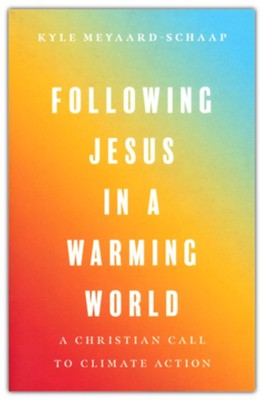
Kyle Meyaard Schaap, Following Jesus in a Warming World: A Christian Call to Climate Action 

title page photo of Following Jesus in a Warming World

(Downers Grove, IL: Intervarsity Press, 2023), 200 pages including notes. 

I heard Meyaard-Schaap at the Festival of Faith and Writing at Calvin University in April and picked up his book right afterwards.  Coming from a conservative Christian background, he takes on the evangelical wing of Protestantism for ignoring the issues of environmentalism. He even challenges this attitude as failing to live up to their “pro-life” rhetoric.  

Much of the book involves Meyaard-Schaap recalling the “Big Story” of scripture. Moving from Genesis to Revelation, he interprets the Bible as God’s love story for the world. He challenges, with scripture, those who believe God will destroy this world and create a new one. As he points out the passage at the end of Revelation about a new heaven and earth should be translated as a restored heaven and earth. The word used here isn’t the same word we might use for a newly built house. Instead, John in Revelation uses kainos, a word implying that God doesn’t start over but restores his masterpiece (page 59). Just as the world is transformed, so will we. We see this promise in Paul as well as in Revelation. 

Another area of scripture which Meyaard-Schaap focuses is on the meaning of “good news.” He makes the case that Jesus’ message of hope is for the poor in the world, who face the blunt of challenges with climate change. This is true in our own country as the poor often live in the most dangerous places such as next to freeways with exhaust or by chemical plants which spews pollution. But such a crisis becomes greater by those living in places where sea level rise creates a life-threatening challenge. This is another reason for us to be concerned about the environment and pollution. 

In addition to providing reasons for Jesus’ followers to be concerned over climate change, Meyaard-Schaap provides ways that individuals and groups of Christianns can become involved in the debate. He encourages others to join in telling stories of the dangers and of redemption. Finally, he encourages us to be joyful even amidst the tragedy around us. After all, God loves this world and those of us in it, which is indeed good news. 

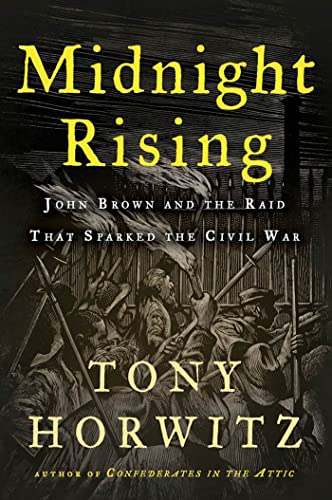
Tony Horwitz, Midnight Rising: John Brown and the Raid that Sparked the Civil War 

Book cover for Midnight Rising
Version 1.0.0

(New York: Henry Holt, 2011), 365 pages including notes, indexes, and photos. (Audible, 11 hours and 5 minutes). 

This book sat on on my TBR pile for a while. Reading Horwitz’s wife book on his death brought the book back to my attention. Unlike most of Horwitz’s books I’ve read, this book is void of humor. The books I’ve read by Horwitz (Confederates in the AtticOne for the Road, A Voyage Long and Strange: Rediscovering the New World, and Spying on the South: An Odyssey Across the American Divide), he travels to learn about history and places. While the subject matter may not be very funny, his encounters as he travels can be funny and delightful. With Midnight Rising, he sticks to writing straight history as an academic exploring what some suggest is America’s first homegrown terrorist and others saw as a well-meaning but misguided fighter to end slavery. 

John Brown was a complicated man.  Coming from a strict Calvinist background, he broke with his father’s pacifist views and later moved to Kansas just for the purpose of fighting the spread of slavery. Steeped in the Old Testament stories, he saw himself as a modern-day Gideon, leading a small group of freedmen and slaves to strike a blow against the slave economy of the South. I was amazed Brown had pondered his vision of an insurrection starting in Harpers Ferry, Virginia (now West Virginia) for so long. He even discussed his plan with many other people including Frederick Douglass. While Douglass desired an end to slavery, he felt Brown’s plan foolish and refused to join him. 

But Brown and his sons were gained some support, both from northern abolitionists who financed his operation and a few followers who joined in the raid. They set up in a house in Maryland, north of the city and scouted out the city and countryside before they began their campaign. Many of those who joined Brown knew they would likely give their lives to the cause. Ironically, within Harpers Ferry lived many free blacks. The first death at the railroad bridge at the beginning of the raid was a free black who worked for the railroad.  Brown was able to surprise Harpers Ferry, but the raid began to quickly fall apart as townsfolks took up arms and fought back. Brown and most of his men found themselves pinned down in a firehouse. Their capture came when a contingent of Marines under the command of Robert E. Lee rushed the building. Wounded, Brown was tried while resting on a cot in the courtroom.  Brown and several of his men were executed for their role in the attempted rebellion in nearby Charlestown.  Before his death, Brown predicted the upcoming war between slaveholding and free states, which erupted in 1861. 

This book provides a good study into Brown’s plans and the fatal attack in 1859 in Harpers Ferry.  The next time I visit the town, I will have a better understanding of what happened there so long ago. While the fire house still stands, much of the industrial machinery was removed during the Civil War, leaving the sleepy town without evidence of its industrial past.