
Jeff Garrison
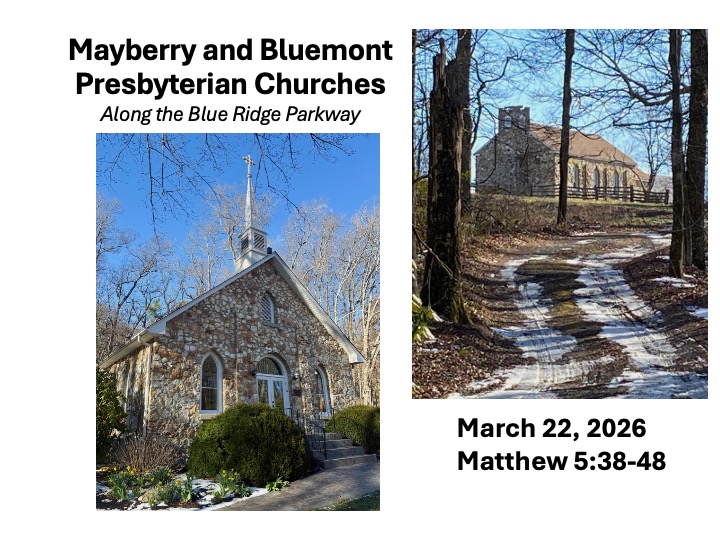
Bluemont and Mayberry Churches
Matthew 5:37-48
March 22, 2026
At the beginning of worship
A few years ago, there was a video making the rounds of two women in a grocery store parking lot. One carelessly opened her door into the car next to her. Shocked, the woman in that car asked if she was going to apologize. The first woman said a few harsh words to the other, about how she didn’t hurt the resale value of her car. Soon they both began banging their doors into each other’s car. Then they began drove around the parking lot in an improvised demolition derby. Those coming out of the store gathered along the sidewalk to watch. At one point, as one of the women backs her car into the other and the camera focuses on her bumper sticker. “War is not the answer.”[1]
Let me ask you a question. Have you ever done something that, if it were pointed out that you are Christian when doing it, would be embarrassing? (You don’t have to raise your hands; wait till the Prayer of Confession to make your confessions). Of course, you have. I have; we all have… If we have high values, it’s hard to live up to our standards. Thankfully, we live by grace and not the law.
If you want to see the video on Youtube, look up my sermon online. There’s a link to it.
Before reading the Scripture:
Today we’ll finish up Jesus’ six commands in the Sermon on the Mount. These reinterpretations of the law seem more difficult to obey. As I said all along, Jesus raises the bar. It’s harder to know which reinterpreted commandment is the hardest, but I suggest it might be the last two. Turn the other cheek and love your enemies… Jesus forces us to look out for the best interest of our enemies. But we don’t like to do that, do we?
Think about Cuba today. Supposedly the island is again our enemy, and we’ve put a blockade on them, cutting them off from fuel. The nation has gone dark as it struggles to maintain its power grid. Even hospitals have been forced to operate without power. Considering Jesus’ teachings, what kind of reception a politician would receive if he or she suggested we allow the island to receive enough oil to alleviate the suffering of the Cuban people? And consider what would Jesus do?
In these six reinterpretations of commandments from the Old Testament, Jesus mostly follows a similar pattern. He provides the original teaching with “You have heard it said.” Then he gives a new commandment, “But I say.” And he follows this with some suggestions of how we can follow his command.[2]
In today’s reading, Jesus comes out against revenge, challenging the command, an eye for an eye, a tooth for a tooth. This law, which isn’t unique to the Hebrews as it was found in even older laws in the region, attempts to limit revenge. Instead of the “Sicilian justice” as seen in the Godfather, the law limits revenge.[3]
The second law we’ll look at concerns loving our neighbors. Of course, the Jewish people had this law in the Old Testament but tried to limit it to only those neighbors who lived adjacent to them. This is why the Parable of the Good Samaritan is so radical.[4] In that parable, Jesus extends the neighborhood to include the enemies living across the border. In his teaching here, Jesus does the same thing, expanding those we’re to love.
The Sermon on the Mount takes us back into its beginning with the Beatitudes. Here, Jesus forces us to reconsider the seventh Beatitude, “Blessed are the peacemakers.[5]
Read Matthew 5:38-48
“Turn the other cheek, love your enemies,” Jesus tells us. Do we? Do we truly love those who are different from us, who have different ideas about the world, different beliefs? Are we willing to give away what we own to maintain peace? Will we turn the other cheek? Will it work? What does these passages mean to us in a divide world? Do they apply with how we deal with Democrats and Republicans and MAGA and illegal immigrants.
It seems those on the edges of the political spectrum really hate those who disagree with them. Does this passage apply here? You bet. It says essentially, “if you want to please your Savior, tone down your hateful rhetoric… Actually, it says, do away with such behavior.” And to push this further, what does our passage say about how we relate to Iran, Hezbollah, Cuba, Russia, China, or a New York Yankee fan? I’m sorry, none of us are going to leave today unscathed!
Jesus begins this section of his sermon with rhetorical statements: “You have heard it said, ‘An eye for an eye and a tooth for a tooth,’ and ‘you shall love your neighbor and hate your enemy.’” The eye for an eye part, along with the love for our neighbor are found in the Old Testament.[6] But not the hate for an enemy, unless Jesus summarizes an idea advanced in the Psalms of which a few seem to encourage us to love God so much that we hate the godless.[7]
Eugene Peterson in The Message, translates this verse in this manner: “You’re familiar with the old written law, ‘Love your friend,’ and its unwritten companion, ‘Hate your enemy.’” Somehow these two ideas have been married together, but Jesus divorces them by insisting his followers love not just their friends, but also their enemies.
Furthermore, this command doesn’t just apply to individuals. Jesus addresses the community here. Not only is this something I’m to do. We’re all to be doing this together. The early church, under Jewish and later Roman persecution, would have heard these words in a different context. Their enemies were real and a threat! They could have them stoned or fed to the lions. Yet they loved those who persecuted them and prayed for them!
And just to clear up things, in case any of you are thinking—“Sure, I’ll pray for my enemies, I’ll pray for their demise.” That ain’t what Jesus means. We’re to pray for the wellbeing of those who hate and persecute us. Remember, as he was being nailed to the cross, Jesus prayed for his executioners.[8] Jesus practiced what he preached.
Now why would we want to love our enemies and pray for our persecutors? Wouldn’t it be easier to insist on an “eye for an eye”? As I have suggested through the Sermon on the Mount, Jesus wants to create a new community of followers who live differently that the world. He suggests we maintain different standards, ones that works for peace and reconciliation. Jesus came to save his people from sin, an angel tells Joseph in Matthew 1.[9] Sin causes divisions. Freed of sin, we work to restore divisions.
Our God is good to all creation—those who are gentle and kind and those who are mean and bullies. Everyone benefits from what the Lord provides. The rain falls upon the righteous and the unrighteous. So why would we want to take a risk and give our enemies more than they demand? Why would we want to take a risk and love our enemies? One reason. We want to be more like God. We want to be godly. After all, God took a risk on us. And God loved us before we loved or even knew God!
If we only love those who are like us, Jesus points out, we’re no different than anyone else. It’s easy to love your friends. But the church is different. We’re to be an alternative to the world! We’re to practice radical hospitality, and we’re to love those who, for many, aren’t considered loveable. “Love sought is good,” Lady Olivia says in Shakespeare’s Twelfth Night, “but giv’n unsought is better.”[10] As Christians, we’re to give love unsought!
In the second century, there was a report made to the Roman Emperor Hadria about Christians. Remember, Christians back then were persecuted, but this is what the report said:
They love one another. They never fail to help widows; they save orphans from those who would hurt them. If they have something they give freely to the man who has nothing; if they see a stranger, they take him home, and are happy, as though he were a real brother. They don’t consider themselves brothers in the usual sense, but brothers instead through the Spirit, in God.[11]
It was this kind of love which drew the attention of others and helped the church grow even through persecution. At a time when Rome attempted to stamp the church out, the church was known for love… But what about today?
One of the common reasons given by people who no longer attend church is that they feel judged. One study found that 87 percent of Americans say that Christians are judgmental. 87%![12]I suppose the good news is that if 87 percent said we’re judgmental means even most of us Christians acknowledge the problem. Of course, Christians know there is a judgmental issue because we do it to one another. We’ve all been judged unfairly! We don’t take Jesus’ admonishment “Judge not” to heart.[13] Do we really want to be known as judgmental and by what we’re against instead of by what we’re for? 87% doesn’t sound as if we live up to that old song, “They’ll Know We are Christians by our Love”. But let’s strive for it.
As believers, we acknowledge our brokenness and complete dependence upon God. This should make us more open to our enemies.
Jesus ends this passage with a command to be perfect as is our heavenly Father. Although perfection is expected of us, we know that on our own, we won’t achieve it. Instead, as I said earlier, we’re driven back to the Beatitudes, back to the realization that we, too, are poor in spirit.
Despite being poor in spirit, Jesus offers us some helpful ways to live in our faith. We don’t retaliate against our enemies. We are gracious to all people and pray for our enemies. You know, we live in a time when the world appears to be on the verge of exploding. It may sound to some as treasonous, but there’s no better time than now to begin praying for our enemies. Amen.
[1] https://www.youtube.com/watch?v=0EVxSCcKo8Y
[2] Frederick Dale Bruner, The Christbook: Matthew 1-12 (1990, Grand Rapids: Eerdmans, 2004), 246. I also covered this structure in my first sermon on the commandments. See https://fromarockyhillside.com/2026/02/22/murder-and-anger/
[3] This law, known as the lex talionis (Law of the Tooth) was found in the Code of Hammurabi in the 18th Century BC. Bruner, 247.
[4] Luke 10:29-37.
[5] Bruner, 266-7. Matthew 5:9.
[6] Leviticus 19:18
[7] Bruner, 267. See Psalm 58, 109, 137:7-9 and 139:21-22.
[8] Luke 23:34
[9] Matthew 1:21
[10] William Shakespeare, Twelfth Night, 3.1.167. Of course, Olivia was trying to make a play for someone and not speaking of universal love.
[11] “Aristides to Emperor Hadria” as quoted in God’s Virtues: An Inspirational Collection of Stories, Quotes, Hymns, Scriptures and Poems (Tulsa, OK: Honor Books, 1995), 43.
[12] Thom & Joani Schultz, Why Nobody Wants to Go to Church Anymore (Loveland CO: Group Publishing, 2013), 23.
[13] Matthew 7:1, Luke 6:37
That is a sad but also funny story how some folks are pushed to their limits. Our series this month in church is all about POV point of view and I have to admit it’s amazing how you can form so much in a series and how opening our eyes can show so much more than we know. Those ladies reminded me a bit from the movie Fried Green Tomatoes, have you seen it? it’s old but I’ve seen it many times. Enjoy your week and weather as it sounds like we’re both experiencing the same kind of weather all across the states! Take care.
I’m not sure where the clip came from, but that bummer sticker is ironic.
I’m beginning to think there is no end to the awful things some are willing to do. And in answer to your question… yes, I know I do things that don’t reflect my claim to be a Christ follower. I can blame it on human nature, but that’s a cop out and no excuse. I can say it’s not as bad as things others do, but again… a cop out.
Lord have mercy on me, a sinner!
And God is merciful!