
Can we really avoid judging?

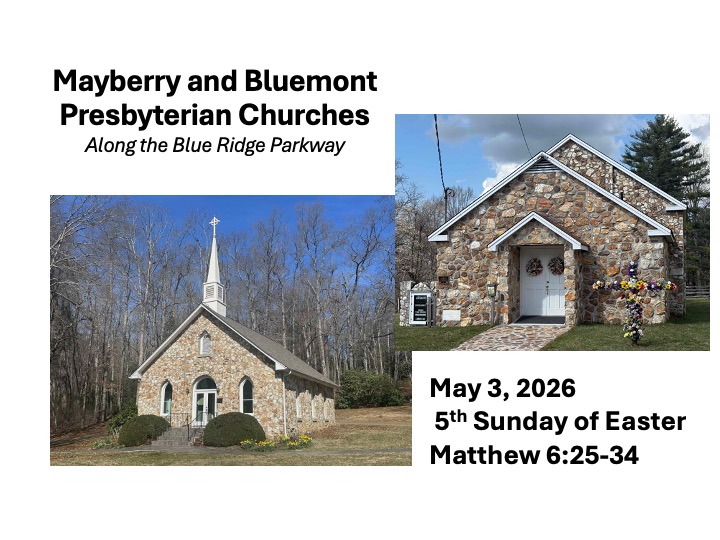
Title slide with photo of Bluemont and Mayberry Churches

Jeff Garrison
Mayberry & Bluemont Churches
May 10, 2026
Matthew 7:1-6

Sermon recorded at Bluemont on Thursday, May 7, 2026.

At the beginning of worship:
Are any of you Eeyore’s? You know who I am talking about, don’t you? The donkey with floppy ears in Winnie the Pooh. He’s always down and out. If the sun shines, he worries about a drought. If raining, he knows they’ll be a flood. 

You know, friends who are Eeyores, they drag us down. They take a lot out of us. It’s easy to judge such friends as unworthy of our attention. Yet, the Eeyore’s of the world need friends. And we all know this. All of us have at one time or another, found ourselves in a funk. At such times, friends help us get through the darkness. 

A suicide prevention article from years ago had this take on Eeyore: 

One awesome thing about Eeyore is that even though he is basically clinically depressed, he still gets invited to participate in adventures and shenanigans with all of his friends. And they never expect him to pretend to feel happy. They just love him anyway, and they never leave him behind or ask him to change.[1]

If you are an Eeyore, I hope you have the same experiences as Pooh’s flea-bitten friend. May you have all kinds of adventures and shenanigans. Who here wants to oversee shenanigans in the church? As a church, we should be willing to welcome all Eeyore’s and others who are easily left behind. We need to create a counterculture community, which pushes back against the common view of Christians as judgmental. We should strive to create a community which displays hospitality, one that not only welcomes the Poohs and Tiggers of the world, but also the Eeyore’s. 

Before reading the Scriptures:
We’re moving into the final chapter of Jesus’ Sermon on the Mount. Chapter 7, verses 1-12 are consider the last section within the meat or the main part of the sermon. Today, we’ll look at the first half of these verses. Next week, will finish the middle section. By splitting these in two, we can focus more in detail. After verse 12, Jesus ends with a few other topics as he brings this all-inclusive sermon to a close. 

Our passage begins with sharp words. “Don’t judge.” What does Jesus mean? 

Read Matthew 7:1-6

My mother in 1955

Today is Mother’s Day. So let me talk a bit about my mom as one of her traits applies to the broader meaning of this text. Mom had the capacity to always think first about the feelings of others. She also tried to instill such feelings in her children. As we’re talking about judging, I’ll let you be the judge of her success. However, I admit I fall short of what she taught. 

In the 5th grade at Bradley Creek Elementary School, during the winter when the weather was bad, we held PE on the stage of the auditorium. The school had no gym. There’s not a lot you can do up there on the stage, so our teacher decided we would learn to dance. This brought groans, especially from the guys in the class. And probably a few girls who didn’t want to dance with us. But I’m not sure about that. Among us guys, as we talked about the prospect of dancing, we realized this meant we had to dance with certain girls. One of the girls was the only African American in our class. Of course, that wasn’t how my friends referred to her.

That day, I came home from school, bragging as had my friends that I was not going to dance with her. My mother exploded. “Yes, you will!  You will not hurt that girl’s feelings.” She then picked up the phone and proceeded to call my teacher. She told him I better be willing to dance with her. 

I wonder if my mother’s concern for the feelings of others came from her own background. Her family struggled and she always had a bit of inferiority complex. Part of it may have come from her father, whom she adored, but who also spent time in the slammer for bootlegging. My great-grandmother had such disdain for her son-in-law; she left the land and house she owned to her daughter and granddaughters, to keep it out of his hands. While my father’s family wasn’t rich, they were certainly better off financially and didn’t have such baggage hiding in the closet. At least, not that I know of, for one of the things we see throughout the Sermon of the Mount is that we don’t always know the heart and secrets of others. This is a part of the reason we’re not too quickly judge others. 

Whatever reason, my mom was well tuned to the feelings of others. It’s a noble and Christ-like trait. 

In The Message paraphrase, our text today begins, “Don’t pick on people, jump on their failures, criticize their faults—unless, of course, you want the same treatment. That critical spirit has a way of boomeranging.”

I like the fresh way that Eugune Peterson translates this passage in this paraphrase, but I think he may have missed one point. We don’t judge to keep others from judging us. This is not a “tit-for-tat” suggestion. “I won’t judge you if you don’t judge me.”  That’s not even healthy for all of us need healthy criticism to grow and mature spiritually. Otherwise, with no guardrails, we can go astray.

The judgment Matthew speaks of us avoiding by not judging  is not the condemnation of others for our sin, but God’s judgment.[2] If we judge unfairly, God will judge us. In the Sermon on the Mount, Jesus envisions an accountable community which looks out for one another. 

Often, people cite this passage and use it to condemn all judgment. I recently heard this passage cited against challenging political behavior. This isn’t what Jesus means by not judging. 

Discernment is a Christian discipline which requires us to make judgments. Later in Matthew’s gospel, Jesus instructs the disciples on how to confront others guilty of sin.[3]  Paul, in his writings to the Corinthians, condemns then for not confronting one involved in a grievous sin which has the power to destroy the church.[4] Again, such a situation requires judgment. In a way, we can’t avoid some judgments.  

One commentary suggests a better translation of the opening verse might be, “Do not judge unfairly.”[5]  Jesus addresses here a social sin, “judgementalism.”  It’s the sin of constantly finding fault with what others say and do. And not only do we find fault in others, but we also overlook the faults we harbor. Judgmentalism indicates a disease within our spirit, for we assume we are superior to others.[6]  While there are times we are called to judge, we must do so honestly and with humility and mercy. 

To help clarify what he means, and perhaps to lighten things up with a bit of humor, Jesus tosses in a parable. Don’t go around trying to take a speck out of someone’s eye when you have a log in your own eyes. Try to imagine your optometrist looking at your eyes with a log in his. The verbal picture here is quite funny.

Jesus essentially says need of healing before we can heal someone else. Furthermore, Jesus’ command, “don’t judge,” doesn’t mean “don’t think.”[7] At times, discernment becomes necessary. But we must be merciful. As Bo Diddley asks in a classic blues tune which was later recorded by Eric Clapton, “Before you accuse me, take a look at yourself.” 

Another point to understand. In verse 5, Jesus uses the word “hypocrite.” We’ve heard this word before in the Sermon on the Mount, but this time is different.  Elsewhere in the Sermon, Jesus used it to refer to those outside the community of believers, generally the Pharasees and Sadducees, but here, Jesus refers to those inside the community, believers who don’t live up to their calling.[8] Yes, as we well know, there are even hypocrites inside the church. We must be careful of how we look at others, considering our own sin and also knowing we don’t know their hearts.  

After the parable, Jesus makes a strange statement in verse 6. “Do not give what is holy to dogs; and do not throw your pearls before swine.” This is one of the harder sayings of Jesus to understand. It certainly shows the culture of that time and that part of the worlds, where dogs and pigs were considered unclean, so you had to discern what to and not to give them. That which is holy and valuable have other uses.  

Perhaps Jesus adds this statement to remind his listeners we need to discern or make judgments. Otherwise, they might toss away valuables.  

So yes, despite a literal reading of verse 1, judgment may be necessary. But judgment must be done with justice in mind. We must be honest and fair with those we judge, so that we won’t do so prejudicially. Furthermore, we must be honest about our own faults which can prejudice our decisions. 

We all stand in need of forgiveness. We can’t use the sins of others to boost our standing. Instead, in humility, we accept our need of divine forgiveness and, as Jesus and my mom taught, be concerned about others. Amen. 


[1] This was from “Suicide Prevention Australia” and found on Facebook in 2014.

[2] Douglas R. A. Hare, Matthew: Interpretation, A Commentary for Teaching and Preaching (Louisville, KY: JKP, 1993), 7

[3] Matthew 18:15ff.

[4] 1 Corinthians 5:1-2. 

[5] Jonathan T. Pennington, The Sermon on the Mount and Human Flourishing: A Theological Commentary (Grand Rapids, MI: Baker Academic, 2017), 256.

[6] Hare, 76. 

[7] Frederick Dale Bruner, The Christbook: Matthew 1-12 (1990, Grand Rapids, MI: Eerdmans, 2004), 340. 

[8] Pennington, 260.

Don’t Worry

title slide

Jeff Garrison
Mayberry & Bluemont Churches
May 3, 2026
Matthew 6:25-34

Sermon taped on Thursday, April 30, 2026 at Mayberry Church

At the beginning of worship:
There’s a legend about Death visiting a city. At the city gates, an old man recognized Death and asked what business he had in the city. “I’ve come to take 1,000 people with me tonight,” Death said. 

The next day, Death reappears and the old man was again sitting by the city’s gate. “Yesterday, you said you were going to take a 1,000 people from our city,” the man cried. “This morning, the newspaper reported that 7,000 people died. Why did you do this?”

“I didn’t,” Death answered. “I took my 1,000. The rest succumbed to worry and anxiety.”

We worry a lot, don’t we? We like to have things under control, but Jesus tells us not to worry about the future. A preacher once addressed the problem of worry in our culture in a sermon which he titled, “Don’t let worry kill you, let the church help!” Yes, even churches can be filled with anxiety and worry. 

Before reading the Scripture:
Last week’s passage ended with a proverb. No one can serve two masters. We can’t serve God and wealth. Jesus continues his sermon on the Mount, drawing the attention of his audience to the nature which surrounded them as he begins to discuss anxiety or worry. 

This is one of the most beloved passages of Scripture, perhaps falling in behind Psalm 23 and John 3:16. The poetic words in this passage contain power, encouraging us to trust God. But I want you to listen to the passage closely and ponder what Jesus is really saying. If we take this passage too literally, it sounds like we shouldn’t worry about or plan for anything. But is that what Jesus says?  

Read Matthew 6:25-34

A Scarlett Tangier in my cherry tree, June 2025


Jesus is almost two thirds through his sermon. People may be getting hungry as he tells them not to worry about what they eat or drink or wear… He points a finger to the air and follows a few birds as they dart from one bush to another. “Look at ‘em,” Jesus says. “They don’t have a care in the world. You know, they don’t sow or reap. They don’t set out crops and then, like farmers, bite their nails and pray the crop will be plentiful. Can you imagine a bird planting a crop?” he might have asked. 

The thought of Joe Sparrow pushing a plow or storing grain might have brought laughter to the crowd. No one images a bird doing such a thing.

Then Jesus gets to the point. “You know, these birds don’t worry about tomorrow, but they get by. And think about it, Jesus says, “Are you not more valuable than they?” Here, Jesus reminds them of the teachings of the first two chapters in Genesis, where God crowned humankind as the pinnacle of creation.[1] God created us to work, to be gardeners in his world, to be his servants with dominion over creation. Certainly, if God cares for the lonely sparrow, God will care for us. 

When taken together on the heels of the previous passage, we’re again remained not to be fanatical about accumulating stuff. It’s something we have a hard time doing. But the disciples who abandoned their boats to follow this teacher from Galilee knew something about placing their trust in God. And so did the day laborers who did not own land and couldn’t count on having work from one day to the next. Of course, not everyone lives in such a manner. Some must plan for tomorrow and next month and next year. Even in Jesus’ day, those farmers who hired the laborers had to plan which fields to plant and so forth.

Perhaps this passage shouldn’t be taken too literally. After all, birds die in blizzards. Wildflowers wilt during a drought. Furthermore, a literal interpretation sounds like we should have no cares and should live a lazy life which isn’t at all what God placed on earth to do. “Don’t worry, be happy,” as the song goes. Some Christians have taken it this way. In Paul’s writings to the Thessalonians, he deals with such laziness and informed them if they don’t work, they don’t eat.[2] Wisdom literature within the Bible often condemns laziness and those who do not plan.

When you think about it, birds and lilies are not good models for human beings. Notice, Jesus doesn’t say we’re to be like them. Instead, he says, Look. Or, think of it this way, “consider or ponder” for a moment the birds of the air and the lilies of the field. They should remind us of what God can do for us. They are poetic symbols of God’s providential care.[3] Seeing the wonders of nature, we see the glory of the Creator reflected in his creation, the glory of a God who cares for the earth. 

In Dale Bruner’s commentary on the passage, he acknowledges the danger of misinterpreting this passage. Bruner, early in his career, before he became a New Testament scholar, worked as a missionary in the Philippines. He writes that he became convinced this text would be cruel to preach in such a context, among those who are so poor and who go around without proper clothing.

But then, Bruner continues and questions the wisdom of preaching such a passage to the well-to-do. He feared this passage could confirm a dangerous prejudice that spiritual values are to be placed over material needs. 

This sets up an opportunity for Bruner to clarify what the passage doesn’t teach. It doesn’t say we should be unconcerned whether others have enough to eat or wear. Certainly, Jesus’ ministry showed his concern for the poor. Instead, the passage commands us to take our eyes off ourselves, off our lives, away from our own selfish anxieties. Bruner concludes, “look around God’s world for a place where we can throw ourselves into the cause of God’s poor.”[4]

Our passage could be interpreted from a celebrative lens. Consider how the lilies and the birds all reflect the glory of God’s creation. Watching and listening to the birds or exploring the wildflowers give us a reason to reflect on God’s gracious care. We can delight in God’s creation and strive to care for it.[5]

In a way, this passage links with our text last Sunday where Jesus encourages us to save treasures in heaven and not on earth. If you remember, Jesus never said that earthly treasures are bad. He just said we can’t count on them. This ties into the climatic verses of this passage. Verse 33 reminds us of how our primary focus should be on God and God’s kingdom. And then, the passages end with verse 34, reminding us not to worry. We are not to worry about tomorrow (nor about those things we can not control). Jesus doesn’t say that planning is bad, we just shouldn’t worry about what is beyond our control and trust those things to God. 

This closing verse seals the meaning. Jesus doesn’t leave us thinking that because we belong to him that tomorrow will be wonderful. Yes, at some point, we’ll enter the kingdom, but until then there will hard days in which we have to trust God.[6]

Throughout this middle section of the Sermon on the Mount, Jesus attempts to focus his listeners on God’s goodness and love. Instead of trying to win earthly admiration with public prayers and acts of piety, we are to do such activities quietly and let God see and reward us. Instead of making the accumulation of stuff our primary purpose, our hearts should be first focused on God. 

Do you remember those bumper stickers popular back in the 1980s which read, “He who dies with most wins.” Jesus’ teachings point out such nonsense. Our purpose is not to accumulate, but to, as the Westminster catechism reminds us, “enjoy and glorify God forever.”[7]

May we so glorify God and enjoy his blessings. Amen. 


[1] Genesis 1:27, 2:4ff. 

[2] 2 Thessalonians 3:6-13. 

[3] Douglas R. A. Hare, Matthew: Interpretation, a Commentary for Teaching and Preaching (Louisville, KY, JKP, 1993), 74. 

[4] Fredrick Dale Bruner, The Christbook: Matthew 1-12 (1990, Grand Rapids, Eerdmans, 2004), 329. 

[5] Hare, 75. 

[6] Looking for things to soon be made good might be what we desire, but it’s not what we get. This idea comes from Scott Hoezee’s commentary on this passage.  https://cepreaching.org/commentary/2014-12-15/matthew-624-34/

[7] Westminster Shorter Catechism, Question 1.

Don’t Let Stuff Weigh Us Down

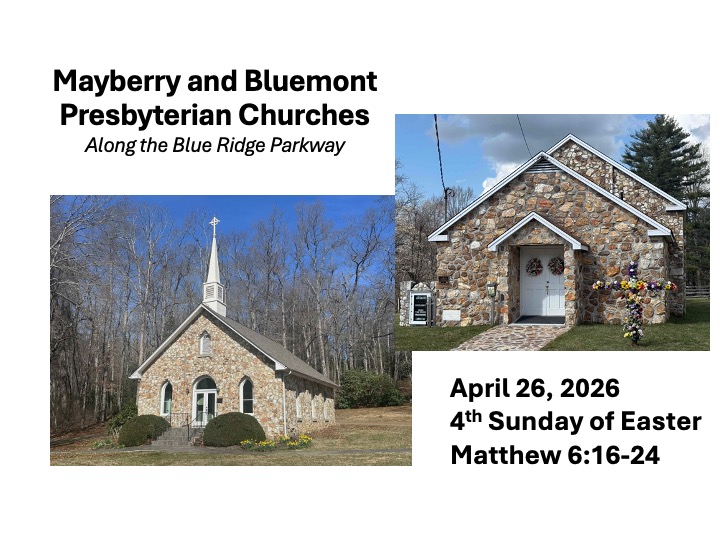
Title slide with photos of Mayberry and Bluemont Churches

Jeff Garrison
Mayberry and Bluemont Churches
April 26, 2026
Matthew 6:16-24

Sermon recorded at Bluemont on Friday, April 24, 2026

At the beginning of worship:

Appalachian Trail in Pennsylvania

When hiking the Appalachian Trail through Pennsylvania, I stopped late one day at a lovely campsite. Thinking I’d spend the evening by myself. Fixing dinner, as the light faded, a family of four trudged in. Dead tired—they set out that morning to hike ten or so miles and had only covered half that distance. The man asked if I would mind if they shared the campsite, as there was a spring for water nearby and plenty of room. “Not a problem,” I said, even though I wasn’t overly excited. 

Continuing with dinner, I glanced over amusingly at the family. The scene could easily have been out of National Lampoon Vacation movie, if they made a backpacking version. The father even resembled Chevy Chase. 

New at backpacking, they had not tried out their brand-new gear. Some of their gear remained in the original packaging. The family appeared to have stepped out of an L.L. Bean catalog. With my dirty and torn clothes and well used equipment, I looked a bit like a hobo. After a comedy of errors, they finally pitched their tent. Then came dinner.   

The dad became frustrated trying to use the stove. Finally, he came over and asked for my help. He had the same stove as mine, an MSR multi-fuel stove. This was preferred by long distance backpackers because it could burn regular gasoline. In 1987, I could top my fuel bottle up at a gas station for 25 cents-it’d be a dollar today. While a good stove, it wasn’t the type of stove most folks used on weekend trips. 

Next, he had the top of the line cook set that all nestled together and included a windscreen for the stove. Knowing this, he left behind the windscreen which came with his stove. But there was a problem. The cook set was designed for a different type of stove. They didn’t go together. No matter how hard he tried, it wasn’t going to work. I showed him how to set up some rocks upon which he could make a windscreen as he cooked. Soon, he was heating up dinner.

After they’d finished eating, his wife put their kids to bed, he came back over to talked. He was a physician. He’d hiked a few times with the Boy Scouts and now thought he’d like to get his family into it. He went to a backpacking store. I’m sure the guy selling gear had a nice dinner later that evening on the commission he earned. Everything this family had with them, and they had way more than they needed, was first class (even if some of it wasn’t designed to work with other pieces of gear). And the sheer volume of their gear was overwhelming. He confided in me that they were probably going to hike back to their car in the morning instead of continuing down the trail, for there was no way they’d make the distance planned.  

Talking with this guy, I realized a couple of things. In the woods, it didn’t matter he had the money to buy fancy gear. It didn’t do him any good. Backpacking is a great equalizer. When you have too many treasures, it weighs you down. This guy carried a pack weighing nearly eighty pounds, and his wife had another fifty. Each of their kids had a small knapsack. All this stuff was killing them. My pack weight was more like his wife’s and that was only when I was fully loaded with ten days of food, a liter of fuel, and two quarts of water. Thinking about this, I felt a tinge of pride.

Then I realized that I, too, was storing up treasures. These were in the form of memories and bragging rights. Idolatry is a sneaking temptation. I wanted to be able to say I hiked the whole trail and at this time had made it halfway to Maine, a goal which became an obsession.

Ultimately, however, whatever we do, God must come first. As we’ll see this morning, it’s not about what you or I can do. It’s about what God can do through us.

Before reading the Scripture: 

We’re continuing in Jesus’ Sermon on the Mount. Two weeks ago, we looked at what Jesus taught about almsgiving and prayer. Through out of this central part of Jesus’ sermon, he uses a similar style. He states a well-known practice or discipline, such as almsgiving, prayer, and fasting, Then, he explores how it can be abused. Finally, Jesus ends by encouraging how we might practice such disciplines by having our priorities right and drawing us closer to God.[1] Understand this. Jesus criticizes any attempt to use religion for earthly gain! Let’s hear what he has to say. 

Read Matthew 6:16-24

For most Protestant Christians, fasting went out of style centuries ago. We might give up something for Lent, an idea we borrowed from the Roman Catholics, but it never really caught on. There used to be calls for fasting during times of trouble, but that seems to have waned. 

Note that Jesus doesn’t condemn fasting.[2] He just wants us to do it for the right reasons. If we fast, it should be to draw us closer to God, not to gain the praise of admirers. When we start using religion for personal gain, we’ve fallen into temptation, as Jesus repeatedly shows. 

Next, Jesus moves to the dangers of treasures. He knew “stuff” wouldn’t satisfy us like a relationship with God. When it comes to stuff, be it money, the junk we collect, or our accomplishments, it’s never enough. We will always want more. Last season’s hero soon becomes a has-been.[3] Supposedly, John D. Rockefeller was asked how much more money he wanted. “Just a little more,” he said. If we try to satisfy our appetites with treasures, our stomachs will always feel empty.  

This passage encourages us to look deeply behind our motives and to get our priorities right. Jesus provides three connected proverbial thoughts for us to see where we place their trust. 

First, we’re not to trust worldly treasures for they have a way of disappearing. A fine wardrobe can be destroyed by nature (moths). Time takes care of objects crafted out of metal as they succumb to rust. And what’s to stop someone from stealing our stuff when we’re not looking? 

Notice, however, Jesus doesn’t say having nice things is bad. He just says we can’t trust them to always be there and that the problem with such niceties is that when we place too much trust in them, we risk not trusting God. Ultimately, our treasures fail us. 

The second proverbial thought is about a “healthy eye.” No, Jesus isn’t making a pitch for eye surgery. Jesus’ listeners would have known right away what he was talking about when he mentioned an unhealthy or evil eye. They understood an evil eye as an envious, grudging or miserly spirit. A good eye connotes a generous and compassionate attitude toward life. 

One of my professors, in his commentary on Matthew, said it’s as if Jesus’ says: “Just as a blind person’s life is darkened because of an eye malfunction, so the miser’s life is darkened by his failure to deal generously with others.”[4] Generosity brings light into the world; greed darkens it. 

The next statement by Jesus concerns serving two masters. A slave would run ragged if he had to answer to two masters. Likewise, if we try to serve both God and money, we find ourselves with two masters and the latter, money, makes a harsh master. There can never be enough. We need to place our priorities in order. We need to stick with God.

But then again, as I said, Jesus never says that treasures in and of themselves are wrong. He never says our desire to have treasure is wrong. We’re not Buddhists trying to remove desire in search of enlightenment.[5] Instead, Jesus knows we have desires. So, he encourages us to put our desires into the right channels. “Store your treasures in heaven.”     

It sounds too simple. “Store up your treasures in heaven; don’t worry about things here on earth.” Easier said than done, right? We all worry about having enough for tomorrow—and the day and the year and the decade that follows. We must admit that our prayers for daily bread seem unnecessary when we have a pantry full of food. When we have too much, it’s hard to depend upon God.    

But Jesus wants us to trust in God, which is why we’re to store treasures in heaven. On earth, we’re to be about doing the Father’s work. And when we do what God calls us to do, we store our treasures in heaven. But when we forget about what God wants us to do and focus only on our wants and desires, we lose our way.

How might we learn not to store up our treasures here on earth? First, “Enjoy things, but don’t cherish them.” God created this world good and wants us to enjoy life and the blessings provided, but God gets angry when we see such blessings as being ours. Then we easily serve or worship such stuff. We are given this world as a steward and one day we must give it all back. 

Second, “Share things joyfully, not reluctantly.” If it bugs you to share something you have with someone who needs it, you should then know that item has gotten a hold on you. It’s an earthly treasure, an idol. 

Finally, think of yourself as a pilgrim, not a settler. “The world is not my home, I’m just passin’ thru,” the old gospel song goes.[6]Store your treasures at your destination, then your journey will then be easier.

Look inside yourself and use these thoughts to evaluate what you have: Enjoy, Share, and think like a pilgrim. A pilgrim is like a backpacker. Remember, you don’t want your pack weighing you down and keeping you from enjoying the view along the way. Amen.  


[1] Jonathan T. Pennington, The Sermon on the Mount and Human Flourishing: A Theological Commentary (Grand Rapids, MI: Baker Academic, 2017), 230, 232.

[2] This is the only place where Jesus addresses fasting. Later in Matthew’s gospel (9:14) as well as Mark 2:18 and Luke 5:33, John’s disciples questioned why Jesus’ disciples don’t fast. There was some fasting in the early church. See Acts 13:2-3, 14:23. 

[3] Frederick Dale Bruner, The Christbook: Matthew 1-12 (1990, Grand Rapids: Eerdmans, 2004),, 320.

[4] Douglas R. A. Hare, Matthew: Interpretation: A Biblical Commentary for Teaching and Preaching (Louisville, KY: JKP, 1993), 72. 

[5] Bruner, 321.

[6]  Kirk Nowery, The Stewardship of Life (Camarillo, CA: Spire Resources, 2004), 122-123.

Jesus’ Teachings on Piety and Prayer

Jeff Garrison
Mayberry & Bluemont Churches
April 12, 2026
Matthew 6:1-15

Sermon recorded on Friday April 10, 2026 at Bluemont Church

At the beginning of worship:

Johnny prepared to go out on his first date with Cindy, a cute girl in his High School English class. He’d borrowed his dad’s car for the evening. That day, after school, he stopped by the local candy store, looking for a way to impress her. The owner of the store noticed Johnny’s difficulty at picking out a box of chocolates and asked if he could help. 

When Johnny told him he wanted to impress a girl on a date, the store owner suggested a one-pound box if he just wanted to shake her hand after the date. But he said, if you want to kiss her on her cheeks, I’d go with a two-pound box. And, if you want to kiss her on her lips, go with the five-pounder.

That night, Johnny showed up at Cindy’s home with a big five-pound box of chocolate candies under his right arm. This pleased Cindy. She invited Johnny in to meet her family. Sitting in the living room, he spied a Bible on the coffee table. He picked it up and asked if could read a few verses and pray before they left for their date. 

Later that night, Cindy slide across the seat of the car to be closer to Johnny. She whispered into his ear, saying. “Johnny, your wonderful. I never knew you were so religious.” 

Johnny responded. “I never knew your father owned a candy store.”  

We all know to whom Johnny directed his prayers that evening, don’t we? We’ll talk about the right use of prayer this morning.

Before reading the Scripture:

After breaking for Palm Sunday and Easter, we’re back to Jesus’ “Sermon on the Mount.” We’re in the heart of this sermon, where Jesus teaches about piety and prayer. The center of our text is the Lord’s Prayer.

I won’t spend too much time on that prayer. Several years ago, I gave six sermons dealing with the six petitions in the Lord’s Prayer, so if you want to dig deeper into the prayer, look up my older sermons.[1] I’ve footnoted them in this sermon, so you can find them easily on my website. But I still will discuss the Lord’s Prayer briefly. It’s important to see how the prayer fits within the larger sermon. In this text, Jesus continues with his concern raised with his re-interpretation of the law. While our behavior is important, what’s in our heart is also important. God and other people watch what we do. But God also knows the reason why we behave in such a manner. 

Why do we help others? Is it only to obtain recognition or some other reward? If that’s the case, God’s not impressed. 

I am also going to read our text this morning from The Messagetranslation. This paraphrase of the passage offers us a fresh way to hear Jesus’ message. Plus, I like how The Message draws upon the language of the theater in the opening of this passage. This seems to be closer to the Greek which use the language of the theater to express Jesus’ message.[2]

Read Matthew 6:1-15:

In Chapter 6, Jesus moves from reinterpreting the law to how we live out our faith through piety, prayer, and fasting. As with the commands in which Jesus raised the bar, here he also shows his concerned for what’s in our heart. 

Jesus assumes all religiously devoted people will practice these acts of devotion, especially the first two which we’ll look at today: almsgiving and prayer.[3] The first involves helping those in need. The second involves our relationship with God. Both are important. Jesus assumed everyone will give to those in need and pray. But Jesus wants us to respond for the right reasons. Why do we do such acts? Is it to earn praise from others? Or are our hearts truly moved to compassion and to a desire to connect with God? 

As we’ve seen, Jesus draws from the language of the theater. You know, an actor attempts to convincingly portray a character. Whether it’s a hero or a villain, when the actor brings the character to life, they earn the appreciation of the audience. But our lives are not lived out in the theater. We should play ourselves and not seek the approval of others. Instead, we need a generous heart, which is something only God can see. 

Jesus begins with almsgiving, the support of those who are in need. Think of it as slipping a dollar or two to a beggar sitting on a sidewalk. Or maybe helping someone have enough money to make their electric bill or to get their car fixed. Or dropping off some groceries to someone sick. All these are good things. 

But there is a catch to doing good. When others see us perform such acts, they praise us. So far, so good, right? But when we eat up the praise, our pride gets the best of us. Soon, we do such acts, not out of compassion and empathy for those in need, but because we like the boost it brings to our ego. At this point, we’re sliding down a slippery slope. Those of you involved in the study of The Screwtape Letters saw examples of this. Even good acts, if done for the wrong reason, will leads us in the wrong direction.

We worship a generous and gracious God. And while we should strive to be godly, we need to understand that praise is due to God, not us. Even if we are generous, it’s only because God’s generosity allows us the means to be generous. So, as a literal translation of this passage reads, don’t let your left hand know what your right hand is doing. In other words, perform deeds of mercy but don’t make a big deal out of it. 

Furthermore, when we perform acts of charity for our own benefit, we belittle the ones we help. It is much better to protect their dignity and help quietly instead of making a fuss about what we are doing and their needs. Using the misfortunate of others for our own praise is troublesome.

Jesus then moves into prayer, our conversation with God. Again, Jesus encourages us not to make a show of our prayers. We’re to pray simply in secluded places. 

You know, there are people who like to make prayer into an approved form of work. I’ve read in several places how the Reformation came about on the prayers of folks like Martin Luther, who supposedly prayed four hours a day. It sounds like Luther’s pious, right? But there is a problem. It’s a myth. Luther, himself, talked about how after a few minutes of praying, he struggled to stay awake.[4]

Furthermore, such a concept is a problematic to our theology. The idea of four hours of daily praying makes the Reformation more about Luther efforts than God’s faithfulness. Don’t think you have to pray long with elaborate words to pray successfully. 

In Jesus’ day, public prayer seems to have been popular. Jews as well as pagans strove to pray to be seen as faithful.[5] Remember the priests of Baal, who had elaborate prayers compared to Elijah’s simple prayer.[6] The idea is that if you prayed the right things, long and hard enough, you would encourage the gods to answer. Jesus strives to pull this bad theology up by its roots. God already knows our needs. Our prayers, which involves speaking and listening to God, draws us closer to the Almighty. It’s not about us tying to encourage God to fill our shopping list, but about us striving to become closer to God. 

This is why Jesus then gives his audience the Lord’s prayer. The corporate nature of the prayer stands out in the prayer. It’s not about me taking my own concerns to my God. It doesn’t begin with “My father,” or “give to me.” Instead of singular concerns, the prayer is plural. “Our father,” and “give us,” we pray. It’s not about God belonging to us, individually. Instead, all of us, collectively, belong to God. Good prayer comes from having our theology right. For our prayers are between us and God. 

Remember Johnny, whom I told you about at the beginning of worship. Who did he direct his prayer to? God or Cindy’s father? 

Now, I should say something about public prayer, as I am often expected to lead them. Jesus, here, isn’t addressing prayer in worship. Such prayers are necessary and expected. We see examples of such prayers in the Psalms. But again, like our personal prayers, such prayers need to be addressed to God, not to those in the congregation. I will be the first to acknowledge, this is hard. We want to please others. We like it when others praise us for our sermons and prayers and whatnot. But our piety isn’t about bringing glory to us, but to God. 

So do good and pray faithfully, but for the right reasons. Amen. 


[1] These six sermons were preached in the fall of 2022.  See:   

[2] In verse 1, Jesus’ warns not to be in “theater to them.”  Frederick Dale Bruner, The Christbook: Matthew 1-12 (1990, Grand Rapids, MI: Eerdmans, 2004), 283. 

[3] Douglas R. A. Hare, Matthew: Interpretation, a Commentary to Teaching and Preaching (Louisville, KY: JKP, 1993), 63; and Jonathan T. Pennington, The Sermon on the Mount and Human Flourishing: A Theological Commentary (Grand Rapids, MI: Baker Academic, 2017), 213.

[4] Frederick Dale Bruner, who studied Luther extensively, noted this in a lecture I once heard. He said that once he began to study Luther extensively, he looked for an affirmation of such prayer and never found it. Instead, it seems to be a story made up in the 19th Century to encourage prayer. 

[5] The Jews, who did pray in public, were encouraged to do so softly and not be boisterous. Bruner, 287.  Even this seems too much for Jesus, for they were praying to gain attention instead of connecting to God. 

[6] 1 Kings 18:22-39.

Turning the Other Cheek and Loving our Enemies

Title slide for sermon with photos of Mayberry and Bluemont Churches

Jeff Garrison
Bluemont and Mayberry Churches
Matthew 5:37-48
March 22, 2026

Sermon taped at Bluemont on Thursday, February 19, 2026.

At the beginning of worship

A few years ago, there was a video making the rounds of two women in a grocery store parking lot. One carelessly opened her door into the car next to her. Shocked, the woman in that car asked if she was going to apologize. The first woman said a few harsh words to the other, about how she didn’t hurt the resale value of her car. Soon they both began banging their doors into each other’s car. Then they began drove around the parking lot in an improvised demolition derby. Those coming out of the store gathered along the sidewalk to watch. At one point, as one of the women backs her car into the other and the camera focuses on her bumper sticker. “War is not the answer.”[1]

Let me ask you a question. Have you ever done something that, if it were pointed out that you are Christian when doing it, would be embarrassing? (You don’t have to raise your hands; wait till the Prayer of Confession to make your confessions). Of course, you have. I have; we all have… If we have high values, it’s hard to live up to our standards. Thankfully, we live by grace and not the law.

If you want to see the video on Youtube, look up my sermon online. There’s a link to it. 

Before reading the Scripture:

Today we’ll finish up Jesus’ six commands in the Sermon on the Mount. These reinterpretations of the law seem more difficult to obey. As I said all along, Jesus raises the bar. It’s harder to know which reinterpreted commandment is the hardest, but I suggest it might be the last two. Turn the other cheek and love your enemies… Jesus forces us to look out for the best interest of our enemies. But we don’t like to do that, do we? 

Think about Cuba today. Supposedly the island is again our enemy, and we’ve put a blockade on them, cutting them off from fuel. The nation has gone dark as it struggles to maintain its power grid. Even hospitals have been forced to operate without power. Considering Jesus’ teachings, what kind of reception a politician would receive if he or she suggested we allow the island to receive enough oil to alleviate the suffering of the Cuban people? And consider what would Jesus do?

In these six reinterpretations of commandments from the Old Testament, Jesus mostly follows a similar pattern. He provides the original teaching with “You have heard it said.” Then he gives a new commandment, “But I say.” And he follows this with some suggestions of how we can follow his command.[2]

In today’s reading, Jesus comes out against revenge, challenging the command, an eye for an eye, a tooth for a tooth. This law, which isn’t unique to the Hebrews as it was found in even older laws in the region, attempts to limit revenge. Instead of the “Sicilian justice” as seen in the Godfather, the law limits revenge.[3]

The second law we’ll look at concerns loving our neighbors. Of course, the Jewish people had this law in the Old Testament but tried to limit it to only those neighbors who lived adjacent to them. This is why the Parable of the Good Samaritan is so radical.[4] In that parable, Jesus extends the neighborhood to include the enemies living across the border. In his teaching here, Jesus does the same thing, expanding those we’re to love. 

The Sermon on the Mount takes us back into its beginning with the Beatitudes. Here, Jesus forces us to reconsider the seventh Beatitude, “Blessed are the peacemakers.[5]

Read Matthew 5:38-48

“Turn the other cheek, love your enemies,” Jesus tells us. Do we? Do we truly love those who are different from us, who have different ideas about the world, different beliefs? Are we willing to give away what we own to maintain peace? Will we turn the other cheek? Will it work? What does these passages mean to us in a divide world? Do they apply with how we deal with Democrats and Republicans and MAGA and illegal immigrants. 

It seems those on the edges of the political spectrum really hate those who disagree with them. Does this passage apply here? You bet. It says essentially, “if you want to please your Savior, tone down your hateful rhetoric… Actually, it says, do away with such behavior.” And to push this further, what does our passage say about how we relate to Iran, Hezbollah, Cuba, Russia, China, or a New York Yankee fan? I’m sorry, none of us are going to leave today unscathed! 

Jesus begins this section of his sermon with rhetorical statements: “You have heard it said, ‘An eye for an eye and a tooth for a tooth,’ and ‘you shall love your neighbor and hate your enemy.’” The eye for an eye part, along with the love for our neighbor are found in the Old Testament.[6] But not the hate for an enemy, unless Jesus summarizes an idea advanced in the Psalms of which a few seem to encourage us to love God so much that we hate the godless.[7]

Eugene Peterson in The Message, translates this verse in this manner: “You’re familiar with the old written law, ‘Love your friend,’ and its unwritten companion, ‘Hate your enemy.’” Somehow these two ideas have been married together, but Jesus divorces them by insisting his followers love not just their friends, but also their enemies.

Furthermore, this command doesn’t just apply to individuals. Jesus addresses the community here. Not only is this something I’m to do. We’re all to be doing this together. The early church, under Jewish and later Roman persecution, would have heard these words in a different context. Their enemies were real and a threat! They could have them stoned or fed to the lions. Yet they loved those who persecuted them and prayed for them! 

And just to clear up things, in case any of you are thinking—“Sure, I’ll pray for my enemies, I’ll pray for their demise.” That ain’t what Jesus means. We’re to pray for the wellbeing of those who hate and persecute us. Remember, as he was being nailed to the cross, Jesus prayed for his executioners.[8] Jesus practiced what he preached. 

Now why would we want to love our enemies and pray for our persecutors?  Wouldn’t it be easier to insist on an “eye for an eye”? As I have suggested through the Sermon on the Mount, Jesus wants to create a new community of followers who live differently that the world. He suggests we maintain different standards, ones that works for peace and reconciliation. Jesus came to save his people from sin, an angel tells Joseph in Matthew 1.[9] Sin causes divisions. Freed of sin, we work to restore divisions.  

Our God is good to all creation—those who are gentle and kind and those who are mean and bullies. Everyone benefits from what the Lord provides. The rain falls upon the righteous and the unrighteous. So why would we want to take a risk and give our enemies more than they demand? Why would we want to take a risk and love our enemies? One reason. We want to be more like God. We want to be godly. After all, God took a risk on us. And God loved us before we loved or even knew God!

If we only love those who are like us, Jesus points out, we’re no different than anyone else. It’s easy to love your friends. But the church is different. We’re to be an alternative to the world! We’re to practice radical hospitality, and we’re to love those who, for many, aren’t considered loveable. “Love sought is good,” Lady Olivia says in Shakespeare’s Twelfth Night, “but giv’n unsought is better.”[10] As Christians, we’re to give love unsought! 

In the second century, there was a report made to the Roman Emperor Hadria about Christians. Remember, Christians back then were persecuted, but this is what the report said:

They love one another. They never fail to help widows; they save orphans from those who would hurt them. If they have something they give freely to the man who has nothing; if they see a stranger, they take him home, and are happy, as though he were a real brother. They don’t consider themselves brothers in the usual sense, but brothers instead through the Spirit, in God.[11]

It was this kind of love which drew the attention of others and helped the church grow even through persecution. At a time when Rome attempted to stamp the church out, the church was known for love… But what about today?

One of the common reasons given by people who no longer attend church is that they feel judged. One study found that 87 percent of Americans say that Christians are judgmental. 87%![12]I suppose the good news is that if 87 percent said we’re judgmental means even most of us Christians acknowledge the problem. Of course, Christians know there is a judgmental issue because we do it to one another. We’ve all been judged unfairly! We don’t take Jesus’ admonishment “Judge not” to heart.[13] Do we really want to be known as judgmental and by what we’re against instead of by what we’re for? 87% doesn’t sound as if we live up to that old song, “They’ll Know We are Christians by our Love”. But let’s strive for it. 

As believers, we acknowledge our brokenness and complete dependence upon God. This should make us more open to our enemies. 

Jesus ends this passage with a command to be perfect as is our heavenly Father. Although perfection is expected of us, we know that on our own, we won’t achieve it. Instead, as I said earlier, we’re driven back to the Beatitudes, back to the realization that we, too, are poor in spirit.  

Despite being poor in spirit, Jesus offers us some helpful ways to live in our faith. We don’t retaliate against our enemies. We are gracious to all people and pray for our enemies. You know, we live in a time when the world appears to be on the verge of exploding. It may sound to some as treasonous, but there’s no better time than now to begin praying for our enemies. Amen. 


[1] https://www.youtube.com/watch?v=0EVxSCcKo8Y

[2] Frederick Dale Bruner, The Christbook: Matthew 1-12   (1990, Grand Rapids: Eerdmans, 2004), 246. I also covered this structure in my first sermon on the commandments. See https://fromarockyhillside.com/2026/02/22/murder-and-anger/

[3] This law, known as the lex talionis (Law of the Tooth) was found in the Code of Hammurabi in the 18th Century BC. Bruner, 247. 

[4] Luke 10:29-37.

[5] Bruner, 266-7.  Matthew 5:9. 

[6] Leviticus 19:18

[7] Bruner, 267.  See Psalm 58, 109, 137:7-9 and 139:21-22.

[8] Luke 23:34

[9] Matthew 1:21

[10] William Shakespeare, Twelfth Night, 3.1.167.  Of course, Olivia was trying to make a play for someone and not speaking of universal love.

[11] “Aristides to Emperor Hadria” as quoted in God’s Virtues: An Inspirational Collection of Stories, Quotes, Hymns, Scriptures and Poems (Tulsa, OK:  Honor Books, 1995), 43.

[12] Thom & Joani Schultz, Why Nobody Wants to Go to Church Anymore (Loveland CO: Group Publishing, 2013), 23.

[13] Matthew 7:1, Luke 6:37

Making a Vow

Title slide

Jeff Garrison
Mayberry & Bluemont Churches
March 15, 2026
Matthew 5:33-37

Sermon recorded at Mayberry Church on Friday, March 13, 2026.

Before reading the scripture:

A few weeks ago, as we slipped into heart of Jesus’ Sermon on the Mount, I spoke about how Jesus takes a number of what we would call “Old Testament Commandments” and reinterprets them. I pointed out how scholars often refer to these six commands as antithesis, but that isn’t quite correct. Instead of offering an alternative, Jesus takes us deeper into the commandment’s meaning. I also spoke about how the six commands could be divided into two sets. The first three focusing more on our moral actions and the second three on our political or community actions.[1]

Today, we’re going to look at the first of the political or community commands. Unlike the others, here Jesus negates what had been taught in the Hebrew Scriptures of the Old Testament.  We’re talking about making vows. Jesus says don’t. The Epistle of James says the same thing. 

But we often make vows. We do it when we marry. We do it if we take a public office, or if we are called to testify in court, or join the military. I did it when ordained into ministry, as has all elders in our church. We even find those heroes of our faith in scripture, such as Paul, making a vow.[2]

In my study on this passage, I found myself torn. This is the most overlooked part of Jesus’ great sermon.[3] I had originally thought I would pair this passage with the next two passages about avoiding retribution and loving our enemies but began to feel it wouldn’t be fair to scripture. I knew I’d spend my time on the later and not on these four verses.

An example of this came from our men’s Bible Study on Wednesday. We look at the last three commands and spent almost all our time focusing on the last two commandments. 

In my study, I learned that for the first three centuries of church history, Christians mostly took this passage literally. They avoided making vows. Then comes Constantine who provided the church with legal standing within the Roman Empire. After Constantine, Christians ignored this passage and began to make vows.[4] We came up with excuses and work arounds. But is that right? 

However, there are some churches, even today, who discourage making an oath. Our Amish neighbors are one. Are they right?

The command against taking a vow concerns itself with politics. After all, such vows are often done for governmental reasons, whether it be in a court of law, or for marriage, or to serve within government. I’m not sure I have a clear-cut instructions for you today, but I encourage you to struggle with me about what Jesus’ command means and how we should apply it to our lives. 

Finally, regardless of what you decide to do about making a vow, I can say this with confidence. God wants us to be truthful, to honor our commitments, and to put God first among our allegiances.

Read Matthew 5:33-37 and James 5:12

While I was driving to and from the Theology Matters conference[5] I attended last week, I listened to Gilbert King’s, Devil in the Grove: Thurgood Marshall, the Groveland Boys, and the Dawn of a New America. The book is about a supposedly rape of a young woman in Central Florida in 1949.[6] It was just after World War II, and returning African American soldiers were beginning to push back against segregation. They wanted a better life for themselves than working in near slave conditions in the citrus groves. Of course, that wouldn’t excuse such a crime. But there wasn’t any evidence produced that there had been a crime. 

However, that didn’t stop four young black men from being charged. Three were arrested and the fourth killed while being apprehended. Sheriff Willis McCall and his deputies used torture to extract confessions from two of the suspects. The three were found guilty and two sentenced to death. Upon appeal, the Supreme Court ordered a new trial. 

Before the new trial could began, Sheriff McCall transported two of the men back to the county jail from state prison. Supposedly, he had a flat tire while driving, not on the highway, but a back road. While working on the tire, he supposedly was attacked by the cuffed man under his care. He said he shot them in self-defense. 

Only, one of the men didn’t die. The sheriff called the coroner who discovered him breathing. At this point, the FBI got involved. The second trial featured future Supreme Court Justice Thurgood Marshall on the defense side. There were many problems with the prosecution, including the outright lies of the Sheriff and Deputies. They also withheld evidence including a doctor’s report raising questions on whether a rape occurred and the contention the woman had been attacked. 

While another all-white jury again convicted, the state of Florida eventually paroled and exonerated the defendants. Even the prosecutor in the case later had a change of heart and admitted his complicacy in the injustice carried out by the state. 

While the book illustrates the problem of racism and shows how change comes slowly, it also demonstrates the need for honesty, especially in court proceedings. Our legal system is built upon those involved within telling the truth. When the truth is concealed, justice will be denied. This is why taking an oath is so important. In the Ten Commandments, we’re told not to misuse the Lord’s name.[7] This would involve swearing by God’s name that something is true. If it’s not true, we have misused God’s name. 

Let me take off on a tangent for a bit. Personally, I have a moral problem with capital punishment. I know there are those who say Scripture allows for it. Yes, ancient Israel carried out such punishments. But those who want to use the Bible to support the death penalty never mentions one caveat. In the Old Testament, the crime for lying or falsifying evidence in court was so serious it carried the same sentence the accused party faced.[8]

Lying or falsifying evidence in court, according to Biblical standards, would mean the Sheriff, deputies, and prosecutor in the Groveland Boys trial could have been executed. Truth is required in court for a society to be fair.  

But let’s go back to Jesus’ teachings. Here, Jesus suggests we not even make a vow at all. Why?  I think Jesus wants to create a community of believers where one’s word is honest and doesn’t need other qualifications. Looking at the qualifications which Jesus cites in this passage (swearing by heaven, the earth, Jerusalem, or even one’s own head). 

It appears people in Jesus’ day may have tried to get around the 3rd Commandment by making vows to things other than God. Jesus won’t have any of it. Don’t make a vow at all but let your word be honest. 

Furthermore, as Jesus illustrates, all these other things people used to make a vow upon link back to God. Heaven contains God’s throne. The earth, as Isaiah also reminds us, is God’s footstool.[9] In Jerusalem resides God’s king.  And God, as Creator and Lord, has a claim even over us as individuals, as we’re humorously reminded that we cannot change the color of our hair. Of course, this was before hair could be dyed, but you get the point.  As the Psalmist says, “The earth is the Lord’s and all who live in it.”[10]

So instead of making a vow, Jesus suggests we just be honest. Of course, if everyone remained honest, there would be no need for a vow as an assurance of our truthfulness. The book of James reiterates Jesus’ teachings on this point. Truthfulness should be a hallmark of a believer. If people can’t believe our word, we have a problem. 

So, should you make a vow or take an oath? I will leave such decision with you. It was allowed in the Old Testament, but Jesus discourages it. As for me, I confess to having more problems with it than I had before this week. But I do know this. God’s will for us is to be truthful in our words and faithful in our commitments.[11]And, our allegiance belongs to God before anything here on earth. Whatever you do about making a vow, be truthful and faithful. Amen. 


[1] See https://fromarockyhillside.com/2026/02/22/murder-and-anger/

[2] Acts 18:18. The Book of Numbers in the Old Testament goes into great detail about making vows. Especially see chapters 6, 15, and 21. 

[3] As an example, this passage is never singled out within the Revised Common Lectionary but paired with the verses before it and it appears only once every three years.

[4] Frederick Dale Bruner, The Christbook, Matthew 1-12 (1990, Grand Rapids, MI: Eerdmans, 2004), 234ff.  Bruner not only outlines the history behind the church’s interpretation of this text, but also admits his personal views changed between his first commentary on Matthew and his updated edition. 

[5] https://www.theologymatters.com/2026-conference/

[6] Gilbert King’s, Devil in the Grove, Thurgood Marshall, the Groveland Boys, and the Dawn of a New America (2012, Audible 2013). 

[7] Exodus 20:7.

[8] Deuteronomy 19:17-19.

[9] Isaiah 66:1. 

[10] Psalm 24:1

[11] Douglas R. A. Hare, Matthew: Interpretation, a Commentary for Teaching and Preaching (Louisville, KY: JKP, 1993), 54. 

Sermon on the Mount: Adultery and Lust

Jeff Garrison
Mayberry & Bluemont Churches
March 1, 2026
Matthew 5:27-32

Sermon recorded at Bluemont Church on Thursday, February 27, 2026

With the world events of the past few days, I am including the outline of my pastoral prayer after the sermon in the hope it might bring comfort to a situation few, if any, understand, and that no one knows what will happen next..

At the beginning of worship: 
“The Hammer of God” is one of G. K. Chesterton’s Father Brown stories. Set in a church, one of the curates no longer prays on the floor with his fellow clergy and parishioners. Instead, he climbs one of the church’s spires for prayer. There, high above everyone else, he begins to fantasize about how he might deal out justice upon a sinful brother. All it would take from such height would be to drop a hammer. Father Brown realizes something is up and confronts the man as he comes down from on high. 

“I think there is something rather dangerous about standing on these high places, even to pray,” said Father Brown. “Heights were made to be looked at, not to look from.”

“Do you mean you think I might fall over?” the man asks.

“I mean that one’s soul may fall if one’s body doesn’t.” 

Father Brown told of another man. In time, the man preferred to pray in high and lonely places such as the belfry or the spire. Looking out upon the world from such heights, he began to imagine himself as God. He committed a terrible crime. For he saw himself as the judge of the world and struck down a sinner. He would have never had such thoughts had he stayed with others upon the floor.[1]

As Jesus reminds us, we’re not the judge and when dealing with the sin of others, we must be careful and graceful.[2]

Before reading the scripture:
Last week, we moved into the heart of Jesus’ Sermon on the Mount and looked at the first commandment he deals with, “thou shalt not kill.” We saw how Jesus equates anger with murder. The second command Jesus deals with, adultery, parallels the first. In both cases, Jesus strives to get behind the commandment, to the root cause. While few of us have murdered anyone, we’ve all been guilty of letting our anger get the best of us, and we can see how harsh words spoken in anger can destroy another person. 

Last week I forgot to add into my sermon an old English proverb, but it can be applied to all these moral commands of Jesus.

He is a fool who cannot be angry; 
but he is wise who will not remain so.[3]

We all get angry, but what do we do with our anger?  Do we stew on it? Likewise, we are created with desire, so when we see someone who is attractive to us, how do we handle it?  Do we let our desire turn to lust and consume us or do we maintain appropriate boundaries? The link between anger and lust is that both objectify other people. 

If you recall from last week, in this section Jesus expands the teaching on six different commands. In the past, many scholars refer to these as antithesis, but I suggested that’s a wrong way to look at them. Instead of presenting an opposite view of the law, Jesus takes us deeper, to the intention of the law. 

Today, we’ll look at the second and the third commands of Jesus, that of adultery and divorce. Again, Jesus employs hyperbole, as he did last week, to emphasize the seriousness of our sin: plucking an eye or cutting off an arm. 

Read Matthew 5:27-32


In Greek mythology, Ares, the god of war, and Aphrodite, the god of love, were lovers. We might think of war and love, anger and lust as opposite emotions. The Greeks were wise. Hate and desire become united within our ego. When we indulge such emotions, we create in our minds an object out of the other person. In this manner, both emotions put the other person down, visualizing them as less than they are.[4]

Last week, we saw that Jesus strove to protect life. This week passage shows his intention to protect marriage.

As I have emphasized all along, Matthew focuses on Jesus’ goal to build a community which breaks through barriers of race and nationality. This also extends to sex. Paul sums up Jesus’ teaching when he says, 


There is no longer Jew or Greek; 

there is no longer slave or free; 
there is no longer 
male and female, 
for all of you are one in Christ Jesus.[5]

This new community envisioned by Jesus, in which men and women are equal, requires a new and stricter self-discipline for men or the male sex.[6] No longer are men required to just keep their hands off women who are married, as adultery had been interpreted. For the peace of the community, men should no longer objectify women. 

Of course, the same goes for women but that may have been less of a problem in Jesus’ day. But today, we overly sexualized everything as we see in advertising—after all sex sells—we should dig at the heart of Jesus’ intention here. Jesus wants us to stop seeing other people as a means to our own pleasure. But it’s hard because we’re always surrounded with sexual images.

We’ve just gotten past the Superbowl. The half-time shows have become increasingly sexualized over the years. We’ve descended a long way since the first bowl in 1966, where a college marching band provided the entertainment. But the sexualization wasn’t really debated this year. Instead, the debate centered around a guy from Puerto Rico singing in his native language.  And then, there was the “family alternative” in which the headline act had, in his repertoire of songs, one praising pedophilia.[7] Is there no shame? We can’t get away from sexual thoughts and images.

Think about this. You go into a casino, and you’re served by scantly clad women. And the rich gather in places like Mar-o-logo with such women dangling from chandeliers. Modesty is out of favor. 

In Jesus day, modesty was still in favor in Galilee, but not in the rest of the Roman empire where pagan temples often featured prostitution. And the sex desires of men ran rampant. In Greek culture, it was common for men of means to take on an underage boy lover in addition to a wife. Realizing this, Jesus wants his followers to hold themselves to a higher standard and stand out from the rest of the world. 

We can only imagine what Jesus would say in our world. We might think our fantasies are harmless, but Jesus shows otherwise. Jesus wants us to need honor one another and men do this not only by avoiding the bedrooms of married women, but by not sexualizing others. We are to see all people—men and women—as having been created in God’s image. 

Next, Jesus addresses divorce. We now know this was a big debate among rabbis of Jesus day. The Mosaic laws provided for divorce. In a way, the law was civilizing for that era, as a man couldn’t just abandon his wife. He had to set her free and allow her to remarry.  One school, led by Rabbi Hillel, took a rather liberal view of this law. He saw anything a woman did to displease her husband as a reason for divorce. You burned dinner, you’re out. The other, led by Rabbi Shammai, took a more conservative view and only allowed divorce for adultery. Here, Jesus aligns with the second school.[8]

Matthew understands the seriousness of divorce. He records more about divorce than all the other gospels combined and almost as much as the entire New Testament.[9] In Chapter 19, Matthew records Jesus’ acknowledgment that God didn’t intend for us to divorce but only allows it because our hearts are hardened.[10]

It may be hard to hear Jesus’ teachings in our world today. Many of us, including me, have been divorced. I married in college and that ended a few years after graduation. 

One of the things Jesus does as he goes through the commandments in this section of the Sermon on the Mount is to make us all realize our guilt. And that’s one of the purposes of the law. 

The Second Helvetic Confession reminds us that we’re not given the law to be justified by keeping it. Instead, the law teaches us our “weakness, sin, and condemnation,” which leads us to grasp the grace offered by Christ.[11] As we accept this love and are freed of our sin, we must treat all people created by God with respect and honor. And that’s essentially what Jesus teaches in this part of the sermon, whether is about murder and anger, adultery and lust, or divorce. 

We should all ask ourselves, whenever angry or lustful thoughts invade our brains if what we think glorifies God and honors others. Furthermore, we should remember that we’re not the judge. Like Father Brown in the story I told earlier, we must show grace to everyone. After all, God has shown us such grace. Accept God’s grace and be thankful. Amen.  


[1] G. K. Chesterton, “The Hammer of God,” as told by Malcom Guite, The Word in the Wilderness: A Poem a Day for Lent and Easter (Norwich, UK: Canterbury Press, 2014), 17-18. 

[2] Matthew 7:1-5.

[3] Fredrick Dale Bruner, The Christbook: Matthew 1-12 (1990, Grand Rapids: Eerdmans, 2004), 209.

[4] Bruner, 219. 

[5] Galatians 3:28.

[6] Douglas R. A. Hare, Matthew: Interpretation, A Commentary for Teaching and Preaching (Louisville, KY: JKP, 1993), 53. 

[7] See https://relevantmagazine.com/current/oped19/a-kid-rock-concert-is-airing-on-tbn-this-sunday-how-is-this-okay?

[8] Bruner, 226-227.

[9] Mark only deals with divorce where he repeats Matthew 19. See Mark 10:1-12.  Luke only has one reference to divorce 16:18). Paul, in First Corinthians (7:11-13) has three references to divorce, but only deals with those married to a non-believer and not divorce for any other reasons. 

[10] Matthew 19:1-12, especially verse 8.

[11] Presbyterian Church USA, The Book of Confessions, “The Second Helvetic Confession,” Chapter XII, 5.083.

A Pastoral Prayer outline for today in light of the recent world events

Almighty God, creator of all things and through your Son Jesus Christ, redeemer of our world, many of us woke yesterday to the reports of a distant war. As followers of Jesus, we don’t know what to make of it. We know Jesus said there will be wars and rumors of wars until history comes to an end, but we also know he especially blesses the peacemakers. Help us, O God, navigate these days, as we pray for those who are living through the nightmare in the Middle East. We especially pray for families of young girls killed at a school in Iran, and for all the civilians caught in this ongoing battle. We pray for the safety of our military who is engaged in the fighting.  And we long for all wars to cease, whether in the Middle East, in the Persian Gulf and Asia, in Africa, or in Ukraine and Russia. 

You, O God, are our rock, give us the strength to stand faithfully with Jesus Christ. Help us to see his image in those who suffer in this world, whether from poverty, the fallout of war, or the trap of addictions. For we know you promise that we encounter Jesus with those struggling in life. Help us also to live our lives in a manner that will honor Jesus. May we be gracious as Jesus has been gracious to us. Give us the wisdom and the strength not to objectify other people, but to see your image in all people. 

O God, we pray for those in need in our midst. Remember those who grieve and those who need to experience healing…. 

Murder and Anger

title slide with photos of the two rock churches along the Blue Ridge Parkway

Jeff Garrison
Mayberry & Bluemont Churches
February 22, 2026
Matthew 5:21-26

Sermon recorded at Mayberry Church on Thursday, February 19, 2025

At the beginning of worship:

One Sunday morning, Charles Haddon Spurgeon climbed into his pulpit at the Metropolitan Tabernacle in London. Surprised to find a note left for him, he opened it. Inside, was scribbled the word, “Fool.” Spurgeon thought about it for a second then showed the note to the congregation. “I have received many anonymous letters over the years complaining about my sermons and other things, “Spurgeon confessed. “But this is the first time I received a letter without a body, signed by the author.[1]

That’s tit for tat, isn’t it? After the sermon today, you can answer for yourself if Spurgeon broke Jesus’ command not to call anyone a fool.

Before reading the scripture

As we begin to dig into the meat of Jesus’ Great Sermon, we come to a part often labeled as as Jesus’ six antithesis. Each of these paragraphs begin with Jesus recalling a portion of the law. “You have heard it said,” Jesus says, then he adds a “but.” Jesus then deepens his understanding of the law, raising the bar. In a way, these statements are not an antithesis, but a deeper interpretation of the law. One commentator refers to them as an exegesis, a process in which Jesus takes the law and digs deeper into its meaning.[2]

Today, we’ll look at the first of these, which deal with anger and murder. The first three commands Jesus addresses deals with moral concerns. I plan to address the other two, adultery and divorce, next week. Then Jesus provides three additional political concerns dealing with making an oath, retaliation, and our need to love everyone.[3] Let’s turn to the gospel of Matthew and read from the fifth chapter, verses 21 to 26.

Read Matthew 5:21-26

I remember the first time I heard verse 22, where Jesus says to call someone a fool endangers us to the fires of hell. Unfortunately, I didn’t come by this passage in casual reading. I had the verse quoted to me. It was used as a weapon against me. I was shocked. I was about 10 or 11 years old and spending the night at my aunt and uncle’s farm. My brother and I, along with our cousins were supposed to be in bed. But we were wrestling or something with the lights out. For some long-forgotten reason, I called Terry, my older cousin, a fool. “You better watch out,” he retorted, “you’re heading for the fires of hell.” 

I didn’t know what he was talking about. He then quoted me this passage from scripture. Of all the passages in scripture, I have no idea why he memorized this one. Nor could I believe it was in the Bible. Terry didn’t have one handy to look it up. When I got back home, I looked it up and sure enough it was there in black and white. Taken back, I felt I’d committed an unforgivable sin at such an early age.   

Of course, I also found such knowledge beneficial and for several years thereafter, I quickly cited this verse to instill fear and guilt into anyone bold enough to call me a fool. Looking back on it all, Terry and I both probably misunderstood Jesus’ intentions.  

In the book of Proverbs, we find fools repeatedly condemned. Considered a grief to their fathers and bitterness to their mothers, silence is a fools only hope, as others may then consider them wise.[4] Proverbs warns us to avoid foolish behavior; it’s good advice. But Jesus, in the Sermon on the Mount, also warns us against calling another person a fool. Even though people do foolish stuff, as highlighted in Proverbs, we’re not to destroy their self-esteem with such language. 

Jesus knows words damage. Harsh words can scar a person for life. The old childhood saying, “Sticks and stones may break my bones, but words will never harm me,” is ridiculous. Words have the capacity to destroy us, and it may take longer to recover from a word spoken in anger than it does from a broken bone. 

I just finished reading Doris Kearns Goodwin’s An Unfinished Love Story: A Personal History of the 1960s. Both Doris and her husband Dick, who is older than her, worked for Lyndon Johnston, but at different times. They didn’t know each other then. Now, toward the end of her husband’s life, they organize his papers. Surprised to read accounts of cruel things said by LBJ which hurt her husband, she also realized he’d said things which hurt the President. Goodwin realized his bitterness remained raw over 50 years later. Words hurt.[5]

This is why Jesus suggests we consider what we say to other people and we think twice before we lash out with our tongues. 

Our passage begins with the 21st verse. The next five verses expand on the sixth commandment, “thou shalt not kill.” In discussing murder, Jesus brings in anger as a similar sin. Following this passage, he does the same for adultery and lust. Then he goes on to discuss divorce and compassion, the taking of an oath, retaliation, and finally loving our enemies.   

Calling these six items’ antitheses is incorrect for Jesus isn’t contradicting the law, nor does he say the law is wrong.[6]Instead, in each case, he ups the ante. What seems to be an easy commandment to keep becomes more difficult. After all, few people commit murder as defined by the law, but we’ve all probably violated Jesus’ reinterpretation of the law. 

Let’s now examine this passage and see what Jesus is saying. He parallels murder and the judgment for which one is liable with that of being angry with someone in the faith. The word brother is used here, and Jesus assumes his reader understands he’s referring both to brothers and sisters within the faith—not just one’s biological siblings. That’s why the New Revised Standard Version translates this as brother and sister. 

In other words, Jesus addresses our anger at those who make up the family of faith. To paraphrase and to try to get all of what Jesus means here, think about how if we take the life of another, the secular courts will judge and punish us. If we’re angry and insult another believer, we’re guilt of the same crime. It won’t be contested or tried in secular court, but it may be taken before the council (or the church governing board) to be judged. And furthermore, if we let our anger get the best of us, abusing others by calling them names like fools, then we’re in danger of divine judgment—the fires of hell.  

Jesus then links this instruction on anger to our relationship with God. He reminds those listening to the truth of Hosea 6:6: “For I desire steadfast love and not sacrifice,” says the Lord, “the knowledge of God rather than burnt offerings.” We’ve been shown mercy from God; therefore, God wants us to show mercy to one another. This is why later in the Sermon on the Mount, when Jesus teaches the Lord’s Prayer, he links together our forgiveness from God to our willingness to forgive one another.[7]  

Jesus’ advice of leaving one’s offering by the altar is interesting. On one level, it’s very practical. It’s something we can do; go make things right with your brothers or sisters before you come to worship. And notice, it may not even be something we’ve done. If someone else has something against us and we’re innocent, we’re still to try to restore the relationship.  

Furthermore, Jesus doesn’t say wait until they’re ready to forgive or only forgive if we’re the ones at fault. Of course, we know we’re never the ones at fault, right? Or if we’re partly at fault, the other person is guiltier than us. Or so we think. But we can’t use such excuses; instead, we should seek peace and forgiveness, regardless. Too often people think our religion is about keeping a bunch of laws. It’s not, at its core, it’s about relationships. 

However, on another level, leaving our offering at the altar seems impractical. After all, if we had a pigeon to offer, a common sacrifice in the first century, it’d fly away. If we left an unblemished lamb, someone else might be eating lamb chops for dinner. In fact, in all six antitheses, Jesus gives advice that pushes the limits of practicality. Cutting off a hand or plucking out an eye, advice that he offers later in this chapter, seem extreme.  

Jesus uses hyperbole to emphasize the seriousness of the action. In other words, our Savior does not necessarily want us to follow the letter of his sayings as much as he emphasizes the seriousness of sin. We need to do something to eradicate sinful thoughts and actions from our lives. Be creative, Jesus says, do something to make a positive change. Don’t go worshipping God, praying that God will be on your side and against your enemy, instead go make up with your enemy then you can worship God appropriately. 

Taking his advice on worship, we know God wants us to worship him, a truth Jesus doesn’t challenge. However, we need to remember that our lives as Christians aren’t just limited to a right relationship with God. Our lives also involve living in a right manner with others. In fact, we can’t have a right relationship with God without also making right our relationships to others. The Christian faith is about restoration of broken relations—both with the divine as well as with others, for even our enemies have been created by God and in God’s image.

Jesus then concludes this passage telling us to come quickly to terms with our accusers lest they take us to court. It’s often suggested that in the first example, at the temple, the broken relationships are with fellow believers.[8] Jesus then extends this to include those who are not part of the Christian family. Again, Jesus offers practical advice. Seek to come to terms early for if we wait till we’re in court, we might find ourselves in hot water. 

Jesus may have also had an ulterior motive here. If anger is bad for one person, it is bad for all. By quickly coming to terms with our accusers, we not only protect ourselves from more harm, but we also have the possibility of defusing the anger in them. If such anger is defused early, it’s not nearly as destructive. The urgency of Jesus’ tone underscores the need to move quickly to resolve anger, for anger if not dealt with will take on an ugly life of its own.

This passage is about our call as followers of Jesus to build up relationships. Anger and words hastily said are counter productive. They tear down; they don’t build up. Jesus’ advice is for us to be careful with our words. And we’re to be pro-active, taking the first steps to restore broken relationships. By your fruits you will be known, Jesus teaches. What kind of fruit do we nurture? Are we peacemakers or do we just throw gasoline on a fire? 

Jesus, by giving suggestions here of things we can do to address the problems created by anger wants us to be peacemakers. If you accept Jesus’ challenge, then do something. Take responsibility for your actions, be willing to forgive, reach out in genuine love. Or, at the very least, take time before responding when you feel hurt or attacked, and think about what you’re going to say. Amen.  


[1] I do not remember where or when I first heard this story, nor do I know if it’s true or apocryphal. 

[2] Jonathan T. Pennington, The Sermon on the Mount and Human Flourishing: A Theological Commentary (Grand Rapids, MI: Baker Academic, 2017), 181.

[3] The breaking of the six commands into moral and political come from Fredrick Dale Bruner, The Christbook: Matthew 1-12, (1990, Grand Rapids, MI: Eerdmans, 2004), 206, 233.

[4] Proverbs 17:25, 28.

[5] Doris Kearns Goodwin, An Unfinished Love Story: A Personal History of the 1960s (Simon & Schuster Audio, 2024). 

[6] Robert H. Gundry, Matthew: A Commentary on his Literacy and Theological Art (Grand Rapids: Eerdmans, 1982), 83.

[7] Matthew 6:12

[8] See Bruner, 217.

Salt and Light

Title slide with pictures of the two rock churches along the Blue Ridge Parkway

Jeff Garrison
Mayberry & Bluemont Churches
February 15, 2026
Matthew 5:13-20

At the beginning of worship:
Did you hear about the guy pulled over by police? The officer asked if it was his car. He said yes. Then the officer had him step out of the car and put his hands on the hood. He handcuffed the man and hauled into the station on suspicion of stealing a car. Yet, the man kept insisting it was his car. The officer put him into the holding tank and, taking his license and registration, began to check out his story. 

Thirty minutes later, the officer released the man and apologized. “I couldn’t believe it was your car,” the officer said. “You have all those bumper stickers about loving Jesus and and following you to church. When I saw you give the finger and heard you shouting obscenities and lay on your horn at that poor driver who was obviously lost, I just assumed you stole the vehicle.” 

You know, actions speak louder than words. If we’re a follower of Jesus, we need to remember this. 

Before reading the scriptures:
The last two weeks, we looked at the beatitudes, which make up the beginning of the Sermon on the Mount.[1]  I hope you read or watched those sermons on-line as we had to canceled in person worship due to ice and snow. Today, we’re heading into the middle portion of the Jesus’ sermon.  

Jesus begins with two emphatic statements directed at his audience. You are the salt and the light of the world. But these statements are not to be taken individually. The “You” used here is plural. If Jesus gave this sermon here, he’d say, “Y’all.” It’s all of us. Those who believe and accept Jesus, in other words, the church, are the salt and the light of the world.[2] We’ll look at what that means. Next, Jesus teaches about his relationship with Scripture and the Covenant. 

Let’s look at what Jesus has to say here.

Read Matthew 5:13-20

What does it mean to be the salt and the light of the world today? You know, salt is important. We tend to take it for granted, except for the past few weeks with ice everywhere, stores quickly sold out of salt. 

In the ancient world, salt was even more valuable and harder to come by than today during an ice storm. It preserved food and likewise, we’re to help preserve the world. When used sparingly in cooking, it helps enhance the flavor. We’re to flavor the world with Jesus’ grace. And, in a world without modern medicine, they applied salt to wounds to assist in healing. We’re to help heal the world.

Oddly, as a friend wrote on this passage, we’re the first generation to be paranoid about our use of salt.[3] Too much of it, we know, causes hypertension and other health problems. But we must have some, or we have other issues. Salt is the only mineral we take straight from the earth and consume. So, when Jesus said the church is the salt of the earth, he wants us to spice the world up, to help preserve the world, and to help heal it. 

In a way, light is like salt. Compared to light in the ancient world, it’s cheap. We have light everywhere. Sometimes we have so much light it becomes a determent of our ability to see things like the stars. Thankfully, we live where the skies are dark and the stars shine brightly, but that’s not the case if you live in an urban area. In a world without electricity and bright LEDs, when the sun wasn’t up or the moon down, you appreciated light. The only light came from campfires, or candles, or oil lamps. Each of these have a limit as to how far you could see before you slipped back into darkness. 

When I lived in Utah, I drove across central Nevada several times at night. I took highway 50, which Life Magazine claimed back in the 1950s to be the loneliest road in America. The other path was a combination of US 6 and Nevada 375, which is even a lonelier road, as you seldom saw a car at night.[4] 

Cutting across the state, you crossed many block-fault mountains which run north and south. Coming off the summits, you’d often see your next town, just a few lights clustered together, way off in the distance. The next sign of civilization, far away. If you needed gas, you’d hope that within the oasis of light a gas station remained open. Or if you didn’t need gas, you’d hope there was a place for coffee to keep you away. As for gas, I always tried to keep my tank above the halfway mark. 

As the church, we’re to be light helping guide the world. Maybe a better metaphor would be navigation lights which help boaters travel narrow waterways and inlets. In the daytime, you have buoys, but at night the buoys have colored lights on them. Remember the three R’s of navigation: red, right, returning. If you are coming into an inlet at night, you keep the red lights or buoys on your right or starboard side. The green ones go on your left or port side. As a church, as the light in the world, we guide people to Jesus, just as navigation lights guide people safely through an inlet. 

Both opening metaphors apply to how we live. Do we point the way to Jesus, or do we get so tied up in the world’s business and lose focus on what’s important? Interestingly, Jesus doesn’t tell us to become the salt or the light of the world. Nor does he tell us to become salter or shine brighter. Instead, he grants us these abilities. But there’s a warning here. If we squander these gifts, if we fail to use them for Jesus’ purposes, for God’s glory, we become worthless. Salt without flavor or a light hidden is of no use for the world. But if we use them properly, others can see through our efforts, God’s glory. 

Our next section deals with the purpose of Jesus’ ministry. Why did Jesus come? Was it to negate what God has been doing through Israel for the past 15 or 20 centuries? No, there’s still value in that work. 

When Jesus speaks of the Law and the Prophets, he’s referring to the entirety of the Hebrew Scriptures or what we call the Old Testament. Some Christians may attempt to ignore the Old Testament, but that’s not Jesus’ way. He values scripture and regularly quotes or alludes to passages from the Psalms and other books of the Hebrew Bible, especially Genesis and Isaiah. 

By linking the Law and the Prophets together, Jesus refers to a new covenant. The first covenant of the Hebrew people was established with Abraham, Isaac, and Jacob and renewed with Moses and Joshua and the Hebrew people. But in the latter part of Isaiah, God through the prophet speaks of a new covenant, one where Israel is to be the light to the nations.[5] The old covenant has been fulfilled, this new covenant will extend beyond the ethnicity of the Jews to all people. 

As I have pointed out repeatedly as we’ve gone through the opening chapters of Matthew, this gospel is most concern with Jesus’ message going out into the world. We see that in the beginning with the foreign wisemen coming to Jesus and at the end of the gospel with Jesus sending the disciples out to all corners of the earth.

What might we learn from this passage? While much of Jesus’ Sermon on the Mount deals with our interior lives as we saw with the Beatitudes and will observe in the weeks ahead, we also see the importance of living in a manner which honors God. Once Jesus ascended to heaven after the resurrection, he left behind a church to do his work. That’s us. We’re to live in such a manner that people will want to be like us. As the old spiritual goes, “They’ll know we are Christians by our love.”  Will they? Amen. 


[1] See https://fromarockyhillside.com/2026/01/31/the-beatitudes-part-1-blessings-on-those-in-need/ and https://fromarockyhillside.com/2026/02/07/the-beatitudes-part-2/

[2] Douglas R. A. Hare,Matthew: Interpretation, a Commentary for Teaching and Preaching (Louisville, KY: WJKP, 1993), 44; and Fredrick Dale Bruner, The Christbook: Matthew 1-12 (1990, Grand Rapids, MI: Eerdmans, 2004). 187-194.

[3] Scott Hoezee, https://cepreaching.org/commentary/2020-02-03/matthew-513-20-2/

[4] I wrote about one of these trips. See https://fromarockyhillside.com/2025/09/25/nevada-375-and-rachel-nevada/

[5] Jonathan T. Pennington, The Sermon on the Mount and Human Flourishing: A Theological Commentary (Grand Rapids, MI: Baker Academic, ), 166-167.  See also Isaiah 42:6.

The Beatitudes, Part 2

title slide with photos of Bluemont and Mayberry Churches

Sadly, we’re again cancelling in person worship this week due to weather. Both parking lots are iced over and in some places with deep drifts. In addition, many roads are experiencing drifting, along with falling branches and trees, And the temperature on Sunday morning is expected to be in the single digits with wind chill being well below zero. Stay safe. Watch or read the sermon, or do both. Join us tomorrow morning at 10 AM on zoom (if you don’t have the link, email me at parkwayrockchurches@gmail.com). Check in on your neighbors. Hopefully, things will be better this week as the temperatures on Tuesday and Wednesday are forecasted to be in the 40s and 50s.


Jeff Garrison
Mayberry & Bluemont Churches
February 8, 2026
Matthew 5:1-12 (7-12)

Sermon recorded at Mayberry on Thursday, February 5, 2026

At the beginning of worship:
Life in the sixteenth century could be brutal. While good things came out of the Reformation, it being led by humans meant somethings were not so good. Catholics fought those within the Lutheran and Reformed Traditions, and we fought back. And those within the Anabaptist tradition, the ancestors to the Mennonite and Amish folks who live around us here in the Blue Ridge, caught it from all sides. Their persecution peaked in the Low Countries, what we know of today as the Netherlands. 

One of the martyrs of the Amish and Mennonite tradition is Dirk Willems. He was condemned by a Catholic court (although many Protestants at the time would have agreed with the court’s ruling) and ordered to be burned at the stake for his theological beliefs. Dirk was held in an old palace repurposed as a prison. He escaped, by collecting pieces of cloth and creating a rope from which he climbed down from his cell window and took off across the landscape. One of the guards saw him and gave chase. They ran across a wide frozen pond. Dirk, as a prisoner, had lost weight and made it across the ice. His pursuer wasn’t so lucky. He crashed through the ice and cried out for help.

Dirk turned back and saved the man, only to be recaptured. On May 16, 1569, he was led to the stake. A strong wind blew, which kept the fire away from Dirk’s upper body for the longest time. It’s said neighboring villages heard his screams, as he repeatedly shouted, “O Lord, my God.”  

What would you have done? Would you have helped the man or seen it as an opportunity to escape? What would Jesus advise? 

Before reading the Scripture:
I am splitting Jesus’ beatitudes into two halves, following the example of Dale Bruner in his commentary on the gospel. The first half of the beatitudes, which we looked at last week, focused on those in need. Here, we see God’s gracious side. With God, grace always comes before expectations. The second half of the beatitudes deal with our response to the needs of the world. For those willing to participate with God, a blessing is also given. Then, this passage ends with the reminder to those loyal to Jesus to expect persecution.  

Bruner, who wrote an outstanding two-volume commentary on Matthew, admits his struggles to preach on the second half of the Beatitudes.[1] As Protestants, we emphasize grace. And grace abounds in the first four beatitudes. But in the second set of blessings, we learn we can also be blessed for doing what’s right. Sounds like “works-righteousness.” Is it? 

Within our faith, a healthy tension exists between grace and law or works. While grace is necessary for our salvation, we are expected to respond to this grace in gratitude and love. We need both, grace and law. We are saved by grace, but we respond by doing God’s work in the world. Are we merciful, pure in heart, or a peacemaker? What does this even mean? Let’s look at our text for today. Like last week, I will read the entire passage but today will focus on verses 7 through 12 in the sermon. 

Read Matthew 5:1-12

The first set of beatitudes begin with three focused on those in need. They’re passive. The next set of beatitudes begin with three beatitudes focused on helping those in need. These are active, calling us forth to participate with God’s plan for the world.[2]Blessed are the merciful, the pure in heart, and the peacemaker. Let’s begin by considering what each means. 

Who are the merciful? Matthew, more than any of the other gospels, shows concerned for our moral life. For Matthew, being ethical, being moral, is to be merciful. It involves compassion. Twice in his gospel, Matthew recalls Jesus quoting Hosea, “I want mercy and not sacrifice.”[3] Jesus, himself, while often described as having compassion, more often shows what compassion looks like though actions on behalf of the needy.[4] Compassion sees or understands the needs of others and responds. It’s having empathy on behalf of others.[5]

Forgiveness is another component of this mercy which Jesus repeatedly demonstrates. Later in this sermon, in the Lord’s Prayer, Jesus links our willingness to forgive to our ability to be forgiven. “Forgive us our debts or sins, as we forgive our debtors or those who sin against us.”[6] Later in his gospel, Matthew recalls Jesus’ parable of the unforgiven servant. Here, the one forgiven a huge debt, refuses to forgive a man who owed him a little. The unforgiving servant’s ingratitude and inability to forgive leads to his condemnation.[7]

It’s hard to show mercy to those who have wronged us. However, it’s better than the alternative, letting hate and revenge build up inside of us until we explode.[8]

Next, Jesus blesses the pure in heart. While behavior is important in the Sermon on the Mount, Jesus emphasizes internal purity. Sin isn’t just actions. It can also be words and thoughts. Angry words are as harmful as actions. Lust is as bad as adultery.[9] In Jesus time, the rabbis emphasized keeping all kinds of outward signs of faith. You obeyed the Sabbath. You ate the right foods. You avoided being in the company of sinners. But Jesus flips this on its side and insists his follower’s purity not be just on the outside but also on the inside.[10]  

We might say something like, “My heart tells me.” However, a pure heart goes beyond our feelings. Within Hebraic through, to speak of the heart includes the “interior life of the person.”[11] In other words, a pure heart refers to our thoughts, actions, and intentions. Seeing God is the blessing received by one who’s life is so structured. 

“Blessed are the peacemakers, for they shall be called the children of God,” comes next. We hear this beatitude with the background drumming of war around the globe and think it would be nice to have a few more peacemakers who could save Ukrainians from Russian attacks on their hospitals and apartment buildings. Or those who bring peace to South Sudan, Congo, or even between us and Iran, Cuba, Greenland, and Venezuela. 

While such peace is to be desired, we must understand two things. In Jesus day, the “peacemaker” was the emperor, who by brutal force brought peace to the entire Roman world. But is that really peace when you crucify anyone who threatens your peace? Can we have peace without justice? 

Secondly, peace in a Hebriac sense goes beyond the absence of conflict. Peace implied wholeness. One commentator suggests this verse might be translated as “Blessed are the wholemakers.”[12]

Matthew concern for relationships between people shows up later in this sermon. Jesus orders those angry with another to reconcile even before they make an offering to God. Then, in the 18thChapter, Matthew records another set of Jesus’ teachings about how we should attempt reconciliation. Jesus encourages us not to blow up conflicts but to attempt to settle them quietly, one-on-one. Only if that doesn’t work, should you involve others.[13]

Jesus doesn’t expect us to settle all the world’s conflicts. While some may be called to such work, all of us can do our part to create a peaceful oasis around us. We should all strive to reduce conflict and to create an atmosphere where everyone can flourish. This is especially needed in our own nation. We’re walking on a slippery path. As we saw with the fifth beatitude, we’re called to help those in need (Blessed are the merciful). Yet, here, in the seventh beatitude, we’re also called to bring peace. I suggest this includes bridging the gap between those who support and oppose the current Administration. It’s tough work because neither side trusts the other. But that’s where peacemakers come into play. If we attempt to faithfully walk this narrow path, we’re promised a special relationship to God as we’re adopted into his family. 

After the three helper beatitudes, Jesus reminds us of that old saying, “No good deed goes unpunished.”  His last two beatitudes are for those who experience persecution. We should carefully note, the reason for the persecution isn’t about us, but about our striving to do what is right and to remain faithful to Jesus Christ. “When you’re ill-treated because of me, you’re in good company,” Jesus says, “for the same thing happened to the prophets.” 

The beatitudes end on a note reminding us to expect persecution. Staying faithful to Jesus and his teachings can come at great cost. We may be disliked, disowned, or suffer fiscal or physical attacks. But if we remain true to our Savior and strive to help those in need, we’re reminded in these blessings that God will remain with us in this life and in the life to come, we’ll discover our rewarded in heaven. 

Strive to do good. Stand up for the underdog. Reach out for those who fall. Provide aide for those can’t help themselves. Look out for the marginalized and persecuted. Yes, by doing such good deeds, we may find ourselves persecuted or killed, as we recently seen in Minneapolis. But that’s the price we pay to live with a clean conscience. Remember Dirk Willems. He had a choice. He could flee and live. Or he could help another in need and, as Jesus will discuss later in this sermon, love his enemy.[14]

We’re called to follow Christ and to base our lives on his life. Jesus helped those in need and he ended up crucified. Perhaps his last two beatitudes foreshadow what was ahead for him and some of his followers. But remember, it’s better to strive to do what is right in Jesus’ name than to ignore those in need around us. Amen. 


[1] Frederick Dale Bruner, The Christbook: Matthew 1-12 (1990, Grand Rapids, MI: Eerdmans, 2004), 179.  For discussion on Protestant and Catholic interprets of the two halves of the beatitudes, see pages 183-187. 

[2] Bruner, 173, labels these two sets of beatitudes as “passive” and “active.”

[3] Bruner, 173.  See Hosea 6:6.

[4] Kenneth E. Bailey, Jesus Through Middle Eastern Eyes: Cultural Studies in the Gospels (Downers Grove, IL:  IVP Academic, 2008), 82. 

[5] See Andrew Purves, The Search for Compassion: Spirituality and Ministry (WJKP, 1989). 

[6] Matthew 6:12. 

[7] Matthew 18:23-35.

[8] Bailey,  82. 

[9] Matthew 5:21-22 and 27-30. 

[10] Bruner, 15

[11] Bailey, 84. 

[12] Bailey, 172.  For more on Pax Romana, see Douglas R. A. Hare, Matthew: Interpretation, A Commentary for Teaching and Preaching (Louisville, KY: JKP, 1993), 42. 

[13] Matthew 5:23-24, 18:15-18.

[14] Matthew 5:43-48.