Jeff Garrison
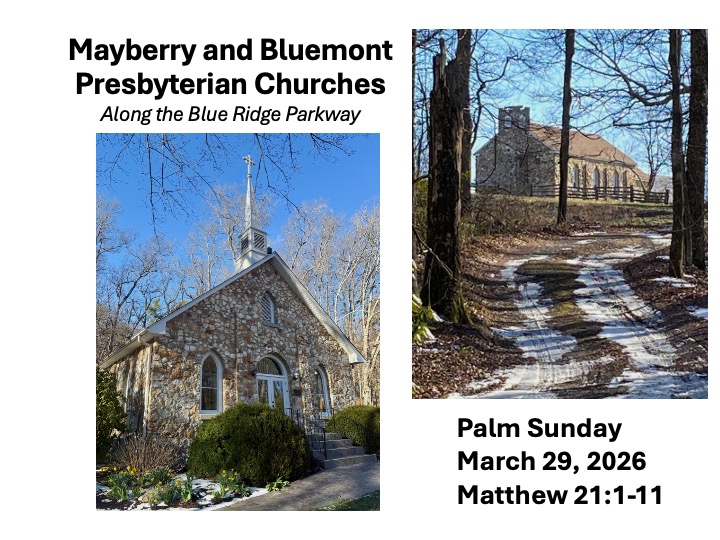
Mayberry & Bluemont Churches
March 29, 2026
Matthew 21:1-11
At the beginning of worship:
In “Palm Sunday,” a poem by Malcolm Guite, begins:
Now to the gate of my Jerusalem,
The seething holy city of my heart,
The Saviour comes. But will I welcome him?
It’s easy on Palm Sunday to make it about those who cheered Jesus on so many years ago. But for us the question remains personal, as Guite ends his poem.
Jesus come
Break my resistance and make me your home.[1]
Before reading the Scriptures:
For Holy Week, I’m taking a two-week break from our in-depth study of Jesus’ Sermon on the Mount. We’ll stay in the Gospel of Matthew but move toward the end of the gospel. Today, we’ll look at Jesus’ entrance into Jerusalem on the day we know as Palm Sunday. This is a story that you find in all four gospels. They may have slight differences, as you have four different people from different perspectives writing it down. But they agree on the main points. Jesus comes into Jerusalem and stirs things up. Next Sunday, Easter, we’ll look at the Resurrection.
Read Matthew 21:1-11
It’s an exciting spring day in the imperial city of Jerusalem. Pilgrims pour in; Jews living throughout the Mediterranean gather at their ancestral city to celebrate the Passover. What a wonderful day for a parade…
Jesus and gang are also heading to Jerusalem to celebrate. When only a few miles from town, Jesus sends his disciples into the next village to procure a donkey and colt for his entry… He tells them where to find these animals. He instructs his disciples to respond to anyone who challenges them with, “the Lord needs it and will return it.” The disciples find the animal; some bystanders question their taking the colt, but they seem satisfied with the answer. Did Jesus work this out in advance or is this a sign of his divinity? The text lets allows us to ponder, providing no clear indication if this Jesus’ humanity at work (he arranged for the colt in advance) or his divinity at work (he knew where to send the disciples).[2]
The disciples, without being asked, placed their cloaks on the animals as a saddle. Now, how Jesus rode two animals, as Matthew seems to suggest, we’re not told. We might humorously image him, holding the reigns in his teeth, with a foot on each animal, like a circus rider taking a victory lap, but that’s probably not the case. Most likely, he sat on the donkey, sidesaddle, as was the custom for riding such beasts. The colt followed along, staying close to its mother.[3]
Quickly, as he and the disciples approach the city’s walls, excitement builds. Followers start placing their cloaks on the ground—in Sir Walter Raleigh’s fashion—as the procession begins. Someone brings in branches—we’re not told here they’re palms. That detail comes from John’s gospel.[4] These branches wave, like the “Terrible Towels” of the Pittsburgh Steelers, making the parade more festive. They welcome Jesus as a general or a king returning home victorious… They chant Hosanna, “Save us,” as they quote from Psalm 118:
Hosanna to the Son of David!
Blessed is the one who comes in the name of the Lord!
Hosanna in the highest heaven![5]
I image its mostly pilgrims making up the crowd. The people of Jerusalem have jobs, they’re busy providing hospitality to all the visitors. Many of these visitors would have been from the small towns and villages in Galilee, who’ve come to Jerusalem to celebrate the Passover.
This is Spring Break, 30 AD. Just like today, most everyone makes a trek south—but instead of Florida, they head to Jerusalem. For many of the pilgrims, this is the highlight of their life—being in Jerusalem for the holiday. It’s like us celebrating New Year’s Eve on Times’ Square, Mardi Gras in New Orleans, or Christmas at Grandma Moses’ farm. A once in a lifetime chance.
And as they come to Jerusalem, they recall God’s great acts of salvation in the past, of how God freed the Hebrew people from Egyptian slavery and saved them from Pharaoh’s army. Reminiscing about God’s past activity opens them up to the possibility God will act again and restore Israel to her former glory. They gather in hope.
Many of them hope Jesus is the one they’ve waited for, for so long. The man God will use to shake off the Roman shackles and allow Israel to once again be free. Jesus, however, doesn’t fulfill their expectations. He offers another kind of freedom. One from our sin.
We’re left to wonder what our response would have been if we were there? Where would we be in this story? Would we have been in the crowds shouting “Hosanna?” And if so, would we’ve also been in the crowds shouting “Crucify?” For you see, it’s hard to separate the parade at the beginning of Holy Week, with the crucifixion which comes five days later.
What is it about our nature which allows us to get excited when our religion seems to support our expectations? And then, back away when things seem to move in a direction with which we disagree? We often forget that God’s ways are not ours.
Jesus takes a risk with this parade. Here, with the parade, Jesus mocks politicians who enter Jerusalem with pomp and circumstance. As Jesus comes into Jerusalem, there were two other significant political figures either already in the city (or if not, they were soon to be there): Pilate, the Roman governor, and Herod, the Roman puppet king from up north.
They, too, probably experienced a parade, one involving fancy horses and soldiers with shiny brass and perhaps even a band. Pilate and Herod display the power of Empire; Jesus, humbly riding on a donkey, displays the power of a mysterious kingdom, one not of this world. Who do we follow? Are we lured by the fancy horses and war chariots of the kings and politicians? Or do we follow the man on a donkey.
This is political, and church always has difficulty with politics. We walk a line between being prophetic in calling government to a higher standard (which is appropriate) and playing the court jester. With the later, we sometimes divert people’s attention from what’s important and thereby providing support for the status quo. In a way, with the decline of the mainline churches, we no longer play the role we once did in politics and that’s probably good.
I’ve heard Miroslav Volf, a theologian and the founder of the Yale Center for Faith and Culture, speak a couple of times. Having grown up in Eastern Europe, he knows something about the problems which exist between the faithful and government. On one occasion, when he was being interviewed by Neal Plantinga, who at the time was President of Calvin Seminary, Volf said: “Don’t look with nostalgia on the time when the church was in the center of everything, for then it was used and abused by those in power… instead, we must find the language and the confidence to cheerfully live our lives as followers of Jesus Christ.” The church can’t and shouldn’t depend on political power.[6] Jesus, riding on a humble donkey, demonstrates this. We depend on God’s power to carry out God’s purposes, and not on military or political might.
Many people think the reason the mainline church decline in influence is that we no longer reflect the values of the larger society. This may be so, but even if it is, we must remember we’re not called to reflect the values of society. We’re called to reflect the values of that man who rode into Jerusalem on a colt some 2000 years ago. And his values constantly challenge us as to who we are and to whom we belong. Do we conform to how others want us to be, or do we strive to conform ourselves to the example of our Savior Jesus Christ? Are we intoxicated by the crowds, or by a desire to stand by the one who is the way and the truth and the life?[7]
We should ponder what Jesus’ risked during Holy Week, and what we are willing to risk for the sake of the gospel. Here are some things we should consider. Do we only support our church when things go our way, or when we hear what we want to hear, or when the church does only the things we want to do? If that’s the case, are we taking risk? Are we being supportive? Are we being Christ-like, and are we being open to where God is calling? Or, to ask the question another way, if we only listen to what we want to hear from Jesus, are we really being faithful to him? It takes faith to stand alone when the crowds disappear; it takes faith to buck the trend. But look at Jesus.
Granted, sometimes we, as individuals and as the church, are wrong, and when we are it takes faith to admit that we are wrong and to seek the new trail Jesus is blazing for us…
We hear the crowds… We’re drawn toward Jesus… Will we just hang around for the fun of the parade, or will we take a risk and continue to follow him as his journey moves toward the cross upon which we’ll be called to sacrifice our wills and desires for his? Amen
[1] Malcolm Guite, The Word in the Wilderness: A Poem a Day for Lent and Easter, (Norwich, UK: Canterbury Press, 2014), 153.
[2] Frederick Dale Bruner, The Churchbook: Matthew 13-28 (Grand Rapids: Eerdman, 2004), 353.
[3] For more on the two animals, see Douglas R. A. Hare, Matthew: Interpretation, a Biblical Commentary for Teaching and Preaching (Louisville: John Knox Press, 1993), 238-239.
[4] John 12:13.
[5] Psalm 118:25-26.
[6] Interview of Miroslav Volf by Cornelius Plantiga, Calvin College, April 12, 2014
[7] John 14:6
There was so much packed into this post: humor, modern-day relevance, and questions that piqued my interest. What would I have done on that day of the parade?
Thanks, Lee. It’s a question we should all ask ourselves!
My good wishes for a happy and peaceful Easter.
All the best Jan
May you have a happy Easter, too, Jan.
I hope you have a nice easter.
May you have a nice Easter, too, Mary. I hope your daughter is doing better.
That’s an interesting observation from Volf. I just finished a book dealing with Tudor times and that was certainly a time where religion controlled everything, made all the worse by the division between Catholic and Henry VIII’s church (which was described as basically Catholic, but with Henry in the place of the Pope)
It’s so important to keep our focus on Jesus and His teachings.
The English Reformation is certainly a weird one, when compared to the Reformation on the Continent.