

Jeff Garrison
Mayberry and Bluemont Churches
May 31, 2026
Matthew 7:15-23
At the beginning of worship:
At the men’s breakfast and Bible study this week, the movie, The Apostle, came up. Some of us watched it one evening during a movie night at Mayberry a few years ago. Robert Devall plays Sonny. A high-flying Pentecostal preacher, Sonny jets around the country preaching revivals. In his absence, his youth pastor and his wife become a little too friendly. Sonny takes a baseball bat to the man who later dies.
Now wanted by the law, Sonny flees. He heads to the bayous of Louisiana, where he reinvents himself. He starts a church which consists of outcasts and, slowly, it begins to flourish. We get a sense Sonny delights in the joy of working with these people, who are completely different from the affluence of his former suburban church. The church cares for one another and does great things which draws the attention of a local radio station. His ex-wife hears Sonny’s voice on air and reports him. Deputies show up to arrest Sonny. But even then, he continues to witness to the love of Jesus as he encourages his people to keep up the good work. The movie ends with Sonny, on a chain gain, working on a ditch bank, while continuing to witness for Jesus.
Today we’re looking at a passage where Jesus warns us that even some who seem to do great things for God, are not on God’s side. This is a sobering passage.
Before reading the Scripture:
We’re in the last section of Jesus Sermon on the Mount. Last week, we began this section looking at the narrow gate and the hard road to which Jesus calls us. This week, we’ll look at the false prophets, those who beckon us through the wrong gate and down the wide path to destruction.
Here, we learn from Jesus that one of the great dangers of the church is not persecution, something the early church faced, but false teachers. Augustine, the great 4th Century Theologian, is to have said, “even in the very name of Christ we must be on our guard against heretics.”[1]
By the 4th Century, many heretics had come and gone such as the Marcionites and Docetites, along with the Pelagianists, Augustine’s nemeses.[2] But such heretical teaching wasn’t new. New Testaments writers express concern over “anti-Christs.”[3]Even in the Old Testament, concerned existed over false prophets and unscrupulous shepherds.[4]
A danger within religious traditions are those who use such traditions for their own benefit, instead of seeking God’s glory. One of the interesting things we find is that while such teachers are dangerous, God can still work through them and do great things through them, such as casting out demons. Jesus’ concern, as we’ll see here, isn’t in the work of these false prophets, but in how their hearts turn from God. They may do great things, but for the wrong reasons. They may be like the Pharisees who eat up their praise of the people with harden hearts. .
This is another hard passage, especially for preachers. Maybe that’s why it doesn’t appear in the Revised Common Lectionary.
Here’s a question for you. Is Jesus addressing religious leaders in this passage? Or, does this text apply to all of us? If you believe he’s only addressing leaders, then you have my permission to take a nap, and I’ll preach to myself. But only if you’re not in a position of leadership or listen to those in leadership.
Consider this, all of us, as I have pointed out numerous times, have a Christian vocation. We’re all a priest within the Priesthood of All Believers. So, listen up.
As we are Jesus’ hands and feet and mouths on earth, we have a responsibility as we saw last week, to enter the right or narrow gate and to walk the hard path which leads to life. The gate is our conversion; the walk is our ethics, how we live our lives as followers of Jesus. But, as this passage shows, we can be misled. We can get so excited about results that we fail to look for the rot inside. Results and success do not make us a Christian. This is an important distinction. Faithfulness, regardless of success, is how Christ judges.
In this passage, Jesus uses two different images for the false prophet. The disguised wolf, the enemy of the sheep (including the metaphorical sheep within the church) and a fruit tree. When the wolf removes his clothes, it’s too late. He’s already inside the herd, where he will destroy the sheep. The fruit tree is known by its fruit, but that takes a while. Unlike a wolf, the bad tree is only known after the harvest.
Jesus then imagines these imposters coming before him at judgment. Despite all they’ve done, their hearts were not right and Jesus, quoting Psalm 8, sends them away.[5] Despite their good deeds, they are not saved.
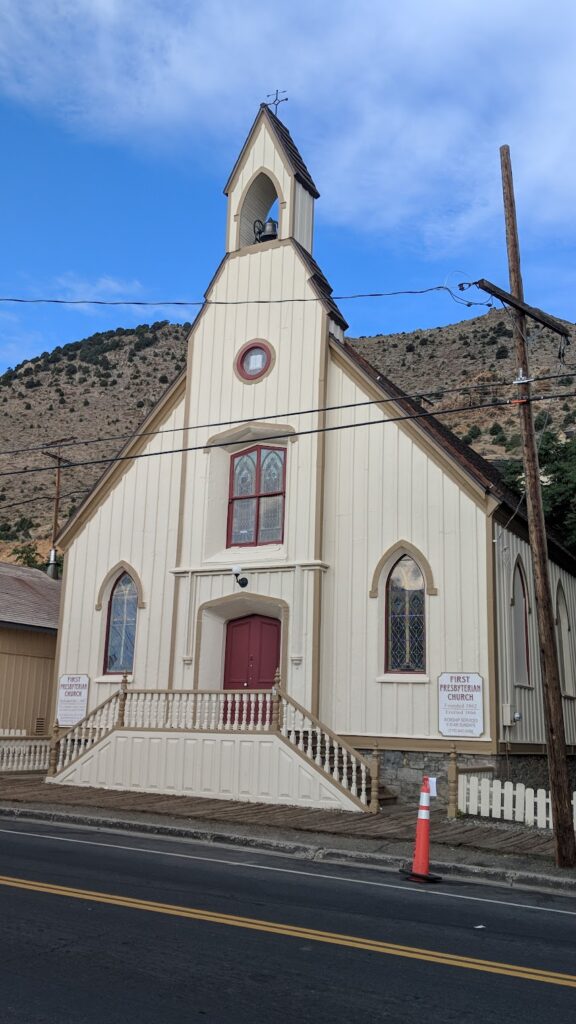
In 1913, the Reverend William Laughlin assumed the pastorate of the First Presbyterian Church of Virginia City, Nevada. His story was that while he attended seminary, he didn’t feel ready for the ministry and taught school. He also appeared to have done some lecturing on the Lyceum and Chautauqua circuits of the day. An editor from a newspaper in Elko, Nevada, praised him as a “polished lecturer full of Celtic fire” who “would soon become recognized as one of the most profound pulpit orators in the West.”[6]
But by 1913, when he accepted the call to the church in Virginia City, the heyday of the Comstock Lode was thirty years in the past. The town continued to lose population. Only a few mines kept digging. The mills which processed the ore, mostly reworked old tailings with better technology to capture the silver and gold missed by previous generations.

Laughlin was a firebrand. He started new programs at the church including a Boy Scout troop. This was only 3 years after the Boy Scouts of America was organized. His preaching excited people and excerpts from his humorous sermons often appeared in the newspaper. The church started again holding socials and events for the Sunday School. At a time when the city declined, things happened at the Presbyterian Church.
But then, the Rev. McCleery, Presbyterian pastor in Carson City, became suspicious. I’m not sure why. Maybe someone gave him a tip. He began to dig and found Laughlin had been in a Methodist minister in Franklinville, New York. After facing charges of immortality, he resigned and moved to Canada.
Laughlin later served Methodist Churches there, along with North Dakota and Idaho. In each place, across two countries, his past caught up with him, and he was exposed as an imposter. In Idaho, he abandoned his wife and kids and refused to support them, moving on. Kind of like Sonny in the movie The Apostle. In 1913, you didn’t have a social security number to help track people from one place to another. In June of 1915, to the shock of the congregation, Laughlin abruptly resigned. Then everyone learned the Presbytery were bringing charges against him. They found him guilty. He was defrocked.

Did Laughlin do some good things in his time in Virginia City? Yes. At least from the newspaper reports, it certainly sounds like he did. The same is true with Sonny in the movie, “The Apostle.” But both were morally flawed. That doesn’t mean that God can’t use them to achieve certain objectives, just as God used the Persian King Cyrus to allow the Israelites to return to Jerusalem after the Babylonian exile.[7]
What none of us know is whether either Laughlin or Sonny trusted in Jesus. Were their hearts ever cleansed by Jesus’ saving grace? Or were they just in it for their own benefit. While I would like to think they were in it for more than themselves, that’s between them and God.
This passage warns those who serve the church to make sure we do God’s work and not work for our own glory own. But there is also a message here for others within the community of believers. Do not be astonished by the powers some portray. The Bible never hides the idea that others may have miraculous powers, so we are not to be lured by their strange abilities. Think of the Egyptian magicians who matched the first of Moses tricks before Pharoah.[8] For the first several plagues, the magicians went go toe-to-toe with Moses, except that the snake Moses turned his staff into who ate the snake Pharoah’s magicians conjured up. Only after the first few plagues did the magicians give up and say, this is from the hands of God.
It’s easy for us to be astonished by others who seem to do great things, even those who collect great wealth, but we shouldn’t succumb to envy or covet their position in life. We are unable to know the condition of their hearts, nor can we know their relationship with God. We will all be judged by our hearts and our faithfulness, not our wealth or success. Beware of the wolves hiding in fleece or rotted trees. Instead, seek out those whose hearts are humble and whose lives are faithful. Amen.
[1] Frederick Dale Bruner, The Christbook: Matthew 1-12 (1990, Grand Rapids, MI, 1990), 355. Bruner takes this quote of Augustine from the Catena Aurea: A Commentary of the Four Gospels: Collected out of the Works of the Fathers by St. Thomas Aquinas (13th Century).
[2] Marcionites (2nd Century) saw God as only love and no judgment, Docetism (3rd Century) thought Jesus only “seemed to be” human.” Pelagius (early 4th Century) seems to have denied Original Sin.
[3] 1 John 2:18
[4] Deuteronomy 18:20-22 and Ezekiel 34
[5] Psalm 6:8. Jesus quotes from the Psalm from the Greek Septuagint text.
[6] My sources for Laughlin’s story come from a variety of newspapers and minutes of Session and the Presbytery of Nevada. I drew the story from my dissertation, “Presbyterians and Miners: The Church’s Response to the Comstock Lode), San Francisco Theological Seminary, 2002 (see pages 95-100).
[7] 2 Chronicles 36:22-23.
[8] The Egyptian magicians were able to turn a stick into a snake (Exodus 7:10-12), create dead fish in the Nile (Exodus 7::21-22), and bring forth frogs (Exodus 8:6-7). But they were unable to created gnats (8:19) and the boils Moses called down even fell on the magicians (Exodus 9:11).
It’s so hard to tell good from bad anymore. I trust in my gut more than usual, which, of course, relies heavily on God.
We are living in turbulent times. We need to be guided by principles and have strong moral compasses, which is what Jesus provides in the Sermon on the Mount.
Lovely work here, Rev. This is the message we need.
Thank you.
I love historical places <3
Of course, history in America is relative as nothing here is as old as in Europe!
I loved the historical deep dive into the Comstock Lode era and the defrocking of Laughlin. It really illustrates how long-standing this human struggle with ego and disguise actually is. A beautifully written, thought-provoking message!
Thanks, Matt. My insight into Laughlin came from the research for my dissertation.
I love the movie The Apostle and haven’t watched it in ages. I like to think that Sonny truly loved Jesus.
I think Sonny did love the Lord, but we have to acknowledge some of Jesus’ greatest disciples are also jerks.
You can never tell what is in a person’s heart, truly. Their motives might be bad all the while trying to look like they’re doing good deeds. I can understand that. I’ve never seen that movie but it sounds like a good one.
Not knowing people’s hearts is another reason to temper our judgmentalism.