
Jeff Garrison
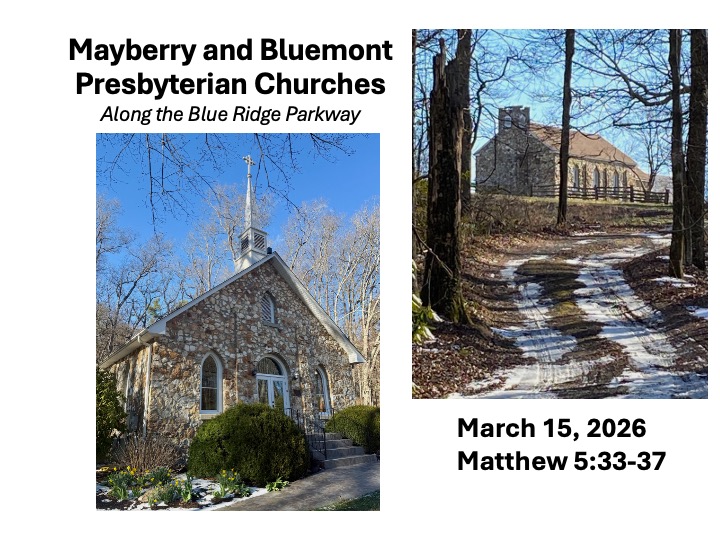
Mayberry & Bluemont Churches
March 15, 2026
Matthew 5:33-37
Before reading the scripture:
A few weeks ago, as we slipped into heart of Jesus’ Sermon on the Mount, I spoke about how Jesus takes a number of what we would call “Old Testament Commandments” and reinterprets them. I pointed out how scholars often refer to these six commands as antithesis, but that isn’t quite correct. Instead of offering an alternative, Jesus takes us deeper into the commandment’s meaning. I also spoke about how the six commands could be divided into two sets. The first three focusing more on our moral actions and the second three on our political or community actions.[1]
Today, we’re going to look at the first of the political or community commands. Unlike the others, here Jesus negates what had been taught in the Hebrew Scriptures of the Old Testament. We’re talking about making vows. Jesus says don’t. The Epistle of James says the same thing.
But we often make vows. We do it when we marry. We do it if we take a public office, or if we are called to testify in court, or join the military. I did it when ordained into ministry, as has all elders in our church. We even find those heroes of our faith in scripture, such as Paul, making a vow.[2]
In my study on this passage, I found myself torn. This is the most overlooked part of Jesus’ great sermon.[3] I had originally thought I would pair this passage with the next two passages about avoiding retribution and loving our enemies but began to feel it wouldn’t be fair to scripture. I knew I’d spend my time on the later and not on these four verses.
An example of this came from our men’s Bible Study on Wednesday. We look at the last three commands and spent almost all our time focusing on the last two commandments.
In my study, I learned that for the first three centuries of church history, Christians mostly took this passage literally. They avoided making vows. Then comes Constantine who provided the church with legal standing within the Roman Empire. After Constantine, Christians ignored this passage and began to make vows.[4] We came up with excuses and work arounds. But is that right?
However, there are some churches, even today, who discourage making an oath. Our Amish neighbors are one. Are they right?
The command against taking a vow concerns itself with politics. After all, such vows are often done for governmental reasons, whether it be in a court of law, or for marriage, or to serve within government. I’m not sure I have a clear-cut instructions for you today, but I encourage you to struggle with me about what Jesus’ command means and how we should apply it to our lives.
Finally, regardless of what you decide to do about making a vow, I can say this with confidence. God wants us to be truthful, to honor our commitments, and to put God first among our allegiances.
Read Matthew 5:33-37 and James 5:12
While I was driving to and from the Theology Matters conference[5] I attended last week, I listened to Gilbert King’s, Devil in the Grove: Thurgood Marshall, the Groveland Boys, and the Dawn of a New America. The book is about a supposedly rape of a young woman in Central Florida in 1949.[6] It was just after World War II, and returning African American soldiers were beginning to push back against segregation. They wanted a better life for themselves than working in near slave conditions in the citrus groves. Of course, that wouldn’t excuse such a crime. But there wasn’t any evidence produced that there had been a crime.
However, that didn’t stop four young black men from being charged. Three were arrested and the fourth killed while being apprehended. Sheriff Willis McCall and his deputies used torture to extract confessions from two of the suspects. The three were found guilty and two sentenced to death. Upon appeal, the Supreme Court ordered a new trial.
Before the new trial could began, Sheriff McCall transported two of the men back to the county jail from state prison. Supposedly, he had a flat tire while driving, not on the highway, but a back road. While working on the tire, he supposedly was attacked by the cuffed man under his care. He said he shot them in self-defense.
Only, one of the men didn’t die. The sheriff called the coroner who discovered him breathing. At this point, the FBI got involved. The second trial featured future Supreme Court Justice Thurgood Marshall on the defense side. There were many problems with the prosecution, including the outright lies of the Sheriff and Deputies. They also withheld evidence including a doctor’s report raising questions on whether a rape occurred and the contention the woman had been attacked.
While another all-white jury again convicted, the state of Florida eventually paroled and exonerated the defendants. Even the prosecutor in the case later had a change of heart and admitted his complicacy in the injustice carried out by the state.
While the book illustrates the problem of racism and shows how change comes slowly, it also demonstrates the need for honesty, especially in court proceedings. Our legal system is built upon those involved within telling the truth. When the truth is concealed, justice will be denied. This is why taking an oath is so important. In the Ten Commandments, we’re told not to misuse the Lord’s name.[7] This would involve swearing by God’s name that something is true. If it’s not true, we have misused God’s name.
Let me take off on a tangent for a bit. Personally, I have a moral problem with capital punishment. I know there are those who say Scripture allows for it. Yes, ancient Israel carried out such punishments. But those who want to use the Bible to support the death penalty never mentions one caveat. In the Old Testament, the crime for lying or falsifying evidence in court was so serious it carried the same sentence the accused party faced.[8]
Lying or falsifying evidence in court, according to Biblical standards, would mean the Sheriff, deputies, and prosecutor in the Groveland Boys trial could have been executed. Truth is required in court for a society to be fair.
But let’s go back to Jesus’ teachings. Here, Jesus suggests we not even make a vow at all. Why? I think Jesus wants to create a community of believers where one’s word is honest and doesn’t need other qualifications. Looking at the qualifications which Jesus cites in this passage (swearing by heaven, the earth, Jerusalem, or even one’s own head).
It appears people in Jesus’ day may have tried to get around the 3rd Commandment by making vows to things other than God. Jesus won’t have any of it. Don’t make a vow at all but let your word be honest.
Furthermore, as Jesus illustrates, all these other things people used to make a vow upon link back to God. Heaven contains God’s throne. The earth, as Isaiah also reminds us, is God’s footstool.[9] In Jerusalem resides God’s king. And God, as Creator and Lord, has a claim even over us as individuals, as we’re humorously reminded that we cannot change the color of our hair. Of course, this was before hair could be dyed, but you get the point. As the Psalmist says, “The earth is the Lord’s and all who live in it.”[10]
So instead of making a vow, Jesus suggests we just be honest. Of course, if everyone remained honest, there would be no need for a vow as an assurance of our truthfulness. The book of James reiterates Jesus’ teachings on this point. Truthfulness should be a hallmark of a believer. If people can’t believe our word, we have a problem.
So, should you make a vow or take an oath? I will leave such decision with you. It was allowed in the Old Testament, but Jesus discourages it. As for me, I confess to having more problems with it than I had before this week. But I do know this. God’s will for us is to be truthful in our words and faithful in our commitments.[11]And, our allegiance belongs to God before anything here on earth. Whatever you do about making a vow, be truthful and faithful. Amen.
[1] See https://fromarockyhillside.com/2026/02/22/murder-and-anger/
[2] Acts 18:18. The Book of Numbers in the Old Testament goes into great detail about making vows. Especially see chapters 6, 15, and 21.
[3] As an example, this passage is never singled out within the Revised Common Lectionary but paired with the verses before it and it appears only once every three years.
[4] Frederick Dale Bruner, The Christbook, Matthew 1-12 (1990, Grand Rapids, MI: Eerdmans, 2004), 234ff. Bruner not only outlines the history behind the church’s interpretation of this text, but also admits his personal views changed between his first commentary on Matthew and his updated edition.
[5] https://www.theologymatters.com/2026-conference/
[6] Gilbert King’s, Devil in the Grove, Thurgood Marshall, the Groveland Boys, and the Dawn of a New America (2012, Audible 2013).
[7] Exodus 20:7.
[8] Deuteronomy 19:17-19.
[9] Isaiah 66:1.
[10] Psalm 24:1
[11] Douglas R. A. Hare, Matthew: Interpretation, a Commentary for Teaching and Preaching (Louisville, KY: JKP, 1993), 54.
An interesting consideration of vows, Jeff. I’ve always thought of them as more serious promises–commitments that are bigger than the personal and extend to others. After reading your post, I realized I’d only made one vow in my life–when I married. Thanks for the thought-provoking post.
Thanks for reading. I’m going through a tough part of the Sermon of the Mount right now. I think there’s a reason this passage is often overlooked, as we don’t know how to handle it. But the overall meaning is that our word needs to be true and our supreme allegiance is to be to God.
Very interesting, Jeff. Somehow the significance of these Bible verses escaped me in the past, although I know I’ve read and heard them. I have rarely taken vows, only in situations like getting married or becoming an American citizen. I was taught by my father to be very careful about making vows, and if I did so, I must honor it. A vow could not be broken. Could this be a “render unto Caesar…” situation when doing civic duties? Some vows are required of us by law? Lots to think about!
Good question about this being a “Give to Caesar what is Caesar’s.”
You are a pleasure to read, Jeff. Your introspective sermon translates well to the written form. Hope you’re doing well on The Rocky Hillside!
Thanks, Lisa. All is well here!
Happy St Patrick’s Day.
I hope you had a great St. Paddy’s Day, Mary.
You bring up so many things to think about in this message, Jeff.
That’s always a hope, to have people thinking and wanting more.