
Jeff Garrison
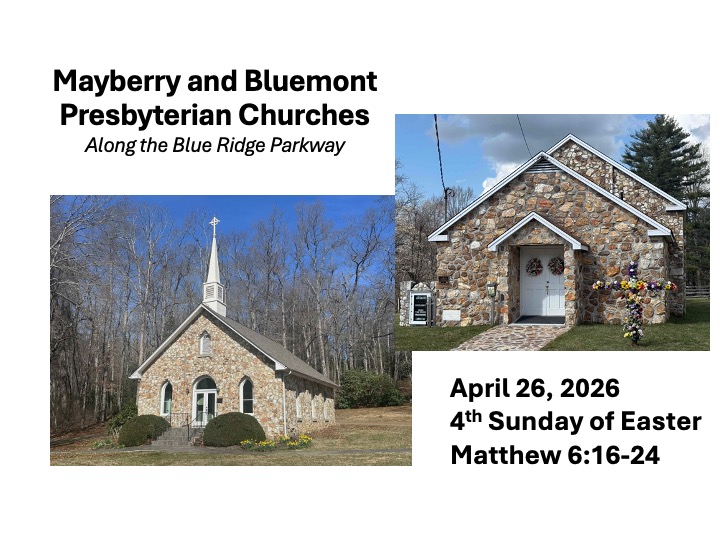
Mayberry and Bluemont Churches
April 26, 2026
Matthew 6:16-24
At the beginning of worship:

When hiking the Appalachian Trail through Pennsylvania, I stopped late one day at a lovely campsite. Thinking I’d spend the evening by myself. Fixing dinner, as the light faded, a family of four trudged in. Dead tired—they set out that morning to hike ten or so miles and had only covered half that distance. The man asked if I would mind if they shared the campsite, as there was a spring for water nearby and plenty of room. “Not a problem,” I said, even though I wasn’t overly excited.
Continuing with dinner, I glanced over amusingly at the family. The scene could easily have been out of National Lampoon Vacation movie, if they made a backpacking version. The father even resembled Chevy Chase.
New at backpacking, they had not tried out their brand-new gear. Some of their gear remained in the original packaging. The family appeared to have stepped out of an L.L. Bean catalog. With my dirty and torn clothes and well used equipment, I looked a bit like a hobo. After a comedy of errors, they finally pitched their tent. Then came dinner.
The dad became frustrated trying to use the stove. Finally, he came over and asked for my help. He had the same stove as mine, an MSR multi-fuel stove. This was preferred by long distance backpackers because it could burn regular gasoline. In 1987, I could top my fuel bottle up at a gas station for 25 cents-it’d be a dollar today. While a good stove, it wasn’t the type of stove most folks used on weekend trips.
Next, he had the top of the line cook set that all nestled together and included a windscreen for the stove. Knowing this, he left behind the windscreen which came with his stove. But there was a problem. The cook set was designed for a different type of stove. They didn’t go together. No matter how hard he tried, it wasn’t going to work. I showed him how to set up some rocks upon which he could make a windscreen as he cooked. Soon, he was heating up dinner.
After they’d finished eating, his wife put their kids to bed, he came back over to talked. He was a physician. He’d hiked a few times with the Boy Scouts and now thought he’d like to get his family into it. He went to a backpacking store. I’m sure the guy selling gear had a nice dinner later that evening on the commission he earned. Everything this family had with them, and they had way more than they needed, was first class (even if some of it wasn’t designed to work with other pieces of gear). And the sheer volume of their gear was overwhelming. He confided in me that they were probably going to hike back to their car in the morning instead of continuing down the trail, for there was no way they’d make the distance planned.
Talking with this guy, I realized a couple of things. In the woods, it didn’t matter he had the money to buy fancy gear. It didn’t do him any good. Backpacking is a great equalizer. When you have too many treasures, it weighs you down. This guy carried a pack weighing nearly eighty pounds, and his wife had another fifty. Each of their kids had a small knapsack. All this stuff was killing them. My pack weight was more like his wife’s and that was only when I was fully loaded with ten days of food, a liter of fuel, and two quarts of water. Thinking about this, I felt a tinge of pride.
Then I realized that I, too, was storing up treasures. These were in the form of memories and bragging rights. Idolatry is a sneaking temptation. I wanted to be able to say I hiked the whole trail and at this time had made it halfway to Maine, a goal which became an obsession.
Ultimately, however, whatever we do, God must come first. As we’ll see this morning, it’s not about what you or I can do. It’s about what God can do through us.
Before reading the Scripture:
We’re continuing in Jesus’ Sermon on the Mount. Two weeks ago, we looked at what Jesus taught about almsgiving and prayer. Through out of this central part of Jesus’ sermon, he uses a similar style. He states a well-known practice or discipline, such as almsgiving, prayer, and fasting, Then, he explores how it can be abused. Finally, Jesus ends by encouraging how we might practice such disciplines by having our priorities right and drawing us closer to God.[1] Understand this. Jesus criticizes any attempt to use religion for earthly gain! Let’s hear what he has to say.
Read Matthew 6:16-24
For most Protestant Christians, fasting went out of style centuries ago. We might give up something for Lent, an idea we borrowed from the Roman Catholics, but it never really caught on. There used to be calls for fasting during times of trouble, but that seems to have waned.
Note that Jesus doesn’t condemn fasting.[2] He just wants us to do it for the right reasons. If we fast, it should be to draw us closer to God, not to gain the praise of admirers. When we start using religion for personal gain, we’ve fallen into temptation, as Jesus repeatedly shows.
Next, Jesus moves to the dangers of treasures. He knew “stuff” wouldn’t satisfy us like a relationship with God. When it comes to stuff, be it money, the junk we collect, or our accomplishments, it’s never enough. We will always want more. Last season’s hero soon becomes a has-been.[3] Supposedly, John D. Rockefeller was asked how much more money he wanted. “Just a little more,” he said. If we try to satisfy our appetites with treasures, our stomachs will always feel empty.
This passage encourages us to look deeply behind our motives and to get our priorities right. Jesus provides three connected proverbial thoughts for us to see where we place their trust.
First, we’re not to trust worldly treasures for they have a way of disappearing. A fine wardrobe can be destroyed by nature (moths). Time takes care of objects crafted out of metal as they succumb to rust. And what’s to stop someone from stealing our stuff when we’re not looking?
Notice, however, Jesus doesn’t say having nice things is bad. He just says we can’t trust them to always be there and that the problem with such niceties is that when we place too much trust in them, we risk not trusting God. Ultimately, our treasures fail us.
The second proverbial thought is about a “healthy eye.” No, Jesus isn’t making a pitch for eye surgery. Jesus’ listeners would have known right away what he was talking about when he mentioned an unhealthy or evil eye. They understood an evil eye as an envious, grudging or miserly spirit. A good eye connotes a generous and compassionate attitude toward life.
One of my professors, in his commentary on Matthew, said it’s as if Jesus’ says: “Just as a blind person’s life is darkened because of an eye malfunction, so the miser’s life is darkened by his failure to deal generously with others.”[4] Generosity brings light into the world; greed darkens it.
The next statement by Jesus concerns serving two masters. A slave would run ragged if he had to answer to two masters. Likewise, if we try to serve both God and money, we find ourselves with two masters and the latter, money, makes a harsh master. There can never be enough. We need to place our priorities in order. We need to stick with God.
But then again, as I said, Jesus never says that treasures in and of themselves are wrong. He never says our desire to have treasure is wrong. We’re not Buddhists trying to remove desire in search of enlightenment.[5] Instead, Jesus knows we have desires. So, he encourages us to put our desires into the right channels. “Store your treasures in heaven.”
It sounds too simple. “Store up your treasures in heaven; don’t worry about things here on earth.” Easier said than done, right? We all worry about having enough for tomorrow—and the day and the year and the decade that follows. We must admit that our prayers for daily bread seem unnecessary when we have a pantry full of food. When we have too much, it’s hard to depend upon God.
But Jesus wants us to trust in God, which is why we’re to store treasures in heaven. On earth, we’re to be about doing the Father’s work. And when we do what God calls us to do, we store our treasures in heaven. But when we forget about what God wants us to do and focus only on our wants and desires, we lose our way.
How might we learn not to store up our treasures here on earth? First, “Enjoy things, but don’t cherish them.” God created this world good and wants us to enjoy life and the blessings provided, but God gets angry when we see such blessings as being ours. Then we easily serve or worship such stuff. We are given this world as a steward and one day we must give it all back.
Second, “Share things joyfully, not reluctantly.” If it bugs you to share something you have with someone who needs it, you should then know that item has gotten a hold on you. It’s an earthly treasure, an idol.
Finally, think of yourself as a pilgrim, not a settler. “The world is not my home, I’m just passin’ thru,” the old gospel song goes.[6]Store your treasures at your destination, then your journey will then be easier.
Look inside yourself and use these thoughts to evaluate what you have: Enjoy, Share, and think like a pilgrim. A pilgrim is like a backpacker. Remember, you don’t want your pack weighing you down and keeping you from enjoying the view along the way. Amen.
[1] Jonathan T. Pennington, The Sermon on the Mount and Human Flourishing: A Theological Commentary (Grand Rapids, MI: Baker Academic, 2017), 230, 232.
[2] This is the only place where Jesus addresses fasting. Later in Matthew’s gospel (9:14) as well as Mark 2:18 and Luke 5:33, John’s disciples questioned why Jesus’ disciples don’t fast. There was some fasting in the early church. See Acts 13:2-3, 14:23.
[3] Frederick Dale Bruner, The Christbook: Matthew 1-12 (1990, Grand Rapids: Eerdmans, 2004),, 320.
[4] Douglas R. A. Hare, Matthew: Interpretation: A Biblical Commentary for Teaching and Preaching (Louisville, KY: JKP, 1993), 72.
[5] Bruner, 321.
[6] Kirk Nowery, The Stewardship of Life (Camarillo, CA: Spire Resources, 2004), 122-123.
This is a fantastic lesson. I love the image of that family trudging through the woods with 80-pound packs—it’s such a perfect metaphor for how we live our lives ‘fully loaded’ with things we don’t actually need. Your point about being a ‘pilgrim, not a settler’ really resonated with me. It’s a good reminder to lighten the load and focus on the destination rather than the gear. Thanks for the perspective!
My back aches thinking about an 80 pound pack! Hopefully it’s a story some can related to.
I bet that was a really good lesson for the backpacking doctor and his family. I would probably not buy as much extra stuff if I were to get stuff to go backpacking and hiking because we did a lot of that plus camping when I was a kid and I had to carry my own backpack.
I hope they learned a few things and tried to hike again.
I did a lot of reading about the Appalachian Trail for a while. You’re so right–the fancy equipment doesn’t seem to be what makes it work. It’s what’s inside.
Of course you hiked that trail!
Yeah, the AT is one of my few accomplishments:-)
Just occurred to me that in our cultural folklore, we misuse the word “pilgrim” to describe early New England white “settlers.”
Actually, most of the New England settlers were Puritan and not “Pilgrims”. We do see to see this word through those weird hats and the Mayflower.
Amazing what great lessons you shared in the backpacking story… about the family AND yourself. Pride has many a guise.
It’s easy to only judge others and not ourselves, but we also need to see our own shortcomings.
An interesting approach, Jeff! I like the camping bookends. I was never much of a hiker-camper. I like cabin camping. 😂 All my stuff is almost killing me. I’m getting rid of as much as I can ~ Swedish Death Cleaning. So true, “We are given this world as a steward and one day we must give it all back.” I don’t want to leave behind a big pile of my mess for someone to deal with. “The Sermon on the Mount” is one of my top favorite passages in the New Testament. I find it so beautiful and inspiring. Enjoy your week, my friend!
I know that soon I will have to do some “reducing” to get rid of books!