
Jeff Garrison
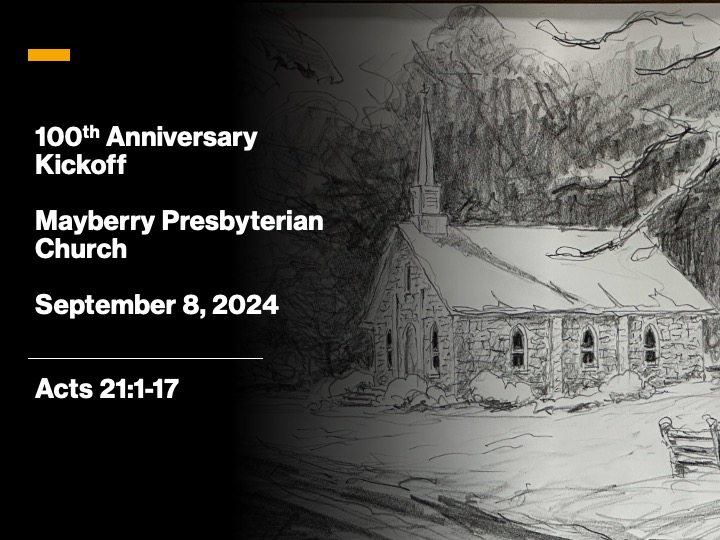
Mayberry Presbyterian Church Anniversary Service
Acts 21:1-17
September 8, 2024
At the beginning of worship:
100 years is a long time. It was the roaring twenties. I’m sure it didn’t feel that way here along the Blue Ridge. The boom the area felt with the building of the dams along the Dan River and the Blue Ridge Parkway were still a decade away. The chestnut trees were dying, a blight which wiped out roughly 20% of the trees of the forest. The loss of chestnuts was a disaster. The nuts fed hogs and were collected as a cash crop so those living in New York City could enjoy “chestnuts roasting on an open fire.”
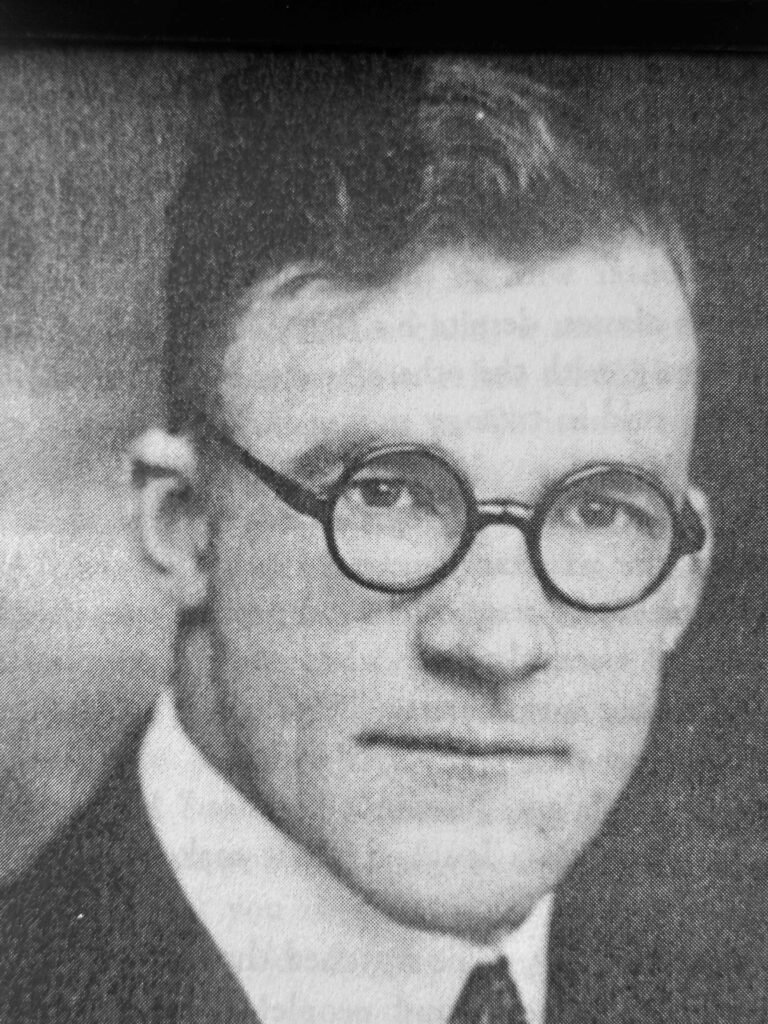
100 years ago, it might not have been the best time to start a church in Mayberry. But there were those with a vision. The brush arbor, which I spoke of in my sermon last week,[1] had been used for revivals in this area since the Second Great Awakening at the beginning of the 19th Century. The Reverend Roy Smith held such services and brought along a promising ministerial student named Bob Childress. They organized a Sunday School. Then they organized a church. And twice a month, as a seminary student, Bob drove his Model T from Union Seminary in Richmond to Mayberry.[2] Just thinking about that journey makes my back ache.
But here we are today, celebrating, and giving thanks for those who came before us.
Before reading of scripture:
I’m not going to preach from Mark this week but will return to the gospel next week. Instead, let’s look at a passage from the Acts of the Apostles.
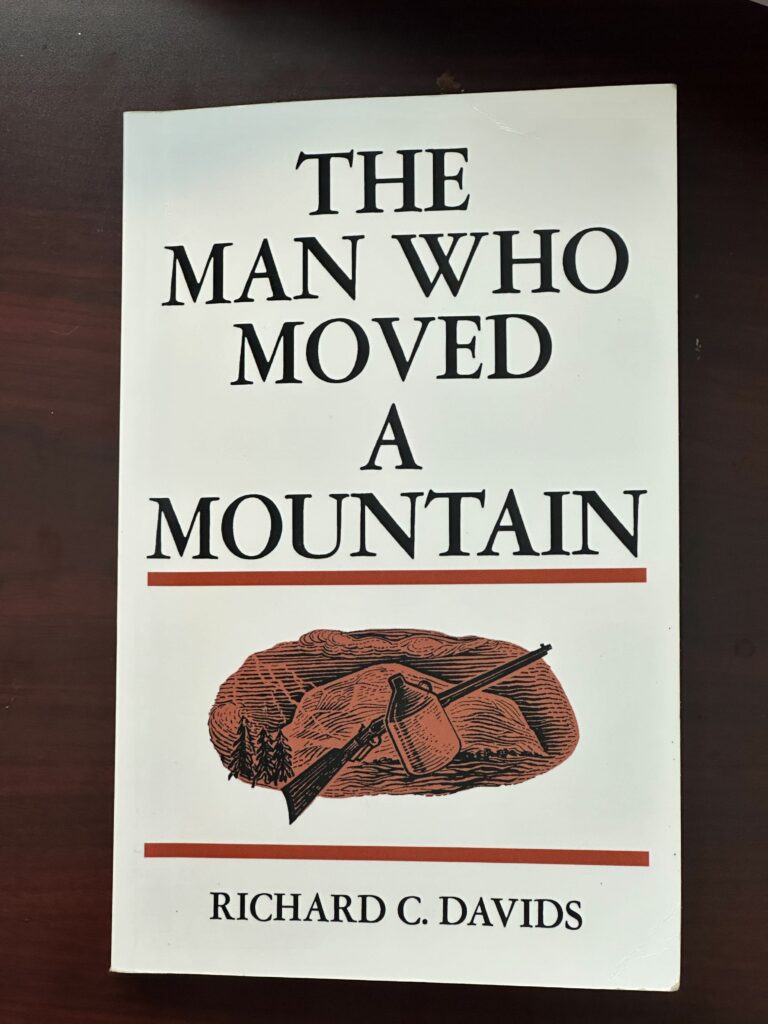
The second half of Acts is often overlooked. The lectionary skips almost all of it, but there are memorable stories in this section, as memorable as those about Bob Childress in The Man Who Moved a Mountain. The last third of Acts is about Paul and his journeys, including his last one to Rome.
Today, the text takes us on a long journey, from modern day Turkey to the Phoenicia shores. Luke, who in addition to writing the gospel, also wrote Acts, provides unique details. He even mentions unloading the cargo of the ship. When Paul last traveled to Jerusalem, his journey from Ephesus to Jerusalem took just two sentences.[3] Here, Luke slows down and provides detail. He shows Paul’s determination to go to Jerusalem despite the danger.
As Paul travels, he stays with believers along the way which provide us with an insight into first century hospitality and what it means to be on a Christian journey. Such hospitality was still around in 1924, when Bob Childress made that drive from Richmond and stayed with Abe Webb, who’d wait up for him and had heated bricks and irons to toss into his bed so he might warm up from the cold trip as he slept.[4]
Read Acts 21:1-17
It seems like a long time ago. It was before COVID. In 2018. I attended the General Assembly of the Presbyterian Church in St. Louis. Afterwards, I rented a car and drove to Iowa City, to attend a session on writing humor at the Iowa Summer Writing Festival. Coming back to St. Louis, to turn in the rental car and catch a flight home, I had an extra day. This allowed me the luxury of taking the backroads, catching up with a friend, and checking out sights.
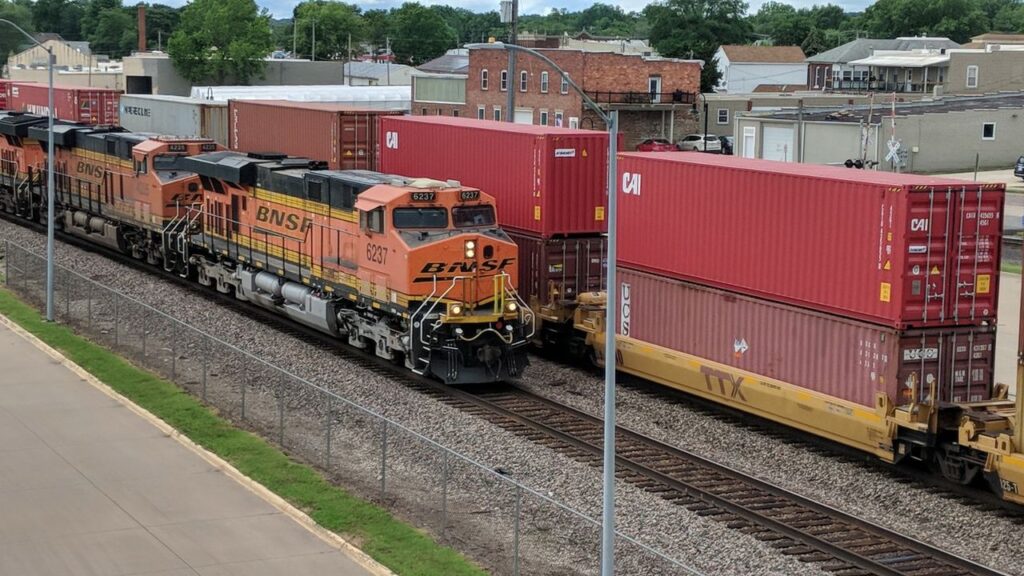
My plan was to cross over the Mississippi, from Iowa to Illinois, at Fort Madison. A major rail town, it’s where the old the Santa Fe line, from Chicago to Los Angeles, crosses the river. Knowing I would see plenty of trains along with barges on the Mississippi, I stopped at the old Santa Fe depot, which is now a local museum. There, I talked to an old railroad passing time watching trains. Before retirement, he worked for the Santa Fe and knew something about the railroad.
As I arrived, trains stopped. The bridge opened, so they had to wait. A large set of barges came out under the bridge. When the bridge closed, the trains began to move. But then they stopped again. And there was a large container train made its way through the other trains, just booking it. The retired railroad guy identified the fast train as a land-bridge express. This train hauls containers from Las Angeles to ports on the East Coast. There, the containers are reloaded onto ships for Europe. These containers don’t go through customs and are sealed for the entire journey. Who knew!
One of my metaphors for the Christian journey I have used before is of a train on a transcontinental journey. Every ten hours or so, the train stops, and one crew gets off while another takes over. Each crew has their own run and responsibility. The guy at the throttle, who waved to us before he crossed the Mississippi, never saw the train being formed by the Pacific nor watched its containers loaded onto a ship on the Atlantic. His job was to move the train safely from point A, probably somewhere in Iowa, to point B in Illinois or Indiana. The engineer trusts that other engineers will see the train to its destination.
When it comes to the church, our task is to faithfully move the church a little further down the line. The church, as well as us as individuals, are on a journey. We are thankful and indebted to those in the past who help bring the church up to the present. And we must trust God to supply others to lead the church after we’re gone and have been promoted to the church triumphant.
Journey has always been a popular theme within Christianity. From the early days, there were those who went on pilgrimages. These were journeys designed to draw people into a closer relationship with God. According to Dante, pilgrimages required “the challenge of distance and a sense of being a stranger in a strange land.”[5]
While pilgrimages fell out of favor with the early Protestant movement, the Puritan John Bunyan brought it back, at least metaphorically.
Bunyan describes our entire lives as a pilgrimage. Pilgrim’s Progress is his allegorical tale. His protagonist, Christian (what a convenient name), dreams of a journey from this world to the next. Christian lived in the City of Destruction, but his journey takes him to the Celestial City on Mount Zion. Bunyan reminds us that our ultimate citizenship isn’t to this world, but to God’s kingdom. Like Dante said, we’re strangers to this world. In this fashion, we’re all pilgrims.
Paul, in our passage this morning, has the same sort of feelings. He makes the journey because the Spirit compiles him, even though others warn him of danger. As he makes his way from Asia-minor to Jerusalem, Paul’s encounters echo many things Luke has already told us in his gospel and in the Acts of the Apostles.[6]
In Caesarea, Paul stays with Philip, the evangelist, and one of the seven original deacons called to the task early in the book of Acts. As a deacon, Philip assignment included the task of seeing that the needs of all the members of the Way, especially the vulnerable such as widows, are fed and cared for. [7]
Interestingly, one of the other original deacons was Stephen. It was at Stephen’s stoning that we first hear of Saul, later known to us as Paul.[8] He was on the other side at this point, ready to persecute those who followed Jesus. Paul, who watched with approval the killing of Philip’s co-worker, has now become friends with Philip. Following Jesus should do this, bring together those who were enemies.
Philip has four daughters, all prophets, which reminds us of Peter’s sermon on Pentecost when he quotes Joel about sons and daughters prophesying.[9] When Paul first set out for Damascus, his mission was to bind up the Christians in Syria and lead them back to Jerusalem for trial.[10] Now Agabus, another prophet, shows Paul how this will be reversed as Paul is bound and taken away.
Furthermore, the warnings Paul receives are akin to the warnings Jesus gives the disciples about going to Jerusalem.[11] For Paul, like Jesus, as we’ve been seen lately in my sermons on Mark, Jerusalem is a dangerous place.[12]
Despite the warnings, Paul feels complied by God’s Spirit to go to Jerusalem, just as Jesus felt complied to go there. It doesn’t seem as if Paul fully knows fully what’s ahead. He doesn’t die in Jerusalem, but he was prepared to die. However, Paul’s ministry takes a significant twist in Jerusalem, as he is taken from there, as a prisoner, to Rome.
I’ve heard it said that when Christians are willing to die for the gospel, the gospel can’t be stopped. Paul knows he’s involved with a movement larger than himself. Even Bob Childress, who faced down drunks with guns, experienced danger.[13] But Bob and Paul knew their first loyalty is to Jesus Christ and to go where Jesus wants them to go.
There are three highlights from this passage I’d like to offer. First, Paul enjoys the fellowship of believers wherever he goes. When Paul enters a town, the first thing he does is to seek out Christians and he delights in their company. And today, this congregation still enjoys being in fellowship with each other. (I should cut this sermon a bit so we can get to the waiting food).
Second, they pray together. When Paul departs Tyre, everyone got on their knees on the beach. In the sharing of hospitality and prayer, both parties are blessed through what they give and receive. The Christian life is of both giving and receiving, of blessings and being a blessing.
The Childress family had such a blessing from prayer one of the years when Bob was in seminary. They were out of funds. It was going to be a bleak Christmas, but a physician in Danville, who had heard Bob preach, felt compelled to send him $300, a lot of money in the mid-1920s. It turned out to be a good Christmas with presents and food.[14]
The third thing: Paul knows imprisonment and perhaps death lies ahead. But he does not fear it. Paul no longer sees himself as a free man. Paul accepts his role as a prisoner of God’s Spirit. He’s a slave to Christ. Even though there are storm clouds ahead, Paul continues because he knows he’s doing what God wills. In the same way, Bob Childress forged ahead at Mayberry because he knew he was doing God’s work.
You know, everyone has troubles. When we feel we are a part of God’s team, we can endure the pain because we know we are not alone. Our purpose is larger than ourselves. It’s no longer about Paul. It’s about what God will do.
These three highlights we can take from Paul’s journey: fellowship, prayer, and focusing on something larger than ourselves. There’s joy from fellowship with other believers. When we pray together, we connect with our Heavenly Father and one another. And finally, we realize our efforts are just a small part of what’s God’s Spirit is doing in the world. We must be faithful and trust God’s Spirit to take care of the rest.
Remember that train rushing from one coast to another. We have our own section of rail for which we’re responsible. As the old gospel song goes, “We must keep our hand upon the throttle and our eyes upon the rail.”[15] It’s not about us, it’s about God’s mission. Amen.
[1] https://fromarockyhillside.com/2024/09/01/the-transfiguration/
[2] Richard C. Davids, The Man Who Moved a Mountain, (Philadelphia: Fortress Press, 1972), 71.
[3] Acts 18:21-22, Beverly Roberts Gaventa, Acts (Nashville: Abingdon, 2003), 291.
[4] Davids, 69-70.
[5] Lisa Deam, 3000 Miles to Jesus: Pilgrimage as a Way of Life for Spiritual Seekers (Minneapolis: Broadleaf Books, 2021), 11.
[6] Gaventa, 292.
[7] Acts 6:1-6.
[8] Acts 7:58.
[9] Acts 2:17, Joel 2:28.
[10] Acts 9:2.
[11] Luke 9:22, 44
[12] In Mark 8:31, Jesus tells the disciples for the first of three times of his upcoming death. See https://fromarockyhillside.com/2024/08/25/who-do-you-say-that-i-am/
[13] Davids, 65.
[14] Davids, 72-73.
[15] Charles Tillman, “Life is Like a Mountain Railway.”





 There was an elderly woman who came home from a Bible study one evening and discovered a burglar in her home. In the darken house, she yelled at the intruder, “Stop, Acts 2:38.” The thief turned and she yelled again, “Stop, Acts 2:38.” He froze. He raised his hands as she calmly called the police. After the officer had handcuffed the man, he asked why he’d surrendered to a woman shouting out a Bible verse. “A Bible verse? I thought she had an axe and two 38s”.
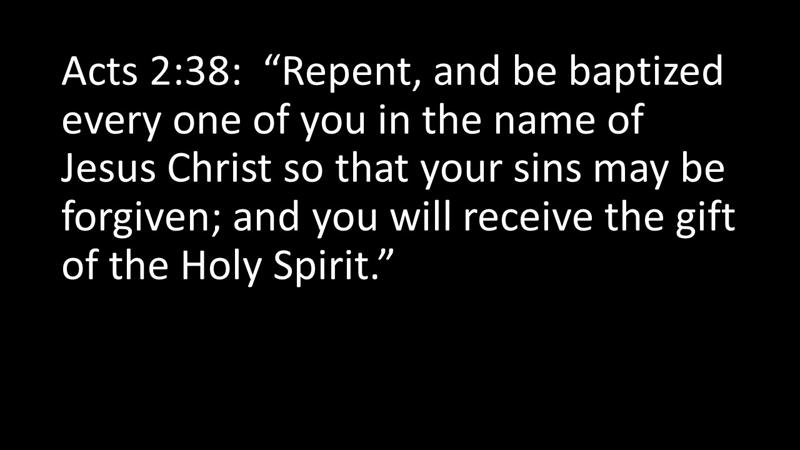 Peter, after his great sermon, that follows the account we’ve just read, called on those within his hearing to “Repent, be baptized, every one of you in the name of Jesus Christ so that your sins may be forgiven and you will receive the power of the Holy Spirit.” Acts 2:38.
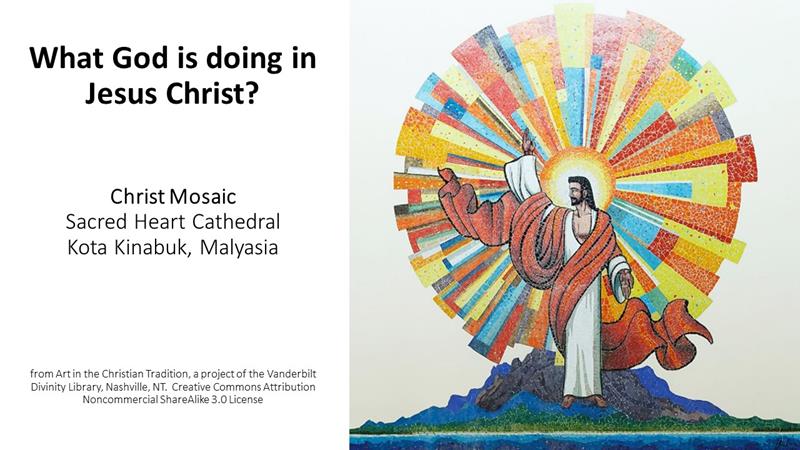 oo often, we think we need force to back up our words, or as in the joke, the possibility of force. But Scripture constantly reminds us our hope is not in what we do or what we have, but in what God has done and is doing in Jesus Christ. We see this with Pentecost, when those flames of the Spirit poured out on a motley group. God takes the initiative. Without God, our efforts are in vain.
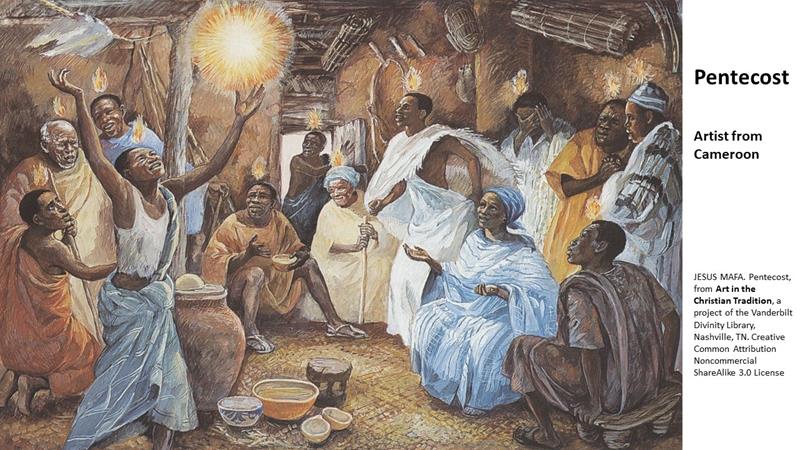 These men and women are not the type of people you’d think could change the world. They’re marginalized. And, to be honest, they don’t change the world. That’s part of the point of the story. God’s the primary actor. Without God’s intervention, nothing would have happened. And the same is true in our lives. God can use us; we don’t have to be sophisticated or multi-talented. The disciples were not great leaders or thinkers, government officials or military heroes. What God needs are people who are faithful. These believers displayed their faithfulness. Many of them were faithful even unto death. With God, all things are possible.
 The final aspect of Pentecost for us to consider is how this event serves as a model for God’s intention for the world. Consider the group who’d gathered on this morning. They were all Palestinian Jews. First century Judaism was more multi-cultural than they were. They gather, a homogeneous lot, without an idea as to what will happen. Soon a violent wind destroys the morning calm. Luke describes the coming of the Spirit as a gale blowing into the house. Picture the curtains blowing, as they used to do in the days before air conditioning when a storm was rising. It was frightening. “What’s happening,” they wonder? Luke goes on to say that the wind was like tongues of fire; like a wildfire that gains momentum consuming all that’s around. And those who had gathered begin to speak, in all different kinds of languages.
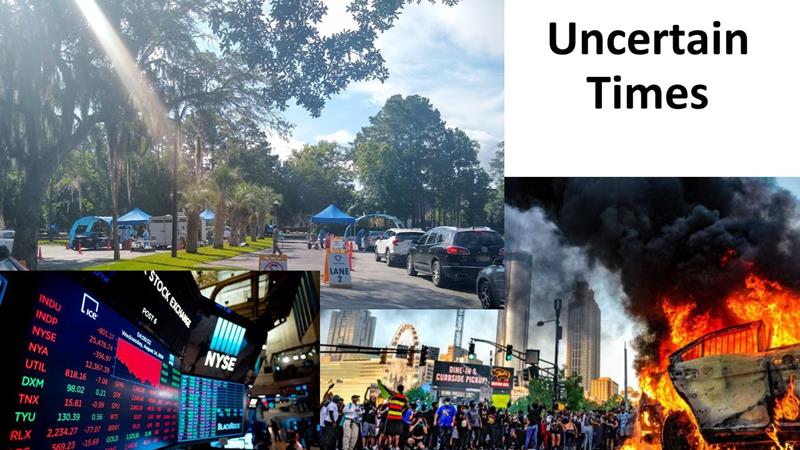 Friends, we live in an uncertain time. We must place our faith in God as revealed in Jesus Christ, and live humbly and compassionately, showing the world a different way to live with one another. Violence isn’t the answer. Love is. God loves this world and calls on his church to love the world. When we marginalize others, when we turn our heads at injustice, we fail to live up to our calling.
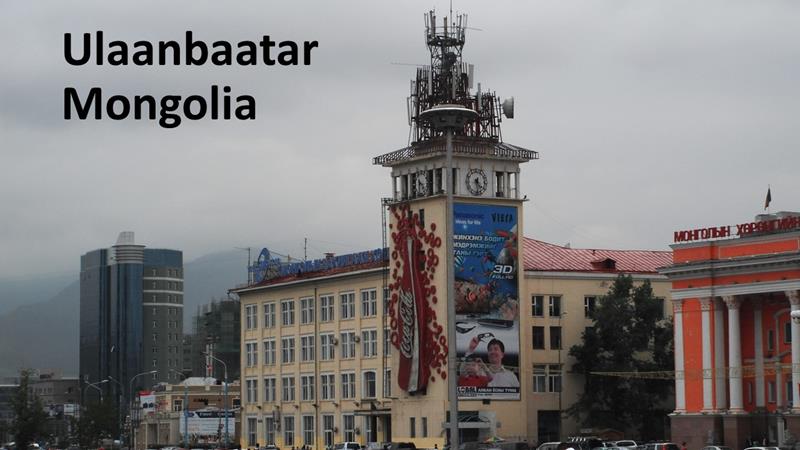 Let me tell you a story. I was in Ulaanbaatar, the capital of Mongolia and was walking with other tourists in the business section of the city. Across a four-lane road, coming toward us, was a man and woman. They were arguing. Then the man pulled back and hit the woman with his fist to her head, knocking her down. In shock, we looked at each other. Others had seen it, too, but no one except us-a group of English-speaking tourist-seemed fazed. We were outraged, yet never felt so helpless. If it had been an English-speaking country, we’d all been on the phone with the police. But here, few knew English and we couldn’t speak Mongolian. We needed those tongues of fire!
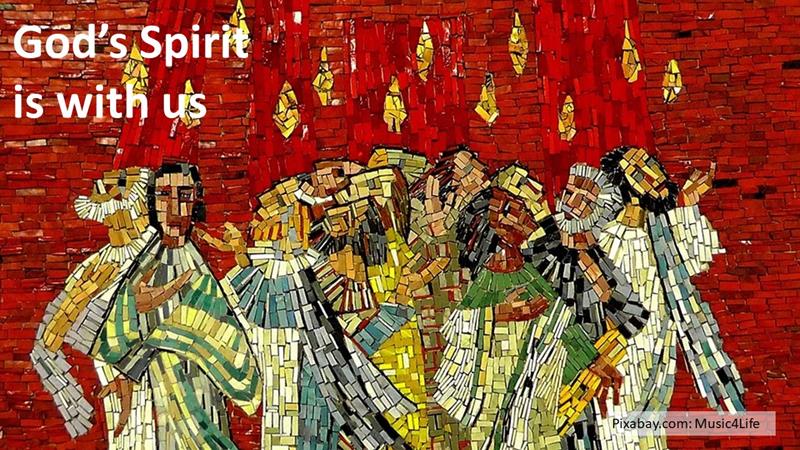 Pentecost shows us that not only does God show up, God gives us the tools needed to do the work for which we’re called. That motley group of disciples are able to preach in the languages of those gathered in Jerusalem. Today, we no longer have to wait for God to show up. God’s Spirit’s with us. Unlike Mongolia, in our country, in our neighborhood, most people understand us. We have no excuse. We must be compassionate toward those suffering from COVID-19. We should grieve the deaths of over 100,000 of our citizens, we need to do our part to keep the virus from spreading further, and we need to speak out against racial injustice. At Pentecost, God gave us a vision of the nations and people being brought together. It’s now our turn. We must help make the vision a reality. Amen.
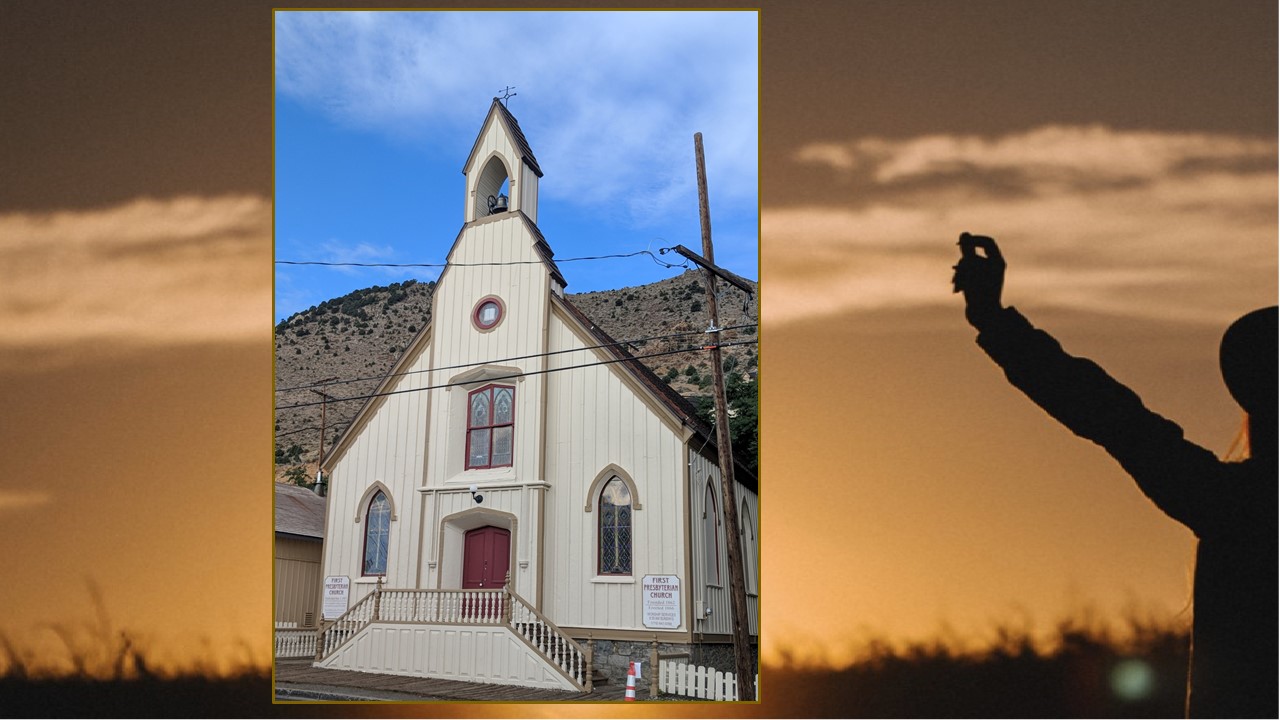 I will always be indebted to the congregation in Virginia City, Nevada, a place where I first experienced ministry on my own as a student pastor for a year. The church on the Comstock, at least in the modern era, has always been small. But there was something about the fellowship of that group that made it an attractive place for all kinds of people. The people in the church worked hard together, keeping the church going, which was quite a task in a wooden building built in 1866. But they also worked hard to help one another. And they tried to help others, sending clothes to an orphanage in Mexico and collecting food for a pantry in Carson City.
 The congregation Luke describes here near the beginning of the book of Acts wasn’t spectacular. It wouldn’t be considered particularly successful according to modern business practices. The fellowship didn’t include the leading folks of Jerusalem. Everyone was poor and marginalized. They didn’t have any glitzy advertising or even a fancy sign out front. After all, they tried to blend in and not stand out because there were those didn’t appreciate their message. But, despite all this, there was something magnetic about this community. They were generous and gracious. They were willing to help each other and to forgive others for the wrongs they’ve done because they’d experienced forgiveness in Jesus Christ. It was this magnetic appeal that drew folks to the church. Why else would someone risk persecutions and isolation by becoming a Christian?
 I recently read an article on why we need to make a weekly commitment to attend church. I’ll post this article I my next e-news. It was written by a young widow who describes the church as “the sweetest fellowship this side of heaven.” Her husband died suddenly one night after having been taken to the hospital by an ambulance for shortness of breath. She was left with seven kids. Before leaving the hospital, she called a friend from church. By the time she was home, the friend was there to sit with her. Others came in to grieve, to bring meals, to help clean the house, fix broken appliances and cars, and to minister to and pray for her and her children. The church is not always perfect, she notes. At times, the church can be even cruel. But when we live up to our calling to reflect Jesus’ face to the world, we demonstrate what was described in our passage today. The church can be the sweetest fellowship this side of heaven.
 Friends, today we receive our estimate of giving offerings for 2020, which is a sign of one half of that last question—how generous we are. We are encouraged to grow in generosity. As Vic Bell suggested last week, we’re to take a step toward being more generous, as we strive to become the church described in Acts. I pray that you will be generous and continue to take steps in this direction. But just as important as generosity is, don’t forget to be graciousness. On your walk with Christ, show grace to one another, just as God has been gracious with us. Realize what God has done and commit yourselves to do what? Say it after me… To be more being generous and gracious. Amen.