The Ordeal

Last week I wrote about being “tapped out” for the Order of the Arrow. But, as I said at that time, before I would be received into membership of this group of honored campers, I had to pass an ordeal. This is the story of the ordeal.


Order of the Arrow memorabilia
Some of my saved Order of the Arrow memorabilia: bottom slash that I received at the ordeal (the top sash was when I was made a Brotherhood member. There is a membership card and both the lodge and camp neckerchiefs.

A few days after the ordeal, I sat at the kitchen table, scratching bug bites while telling Mom all I’d endured. I thought she’d be impressed with her macho 13-year-old son. I was mistaken. While I don’t recall if she used the word fool, but that was essentially what she called me for having allowed myself to endure a day of hard work on meager rations, without the ability to talk back. “You did all that for a patch and a white sash with a red arrow embroidered on it?” she asked. Mom had a way to put me in my place. She knocked me off the high I’d been riding since the ordeal. 

A few weekends after the tap-out, I was back at Camp Tom Upchurch for the ordeal. I didn’t know much about what to expect. In addition to our scout uniforms, they told us to bring work clothes, gloves, and sturdy shoes. As the camp was over two hours from my house, I rode up with other scouts. There were about thirty of us going through the ordeal. Mostly kids but also a few adult leaders, including Mr. Barrow. His son, Ricky, and I were in the same class for the three years I attended Bradley Creek Elementary School.  

After dinner in the dining hall, they told us to stow our gear and to report to the campfire circle with only a pocketknife, a poncho, and a blanket. We knew we’d be spending the night in the woods, so we all doused ourselves with bug spray before heading to the campfire. 

I don’t remember much of the mysterious ceremony. When we arrived, older scouts, dressed like Plains Indians, and already members of the Order of the Arrow greeted us. Someone shot a flaming arrow into the lake. Then the Chief reappeared. He instructed us as to the ordeal we faced. We would spend the night alone in the woods. They required us to maintain silence for the next 24 hours. And, by morning, we needed to carve an arrow to wear around our neck. If we talked, a notch would be made in our arrow. If we received three notches, our arrow would be broken, and we would fail the ordeal. I had worried about this ever since the tap-out ceremony. .

After giving us our instruction, they lined us up. In our left-hand we carried our poncho and blanket. We placed our right hands upon the shoulder of the scout in front of us. In front and back of the line Indian braves carried torches. We were led down a two-track road toward the rifle range. To the right of the road, the land rose, covered by pines and wire grass. To the left, the land slopped into a swamp, with thick vegetation. As we moved down the road, I could hear people running around behind me. Then, the guy behind me dropped his hand from my shoulder and I felt him whisked away. I was next. 

Two braves grabbed me and led me to the left, down toward the swamp. They sat me in a dry spot and told me they’d be back in the morning. It was a moonless night. I looked at the stars as I listened to the mosquitos’ buzz and the frogs sing. Lightning flashed in the distance, but thankfully, the storm missed us. I thought about carving the arrow, but decided it wasn’t a bright idea to carve in the dark, so I spread out my poncho and wrapped myself in my scratchy wool blanket in an attempt avoid the mosquitoes. Surprisingly, I quickly fell asleep.

Something moved nearby, waking me up. “Was it an animal?” I worried. I opened the blade of my pocketknife and laid still, clutching the knife and looking around. My eyes had become somewhat adjusted, but the vegetation was so thick that I couldn’t make out what it was. Then a twig snapped and I turned and saw another scout, testing branches, obviously trying to find wood for his arrow. We looked at each other but didn’t speak and, in the darkness, I couldn’t recognize him. His placement was about fifty feet behind me,. Without saying a word, he walked back back to where his poncho and blanket were lying. 

Lying back down, I watched the stars and battled the mosquitoes for a few minutes. The bug repellant was no longer working. I rolled up in my blanket and, despite the heat and bugs, somehow fell back asleep.

When I woke the next time, the stars had faded away and there was enough light that I could orient myself. Mosquitoes were still buzzing. I knew I needed to carve and arrow before they came to retrieve us, so I looked around for suitable wood. Nearby, I found an old stump from a longleaf pine, its inners filled with lighter wood. I broke off a chunk and began to work shape it in the form of an arrow that was approximately four inches long. Such wood splits easily and has a nice sheen from the resin it contains, but the wood is hard and therefore difficult to carve. I worked with it and even though my arrow wasn’t the best looking one in camp, it had a nice rich golden color and, because of the way the wood splits, was probably the sharpest arrow around. This wasn’t a particularly good thing since the arrow had to dangle from my neck. 

I barely had enough time to fashion the arrow before being rousted up and led with others to the main part of camp. They sat us down under a tree beside the dining hall, handing us a carton of milk and a fried egg between two pieces of white bread for breakfast. We sat for the longest time and after eating. I shaped my stick into a more presentable arrow between scratching mosquito bites. Then, they assigned to work groups. As the smallest kid in the group, my fate was to be assigned to the group with the toughest task.

Our taskmaster had our group jump in the back of a truck and drove us to a sandpit beyond the rifle range. Today, they wouldn’t be allowed to haul us in the back of a truck, but this was 1970. They assigned us the task of loading sand onto the bed of a truck and hauling it to the waterfront to fill several gullies. Another group constructed dams in these gullies to help hold the sand in place. As the morning wore on and the sun rose higher, the temperature climbed. We kept making signs of wanting water to our taskmaster, an older and sadistic scout who was probably sixteen as he could drive the truck. He kept saying we’d have a water break later and pushed up hard. At least mosquitoes left us alone in the sun. 

When he finally did let us drink, we gulped water down at an unhealthy rate. Several guys got sick. After a morning of hauling sand, we were led back to the same site where we’d eaten breakfast for our lunch. Large containers of bug juice (watered-down Kool-Aid) sat on a table, and we could drink all we wanted. For lunch, they provided us a bologna sandwich. As it was with the egg at breakfast, this consisted of a slice of bologna between two pieces of white bread. Mustard, mayonnaise, and cheese were not an option. I ate my sandwich hurriedly and laid down, closing my eyes knowing that before too long, I’d be back working a shovel.

That afternoon, our taskmaster continued to be stingy with the water breaks. At one point several of us got so thirsty when unloading the sand into the ravines by the lake, we ran out into the water and wet our shirts as well as cupped out hands and gulped water lake water. Later, our task master stopped the truck at the camp trading post and brought himself a coke with ice. He drank it in front of us, making slurping sounds and then poured the ice out on the ground, taunting us while trying to get us to talk. An adult leader observed his stunt and called out taskmaster over for a serious conversation. I don’t know what he said, but afterwards, our taskmaster provided frequent water breaks and no more hazing. 

Our afternoon ended at about 4 PM. We remained silent. They told us to clean up and to report back to the dining hall at 6 PM in uniform. We showered, first with water, then with calamine lotion. Dressed, I spent a hour resting, waiting for the bugle to call for dinner. 

We gathered at the dining hall filled with memorabilia left behind by camp staff members going back into the 1940s. Paddles, banners, and flags hung from the rafters, one for each year. Each piece memorized the names of the staff members. As we entered, each table contained platters and bowls of food and pitchers of water, bug juice, and iced tea. 

After a scant breakfast and lunch, this was a feast. Fried chicken, mash potatoes, vegetables, freshly baked yeast rolls, and chocolate cake. Still, we could not talk,. This was okay as we were famished . We stuffed our mouths with a seemingly unlimited amount of food, some of the best I’d ever eaten. 

Thinking back, much of what happened after dinner is now a blur. Exhausted, it was a long ceremony. We were again led out into the woods in a single file, with a hand on the scout in front of us, to a secret fire ring located deep in the swamps. When we arrived, a fire blazed.  Behind the flames stood the Chief. He welcomed us, had us sit down and told us the legend of the Order of the Arrow. He then gave us a secret sign and handshake, and presented sashes, a patch, a pocket ribbon with a small pewter arrow, and a neckerchief. We’d passed the ordeal. 

I was proud I endured the ordeal without a single notch in my arrow. However, I can’t say that I didn’t talk during the day, we just made sure we talked away from the taskmasters and others in charge of the ordeal. After the ceremony, we all made our way back to the dining hall where a cracker barrel was waiting. No longer on silence, we talked about our experience as we ate crackers with cheese and sausage and drank plenty of bug juice. I was now an Arrowman. 

Exhausted, we headed to bed around 11 PM. I would be on a high for the next several days, until that morning when I told my mother about my experience. 


Camp Tom Upchurch would close in 1974. For several years, the Cape Fear Council used camps from other councils until 1981, when Camp Bowers opened. For a history of the Council with Lodge history on the sidebar, click here. The Order of the Arrow was based on the Delaware tribe of Native Americans. Interestingly, the name of the lodge, Klahican, supposedly means “Venus Fly Trap” in the language of the Delaware trip. I find that suspicious as the Venus Fly Traps only grows in three counties in Southeast North Carolina and one county in Northeast South Carolina. They would have been unknown in Delaware!

Order of the Arrow Tap Out

Order of the Arrow tappet
Camp Tom Upchurch patch

Wednesday night campfire at Camp Tom Upchurch in Hope Mills was the highlight of the week. Families gathered with their scouts. On this night, my grandparents had driven over from Pinehurst, which was a lot closer than my parents coming up from Wilmington. Grandma brought a picnic dinner consisting of fried chicken, rolls, potato salad, fresh tomatoes, deviled eggs, and a jug of ice tea. We all devoured the food which was a welcome relief from that they served in the dining hall.

About an hour before dark, a bugle called us to the campfire circle. We sat on wooden benches, the scouts in front, each troop sitting together, with family members sitting behind. The campfire circle was really a semi-circle which faced the lake, with two fire pits between the benches and the water. The air was still, warm and humid, when we arrived. Mosquitoes buzzed and, in the distance, we could hear the roll of thunder. Or maybe it was artillery from Fort Bragg, which wasn’t far away. Be prepared was our motto and we all carried ponchos and had doused ourselves with some deet-ladened insect repellant. 

As soon as everyone found a seat, a staff member dressed as an Indian warrior from the Plains called down the fire. Arrows flew into each pit, igniting the wood. It seemed a miracle, but it really as the church camp song goes, “it only takes a spark to get a fire going.”  This is especially true when the wood has been soaked with some kind of petroleum products. With the fires burned brightly as we sang songs, watched corny skits and listened to stories. As the light drained from the sky, a chorus of frogs threatened to drown us out. When it was finally dark, the mood became somber, and we sang the song of the voyageurs. 

Our paddles keen and bright, flashing like silver; swift as the wild goose flight, dip, dip, and swing.
Dip, dip, and swing them back, flashing like silver; swift as the wild goose flight, dip, dip and swing.

Repeatedly, we sang the song, each time softer. Soon, we whispered the words and could hear fish jump in lily pads near the water’s edge. We started another round and then he appeared. In the middle of the lake the chief stood in a canoe, his arms folded across his chest, a full bonnet of feathers surrounding his head and hanging down his back. A lantern sitting in the bottom of the canoe illuminated him as two other scouts, dressed as braves, paddled quietly. We watched in awe. The canoe beached and several other staff members, dressed as Native Americans, joined the canoe at the show to help the chief out of the boat. 

A distant drum began to beat as the warriors danced around the dying flames. Then the Chief joined in, dancing across the front and then up into the benches where he crossed back and forth in front of the sitting scouts, just inches away. We sat, entranced. When he came to me, he stopped, turned, slapped my shoulders, and then lifted me up. Before I comprehended what was happening, happening, one of the braves whisked me to the front. He had me stand by the fire, with my arms crossed over my chest. Several other scouts soon joined me. After a while, the Chief led us away as the campfire closed with the singing of the scout vespers.

Softly falls the light of day, as our campfire fades away. Silently each Scout should ask, “Have I done my daily task? Have I kept my honor bright? Can I guiltless sleep tonight? Have I done and have I dared, everything to be prepared?”

I had just been tapped out for the Order of the Arrow, the brotherhood of honored campers. That night, the Chief told us we’d been elected by our peers to be a part of this elite fellowship, but before we would be welcomed into the group, we’d have to pass an ordeal scheduled later in the summer. I was excited, yet nervous about what I’d have to endure. I’d heard about the ordeals: a night alone in the woods, a day of little food, hard work and silence.

When he told us we could go back to our troops, I set out to find my grandparents. I could tell they were proud of me. Granddaddy asked me to walk with them to their car and once we got there, I spied on the floorboard of the back seat, one each side of the drive train hump, two watermelons. Granddaddy gave me one and he took the other and we walked over to our troop site. My grandma carried a butcher knife and a saltshaker. She cut up the melons on a picnic table in the center of our campsite, sprinkled salt on them, and gave everyone a thick wedge. I sure the watermelons came from Coy McKenzie’s farm. Coy was grandma’s nephew. In addition to growing and curing some of the best bright-leaf tobacco in the county, he was well-known for his watermelon patch.

Klahican Lodge Order of the Arrow patch

Camp Bud Schiele, 1984

Title slide showing key camp staff

The wasp

The dining hall

The summer had been incredible. And the last week of camp started off smoothly. My staff had all reported back on time and most of the troops had checked in by mid-afternoon on Sunday. A little after four, I headed over to the dining hall to check on dinner. At six, they’d be serving nearly 500 scouts, leaders and staff. Sunday night was always a good meal: baked chicken, whipped mashed potatoes with gravy, vegetables, yeast rolls and cobbler for dessert. I could smell the food as I neared the dining hall. I cut around the back, to enter through the kitchen entrance. Passing the dumpsters, something bumped into my eye. Immediately I felt the sting. I slapped my forehead, killing a wasp. 

They say bad things come in threes. I should have gone out right then and found a rock to hide under to wait out the Apocalypse.

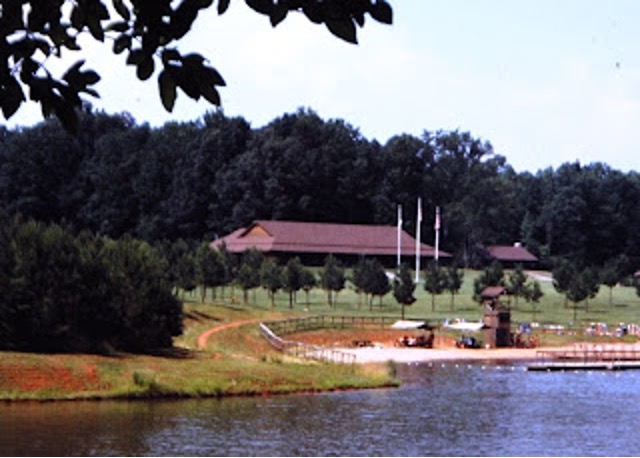
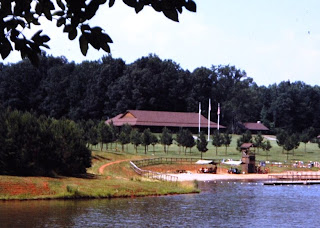
Up until my encounter with a wasp, it had been a wonderful summer at Camp Bud Schiele. The camp, in only its second year of operation, looked like a country club. The rolling grassy hills surrounded a lake which offered swimming, canoeing and sailing, fishing and waterskiing. I had a terrific staff. The first seven weeks had gone off without a hitch.

After this week, we’d store away tents and gear. The week after that, I’d be in Damascus, Virginia, ready for a two-week hike along the Appalachian Trail.

The cooks assured me that dinner would be on time. I got a piece of ice to hold against the wasp sting and headed back to the camp office. By the time of our staff meeting that night, my right eye had swollen shut. There, before me, stood my staff. Every one of them sat with their right eye closed. I wish I felt it was out of sympathy, but I know mockery when I see it.

Camp Bud Schiele Staff 1984
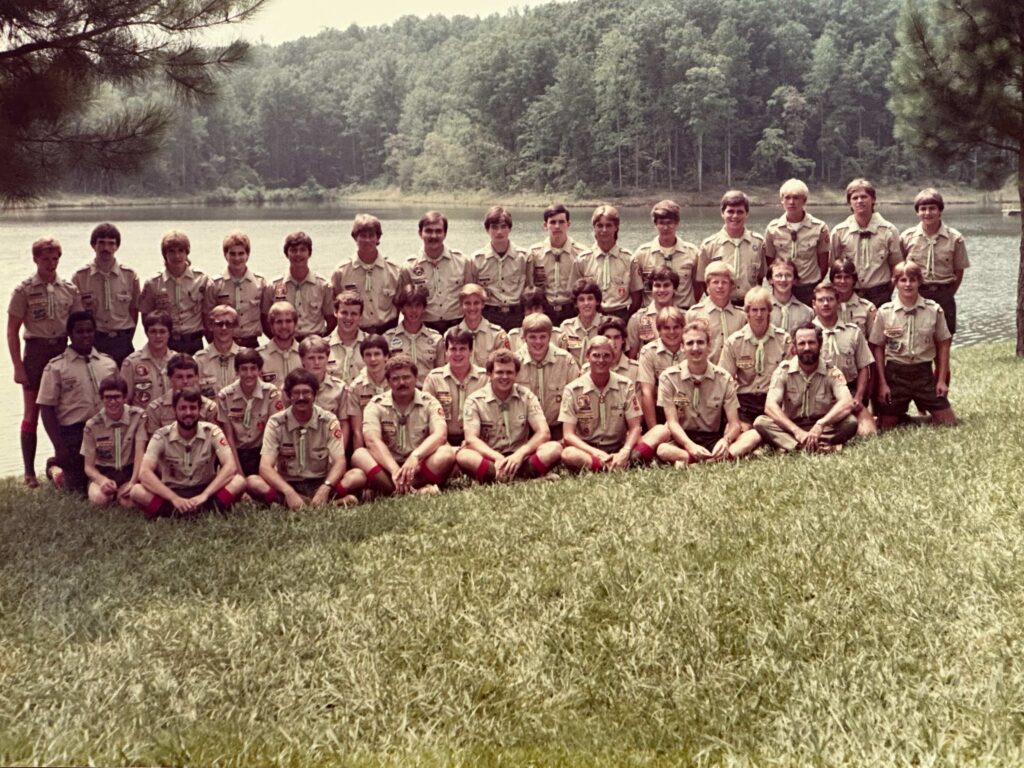
The Full Staff (minus cooks and CITs or counselors in training)

The Forger

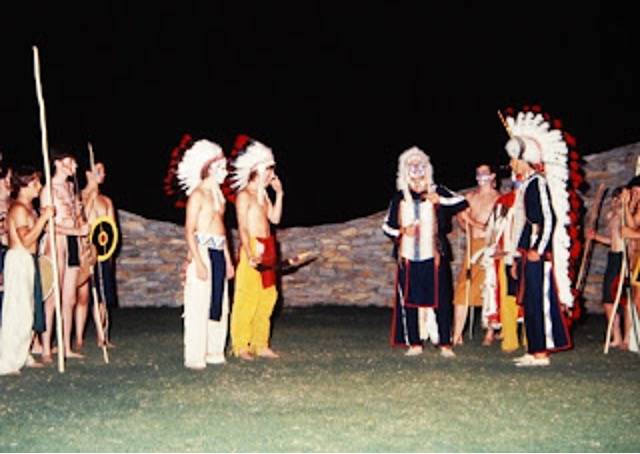
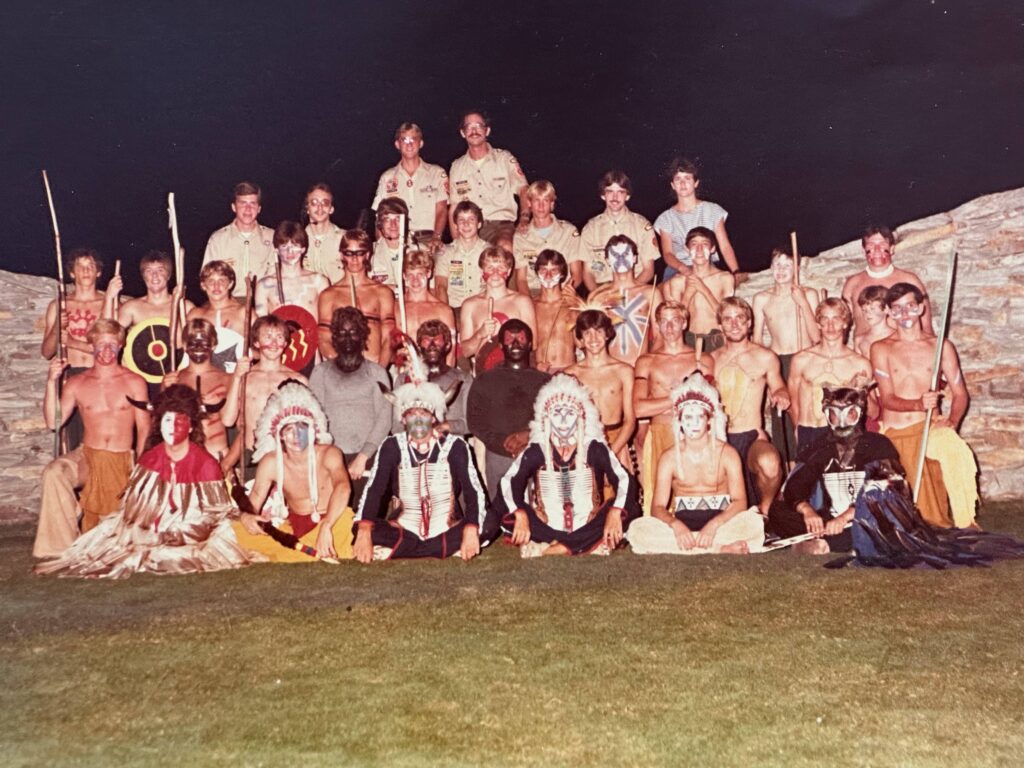
Camp Bud Schiele Indian Pagnent 1984

After Sunday, things slipped back into a regular routine. By mid-week, the swelling had gone down and I’d forgotten about the wasp. The council camp had a tradition going back generations where the camp staff produced a pageant for campers and their families on Wednesday night. It was convenient to do this middle of the week; visiting parents always recharged the son’s wallets which helped our trading post make a good profit. The pageant itself was quite a feat, as the staff dressed up as Native Americans and told some legendary story about natives in Western North Carolina. No one seemed to bothered that the staff dressed like Plain’s Indians, right off a Hollywood movie set. As camp director, I’d spent the evening greeting parents and talking up the scouting program.


A few minutes before the final show of the summer began, my business manager ran up to me and said there was someone in the office who needed to see me. I walked over and met the man who ran a small country store and gas station a few miles away. He wasn’t too happy. He showed me a check written by one of my staff members. The check was written on a closed account.

Todd, the staff member, who had been in uniform, told the man the check belonged to his mother and she had given it to him, pre-signed, so he could get gas and some snacks. The store accepted it, after writing the guy’s name and driver’s license number on the check. As country stores often did, he counter signed the check over to the bread delivery man. The only problem was, the check didn’t belong to the guy’s mom, but to another woman, the sister of a friend. When the check was denied for payment, the bread company had charged the store an extra fine. The store owner had called the woman whose name was on the checks. He learned the checks had been stolen. There had been a number of checks written on this account, which had been closed, across a three-county area. She also informed him there were a half-dozen warrants out for the guy’s arrest.

Honorably discharged after four years serving in the Marine Corp that May, Todd came with good references. His age was another asset. There were many positions he could serve by being over 21. Todd became an assistant field sports director, running the rifle range. For a couple weeks, he also served as a provisional scoutmaster, working with those scouts who came to camp without a troop. I’d been pleased with his work.

Unlike a lot of my staff, Todd always had clean uniforms, which I later learned was because he’d brought four sets of them with a check “which his mother had given him so he could buy uniforms.” As it turned out, even his uniforms were stolen. He purchased them through forgery. Although I didn’t want a sheriff cruiser flying into camp with their lights flashing to arrest a staff member, I also felt I needed to get Todd out of camp. Although I didn’t think he’d do anything, I felt it was a liability to have a staff member working with kids with that many felonies on his head.

I asked the local sheriff if they could wait till ten o’clock. The camp ranger (who was deputized because of the amount of land he managed) and I would detain Todd in my office until then. By ten, all the parents would have left, and the scouts would be back in their campsites. Then, in private, we could hand Todd over to a local sheriff deputy. They would hold him until the sheriff of Catawba County picked him up.

I made arrangement for my program director to take over the staff meeting we always held on Wednesday night and asked him to keep the staff together until I came back to talk to them. With Tony, the camp ranger by my side, I asked Todd to come with me to my office.

It was a long walk through the night. Once inside the office, I told him what was up. Todd was a big guy, probably 6’3” with broad shoulders, about the size of Tony and I put together. Afraid of what he might do, he shocked both of us by sitting down in a chair and crying. Tony offered him a cigarette. I decided not to insist he not smoke in my office. He took one (I’d never seen him smoke) and with tears in his eyes asked what was going to happen to him. I told him didn’t know, but I knew there were several warrants out for his arrest and that forgery was serious business.

The deputy arrived right at ten and arrested Todd. I felt sorry for him, as he was handcuffed. I told him we’d pack up his stuff and keep it safe and then went over to the dining hall where the staff was sitting around waiting. They knew something was up and were visibly shaken, for Todd had been a likable guy. The next day, Tony and I went through Todd’s stuff, inventorying it all and boxing it up and storing it in his car. A few days later, his parents came down and picked up his car and drove it home.

Staff dressed for a pageant
Another staff photo

An indecent photograph

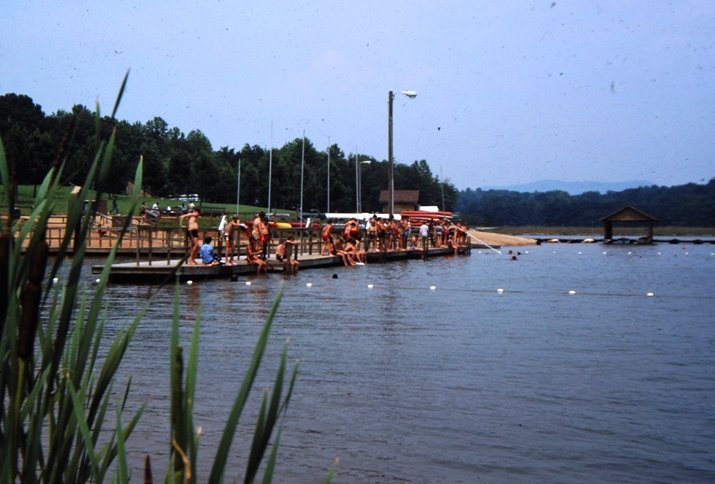
The Waterfront

I’d had enough excitement for one summer. But the week wasn’t over. On Friday, as I was trying to finish up paperwork in my office, the mother of a camper who’d been at the camp a few weeks earlier came by. Like the store owner, she too wasn’t happy. She dropped an X-rated photograph on my desk, one that had come from her son’s camera. I could have gone all summer without seeing that. Her son swore to her that he had no idea where the picture came from, but looking at it, I knew right away who to ask. 

I called for the waterfront director. When he entered my office, I showed him the picture of someone’s privates, with a bathing suit pulled down. The director recognized the bathing suit and sent for two staff members. He had quickly figured out what had happened.

As the scouts checked into the waterfront, there was a place where they could ‘check” valuables, things which shouldn’t get wet, like wallets and cameras. The staff member in question had seen this camera and he, and another staff member, decided it would be funny to take a pornographic photo on some unsuspecting kids’ camera. The staff member responsible for checking in valuables had taken the photo and another waterfront staff, with the bright red striped bathing suit, served as the model.

Although I knew it was just a childish prank, the Scouts have strict rules on such behavior. I found myself having the privilege of firing two more staff members. Like Todd, both were well-liked and hard workers. The rest of the staff were angry at my decision, especially since it there was only one more day of camp left. They were particularly mad that I didn’t allow them to attend the closing banquet we held at the end of the next week, after closing down the camp for winter. At least the model in the photograph must not have been too mad with me, for the next year when he graduated from college, he called to ask me to be one of his references.

It had been such a nice summer. I enjoyed everything the camp had to offered: swimming, water skiing, sailing, canoeing, and fishing. But after that last week, I was never so glad to head off for a two-week hike in Southern Virginia.

Other Scouting Stories:

Ron Carroll, Part 1

Ron Carroll, Part 2

Delano

Harold

Camp Bangladesh

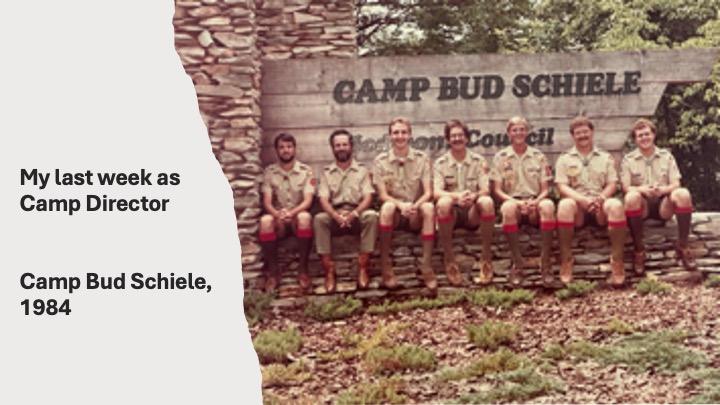
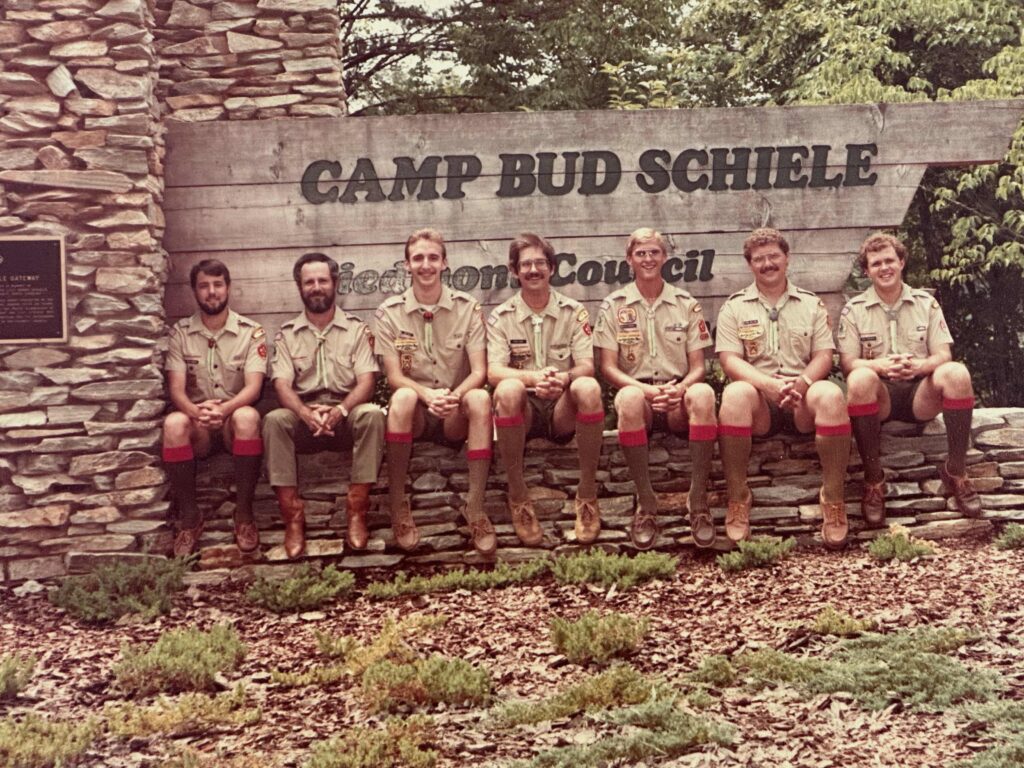
Key staff at Camp Bud Schiele, 1984
The “Key Staff” Members. I’m on the right, with hair and no beard. From right to left. Me, the program director, the waterfront director, the field sports director, the business manager, the camp ranger (Tony), and the nature and scouting skills director.

Recalling a Mentor: Ron Carroll, part 2

A couple of weeks ago, I posted the first of memoir of one of my mentors. Click here for that post. Here is the second part. 

Staff Retreats 

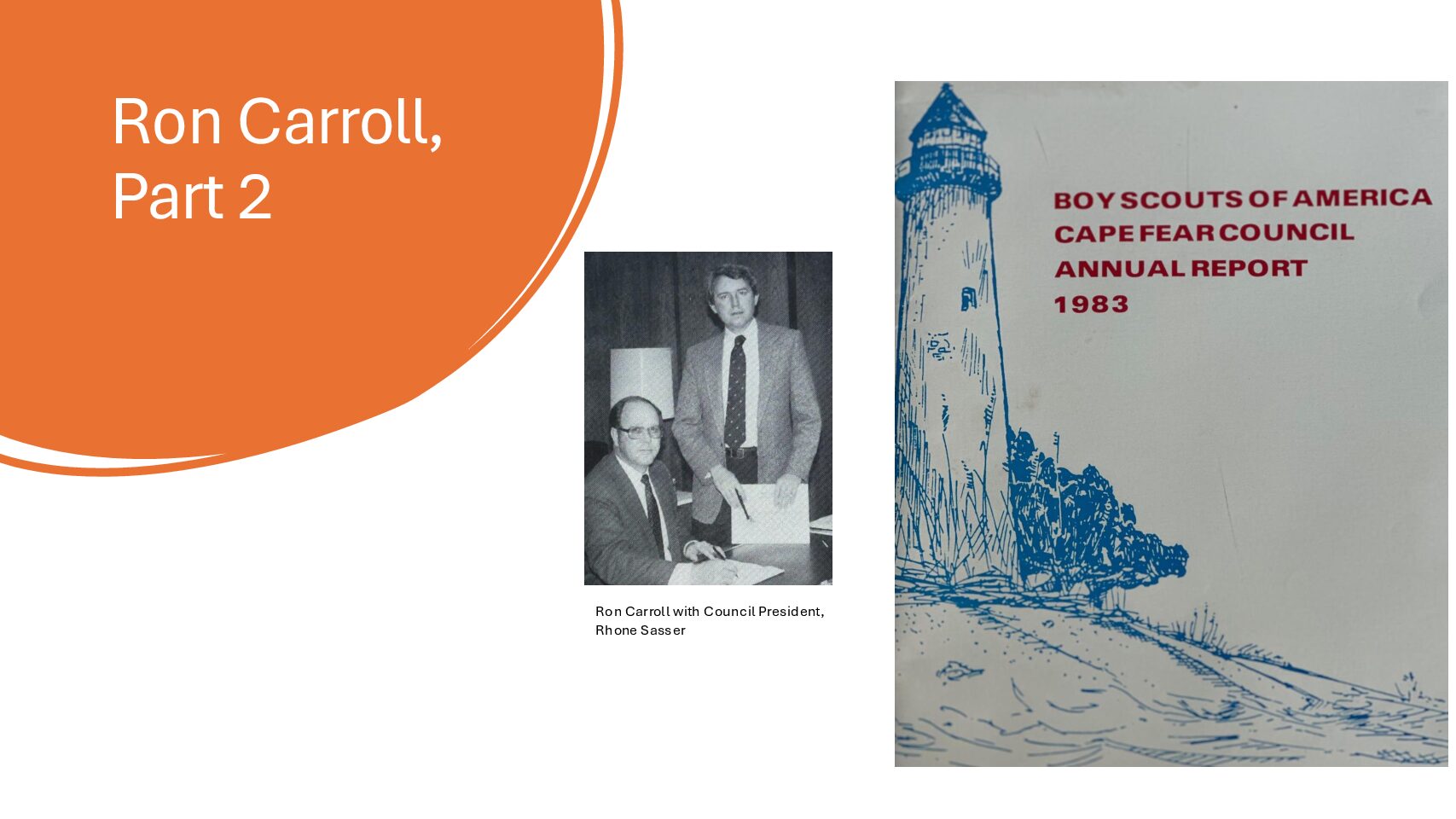
Ron Carroll and Rhone Sasser
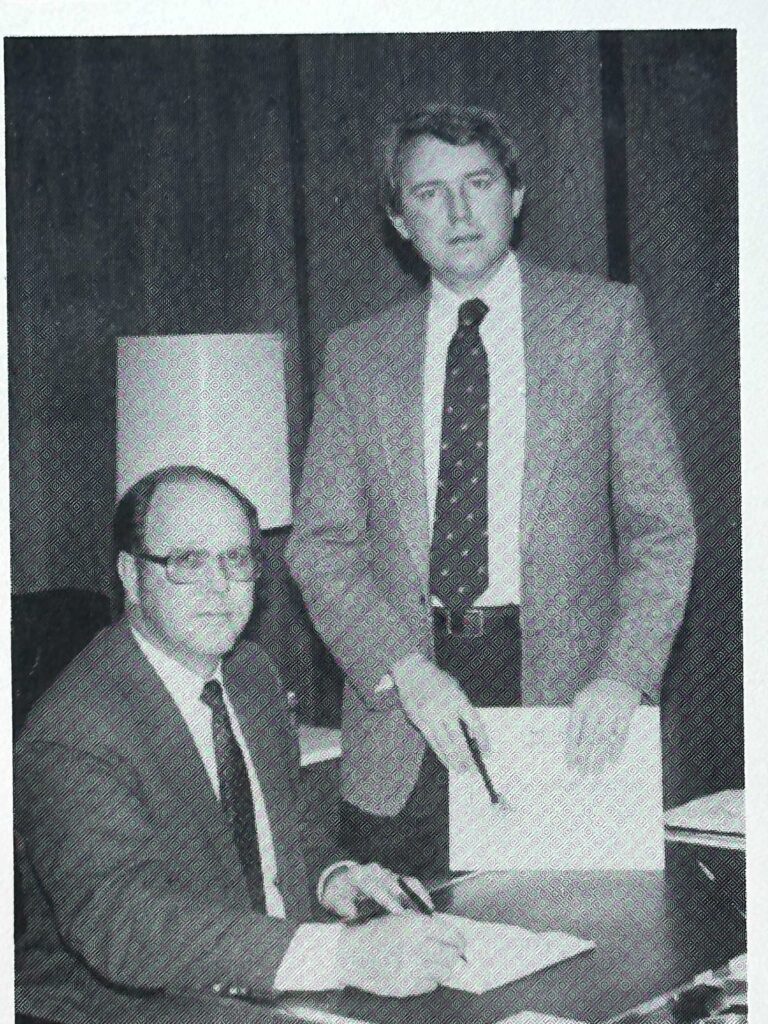
Ron and Council President Rhone Sasser who was President of United Carolina Bank at this time. I no longer have the original photo, this was copied from an annual report.

Ron taught those of us on staff to make the best of any situation. We were a small staff; there were only five of us. Twice a year, Ron pulled us away for a three-day retreat. We spent the time planning and training. We worked hard. But Ron was never one to let hard work get in the way of a good time.

Many of these retreats were held in beach houses owned by a council board member. Several were on Wrightsville Beach, others on Brunswick County beaches. In addition to planning, training, and setting goals, we’d fish and take turns preparing fancy seafood dinners. If the water was warm, we’d swim. There was one fall retreat, after working all day and a big dinner, we played football in the surf as the sun set. It probably wasn’t the brightest thing as the sharks often move closer to shore to feed at dusk, but no one was harmed. 

One fall morning we meet at a beach house on Wrightsville Beach. Ron unlocked the door. We began to barge in with boxes of food, a couple of cases of beer, bottles of booze, bags of chips, along with flip charts and calendars and other assorted accruements. We were all shocked as a barely dressed woman stepped out of the bathroom. She squealed and ducked back in. Then, in the commotion, a young man appeared from the bedroom as the coed returned from the bathroom with a towel wrapped around her. “Who are you?” She asked. Ron told her he arranged with so and so to use the house for a few days. This turned out to be the girl’s father. 

Embarrassed and concerned her daddy might learn she’d taken a premature break from college in order to entertain her boyfriend, she asked for a few minutes to pack. Ron was polite and said we were all in need for some breakfast and that when we return, we’ll have forgotten what we’d seen. We left. An hour later we returned; the woman and her illicit boyfriend were gone. I’m sure when Ron dropped a thank you note to her Daddy, he omitted that it had been our pleasure to meet his daughter.

Ron’s Organizational Skills

Ron had a temper and never liked it when things didn’t go the way he’d plan. In one staff meeting, where he learned several assignments had been dropped, Ron started cussing and fussing and marched us into his office.

Ron’s desk was always immaculate. He started lecturing on how to organize our mail so that everything got done. He had a three-bin file on the edge of his desk. His goal was to never handle a piece of paper more than twice, he said. When he opened his mail, if it could be handled immediately, he did so. If it was of top importance and wouldn’t take much time, it went into this top bin. Second bin was for things that weren’t critical, and the bottom one was for things he wanted to look at but was not so important that the world would end if he didn’t get around to it. In his rant, Ron picked up the stack of papers in his top bin.

On the bottom of this stack was a Hustler magazine. We all started to smirk. Ron’s face became redder and redder as we all broke out into laughter. Finally, before Ron blew a gasket, someone pointed to the magazine. Ron turned over the pile. Then he laughed. His lecture came to an end with some mumbling about priorities.

Ron and Marketing

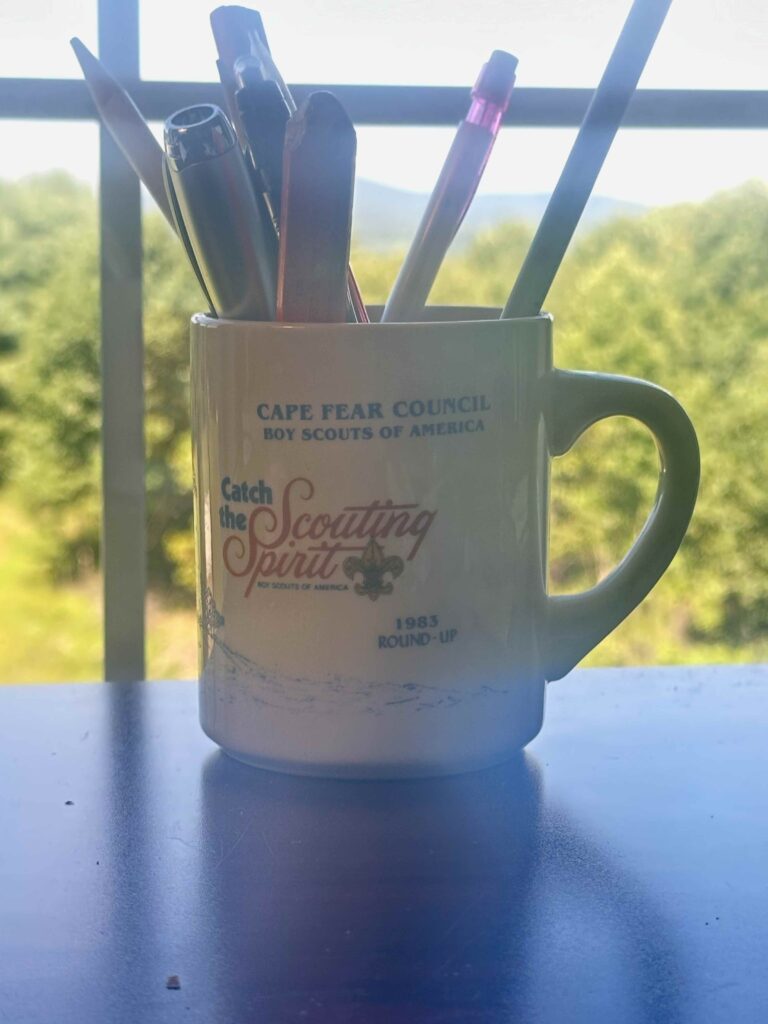
Ron should have been on Madison Avenue. Not only was he a good salesman, but he was also a master marketer. Even when we were doing things like raising money to pay off debt, Ron could come up with positive campaign slogans and materials that turned what many would have considered drudgery into an opportunity to celebrate. I don’t remember all the names, but one desk, I still have a “Catch the Scouting Spirit” mug holding pencils. In a shelf at work, there’s a “Total Development Campaign” apothecary jar holding toothpicks. 

Ron insisted that when an event was over, it didn’t matter how good it turned out. What mattered was how people thought it went. If it was the greatest event in the world and only those who were there knew about it, it was a flop. Then next time we’d have to work just as hard. However, even if the event was mediocre, but everyone thought it was great, then it was a success. The next time such an event would be even easier to promote. Ron encouraged us to learn the stories from scouts and leaders and to tell them in order to promote the program. 

Knowing I was interested in photography, Ron encouraged me to shoot photos whenever possible. With the scouting program financing my film and developing chemicals, I photographed everything. As I was working in rural areas with smaller newspapers, I often had full page spreads of my photographs showing scouts in action. Photos ended up in the council annual report and on camp posters. I was shocked when visiting Ron years later, just before his death, to see the posters framed and hanging in his home. Although at the time my writing was limited to an occasional press release, I’m sure Ron’s insistence on telling stories influenced my writing more than I could have imagined.

Ron and Perception (another part of Marketing)

Perception was also important in how we did our jobs. Ron taught us that you always left your business card and even encouraged us to stop by places in which we knew someone wouldn’t be home or in the office. Leaving a business card was almost as good as making a face-to-face visit. It didn’t take as much time and it left the perception that we were hard at work (in truth, when you have hundreds of volunteers, such time saving techniques were necessary to help everyone feel connected and cared for. He told stories about dropping off his business cards in mailboxes in the middle of the night. I never did that, but I wouldn’t put it past Ron.

In addition to dropping off business cards, Ron was always writing notes to people—both to volunteers as well as his professional staff. Whenever we did something well, he’d write us a note and encourage us to do likewise. To this day, I always care a few note cards in my folder, a habit I learned from Ron.

Building Camp Bowers

One of Ron’s great achievements as the Scout Executive for the Cape Fear Council was creating Camp Bowers in Northwest Bladen County. The council had not had a camp since a few years after my scouting days when they had sold Camp Tom Upchurch. While they had property, nothing had been done toward building a camp. Ron set out to change this. He charged ahead. 

I remember one of my first staff meetings where I learned the importance of fund raising, if we wanted to be paid. We all worked hard and soon were not only raising enough to meet the budget but also paid off the debt which had been accumulating on camp construction through the “Total Development Campaign.” While the camp wasn’t quite finished, we dedicated the camp in May 1981. Hank Aaron, who had recently retired from baseball (and an Eagle Scout) gave the keynote address. A month later, we began the first summer of camp. 

The fire at Camp Bowers

A year later, we held another council camporee at the camp. Troops from all over Southeastern North Carolina gathered. We had around 1000 boys on the site. It was dry and windy spring day, and things were going well. Around lunch, people began to comment about the smoke in the air. It was checked out a learned that a few miles away, someone was burning a large brush pile from where there a track of land had been clearcut. Shortly after lunch, the winds picked up. We received word the controlled burn was no longer in control. A raging fire headed straight toward the camp. 

The word went out to evacuate. Since the camp was a couple miles from a paved road, with only one way in or out, it was important to be on the safe side. After everyone had been safely evacuated, the staff all stayed behind.

Ron went into town to get more water hoses so we could have hoses available at all the buildings. He came back, not only with water hoses, but with a cooler of beer and snacks. That night, the humidity rose, the wind died, and the fire laid down, burning in a bay (swamp) at the edge of camp, not too far from the camp office. We were told to watch the fire and to let the forest service know if it started to come out of the swamp. Ron got the bright idea to haul lawn chairs and the cooler up to the roof of the camp office. We took turns napping and watching the fire, while enjoying cold beer and chips. 

The next morning, the wind picked up and the humidity dropped. We worked liked crazy putting out spot fires and watering down buildings. The North Carolina forest service brought in the big guns. Several large helicopters were based on the lake, picking up water and dropping it a few hundred feet away. A waterbomber made a couple of passes, as bulldozers trenched around buildings. While the first didn’t destroy any buildings, the burned areas were on the camp boundaries were evident even as summer camp began that summer.

Ron’s Single Life

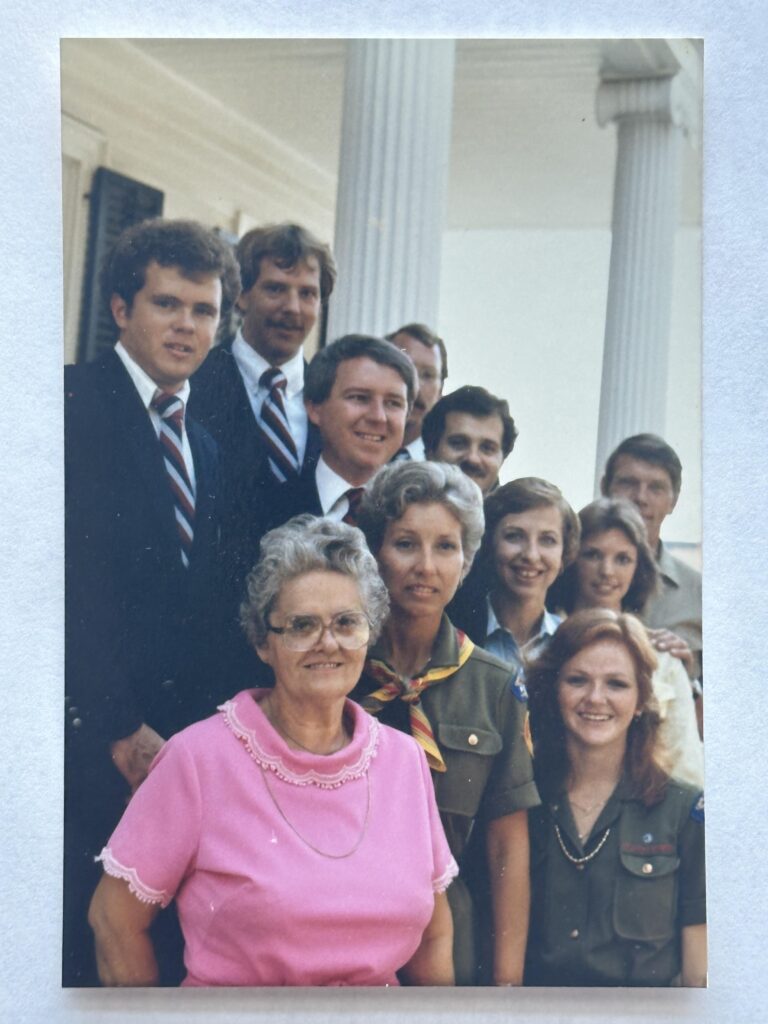
Cape Fear Council Boy Scouts of America Staff 1983
Pam is behind Ms. Lillian, the woman with the pink dress.

Toward the end of my time with the Cape Fear Council, Ron and his first wife divorced. We’d often hold staff meetings on Friday afternoons and those of us available would go out on the town during the evening. Often, I stayed with Ron overnight in the condo he rented on Wrightsville Beach. On one occasion, I had been down to the council office mid-week. Ron suggested we go out. We did and I spent the night with him. The next morning, I had a 7 AM breakfast meeting with the Chairman of the Board of United Carolina Bank (for whom Camp Bowers had been named). That morning, it was foggy. I wondered what’d I’d gotten myself into as I drove back just in time to make the meeting. 

A few months after I left for the Piedmont Council, Ron became the Scout Executive in Orlando Florida. Not long after that, Ron returned to Wilmington to marry Pam, who had been his secretary. It was a delightful wedding and they remained together until Ron’s death in 2005. 

Addendum 1 (added two days later):

Parker, a who was also a part of the staff at Cape Fear Council in the early 1980s and can barely be seen in the back of the photo, emailed me about this post. He told of another skill Ron taught. Always set up for a meeting enough tables and chairs for 90% of the expected guests. This way, if more came, it looked even more successful as you pulled out extra chairs. If there were those who couldn’t make it, you didn’t have a lot of empty chairs sitting around. Parker spoke about how he, in his career working for Chambers of Commerce, adhered to this practice.

For some reason, I didn’t associate this practice with Ron, but it was also another thing I learned from working with the scouts.  Over the years I have fought the battle with administrators, sextons, and volunteers to set up less chairs than expected. It takes a while for them to see the reason, but eventually they do.

Addendum 2 (added two days later)

In my previous post, I told about being with Ron a few months before his death. At the time, Ron and Pam asked me if I was willing to officiate at this funeral. I was. Sadly, when Ron died, they wanted to do the funeral on a particular day in Wilmington, NC. I had already committed to officiate at a wedding the next day on the West Coast and needed to be there for the rehearsal. I wasn’t able to officiate at the funeral.

Other Scouting Stories: 

Ron Carroll, Part 1

Harold Bellamy 

Delano

My Last Week as a Camp Director: Camp Bud Schiele, 1984

Camp Bangladesh (A Summer Camp Scoutmaster)

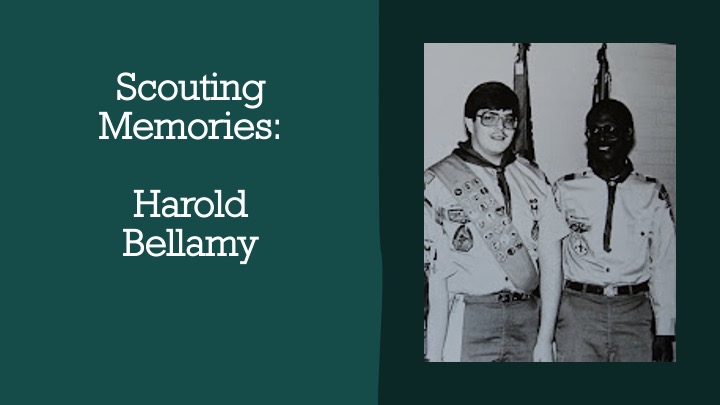
Scouting Memories: Harold

title slide

Last week, I introduced you to Delano. Today, I’m introducing you to Harold, an unlikely Scoutmaster from Tabor City during my time working for the Boy Scouts in Columbus and Bladen County, North Carolina in the early 1980s.


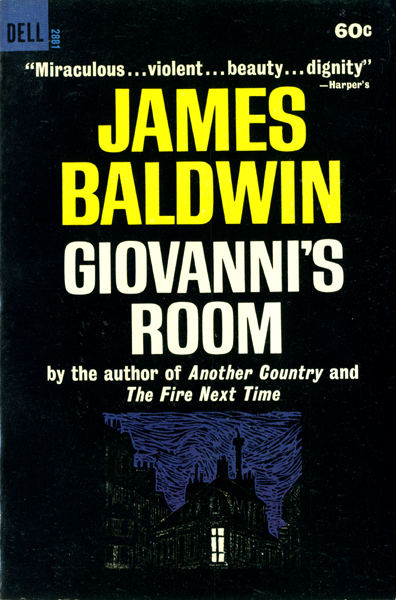
It was probably a cruel joke. Harold volunteered to spend a week with his scout troop at Camp Bowers. He asked me for book recommendations. I lent him a couple of books, one of which was James Baldwin’s Giovanni’s Room. I knew he’d read it. It shocked him to learn of a book by Baldwin he hadn’t read. After all, he taught social studies. Furthermore, like Baldwin, he was an African American, both products of the Black Pentecostal church. And I was a white boy and the Boy Scout’s hired hand. 

Cover photo of the copy of Giovanni's Room that I lent Harold

Giovanni’s Room isn’t your typical Baldwin book. Unlike Baldwin’s better-known writings, Giovanni’s Room has nothing to do with the African American experience. Set in Paris, the story features a unique triangle relationship between an American couple and an Italian (Giovanni). But it’s not the American girl, who’s interested in Giovanni; it’s David, the boy. I read the book in college. I found the book eye-opening and unnerving. Baldwin draws on his readers emotions by making them feel affection for all the characters. And he doesn’t touch on race. In addition to bisexuality, the story also involves capital punishment. After a fight with his former employer at a bar, Giovanni kills the man. The book ends with Giovanni’s execution for the murder.

When I lent him the book, I had a suspicion Harold was unaware of Baldwin’s sexuality. I should add that in addition to teaching Junior High, Harold was also a preacher in an Apostolic Pentecostal Church. But he dug right into the book. 

Harold didn’t exactly fit the Norman Rockwell’s view of a scoutmaster. He ended up with the job by default. A coach at the high school had been recruited to be the scoutmaster. He asked Harold to be his assistant. That next school year, the coach accepted a high school position in South Carolina. When no one else stepped forward, Harold who wanted his troop to do well, took over as Scoutmaster. I don’t think Harold had ever camped before becoming an assistant scoutmaster. I’m not even sure he’d built a campfire and I’m pretty sure he never used a compass. Harold was much more comfortable sitting inside with his head in a book than outside swatting mosquitoes and gnats. 

Even though Harold wasn’t created out of the scoutmaster’s mold, Harold was a great leader. Under his leadership, several of the boys in his troop earned their Eagle. These were the first Eagles earned in Tabor City in more than a decade. In fact, there had not been a troop in Tabor City for a decade before Harold and the coach got together. Harold served as Scoutmaster for four or five years. 

Tabor City had been a rough place. While the Chamber of Commerce crowned the town the “Sweet Potato Capital of the World;” informally it was known as Razor City. The city had a brutal past. In the 1950s, the Klan ruled. An intervention by the FBI destroyed the Klan. However, an uneasy truce existed. As an African American, Harold helped break down barriers which existed into the early 80s. He earned respected from the community, as shown by families allowing their white sons to join his troop. Several of the business leaders of the community thanked me for working with Harold and wanted him to succeed. 

Harold and I became friends, partly drawn together by our interest in history, social studies, literature and practical jokes. Later, as I felt drawn to seminary and to the ministry, we had some serious theological conversations. While I knew Harold to be a preacher at a Pentecostal Church in Tabor City, I just learned (see below) he ordained as a Bishop.

Harold finally forgave me for shattering his idyllic view of Baldwin. When my personal life became chaotic, Harold supported me. He even tried to set me up with another teacher at his school. I no longer remember her name, but husband had died in a work accident. We went out to lunch and her former mother-in-law was there. When we finished, we discovered that she’d paid for our meals! Harold, I think to care for both of us, attempted to bring us together. Later, after I left the area and moved across state, Harold and I occasionally met for lunch or dinner when I drove across state to see my parents in Wilmington. We wrote back and forth a few times after I left North Carolina for seminary in Pittsburgh, but with me having no reason to travel through Columbus County, and Harold no reason to head up north, we lost contact. 

A few years ago, as I was again occasionally driving through Columbus County (from Savannah to Wilmington), I tried to find him. I learned he retired from teaching after serving as a principal in Chadbourn.  In preparation for posting this, I learned of his death. Reading the comments posted on his obituary, I learned that after teaching in Tabor City, he taught at West Columbus High School and, as I had learned earlier, served as principal at Chadbourn Elementary. The secretary at the school could give me no more information about him. I also learned he become a Bishop. He suffered from a long-term illness and died in a Whiteville Nursing Home. He was 71 years old. 


Yet the key to my salvation, which cannot save my body, is hidden in my flesh.
-David imagining Giovanni’s execution in James Baldwin, Giovanni’s Room)

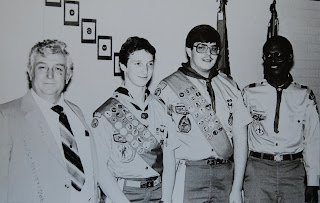
Harold (left) and Delano with two scouts who were rewarded their Eagle award.
Harold (left) and Delano with two recent Eagle Scouts, 1983

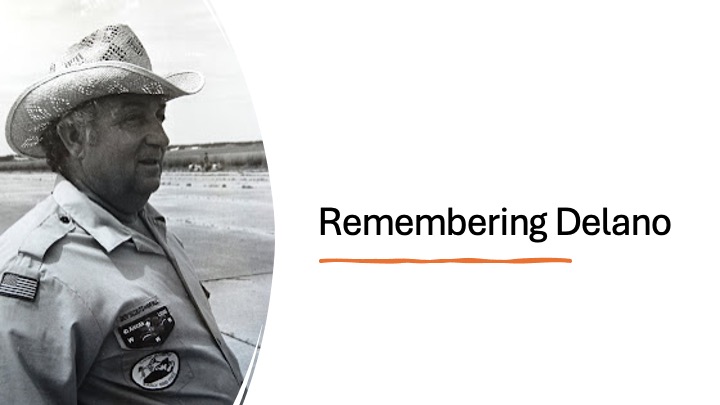
Scouting Memories: Delano

Title slide with photo of Delano

A few weeks ago, I wrote about the time I was a summer camp scoutmaster. In that post, I mentioned my time working for the scouts. Here is a story of one of the many unique characters I met during the time I worked for the Boy Scouts of America (and organization I left to go to seminary and pursue the ministry). 

Delano in a Boy Scout uniform, early 1980s
Delano, early 1980s

“What are those government fools thinking, offering classes to teach us how to distill alcohol? They ain’t a farmer in these parts that haven’t made liquor at one time or another,” Delano fumed. 

This was in the early 80s and after years of prosecuting farmers for turning corn into liquids, a lively discussion on how to do this legally arose. Not for internal consumption, but for internal combustion. If the farmers made their own fuel, they could reduce their dependence on gasoline and diesel fuel. The local community college offered a course on alternative fuels, but Delano didn’t think much of the idea. This was an example of the government meddling where it shouldn’t be meddling. 

Delano’s views weren’t a surprise; everyone in Columbus County complained about the government meddling. Of course, they didn’t see it as meddling when they were first at the hog trough. Otherwise, they classified most government initiatives as meddling. 

However, Delano’s admission on the moonshining activities of area farmers surprised me. Did he include himself in the bunch? After all, he was a Mormon. Mormons weren’t supposed to be drinking. But then, neither were Baptist and those in that area who weren’t Mormon were members of one the several off-brand Baptist Churches. A part of me always wanted to know what went on in the “Primitive, Fire-baptized, Fundamentalist Baptist Church” that I passed on my way to church on Sunday. They always had four or five cars there, but I never got up the nerve to stop and find out.

Even though he marched to his own drum, I loved Delano. There was never a dull moment when he was around. He was always smiling and joking. And he had a repertoire of stories to entertain us. Some involved living between Pireway and the Green Swamp, near the Waccamaw River.

Other stories involved his year in Korea during the war. He was a disabled veteran of that war. He found the country the most hostile place imaginable. Partly, I’m sure, this was because he sent so much time behind enemy lines. He and a group of soldiers found themselves lost and had to make their way through enemy territory, back to the UN lines. Struggling to make it back safely, they crossed minefields and dealt with frostbite and starvation.  His spent his entire time in Korea in the field except his last night before coming home. That night, the heat was unbearable; he wished he was back outside. Korea left him disabled. Although he could walk and get around, he wasn’t particularly fast and limited with the types of work he could do. 

Delano enjoyed helping others. One winter, the scouts helped provide firewood for needy families. We gathered at a recent clear cut area. The remaining wood was destined to be burned and had been pushed into wind rows. The paper company allowed us permission to glean from this site. Delano showed up with his chainsaw and splitting maul. While he had limited mobility, he could split wood. His son placed a piece of wood upright, then he split the log. His boy collected the wood and threw it into the back of waiting pickups. We delivered a dozen or so truckloads of wood to needy families that Saturday.  

Like his neighbors in the Green Swamp, Delano supplemented his livelihood from the bounty of the earth. He entertained us with stories about the tricks of the trade his neighbors employed to put food on the table. He never indicted himself, but one had to wonder. 

One favorite was dialing for fish. The fisherman used an old crack phone to create an electrical pulse in the water. This stunned the fish. The shocked fish floated to the surface and were scooped up in a net.  

To hear him tell the story, nobody in his neighborhood purchased canned dog food to feed canines. Dogs got scraps from the table. Canned dog food served as chum for fish. Holes were punched in a can which was then tossed into the water at a spot where you wanted to fish in a day or two. The dog food attracted fish so that when you came back for business, you didn’t have to spend much time finding them. You just had to hope the fish, fat on dog food, were ready to bite into a juicy worm. 

I first met Delano at a chicken bog for scout leaders held in Fair Bluff. Having been told he was a Mormon, I made sure we had alternatives to the coffee and tea which everyone else would be drinking. I picked up a couple bottles of apple juice and offered him one. He refused and poured himself a cup of coffee. At this same event, I became troubled when I learned a chicken bog contained not only fowl, but also sausage. Knowing we had several Jewish leaders, I apologized. What little training I’d had from the Scouts by this point in my career had stressed sensitive to such issues. But sausage wasn’t a problem, these guys assured me, if their wives weren’t around. The same applied to Delano. 

Even his scout troop enjoyed drinks that went against the Mormon Word of Wisdom. Making my rounds at the first camporee, I noticed his troop were all drinking Cokes and Mountain Dews with their breakfast. At camporees, where all the troops in the county gathered, Delano made a point to invite me to eat Saturday dinner with his boys. Sometimes the fare would be normal, venison or fried fish. Other times the menu was exotic. In the three years I worked in this district, the Pireway troop served bear, squirrel, turtle, raccoon, and even a greasy opossum.

Delano and I got along well. Both of us believed that when camping, an afternoon nap was a necessity. He had a small but devoted group of scouts who looked up to him and knew that he looked out for their best interest. There’s not much more you could expect from a scoutmaster. 

Sadly, as I was leaving the Waccamaw District in early 1984, the church reassigned Delano, giving him responsibilities inside the church and appointing someone else as the scoutmaster. His son, had earned his Eagle. I have no idea who took over the troop, but they would have a hard time fitting into Delano’s shoes.

Eagle presentation, 1983
Delano next to his son at his son’s Eagle presentation. Next to him is another Eagle from the Tabor City troop and his scoutmaster (Harold).

###

Jeff Garrison, 1981
You won’t see many pictures of me like this. 1981, I’m working with the BSA, and have hair but no beard.

I rewrote this post from something I wrote nearly 20 years ago. After the piece was first published online, a relative of Delano contacted me to thank me for the article and to let me of Delano’s death. 

Camp Bangladesh

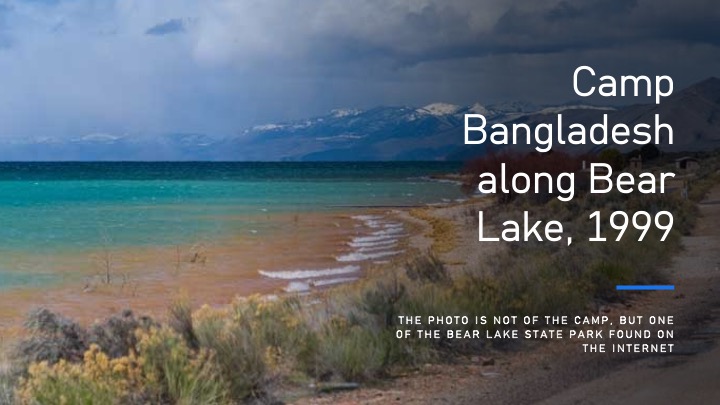
title photo with view of Bear Lake
Ralph and Olga at "The Joint" in Randsburg, CA
Ralph and the bartender Olga at “The Joint” in Randsburg, CA in 2005. Ralph grew up and went to war (WW2) with her son.

I came across this piece that I wrote in August 1999, five years before my first blog. It brought back good memories. That summer, I played the role of scoutmaster for Troop 360, chartered by Community Presbyterian Church of Cedar City, Utah. Joining me as assistant that summer was my friend, Ralph Behrens. Ralph and his wife Pat were good friends of mine in Utah, and I often stayed with them when I would return to visit Cedar City. Sadly, both have died. 

We took a dozen boys that summer to camp along Bear Lake in Northern Utah. The camp week ran from Monday morning through Saturday, so we loaded up after church on Sunday. I drove a 15-passenger rental van with the scouts and Ralph followed with his pickup truck, the back of it filled with gear. We made the 330-mile drive to Logan, Utah, arriving at dusk, where we stayed overnight at the Presbyterian Church. Early Monday morning, after a stop for breakfast, we drove Highway 89 up Logan Canyon and across the mountains, before dropping down to Bear Lake. This was an incredibly beautiful drive and the lake before us as we dropped out of the mountains was so inviting. My story will pick up on our arrival at camp. 

I looked for the camp and it appears that it is no longer in operation. Probably because the Mormons pulled out of the Boy Scout program, there seems to be a consolation of councils in the West and fewer camps. This camp had a lot of strikes against it as it consisted of small spit of land between the lake and the highway. However, I am sure the land was very valuable as it had so much lakeshore footage. I have edited my story slightly. I’m also sure I have a few more pictures of the camp, but am not sure which of many tubs of photos they’re in. The one of my son preparing to scuba dive was in a collection of albums and the only one from camp that summer. 

Camp Bangladesh
August 1999


Camp Bud Schiele
Dining hall and waterfront at Bud Schiele

A lot has happened in the fifteen years since I was last in a scout camp. Back then I was the Camp Director at Camp Bud Schiele in Western North Carolina. With grounds manicured like a country club and lots of trees, it wasn’t a bad place to spend the summer. However, after eight weeks in an all-boys camp with very few females, I knew the summer was winding down when the camp cooks, who were older than my mother, started to look attractive. In order to see what improvements made to the scouting program, I signed this summer for a week at camp with our local troop. I knew a lot had changed. However, I wasn’t prepared for what I experienced, especially girl counselors.

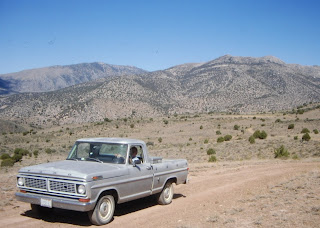
Ralph's truck on the "Hole in the Wall" Road in Central, Utah
Ralph’s truck on another trip

Ralph and I and a dozen boys arrived safely at Camp Bangladesh on a Monday morning. It was supposed to be an aquatic camp, but it felt like an overpopulated refugee settlement on the eastern shore of Bear Lake in Northern Utah. Greeting us at the gate was Gilligan, looking fresh and neat from his recent cruise on the S.S. Minnow. He wore Navy khaki, we assumed, because he didn’t meet the six-foot height requirement for the Coast Guard (and would have been unable to walk ashore if his boat had sunk). Gilligan directed us to our campsite and told me to report to the pavilion and check in. On the way, I stopped at the head (euphemism for latrine), where I quickly surmised that the U.N. and International Red Cross Refugee Commissions hadn’t yet inspected this site.

At the pavilion, the powers that be lightened my wallet as Robyn gave the troop a tour of the camp. Robyn substituted for our camp friend Randy who was, we later surmised, in the bushes with a female staff member. We never saw Robyn again; some think he got lost in the sage brush. Unable to see over it, he may have traveled in circles till he passed out. As for Randy, he and the Misses showed up hand-in-hand halfway through the week. We learned then that Randy was quite a philosopher and explained all the world problems as “someone must be smoking something.” We all assumed he was the “someone.”

At the opening scoutmaster’s meeting on the first day, I qualified for the BSA’s “Safety Afloat” certification by listening to a lecture. Little did I realize the camp practiced another form of safety afloat. They kept most of their boats in dry dock. They reserved the fully functioning boats for staff use. Our troop re-christened the small sloop named the “Ark” into the “Love Boat.” They had suspicion as to what the staff did on the boat that they kept safely moored offshore and off-limits to campers.

I will forever remember the galley experience at Camp Bangladesh. They served dinner in two shifts (called watches). If you’re unlucky enough to be on the second watch, as we were, it was like eating in an emergency canteen following a Kansas tornado. Another unique experience was dining in this open-air pavilion during a thunderstorm. Paper plates and cups flew with the wind, ridding the camp of rubbish by sending it all to Idaho. I’m sure it was from such an experience that the shifts became known as a watch, for we watched our food fly away.

The day following, the camp staff must have had a knife sharpening contest. The cook took first place. That night we were treated to beef trimmings, trimmings so fine we didn’t even notice them. Even the camp’s sole vegetarian seemed satisfied. In all seriousness, the night with the gluey noodles made up for the undercooking of the previous night’s rice, things have a way of balancing out in the end. Quality aside, the real problem was with quantity and our neighboring unit leaders resorted to rattlesnake hunting to supplement their boy’s diet. Ralph and I, being more practical, took our boys for milk shakes at the ice cream stand on the south end of the lake.

Of course, what goes in must come out, which brings me back to the subject of the rotten white buildings dotting the landscape and were a contributing factor for the outbreak of constipation that struck our campers. The smell of these buildings was so bad that I stopped using flashlights and followed the stench from one to another on the path back to our site. People had reported several large skunks along the highway east of the camp . They all facing east, obviously running across the highway afraid another skunk laid claimed the territory when they meet their demise under the tires of moving vehicles. 

Our troop’s strawberry blonde commissioner was Ms. Pope. We could never remember her name, so Ralph and I started calling her Hillary, in honor of the First Lady. In addition to serving as our commissioner, she was also the commandant of the dining hall and ruled with an iron fist. Hillary was an electronic engineering technician student at Weber State (MIT on the Salt Lake). We found her knowledgeable about most everything except for the difference between a foot and a yard. If she gets that confused between volts and watts, we’re afraid she may be in for a real shock.

In addition to her commissioner duties and studying electricity, Hillary is looking for a good Mormon husband who will allow her to stay home and tend to a scout troop. If Robyn hadn’t gotten himself lost in the sagebrush, they’d made a cute couple. Of course, I’m sure Hillary would have wanted Robyn to grow up a bit, but until then they’d be shoe-in winners in a Dennis the Menace and Margaret look-a-like contest. However, I secretly doubt Hillary desires a husband. She really harbors ambition to be the first female Chief Scout Executive. I just hope she doesn’t get her sights on the Presidency of the U.S. of A, or our country will never be the same.

There were three classes of staff at Camp Bangladesh. The elite, like Hillary, wore Navy uniforms and look like they just walked out of a surplus store or off the set for a remake of McHale’s Navy. The second tier wear dark green sea scout shirts and various colored pants. Our favorite in this class was Hot Legs—the blonde lifeguard with a nice tanned body fitted into a red one piece swimsuit. When on duty, she looked more like a movie star posing than a lifeguard as she stretched herself out sunning on the pier. I never saw Hot Legs without large sunglasses. She wore them even when the sun wasn’t shinning. Our boys, seeing her without the glasses one day, reported that she had a serious case of raccoon eyes and better keep them on.

The bottom rung of the staff hierarchy was the kitchen crew. Without regular uniforms, their selection was based on their lack of speed and foresight. Or maybe they were pressed into service, like the British did to our seamen before the War of 1812. If that’s the case, they’ve decided as a group that indifference is a subtle way of protest. Or, maybe they really didn’t think we wanted nor needed anything to drink with our uncooked rice until the meal was nearly over. 

Speaking of drinks, choosing the beverages of one’s choice was another interesting experience. Any other camp would have put labels on the coolers, but that would be too much work for the staff of Bangladesh. We learned that the way to tell what a cooler contained was to look underneath at the color of the puddle on the floor. Since we were the only non-Mormon troop in camp, the dining hall didn’t serve coffee. Suspecting such, I brought my own stove and percolator and fixed coffee every morning. I quickly became popular and found myself having to go into town to buy more coffee midweek as all the neighboring Mormon leaders decided to forgo their prophet’s word of wisdom and have a several cups of Joe a morning with Ralph and me. 

Scuba divers on the dock waiting to dive
my son learning to scuba dive


Our patch for the week informed us we’ve been on an aquatic land cruise—I supposed it’s a land cruise because most that’s where most of the boats remained. But there were some good things about the experience. First, I wasn’t in charge and could blame everything on the camp director, Captain McHale himself. Instead, I passed the hours sitting in my camp chair or laying in my hammock, reading books.

Our boys averaged three merit badges and only one fight a piece and they all eventually got to sail on the one of the few fully functioning sailboats available for campers. I even spent a wonderful afternoon on a Hobie (that was reserved for scout leaders). For an extra fee, I allowed my own son to experience the underwater world as he took a scuba diving class.  Now that I’m home, I’m hoping to break my Valium addiction by the end of the year.

Afterwards:

Even though I put a light spin on this, from my experience of working within the Scouting program in the Southeastern part of the states, it shocked me the camp passed the Boy Scouts of America’s rigorous peer inspection program. The waterfront controls were lacking, and I spent less time in my hammock and more time playing lifeguard than I hoped.  

After this experience, I‘m not sure why, but we signed up for another year. In 2000, Ralph and I took the troop to a camp in the Ponderosa pines south of Williams, Arizonia. It was one of the best run camps I’ve seen. Sadly, there was no large lake, just a pond for canoeing and a swimming pool. But the food was great. After that camp, it shocked me to learn most of the boys preferred the camp on Bear Lake. But they cherished the freedom, and the lake was a great.