The Slain Yet Victorious Lamb

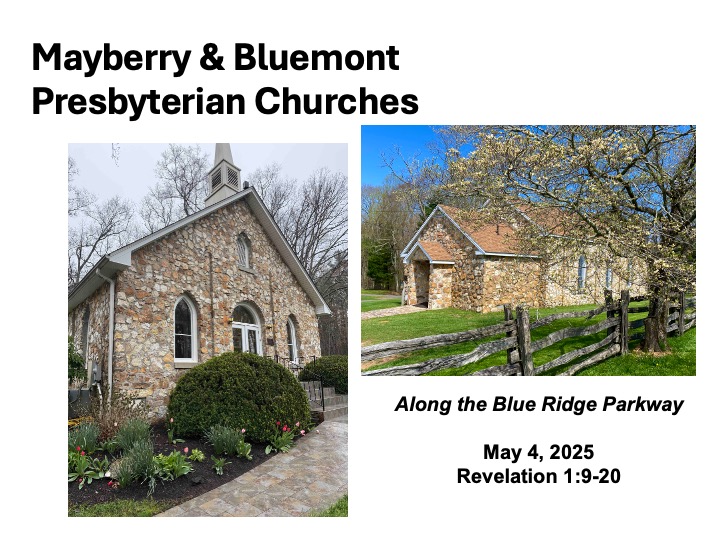
title slide with photos of the two churches were the sermon will be preached

Jeff Garrison
Mayberry & Bluemont Churches

Revelation 5
August 3, 2025

Sermon recorded on Friday, August 1, at Bluemont Presbyterian Church

Yale Divinity School’s famous Beecher lectures, given by Frederick Buechner, were published in a little book titled, Telling the Truth: The Gospel as Tragedy, Comedy, & Fairy Tale. Some might take offense at the title, but it makes sense. As tragedy, the gospel begins with the crucifixion. As comedy, the reversal from death to life fits the classic understanding of the word. And as fairytale, we have the extraordinary things that happen to Jesus and his followers down to this day.[1]

In the text we’re looking at today, we see a bit of all three: tragedy, comedy and fairytale. We’ll see it in the resurrection lamb. As tragedy, the lamb was slain. As comedy and fairytale, the lamb lives and is all powerful. 

Lambs and Sheep play a key role in scripture. The Patriarchs herded sheep. The blood of lambs marked Israel safe during the night of Passover. David ruled as the shepherd king. The shepherds greeted the infant Jesus in Bethlehem. And Jesus, the good shepherd, becomes the sacrificial lamb. He died that we might live yet lives and offers us life eternal. Lambs and sheep are often seen as docile and meek. Perhaps this is why they were used in sacrifices. But the sacrificed lamb is victorious and in him we have hope. 

Before reading the Scriptures:  

We’ll finish our tour through the first five chapters of Revelation today. If enough people show interested, I’d be more than glad to run a Bible study on the rest of the book in the fall. So let me know. Next week, I’ll move on to other texts for my sermons. 

As I pointed out last week, the fourth and fifth chapters of Revelation envision heavenly worship. In the fourth chapter, the focused on the throne. John hears hymns around the throne praising the Almighty. In the fifth chapter, a scroll is introduced as well as the slain lamb who lives. Last week we learned the word “Throne” occurs 40 times in Revelation.[2] The “Lamb of God,” is another of the book’s favorite phrases. Introduced in the fifth chapter, the phrase occurs 28 times in the remaining 17 chapters of the Book of Revelation![3] Let’s look at what John witnessed. 

Read Revelation 5:

The scroll and the lamb are the focus of the fifth chapter. Frst century Christians would understand a scroll as scripture.[4]Sealed with seven seals, it contains God’s plan. But there’s no one worthy to open the seals. 

This brings tears to John’s eyes. For you see, without opening the scroll (without moving into God’s future) the powers of evil who have thrown themselves against the godly and have persecuted the church will prevail.

John’s vision comes at a perilous time for the continued existence of the church. Persecution threatens. John, himself, exiled to a deserted rocky island because of his faith in Jesus Christ, could have been killed.[5] But there, on those rocky shores with the sound of lapping waves, John’s vison fills the sky. He’s reminded of the truth. God will be victorious. 

It might not have looked that way when the Romans sent John into exile on this rocky island. Nor did it look that way at daybreak on the first Easter when the women make their way to the tomb to prepare Jesus’ body for the grave. It may not look that way for some of us today, who are troubled by what’s happening in our world. But God has a way of surprising us!

One of the elders standing near God’s throne points out there is, after all, one who can open the scroll. I should point out here that time in Revelation isn’t neat and chronological as we like. At the point there was no one worthy probably refers to the time before Jesus’ death. Seeing the condition of humanity, God rescues the world by entering the human sphere in the life of Jesus Christ. Now, moving back to after the resurrection, someone is worthy.  

Now notice the difference between the fifth and sixth verses. Do you catch the humor? In the fifth verse, John’s encouraged to look at the lion. But in the sixth, he sees a lamb. He expects to see a raging lion who has conquered evil by brute force. Instead, we see a sacrificed lamb.[6] God didn’t choose to conquered evil by physical strength; rather, God chose to submit to evil through Jesus’ death on the cross. This sacrificial act shows the limitation of evil’s power. Jesus’ resurrection conquers death and demonstrates evil impotence. “Victory through sacrifice” is the central theme of the New Testament revelation.[7]

It’s important for us to remember when John witnesses this vision, the church faced mortal danger. John’s vision isn’t to go and tell his fellow Christians that everything will be alright. They know good and well that things are grim. If something doesn’t happen, they may all be exterminated. What John’s vision does for his readers is to assure them of God’s control. In the end God, through Jesus Christ, will reign triumphantly over evil and death and destruction. There may be suffering and persecution here on earth, but in heaven, they’re already celebrating victory won over evil when Jesus rose from the grave.

The lamb envisioned in Revelation 5 is a little weird. Seven horns, seven eyes (just like the seven seals). This isn’t to be taken a literally as to how Jesus Christ looks. As we’ve seen in the first five chapters of Revelation, seven represents perfection and holiness. These are the attributes assigned to the lamb representing Jesus Christ. With seven eyes, the lamb sees all. With seven horns, lamb isn’t just a helpless lamb, but a powerful ram able to protect those within his flock.

So, Jesus Christ, the sacrificed lamb, takes the scroll. God’s plan moves forward. Having defeated death on the cross, Jesus Christ sets out to free the universe of all evil. This causes song upon songs to rise throughout heaven. Christ, the Lamb of God, is praised. He inaugurates a new era.

Think about this for a minute… Christ has in his possession the scroll containing the future. But we are only in the fifth chapter of the book of Revelation. There are 17 more chapters. There are stories of galactic battles and martyrs to come; at this point Christ who has mortally defeated evil has not yet fully conquered it.  

Evil is still present in the world. We know that. We’ve seen it this week when Russia attacked a maternity hospital and apartment complexes in Ukraine. And we see it in the Congo when Islamic Nation terrorists attack and kill students at a Christian school. We saw it last year in Israel, when Palestinians attacked a concert in Israel. And we continue to witness it in Gaza as Israel destroys hospitals, attacks relief distribution centers, and starves the residents. We see it in the face of dead children. Whichever of these situations you pick, there are dead children. It should break our hearts and cause us to cry out to God, “how long, O Lord, how long.” 

We don’t understand why God allows such evil to happen. The question of why, if God is all-powerful, God allows such evil, has been around for thousands of years. The rabbis debated this question in Jesus’ day. The book of Job, written to help us wrestle with this problem, leaves us with what many consider an unsatisfactory answer. 

In Job’s search, he encounters God and comes away only with a sense of God’s awe and power.[8] He learns it’s impossible for us to fully understand the Creator. Yet, we’re called to sing. We know the future. We know what happens, but also what will happen. So, we join the multitude singing praises and trusting in the goodness of a God who raised Jesus from the dead.

Think about the choir in Revelation 5. The singing begins with the four living creatures who guard the throne and the twenty-four harp strumming elders who represent the twelve tribes of Israel and the twelve apostles of the New Testament. Their music inspires a multitude of angels to join the chorus. And the angels inspire all creation to join in the song of praise. Doxology! “Praise God from whom all blessings flow!”

Now, was all of creation singing praises to God during John’s lifetime? Of course not. As I said earlier, time in this chapter is somewhat transitory. It moves quickly from before Christ’s victory over death to the complete fulfillment of God’s plan for creation at the end of history. We desire such a fulfillment, but its realization remains in the distance. But let’s not forget. We know the ending. We know who’s in charge and how history will end.

Friends, like those in this vision, our lives should be filled with the song of resurrection. May the song fill us with hope. Know that death is not the last word. Know that evil is not the last word. The risen Christ rules. A new world will come. Don’t despair. Rejoice! Amen. 


[1] Frederick Buechner, Telling the Truth: The Gospel as Tragedy, Comedy & Fairy Tale (San Francisco: HarpersCollins, 1977), 7.  

[2] https://fromarockyhillside.com/2025/07/27/worship-its-not-about-us/

[3] Robert L. Reymond, The Lamb of God: The Bible’s Unfolding Revelation of Sacrifice (Mentor, 2006), 103.

[4] Eugene H. Peterson, Reversed Thunder: The Revelation of John and the Praying Imagination (HarpersSanFrancisco: 1988), 64.

[5] John 1:9.

[6] M. Eugene Boring, Revelation: Interpretation, A Biblical Commentary for Teaching and Preaching (Louisville: John Knox Press, 1989), 108. 

[7] Robert H. Mounce, The Book of Revelation, revised, (Grand Rapids: MI: Eerdmans, 1997), 132.

[8] Job 38-41.

Worship: It’s Not About Us

Title slide for sermon for Mayberry & Bluemont Churches on Sunday, July 27, 2024. Text: Revelation 4. Slide shows photos of the churches.

Jeff Garrison
Mayberry & Bluemont Churches  
Revelation 4
July 28, 2025

At the beginning of worship:
In Barbara Brown Taylor’s, An Altar in the World, she writes about Francis of Assisi building a church on the ruins of an old one. Francis employed his labor from the people of the town. Quoting Taylor: 

to most of the people helping Francis in the construction: building the church became more important than finishing it. Building it together gave people who were formerly invisible to each other meaning, purpose, and worth. When completed, Francis’s church did not stand as a shelter from the world; it stood as a reminder that the whole world was God’s House.[1]

The focus of our scripture today is worship. And while we worship here on Sunday mornings and occasionally at other times, we shouldn’t forget that all the world stands as an altar to God. Paul reminds us to pray without ceasing.[2] Our lives should also be worshipping God without ceasing. 

Before reading the scripture:
We’ll spend the next two Sundays in the 4th and 5th chapters of Revelation. Both chapters go together and center on worship in heaven. In Chapter 4, the focus is on God’s throne. Chapter 5 focuses on the slain yet resurrected lamb who now rules, Jesus Christ. Much of the language here is poetic and metaphorical. It reminds the readers of similar visions of Isaiah and Ezekiel.[3]

These two chapters go with the previous two chapters where Jesus addressed the seven churches. One of the themes running through those chapters is the coming persecution. The reader of Revelation will hear more about the troubles on earth. But before going there, John gives a counter vision, one which reminds his readers of God’s control despite the troubles they face.

In Revelation, each new part of the book begins with a scene of heavenly glory.[4] Even during our troubles, we’re to keep God in focus. 

While we have a description of God’s throne, John doesn’t provide a vision of God. We know God through Jesus Christ, God’s revelation to us, not from any vision given to the Biblical witnesses. God, hidden since the curse in Genesis 3, remains hidden. Only at the end of Revelation, after the removable of the curse, does God again live intimately with his creation. Let’s hear what John saw there on the Isle of Patmos:

Read Revelation 4

A Rabbi on his deathbed, surrounded by his disciples, was asked to express his most profound wish. He said: “I hope that the day will come when people learn to fear God as much as they fear each other. This shocked his students. “How is it possible that people would fear each other more than God?”

The dying rabbi looked up at his students and said: “When someone does something wrong, they often say: ‘I hope no one sees.’ But they never say ‘I hope God does not see’ because they know God watches. Imagine a world where people lived with an awareness of the Almighty throughout their daily lives. Such awareness would affect their interactions with other people, their business dealings, and their public and private moments.”[5]

Our topic for today is worship.  We were made for worship. Everyone worships something. As Bob Dylan sang, “you gotta serve somebody.” It’s just that many people worship and serve the wrong things. It may be money, it may be intellect, it may be power, and it may be a philosophy or an idea or even another person. But nothing we worship, outside of God, can satisfy our deepest longings. As with the story of the rabbi, worship reminds us of God’s presence.

Worship is more than just music or a sermon or prayers or chanting or any of the other corporate stuff we might do together. Worship, in a Biblical sense, is our attitude before God. However, this doesn’t mean that corporate worship isn’t important, as we see in today’s text.  

John, on the Isle of Patmos, a rocky outcrop reserved for those deemed to be troublemakers within the Empire, is a prisoner for preaching the gospel.[6] Isolated from his family, his friends, and his church community, he’s given a vision of heaven.

When we think of Revelation, we often conjure up frightful visions of riders on horses and multi-headed beasts rising out of the sea. And all that is in this book.  One of the problems many people have with Revelation is they think they must (and can) understand it all. They look for keys to interpret. Certainly, the book is confusing and has its share of blood and guts. Yet, God’s faithfulness and victory at the end remains the overarching theme. Interestingly, before getting to the horrific visions, we have a vision of heaven and the worship which occur there. 

This implies that while the earth is in turmoil, in heaven the focus is on worshipping the Creator. God is in control. This reminder prepares John for what’s ahead by reminding him who’s in charge. We should choose worship over worry.[7] In John’s world, there is turmoil and in heaven there is worship. In our world, when we worship, we leave our worries behind because we realize God is in control.  

The fourth chapter of Revelation is where the apocalypse-proper begins. It follows the opening chapters which contain a series of letters to seven churches. The last letter, to the lukewarm church of Laodicea, includes a simple vision. “Listen, I am standing at the door knocking,” Jesus tells them, “If you hear my voice and open the door, I will come…”[8]

Interestingly, the fourth chapter begins with a vision of an open door, providing John with a glimpse of worship in heaven. Our doors may be shut, but God’s door is open. A voice from inside the door calls John to come on up and he’s immediately caught up in the spirit, or as another translation renders this passage, “caught up at once in deep worship.”[9] In this state, John sees the glory of God’s throne.

God’s throne is referred to 40 times in the Book of Revelation.[10]The constant appearance of the throne reminds us that even though chaos reigns on earth, all remains well in heaven. God is sovereign and in control and will in time (as you’ll see if you read to the end of this book) restore order and do away with sin and evil and death. Here, in this vision of worship, the throne gathers and unifies all creatures in worship.[11]

In the old New England Churches, which also served as a place for town meetings, the architecture was intentional. They raised the pulpit high, often requiring the pastor to navigate narrow steps to get into it. The proclamation of the word of God came from above the congregation. However, the churches would also have a lectern on the level of the people. From here, the business of the town was conducted. The architecture of the building reminded everyone—especially elected officials—that they stood under God’s word and God’s watchful eyes. 

The throne is what centers everyone in John’s vision. However, John doesn’t describe God. Seeing God would be fatal according to Jewish thought. The mortal, the sinful, cannot withstand looking directly at God. This is why the incarnation is necessary. Jesus needed to come in the flesh. Here, instead of seeing the Almighty, God’s glory is reflected in precious stones which radiate the brightness reflecting off the throne. Jasper, carnelian, and emeralds dominate the scene. Furthermore, lightning and fires protrude from the throne and thunder peals out from it. It’s an awesome and frightful sight.

Surrounding the throne are those who worship God, day and night. We’re told of the twenty-four elders in white robes with gold crowns. There is debate on how to interpret these elders, but one possibility is that they represent the old and the new: Israel’s twelve tribes and Jesus’ twelve apostles.[12] In addition are the four six-winged animals with eyes bursting out of their heads, who lead the 24 Elders and the multitude of people who have gathered around the throne. Certainly, there are symbolic meanings to these four beasts representing the noblest, strongest, wisest and swiftest in creation.[13]

Another thing we should understand looking around the throne is that our God shares his leadership and glory. The beast who leads worship and the elders who surround the throne are examples. God isn’t a power-hungry emperor like the dude in Rome, but one who wants us to participate with him in creation and recreation. But as we join in his endeavor, we’re not to claim glory for ourselves but attribute it to God. 

The beasts cry out: “Holy, Holy, Holy, the Lord God the Almighty, who was and is and is to come.” Responding, the elders fall flat on their faces, casting their crowns toward the throne. In other words, the elders are not taking any of the glory for themselves; it’s all given to God. And they sing: “You are worthy, our Lord and God, to receive glory and honor and power, for you created all things, and by your will they existed and were created.” Through this continual reiteration, they act out what is eternally true. This is the heart of worship—reminding ourselves of God’s role and our roles in life.

In front of the throne is a glass sea, like crystal, the still waters that remind us of baptism, of our cleansing that allows us to come before the throne. The waters of the sea are perfectly still, reminding us of Jesus calming the storm. When water is calm, it’s like a mirror. In John’s case, the sea reflects the glory of God’s throne…

What can we learn from John’s vision? How can our attempts at worship reflect what’s going on at the throne? 

We’re to worship God in a way that helps us and others who worship get through life by knowing and affirming God’s sovereignty. Worship must focus on God and not us. It’s not about us, it’s about God. 

Worship is a duty in which we voluntarily engage because we are grateful for what God has done and is doing. Examine yourselves. What does our attitude in worship say about our trust and belief in God? 

The time you spend here on Sunday morning is very important. Throughout the week, we’re constantly bombarded with messages from advertisers saying it’s about you, that they can help you be fulfilled. But in this hour, we’re reminded once again, week after week, that those selling products lie. It’s not about us; it’s about God. In this hour, we re-center ourselves. We’re reminded once again of what’s truly important and eternal.  Amen.


[1] Barbara Brown Taylor, An Altar in the World: A Geography of Faith (New York: HarperOne, 2009), 10.

[2] 1 Thessalonians 5:17.

[3] Isaiah 6 and Ezekiel 1.

[4] M. Eugene Boring, Revelation: Interpretation, A Bible Commentary for Teaching and Preaching (Louisville, KY: John Knox Press, 1989), 101. 

[5] Michael Siegel, Reflections on Fear” as used by Rev. Eugenia Gamble in her message on “30 Good Minutes,” first broadcast February 2008.  

[6] Revelation 1:9

[7] Rick Warren, “Live your Calling: What On Earth Am I Hear For?” (Part 2), 2-15.  

[8] Revelation 3:20. See https://fromarockyhillside.com/2025/07/20/whats-wrong-with-being-lukewarm/

[9] Revelation 4:2, The Message 

[10] Robert H. Mounce, The Book of Revelation, (Grand Rapids, Eerdmans, revised 1997), 119.

[11] Eugene Peterson, Reversed Thunder: The Revelation of John and the Praying Imagination (HarperSanFrancisco, 1988), 59-60.

[12] Peterson, 61.  For a different view, see Mounce, 121-122.

[13] Peterson, 62, Mounce, 124.

What’s wrong with being lukewarm?

Title slide for sermon with photos of Mayberry and Bluemont Churches

Jeff Garrison
Mayberry and Bluemont Churches 
July 20, 2025
Revelation 3:14-22

At the beginning of worship: 

Back in the 80s, during the dark days of apartheid in South Africa, a wealthy black South African joined the nonviolent movement against apartheid. There weren’t many such people in the country—wealthy blacks that is. One of his white friends asked him why he risked all he had—his wealth, jail time, his life—to fight against this system. 

This South African replied he had a greater fear. He feared judgment day, when he would stand in front of the Lord’s throne and be asked to show his scars. And if he had no scars to show, the great judge might ask him, WHY? “Why do you have scars? Is it because there was nothing down there worth fighting for?” He decided it was time to stop looking out for himself and to start serving his brothers and sisters.[1]

When we’re comfortable in life, we become risk adverse. We want to sit back and take it easy. But Christ calls to take a stand, to fight for what is right, good, and noble. Do we? 

Before reading the Scripture:

We’ll finish our tour through the seven churches of Revelation with a stop at Laodicea. The city was located about 40 miles southwest of Philadelphia. It’s 100 miles east of Ephesus, where we began our somewhat circular route a couple months ago. If you convert your hand to a map of Asia Minor, you’ll find Laodicea down around the knuckle of your ring finger. Before getting into the passage, let’s run through the seven churches and consider what the overwhelming message was for each church. 

We began in Ephesus, a doctrinally correct church who lost their love. Next, we have Smyrna, a city with a church which has a lot going for it but facing persecution. Next, we have the church in Pergamum, which compromised its doctrine. In Thyatira, we have a church that has compromised its morals. The Sardis church is spiritually dead. In Philadelphia, we have a poor church striving to hold on. And today, we’ll look at the lukewarm church, Laodicea.  

As we’ve seen in all these letters, knowing something about the city gives insight into Jesus’ words. 

Here’s a bit of background for Laodicea. It was a very wealthy city, a center of banking as well as an area with fertile soil and great grasslands for grazing sheep. In addition to banking and farming, textiles were also an important occupation. Founded at a crossroads, water had to be brought in by a series of stone pipes and aqueducts. This is an important clue as we’ll see. There’s a medical school and a pharmaceutical industry in Laodicea, the latter producing a salve for the eyes that was important across the empire.[2] Let’s listen to what Jesus has to say.  

Read Revelation 3:14-22.

This passage is an indictment, an accusation against the lifestyle of the Christians in Laodicea. It may well be an indictment of our lifestyle. Christ stands at the door knocking; will we let him in?

This message to the church in Laodicea is like the one to Sardis. Both churches think they are alive but are fooling themselves. Jesus, the faithful, true, and eternal one, knows their works. He knows what they’ve been up too and ain’t happy. “You’re lukewarm,” Jesus says, “neither hot nor cold.” 

This opening charge against the Laodiceans has been applied to many churches throughout the ages. But before we get too general with our interpretation, let’s consider some of the background here so we can understand the context for Jesus’ words. After all, why would Jesus say he’d rather have them cold rather than lukewarm? If we’re not careful, we may misinterpret Jesus’ intentions.

A series of hot springs sat across the valley from the Laodicea. Seen as a place of healing, the hot mineral waters provided a cleansing bath and an unpleasant drink. Many used these waters when ill. These springs left mineral deposits which could be seen from Laodicea. 

On the other hand, in Colossae, to the northeast, a cold spring poured out delicious water. It was treasured for its refreshing taste. Laodicea, however, had no such springs. Its water came from these distance sources. A series of stone pipes transport the water to the city. By the time it got to Laodicea, the water was warm. With its strong mineral content, the water was hardly fit to drink. 

Understanding this background, we can see that the church in Laodicea, as one commentator noted, provided neither “refreshments for the spiritually weary nor healing for the spiritually sick.” They were not doing what they were supposed to be doing and as a result they left a bad taste in Jesus’ mouth. Jesus wants to spit ‘em out, just as the Laodiceans wanted to spit out their local water.[3]   

It’s important we understand this. I want to make sure you don’t go away thinking that it’s better to be a “cold Christian” than a lukewarm one. That’s not Jesus’ message. Instead, he’s saying, “Do something worthy of the gifts you’ve received. Be refreshing cold or provide healing warmth. Don’t sit on the fence.”

As I said earlier, Laodicea was a wealthy city. They had so much money that when the city was destroyed by an earthquake in 60 AD, they rebuilt it and didn’t blink. Rome and other cities offered help. Remember, Rome helped Philadelphia rebuild. But Laodicea didn’t need or want help. They were proud of the fact that they could build a new city on their savings. “We’re wealthy,” they thought, “We don’t need any handouts.”

Though the city was wealthy, it was not being judged for its riches. The sin of Laodicea was pride. The city boasted that it was rich; “ah, look at us, we can rebuild without help from Rome.” In addition, they probably want to be indebted to Rome. 

The people of the city, and this must have included the Christians, proclaimed their own glory. They saw themselves as ones who’d pulled themselves up by their own sandal-straps. They had created their situation in life; they had built their own fortune and took pride in their accomplishments. This pride kept the city’s inhabitants from seeing their own spiritual poverty.  

The other cities in Revelation are condemned for tendencies toward idolatry and were warned to stay away from the idols and the “thrones of Satan.” But Laodicea’s censure is harsher than the others, perhaps because when a people believe they are so great and powerful, they create a god out of themselves. This idolatry can be more destructive than believing in a god of metal or stone or even worshiping Caesar. 

Christians in cities like Ephesus and Sardis had a problem with their neighbors enticing them to worship a false god. In Laodicea, there is no evidence of the people believing in anything other than themselves. John instructs the congregation of Laodicea to spend some of their riches, to invest their treasure by buying from Christ pure gold, white linen and ointment for their eyes.  

Laodicea indictment shows the real poverty of the city. True wealth comes only from Christ. With him, we can store our wealth in heaven, where it won’t rust, be eaten by moths, or be stolen.[4]Only Christ, who is standing outside their door, can restore their sight.

Does this sound like us?  Do we take pride in our own accomplishments? You bet. Do we think we’re self-sufficient? Yep. And you know what; God may have a surprise for us. 

I remember talking to a guy once, who was dying. He complained that all this money made no difference. Having been the boss all his life, starting as a young officer during World War 2, he had remained in control of others. He told other people what to do, but in his final couple years he learned the idea of being in control is a myth. When it comes down to our end, our only true security is with God.  

We should understand Jesus calls the Laodiceans to do more than nod respectfully at him. After all, that’s all Caesar required; Jesus, however, requires commitment.  He wants them, and us, to be either the hot healing waters or the cool refreshing waters. He wants the church not to think too highly of itself, instead to love and minister to others. 

Too often we Christians seem to think that just because we’ve been saved, we receive a get into heaven-free card and don’t have to worry about anything. That’s true to a certain extent, but it’s not the purpose behind God’s salvation. God isn’t trying to fill up empty rooms in heaven, God calls us through Jesus Christ because there is work to be done and as Christ’s body on earth, we’re his hands and feet and mouths.  

While the Christians in Laodicea will not have to spend any of their treasure to obtain these wondrous gifts from Jesus; it will cost them their fortune. The price Jesus demands is their pride, he demands for the city to stop boasting on how they made themselves rich, instead he demands their lives. They are to live for him; they are to put his concerns at the forefront of their lives; and they are to credit God for whatever successes they enjoy. 

As with the other churches, Jesus promises great things to those in Laodicea if they would just open the door and let him in. If they repent, if they change their ways, if they invite Jesus into their lives, he will come in and eat with them. This promise reflects the gracious hospitality of the culture—eating together was considered an honor. Furthermore, Jesus tells them they will have a place on his throne! That’s quite a promise. 

Unlike the churches in most of the other cities, Laodicea was financially well off. But they had become too cozy, nothing was worth fighting over. I hope that’s not the case for us. Jesus Christ calls us to do more than just to go to church; he calls us to be his disciples, to be his ambassadors in the world. Jesus calls us to take a stand; he calls us to strive to make the world a better place. Salvation is more than a one-time experience of being born again.[5] That’s just the beginning. 

Jesus stands at the door knocking, but the Laodiceans celebrate their glory. With the loudness of the celebration, will they hear the knock? Our Savior also stands metaphorically at our doors, knocking. Do we hear him, or are we too preoccupied? Will we receive him? Or will he have to go down the road and knock on another door?  Amen.  


[1] I used this story in a sermon in the 90s.  I think it came from Alan Boesak, The Finger of God: Sermons on Faith and Socio-Political Responsibility (Maryknoll, NY: Orbis, 1984).  

[2] For background on Laodicea, see G. B. Caird, The Revelation of St. John the Divine (New York: Harper & Row, 1966), 56-57; and Robert H. Mounce, The Book of Revelation, NICNT revised (Grand Rapids: Eerdmans, 1997), 106-108.

[3] Mounce, 109.

[4] Matthew 6:19-20.

[5] When I think about salvation as a journey, I think about Peter who was “converted” over and over again as Jesus expanded his vision of what it meant to be a disciple.  

Philadelphia: A Church who kept their eyes on Jesus

Title slide with photo of two churches

Jeff Garrison
Mayberry and Bluemont Churches
July 6, 2025
Revelation 3:7-13

Sermon recorded at Mayberry on Saturday, July 5, 2025.

At the beginning of worship:

From the beginning of the printing press through the Enlightenment, a popular devotional Christian literature flourished known as Ars moriendi or the “Art of Dying.” Death often happened suddenly and few understood diseases. Protestants and Catholics didn’t talk much to each other during those centuries. But both penned these tracks to help the faithful prepare for the time of death. 

Erasmus, the great satirist, who also collected the Greek New Testament used by Luther and Calvin, wrote one of these books titled Preparing for Death. In his book, Erasmus recalled a hypothetical dialogue between a dying man and Satan. Knowing he can’t attack the man’s faith directly, Satan attempts to undermine his hope, pointing out how he can’t possibly expect God to forgive him for his deeds. Repeatedly Satan question the man, but the man remains firm. He trusts in God, not because of what he’s done, but because of his Savior.[1] We should also be so faithful. Our hope in this life and the next is in Jesus Christ. As the Heidelberg Catechism reminds us, “our only comfort in life and in death is that we belong—body and soul, in life and in death—not to ourselves but to our faithful Savior…”[2]  

Before reading the Scriptures:

Today we stop at Philadelphia, our sixth city in our tour through the seven churches of Revelation. It’s appropriate we’re here on the weekend of Independence Day, for it was in our own Philadelphia the Continental Congress signed the Declaration of Independence. 

The name, Philadelphia, derives from the Greek word for “brotherly love.” Unlike our own Philadelphia, I doubt you’d find any cheese steak sandwiches there. You might have to be content with some hummus on pita bread. The ancient Philadelphia is approximately 28 miles southeast of Sardis. 

As a city, Philadelphia was known for the grapes grown in the rich volcanic soil. The dormant volcano still caused earthquakes. Early in the first century, before Jesus began his adult ministry, the city crumbled as the earth shook. Due to the generosity of the Roman emperors, the city was rebuilt. Philadelphia expressed it gratitude by even changing its name for a time to New Caesarea and Flavia to honor the Romans. 

The city was known for its many temples and religious festivals, the chief of their worship being the god Dionysus. A hundred and some years after this letter, the city built a temple for the imperial cult. They were given a Roman title meaning, “warden of the temple.” With so many ruined temples around, by the fifth century, the city picked up the nicknamed “little Athens,”[3]

Out of the seven messages, Philadelphia and Smyrna are the two cities whose churches receive only praise. Yet, the church in Philadelphia, much like the church in Smyrna, is poor and persecuted. Let’s listen to what Jesus has to say…  

Read Revelation 3:7-13.

From what we learn in this letter, the church in Philadelphia must have been struggling. Like most of the Christians of the first century, they are poor and powerless. Yet, they live in a wealthy city. It’s also a new city; it’s the youngest of all the cities in which letters are addressed. Besides being so young, the city has been recently rebuilt after an earthquake in the year 17. With all this new building and opulence in Philadelphia, one question we might ask of the church there is how they remained faithful when everything seems to be against them. They didn’t get a chance to enjoy the good life. 

As I’ve noted before, each of the letters begin with a description of Jesus that gives us indication of the message coming. In Philadelphia’s case, Jesus is seen as a gatekeeper. He holds the key of David and can open and lock doors at will.  We know from John’s gospel, Jesus controls access to God the Father.[4] Here, he’s setting before them an open door that no one can shut. Perhaps the Christians of Philadelphia have been excommunicated from the synagogue, referred to as a Synagogue of Satan. [5] Having been barred from the building for worship, Jesus reassures them that there is one door open that none of their peers or those in power on earth can close. They may be shut out of a place of worship here on earth, but those who deny them here will find themselves humbled in the end. Again, it’s a case of the last shall be first.  

Jesus makes several promises to the Christians in Philadelphia. First. because of their patience, Jesus will keep them safe in the upcoming persecutions. Some argued this means the church will be pulled out of the world before the great tribulation, but the thrust of the verse indicates this is not the case. Instead, the church is spiritually protected from the evil one.[6]

Yes, there’s going to be martyrs, as we see throughout Revelation, and although the evil one can take our lives, he cannot destroy us.[7] Jesus encourages them to hold on to their crowns while tested. Afterwards, when Christ comes, they will have God’s name written on them. They’ll also bear the mark of of the new city of Jerusalem, a city newer than Philadelphia, which they will inherit.  

In addition to becoming citizens of the new city, the Christians in Philadelphia are told God will make them a pillar in the temple of God. This metaphorical language recalls the number of pillars for temples which exist in Philadelphia. Of course, at the end of Revelation, we’re told there’s no need of a temple in New Jerusalem for God is always present.[8] Instead of thinking of a temple as a building, think of it as the collective church, holding fast to their Savior. 

Let me suggest a few things we might learn from the church in Philadelphia. First, the two churches doing the best in the eyes of Jesus are poor. They were maligned and under attack. I bet at the meeting of the West Asia Minor Presbytery, these two churches remained sidelined. Yet, according to Christ, they are the successful ones because they are the most faithful. Often, our priorities become mistaken when we try to evaluate our faith and our effectiveness of our churches.

Eugene Peterson, in his book on Revelation, notes that much of our anger and disappointment with the church arises from failed expectations.

We expect a disciplined army of committed men and women who courageously lay siege to the world powers; instead, we find some people who are more concerned with getting rid of crabgrass in their lawns. We expect a community of saints who are mature in the virtues of love and mercy, and find ourselves working on a church supper where there is more gossip than casseroles… At such times it’s more important to examine and change our expectations than to change the church, for the church is not what we organize but what God gives…It is God’s will that we have the church[9]

Being successful in the ways the world defines success is not what we’re called to be. We’re called to be faithful and to be trusting in God who is working all things out to his purposes. In whatever situation we find ourselves, it’s important we remained focused on the one who can bring the dead to life. Nothing else matters. Maybe that’s why the two poorest churches get such a pat on the back. They know they are not in charge; they know their success has nothing to do with their abilities; it’s all attributed to their Savior and Lord. 

Consider, however, the difficulty of remaining faithful when nothing seems to go your way. How did the Christians in Philadelphia continue when persecuted? How did they hold their heads up high, when they worked in occupations where, because they were Christians, they were passed over for promotions? 

You know, it’s easy to grow weary of being last! It’s hard to stand fast, waiting for the glory we hope to see in the next life. It’s hard to keep hoping when you’re constantly pushed down. We’d like a taste of glory; we’d like it now.  

So how do we keep our faith when nothing seems to go our way? What kind of courageous strength did the Philadelphians have which allowed them to continue to be faithful when faced with persecution I suggest their only strength, and our only strength, is in the righteousness of our Lord Jesus Christ. The only thing they did was to focus on Jesus and to trust in his promises. Anything else would be to put the burden on their backs. 

As I reminded you early from the Heidelburg Catechism, “Our only comfort in life and in death, is in Jesus Christ.” If we follow and trust in him, things will work out. Amen.

This sermon was edited from one preached on May 20, 2007 at First Presbyterian Church of Hastings, Michigan. 


[1] Christopher P. Vogt, Patience, Compassion, Hope and the Christian Art of Dying Well (Lanham, MD: Rowman & Littlefield, 2004), 21.

[2] Book of Confessions, 4.001 (my paraphrase to make it plural.)  

[3] Robert H. Mounce, The Book of Revelation, revised, NICNT  (Grand Rapids: Eerdmans, 1997), 98-99.

[4] John 14:6

[5] See Mounce, 101.

[6] See Mounce, 103, G. B. Caird, The Revelation of St. John the Divine (NY: Harper & Row, 1966), 54.

[7] See Matthew 10:28, Luke 12:4

[8] Revelation 21:22

[9] Eugene Peterson, Reversed Thunder: The Revelation of John and the Praying Imagination (New York: Harper Collins, 1988), 55.

Sardis: Sleeping on the Job

title slide with photos of Mayberry and Bluemont Presbyterian Churches

Jeff Garrison
Mayberry and Bluemont Churches
June 15, 2025
Revelation 3:1-7

Sermon recorded at Bluemont on Friday, June 13, 2025.

At the beginning of worship:

One of the most embarrassing things I’ve done as an employee occurred the summer after I graduated from high school. I’d been working at Wilson’s Supermarket since I was 16. Back then, the store closed at nine. After the floors were mopped, the stockers came in and filled the shelves. That summer, for the promise of more money, I agreed to work night shift when someone was on vacation. It was hard work. Even harder because I spent the days on the beach or running around with friends. Young and invincible, who needs sleep? 

I reported to work at 11 PM. One night, I got home around 9 PM. My family had gone on vacation without me. Alone, I had run without sleep for days. I decided to take a nap before going in—so I set the alarm for 10:45 and fell asleep, dressed for work. I woke up and it was nearly 3 AM, the alarm had gone off and died. I’d slept right through it. I felt like a fool going to work four hours late. It was probably only because I had been a reliable employee in the past that I wasn’t fired. But it was the last week I worked night shift at the supermarket which was okay with me. I could have used a “wake-up call.”

All of us, at one time or another, can benefit from a wake-up call. And most of us have received them. Maybe it’s a note from the Dean of your college saying, shape up or ship out. I got one of them, too. Maybe it’s your doctor telling you to get your cholesterol under control or to ditch the cigarettes if you want to live to see your children grow up. Maybe it’s a reminder from your spouse which forces you to deal with what’s important. Wake-up calls can be a good thing. They force us to concentrate on what’s important and hopefully allow us to make the changes needed in our lives.  

Before reading the scripture:

Today will be our fifth city as we work our way through the seven churches of Revelation. We’ll stop at Sardis. Get out your right hand up as a map. Tuck your thumb in and hold your hand sideways. If you remember, we started our journey at Ephesus, a city on the coast that’s located at the tip of your ring finger. Then we moved up over a peninsula of land to the city of Smyrna, also on the coast, some forty miles north, on your hand about the tip of your big finger Then we traveled further up the coast, then inland a bit to the beautiful city of Pergamum. Last week, we moved inland a bit more, to about where your knuckle of your big figure is at to the city of Thyatira. 

Today, we’re moving about forty miles southeast to Sardis. As I’ve mentioned, the seven cities make a circle, and you can now see the circle taking shape.  

This is a sobering letter. While there’s no mention of heresy nor reference to persecution, the Christians of Sardis receive the harshest message of all the seven letters. They think they’re alive and doing well, but they are dying. Of the seven churches, I wonder if the church in America isn’t most closely related to Sardis. This is a haunting letter. The church in Sardis appears to be growing and flourishing, but underneath it’s rotten at the core. The church lost its focus. It no longer values of the gospel. It no longer bears the fruits of the spirit: love, joy, patience, kindness, goodness, faithfulness.[1]

There is a personal side to these messages. If we know something about the city, we have clues into Jesus’ message. Sardis was a proud city with an enviable past. In the 6th Century BC, it was one of the most powerful cities in Asia, but by the time of the Romans, it was considered a relic of the past. 

Situated on a 1500-foot-high acropolis, high above the surrounding valley, Sardis could easily be defended. But twice in its history, the city guards slept while enemy soldiers slipped into the city and attacked from the inside.[2] With that in mind, let’s listen to what Jesus has to say to Sardis.  

Read Revelation 3:1-8

In Mitch Albom’s novella, for one more day, a man receives a wake-up call. Chick, a former professional baseball player and top-notch salesman, spiraled into a drunken failure. When he wasn’t invited to his daughter’s wedding because of his drinking, he attempts suicide. But he miraculously lives and while lying on the stretcher, his mother comes to him one last time. You’re not sure if it’s real or a vision. Afterwards, he gives up drinking and tries his best to help others. He works for the local Parks and Recreation Department. Shortly before his death, he asks that he be remembered for his final years, not the glorious years as a ballplayer. Those years, he was like Sardis, alive but nearly dead. The booze only numbed the pain. 

Not being invited to the wedding and his mother’s visit in the hospital served as wake-up calls. He turns his life around, reconciling his differences with his daughter.[3]  

Sardis receives a wake-up call. The church there, much like the city, and much like Chick in Albom’s story, lives on past reputation. As I’d said earlier, the city had once been a jewel of Asia, but by the first century had become a shell of its past. Its citizens still basked in their former reputation, but times have changed. 

There wasn’t much to be bragging about within the church in Sardis. Too many of the Christians forgot what they’d been taught by their mothers and fathers and other who influenced their faith. Spiritually, they’re dead.   

Jesus tells them that he’s coming like a thief in the night, a warning that should have caught the attention of the residents of Sardis. After all, the city’s location made it a natural fort. Yet, the city twice fell when enemy forces slipped inside the city—as thieves in the night. When Jesus tells them to stay awake, they recall those who supposedly watched their gates but napped on the job. 

While the thief in the night illustration might be seen as a warning for the end times, we must also remember all but one of the cities have disappeared.[4] Our time is up when we leave this place. We only have the present to get right with God.

Unlike other cities, the problem with Sardis isn’t heresy or great sins committed by the church. Unlike last week, we don’t have any Jezebels encouraging wild parties in pagan temples. Instead of transgressions, the church in Sardis adopted the culture of its community. There isn’t anything which distinguishes itself from those not in the church. 

Unfortunately, this is often true for the church in America. Numerous surveys show that Christians are just as likely to divorce as non-Christians. Child and spouse abuse seems to know no religious boundaries. Professing Christians have headed companies which frauded shareholders and employees and the public. I’ve known several “committed Christians” who embezzled from their employers. 

Does our faith make any difference in our lives? Does being a follower of Jesus change who we are and how we act and how we relate to one another? If we say Jesus is our Lord and Savior, does it make any difference in the decisions we make here at church, in our homes, in our communities, at our workplaces? Do we make our decisions based on our faith in Jesus, or on what we think will get us ahead the fastest? 

Sardis received a warning. “Wake up,” Jesus says, “some of you still haven’t spoiled your clothes.” In other words, some of the Christians in Sardis haven’t sold out what they believe in. But most have. The same is true for the church today. There are still Christians who, because of their Christian faith, stand up for what they believe even though it is uncomfortable and goes against the norms of society. Sometimes it cost them their jobs. They lose friends and their status in the community. But they retain their honor, their dignity. 

Jesus tells the church in Sardis that those who conquer, in other words those who are awake and who strive to live the gospel, will receive a three-fold promise. First, they too will be clothed in white robes, which is the dress of the saints in the book of Revelations. Even if their clothes are now stained, there is still a chance for them to wake up, to repent, to turn around, and put on new clothes.

Second, their names will remain in the book of life—but the implied threat here is that those who are do not repent will not find their names in the book of life. The blotting out of names from the book of life probably refers to an ancient practice of removing the names of criminals from a city’s roll, thereby denying citizenship protection.[5] Even though we are saved by the grace of our Savior, we have a responsibility for our actions. We are to be stewards of all God gives us, using our gifts in a way that will bring him glory and honor. 

Finally, for those who conqueror, Jesus will put a good word in for them with the Father. Jesus, as Paul reminds us, “prays for us.”[6]

The decision is in the hands of the folks in Sardis—will they wake up or will they continue sleeping and face the coming judgment? We, too, must make such a decision. Amen.


[1] Galatians 5:22

[2] Robert H. Mounce, The Book of Revelation, revised, NICNT (Grand Rapids: Eerdmans, 91-2.

[3] Mitch Albom, for one more day (New York: Hyperion, 2006).

[4] As we’ve seen, only Smyrna still exists as a city. https://fromarockyhillside.com/2025/05/25/smyrna-poor-yet-rich/

[5] Mounce, 96-7.

[6] Romans 8:34 (the NRSV says intercedes instead of prays)

Thyatira: Don’t Compromise Your Morals

Title slide showing the two rock churches where the sermon will be preached.

Jeff Garrison
Mayberry and Bluemont Churches
June 8, 2025
Revelation 2: 18-29

Today is Pentecost, the day we recall God sending the Holy Spirit to empower the disciples and early believers to establish the church. It’s important for us to remember this was God’s work. Yes, the disciples played a role, but the Spirit empowered them. I’ve said before, the book we know as “Acts of the Apostles,” really should be called, “The Acts of God Through the Apostles.” Without God’s help, we’d be lost. We can’t save ourselves nor our world. While we might make a small effort to make things better (and that’s our calling), any long-term change depends on the Almighty. 

Before we adopted our dog, Mia, there was Trisket. He was a good boy. An English Shepherd, he always stayed close, kind of like God’s Spirit. He’d run around but quickly came back to check on us. 

We got Trisket as a puppy. Caroline was a toddler. He lived well into his 17th year. Caroline named the dog for the cracker. He was about the same color. The dog had a weird taste in food. I don’t know if he ever ate a trisket, but he preferred banana pudding and fresh pineapple to steak. But that’s another story. 

Trisket had one bad habit, but one common with canines as I’ve recently heard a similar stories about one of your dogs. He loved to roll in something dead. The first time I remember experiencing this was when he was less than a year old. We were living in Utah. Thomas, Caroline, Trisket, and I hiked up a canyon in the winter. As a herding dog, Trisket stayed close, so we let him off leash and he ran around. Then he discovered some dead carcass and proceeded to roll in it. 

A few minutes later, he returned, all excited with his tail wagging and stinking to high heaven. I grabbed him by the collar and dragged him into the nearly frozen creek. We both got wet. But I did my best to clean him up for the trip home. I wasn’t going to let him inside the car smelling like a dead rat. 

For some reason, far beyond my ability to understand, the dog found great pleasure out of this disgusting habit. He would come back to me, with a smile on his face and his tail wagging. But as soon as I looked up at him, his tail quickly dropped between his legs. He bowed his head, knowing he’d been caught doing something which brought him great happiness (in some perverse sense) while angering me. But he also knew he’d get a bath, which he enjoyed.   

There’s an old Appalachian folksong titled “Don’t You Hear Jerusalem Moan,” which makes fun of various preachers. One verse goes:  

      There’s a Presbyt’ian preacher, an’ he lives in town,
his neck’s so stiff he cain’t hardly look around. 

Another of the verses goes: 

Well, a Cambellite preacher, his soul is saved, he has to be baptized every other day.

That was my dog. Of all things, a Campbellite. He loved sinning and bathing. I suppose a lot of us are like that. We know we shouldn’t do something, but it’s just so much fun. Afterwards we feel guilty, and repent. Thankfully God still loves and forgives us. I’m also sure there have been times God has wanted to wring my neck just like I wanted to wring my dog’s neck. But God has been graceful, and so should we. 

After Trisket’s sins, I performed the closest thing to a canine baptism. A bath. And once Trisket dried and his hair fluffed back out, he acted as if he was the most beautiful animal on earth. And he was. 

Before reading the Scripture:

We’ve off to another stop on our trip through the seven churches of Revelation—the city of Thyatira. Y’all know I lived in Michigan for a decade and there learned how to use my hand as a map. You can do the same thing for the country of Turkey, where these churches are located. 

Take out your hand, tuck in your thumb, and hold your hand sideways and let’s plot these churches. We started our journey at Ephesus, a city on the coast that’s located at the tip of your ring finger. Then we moved up to the city of Smyrna, some forty miles north, found on the upside of your big finger. Last week, we traveled further up the coast, then inland a bit to the city of Pergamum. This week, we’re continuing to move inland, to about where your knuckle of your big figure is at to the city of Thyatira.   

This is a city out in the hinterlands. It was established to be a military outpost—to be a buffer to protect the more important cities near the coast safe. But unlike Pergamum, which was located on a hill, there were no natural fortifications. They had to rely on soldiers and the citizen-soldiers for protection. Various emperors over the centuries populated Thyatira with craftsman, who could be free to drop their crafts and pick up a sword. As such, Thyatira was a blue collar, working class, city. One commentator said: “the longest and most difficult of the seven letters is addressed to the least known, least important and least remarkable of the cities.[1]

Although the city might have been unremarkable in the ancient world, we know of at least two women from there. One’s infamous; we’ll read about her in just a second. Lydia, the other woman, is more noteworthy. She’s Paul’s first convert on European soil, in the city of Philippi, Lydia hailed from Thyatira and sold in purple cloth.[2] Think of her as a sales representative for the tradesmen back home.  

Read Revelation 2:18-29

Let’s explore this message from Jesus.

We start with a unique vision of Jesus. Piercing eyes and bronze shoes, this is the only place in Revelation where we find Jesus with the title, Son of God. 

These opening descriptions of Jesus align with a situation within the community. Here, Jesus stands in contrast to the local worship of Apollo, the sun god, and his earthly son, Caesar. Coins from this community show Apollo shaking Caesar’s hand. The letter reassures the Christian community of God’s true son. Jesus’ eyes flame brighter than Apollo’s.[3]

The piercing eyes also indicate the omnipotence or all-knowing characteristic of God. The bronze feet represent the steadfastness of our Lord. God sees their good deeds and their bad. As they’re called to stand faithfully with God, God will also stand by them. 

Next, Jesus provides praise. Thyatira receives a good pat on the back. They’re loving and faithful and full of service and persevere when things get tough. Not only are they doing well, they also are growing in their faith. They do more work and grow in their excitement for the gospel. In a way, they are the opposite of the Ephesians, who started out loving and caring and ended up so legally bound they can’t love. 

Although praised, there is a problem in Thyatira, a woman identified as Jezebel. I’m sure that’s not her real name. After the first Jezebel, who would name their daughter that? But those reading the letter knew the woman. In scripture, the first Jezebel, the foreign wife of King Ahab, came to Jerusalem and tried to convert the holy city to her faith. But thankfully, Jezebel had a problem, a prophet named Elijah. He and the queen and her priests duked it out.[4]

The Jezebel in Thyatira appears to be a lot like her namesake. She tries to seduce the faithful to worship and live in a manner unbecoming for Christians. She encourages them, we’re told, to engage in illicit sex and to eat the food of idols. 

Thyatira had a lot of craft guilds with links to pagan temples. Those involved in such crafts were expected to pay homage to pagan idols and practices which included eating banquets in the temple. Perhaps, it was expected they have sex with temple prostitutes. This created problems for Christian members of craft guilds.[5]

Some Christians, thinking it didn’t hurt, compromised what shouldn’t have been compromised. 

It appears Jezebel encouraged this type of accommodation. We can try to understand their reasoning. If guild members failed to patronize the temple of the gods of their trade, they could lose their union card. In other words, they risked being kicked of the guild. But still, there is a limit to what we as Christians should do to accommodate to culture. It appears some in the city, at Jezebel’s encouragement, crossed the line. 

In the late 1990s, Jim Carrey played the role of Fletcher Reed in the comedy, “Liar, Liar.” Fletcher, a high-powered attorney, loves his son Max, but the demand of his profession causes him to miss events and break promises. At Max’s 5th birthday party, he wishes his dad could go 24 hours without telling a lie. Surprisingly, the wish comes true. 

The inability to tell a lie creates all kinds of problems and humorous situations. With a trial scheduled that day, Fletcher asks his son to remove the wish. “Max,” he says, “no one can survive the adult world if they have to tell the truth.” Even that line is a lie, but it’s one we often believe when we play loose with what’s right and wrong.

A similar thing may have been happening in Thyatira. Imagine a sales manager telling his Christian sales staff to entertain clients at the temple. After all, throwing out cliches, “when in Rome do as the Romans,” or “what happens at the temple, stays at the temple.

But Jesus, with those piercing eyes, knows what’s up. He tells them to clean up their act. And if they don’t, he warns them of a coming judgment. But if they stay the course and focus on Jesus and his teachings, he promises they’ll have authority. Remember what I said about this little hick town on the frontier. Economically, Thyatira is probably the least of the seven cities, but as we often see in the gospels, the last will be first.[6] They just must hold firm to what they’ve been taught, and they’ll go from insignificant to having authority.

It’s the same with us. Where do we make compromises with the gospel to get by a little easier in life. I hope none of you are out participating in a pagan orgy, but there are other ways we compromise our ethics and morality. When you come down to it, getting ahead, being popular, and an enjoying an easy life doesn’t count for much. When the roll is called up yonder, the only question asked of importance, is this: Have we been faithful to our Lord. Amen. 

This sermon was adapted from one I preached in 2007 at First Presbyterian Church of Hastings, Michigan.


[1] Quote from C. J. Hemer, as quoted by Robert Mounce, The Book of Revelation, NICNT, revised (Grand Rapids, Eerdmans, 1997), 84.  I’ve depended on Mounce for most of my information about Thyatira.  

[2] Acts 16:11-15.

[3] See G. B. Caird, The Commentary on the Revelation of St. John the Divine (New York; Harper & Row, 196), 43; and Mounce, 85. 

[4] See I Kings 16:31ff. 

[5] Bruce M. Metzger, Breaking the Code: Understanding the Book of Revelation (Nashville, TN: Abingdon Press, 1993), 37.

[6] Matthew 19:30, 20:16; Mark 9:35, 10:31; Luke 13:30. 

Pergamum: Theology Matters

Jeff Garrison
Mayberry & Bluemont Churches
June 1, 2025
Revelation 2:12-17

Sermon recorded at Bluemont on Friday, May 30, 2025.

At the beginning of worship: 

In the late 1990s, I was a pastor in Utah. Dave who pastored the church in Sandy, Utah served as a commissioner to the General Assembly. In a heat of debate, Dave stood up and made a bold statement. Identifying the culture in which we ministered, he proclaimed, “Theology matters.” It became a rallying cry for a few years within the denomination. Occasionally, I still hear someone cite it.[1] Theology does matter. Not as much as love as we saw with our visit to Ephesus, but our ability to articulate our faith is important as we’ll see this morning.

Before reading Scripture: 

We’re going to move inland a bit in our journey through the ancient world of Asia Minor this morning as we work through the opening chapters of Revelation. As you remember, we started out in Ephesus, a glorious city along the coast with a quarter million residents. The Ephesian church hated false doctrine, but in their hate, they lost their love. Next, last week, we moved up the coast to the city of Smyrna. A longtime ally of Rome, Smyrna worshipped Caesar. A rich city with poor Christians. Yet, they remained faithful.

Today we move to Pergamum. From Smyrna, the road follows the coastline northwestwardly for about forty miles, and then you take a turn inland. There, about ten miles from the Aegean Sea, on a cone shaped hill, is the magnificent city of Pergamum. One ancient writer considered this to be the “most distinguished city in Asia.”[2] Let’s hear what Christ says to them. 

Read Revelation 2:12-17

Pergamum, like Smyrna, was a center of emperor worship. As we saw last week, Smyrna built the first temple to a Roman god. Pergamum had the distinction to build the first to an emperor. In the year 29, they received permission to erect a temple to Augustus. Caesar Augustus, as Luke’s gospel reminds us, ruled the Empire when Jesus was born.[3]

Pergamum also contains Satan’s throne. Possibility, this refers metaphorically to Caesar’s temple. Or, the fact pagan shrines covered the city 

Residents of the city were expected to go to Caesar’s temple and proclaim Caesar as Lord. Now to the Romans and to Caesar, this didn’t preclude the worship of other gods. After all, after paying homage to Caesar, they could also worship Zeus just down the street. Religious pluralism was the name of the game. You just had to first be willing to pledge your allegiance to Caesar.  

The city had a temple for Zeus, that offered sacrificed animals 24/7. The smoke from these offerings could be continually seen curling up to sky, reminding you of the importance of Zeus in the ancient world.[4] It also had temples for Asclepius, the god of healing. His symbol was a snake, like that on the symbol for medical doctors.[5]

All these temples created a problem for Christians who proclaimed Jesus to be Lord. As John reminds us, “Jesus is the Way, the Truth, and the Life.”[6] And mostly, it sounds as if those in Pergamum insisted on worshipping only God as revealed in Jesus Christ. One of their members we learn became an early martyr. Antipas, the only martyr mentioned by name in Revelation, died here.[7] For their faithfulness, those living in Pergamum are commended. But Jesus does have a bone to pick with them.

Although the congregation refused to show allegiance to other gods, they have tolerated heretical teachings. In a way, they are the opposite of the Ephesians. We’re told that they listen to the teaching of Balaam and Nicolaitans. We must go back to the book of Numbers, in the Old Testament, to learn what Balaam was up to. He was a foreign seer, who practiced what we’d call witchcraft. The king of Moab hired him to curse the Hebrew nation. God turned the tables on Balaam, and he blesses Israel. Later, however, Jewish theologians came to see Balaam as the father of religious syncretism, or the blending of religions.[8]

In the Old Testament, not being faithful to God was metaphorically referred to as adultery. The analogy makes sense. One compromises one’s heart by adopting the practice or the worship of another faith. While it appears the church in Pergamum had been faithful, there were those in the church proposing they compromise their beliefs a bit. “Let’s burn a little incense for Caesar,” they may have suggested. “Then we’ll all get along better.” Jesus will have none of this. If they don’t repent, he’s going to be the one who fights against them.

But if they do repent, Jesus has a wonderful promise. He’ll give them the “hidden manna,” and a “white stone.” There are questions about what this means.  One plausible interpretation, that ties the stone and manna together to the heavenly banquet, is that the stone was like similar engraved stones used by the Romans as a token admission to a banquet. Similar stones may have also be presented to the poor so they might trade the stone for food.[9] This is kind of like a coupon some cities have that allow the homeless to buy food. 

If the Christians in Pergamum repent, Jesus offers to invite them to the heavenly banquet. That’s a promise! So keep your eyes on Jesus.

Now, I don’t lay awake at night and worry about you all going off and worshipping Caesar or Zeus or any pagan deity. However, even today the world tugs at us to change what we hold true so that it will be more palatable to the larger world. And in a way, we’re all guilty. Just as we’re probably all guilty of coming down harder on the sins we’re less likely to commit and ignoring those sins with which we struggle.

After all, how many sermons do you hear on the dangers of materialism in America, which is one of our great idols?  From this passage, we learn that what we believe is important. It has consequences. Believing the wrong things may lead us down the wrong path. Wrong beliefs we’ll cause us to create false illusions about what is right and good and noble. Believing in the wrong things causes us to do things which go counter to the gospel. 

This is a hard message for a society like ours which values pluralism and with some who may suggest there’s no bad ideas. That’s a myth; there are plenty of bad ideas.[10] Think about how ideas of a superior race have led to all kinds of atrocities. It supported our ancestors’ dealings with native populations, to slavery, to the Nazi holocaust, to attacks on Israel and genocide-like policies in Gaza, to Russian continual attacks on the civilians in Ukraine and so forth. Bad ideas abound. The church must stand firm in our truth, Jesus Christ, and resist temptations to compromise our beliefs just so that it is less offensive to parts of the world.  

The late Catholic Bishop Fulton Sheen once said that “tolerance is for people, not for ideas.”[11] We’re to love and to be gracious to all people, even those with who we disagree, but we must hold firm to the principles of our faith. This is why tradition is not only important in the church, but also necessary. For we aren’t the first generation of Christians called to be relevant to the larger world. Without tradition, without theological grounding, we’re liable to be blown about, and in our attempts to be relevant, we become irrelevant.[12] Don’t get me wrong. Tradition should not hold us back. It should, “bear fruit” as it builds on the “achievements of the past.”[13]

The bottom line of what we learn from this passage is that theology matters. What we believe is important for it helps shape how we respond to the world around us. Amen.  

This sermon was modified from one I preached at First Presbyterian Church of Hastings in 2007.


[1] This phrase was used by David Gilbert, a pastor in Sandy, Utah who recently retired from Tazwell, Virginia.  

[2] Quote and description of Pergamum from Robert Mounce, The Book of Revelation, revised, NICNT (Grand Rapids: Eerdmans, 1997), 78-79. Pliny was the one who considered Pergamum to be most distinguished.

[3] Luke 2:1.

[4] Bruce M. Metzger, Breaking the Code: Understanding the Book of Revelation (Nashville: Abingdon, 1993), 34.

[5] Metzger, 34-35. 

[6] John 14:6

[7] The New Interpreter’s Study Bible: New Revised Standard Version with the Apocrypha (Nashville: Abingdon Press, 2003), 2217, footnote for Revelation 2:14.  While Revelation speaks of many martyrs, Antipas is the only one mentioned by name. 

[8] Numbers 22-25, for an explanation see G. B. Caird, The Revelation of St. John the Divine (New York: Harper & Row, 1966), 38-41.

[9] Mounce, 82-3.

[10] I am indebted here to Craig Barnes 2004 installation address as the Robert Meneilly Professor of Leadership and Ministry at Pittsburgh Theological Seminary.  

[11] As quoted in a sermon on January 21, 2007 by Dr. Vic Pentz, Peachtree Presbyterian Church, Atlanta, GA.

[12] See Ephesians 4:14.

[13] The quote, given to me by Don Drummond. Source: Zalman Schachter-Shalomi and Ronald S. Miller, Aging to Saging, who quoted from Robert Augros and George Stanciu, The New Story of Science.

Smyrna: Poor, Yet Rich

title slide with photo of the two churches where the sermon is to be preached.

Jeff Garrison
Mayberry and Bluemont Churches
May 25, 2025
Revelation 2:8-11

Sermon recorded at Mayberry on Friday, May 22, 2025

At the beginning of worship: 

Wouldn’t it be great to receive a letter from Jesus? Imagine pulling the envelop out of the mailbox, your hands shaking as you tear open the flap and take out the letter. Does the letter contain good news? Has Jesus heard our prayers? Or maybe the news isn’t so good; maybe he knows some of the darkness that lurks in our hearts… 

From a human perspective, there can be a good and a bad side to an all-knowing God. It’s nice to have a God that knows what we need; it’s a little frightening to have a God that knows what we’re up to.  

Of course, in the first century, a letter wouldn’t have been arriving in our mailbox, or as an email. Instead, a messenger would have brought a scroll containing the message. Word would have spread fast throughout the Christian community, and everyone would have gathered in anticipation, wanting to know what Jesus had to say to them. The messenger would read the letter to the assembled crowd. No one would have thought of taking this letter out to a private secluded spot and contemplating what was said.[1] The letter was to the church, not to individuals.  

Before reading the Scriptures:

Today, in our trip to the seven ancient churches of Asia-minor, modern-day Turkey, we’ll stop at Smyrna. The city is located along the coast; some 40 miles as the crow flies north of Ephesus, where we visited two weeks ago. Of the seven cities Jesus sends a message to in Revelation, only Smyrna exists today. However, its name has been changed to Izmir. 

If you remember from two weeks ago, Ephesus put so much attention on doing right and hating evil they lost the love they once had. As I suggested, the Ephesians had become bitter legalists. Smyrna, on the other hand, is not chastised by Jesus. In fact, it’s one of only two churches to which these letters are addressed that received no condemnation from Jesus. However, things are not all right in the city.  The Christians there are poor, and they face persecution. And it won’t get better any time soon.   

Read Revelation 2:8-11

Smyrna, of the first century, was a rich city. Like Ephesus, it too was a seaport. The city had about 100,000 inhabitants, significantly smaller than Ephesus, yet the city had certain bragging rights. Smyrna was believed to be the birthplace of the ancient poet Homer. The city obtained the status as the “first city of Asia,” a designation given because it had been Rome’s ally for centuries, back to the wars between Rome and Carthage. 

Smyrna was the first city in Asia to build a temple to the Roman goddess Romas. By the time of John’s Revelation, it also served as a center of Roman emperor worship. A temple honoring Emperor Tiberius stood in the city. With its strong ties to pagan and emperor worship, Christians in the city found themselves on the margin. As a persecuted minority, they didn’t enjoy the economic prosperity of their neighbors.[2]  

Making life even rougher for Christians in Smyrna was a significant Jewish population. The Roman Empire protected certain minority religions, included the Jews. You might remember that this special status allowed the early church to spread throughout the empire and, as we see in Paul’s encounter with the Jews in Corinth, the Romans didn’t want to interfere with disputes between Christians and Jews. Early on, the Romans saw the two as a part of the same cult.[3] But as the first century wore on, the two began to be seen as different faiths., mainly because those of the Jewish faith didn’t want anything to do with those who accepted Christ. This was especially after the Jewish revolt in Israel which resulted in the destruction of the temple. 

Furthermore, the Roman’s found the Christian insistence of Jesus being Lord a direct challenge to the Caesar’s claim. As this separation between Jews and Christians grew, Christians found themselves attacked and persecuted by both the Romans and the Jews. This seems to be the case in Smyrna.  

The members of the church in Smyrna who gathered to hear the letter were poor, yet they lived in an affluent city. They were persecuted. They had little going for them and I’m sure they’ve been praying over and over to Jesus for help. And now they’ve received a letter. What will Jesus say to them?

The letter starts out promising. Jesus reminds them that he is the first and last, the one who was dead yet has come to life. These letters always start a description of Jesus. Here we’re reminded of his death and resurrection. This will become more meaningful as the letter continues. Jesus assures the Christians of Smyrna that he knows what they’ve endured, yet he says that they’re rich. Of course, this doesn’t mean they’re rich by banking standards. Certainly, they’re still at the bottom of the economic ladder when it comes to income or wealth. But they know the truth. Their faith is strong. They are rich for the gospel is clear that the last shall be first.[4]

Then the letter continues warning the faithful in Smyrna of what’s coming. Those listening to the letter, I’m sure, hoped to hear that Jesus will make everything better. Yet, they now learn the city’s Christians will endure more persecution. “Don’t fear,” Jesus says. Don’t fear even though some of you be imprisoned and others will die. They’re not to fear because the one, who was dead but is now alive, will grant them the “crown of life.” That’s the hope of the resurrection.

Smyrna is a city known for persecution. In the next century, Polycarp, Bishop of Smyrna, becomes one of the most famous martyrs. He was burned burned to death during the reign of Marcus Aurelius for refusing to renounce Christ and worship the emperor. The sufferings of those in Smyrna will get worse. This isn’t the type of letter I’m sure most of them wanted to receive. We must admit our world is different. We have a hard time seeing ourselves in the mirror here, yet we know that the church continues to suffer in the world.  

It’s often cited that there were more Christian martyrs in the 20thCentury than in the previous 19 centuries. Sadly, the 21st Century seems to be off on a similar trajectory. For much of church history—and if we take Paul’s writings seriously, the church is one body—Smyrna is the norm.[5]  Much of the church in the world is poor and in many places the church is persecuted. The prosperity of the Christian Church in North America and Europe isn’t the norm. As rich Christians, we have better stand with our brothers and sisters around the globe who struggle to make a living and to survive persecution.   

Let me suggest what we learn about the Christian life from this letter. I’ll highlight three major lessons.  

First, faithfulness does not mean an easy life. Too often we think that if we just accept Jesus, it’s going to be alright. Nonsense, such teachings go counter to the gospel. Jesus tells us that if we’re truly followers of him, expect to be hated.[6] Yet, we’re not allowed to hate back; we must love even of our enemies.[7] In Smyrna, those Christians listening to the letter read learn that Satan’s attacks will intensify. Their faith will be challenged.  

We don’t know what it means to have our faith challenged. American Christians often act like we’re persecuted when someone says happy holidays instead of Merry Christmas. But think about what’s happening to Christians in places like Iraq and Iran, Palestine and Pakistan, Nigeria and North Korea. Living with prosperity, we should remember that being a follower of Christ doesn’t mean everything will suddenly become easy. If we learn this lesson, we won’t be so surprised and lose faith when things don’t go the way we want. We got this belief that there should be a solution to everything, and if we just do what’s right, we’ll be okay. And we will, in an eternal sense, but the short run might be difficult.  

A second thing to take from this letter is a warning not to compromise the gospel to fit into the larger culture. Society expected first century Christians to worship the emperor or stick to their Jewish roots and to forget about Jesus. But we must remember that our allegiance isn’t to a nation nor is it to a peer group, it’s to Jesus Christ and to him alone.

A third thing: society shouldn’t define success for us. By common definitions, Smyrna was a rich city. People had money. The per capita income was high. Success meant having a villa overlooking the sea and operating a thriving import business. Success was eating rich foods, not cornbread and beans. It meant drinking fine wine, not branch water. Success wasn’t overalls, but colorful tunics, and fashionable sandals instead of clodhoppers. 

But the Christians of Smyrna lived in the slums. Overworked and underpaid, they went hungry and were lucky to have clean water to drink. I imagine them in rags and going barefooted. Yet, they were faithful and because they are faithful, they are successful. As Christians, we resist external definitions of success. Such ideas will mislead us into placing too much value on the wrong kinds of things. As Jesus warns, don’t store treasures which will rust and rot and may be stolen.[8]  

To sum up this message to Smyrna, being faithful to Jesus may lead to troubles in the short-term. However, it’s the only long-term insurance of value. Amen.  


[1] Eugene H. Peterson, Reversed Thunder: The Revelation of John & the Praying Imagination (New York: HarperCollins, 1991), 43. 

[2] For information on Smyrna, see G. B. Caird, The Revelation of St. John the Divine (New York: Harper & Row, 1966), 34-36 and Robert H. Mounce, The Book of Revelation (revised) (Grand Rapids: Eerdmans, 1999), 73-77.    

[3] See Acts 18:12-17.

[4] Examples: Matthew 19:30, 20:16; Mark 10:31; and Luke 13:30

[5] Ephesians 4:4-6; 1 Corinthians 12:12-26.

[6] See Matthew 10:22, 24:9; Mark 13:13; Luke 21:17 and John 15:18.

[7] Matthew 5:43-48

[8] Matthew 6:19-21

Ephesus: The Church Who Forgot to Love

Title Slide with photo of two rock churches

Jeff Garrison
Mayberry and Bluemont Churches 
May 11, 2025
Revelation 2:1-7

At the beginning of worship:
Let me tell you a bit about Sam Jones. He was one of America’s most popular preachers in the late 19th and early 20th Century. You could sum his message up in this manner: “Quit your meanness!” At his peak, he often outdrew Dwight Moody. Many considered him a better preacher. By all accounts, he was funnier. 

Sam Jones is mostly forgotten. While there have been numerous biographies of Moody, there’s only been one of Jones published since his death in 1906. Laughter in the Amen Corner came out in 1993.[1] Reading this book I learned Jones was from Cartersville, Georgia. It’s just a jump from Donna’s hometown. The next time we visited, I insisted on going. Donna thought I’d lost my mind and acted like Cartersville was on the far side of the earth. 

That didn’t matter. I drove the 15 miles over to Cartersville. I wanted to see the town that produced Sam Jones. 

Cartersville is a pleasant railroad town. Lots of trains race through the town, but they no longer stop. For Civil War buffs, this is the same railroad grade upon which the great train chase with the locomotive “The General” occurred.   

As with most county seats, the courthouse sits on a hill in the middle. Three churches flank the courthouse in Cartersville. Looking up from the train station, you have the Baptist on the left and the Methodist on the right. We Presbyterians are behind the courthouse—but we had a fine church there, one we cand be proud of. I walked around town to see what I could glean. 

At the Baptist Church, I learned Lottie Moon, the famous missionary to China and for whom the Southern Baptist have named their world mission offerings after, grew up in that church. And then, at the Methodist Church, I was surprised to see it named for Sam Jones. A few years after Jones’ death, they built a new sanctuary and named it, according to the cornerstone, “The Sam Jones Memorial Methodist Episcopal Church, South. (This was before all the mergers leading to the United Methodist Church.) I was amazed that this little town produced two of the South’s most famous religious figures in the late 19th Century. I was a bit envious, wondering when the Presbyterian Church would catch up.

Although Jones was a proud Southern Methodist, it didn’t make much difference to him what flavor of religion one belonged. “A creed hasn’t’ got legs,” Jones often quipped, ‘and I can’t follow it.” And he’s right. Ultimately, we’re not called to be Presbyterian or Methodist or Baptist, but to follow the Savior. Jones humor was such that it pointed out human folly. “I could never preach,” he told a reporter, shyly adding, “but I can talk a little.” Once Jones got the crowd laughing at themselves, he’d introduce them to Jesus. It’s not a bad strategy.   

Before reading the Scriptures

Starting today, we’re going to look at each of the seven churches of Revelation. While all of Revelation is a letter, there are individual messages to seven churches, which we were introduced to last week

These seven churches are in towns which form a circle along a Roman postal route.[2] Jesus is present within each church, so he’s able to communicate what’s happening in the life of each congregation. But it would be a mistake to think these letters only applies to the seven individual churches. The number seven, the divine number, implies fullness. So, within these letters we find situations that are present in our churches still today; hence, looking at these letters will be a lot like us looking in a mirror.   

These seven messages within the larger letter all take on a similar form. They’re addressed to an angel of each church. Christ is the author, but for each church a different metaphor is employed to refer to his identity. In most cases, there is praise for what the church does well as well as condemnation for where they fail.[3]

Like these churches, we’d probably find Christ evaluating us in a similar manner, patting us on the back for the good we do and chastising us for the times we fail to live up to his standards.  

The first church in our visit is Ephesus. We know a lot about the early life of this church from the book of Acts. We also have Paul’s letter to the Ephesians. Christianity was probably brought to Ephesus by Priscilla and Aquila around 52 A.D.[4]  Paul spent a couple years in the city. So did Timothy. Ephesus bustled with trade in the first century. A port city of nearly quarter million people, it sat on a major trade route into Asia. 

The city boasted several major pagan temples, the most important one being for the Greek fertility goddess Artemis (the Roman goddess Diana). We know from Acts the silversmiths of this temple rioted because people were converting to Christianity and buying fewer pagan statues.[5] Trade wars are nothing new. 

Let’s turn to Scripture and see what Jesus has to say to this congregation. 

 Read Revelation 2:1-7.

Think for a minute. Do you know any Christians who used to have a vibrant faith, was a pleasure to be around, but since has become a legalist? Someone joyous and happy, but now bitter?  Someone who use to be sweet and are now sour? Perhaps you’re feeling this way. It seems to be a common occurrence. We burn out. We lose focus. And we have all the right intentions but find ourselves bogged down in petty disputes. 

As the revivalist Sam Jones, whom I introduced earlier this morning, once said, creating a commonly used cliché, “the road to hell is paved with good intentions.” We start out with great plans but become sidetracked. Perhaps that’s what happened to the church in Ephesus. Or maybe they just felt good demanding other people obey God’s law. It gave them a sense of authority which is why humility is so important.

The Ephesians are zealous enforcers of orthodoxy. They tow the party line. They deal with heretics, those whose teachings go against the gospel, swiftly. The congregation has been patiently waiting for Christ’s return and has not grown weary. That sounds good. But then the tone of the letter changes, as Jesus charges them for abandoning the love they once had. 

It appears the Ephesians started off being a loving community. But their love waned. They put too much emphasis on right and wrong beliefs. Now, according to this letter, While Jesus isn’t too happy with these false teachers, he’s even more concerned about the lack of love among the faithful. They’re like those Jesus condemns in the Sermon of the Mount. They try to take a speck out of someone’s eye with a log in their own.[6]

In John’s Epistles, we’re told that God is love and those who love abides in God and God abides in them.[7] The church in Ephesus, for all their insistence on believing right, missed the boat. As important as right doctrine may be, it’s more important to have a loving community. Surpassing all creeds in importance is the command to love.

John Leith, the late professor from Union Theological Seminary in Virginia, in the 1980s wrote a powerful little book titled The Reformed Imperative. It’s a challenge to fundamentalism—on both the left and right wings of the ideological spectrum. We tend to think of fundamentalism as conservative, but it can go either way. And both sides are wrong, according to Leith. Both make too simple distinctions between people. 

“The gospel is hidden from those who in their self-righteousness are proud of their moral achievements,” he wrote. And those “who know that they are righteous by their identification with the proper causes,” yet are vindictive toward others who have different views, whom they desire “to discard, to destroy.”[8] Fundamentalist according to Leith miss the good news.

In other words, those who think they’re religious, yet who do not love, find the gospel hidden. And those who make a big deal about their faith, but do not love, miss the gospel’s truth. And those who are proud of their righteousness, but hold others in disdain, miss the good news. Leith, writing about the church in the late 1980s, could also have been writing about churches today. And he could have been writing about Ephesus in the first century. 

The Ephesians felt so good about their success in rooting out evil that they became self-assured of their righteousness. They forgot what’s most important. They forgot how to love. In striving to be right, they missed the gospel and became what they abhorred, heretics and hypocrites.

The dilemma of the church in Ephesus remains within the church today. How can we, the church, remain faithful to the truth while loving all people? It’s a tough challenge. Often someone quotes the cliché, “love the sinner, hate the sin.” But the tone of their voice makes me wonder if there is really love for the sinner. If we don’t love, despite right beliefs, we fall into the same trap as the Ephesians. 

Many of you, I’m sure, remember the old Wendy’s commercial. A grandmother-looking lady shouts, “Where’s the beef?” The implications being a hamburger joint is judged by the amount of beef between the two halves of the bun. Likewise, the church is judged, not so much by our orthodoxy, but by our love. Where’s the love? That’s what we need to ask, that’s the way our faith is evaluated. Do we love one another? 

Remember Sam Jones’ comments about not being able to follow a creed because “it ain’t got any legs.” What’s important is following Christ. We follow him who loved even his enemies and those who nailed him to the cross. Don’t get so hung up on making sure that everything is proper, and everyone acts up to our expectations. While proper thinking and right actions are important, it’s more important that we as a community love God and one another. Amen.      


[1] Kathleen Minnix, Laughter in the Amen Corner: The Life of Evangelist Sam Jones (Athens: University of Georgia Press, 1973).  Jokes and information on Jones from Minnix and from Doug Adams, Humor in the American Pulpit from George Whitefield through Henry Ward Beecher (Sharing, 1992). 

[2] G. B. Caird, The Revelation of St. John the Divine (New York: Harper & Row, 1966), 28. 

[3] For a detail discussion on the nature of each message see M. Eugene Boring, Revelation: Interpretation, A Biblical Commentary for Teaching and Preaching (Louisville: John Knox Press, 1989), 85-97. 

[4] Robert H. Mounce, The Book of Revelation, revised edition (Grand Rapids: Eerdmans, 1997), 67

[5] Acts 19:21ff

[6] Matthew 7:3-5. 

[7] 1 John 4:7

[8] John H. Lieth, The Reformed Imperative: What the Church Has to Say that No One Else Can Say (Louisville: Westminster,1988), 60-61.  

John’s Vision of the Resurrected Christ

Title Slide with photos of the two rock churches

Jeff Garrison
Mayberry and Bluemont Churches
May 4, 2025
Revelation 1:9-20

Sermon recorded on Friday, May 2, 2025, at Bluemont Church

At the beginning of worship: 
We began our tour of the opening chapters of Revelation last Sunday. I devoted a bit of time in that sermon discussing the term used in verse 4, “Grace and Peace.” 

I discovered something else about this term from a book I’d read almost 40 years ago. I’d forgotten this. The book I pulled off my shelf and reviewed is titled Comfort and Protest: The Apocalypse from a South African Perspective. Allan Boesak wrote it at the height of apartheid in his country. He drew on ancient Roman historians, to point out that this familiar greeting for Christians was also used by the Caesars. 

But the message from Caesar, while proclaiming grace and peace, might lack it. Domitian, the emperor under whose reign some think Revelation was written, would always include these words in introductions to his proclamations, including those calling for a death sentence against his foes.[1]

For the faithful in the first century, they had to ask themselves under whose grace they wanted to live. Would it be the “grace of Caesar, whose ‘mercy’ might spell death, destruction, and inhumanity’”? Or would it be the grace of God who frees us from fear and sin and saves us from death? Under whose grace do we live?

Before reading the Scripture
Today, we’ll look at John’s first vision in Revelation, where he sees Christ. This is the beginning of the letter to the seven churches. What we looked at last week was the salutation, the opening which was a common form for letters in the first century. 

The body of John’s letter begins with a vision. This isn’t something uncommon.  A vision kicked off the prophetic ministries of Isaiah and Ezekiel.[2] It also kicks off John’s ministry. It’s awesome, yet it draws on a similar vision of the prophet Daniel. Overwhelmed, John falls as if he’s dead. But Christ lifts him up and by the time this opening vision ends, John is ready to begin writing what he has seen. Let’s listen to what John sees and hears his first vision:

Read Revelation 1:9-20
“I’m one of you,” John begins. He assures those who listen to his letter that he is their brother. John shares with them in persecution, in the hope for the coming kingdom, and in their endurance. 

Furthermore, John preaches the gospel. And this preaching got him into trouble. He has been exiled to Patmos, a small rocky island some 75 miles east of Ephesus. There is no evidence the island was an Alcatraz, a prison for hardcore convicts.[3] Instead, it seems to have been a place where the Romans sent troublemakers, knowing they’d be out of sight and not too much territory to get into mischief. 

For John, this meant he lost his congregation and the ability to reach other communities with his preaching. But now, through this vision, God speaks through John by letter. 

John tells us this vision happened on the Lord’s Day, a day when he would normally be gathering with other believers for worship. But in exile, he not able to do this. So, Christ comes to him, beginning with a loud voice with the blast like a trumpet saying, “Write this and send it to the seven churches.”

John turns to see where the voice is coming from, and he sees seven golden lampstands. Standing in the middle of these candlesticks is one who resembles the Son of Man, in other words Christ. This is not the Jesus John knew in Galilee. This is the resurrected Christ in all his glory. The candlesticks represent the church that is to bring light into a darken world.[4] And Christ, standing in the middle, reminds us that he’s always with the church, even during times of persecution and danger.[5]

The vision of the Son of Man is like the one Daniel experienced.[6]Clothed with a long robe with a golden sash across his chest, his hair has turned white. While this may sound like Jesus had prematurely aged, the whiteness probably means purity. His eyes appear to have fire in them and his voice sounds like the rapids of a raving river. 

Instead of taking this vision literally, each part is symbolic. The sharp two-edged sword from his mouth draws upon John’s gospel and the Book of Hebrews. In John’s gospel, Jesus is the Word become flesh.[7] In Hebrews, we’re reminded God’s word is a sharp two-edged sword.[8] In his hands he holds the seven stars. Again, as with the candlestands, the seven implies perfection. These stars represent the angels watching over the seven churches. Starting next week, we’ll see each church receives an individual message within the larger letter. The churches are not perfect.[9] But they can be made perfect in Christ. 

The feet of the Son of Man are bronze in John’s vision. 

Again, this leads us back to the Book of Daniel. Nebuchadnezzar had a dream of a similar being, except that its feet were clay. When struck at the feet, the entire statue falls and shatters into pieces. Daniel interpreted this dream for the King of Babylon.[10]

The vision in Daniel reminds us of the limitations of people and human organizations. Sooner or later, not only do we, but also our institutions, come to an end. Here, the feet of Christ are different. Bronze is made by combining iron and copper. Iron is strong but will rust. Copper won’t rust but is soft and pliable. But when forged together into bronze, the metals take the best from each to create an enduring material.[11]  

The feet of the comic Christ are not clay. They will stand while human organizations, sooner or later, will fail. 

Some suggest the stars in Jesus’ hands presents an anti-astrology message. Instead of looking at the stars for the fate of the world, Jesus’ hands hold its fate. It’s also challenges the Roman Empire. The true cosmic leader is not the emperor but Christ.[12]

While the vision of Christ draws on images of God, John doesn’t make Jesus and God two competing entries. Instead, John reminds us that God is revealed in Jesus Christ.[13]  

This vision overwhelms John. He falls as if dead. But Christ reaches out to lift him up and, as we often hear in Scripture when there is a divine or angelic encounter, John is told not to be afraid. Again, as we heard last week, Christ identifies himself as the first and last (or the A and Z).[14]

Here we have a connection between the cosmic Christ and the earthly one, for he announces that he was dead (and remember, John was at the foot of the cross to watch[15]), but he is now alive forever. The cosmic Christ assigns John a task. He’s to write what he has and will see. He’s also given clues to what he has seen, the symbolic meanings of the stars and lampstands.

What might we take from this passage? Can we find comfort in these words? Certainly, we can, if we follow Jesus. We are reminded, even when going into persecution, that he is with us. Jesus Christ, who remains with his church, is in control today and always. Regardless of what happens in this life, and bad things can happen, Jesus resides with us. In the life to come, we’ll reside with him. Thanks be to God. Amen. 


[1] Allan A. Boesak, Comfort and Protest: The Apocalypse from a South African Perspective (Philadelphia: Westminster Press, 1987), 47. 

[2] Isaiah 6 and Ezekiel 1. 

[3] Some have suggested Patmos was a prison, but most scholars disagree and see it mostly as a place of exile.  See Robert H. Mounce, The Book of Revelation, Revised (1977, Grand Rapids, MI: Eerdmans, 1997),54 (especially note #5).

[4]  Mounce, 57; Bruce M. Metzger, Breaking the Code: Understanding the Book of Revelation (Nashville: Abingdon Press, 1993), 26. . 

[5] G. B. Caird, The Revelation of St. John the Divine (New York: Harper & Row, 1966), 25. 

[6] Daniel 7:9-10.

[7] John 1:14. 

[8] Hebrews 4:12. 

[9] See Revelation 2 and 3. 

[10] Daniel 2:31-35.  See also https://fromarockyhillside.com/2021/08/22/gods-wisdom-vs-human-wisdom/

[11] Eugene H. Peterson, Reversed Thunder: The Revelation of John and the Praying Imagination (San Francisco: Harper & Row, 1988), 35-36. 

[12] M. Eugene Boring, Revelation: Interpretation, A Bible Commentary for Teaching and Preaching (Louisville, KY: JKP, 1989), 84. See also Mounce, 57. 

[13] Boring, 83. See also John 1:18 and 14:9.  

[14] See Revelation 1:4 and 1:8. See also https://fromarockyhillside.com/2025/04/27/the-beginning-of-revelation/

[15] John 19:20. Some question John of Patmos being different than John of the gospel, but I disagree as their topics are too similar.