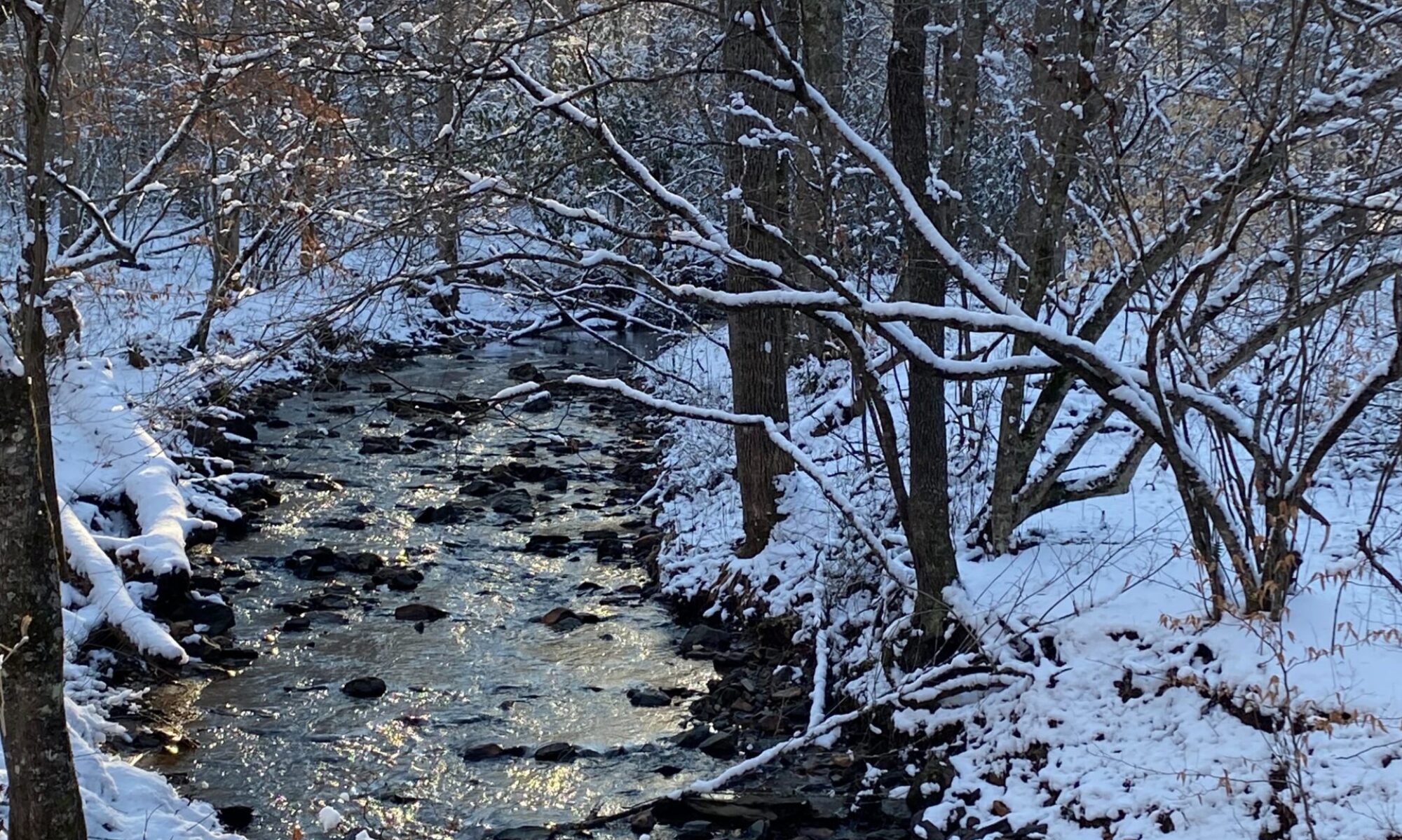

Because of the current winter weather, on top of last week’s ice, we will not be gathering again in person for worship this Sunday (February 1, 2026). Today, it’s snowing hard and tomorrow is to be extremely cold with high winds and blizzard-like conditions. Thankfully, I taped the sermon on Thursday so you can watch or read it. There will be a gathering of those interested on Zoom tomorrow morning (February 1, 2026) at 10 AM. If you would like a link, please send me an email at parkwayrockchurches@gmail.com. I will also send out a link to those who receive my weekly musings. Stay warm and safe. Check on your neighbors and help those you can get through this difficult time.
Jeff Garrison
Mayberry & Bluemont Churches
February 1, 2026
Matthew 5:1-12 (1-6)
At the beginning of worship:
I started reading Amy Leach’s book, The Salt of the Universe, this week. In this collection of essays, she deals with her childhood growing up in Texas as a 7th Day Adventist. I appreciate Leach’s deep knowledge of literature on a variety of subjects including the early Christian writers. I also found myself laughing at her gentle humor as when she introduced Basil the Great, one of the early church’s theologians, with a subtle warning not to confuse him with Parsley the Great.[1]
Leach wrote about one writer whom I did not know, Ellen White. I had to look her up. Married to one of the founders of the 7th Day Adventist movement in the 19th Century, White wrote many of the church’s documents especially concerning health and vegetarianism. Leach says she prefers another 19th Century New England woman author, Emily Dickerson. She then provides a quote from each woman about abstinence.
White: Let not one drop of wine or liquor pass your lips, for in its use is madness and woe. Pledge yourself to entire abstinence, for it is your only safety.
Dickerson: Who never wanted,-maddest joy
Remains to him unknown:
The banquet of abstemiousness
Surpasses that of wine.
Leach goes on to say: “One is abstinent for safety’s sake, the other abstinent for joy. One is abstemious due to fear of madness, other due to love of madness. The maddest joys, the wrenchingest songs, the stirringest stories—they all come from wanting. More intoxicating than having a thing is wanting it.”[2]
Jesus talks quite a bit about we desire and want. We need to want the right things and for the right reasons. We’ll see this today as we begin our exploration of his Sermon on the Mount.
Before reading the scripture:
This morning we start our exploration of Jesus’ Sermon on the Mount. While I’ll take a break over Easter, we’ll be working our way through the sermon for the next four months. Jesus’ sermon begins with nine beatitudes, or blessings, which seem to go counter to our ideas of blessings. While I will read all the beatitudes, we’ll only look at the first four today. These all deal with a blessing upon those who are in need. The needy experience God’s grace. Next Sunday, we’ll look at the blessings upon those who are helpers and see the truth behind the old saying, “No good deed goes unpunished.”
In a way, Matthew’s beatitudes illustrate an important principle of Reformed Theology. Grace always precedes action. We don’t earn our salvation; it’s a gift from a gracious God. In this manner, the beatitudes reflect the 10 Commandments, which came only after God has freed the Hebrew people from slavery.[3] God shows his grace and we respond which should cause us to want to show the same mercy to others than God has shown us.
I’ll read all the beatitudes this week and next but today will just focus on the blessings for those who are in need. We live in a world that looks down on the needy, but Jesus challenges such thinking.
Read Matthew 5:1-12
We learn at the end of the fourth chapter of how Jesus drew a crowd not just from Galilee, but all-over including Gentile areas. Then the fifth chapter, Matthew reiterates the idea of crowds following Jesus, which leads him to head up on a mountain. One of the debates around this sermon has to do with the audience.[4]Was Jesus speaking to the disciples or to the crowds? The opening of the sermon, which applies to the next three chapters, makes it appear Jesus talks to the disciples, but if you go to the end of the sermon, in chapter 7, the crowds appreciate Jesus’ message and claim he speaks with authority. I think Jesus intends this passage to be heard by everyone, including us today.
Jesus seeing the crowds heads up a mountain. We’re not told which mountain, but perhaps we’re to think Sinai or even Zion, although in the fourth chapter, we learn Jesus is in Galilee. But the unknown mountain setting may also be just to remind us of Sinai, where Moses receives the law, or Zion, the site of the God’s temple.[5] Or, maybe by sitting uphill, and addressing those downhill, Jesus can speak to a larger crowd.
Next, Jesus sits down and calls his disciples close to him. The sitting is a pose Jesus often uses to teach but may also imply a Christological statement. Sitting on a rock on the earth he’s to rule, he’s on his rightful throne.[6]
He begins his sermon. A beatitude would have be a familiar concept to the Jews who made up most of the crowd. There are many such Psalms which begin with a blessing including the very first Psalm, but it’s a conditional blessing. The blessing (or happiness as it’s often translated) in Psalm 1 is applied to those who follow God’s way and not the way of the wicked.[7] But Jesus bestows his blessings on those in need. His words are grace-filled. They also run counter to traditional logic. We easily ignore the broken down, grief-filled, and weak members of society, but because they have no one else, God will bless them. They’ll populate the kingdom of heaven, they’ll find comfort and inherit the earth.
We might wonder if the poor in spirit, who are promised the kingdom of heaven will be better off than the meek, who inherit the earth. But maybe it’s the same. After all, in Revelation, we learn they’ll be a new heaven and a new earth which appear to have been married together.[8]
Of course, such promises seem far off. On earth, in our worldly economy, those broken down by life find themselves cast aside. But the promise here is that God will be beside them. Jesus came, as we saw last week, not to those in power in Jerusalem or Rome, but to the people in the villages of Galilee who struggled to make a life in a brutal empire. Those who think they have it made may be in for a surprise in Jesus coming kingdom.[9]
This is why Jesus later emphasizes the difficulty the rich will in getting into the kingdom, saying it’ll be easier for a camel to traverse the eye of a needle.[10] Those who consider themselves rich don’t see a need for God in their lives. They think they have it made. But the poor, they have nowhere else to turn. It’s easier for them to grasp the free grace offered by God.
While the first three beatitudes focus on the helpless, the fourth beatitude encourages effort on our part. When we hunger and thirst for righteousness, we join with God’s desire for the world. Our hunger and thirst should create within us a desire, not for more stuff, but for the good and wholesome. My opening story from Amy Leach and her quote from Emily Dickerson captures such desire. As does Jesus, later in the sermon, where he encourages us to “Seek first the kingdom of God and its righteousness.”[11]
As Christians, righteousness often gets interpreted through the lens of Paul, who uses this word 29 times in his letter to the Romans. Paul understands righteousness as being inferred by God onto those who accept the grace and freedom offered by Jesus. In this manner, Paul rightly dismisses our ability to be righteous.[12] Matthew, however, comes at righteousness a bit different in the Sermon on the Mount. While God’s grace is freely offered, as we see in the first three beatitudes, we are to still strive to live noble and good lives.[13] I think Paul would agree.
Righteousness is not just a relationship with God, it also involves our relationships with others. Do we strive to do what we can to help others, especially, as Jesus later says in Matthew’s gospel, “the least of these”?[14]
Our fourth beatitude makes a nice transition into the next of blessings, where Jesus confers blessings to the helpers of the world. As Mr. Rogers said, during times of turmoil, “look for the helpers,” those who strive to pick up those who have fallen. Our world can be such a dark place, but those seek to do good and live honorably make it a bit brighter. And that’s our goal as followers of Jesus. As Jesus tells us later in this same sermon, we’re to be a light to the world.[15] Amen.
[1] Amy Leach, The Salt of the Universe: Praise, Songs, and Improvisations (New York: Farrar, Straus and Giroux, 2024), 36.
[2] Leach, 35.
[3] Frederick Dale Bruner, The Christbook: Matthew 1-12 (1990, Grand Rapids, MI: Eerdmans, 2004),155-156.
[4] Bruner, 153-154.
[5] Douglas R. A. Hare, Matthew: Interpretation, a Commentary for Teaching and Preaching (Louisville, KY: John Knox Press, 1993), 35. For a more detail discussion on the meaning of the mountain, see Jonathan T. Pennington, The Sermon on the Mount and Human Flourishing: A Theological Commentary (Grand Rapids, MI: Baker Academic, 2017), 138-140; and Bruner, 152-153.
[6] See Hare, 34; and Pennington, 140-141.
[7] For my sermon on Psalm 1, see https://fromarockyhillside.com/2023/01/08/psalm-1-two-roads/ Other examples of beatitude Psalms include: 32, 106, 112, 119, 128.
[8] Revelation 21:1ff.
[9] This certainly seems to be the case in the Parable of the Judgment of the Nations in Matthew 25:31ff.
[10] Matthew 19:24.
[11] Matthew 6:33.
[12] All have sinned and fallen short of the glory of God,” Paul writes. Romans 3:23.
[13] For a discussion on how Paul and Matthew use the term “righteous,” see Bruner, 169-170.
[14] Matthew 25:40, 45.
[15] Matthew 5:14.
I’m looking forward to this series, Jeff. The Sermon on the Mount is one of my favorite parts of the New Testament. The message of Jesus is much needed at this time. Stay safe and warm! I’m so grateful to be out of winter.
While I have preached from the “Sermon” this will be the first time to work through it verse by verse. I’m looking forward to it.
That was an interesting read. Thank you for your thoughts.
Glad you found it interesting.
Excellent! I look forward to this series of sermons.
So am I. I have preached on the Sermon on the Mount, but never working through the entire sermon in one shot.
Enjoyed the sermon and I read some of Ami and like it, may look for her books
Thank you for all you do for us.
Stay warm
M&M
In addition to this book, I also have her first book, Things that Are, which I’d be glad to lend to you. I hope you and Mike are staying warm.