I have a love affair with maps. It started in childhood when we lived in Petersburg, Virginia for a few years. As a third grader, I studied the maps of my home area during the Civil War. A couple years later, as a Boy Scout and living near the coast of North Carolina, I began to draw maps. I drew woods behind our home along with favorite camping areas. There were also the creeks and the islands around me. Gradually, I moved into larger maps and imagined trips to far flung places in the world. I have boxes of maps covering highways, railroads, topographical and geological maps.
While it doesn’t compare to traveling and exploring, I spend hours poring over maps. They tell us a lot about our world. I prefer that maps that cover a wide view of the landscape instead of strip maps, which just show the area traveling.
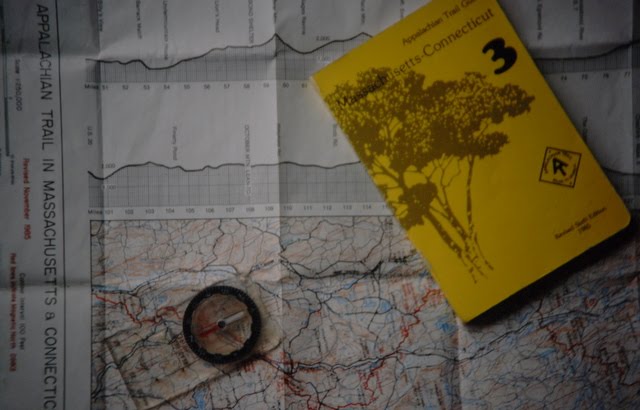
A set up shot showing strip trail maps (including elevations) along with my compass and a guidebook
Most of the maps used when I hiked the Appalachian Trail were strips. I often found myself wanting to know what was just off the map. At night, I might look at distant cities lights below and wonder what city, but it was off your map.
The same is true with the old American Automobile Association’s TripTik maps. They were fine for showing you what was on the roads you intended travel. But what if you decided to take a detour? Of course, they also had state maps that provided such detail.
My favorite maps are the old 7.5- and 15-minute quadrangle topographical maps. When hiking out West, I often used such maps. Standing on one peak, I could pick out the other peaks. With such maps and a good view of the terrain, I would orient myself without even pulling out a compass.
The sad future for maps
Sadly, maps are going out of style. We now navigate more and more by GPS and google or Apple maps. The electronic version, seen on a 3 inch screen, makes the old TripTiks seem full of detail. I also find it much harder to dream using an electronic gadget. The linear strips of maps focus us just on where we are at and where we are going. We fail to see ourselves in the world. These medieval maps remind us that world is complex when we add the spiritual realm. I ordered the book. When it arrived, I skipped over other books on my TBR pile to delved into Deam’s medieval world.
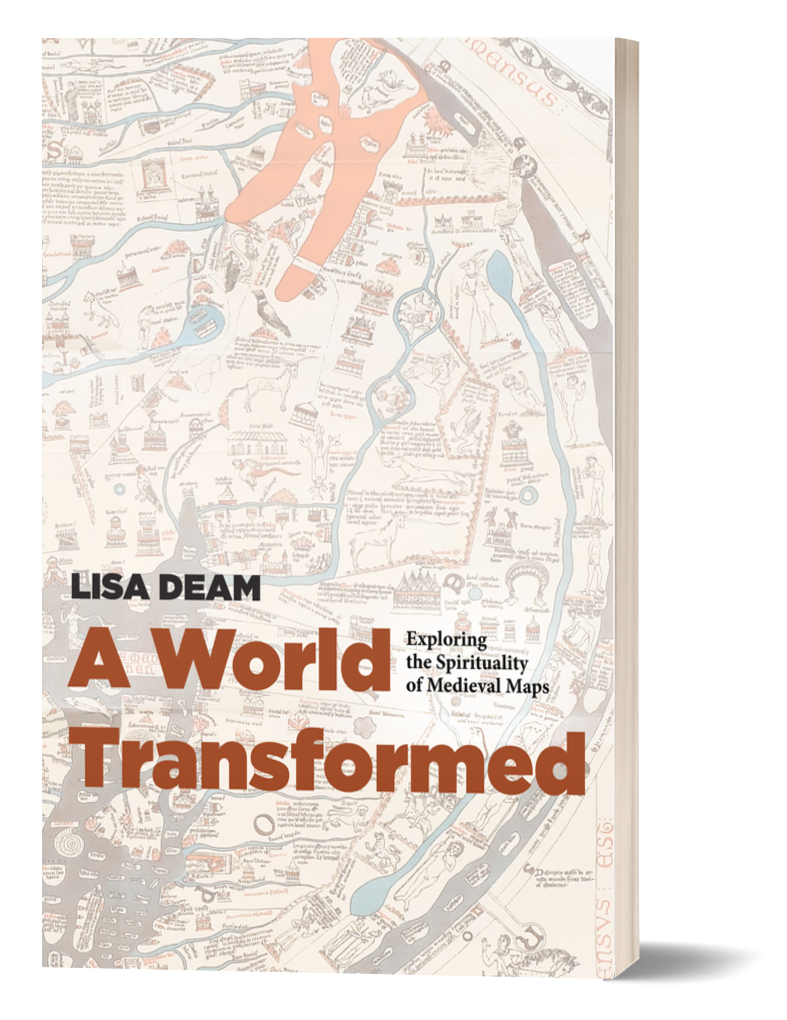
Lisa Deam, A World Transformed: Exploring the Spirituality of Medieval Maps
(Eugene, OR: Cascade Books, 2015), 142 pages including notes, drawings and photos.
Lisa Deam has a PhD in art history. Torn between the study of art and religion, she found a way to blend the two with medieval maps. These old maps are not the equivalent of the gas station maps I grew up studying. Such maps were works of art. Most of these maps centered the world by placing Jerusalem, the locale of Christ’s atoning death and resurrection, in the middle. Everything else in the world flowed there, including the three known continents of the pre-enlightened world.
Some of these ancient maps also had Christ behind the world, with his hands and feet holding the world up. Often the edges of the maps contained monsters and were scary places. But with Christ’s hands and feet the medieval travelers were reminded they were not alone when travelling. God’s protection was present.
These maps also contained a lot of information. Of course, some of the monsters were fantastical, but the map contained bits of history beyond what happened in Jerusalem. Interestingly, one of the themes were the conquests of Alexander the Great. Of course, one studying such a map in the 1300s would have no idea or first-hand knowledge of these places where Alexander or even Jesus walked.
The Hereford Map, produced around the year 1300, receives the most attention from Dean. This four-foot map resides in the cathedral has great detail. She also spends time with the Ebstorf Map and a small “Psalter Map.” Unlike the other two, the Psalter map was designed for private devotion.
Recommendation
Dean does not set out to write a history of cartography. Instead, we’re taken into the world of the era and invited to think of how their worldview and beliefs were seen through these maps. In addition, questions at the end of each chapter invites us to contemplate about our own lives and worldview in relation to God. While the book contains much new knowledge of maps in the 13th and 14th Centuries, it’s really written as a devotional guide.
I enjoyed reading this book. I only wish it included a 4-foot square copy of the Hereford Map that I could have spent lots of time poring over as I read the book. It does include a small version of the map and a few large, detailed sections of the map for the reader to see with their own eyes what the author is describing. I recommend this book.
Today is Robert Burns Birthday, the poet from Scotland. It’s also Virginia Woolf’s birthday, but for some reason Burns draws more interest. It’s probably the whisky. After all, Woolf is English and who’d want to drink gin when you can have the water of life. In honor of Burns, I’m pulling this post from my old blog, which is a talk I gave back in 2018.
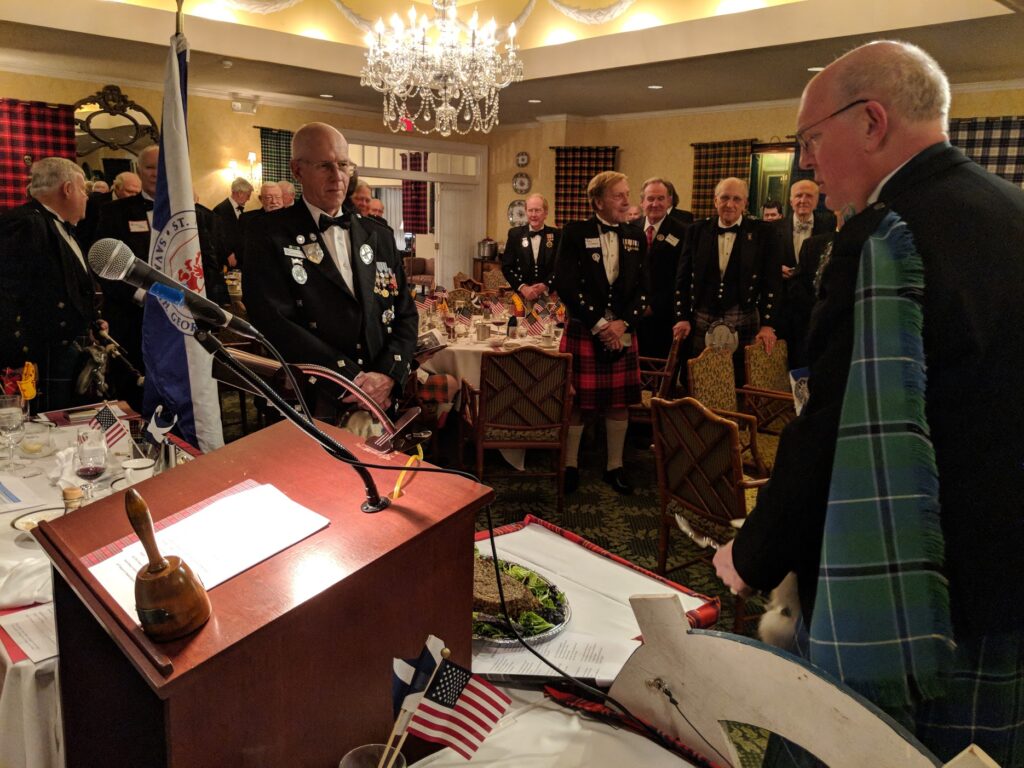
I gave this Burns Night talk to the St. Andrew’s Society of the City of Savannah on January 26, 2018
Addressing the Haggis
Wow! In our program tonight I am identified as a Rector. I’m not sure how to take this. Should I be honored? After all, the word comes from an old English meaning “to rule.” Or perhaps, because I’m in a crowd of Scots, I should be afraid. As you know, Scots are independently minded. I can assure you that you will not find a minister within the Church of Scotland, the mother church of all Presbyterians, referred to as Rector. You may find the headmaster of a school referred to in that way, but as for the Kirk, that’s way too English, way too Anglican.
Let me take this moment to share with you a bit of history. In the 17thCentury, following the Scottish Reformation, the people of Scotland signed the National Covenant, which adopted a Calvinist theology and a Presbyterian form of government. This placed Scotland not only in opposition to the Roman Church, but also to the Episcopal form of government as advanced by the Anglicans.
There were a number of battles over these issues. The Scots don’t like being told what to do. They didn’t like being told that had to pray in a particular manner so they resisted the Anglican prayer book. The clergy didn’t like being told they had to dress all fancy when leading worship which led to the adoption of the Geneva robe. And the Scots had a problem Bishops and clergy vested with lots of power, so they adopted a system of government that shares between the clergy and lay elders.
As you can imagine, this didn’t go over well with the crown. They liked the idea of having loyal bishops who could help it control the Kirk. The church fought back and eventually a compromise was achieved. The Crown would be Anglican when they were in England, and when in Scotland, they’d be Presbyterian. In Scotland, the Queen has no Bishops to do her bidding and there are no rectors within the Kirk.
Now on to matters at hand—our remembrance of Mr. Burns. Sadly, I never studied him while in school. In college, the only poets of interest to me were musicians. Steely Dan was a favorite. They had some immortal lines back in the seventies and eighties, one of which comes to mind this evening. It’s from their hit song, “Deacon Blue,” and you may know it. “Drink Scotch Whisky all night long and die behind the wheel.” A great line, but please, don’t try to live it out. We could say the same for he same for many of Burn’s ideas and examples.
I was in Scotland this summer. As you’ve heard, I scheduled a couple days around Edinburgh with a friend of mine, Ewan. He’d taken time off to be with me, but as it happens in our calling, people are not always considerate as to when they die. On our second day together, I could go to a funeral for a woman I didn’t know or spend the day tramping around Edinburgh on my own. After that hospital visit, I chose the latter.[1]
I started out my morning by the castle which dominates Edinburgh’s skyline. Having toured it before, I wanted something without long lines. In the shadow of the castle, I’d learned of a Writer’s Museum and, fancying myself as a wannabe writer, decided to visit. Besides, the admission is free which warmed my Scottish blood.
But the museum is hard to find. I had to humble myself and ask for directions. Not only did I have to do this once, but several times as it appears not many people know of the museum. Finally, someone pointed me to a small alley and said I’d find it up there. There were no signs, but the alley opened up into a square and there was the museum. It’s housed in a very old but unique home with wonderful wooden spiral stairways. There are large exhibits on Robert Louis Stevenson, Sir Walter Scott and the man of the night, Robbie Burns. As a kid, I’d read Treasure Island, so I spent most of the time in the Stevenson’s section, while quickly running through the other parts. Had I known that I was going to be expected to talk about Burns, I would have lingered a little longer…
Leaving the museum, I worked my way across the city. One stop you’ll have to make is the Scott Monument, named for the author not the people. If you’re not claustrophobic or afraid of heights, I recommend you climb it. From the top is the most incredible views of Edinburgh. I think it’s even more striking than the views from Arthur’s Throne. So the next time you’re in Edinburgh, if you are in reasonably good shape, have five pounds to spare and a few more to lose to exertion, and enjoy the snugness that comes from being confined in a straightjacket (as the stairwells are smug), check it out.
Don’t worry, I’m getting closer to Burns… By mid-afternoon I’d made my way to Canonsgate Church. It’s the burial site for Adam Smith and I wanted to pay my respect and do a Facebook selfie to dispel any rumors that I have socialist leanings. While there, chatting with a guide, I asked if there were others buried in the church yard that I might be interested in. “Oh yes,” she said, “On the other side of the church is the grave of Robert Burn’s lover, Clarinda.”
I’ve told you that I’m not a Burn’s scholar, right? But I knew enough about the man to know that he had more than a few lovers across Scotland. “I’m sure you’re not the only church in Scotland claiming a grave of a Burn’s lover,” I said. She took offense at my sarcasm and reminded me that Clarinda was special. What does that make his other lovers?
In Garrison Keillor’s novel, Wobegon Boy, the protagonist writes a poem for his wife as a wedding gift. Reading it she embraces him and it suddenly dawns on him why men have been writing poems all these centuries: “to impress a woman with the hopes she will sleep with you.”
Our friend Robbie wrote many such poems for Clarinda. The two of them lured each other with their poetry and correspondence even though they likely never consummated, in a physical manner, their relationship. But their letters and poems are to be cherish. Clarinda is the reason we have “Ae Fond Kiss” and “Clarinda, Mistress of My Soul.”
Of course, Clarinda wasn’t her real name. That was Agnes, but everybody called her Nancy. That is everyone but Burns, who gave her this beautiful nickname that is much softer sounding than Agnes and less common than Nancy. And, with this secret name, it was a safer way for Burns to correspond with a married woman.
We can speculate as to why Clarinda maintained her purity while Burn’s promised to conquer her “by storm and not siege.” Their relationship got off to a slow start because after first meeting, Burns had to cancel their next due to an accident that put him on crutches and in bed. But there were other reasons.
Clarinda was pious and religious and even though her husband had run out on her, she wasn’t going to do the same. She would later travel to Jamaica in an attempt to win him back. And then there were a few other details. At the time they were flirting with each other, Robbie had already planted his seed with Jean Armour. When Clarinda resisted Burn’s advances, the poet set his eyes on her servant, Jenny Clow. Ms. Clow would also give birth to the poet’s child. Only a fool would be lured into his bed with the thought she’d have a long-lasting relationship with the man whose seed was germinating all over Scotland. Clarinda was no fool.
Clarinda and Burns were attracted to the others use of language. Both were gifted, and Clarinda was nearly Burn’s equal with the pen as these few lines illustrate:
Go on, sweet bird, and soothe my care, Thy cheerful notes will hush despair; Thy tuneful warbling, void of art, Thrill sweetly through my aching heart. Now choose thy mate, and fondly love.
Although Clarinda probably never allowed Robert to take her to bed, the words the two of them exchanged were certainly intimate and salacious. As an old woman, she looked back fondly on their relationship and said she hoped to meet him in heaven. Of course, that’s assuming Burns made it… The Rev. John Kemp, Clarinda’s pastor, certainly had his doubt as to Burns eternal destination. Maybe he and Burns share eternity together. Later, the Good Reverend was discovered to have three wives at the same time! Had Burns’ lived, he would have enjoyed the satirical wit that situation offered.
Clarinda, Jenny, Jean (not to mention Mary and a few others)… What would be Burns’ fate if he lived in today’s “Me Too” climate? I mentioned Garrison Keillor and we know what happened to him, along with a long line of other popular folk whose sexual indiscretions have come back to haunt them. I don’t know how this would affect Burns. It may not have had any impact. In his day, more than one minister chided Burns for his behavior. He didn’t seem to let their scolding’s worry him.
Poets are often great lovers. Their command of language is such that they can take words and draw our minds into new places and possibilities. Think of King David, a poet from the Bible. Many of the Psalms are attributed to him and, we’re told, he was a man after the heart of God. And like Burns, he wasn’t always honorable. This is speculation, but can you image the love note he sent down to Bathsheba? Of course, we know the pain that little affair caused. Poor Uriah. But we remember David, with his frailties, because we all have had our own shortcomings. David gives us hope and shows us the wideness of God’s mercy.
Burns may not have had the same desires for God as David, but we still appreciate him. In his day, he brought humor to a serious society and pointed out social inequalities and hypocrisy. And today, he us still reminding us to look for beauty. Furthermore, Burn’s collection of poems and songs in the Scottish dialect provide identity to those of us whose ancestors left those rocky shores. Our hearts are still warmed by the beauty of heather blooming in the crags. And, even better, we can easily plagiarizer his poems when we court our sweethearts.
I did visit Clarinda’s grave that afternoon. It was covered with flowers—fresh flowers. She’s buried next to her cousin, Lord Craig. His grave looks like it was last attended to during the Boer War. It’s been nearly two centuries years since her death and there are people who not only remember her, yet think highly enough of her to regularly place flowers on her grave. That’s quite an honor. Here’s to you, Clarinda.
Thank you.
Feb. 1, 2021: I recently came across this article on Burns:The Scotsman
Sources Consulted:
_________, Robert Burns in Your Pocket (Glasgow: Waverley Books, 2009).
Brauer, Jerald C., editor, The Westminster Dictionary of Church History (Philadelphia: Westminster, 1971).
Dawson, Jane, John Knox (New Haven: Yale, 2015).
Douglas, Hugh, Robert Burns: The Tinder Heart (Gloucestershire, UK: Alan Sutton Publishing, 1996).
Herman, Arthur, How the Scots Invented the Modern World (New York: Random House, 2001).
MacCulloch, Diarmaid, The Reformation: A History (New York: VikingPenguin, 2005).
[1] I had this story used in my introduction (The story came from the Chic Murray Facebook site and was “adapted” for this occasion:
This past summer, our speaker was visiting the Rev. Ewan Aitken, a friend of his in Scotland. Ewan asked if it was okay for him to run in and see someone at Edinburgh General Hospital.
“No problem,” Jeff said, and asked if it was okay if he went in, too.”
“Come on.” Ewan said. While Ewan was making his pastoral visit, Jeff decided to see what he could do to cheer up some of the patients. He stepped into a ward and went up to a bed and said hello.
The man looked up and said, “Far far yer honest sonsie face great chieftens o the puddin race a boon them aw you tak..
Oh for goodness sake, Jeff said and moved on to the next bed
“WEE courin timid beastie wad caused this panic in tha breastie…..” the patient mumbled.
Shaking his head, Jeff moved to the next bed.
“Some hae meat and canna eat and some hae nane and want it…”
At this time, Ewan was ready to leave and came over to Jeff who asked if this was the insane ward.
“Oh no,” Ewan, said, “this is the SERIOUS BURNS UNIT.”
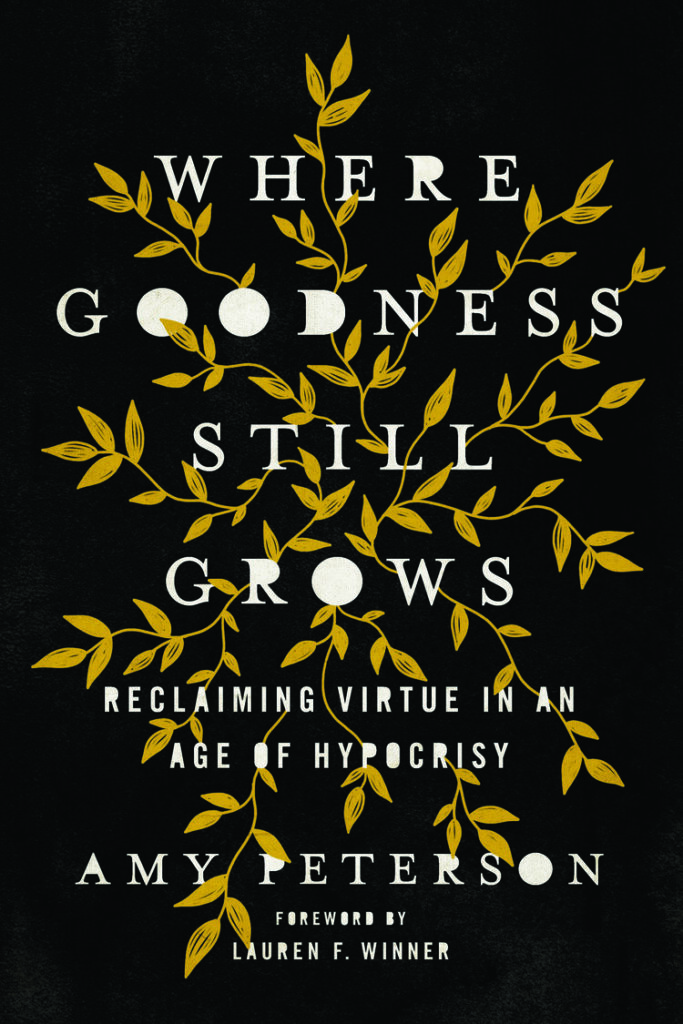
Fifteen years ago, I read Reverence: Renewing a Forgotten Virtue by Paul Woodruff. Since then, I’ve read it several times and have spent considerable energy thinking about virtues. Perhaps this itch drew me to this book. In this age when truth seems so elusive, we need to have a conversation about virtue and how to ground society in that which is good.
In her Introduction, Peterson writes about growing up in an evangelical Christian home in the later part of the 20th Century. As a teenager, she watched as church leaders lambasted President Clinton as unfit for office. As a child, she was nurtured with stories of virtue collected by William Bennett. Later, she served a missionary stint in Southeast Asia. But she began questioning what she had been taught. The watershed moment was the election of Donald Trump and the flipflop of evangelical leaders who accepted or willingly forgave Trump’s behavior. She began to question if those who claimed to be virtuous in the 90s were only doing so as a way to “preserve power and keep everyone in place.” This soul-searching led Peterson to “reimage” a world built on Biblical virtues. And, it appears, her faith has become stronger and grounded more firmly in the Biblical tradition.
What a virtuous world might look like:
Lament
Where Goodness Still Grows is Peterson’s attempt to outline what a virtuous world might look like. She explores nine spheres, as she tells her own story as well as digging deep into the Biblical story and the story of others. Lament is the first area explored. Having been steeped in “praise services,” lament becomes a useful tool for crying out to God for what is wrong in our world.
Kindness
The second area explore is kindness. She breaks apart the word that has evolved from an Old English concept of maintaining one’s position along the economic ladder. This leads her to come to an uncomfortable understanding about how her parents and grandparent’s “kindness” provided her with a status not enjoyed by many within minority groups. Her Biblical understanding of kindness requires her to see God’s image in everyone and may possibly require a redistribution wealth.
Hospitality
Peterson explores includes hospitality, where she questions how evangelicals can be so against immigration.
Purity and Modesty
She challenges the evangelical church’s link to purity and modesty only to sexuality. She finds no support for this within scripture. the Bible ties purity to the Temple. Modesty is often about not flaunting wealth. By linking modesty to how women dress, is to miss the Biblical view and also to create a low standard for men who need to have women dress themselves in a modest manner to keep their “animal instincts’ in check.
Authenticity
Peterson recalls her desire to be authentic. Within the church she grew up in, praying spontaneously was viewed as authentic. Rote prayers were inauthentic. As she matured (and later found a home within the Episcopal Church), she understood a different view of authenticity. Writing about authenticity, she comes back to the evangelical support of Trump. She believes his ability to be spontaneous and having fresh ideas drew evangelicals. Instead, Peterson ties Biblical authenticity to being a disciple of Christ, clothed with the virtues of Colossians 3:12. However, this does not mean that one can’t be authentic if one isn’t a believer.God’s image allows us the ability to be authentic. At the end of the chapter, she makes the case that spontaneity shouldn’t be tied to authenticity within the church. “Authentic Christians” practice daily the role given. We are sinners, “saved by and growing in grace.”
Love and Hope
Another areas Peterson explores is love. She finds love often contradicted in evangelism training that tended, in her experience, to objectify others. Another area is discernment. We cannot logically prove everything. There must be room for mystery. Finally, she investigates hope through an extended metaphor of raising chickens, which gives her a whole new understanding on Jesus’ lament on how he’d like to be a mother hen and protect Jerusalem under his wings. As a mother, this image is powerful for Peterson. Her chickens and other “homesteading” projects helps her understand our humanity. There is hope in being “gathered like children under a mother’s wing.”
My recommendation
In her introduction, Peterson suggests that her work isn’t the “definitive answer about virtue.” But she hopes it will raise questions. This she does. Peterson also leaves those of us who have never brought into a more simplistic view of the world as presented by fundamentalist Christianity with a little more hope. Hopefully, her book will encourage Christians to think about truth and what God wants for our world. If you read this book, I’m curious as to your take on it.
I’m in shock over this week’s events at our nation’s Capitol. If you are a praying person, will you join me praying for our country.
We need to open ourselves to God, asking for insight in how what we might do as individuals and in the groups we’re a part of to being healing to our nation.
There will be a lot said about yesterday’s events in the days and weeks (and months) ahead. I am sure there are those I will agree with and those with whom I will disagree. However, we should remember one of the founding principles of the Presbyterian Church. “There are truths and forms with respect to which men of good character and principles may differ, “our Book of Order states. In these things, it is the “duty both of private Christians and societies to exercise mutual forbearance toward each other.” How we relate to those who think and believe differently from us is a telltale sign of the trust we have in God.
That said, as a follower of Jesus and a pastor, these are some things that weigh heavy on my heart.
Words matter
First, our political rhetoric has gotten out of hand. It seems people on all sides think that if the government doesn’t do what they want, or if the vote at the ballot box doesn’t go their way, it is a personal affront and they have a right to take things into their own hands. While the right to peacefully protest is a hallmark of our nation, we do not have the right to incite violence or to intimidate others. If this doesn’t stop, we’re going to destroy ourselves and our nation.
The problem of white privilege
Next, as many of my African American friends have pointed out, if those who attacked our Capitol were people of color, there likely would have been more bloodshed. White privilege is real. You can see this with the supposedly Q-anon leader stomping though the Capitol with bull horns, dressed like Hagar the Horrible. Had he been a person of color, instead of roaming around like a pagan Viking, his blood would likely be flowing across the marble floors.
The misuse of Jesus’ name
Finally, as I posted on Facebook on Wednesday afternoon, I was offended to see people on the porticoes of the Capitol with signs and flags bearing Jesus’ name. These were not law-abiding protestors. They had already pushed past the barricades set up for those protesting. The above photo I snapped from my TV screen. The sign says, “Jesus Saves.” I doubt such a sign will convince non-believers that Jesus is the Prince of Peace. Would the Jesus, whom we know through the Gospel stories, be seen taking part in such a demonstration?
No, Jesus, the one who had the power to call down angels to save himself, refused to take part in any insurrection. He also stopped his followers from going down such a path, telling Peter to put away his sword. My advice for those who carried such signs and symbols yesterday is to leave Jesus out of whatever devious plans they concoct. If they really believe in Jesus, they should immediately drop to their knees and beg forgiveness. Such signs are a violation of the commandments. It’s blasphemy.
Let’s pray
We all need to be praying and confessing. We need to confess our failure to live up to our ideals as we seek a better way forward. I offer this simple prayer:
Lord, what we witnessed this week was humbling and scary. We are blessed to live in a nation rich with opportunity. We are grateful. Yet, we realize our hands and our hearts are not clean. Forgive us when we did not speak up for justice, when we did not support those being demonized, and when we didn’t challenge false and dangerous ideas. Show us, Lord, how you might use us to build bridges with others who have also been created in your image. Use us, in the words of Francis of Assisi, to be an instrument in your peace. Lord, what can I do to further your kingdom? Amen.
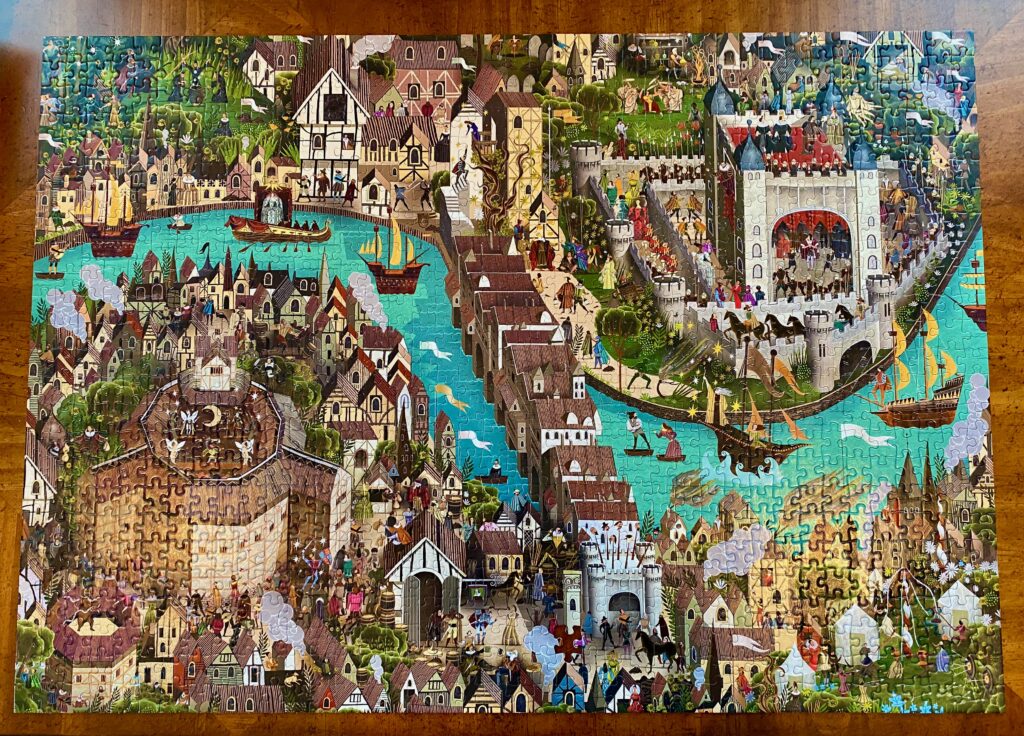
The “Christmas Puzzle” at the house which was completed a little over an hour before midnight on New Year’s Eve
2020 has come to an end. It was a year that we’ll not forget. Personally, it didn’t rise up to the trauma of 2016 (when I ruptured my quad-tendon, was in the hospital with sepsis following a prostate biopsy, and dealt with a tropical storm and later Hurricane Matthew), but it was still a terrible year. Stuck at home with a pandemic and unable to escape from the political rhetoric made for some long days. Vacations were cancelled. I still haven’t been to Fenway Park (which was scheduled for mid-June). And we enter 2021 with much of the same going on. The pandemic is raging and the political rhetoric hasn’t tone down. Maybe the best thing to do is to escape into a puzzle or a good book.
The puzzle above was done in our house between Christmas and New Year’s Eve. It is of Shakespeare’s London and you can see snippets from 16 or so plays within the puzzle, along with others from his era (Queen Elizabeth I, John Donne, Sir Walter Raleigh, Francis Drake). It wasn’t the easiest puzzle but a icy rain on Christmas Eve that turned into snow meant there was no reason to get out, so time was put into finding the pieces.
2020 Reading Summary:
Number of books: 53 of which 37 were reviewed in my blog Categories: History, Biography and Memoir: 18; Bible, Theology, Church: 11, Poetry: 7; Fiction: 6
A few insights into my reading:
-I have now read the first four volumes of Robert Caro’s biography of Lyndon Johnson. Like a lot of others who are interested in this man and this period of history, I am impatiently waiting for his fifth volume (the fourth just got us through John’s first year in the White House after Kennedy’s death). -Four of the authors I’ve read are good friends and I have met another six of the authors. -With the racial troubles our country faces, I found myself reading several African American theologians and a new history of the 1898 Wilmington (NC) racial troubles (or atrocity). One of the books on my TBR pile deals with the Tulsa race war. -I am spending more and more time with poetry (and I alway read books of poetry at least twice). -It appears I need to read more fiction!
My favorite books:
In my opinion the best book I read during the year was Andy Rooney’s My War, followed by S. C. Gwynne’s biography of Stonewall Jackson. This is my second book by Gwynne (I read his biography of Quanah Parker, Empire of the Summer Moon, in 2017). If God is willing, I’ll read whatever else he publishes. My favorite fiction book was Steven Pressfield’s Gates of Fire, which is a historical fiction account of the Battle of Thermopylae. If you don’t remember that battle, don’t worry. Ii occurred a few years before our time…
Here’s My listing of books read (posted by the order I finished the book), along with links to those I reviewed:
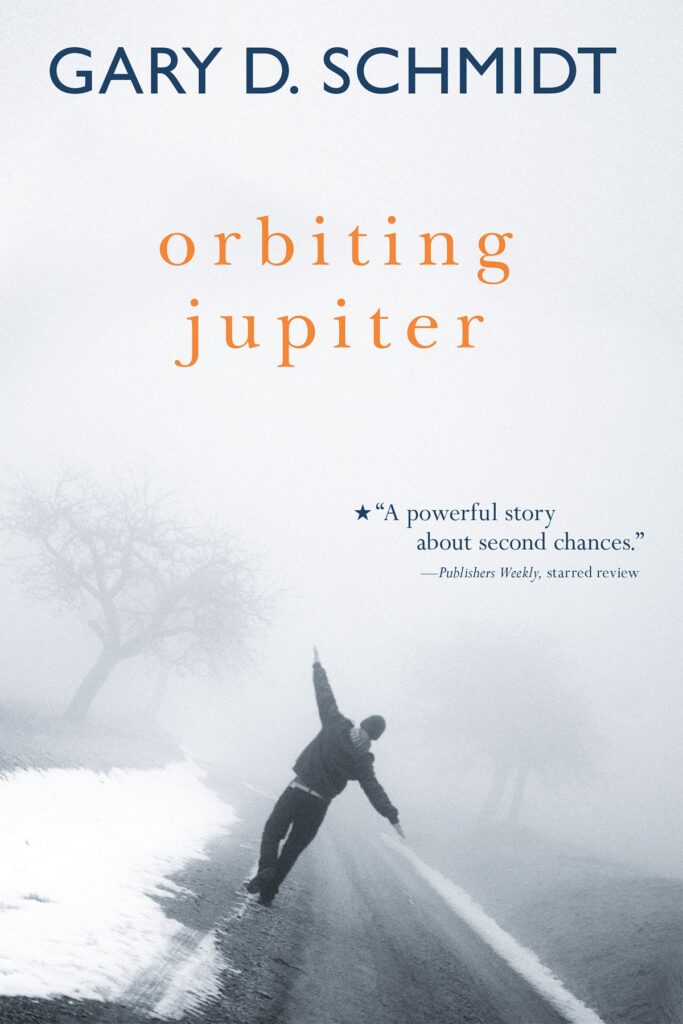
This young adult novel is about Joseph. A teenage father, he’s sent to a foster family who own a farm in rural Maine.
The family has one other boy, Jack. After getting off to a shaky start, the two become like brothers, watching out for the other. The story centers around what happened to Joseph in his past. When he was 13, he fell in love with Madeline. While Joseph was from a broken family that economically lived on the margin, Madeline’s family was well off. When she became pregnant, they sent her away where she gave birth to a daughter she named “Jupiter.” The planet plays a prominent role in the story as Joseph had pointed it out to Madeline and he often looks for it in the sky. The story’s conclusion occurs around Joseph attempt to find his daughter.
Upon Joseph’s release from Stone Mountain, a juvenile detention center, he find himself with chores to do on a farm. He works beside Jack and makes friends with Dahalia, one of the orneriest cows in the barn. Thereafter, he’s the one who milks her. At school, he struggles with some teachers who think he shouldn’t be in school, but others see promise in him. Joseph is exceptionally strong in math and a prospect for the track team. The story occurs in winter. Schmidt captures the the cold of Maine. When milking, the boys lean in on the cows to capture their warmth.The frozen landscape makes the river dangerous, but also creates an opportunity to ice skate on the family’s pond.
Christmas is especially meaningful for Joseph as he attends church with the family and learns about Joseph, Jesus’ earthly father. He also learns of Mary’s early age. While Schmidt doesn’t mention it, it’s traditionally assumed the Virgin Mary was 14 when she gave birth. This is Madeline’s age when she gives birth to Jupiter. I won’t spoil the ending. However, this book is sad, and I found tears in my eyes. Yet, there’s hope in the child, Jupiter.
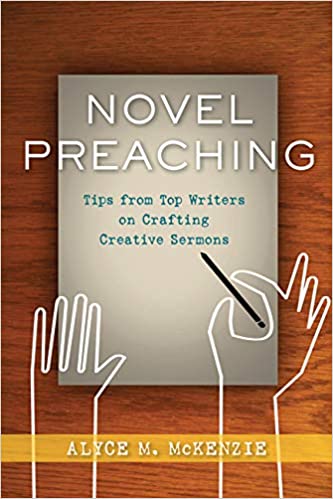
Alyce McKenzie, Novel Preaching: Tips from Top Writers on Crafting Creative Sermons
As a “working preacher” who has also taught homiletics on a graduate level, I try to read at least one book a year on the craft, along with another book on writing. This year I chose this book, written by a professor of homiletics at Perkins School of Theology, a Methodist seminary in Texas.
Writer’s Conference
This book is divided into three parts. The first two deal with the practice of preaching, where the author attempts to provide the information in a creative manner. In the first part (which is what I thought the book was about from its title), she images being at the Breadloaf Writer’s Conference. Taking her readers along with her, we go from conversation to conversation with fiction authors. As we overhear their discussions, we gain insight into how preachers might us some of the tools of authors to engage his or her congregations in their sermons. We learn about noticing and being aware of what’s important in the text and in our sermons. McKenzie draws from a number of authors including Annie Dillard, Natalie Goldberg, Frederick Buechner, Stephen King, Isabelle Allende, Toni Morris. We gain insight into character, plot, and shape along with picking up ideas of how to journal and to capture such insights into the human condition.
A Cooking Show
The second part of the book involves a cooking show. Here, she draws from well-known (and some not so well known, at least not for me) professors and writers of homiletics. Each one teaches how they approach a sermon, and the reader gets to pick up a recipe card at the end of their presentation. By the time I got to this part of the book, I was a little over with the cuteness of McKenzie’s writings. The writer’s conference wasn’t quite as overblown as this imaginary journey through some kind of convention with all kinds of “chefs,” a few of whom I’ve met, many of whom I’ve read and heard lecture. Those I knew before reading this book include Charles Rice, Fred Craddock, Tom Long, David Buttrick, Richard Eslinger, Henry Mitchell, Paul Scott Wilson, Nora Tubbs Tisdale, Justo Gonzalez, Eugene Lowry and Mike Graves. To her credit, McKenzie draws from across Western Cultures including African American, Korean American, men and women, Protestants and one Catholic example.
Best part of the book–Sermons
I found myself wondering about those not included: Tex Sample (who focuses on the language of the working class), Cornelius Plantinga, Jr (who has written about preaching and literature long before this book’s release), Robert Smith, Jr (an African American who has strong grasp of doctrinal preaching), and Haddon Robinson. The latter really surprised me as his Biblical Preaching may be one of the most popular books on preaching and is the “bible” of expository preaching.
The final section of the book was my favorite. The section consists of a number of creative sermons written by McKenzie. Who’d ever think of angels as UPS workers (after all, angels deliver messages from God which ties into the packages delivered by a UPS driver. I’ll come back to these sermons, I’m sure. McKenzie is able to touch on her audiences fear and concerns and offer a helpful word of reassurance from scripture. I would have preferred to have read more sermons and less of her “tidbits” of information from authors and homiletic professors.
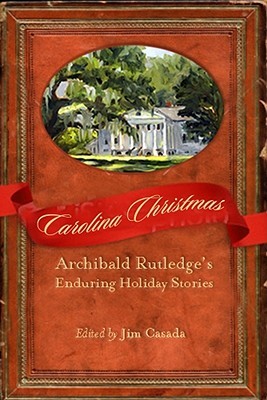
edited by Jim Casada (Columbia, SC: University of South Carolina Press, 2010), 225 pages.
Archibald Rutledge was the poet laureate of South Carolina for decades. He was a well-known poet and author writing about nature and hunting during the first half of the 20th Century. Having read several of his works beforehand, I waited till a week before Christmas to read his collection of “Christmas stories.” This book was a gift from my staff in Georgia.
While the book is filled with Rutledge stories, Jim Casada selected the stories included within the collection. Casada also provides insight into when the selection was written, the circumstances around the story, and where it had previously been published. Many of these stories have been published multiple times. First, in magazines (especially Field and Stream, Outlook, and Outdoor Life), and later in collections published by Rutledge.
The book is divided up into six parts. The first section all deals with Christmas stories at Hampton Plantation. Rutledge spent thirty years teaching at Middlebury Academy in Pennsylvania. During these decades, he would always come home for Christmas. In one story, he writes about catching a train during a blizzard up north and arriving on the Atlantic Coast Line early the next morning in the sunny South. His brother meets him at the train station in Charleston and two hours later they’re hunting. Such descriptions brought back memories of me, as a young seminary student, catching a train from Pittsburgh during a snowstorm, heading south to visit my sister the week before Christmas in Florida. When the train arrived in Savannah early in the morning, wearing shorts, I went for a walk along the platform.
A Natural Christmas
The second part of the book, titled “A Natural Christmas,” has selections where Rutledge describes walking in the forest and fields of coastal South Carolina during the Christmas break. Known as a hunter, we are provided a glimpse of Rutledge’s vast knowledge of wildlife, especially birds. While most of these stories are about watching birds, he mentions dove hunting. During such a hunt, in 1896, he shot a bird twice the size of the others. It turned out to be a passenger pigeon. Before Rutledge’s time, these birds flew in vast numbers that would darken the sky. But even by the time Rutledge came along, they were rarely seen. This story was published in 1911. That was just three years before the last of passenger pigeon died in a Cincinnati zoo. I find it interesting the world Rutledge describes had not yet been impacted by chemicals like DDT. Such chemicals have been destructive to birdlife. Reading his prose is to be taken back to a more primeval world.
Deer Hunting
Deer hunting is the focus of the third part of the book. Such hunting on the coastal plain is done with shotguns. In telling the dangers of using rifles in such flat terrain, he draws on a familiar form of transportation of his day. “Express bulletins don’t make no local stops,” he humorously notes. Around Hamilton, deer hunting was also done with dogs who would chase the deer out of the bays and swamps. While I never hunted with dogs, I did go a few times with my father. I was not yet old enough to carry a gun. We were stationed along a remote road. We froze while waiting and listening for the dogs to drive the deer out way. While my dad did shoot several deer, he never did when he had my brother and me in tow. Again, these stories are filled with wisdom and insight into hunting. My favorite of his deer hunting stories was the last. In this story, he prepared to take his son hunting when he returned from Europe after World War Two.
Other Game
There is a small section of stories about hunting other wild game, especially turkey and quail. He mentions squirrel, rabbit, duck, and ‘coon hunting, but his stories are mainly limited to deer, quail and turkey. There is also a very short selection of seasonal poems. Casada feels his poetry hasn’t “aged” as well as his prose. One of the three poems, “Christmas Eve on the Rapidan (1863)” was set om the Civil War. Rutledge’s father was one of the youngest colonel’s in the Confederate army. The last section of the book has a number of recipes.
Rutledge is a master at describing the land in which he’s hunting and the “chase” of the deer. His stories often contain humor, and the hunter doesn’t always come away with dinner. On one occasion he notes that after a week, they were still eating pork. In another story, he writes about a turkey hunter who followed a bird into a tree. Moving closer on Christmas Eve, as the light drained from the sky, he saw two dark figures in a tree. Not able to determine which was the bird and which was a clump of mistletoe, he fired and guessed wrong. The bird flew as a chunk of mistletoe fell to the ground. He picked it up to carry home for decoration. I also remember shooting mistletoe from a tree. It was an easy way to harvest the seasonal green, however the white berries often don’t survive the fall.
Rutledge and African Americans
These stories are dated by Rutledge use of the term Negro for African Americans. While they were no longer slaves, they were still bound to the land and held a subservient role. During deer hunts, white hunters were stationed around a swamp or bay, while African American men led the chase. Using dogs, they’d go into the swamps to flush out the deer. One has to remember that Rutledge is writing from another age. While he often speaks highly of African Americans as a race, especially his childhood friend Prince, there is a separation. He lived in the big house and they lived in the shacks around the plantation. These stories were all written in the first half of the last century. At the time, long before the Civil Rights Movement, Rutledge saw no problems with such relationship. Anyone reading this book today needs to understand time has changed and realize Rutledge was blind to such injustices.
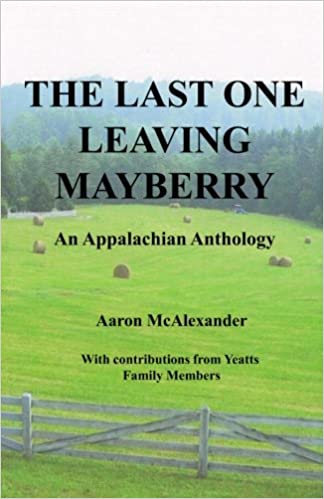
Aaron McAlexander, The Last One to Leave Mayberry
(Stonebridge Press, 2011), 219 pages, a few b&w photos.
McAlexander’s family is from Mayberry even though he grew up in Meadows of Dan, which is located three miles north of Mayberry. In this book, he along with others from his family tell of their ancestor’s moving to this hardscrabble mountain terrain.
Today, there’s not much in Mayberry. There’s the church and there’s the store. Even in the good old days, there wasn’t much to Mayberry. The store also had a Post Office, but that closed in the 30s. There was a tannery and a number of diaries along with a school. Although the community is sparse, it created many good memories that McAlexander mines to create this collection of short stories.
If you read this book, you’ll learn about trout fishing, the first telephone in the community, and the depression (that Mayberry seemed to experience long before the rest of the country). There are stories about men going off to World War 2 and a training flight over the mountains that crashed in the dark hours of morning in 1945. You’ll learn about a “suck-egg dog” (beside being a nasty term for one’s enemies). You’ll learn of the influence of the Blue Ridge Parkway, which divided farms, and about a blacksmith who became a Presbyterian preacher, who occupied the pulpit I currently attempt to fill. You’ll learn of mysteries that still remain mysterious. You’ll read about people who make a break for the West, only to come back home. McAlexander himself headed off as a physics professor, but upon retirement maintains a cottage in the community in which so many of his relatives reside (many of whom are below ground). This is a delightful book with good stories.
This is a short Christmas program for those at home. I tell the following story in the program followed by “Let All Mortal Flesh Keep Silence”
I have told this story several times including in an article published in Nevada Magazine’s online edition.
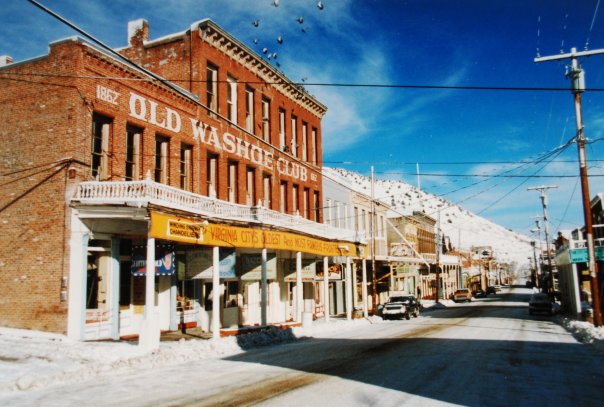
1988 was the first time I was without family on Christmas. It was also my first white Christmas. And it was a holy Christmas. I had taken a year off from seminary to serve as a student pastor in Virginia City, Nevada, the old mining town made famous by the TV show, Bonanza.
The week leading up to Christmas had been hectic. To top it off, a zephyr blew in two days before Christmas. I watched the clouds rolled angrily across the Sierras. Soon snow flew. The gale force wind made the frigid air feel even colder. I wore heavy sweaters even inside. By late morning of Christmas Eve, there was enough snow to ski on the streets of Virginia City. Having taken care of everything for the evening service, I joined a group of friends skiing down the old railroad grade to Gold Hill.
When we got back, we stopped by the church to shovel the snow off the steps. I turned up the heat inside. Snow drifted and the high winds made travel dangerous. About an hour before the service, word came that the steep roads into town from Carson City and Reno were closed. Now, my preparedness was for naught. Our “lessons and carols” service featured a number of readers, many of whom lived off the mountain and couldn’t make it in. Howard, our organist, assured me everything would work out. St. Mary’s of the Mountain, the Catholic Church in town, had already contacted him to play for their Midnight Mass as their organist wasn’t able to make it in.
It was a great service. Despite the cold and ice, people from town flocked in. We recruited readers. As the service began, the building creaked and groaned against the gale. At times, wind seeped into the building and caused the candles to flicker. Our worship service closed with candles challenging the dark as we sang “Silent Night.”
Afterwards, a group of us headed to the Mark Twain, one of the many saloons along C Street. We had good conversations while waiting for the midnight hour to head down to St Mary’s of the Mountain for Midnight Mass. We wanted to support Howard, who was playing the organ.
When I say, “we went down,” that’s just what we did as Virginia City sits on the eastern flank of Mt. Davidson and every block you travel you gain or lose significant elevation.
Sometime during the Mass, the raging storm blew itself out. When we stepped out of the church, clear skies greeted us. Crisp cold air billowed from my mouth like a locomotive. I zipped my coat tight, bid my friends a Merry Christmas and headed home, walking up the hill toward the lighted V, high on Mount Davidson. Snow squeaked under my feet due to the cold. The scent of pinion pine burning in woodstoves filled the air. A few cars were parked by one of the saloons on C Street. Otherwise, the street was deserted. When I reached B Street, where I lived, I was nearly out of breath.
I paused to survey the town. In a few houses, lights still burned. They stood as cheery refuges from the cold. But most were dark. Folks had settled in for a long winter’s nap. Then I looked up into the dark sky dotted with brilliant stars. Orion the hunter stood high overhead, followed to the southeast by his faithful dog. To the north, the Dipper was rising. Although alone, I felt a presence…
Things had worked out. Our worship serve was special and several of us were blessed with a second service at midnight. Even though my family were thousands of miles away, I was with good friends. And I felt God’s love, a love that had come into this world in a child.
The hymns and carols of the evening echoed in my head. “Let All Mortal Flesh Keep Silence” seemed appropriate I had experienced something holy and silent awe was a fitting response.
This ancient hymn has its roots in the early church and is used as the beginning of the Communion rite in the Orthodox Churches. In English, we sing the words which recall God’s mystery to Picardy, an old French folk melody. The music is haunting, as it should be when we contemplate the incarnation, God coming to us in the flesh.
This Christmas, may we spend some time in awe, pondering the mystery of what happened so long ago. And while 2020 has appeared as a storm to us, we know that after the storm passes, there are good times. As followers of Jesus, we need to have faith.
May we also be aware that that child, born in Bethlehem, will come again and claim his throne. That’s where our ultimate hope lies. Until then, we hold on to hope and dedicate ourselves to him, our true Lord and our only Savior. Amen
Last week I spent a few days with my father and uncle (and my uncle’s brother-in-law) fishing off Cape Lookout.
The end of a day
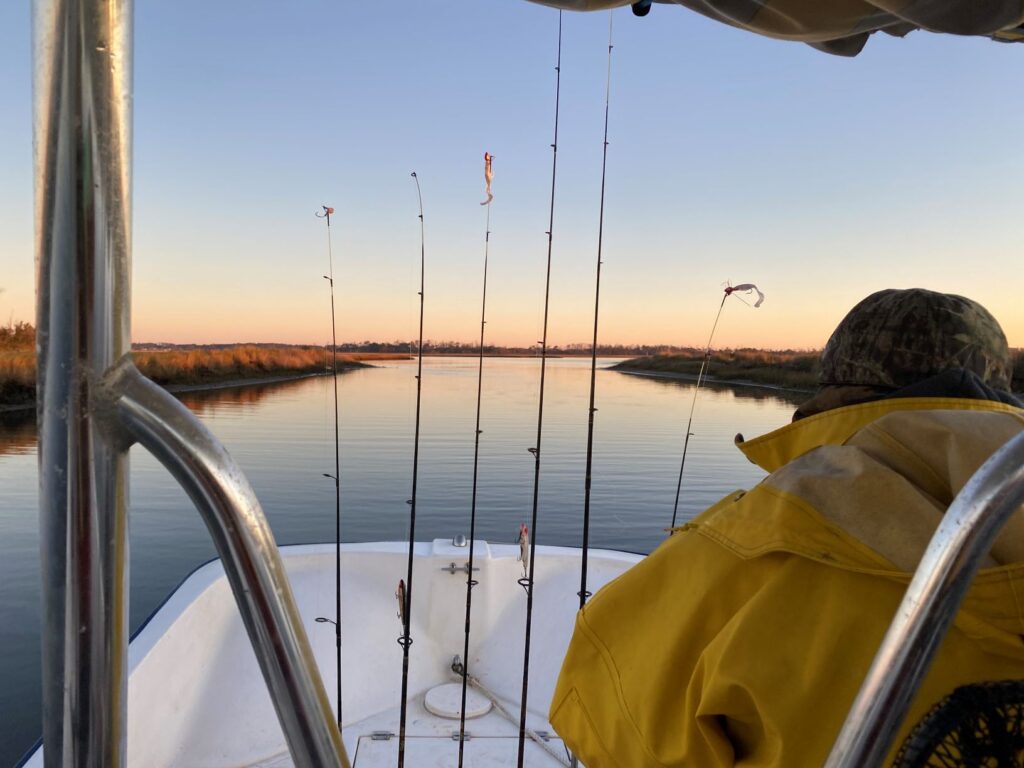
We leave the jetty off the southwest side of Lookout a little after four. To the west, the sun is dropping close to the horizon.
I’m at the helm of my dad’s boat, following Dale and Larry. We race across calm waters, parallel to the beach on the south end of Lookout, heading toward Shackleford Banks. The day before, this section was so rough, we turned around and sought safety behind the banks. As we pass into the Lookout Bight, we make a hard right into Barden’s Inlet. Quickly passing the split of land at the end of Lookout, we’re soon running along the backside of the island. We’re now heading parallel to our previous heading, but in the direction, with just a split of land separating us from where we were.
The channel cuts a path resembling a giant question mark, as we maneuver between Lookout and Shackleford Banks.
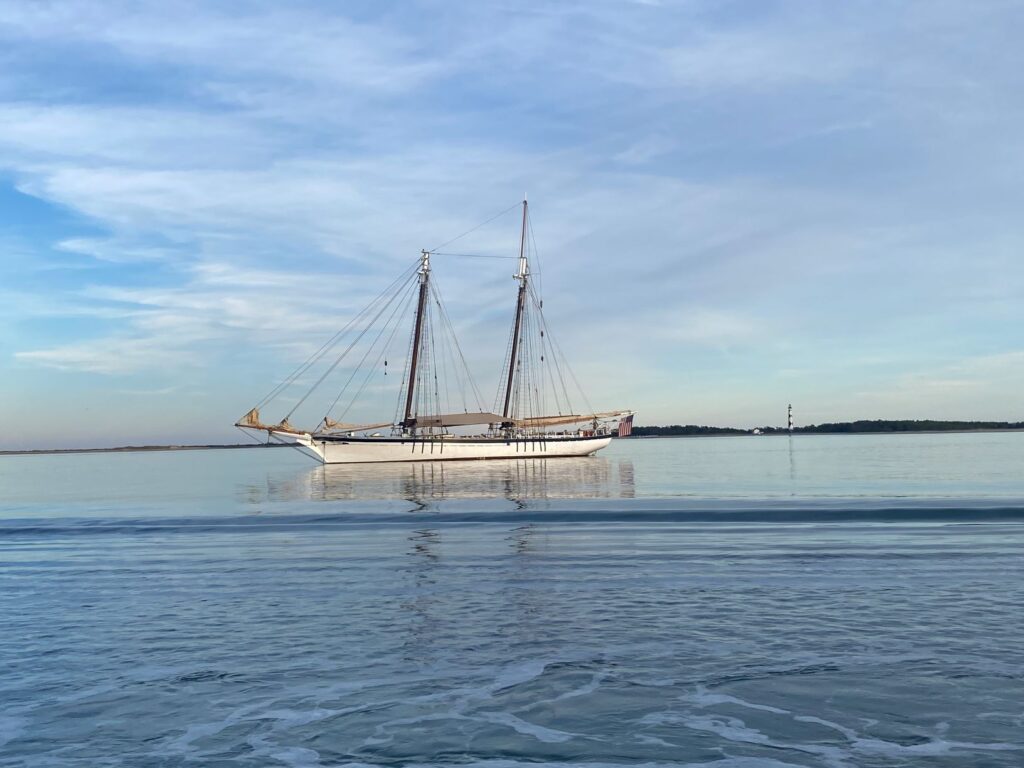
We pass a lovely two mask schooner that has taken shelter behind the banks. The still water is only marred by the wake of our boats.
After passing the Old Coast Guard and Life Saving stations, we cut back toward the Lookout Lighthouse, which not only rises up into the sky but whose reflection follows us as we snake back north, keeping the red buoys on our right. Once we pass the lighthouse, the channel straightens as we head toward the east end of Harker’s Island. The sandbars have shifted and there are places we ignore the buoys. In one place, a sandbar has completely covered the old channel and we take a green buoy to the right. If we’d stayed in the marked channel, we’d been grounded.
We take the northern channel at the split and curve around the west end of Harkers Island. The sun has now set behind us. As we make the turn into Eastmouth Bay, the pink sky reflects off the calm waters. As we approach the channel into our dock, I push the throttle up to slow the boat down as I raise the motor enough to make it over the sand bar at the mouth of the dredged cut. We putt into the dock. It’s been a good day. Now there are fish to clean.
The cooler contains Day and my fish. Larry and Dale’s are in the bucket.
Heading out early in the morning
We’d left that morning around 7 AM and watched the sun rise as we were running around Harker’s Island.
The temperature was below freezing, as evident by the ice on the docks. But unlike the day before, when the gales of earlier in the week had calmed to a stiff breeze of 20 miles an hour, this morning was calm. We didn’t feel the cold nearly as much as the previous day. We arrived at the rock jetty off Lookout, set anchor, and began to fish. A dozen or so boats were already anchored and had lines in the water by the time we arrived. As the day continued, even more would arrive.
sunrise
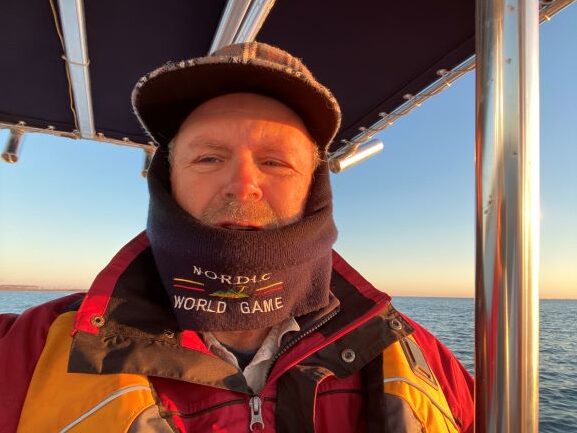
at the helm
The fishing wasn’t great the first few hours. I seemed to lose jigs to the rocks, while just on the other side of the rocks, a dude with an orange coat, sitting on a swivel seat on the bow of his boat, caught fish after fish. Most were thrown back, but he kept a few. I pondered why they liked his grub and not mine. But then I got a bite. The light rod bent over and began to work the fish, but before we could get it to the net, he got off. Fifteen minutes later, my dad caught a speckled trout. There was one in the cooler.
We were just about to head to the other side of the jetty, when Dad caught another while I lost another. So, we stayed and kept fishing. Larry and Dale had moved their boat to the other side and texted us to let us know a wildlife officer was over there checking fish and license. We assured him we only had “legal” fish. The officer only checked a half dozen boats, and then left, but he’d written a lot of tickets for fishing without licenses or having kept more fish than allowed.
Finally, I did land a speckled trout that was just barely large enough to keep (speckled must be 14 inches long). As the tide dropped, exposing the rocks and the shoreline approached out anchorage, we watched another guy fishing from the surf, on our side of the jetty catch fish after fish. I began to wonder what was wrong with our technique.
Catching fish
that’s me
my Dad
Then it happened. Dad caught a puppy drum. It was a good fight. I pulled my line in and helped him out the net. While dad was putting the fish away and putting a new grub on his jig, I got a bite. It was another puppy drum. This one also took several minutes to get it into the boat. I’d get the fish almost to the boat and it would begin running, pulling line off the reel. As the line was only 8-pound test, you have to keep your drag fairly loose to keep the line from snapping. Dad waited until the fish tired and I got it to the boat, where he could help net it. It was another puppy drum, about 21 inches long. It went into the cooler, too.
The limit of drum is one a piece, but for the next hour, we kept catching and releasing them. The fish ranged from 20 to 26 inches and they all gave a great fight. I’m not sure how many we caught, but each of us caught seven or eight fish. All the fish fought hard and took several minutes to get into the boat.
boats around the jetty which can only be partially seenby where the rocks are above water
As the noon hour approached, we were both getting hungry. We finally took a break to have lunch (beans and weenies and crackers), even though the fish were still biting. Several other boats along with the guys on shore got into catching drum, so after lunch we moved to the other side of the jetty. We anchored next to Larry and Dale and began fishing. Pretty soon, we both caught a gray trout (we could only keep one, but we only caught one apiece). Then we caught a few more speckled trout. It seemed as if for every trout I got into the boat, I would lose one jig to the rocks. About half of the trout, we had to throw back as they were not of legal size. I also caught a bluefish.
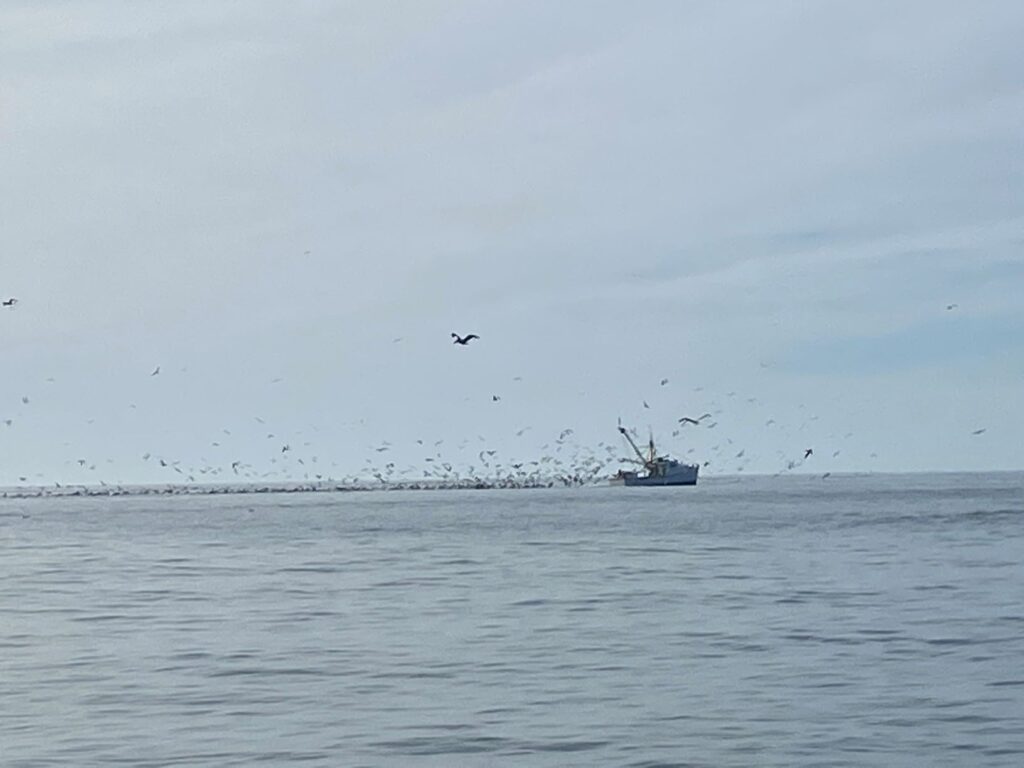
While we fished the jetty, out in deeper water shrimp thrawlers worked back and forth. You could hear the drone of their diesels and when pulled in their nets to cull their catch, the sound of gulls squawking overwhelmed the sounds of the waves breaking on the rock.
As the trawler culls their catch, the gulls fight for that which is thrown back
As the afternoon wore on, more. and more boats left for home. There were only a half dozen of so left when we decided to call it a day.
The sun burns brightly in the blue sky. What warmth it provides is swept away by a strong breeze. The move, the death of my mother, settling into a new church, and dealing with the new house has taken a lot out of me. I need a break. I take Tuesday off and spend the afternoon hiking around Rocky Knob, along the Blue Ridge Parkway, east of Floyd, Virginia.
One of the surprises in the move came in our new house. I fell in love the view of “the Buffalo.” Perhaps that’s why I didn’t notice the large number of air freshers in the house. I’m not sure how, but when I first toured the house the day after it went on the market, nothing seemed out of the ordinary. The former owners (children of the man who owned it) had the ceilings painted and aired it out. They may have even used an ozone machine to mask the smell of smoke.
The inside is prepared for paint. The picture in the bottom left is an early morning view of “The Buffalo”
I realize from the first time I saw the house, there are things to be done. With the house being smaller than the one in Georgia, I need to finish the walkout basement. I also envisioned adding a deck around the back to be able to fully enjoy the view of the Buffalo. Then there’s landscaping and what to do with five acres of pasture. I put all those things on hold. While moving in, entering the house after it had been closed up for six weeks, we realized the former occupants were smokers. Heavy smokers. Currently, we’re staying in a farmhouse of friends while painters are working hard to seal in the walls. When we move back in this weekend (or early next week), it will be very nice. For now, it’s an inconvenience.
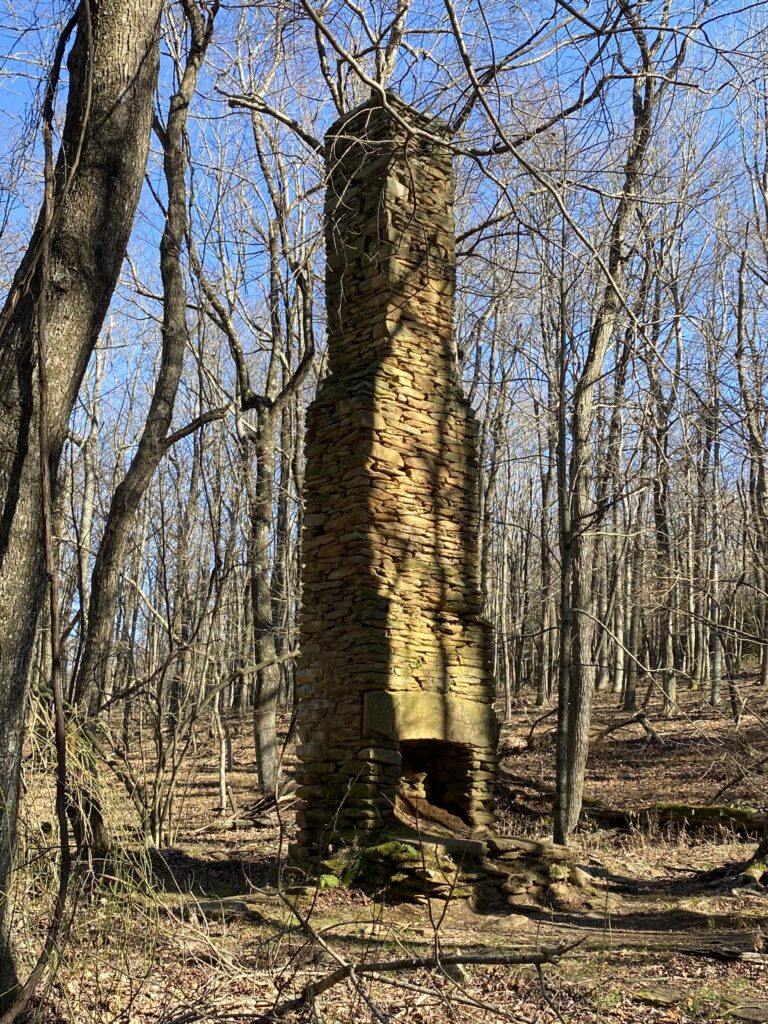
I can imagine coming into this cabin and warming up at the fireplace.
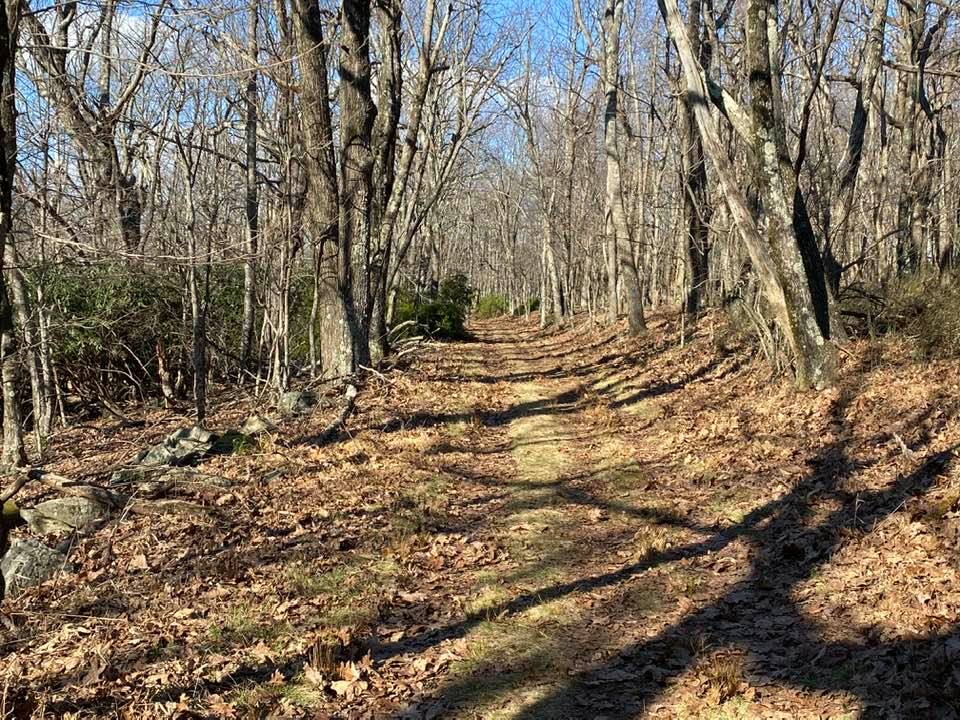
I take Tuesday afternoon off. Driving to the Rocky Knob ranger station, I park my car and head off on the Black Ridge Trail. I take the loop which leads me to the West side of the ridge. The path drops into a hollow. I’m sheltered from the wind. After a few minutes of hiking, I come upon an old chimney. The craftsmanship is amazing. While there is no evidence of a house, the chimney appears to be in perfect working order. From there, I cross a small creek, as the trail heads back up toward the Blue Ridge Parkway. Just before reaching the Parkway, the trail heads south, with pasture to my right and the parkway high above me to the left.
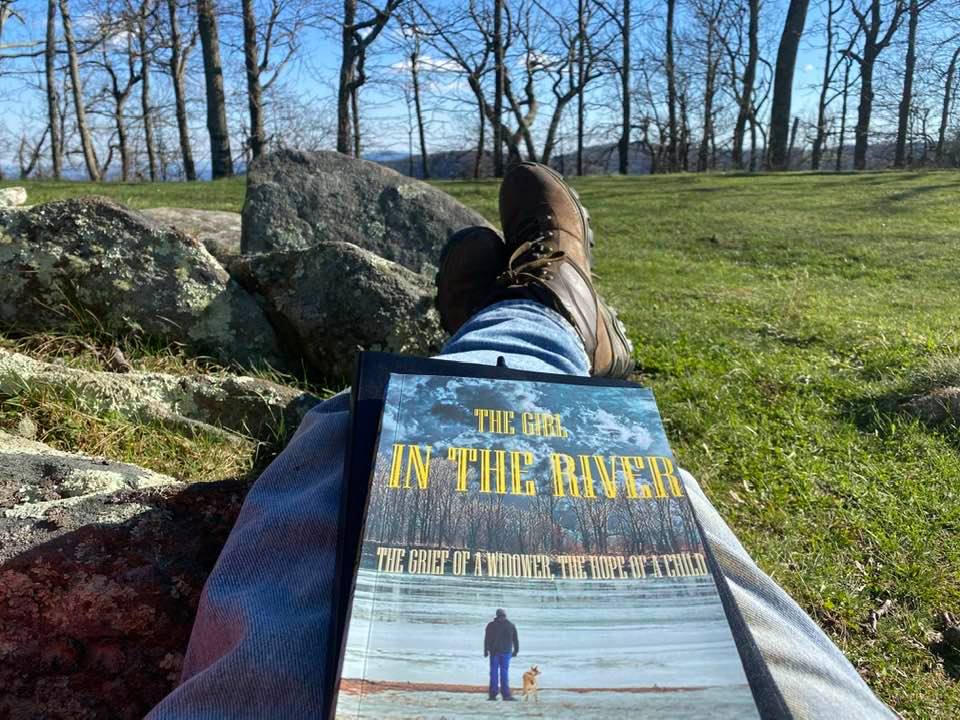
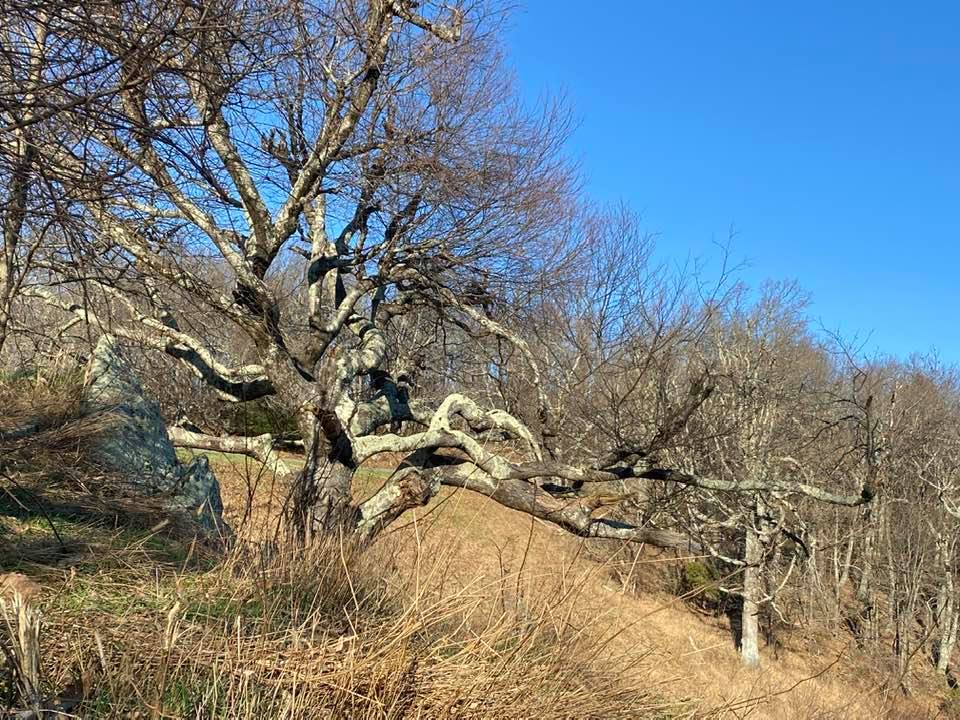
When the trail climbed up and over the Parkway, as I left the hollow, the north wind became intense. I was now on the Black Ridge, which hangs high above Rock Castle Gorge, where I had hiked last August. Vegetation is thick in the canyon with tall trees reaching to the edge of the ridge. On top, the trees are short, gnarled by the wind. The grass remains green, even this late in the year. Granite boulders stick up in the midst of the meadow, creating a tombstone-like appearance. As with the old chimney, ghosts abound in these hills. I find a large enough boulder to block the wind and provide a back rest. For a few minutes, I write in my journal. Afterwards, I pull out Billy Beasley’s new book, The Girl in the River and read a few chapters. I’ll review the book in my blog next week.
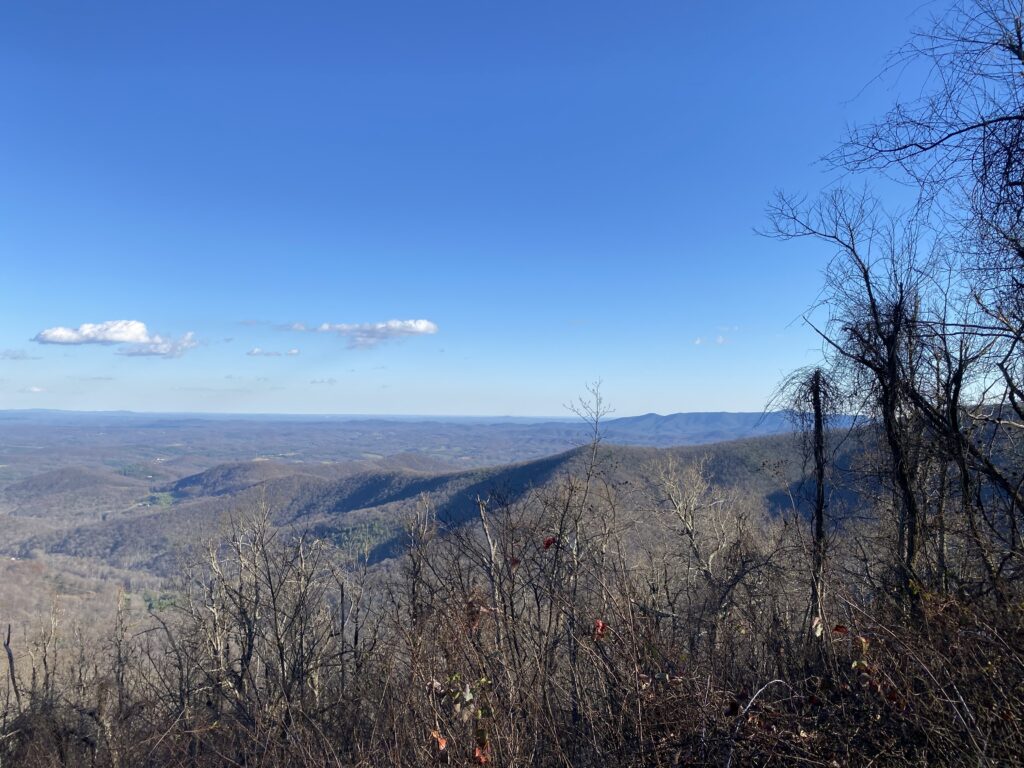
Looking east. Rock Castle Gorge is to the bottom right.
I enjoy the chilly walk along the ridge, frequently stopping to look to the east. Passing a woman with two dogs, I say hello. One of the dogs is trying to get to me, but she says he’s in training. I smile and say I’ll continue on, in order not to entice the dog to run after me. When I reach my car, I check the time. It’s not yet 4 PM, I’ve been gone for less than two hours. Much of that time I spent reading. Not ready to head home, I set out to find another trail.
It’s interesting how the wind “designs” the trees along the ridge
Esau McCaulley, Reading While Black: African American Biblical Interpretation as an Exercise in Hope (Downer’s Grove, IL: Intervarsity Press, 2020), 198 pages including a discussion guide, bibliography, scriptural index and index.
McCaulley provides an interesting insight into the struggles facing African American theologians today. Coming from an evangelical tradition, he quickly notes the failure of evangelicalism for those of his race. He acknowledges that most black churches accept the four pillars of evangelicalism (a born-again experience, missionary efforts, high regard for Scripture, and emphasis on the atoning sacrifice of Jesus). But, he notes, there are two unwritten pillars among most evangelicals. One is to downplay injustices of the American past. The other is to remain silent on issues of racism and systemic injustice. (10-11)
He also has a problem with progressive Christianity. He sees this movement “weaponizing” African American theologians to support their own positions. Both sides, he believes, “tokenize” Black theologians. He criticizes the evangelical movement use of black evangelical theologians to attack black progressives. While disingenuous, it keeps the evangelical movement from being labeled as racist.
McCaulley argues for an authentic African American theological voice that takes Scripture seriously while addressing the need of community. Citing examples, he notes how slaves first heard the gospel tempered and misused. They were encouraged to be happy with their lot in life. But instead, the Bible’s overarching story of a God who frees people couldn’t be tempered. From this background, African Americans developed their own churches and theological traditions.
McCaulley focuses on the teachings of Paul. Some may suggest that Paul never challenged the slave culture that existed in his time. However, McCaulley cites many places where Paul does challenge the culture even though he (or the early church) was in no position to change it. McCaulley also draws heavily on the Old Testament, especially laws concerning slavery, and the Exodus.
Five of the chapters of the book lay out ideas for a more comprehensive African American theology. One is a theology of policing. McCaulley admits the need for policing but also for it to be done in a manner that supports and not destroy the community. He tells his own story of being stopped by police in high school. He and his friends were forced out of his car and searched for no reason. Such experience is truer for those in his community than in mine. In this chapter, especially as he deals with Romans 13, he balances the way his community and the police need to deal with the fear they both feel for the other.
In another chapter, he looks at how the New Testament supports the need for protests. Blacks are not just to be submissive. They need to work for a vision that is set in the Exodus and Prophetic traditions of the Old Testament and taught by Jesus (and Paul). This is followed up with a chapter on justice.
In a chapter that critiques of many in the African American community who have abandon Christianity (seeing it as a white/European religion), McCaulley makes the case for an African American witness in Scripture. Such tradition continued in the early church which found a stronghold on the African continent. Then, in a final chapter focusing on the need of his community, he explores rage and what should be done with it.
McCaulley finds solace in Scripture. Like his ancestors, he senses that God is on the side of the oppressed. God’s desire is for freedom (real slavery as well as bondage to sin). This is the hope his community needs to move forward. It is the author’s hope that other members of his community will step up as they offer their witness to hope of the gospel. Such a witness doesn’t have to depend on white interpretations but can draw from Scripture and the experiences of his race.
This is a book that needs to be read. I image it will be helpful for those within the African American community. However, even those of us who are of others races should read it to better understand the rage felt by African Americans. Perhaps we can catch a part of their vision of a theology that encompasses all of us.