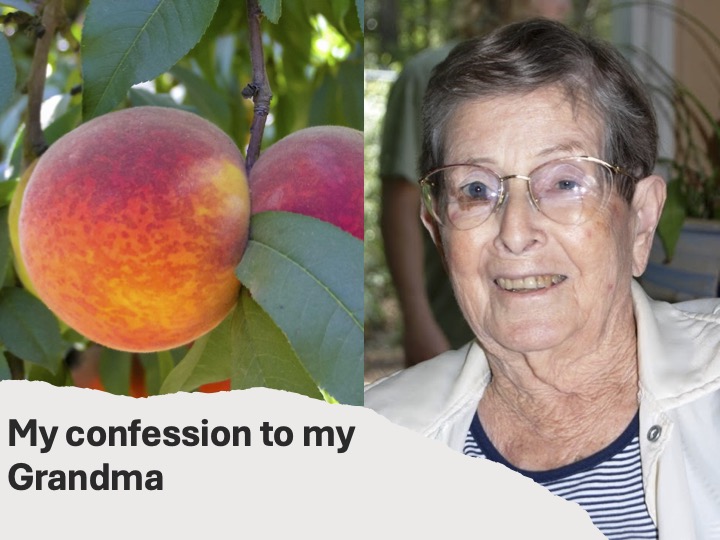
In the early 1970s, as a young teenager, I would spend a couple weeks each summer with my grandparents. The evenings were often spent fishing with my grandfather, as I’ve shared before. But on other evenings, we did other activities. This one evening, we headed over to J. B. Cole’s Orchard in West End to pick peaches. Cole grew huge redskin peaches, as big as a softball. And when ripe, they were so moist that biting into one sent juice streaming down your chin.
After dinner, I got myself ready. I strapped my trusty Ka-bar sheath knife on my belt. I don’t remember why I thought I needed it, but during these summers, I kept it close. At least I’d be able to defend myself if wild animal attacked us while there amongst the peach trees.
Once we arrived, we each took a bushel basket and set out into the trees. My grandparents worked one side of the tree. I picked peaches on the other side, carefully placing the ripe peaches into a bushel basket. While it was a peasant evening, my stomach wasn’t quite right. On occasion, I released a fragrant whiff of gas.
“Jeff,” my grandmother called in a rather angry voice. “Did you cut one?”
“What?” I shout back while thinking “Did my grandmother ask what I thought she asked?”
“Did you cut one?”
I’d never heard my grandmother speak this crudely. She sounded like a one of the boys in my seventh-grade class. Why was she asking if I’d farted? It’s just not polite. And how could she even tell on the other side of the tree? I had quietly released the gas.
Finally, I spoke quietly and confessed. “Yes, a little one,” I said. My face was red with shame.
“Don’t be doing that,” she said. “Put your knife away. These aren’t our peaches; they don’t belong to us until we pay for them.”
“That’s why she’s talking about,” I thought to myself. “How do I get out of this situation?”
I accepted my grandmother’s chiding, not wanting to admit to my misunderstanding. In my young teenage mind, it was better to be thought of as a petty delinquent than one with gastrointestinal issues.
That evening, after picking several bushels, we paid the man and took them home. That night, instead of a Pepsi ice cream float, we had peaches on our ice cream. There were peaches for breakfast. For the next couple of days, my grandmother busied herself canning peach halves in quart mason jars, saving up for winter cobblers. And that weekend, we churned a freezer filled with peach ice cream. .
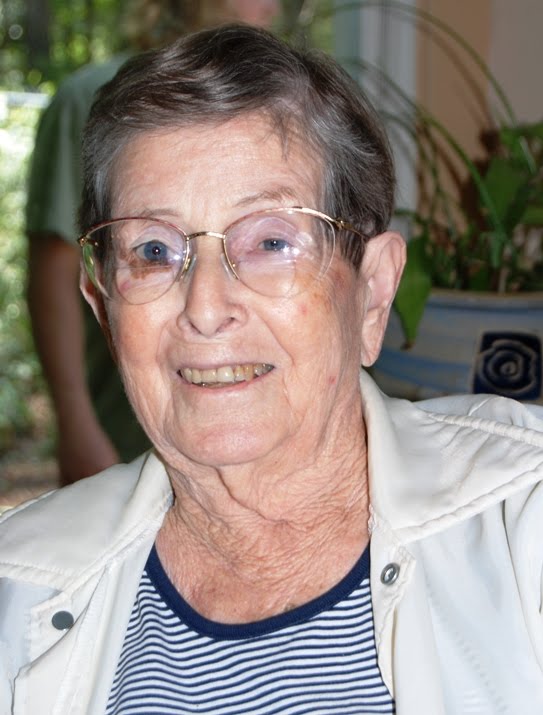
Confession is good for the soul, they say. I’m not sure that includes confessing for transgressions not committed, but since I’m sure there are a few misdemeanors I’ve overlooked, confessing for this one transgression didn’t do me any harm. I never told my grandma that I confused cutting a peach with passing gas. There was never a reason to bring it up, even when she was in her nineties.
Buck and Nancy advised Cape Fear Presbyterian Church’s youth group during my senior high years. Buck, after a stint as a Marine Corps officer in Vietnam, taught high school biology. Nancy taught elementary school. Young and full of energy, they helped form a small but tight-knit group. One of my fond memories was spending a weekend painting the youth room. The cinder block walls were painted, each block a different color: green, blue, and yellow. These ran in diagonal strips up the walls. Then we outlined each block, painting the mortar black. When done, we had created a psychedelic show piece. It was very 70s! By the time I graduated from college, the youth who were then in the group had painted over our masterpiece.
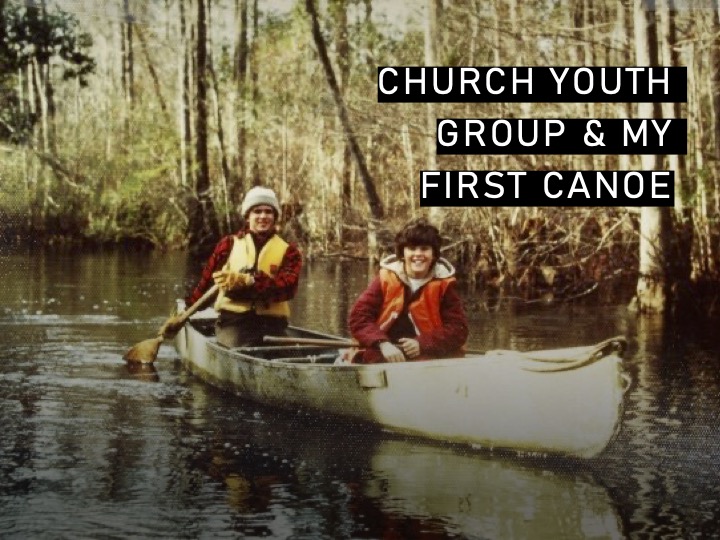
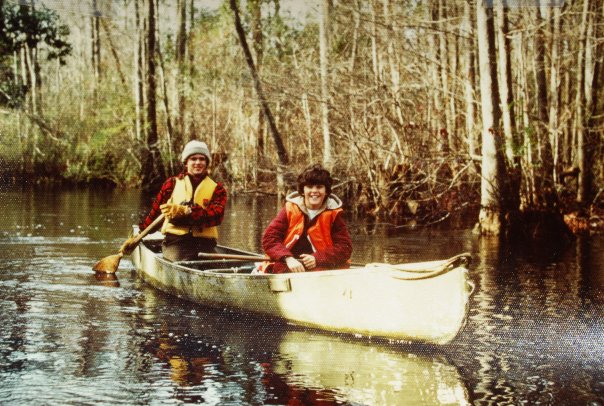
But the best highlight of my time with our youth group was spending a weekend at Camp Kirkwood, a Presbyterian camp between Burgaw and Wallace, North Carolina. These trips also included a day-long canoe trip on the Black River. By my junior year in high school, I was paddling my own canoe!
The water was high and fast that late winter day in 1973, on our first river trip. When we reached a bend in the river, water continue to flow straight, cutting through the swampy side of the river. This made it difficult to navigate by canoe as the water attempted to push the boats out of the main channel and into the swamps. We struggled and paddled hard, especially at the bends and in the shoots through blow downs, where the force of water threatened to push us into trees that had fallen into the river. Buck and Nancy paddled up and down the line of canoes, offering suggestions and encouragement, trying to keep everyone together and dry.
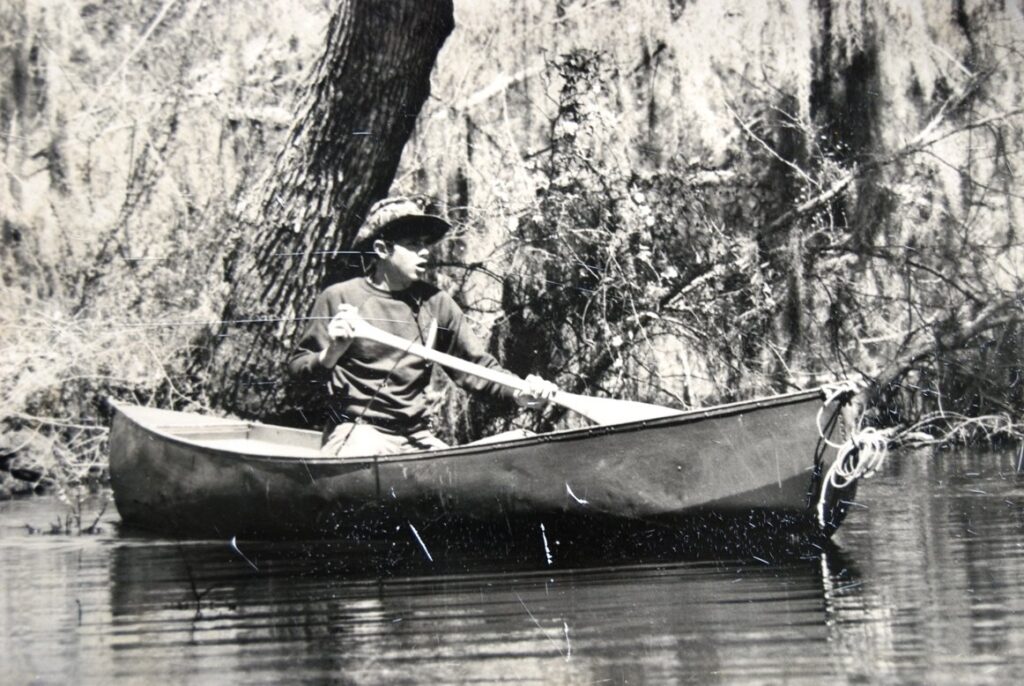
Paddling and fishing on the Black River, 1975 (photo by Donald McKenzie)
Most of the canoes had two paddlers, but a couple of boats had three. One of these was a boat with Marge and Rosa in the bow and stern with Billy sitting on the floor in the middle. Billy always marched to his own drum. At one point, Buck was yelling for everyone to stop. Billy, thinking he would be helpful, reached up and grabbed a branch of a tree to hold the boat. His choice of branches wasn’t the best. He picked a rotted one, that broke off and fell across the canoe. Luckily, they didn’t capsize. Seeing this large branch straddle the canoe, like out-riggers, gave us all a laugh.
At lunch, on a high bluff overlooking a bend in the river, clouds began to come in and the temperature cooled. Buck hurried us on, saying we might be getting some rain. But it never did rain that day and by mid-afternoon, we were pulling our canoes out and loading them on the trailer for the trip back to Camp Kirkwood.
This was my first river canoe trip. I’d paddled a canoe on a lake at scout camp, but there was something about the river where every bend held new possibilities. The Black River gets its name from the dark water that’s stained by the tannin acid from the cypress which grow in the swamps around the river. Although I didn’t know it at the time, we’d canoed through swamps that contained some of the oldest trees in the Eastern United States. One tree there is over 2400 years old. But that didn’t matter, I was hooked.
Not long after this trip, I began working at Wilson’s Supermarket (for the tread of my time at Wilson’s start with this post). I immediately started looking at canoes and saving some money. My dad suggested that before buying a new canoe I try to find a used one. We placed an ad in the classified section of the Star News. It was a simple advertisement, “Wanted: A Canoe” and included our phone number. A few days later, while at school, a man from Southport called and left me a message. I called him back. A day or two later, my father drove me over to look at his Grumman Canoe.
The man was moving and needed to sell it and offered it to me for $60. At this time, a new would have cost me nearly $350. I brought it and we tied it to the top of my father’s car and drove home, stopping along the way to buy paddles and life jackets.
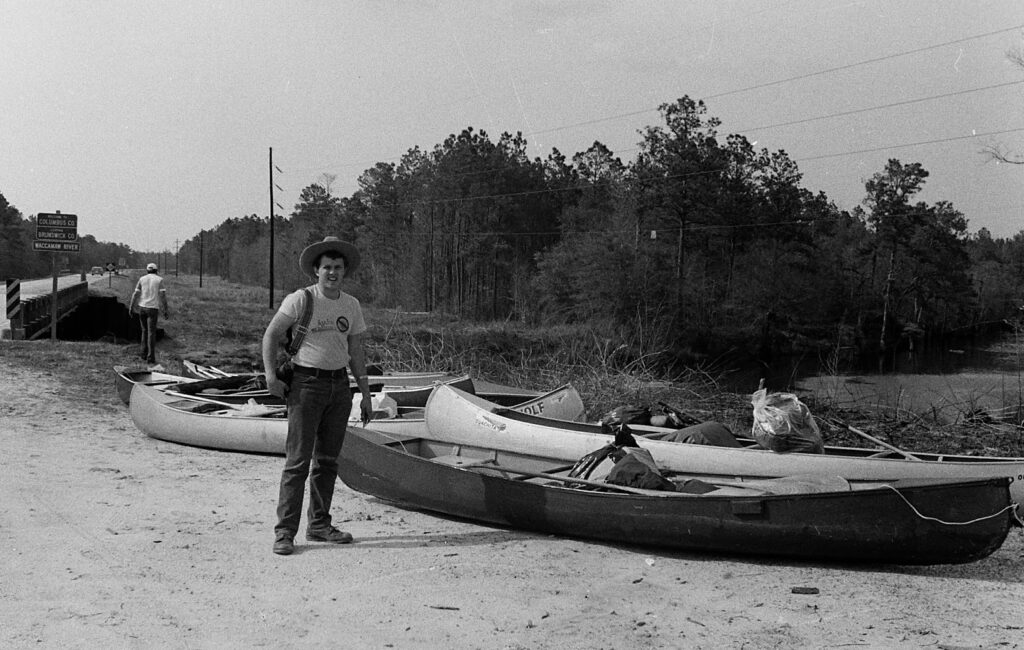
Coming off the Waccamaw River (early 1980s)
Over the next ten years, I got more than my money’s worth out of the canoe. That $60 investment was the best I’ve ever made as it provided me over a decade of explorations all over North Carolina, and into Tennessee and Virginia. But mostly I used it to paddle the black water swamps of Eastern North Carolina. In addition to the Black River, I paddled the upper part of the Northeast Cape Fear River, the South River, Colly Creek, the Waccamaw River, Town Creek, Lockwood Folly, Holly Shelter Creek, among others.
I was heartbroken in 1985. I came home from the National Jamboree of the Boy Scouts of America to discover that during my absence, someone stole my canoe. It had it out behind the garage but had unlocked it to mow. I forgot to lock it back, so the thieves didn’t even have to bring bolt cutters. Thanks to the “replacement cost rider” on my insurance (along with a decade of high inflation) I was paid significantly more than what I’d originally paid for the canoe. I upgraded to a Mad River Explorer, the canoe I still have and which has been in waters all over the United States and deep into Canada.
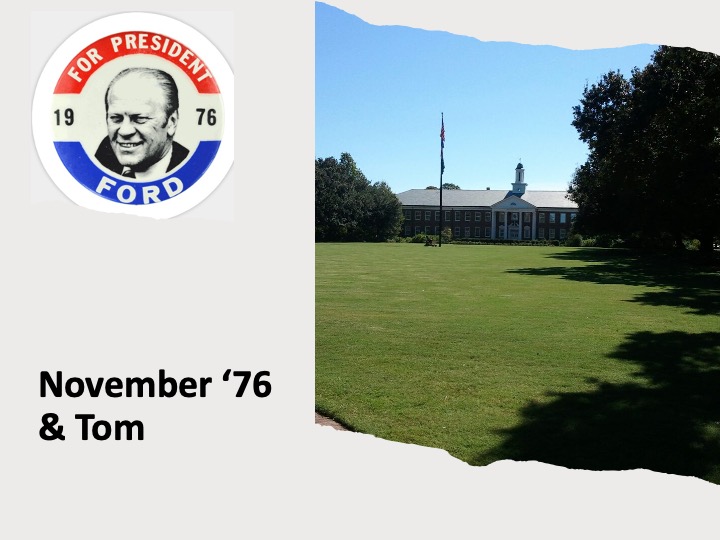
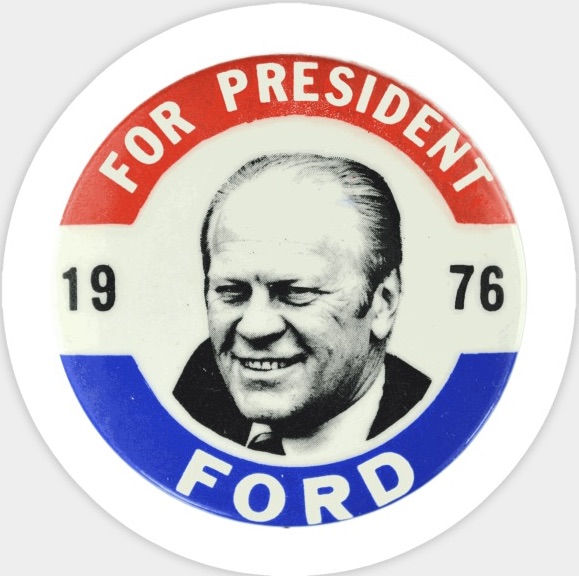
On the second of November, Election Day, Tom and I met in the cafeteria at the University of North Carolina at Wilmington. Normally I rushed from school to the bakery for the second shift, but since it was Tuesday, I was off. At the bakery, those in production worked Sundays and Mondays, then Wednesdays, Thursdays, and Fridays. In my spare time that fall, between classes and work, I had volunteered for the Ford Campaign for President. Tom, whom I knew since 1973, when we both starting to work at Wilson’s Supermarket on the same day, also volunteered. Often on Tuesdays, we would be working a phone bank or putting up signs. But now Election Day was here. It was time to rest.
We talked about the election. While I had worked for Ford, I wasn’t opposed to Carter being President. I had even heard him speak on campus during my freshman year in college. There’s not been many election since that I could say that I admired both candidates. Although in different precincts, both Tom and I voted early that morning. It was our first time going to the polls, and sadly, for Tom, his last.
While eating, Tom shared with me that he was going back to the eye doctor that afternoon. His eyes had been bothering him, and they couldn’t seem to get his thick glasses adjusted. I had no idea this would be the last time I would see him alive. After all, I no longer worked with him at Wilson’s Supermarket, nor did we have classes together.
Tom, however, had a class with my fiancé. She had complained to me a few weeks earlier about Tom, how he often sat by her and tried to talk to her in a psychology class. Thinking he was weird, with his thick glasses, the red splotches on his skin, and the way he often twitched his head when talking, she felt he made it hard for her to make friends within her field of psychology. She wanted me to tell him to leave her alone. I refused. We had a bad argument. I started to break up with her. Had I done so, it would have saved me much heartache a few years later. But I didn’t. Before the topic came up again, Tom was struggling to live.
A few days after that lunch, I received a call from Billy, another friend, who told me that Tom was in the hospital and had a brain tumor. His eye doctor realized something else was wrong and sent him to another physician. Billy and I went to see him at the hospital, but were not allowed in. I later learned they performed the surgery, and the physicians realized it was more complicated than expected. They closed him up and brought in a team from Duke to help with the surgery, but Tom didn’t survive.
Several of us who had worked with Tom at Wilsons attended the funeral. The service was held at the Catholic Church on Wrightsville Beach. It seemed odd, but this was the second time I had been in a Catholic Church. Both times had been for a funeral and at the same church. The first funeral was three years earlier, for an another high school friend. In an odd sort of way, Tom was the glue that held several of us together. After we said our goodbyes that afternoon, I would never see the two of them again.
Tom and I started at Wilson’s Supermarket on the same day. Being the new kids in the store, we became friends. And during my time there, Tom generally followed me. When I became the leader of the Saturday night mop crew and had an opening, I invited Tom. He would later take my place running the mop crew. I taught him how to use a cash register, how to handle price changes, and to order cigarettes. Billy started working at Wilsons a few months after us, and he was the first to leave as he graduated in 1974.
While Tom went to a different school than Billy and me, we often hung out and got into mischief after work.
One night, Tom was riding with Billy, and I was following. We headed south on South College. When we got to where the road split off with Shipyard Boulevard, across from Hoggard High School, we took the right as the road became a four lane. I gunned it and moved to pass Billy. We were on a curve with a medium between us and the opposing traffic. The curve limited my sight. Soon, a car in the wrong lane was coming straight toward me. I swung over, trusting I was ahead of Billy. I barely missed the approaching car. Thankfully Billy, sensing the danger, hit his brakes. Billy later said that Thomas screamed something about me dying and grabbed his arms while he was trying to slow down and move onto the shoulder to give me room. Certainly, had I hit this car head-on, I probably wouldn’t have walked away.
I remember going with Tom to a meeting for Ford volunteers that fall. The county chairperson, some big-shot doctor in town, kept calling on Thomas thinking he had a question whenever he twitched his head. Finally, the doctor asked him what was wrong. Tom said he was okay, but I knew the question hurt him. When I told my mother about this exchange, she was furious. “That man is a doctor; he should have know that Tom has a medical condition and not have shamed him.” Sadly, at the time, none of us knew the severity of his condition.
I don’t know if Tom ever got his driver licenses. He either rode his bicycle or his older brothers gave him a lift. The two of us discussed taking our bikes up to the Outer Banks and riding and camping along the beach, but sadly we never got around to it. Leaving his funeral, I felt a tinge of guilt for not working harder to have made it happen.
After the funeral, one of his brothers confided in me that Tom’s twitches were a part of his condition which led to his brain tumor. He knew that anytime such a tumor, such as the one that claimed his life, was a possibility. But Tom never sought pity; he just wanted to be included as one of us. I look back over these 47 years and think of all that he missed, and yet I’m glad to have had a few years of friendship with him.
###
Sadly, I have no photos of Tom. One day I will check out New Hanover High School yearbooks for 1974-1976 and see if I can find a photo.
We met at an afternoon gathering of the Presbytery of Lake Michigan, held in the old meeting house styled sanctuary of the First Presbyterian Church of Richland. I don’t remember the date. It must have been around 2009. I sat in the balcony, having come prepared with a book. Not seeing anything too important on the agenda, I planned to pass the hours reading. I knew the usual suspects would speak on every issue. Feeling my voice wasn’t really needed to add to the debate, I began reading. I don’t even remember the book, but it had something to do with 19th Century church history.
Jack sat in the same pew, but there was a gap between us. Catching the book title, he slid over and quietly asked about it. Soon, we were whispering back and forth, discussing Charles Hodge, the great 19th theologian at Princeton Theological Seminary. Jack had written his dissertation on Hodge. That was a beginning of our friendship.
Jack had just retired from Princeton Theological Seminary, where he’d spent the previous fifteen years teaching. Before that, he taught few years at Yale Divinity School and before that at Hope College in Holland, Michigan. He’d also served as pastor of several churches in the Pittsburgh area and Westminster Presbyterian in Grand Rapids. We met several times for breakfast. In 2010, I hired Jack to lead a session retreat for the church I served in Hastings, Michigan. In 2011, I hired him again to help run our stewardship program.
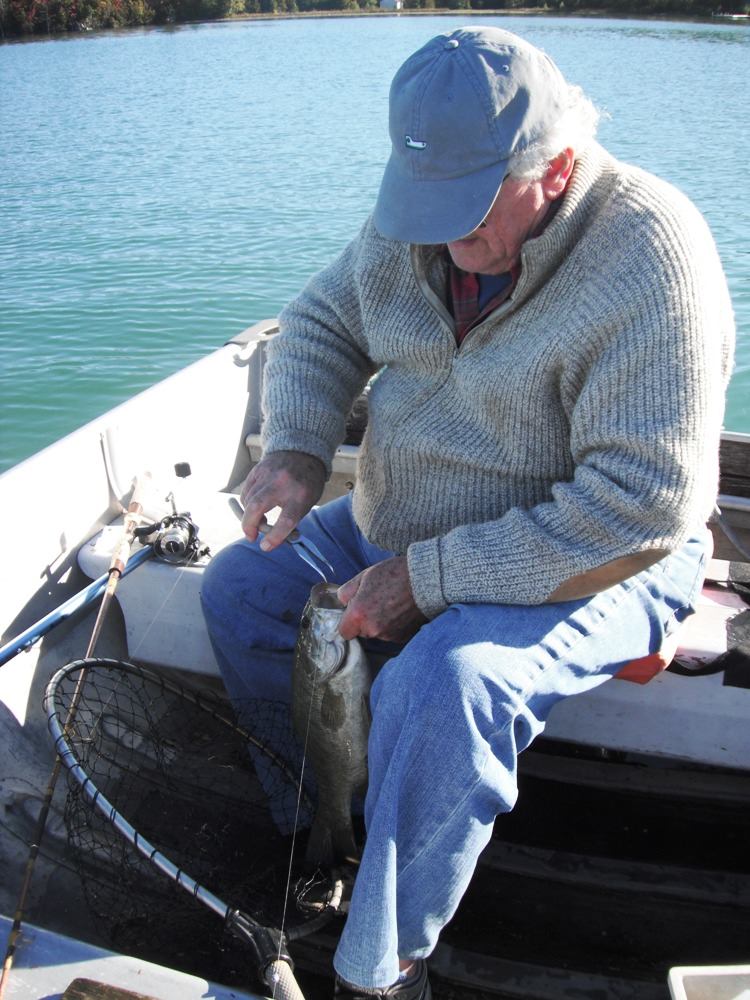
This smallmouth bass grew into an 8 pounder by happy hour!
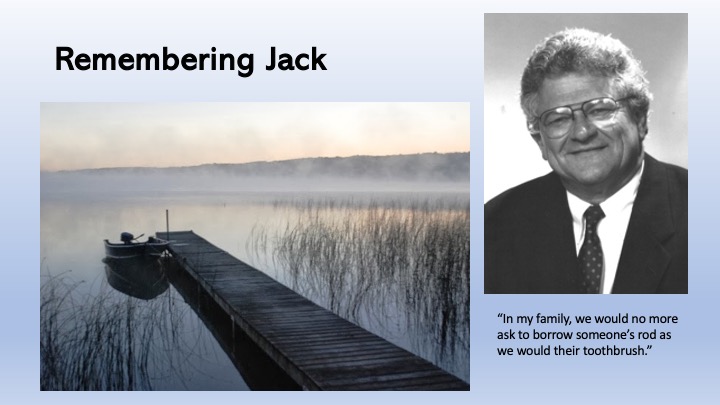
At some point, it may have been at that Presbytery meeting, Jack and I began to discuss his favorite topic, fishing. Over the next few years, Jack and I made several trips to the northern part of the lower peninsula of Michigan where he had a cabin which he and his sons had built back in the 60s. When I asked what I needed to bring on the trip, he told me to bring my rod. “In my family,” Jack informed me, “we would no more ask to borrow someone’s rod as we would their toothbrush.” I packed both.
Jack’s cabin was a simple A frame, set a hundred or so feet from the shore of Lime Lake, which is not far from Sleeping Bear National Seashore. I also went on a fishing trip with him to the Pere Marquette River, but by then his health declined. He could no longer get into the water to fish with a flying rod. While I waded out a bit to fish, I ended up spending most of my time fishing from the bank, where Jack sat in a chair and made an occasional cast. We didn’t catch anything. On the trips to Lime Lake, we caught a lot of smallmouths using rubber worms and a spinning rod.
Jack swore he caught the largest fish on this day
Jack had his traditions. On these trips up north, we’d stop and grab coffee in Cadillac. The next stop was a country store in Maple City that had a little bit of everything, including a meat market which made sausage. We’d pick up a few pounds for our breakfasts. Each trip always included a stop at the Carlson Fish Market off the docks in Leland for some smoked white fish and pate.
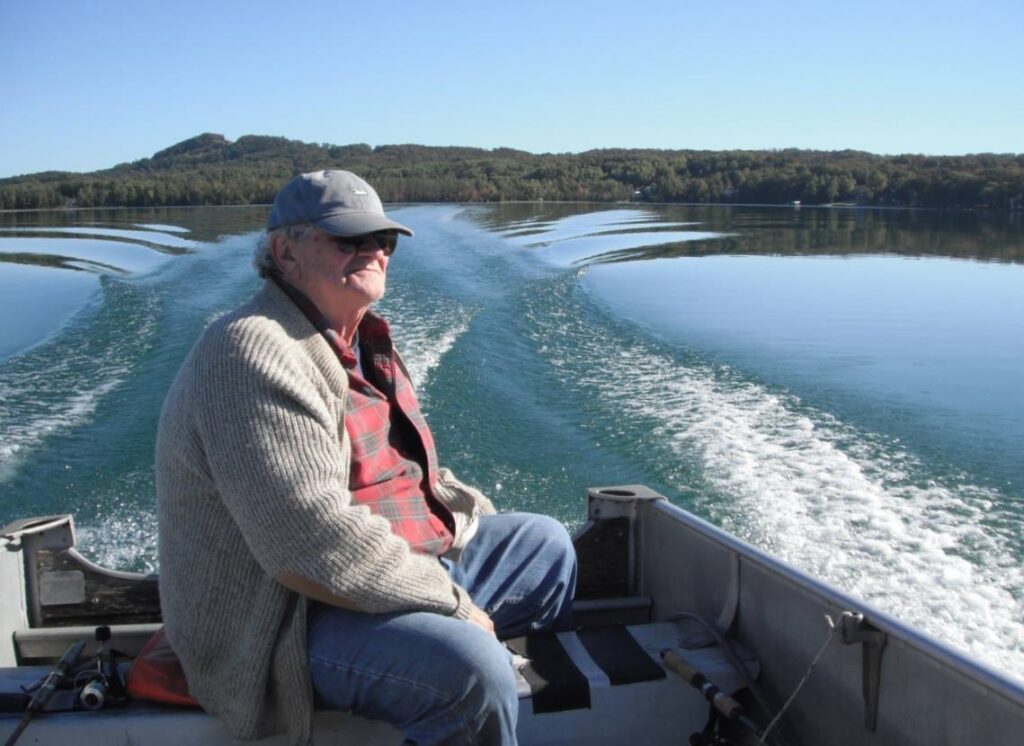
Days at the cabin were relaxed. Breakfast was generally eggs, sausage, and toast. Before we ate, he’d pull out his old leather-bound copy of John Baillie’s A Diary of Private Prayer. Baillie, a Scottish pastor from early in the 20th Century, had two prayers, a morning and evening prayer, for each day of the month. At breakfast, one of us would read the morning prayer. After eating, we’d fish in his aluminum boat. It was always catch-and-release. We’d come in off the water for lunch and maybe take a short nap before heading back out on the water.
We generally stopped fishing around 4:30. When we got back to the cabin, we’d have some crackers and pate or smoked whitefish, with a wee dram of scotch. One of us would read Baillie’s evening prayer for the day. Baillie and Scotch were appropriate for Jack,. He proclaimed his last name was how Stewart was supposed to be spelled. The other Stuarts were highfalutin Francophile Scots. After this Scottish ritual, we’d head out to one of the many restaurants and pubs in the area for dinner.
As we fished, as well we drove around the region, or sat around after dark, nursing one more drink, we’d talk. Topics were numerous: theology, travel, world affairs, politics, what we’ve been reading, and some more theology. One particular concern for Jack was ecclesiology, which Jack felt was the weak link in the Reformed Tradition. But our talks weren’t always serious. We always told jokes. Jack could find a way to intersperse a joke into any conversation.
Jack was raised south of Pittsburgh, near Uniontown, Pennsylvania. I think his father was a coal miner and his family was of modest means. Jack earned a scholarship to Westminster College in New Wilmington, PA. While in college, he became friends with Bruce Thielemann, who later became a very popular preacher at 1stPresbyterian Church in Pittsburgh (click here for some of Thielemann’s sermons). Sharing my remembrance of hearing Thielemann preach in the seminary chapel when I was a student tickled Jack. Thielemann died in 1994 and Jack spoke at his funeral.
After college, Jack and Bruce attended seminary in Pittsburgh. His class was one of the first for Pittsburgh Theological Seminary, which was formed with the merger of Xenia and Western Theological Seminary (Xenia was the seminary for the United Presbyterian Church of North America and Western was a Seminary for the Presbyterian Church, USA The two denominations united in 1959).
While at seminary, he became a friend of Robert Kelly and Jack Rogers. Twenty-seven years later, Kelly was one of my New Testament professors when I was in seminary. Rogers spoke at my seminary graduation and was the moderator of the 2001 General Assembly of which I was a commissioner. The four were mentored by John Gerstner. Jack appreciated Gerstner’s guidance, but could not abide by his rigid conservatism. Jack told me about him meeting Gerstner years after seminary in which his old professor told him how he and his friends were a disappointment because none of them had joined in his battles.
After I left Michigan, Jack and I would occasionally exchange emails or talk by phone. Often, when I was in the area, I would stay with him and his wife, Maureen. On at least two occasions, I was there on a Sunday and would worship with them at the Church of the Servant, which is located near the campus of Calvin University. At home, before meals, he’d offer grace using the opening words of Psalm 103.
Bless the Lord, O my soul, and all that is within me, bless his holy name.
I last saw Jack in October 2022. I was at at Calvin for a Foundation for Reformed Theology seminar. On a free evening, I drove over to his home for dinner. I knewJack wasn’t doing well. Still, it was a shocked a few weeks ago when Marueen emailed me that Jack had been in the hospital and was coming home under hospice care. Thankfully, I was able to talk to Jack two weeks ago. On Sunday, I received an email informing me of his death.
I will miss his jokes and stories. Both the true stories, along with the tales about a fish which must have grown by pounds between catching it and telling about it.
Gerlach and the Black Rock Desert have lost a lot of their appeal. Over the past couple of decades, tens of thousands of people head there every Labor Day. It’s the sight of the Burning Man Festival. This year, because of some rain, 70,000 people became struck in the mud outside of Gerlach. Here’s my adventure in the Black Rock Desert long before it became so famous. The photos are copies from slides.
The Appeal of the Black Rock Desert
I’m not sure what drew me to this dot on a map. Gerlach is a hundred and some miles north of Reno. I knew few people, even in Western Nevada, who’d been there. The only person I knew who had lived in the town was Norm and Missy. They’d lived and worked there before moving to Virginia City. Another attraction that drew me to this dot on the map were hot springs. I’ve taken road trips all over the Intermountain West in search of a good soak.
There was another reason I was interested in Gerlach. I’d watched their high school basketball team play that winter. The Virginia City Muckers creamed them. Our high school boys, used to playing in the thin air of 6300 feet, ran these lowlanders to death. Making it worse, the Gerlach team had only seven players. A couple of these guys were so uncoordinated that I felt sorry for them. I could have been a star on this team. By the end of the game, they only had five players left, and they were all on the court. Their best two players fouled out. The Muckers second string, guys who normally sat on the bench, played, and had no problem running up the score. For some reason I wanted to see this team’s town.
A Sunday drive
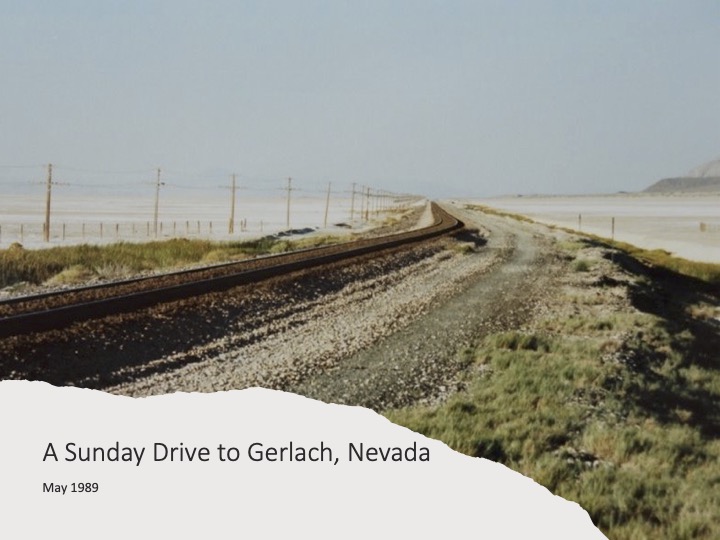
In the late spring of 1989, after preaching on Sunday (the service was at 9 AM), I was on the road by 10:30 AM. I drove to Reno and picked up Carolyn, a woman I was dating at the time. We ate a quick lunch and headed off. Taking I-80 east, out of Reno, we followed the Truckee River to Wadsworth, and then staying by the river, took Nevada 447 due north.
the Truckee River and Pyramid Lake
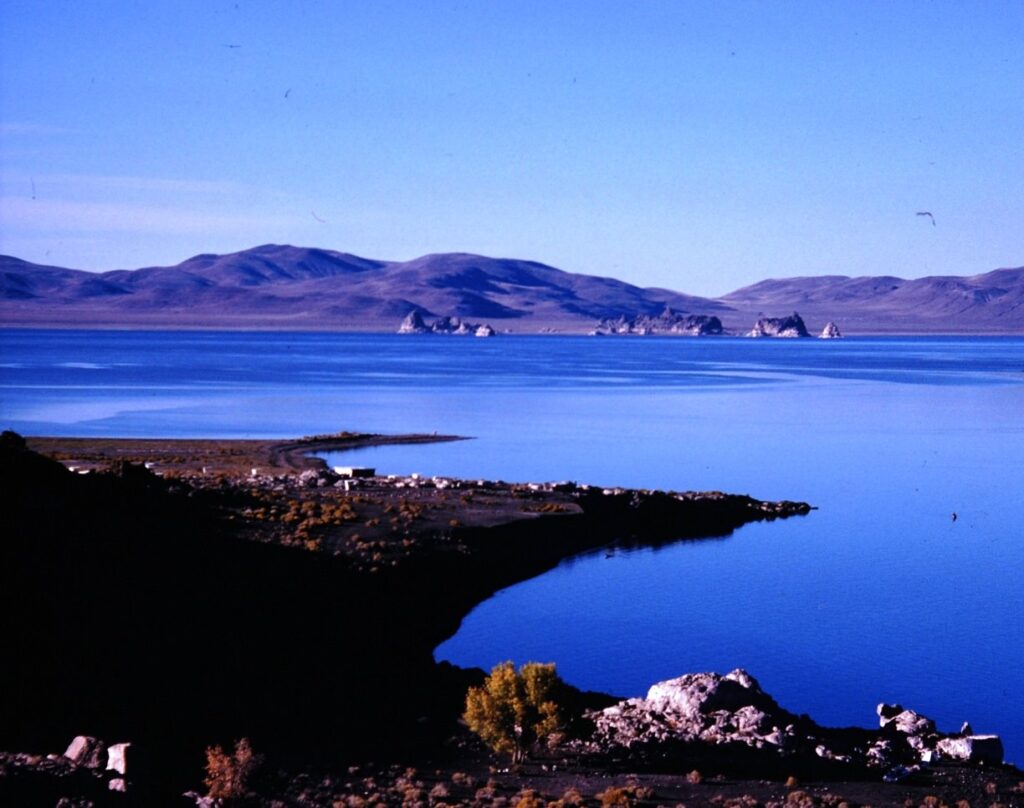
Pyramid Lake, Fall 1988
The road took us toward Nixon and the Pyramid Lake Indian Reservation. We stopped along the south end of the lake. It’s a barren looking body of water, essentially a retention pond. The pristine waters start out as snow in the Sierras. The snow melts into Lake Tahoe, and flows out of the north end of the lake. From there, the waters cascade down the Sierras. The river flows through downtown Truckee and Reno, and then through the River District of Storey County. In the 80s was home of the infamous Mustang Ranch, where there were no cattle, but prostitution was legal. At Wadsworth, the river turns north, and flows toward Pyramid Lake.
Over time, the hot desert sun evaporates the water in the lake. The high mineral content of the water when it reaches the lake leaves behind tufa formations as the lake level falls depending on the water level. Because the water is now so saline, there is little life around the lake.
Meeting Carolyn
I had met Carolyn the previous fall on another trip to this lake. A mutual friend invited us both out on an expedition in search of fall colors, which in the American West mostly comes from Aspen and Cottonwoods turning yellow. There would be pockets of cottonwoods in canyons, with bright yellow leaves flickering in the breeze, along with yellow rabbit brush mixed into the sage. The later, through beautiful, is the bane of allergy suffers. Aspen grows at a higher elevation. At one point, late in the day, when the light was soft and warm, Carolyn caught me taking her picture of her admiring the crescent moon hanging in the western sky. She smiled approvingly. We started seeing each other soon afterwards. Although nostalgic, our stop on the south shore of Pyramid Lake was brief, for we had another 80 miles to go to get to our destination, Gerlach.
Truly the Loneliness Road in America
In the 1950s, Life Magazine dubbed Highway 50 through Central Nevada as the “Loneliness Road in America.” It’s not. It’s not even the loneliness road in Nevada. Nevada 447, north of Nixon, is one of a dozen or so blacktopped roads in the state with a much lower traffic count. We saw only one car heading south as we drove north, and when we returned that evening, we saw no cars. There’s not a lot out here.
The west side of the road is the Piute Reservation; on the east side is Winnemucca Lake, which is dry. Along the way, we pass a couple of ranches and a few scattered cows. This harsh land takes 40 or more acres to support a cow. As the afternoon progresses, the wind begins blowing and at places it sounds like the car is being sandblasted. Five miles south of Gerlach is the only other town around, Empire. It’s a company owned town at the site of one of the nation’s largest gypsum mines and, besides the railroad, is a main source of employment in the region. A spur rail line hauls out cars of the powdery dust. Five or so miles north, along the Southern Pacific lines (the Feather River Route) is Gerlach.
the Town of Gerlach
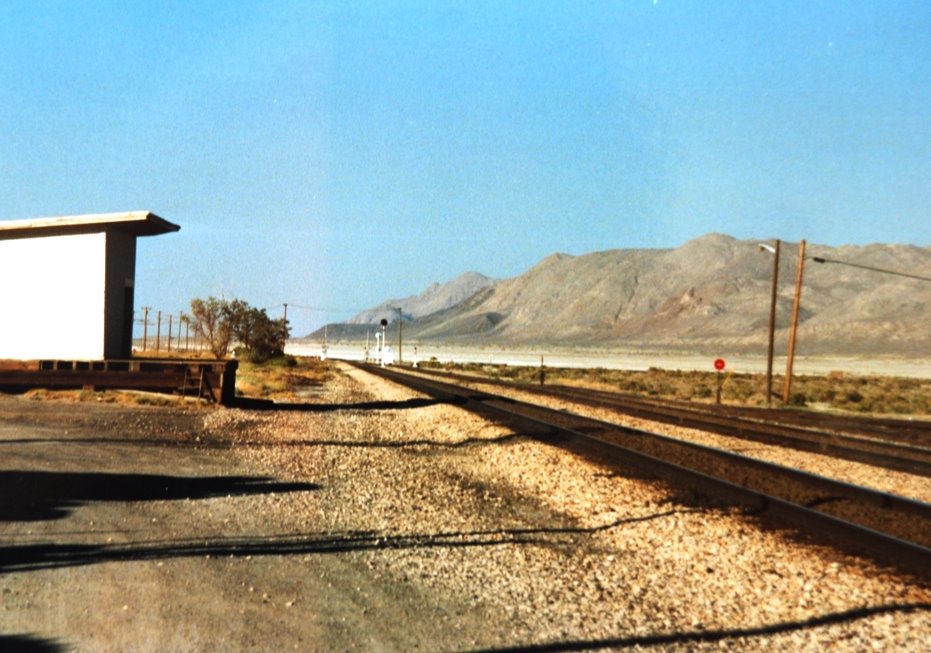
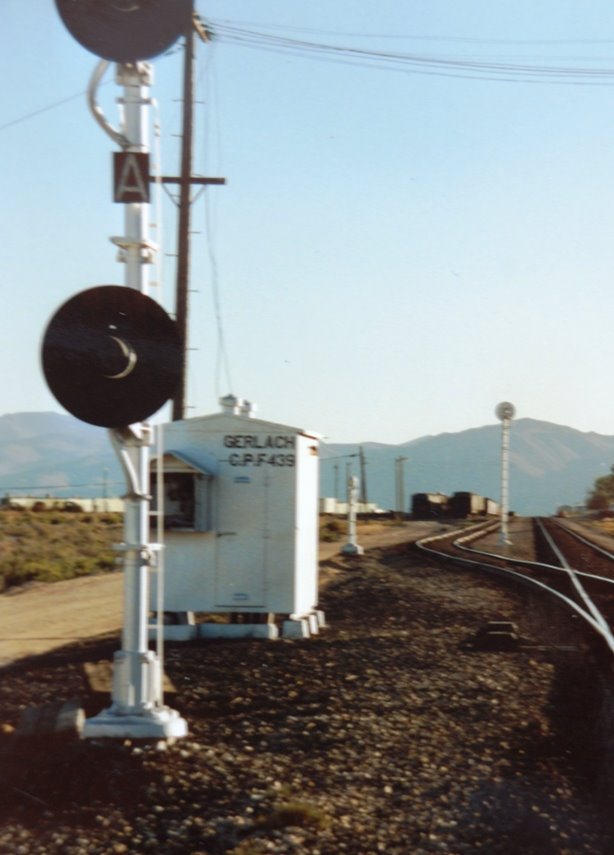
The town is small and sits on the edge of the Black Rock Desert which stretches northeast as far as one can see. We ask about the hot springs and learn they’re not currently open due to construction. A little disappointed, we walk around town and the rail yard and spent some time hiking beside the tracks out into the desert playa. The ground is barren, white, and chalky. Having seen it, I can understand why it became a quagmire after only a half inch of rain during this year’s Burning Man festival.
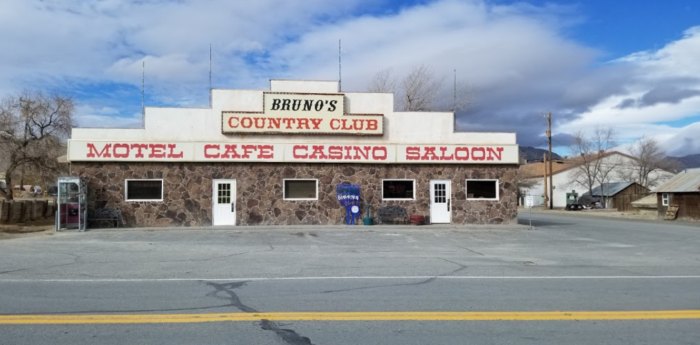
There’s one main establishment in Gerlach, Bruno’s Country Club. It’s a gas station, casino, restaurant, bar, and hotel. I laugh at it being called a Country Club, for there isn’t a blade of grass in sight and certainly no golf courses. If they decided to add a golf course, I assume it’d be like the one in Gabbs, Nevada, a nine-hole course played on clay. Although not a golfer, I image your ball would get nice long bounce on such a surface.
Photo from the internet
After our walk, we head to Bruno’s and enter the dining room that’s across from the casino. The casino isn’t much, just a handful of slot machines, along with a bar and maybe a table for cards. The establishment isn’t fancy, but we enjoy a home-style meal. The staff and the locals having Sunday dinner at Bruno’s are friendly. As tourist, we stick out, and they seem glad to see us and are curious as to what brought us to town. After dinner, the light of the day begins to fade as the sun sets. We take another walk around town. The air cools and the fierce wind of the afternoon has died down.
Heading home
After walking around, we get back in the car. There’s nothing more to do than to drive home through the night. The car’s headlights pierce the darkness of the black ribbon of highway. At a couple of places, I slow down as we drive through six-inch-high mounds of sand across the highway. These were deposited by the afternoon wind. The stars are bright. Overhead and to the Southwest, Orion sinks toward the western horizon, as does waxing new moon. I point it out to Carolyn. She reminds me of the crescent moon on the horizon on that first trip to Pyramid Lake. An hour later, the moon has set, and we’re left with the stars and a lonely strip of asphalt. It’s late when I drop Carolyn off at her home. It’s even later when I make it back up on the Comstock.
Bag posted on the Facebook Page, Hometown memories of Wilmington, NC
I became a Country Boy a few months after I turned sixteen. I’d gone with Mom to the Wilson’s Supermarket on Oleander Drive, the “home of the Country Boys.” Mom pointed out the manager. He stood in the front of the store, watching everything. Garnering courage, I walked over and asked him for a job.
“You have to be sixteen,” he said, obviously not thinking I was quite there. Admittedly, I was small for my age.
“But I am,” I responded, “I can show you my driver’s license?”
He looked at it and nodded his head in approval.
“You’ll need a social security card,” he said. “Can you work four or five hours on Thursday and Friday afternoons and eight hours on Saturday?”
“Yes Sir,” I said.
I had my first job. Of course, I had worked before but it was just mowing yards for neighbors or babysitting. But this was my first regular job, with a paycheck and deduction for taxes…
That next Thursday afternoon, with a tie around my neck, I reported to work. Two of us were to start our grocery careers that day. Tom, the other kid, was from New Hanover High School, popularly known by those of us who attended Hoggard High as “New Hang-over.” His bright red hair and his twitch in his neck when he talked caused lots of people to consider him weird, but he worked hard. Wilson’s Supermarket would his only job.
They trained us that first day to bag groceries. Bert, the manager who hired us, assigned each of us to a more experienced bagger. For an hour or two, we learned the fundamentals of bagging groceries. Don’t put can goods on top of bread or on cartons of eggs. If you have a lot of cans, double-up your bag for strength. This was the era of only paper bags, no plastic ones. You separate the cleansing supplies from the meat and produce.
We also learned if the cart was loaded down, we could jump up onto it and ride it out the door and through the lot, saving energy. Soon, we were on our own, taking out groceries and always saying, “Thank You, Ma’am,” as we slammed the trunk lid. Another lesson we’d later learned was to recognize the big tippers and hustle especially hard for them. This became a game for some, although Tom and I tried to give our best to everyone.
It now seems like a distant dream. In a way, I suppose, it was the beginning of the end. So far, I have never been without a job except for three months I took off to finish hiking the Appalachian Trail. I would have another four-month break for work, but it was a sabbatical, so I still had a job. But back in 1973, I had school along with 15 to 18 hours a week of work. As I found high school boring and wasn’t very motivated, having a job provided dignity.
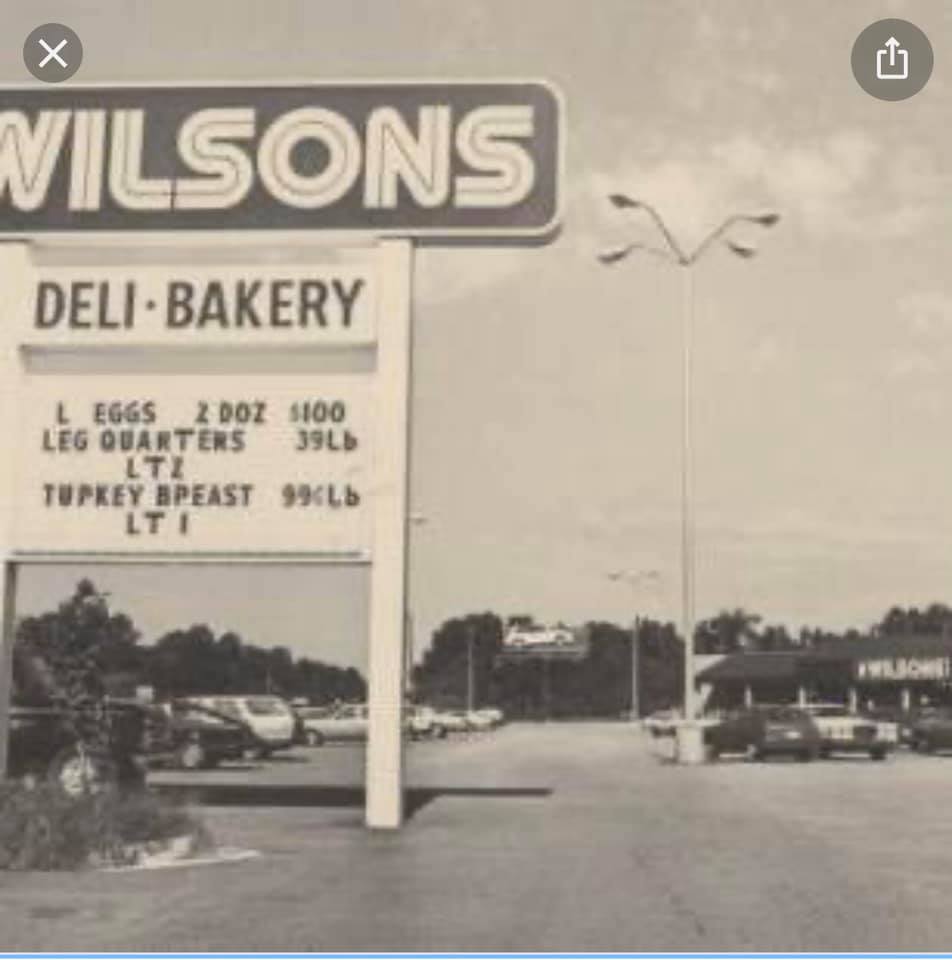
I don’t know how many times I posted the week’s special on a similar sign. Photo from the Facebook page, Hometown Memories of Wilmington, NC
Each day, when I showed up for work, I’d put on a tie. It was expected of all of us “country boys.” While the ads might have had us looking like hillbillies, we were expected to be dressed properly. Beforehand, I’d only worn a ties on Sundays for church, an ideal I still maintain. But unlike most of the newcomers at the store, I didn’t wear a clip-on tie, which they sold on a rack at the end of one of the aisle. I think they were there mostly in case we forgot to bring a tie.
As a 16-year-old, I knew how to tie a Double Windsor. Back in the 70s, with ties wide enough to serve as bibs, tying a big knot like a Double Windsor was quite a feat. Before the week was out, I was teaching Tom and others how to tie one. When you’re a runt, it helps to have a skill. Tom and I began to hang out and became good friends. Six months after I left the store for good, during my second year of college, Tom died from a brain tumor.
Bert, our boss, served as a second father to both of us. Whenever I had problems, especially with girls, questions I’d never think about asking my own dad, I’d ask him. Looking back, I don’t know why? He was easy to talk to, but his martial record certainly left room for improvement. While I didn’t know it when I started, Bert was the father of a elementary school friend of mine, Nicky Pipkin. While Bert had his own troubles with relationships, he always gave me good advice.
I stayed at Wilsons through my first year of college doing a variety of jobs: bagging groceries, stocking the shelves at night, running a cashier, counting money, mopping and waxing the floors late on Saturday night and into the wee-morning hours of Sundays and, thanks to being a non-smoker, managing the cigarette aisle. The pay was never very good, but I enjoyed my time there. It’s rewarding and noble to serve people.
A version of this story appeared in a older blog of mine.
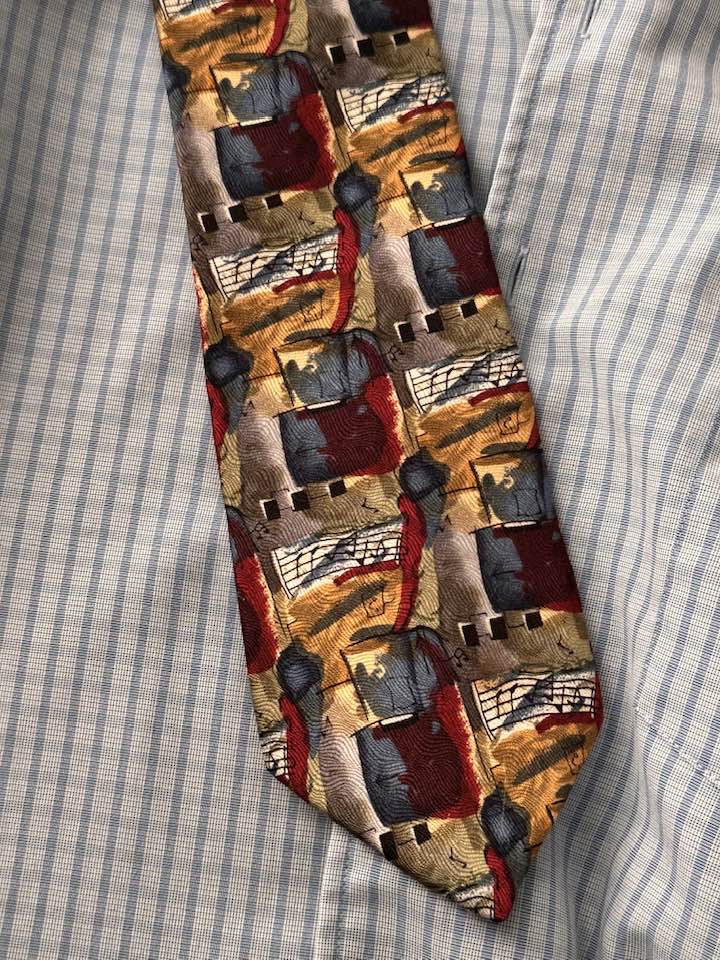
These days, when I need to wear a tie, I try to wear nice ones like this tie, designed by Jerry Garcia (of the Grateful Dead)
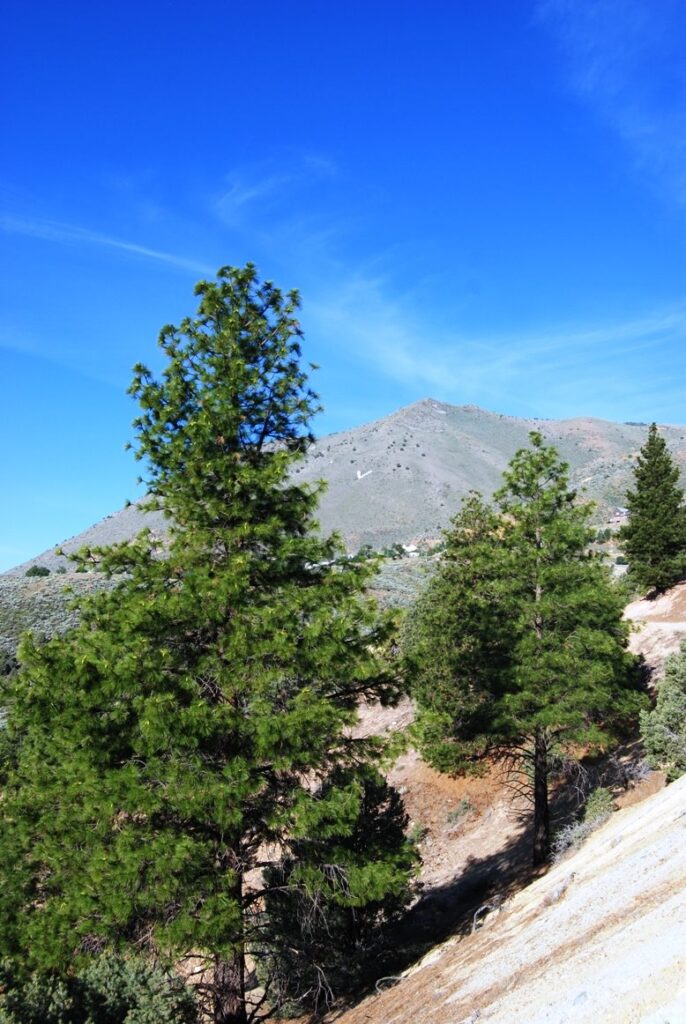
Mt. Davidson from the tailing piles of the North End mines.
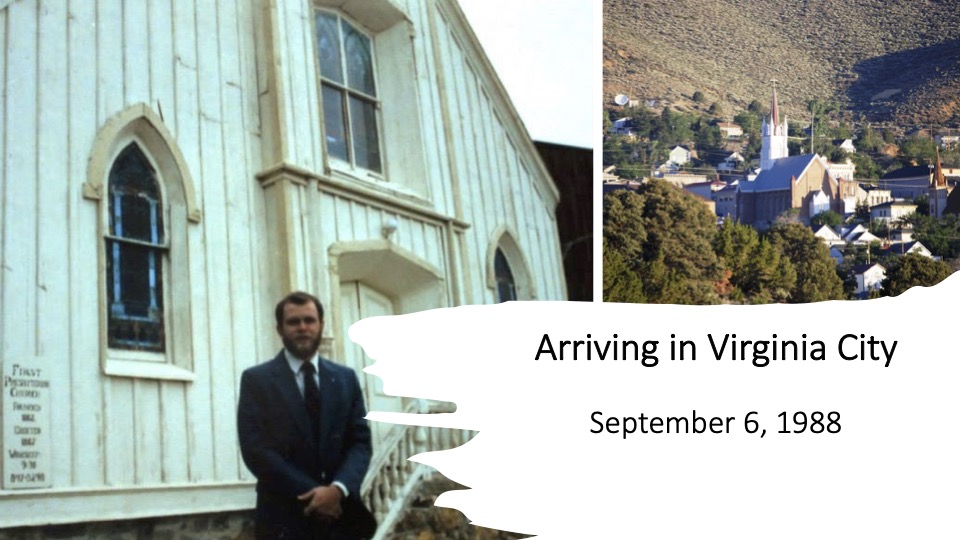
I pulled into Virginia City early in the afternoon. It was a Tuesday, the day after Labor Day, 1988, twenty-four hours after leaving Camp Sawtooth in Idaho. The summer had been idyllic, running a camp with plenty of time to hike in the mountains. Now I was heading again into uncharted territory.
The Drive from the Sawtooth Mountains to Virginia City
The previous afternoon, I’d driven from the camp to Elko on Highway 93. As I crossed the border, I was needing a place to relieve myself. However, I wasn’t sure about going into the casinos at Jackpot. I continued on, finally stopped in Elko, checking into a Motel 6. After diner, in the waning evening hours, I walked around the town watching trains run through and the sun set across the desert.
Up early the next day, I grabbed breakfast at McDonalds and hit the road. I drove west on Interstate 80, which parallels the Humboldt River across northern Nevada. Stopping for gas in Winnemucca, I noticed a tire was low. I added air and continued, but with an uneasy feeling. Earlier in the summer, I had read a book about pioneers traveling across the 40-mile desert, from the Humboldt Sink to the Washoe River. This was not a place I wanted to have a flat tire. I pulled over in Lovelock and checked the tire again. It was low and leaking. I’d picked up a nail. Thankfully in the center of the tire, so it wasn’t ruined. I found a garage who patched it in about fifteen minutes while I had lunch. Without losing much time, I was on my way.
At Fernley, having crossed with 40-mile desert without realizing it, I left the interstate and took Alterative 95 south to Silver Springs. There, I turned left on Highway 50, heading toward the Sierras. The country was barren and I felt isolated. Shortly before reaching Dayton, I looked up a canyon to the northwest and glimpsed the white “V” high on Mount Davidson, my destination. At Moundhouse, where at night one could see several long red neon lights advertising legal brothels, I turned north on Nevada 341. From there, it’s a steep grade up the mountain to Virginia City.
I drove through the waning town of Silver City and squeezed through Devil’s Gate. This was a crack in a ridge barely large enough for a highway. On both sides of the strip of asphalt were relics of the past. Old headframes for mines, abandon trucks, wooden shacks, and rusty hardware. In an open pit mine, I noticed the old tunnels honeycombing the exposed side of the mountain.
The next town was Gold Hill. From there, the road became extremely steep. I pushed the gas to the floor. My car creeped up the 13% grade that wound around a large open pit mind. Cresting at the Divide, the road dropped slightly. From here, it was known as “C Street, the main drag of Virginia City. After passing the old 4th Ward School, I pulled into a parking place in front of the old wooden church on the south end of town.
Arriving in town
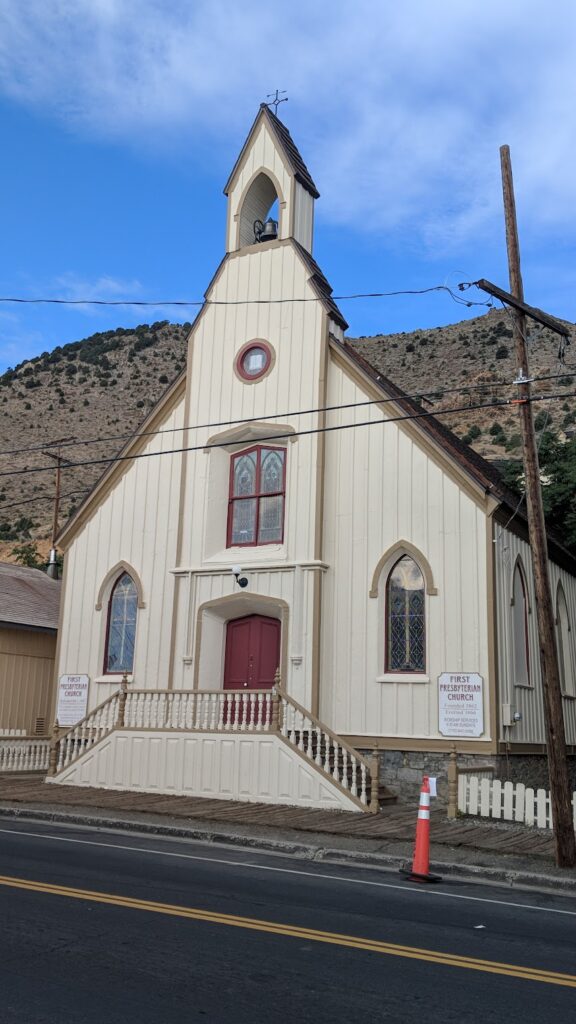
First Presbyterian Church in 2018
The doors were locked. I was hoping someone would be there, as volunteers tried to keep it open for tourists during the summer season. I looked carefully over the 120-year-old whitewashed building, wondering what I was getting myself into. Slowly I walked around the building. The vacant lots on each side were barren, except for a few hardy weeds attempting to defy the Nevada desert. Broken bottles, bits of rusty iron, and weathered, sun-bleached, chunks of wood, all remnants of an age past where hidden under the weeds.
Afterwards, I stood for a few minutes on the front porch, leaning on the rail, looking east, down Six Mile Canyon. It would become a familiar sight with Sugarloaf, the core of an ancient volcano rising the middle of the canyon. In the distance, a couple thousand feet lower, was an alkali desert simmering under the afternoon sun which I’d just traveled through on Highway 50.
“Well, I better get on with it,” I thought, attempting to encourage myself to walk the boardwalk to the Bucket of Blood, a saloon where I had been told to pick up the keys. The sun was warm and although the peak of the tourist season was over, there were still quite a few sightseers on C Street, vying for the slot machines that stood just inside the doors of all the establishments adjacent to the boardwalk. The noise of the electronic bandits and the smell of the sausage dogs and spilt beer overwhelmed me. I lengthened my stride, sidestepping tourists, quickly covered the three blocks.
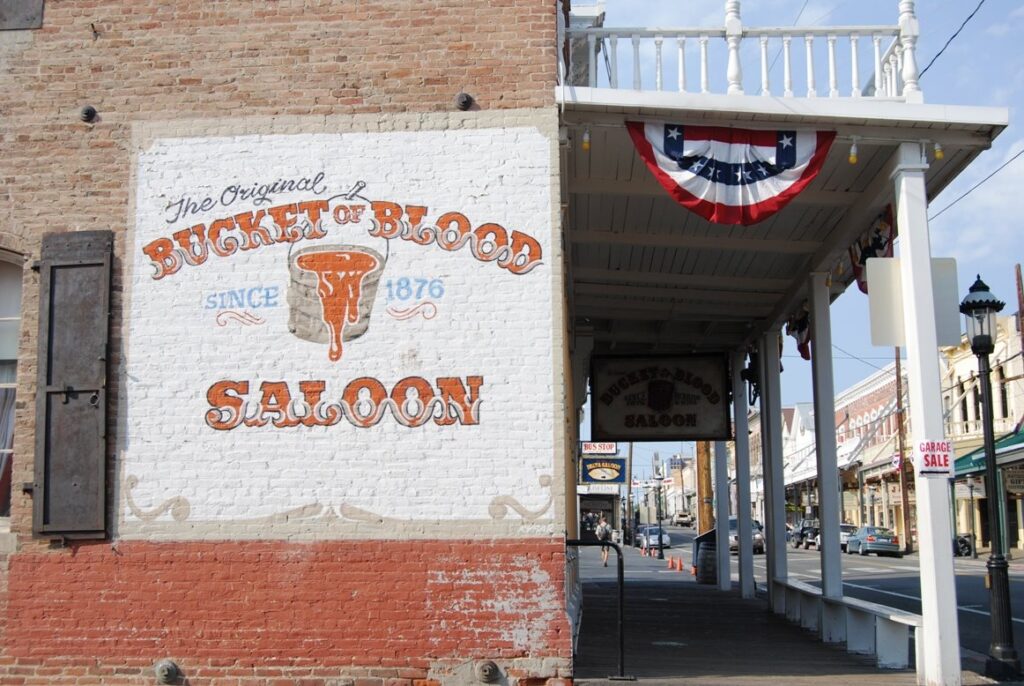
The “Bucket” in 2008
The Bucket, as it’s locally known, is a grand saloon. Except for slot machines, a 20th Century invention, it appeared little had changed since the last century when the mines produced broken men and millionaires. Chandeliers hung from the punched tin ceiling. The wooden bar was adorned with polished brass behind which hung a large mirror. Pictures of another era on the Comstock hung from the walls. I leaned against the bar and asked for Don McBride, the owner of the Bucket and husband of a member of the church.
“He’s not here,” the bartender said looking at me sideways as he washed glasses. “Are you Jeff?”
“Yeah, that’s me.”
“He told me to give you this,” as he handed me an envelope. I opened it. Onto the bar dropped a set of keys, one for the church, another for a house where I’d be staying, and a third for the post office box. There was a map, a church directory, and a sheet with names and phone numbers for people who might be of help. I returned to my car and drove to the house on B Street.
Settling in
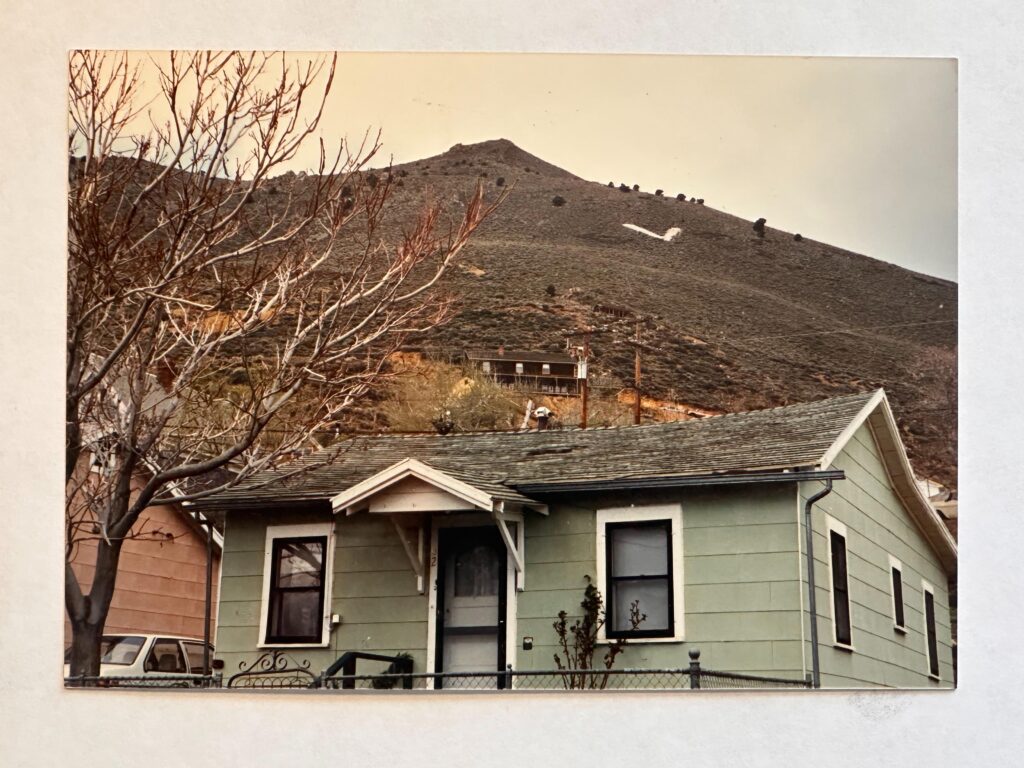
Where I lived on B Street
The little house the church rented for student pastors, my home for a year, was nothing to write home about. I’d been here in April, staying with Laura and David Stellman, the previous year’s student pastors. I’d flown out for the weekend to check out the position. The house had two small bedrooms, each barely large enough for a full-size bed, along with a living room, kitchen, and bathroom which sported an antique iron tub. None of the floors were level, but this is true for most of the buildings in Virginia City,. Mines held up with rotting timbers honeycomb the ground underneath the city. The earth constantly settles and occasionally sinkholes develop.
I later learned the house had an interesting history, but for now it was comfortably furnished. There was a chair, couch, coffee table, and bookcase in the living room. There was also a television, but since I never signed up for cable, it remained unused. Both bedrooms had beds. I decided to live in the front bedroom, which had a single bed and enough room for a small desk and a dresser. The bathroom was off this bedroom, and it also had a small closet. It was warm and stuffy inside. Opening the windows, the regular afternoon breezes began to blow and it was soon comfortable.
On the Formica kitchen table was a note from the women of the church, welcoming me. They also had left a few groceries. In a box was a loaf of bread, peanut butter, jelly, cooking oil, and a few cans of soup. I looked inside the refrigerator and sure enough, there was a dozen eggs, a carton of milk, some orange juice, along with a six pack of beer and a bottle of wine.
I walked out to my car and started shuttling the suitcases and boxes that I’d lived out of at camp that summer. When the car was empty, I drove back down to the church. There in a corner of the small narthex were four fruit boxes of books I’d shipped via mail on book rate, along with two larger boxes that I’d shipped via train. Howard, one of the church’s elders and a school principal in Reno had picked them up for me at the Reno station. I’d shipped these boxes in late May, which now seemed a lifetime ago. Curious as to what I’d packed, I hauled them into the house where I began to unpack.
The books quickly filled the shelves. The big boxes contained stuff for the kitchen: utensils, a wok, a coffee maker, all wrapped in dish and bath towels. There was also a light for my desk, a small fan, winter clothes, a couple of blankets, a two sets of sheets, and a few framed photos to make the house look like home.
By six o’clock, everything was unpacked. I’d even hung the pictures. As I fixed a peanut butter sandwich for dinner, I noticed the house had cooled. The sheer curtains blew in the late afternoon breeze. The sun had long set behind Mount Davison which shadowed the town to the west. The evening appeared pleasant. I ate out on the front steps. I’d been in town nearly four hours and had yet talked to anyone except the bartender. Eating my sandwich and swishing it down with a bottle of beer, I read The Peace Pilgrim.
About halfway through my meal, a man who was obviously drunk and carrying a tutu, stopped by to introduce himself. Virgil Bucchianeri said he was the district attorney. I wasn’t sure whether to believe this man holding a lacy tutu, but he was friendly and wanted to welcome me to the town. He knew I was to be the pastor at the Presbyterian Church. “I’m Catholic,” he said, “but we all get along here.” He had to run, saying he had a rehearsal of a mountain man ballet at the Piper Opera House, which was just down the street beyond the courthouse. Well, I thought to myself, if I was to wear a tutu, I’d probably be drunk, too. I finished my sandwich and picked up my book and continued to read.
Meeting Victor
Victor
A little later, another guy walked over. Victor introduced himself and said he had been attending church since moving to Virginia City from Reno a few months earlier. He invited me to go with him down to the Union Brewery. I put my book up and dropped my plate into the sink. We then walked to the bar on the north end of C Street. I learned that Victor was a relatively new attorney in Reno. Although older than me, he had left behind an academic career for law school. He had been in practice for a little over a year, choosing Nevada because it was a state without a law school. He hoped meant there would be less competition.
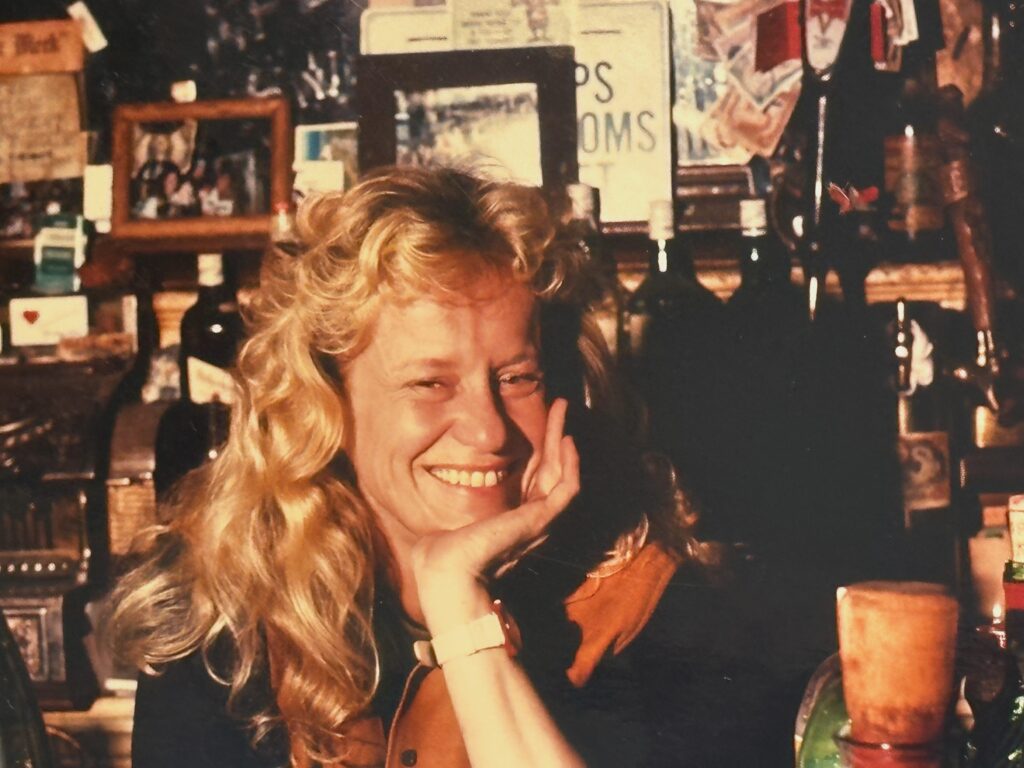
A few minutes later we arrived at the Union Brewery. The bar was housed in an old storefront building along C Street. It was long and narrow, rather dark, with wooden floors and plastered walls filled with photographs, bumper stickers. An artificial tree dangled from the punched tin ceiling, decorated with bras patrons had tossed up onto the branches. The bar was decidedly local, with even a sign behind the cash register that read, “Have you been rude to a tourist today?”
The Union Brewery
We entered and took our places on stools in front of the bar. The bartender brought Victor a non-alcoholic imported beer that they kept on stock for him. Victor introduced me to Julie, telling her that I was the new Presbyterian preacher. She gave me a quizzical look and asked him if I was one of his jokes. Then she asked me what I’d have. When I asked what was on tap, I learned that they made their own beer. This was long before the brewpub concept that taken off. The only homebrew beer I’d had up to this point had been bad, but I decided to try it. She nodded, twisted around, filled up a glass and plopped it in front of me. It was dark with a foamy head.
One sip, and I fell in love with the beer as I’d already fallen for the ballerina-like bartender, with her golden curves and beautiful smile. Julie wore tight fitting jeans and a half-opened shirt. In the low light she seemed angelic, dancing around, keeping everyone glass full, laughing at the jokes, and smiling at the compliments. But up close, the wrinkles around her eyes betrayed her carefree ways.
I later learned she was married to Rick, the bar owner, who made the beer in the basement. I’d have to keep my admiration to myself. As for the beer, I would later learn it was like being in a relationship with someone suffering with bipolar tendencies. Some days are great, others less so as the quality of the beer varied, depending on Rick’s temperament and sobriety. Word would get around town to avoid the latest batch and I would switch to Sierra Nevada or Anchor Steam for a week or two.
We didn’t stay very long in the bar that night. We both nursed down one drink as we got to know each other, then headed back to our places on B Street. Victor had to be in the officer early the next morning and I was exhausted from traveling and unpacking. We said our goodbyes as Victor climbed the steps up to his apartment across from the courthouse. I walked south the half block to my new home where I fell into bed.
The Next Morning
I don’t remember anything else until early the next morning when light flooded the room. Sitting on the eastern flank of Mount Davidson, Virginia City catches the first rays of the sun and they all seemed to gather in my room that morning. Having spent the summer in a narrow north-south running canyon surrounded by tall mountains, I wasn’t used to seeing the sun until late morning. Getting up, I went for a walk. It was time to check out my new home.
Easter Sunrise Services (a part of this article recalls Easter Sunrise Service in Virginia City in 1989)
The Revivals of A. B. Earle (an academic paper published in American BaptistHistorical Society Quarterly, part of his revivals were in Virginia City in 1867)
Looking at Virginia City from Flowery Graveyard (Southeast of the town)
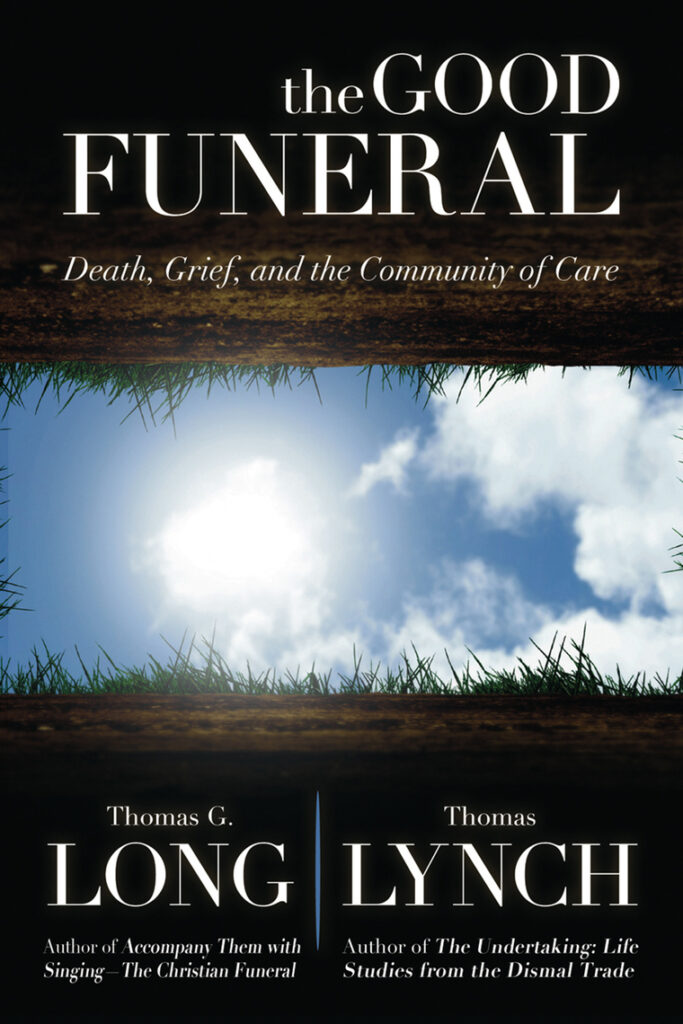
A decade ago, I read Thomas Long and Thomas Lynch’s The Good Funeral: Death, Grief, and the Community of Care. I’d taken a of study leave to read and was staying at my grandma’s house outside of Pinehurst. While there, I did what I have always done when here in Moore County, attend church at Culdee. Afterwards, my daughter and I spent some time walking around the cemetery. Some of the tombstones brought back memories. At this time, I could count at being on being there for at least seven funerals.
Since then, I can add two more, a grandmother and an aunt (of which I officiated as the church was without a pastor at the time). There are also those whom I never knew who are buried there, such as my great-great grandparents and an aunt that died from leukemia when she was three. The cemetery held other memories. As a young teenager, I recalled helping my grandmother clean up the cemetery.
My first memory of the cemetery was from when I was eight years old. We left Moore County when I was six and was living in Petersburg, Virginia at the time. When the call of death came, we headed home… When I die, having lived all over this nation, I have often imagined my cremains coming home to rest on this sandy ridge between the Little River and Nick’s Creek, while awaiting the resurrection.
Memories of my first funeral home visit
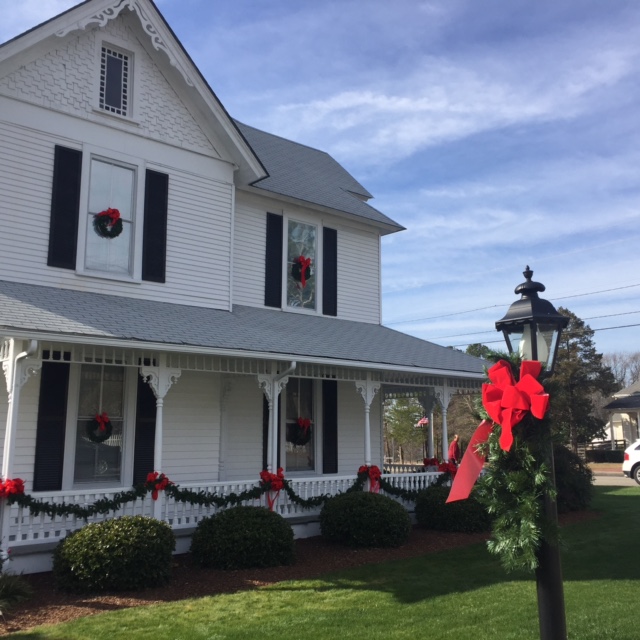
The Frye/Puckett Funeral Home, 2016
My brother, sister and I stood in front of the casket holding the body of my great-grandma, Callie McKenzie. Behind us stood our mom, hovering over like an angel as she wrapped the three of us in her arms. We gazed at the body which everyone said looked so much like her. It didn’t. Bodies never look life-like, and great-grandma’s body was no different. Mom pointed to her hands. Wrinkled, they were covered with brown liver spots. Mom reminded us of all the strawberries she’d picked, the tomatoes she’d raised, the apples she’d peeled, and the corn she’d shucked.
When I was younger, we lived next door and sometimes on Sunday afternoon, after church, we’d gather with our extended family in her backyard, under the pecan trees. The boundaries of her lawn were marked by the back porch, a dirt road over beyond the well, a corncrib in the back, and a smokehouse and woodpile on the far side, just in front of the canebrake. Tables were set out and we’d have lunch, followed by a slice of pie that she’d baked Saturday evening in her wood burning range. She had a gas range but preferred the wood burning one. “We’ll never taste another of those pies,” Mom sadly reminded us.
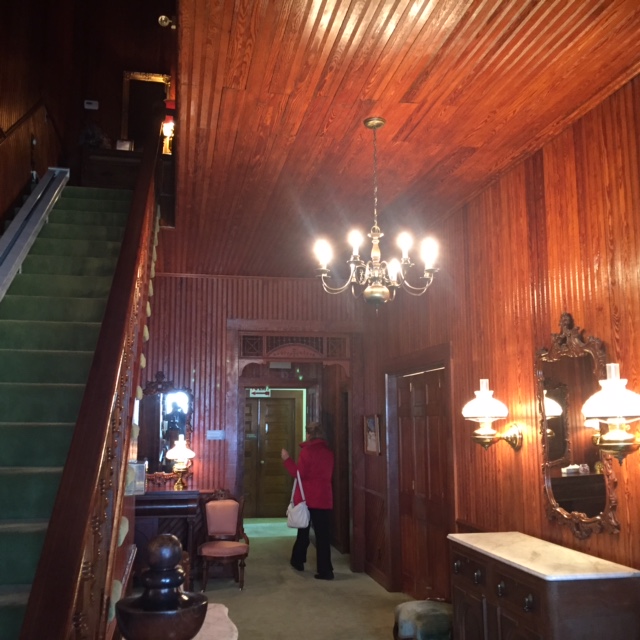
Inside the funeral home, 2016
After a few minutes, Mom shuffled us out on the porch of the funeral home in Carthage, into the warm humid air of a July evening, telling us to behave as she went back in with the adults. Much later, we drove to my Dad’s parent’s home, where we stayed the night.
My grandmother was gone at the time of her mother’s death
It was unnervingly quiet at my grandparent’s home on Juniper Lake Road. No one was home. There were no ice cream and Pepsi floats before bed, as was my granddaddy’s habit. My grandparents and my uncle, Larry, who was just a teenager, were in Florida on vacation and unaware of our presence at their house. Nor did my grandmother know her mother had died.
In this day before cell phones and computers, it was nearly impossible to find someone on short notice. My dad called the highway patrols in Florida and the states in between with a description of their car, in the hopes they could get a message to my grandma. In the heat of July and the tobacco harvest beginning, my great granddaddy decided it was best to go ahead with the funeral on the third day.
My grandparents arrived home a day later. No one was sure when they would be back, and we were visiting with my other grandparents. They pulled back around the house and neighbors, who had been on the lookout, didn’t see them arrive. My grandmother came into her house and saw the newspaper with the obituary open on the dining room table. Well into her well into her nineties, my grandmother spoke of how upsetting it was not to be present, not to be able to see her mother before her body was lowered into the dirt at Culdee’s cemetery.
Great Grandma McKenzie’s death
My great grandma was in her 70s, which now doesn’t seem so old. She was out in the fields, by her son’s pond, picking strawberries, or so I’d remembered. But that must not be right. The harvest of strawberries in this part of the country occurs long before the heat of July. Maybe it was blackberries or some vegetable that she and my great granddaddy were gathering when she had a stroke. Granddaddy, who was five years older, ran back home to call for help. But it was too late.
Her funeral
We lived in Virginia then. My Dad loaded up the car and we drove south, in time to make the visitation at the Frye Funeral Home in Carthage. The next day, I attended the first of many funerals at Culdee. We sat up front with the family, a couple rows behind from my great granddaddy. He sat on the first row, in a bit of shock. The casket, now closed, was up front, just below the pulpit. After the service, three men on each side carried the box containing the lifeless body of one who had dedicated a lifetime to her family and church out to the adjacent cemetery. There, Mr. Fitch, the preacher, quoted a few final verses of scripture, reminding us of our hope in the resurrection. Then they lowered the casket into sandy soil watered with tears. I’m sure we had a big dinner afterwards, but I don’t remember it. My main memories nearly sixty years later are of my great-grandma’s hands, the dinner in the back lawn, and how happy she was to see us whenever we walked through the woods from our house to hers when we lived next door.
The purpose of the funeral
Long and Lynch, in The Good Funeral, reminds us that taking care of the dead is instilled in our humanity. We have to deal with the body whether it is to be buried, burned or disposed at sea. We also must deal with our own grief, for the loss affects not just the deceased and those close (their spouse or children), but the whole community. So the community comes together to remember, to take care of the body in an honorable way, and to offer up the life that is no more to God. We honor the dead for to do anything else would strike a blow at our own humanity.
Similar memoir pieces from this side of my family
A poem written by a distant relative titled “Out at Aunt Callie’s Place“. His aunt was my great grandmother McKenzie.
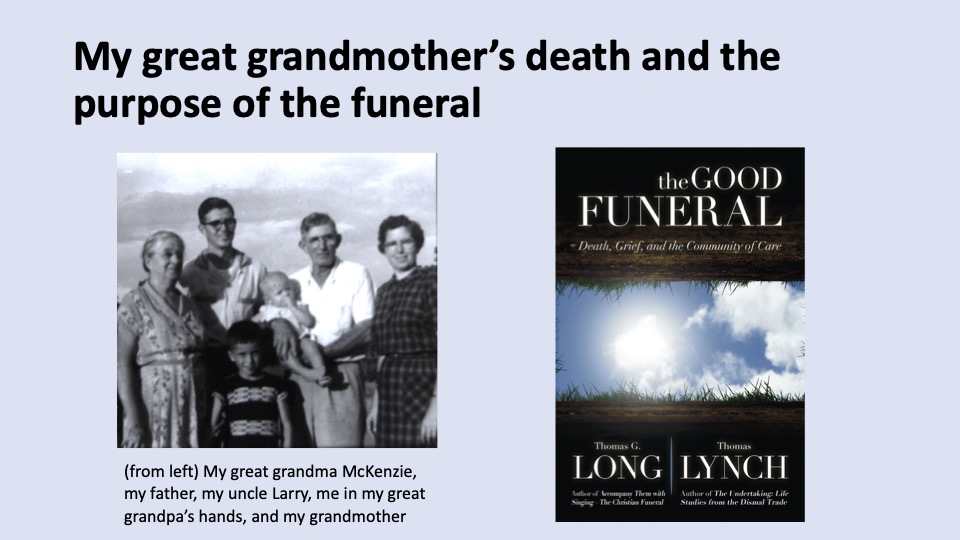
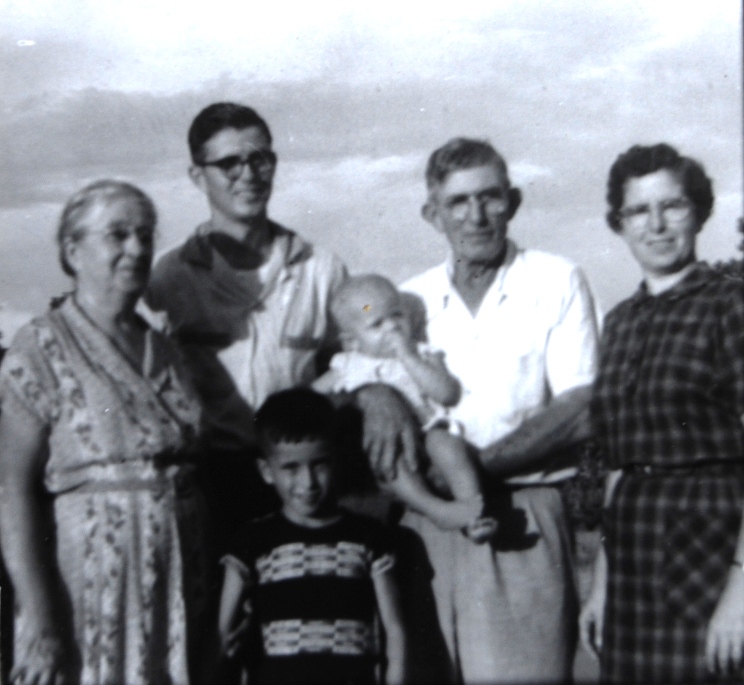
From left: My great grandma McKenzie, my father, my uncle Larry, me in the hands of my great grandpa Mckenzie, and my grandmother. Photo probably taken in late 1957 or early 1958
Last Sunday, I preached on the 23rd Psalm. Today, I thought I would share the story of another shepherd, a man I knew when I lived in Utah.
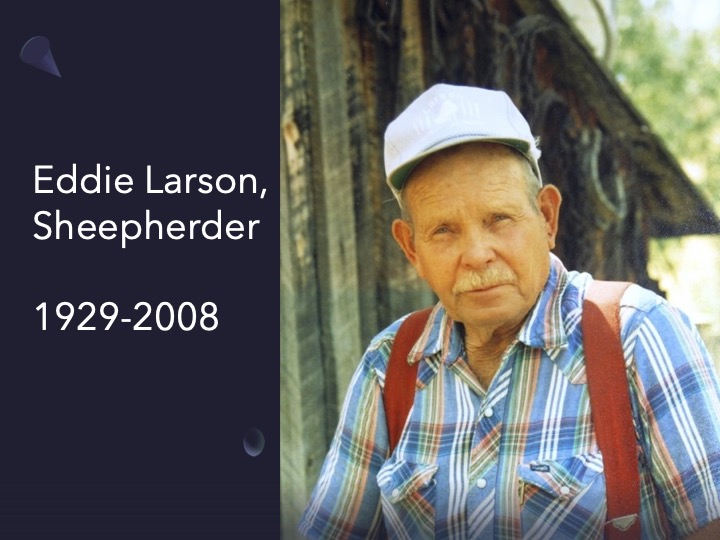
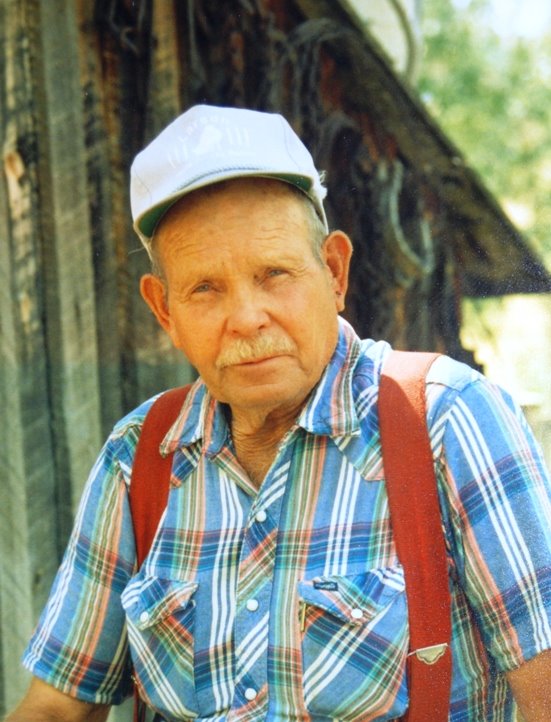
Eddie O. Larson (late 1990s)
“How are we today,” Eddie asked with a big grin.
I always found him cheerful even though he’d known his share of heartache. His wife, Ned, the love of his life, had died of cancer in 1990, a few years before I met him. In his living room was a photograph of a large aspen tree. When the tree was small, Eddie had carved a heart and added his name along with the names of his wife and daughter. Carving on aspens was common among sheepherders. Eddie had forgotten about this tree, but as it grew so did the carving and one day a hunter came upon it. He photographed the tree, framed it, and presented it to Eddie as thanks for allowing him to hunt on his land. Eddie was pleased.
Eddie also loved his daughter. He doted on her and made sure she was well cared for. She was a few years older than me and mentally challenged. Although I never asked, I couldn’t help but wonder if his wife’s cancer and his daughter’s limited mental capacity had anything to do with those blinding predawn sunrises from the west Eddie and his wife experienced back in the early 50s when the herd was on the winter range in Nevada. Above ground nuclear testing was common in that decade as Eddie started out in the sheep business. Although the government said it was safe and there was nothing to worry about from the white ash that sometimes fell afterwards, we now know otherwise.
Eddie’s early life
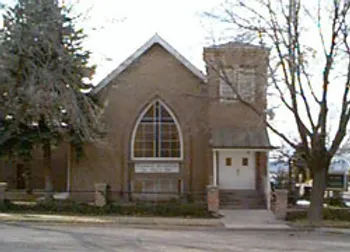
The old Community Presbyterian Church 1927-1997
Eddie Oscar Larson was born in Southern Utah to Swedish sheepherders. His father, Oskan Ludig Larsson changed his name to Oscar Larson. He and his wife, Alma, had only one son rather late in life. Oscar was in his mid-50s and his wife in her forties when Eddie was born.
They were gentiles in a land in which most people followed the Mormon religion. There were three Swedish sheepherder families, along with a few government and railroad workers who made up the Presbyterian Church in Cedar City in the 1920s. The other two families were the Lindells, who sold out and moved in the 1950s, and the Lundgens, who are still in the area. I recently wrote about Roy Lundgen and his wife in this blog.
Eddie was first local resident to be baptized in the new church which was built in 1927, just a few years before his birth. The first baptism was for a child of the pastors, but they soon moved on. While often shunned in this religiously dominated world, his father was successful. They never lived extravagantly, but Eddie was able to go away to school. He first attended a Presbyterian boarding high school, Wasatch Academy, in Mount Pleasant, Utah. From there, he headed to Utah State in Logan, but had a hard time finding a place to stay as he was a gentile. If my memory is right, Eddie graduated from Westminster College in Salt Lake City. While he was in college, his father died.
Eddie had set out to be a coach but decided to follow his father’s footsteps and began to build a herd of sheep. While he never had the size of a herd as his father, he was very successful and limited the size to better manage his land. Eddie would run his herd, with the help of a hired hand, for most of adult life. Right before I left Cedar City and maybe five years before he died, Eddie finally sold his sheep. By this point, he was having trouble with his eyes. About a year before he died, he was moved into a nursing home. Age and illness had robbed this man of the things he enjoyed, running up and down the mountain in all kinds of weather and basking in the beauty of God’s creation.
A Proud Sheepherder
Eddie always proudly proclaimed to everyone that he was a sheepherder, even though for him it was business. For most of his time as a sheepherder, he hired another herder to stay with the sheep. This man lived in a sheep wagon and generally liked being alone. Occasionally his herder would come to town for supplies and drink, and after a few days of the latter, go back up on the mountain or out in the Nevada desert, where he’d dry out while tending and protecting the sheep.
Eddie made almost daily trips to check on his herder and the herd, bringing in groceries and feed for the horses. He’d help haul water for the sheep. Eddie kept around 1600 ewes in his herd. When that many animals are away from a watering hole, a lot of water had to be hauled. He had an old oil truck that allowed him to carry several thousand gallons of water. Such a herd also required many rams, along with horses and dogs to help with the work.
At night, Eddie did the books and dealt with government leases. Although Eddie was one of the largest landowners around, he still leased land for grazing, especially for winter pasture in eastern Nevada. The annual livestock banquet in Cedar City often honored Eddie. There, this humble man seemed larger-than-life. People knew he worked hard, and it paid off. Not only did he have a successful operation, he own a huge parcel of land up on the mountain, some in Nevada including a four acre spring that was the envy of Las Vegas, and a lot of commercial real estate in Cedar City.
The Seasons according to a sheepherder
Eddie lived by the rotation of the earth. In the summer, the ewes and lambs would feast on the grass in the high mountain plateaus. In late summer or early fall, he culled the lambs from the ewes and trucked them to market. It was always a guess as to how long to wait. The longer the lambs ate the mountain grass, the heavier they were and the more profit they’d bring. However, there was always the risk of early snows trapping the herd and then Eddie would have to haul in feed. This would eat up any profit he might have made.
Some years were harder than others. There was the year of the fire. With much of the grass on his range burned, the lambs had to be sold off early, when they were a good 20 pounds light. On another occasion, he told me about an early snow. The lambs had already been sold, but the ewes remained on the mountain. His truck was stuck in the deep snow. It took him a day to walk out. Hhis herder stayed with the herd which was nearly immobilized by deep snow. Getting back to town, he hired a bulldozer to come and clear a path so the sheep could make it down the mountain.
In the fall, as the aspen turn bright yellow, he’d ride a horse, trailing the sheep down the mountain and around the south end of town, using a 100-year-old livestock trail. As the days shortened, he and his hired herder would move the sheep from one alfalfa field to another, where the sheep would eat the remains left from the harvest as they moved toward their winter pasture in Nevada.
By December, the sheep roamed around the deserts of eastern Nevada, between Caliente and Pioche, where they ate sage and what grass remained from the summer. If there was snow on the ground, it was easy work. The sheep could also eat snow for moisture. But if there was no snow, Eddie and his herder had have to drive the old tank trunk to the warm springs at Panaca or another spring on the west side of his property, where they would fill it up and haul the water back to the sheep.
At the end of winter, Eddie’s sheep got to ride in trucks back livestock trailers as they headed east to the lambing barns near Kanarraville. They first sheared the sheep. Usually by men from Australia and New Zealand sheared the herds in the American West from late February through April. These crews would then returned home, shearing sheep Down Under in their spring which is our fall. Lambing always came after shearing. A sheared ewe had less problems giving birth. For a few weeks, Eddie would hire a host of people to help him by serving as mid-wives to the ewes. He was always in church on Sundays, except for this time of the year in which Easter often fell. During lambing, he lived by the lambing sheds.
Finally, as the weather warmed and the snows retreated on the mountain, they’d move the herd up to higher elevations, where the cycle would repeat itself.
My experience with Eddie
Part of the reason I felt called to Community Presbyterian Church in 1993 was the congregation’s vision of expanding and building a new church building. Eddie, the first local child baptized in the old church, volunteered to help raise the money for the new complex! He shared the vision for the church to grow and to serve the community he loved and helped us achieve it. We moved into a church complex in 1997. Just before I left Cedar City, in January 2024, Eddie donated mountain land to the congregation for use as a camp and perhaps a future conference center.
I am thankful for the few times I took Eddie up on his invitations to take a day off and ride with him. We’d head out early. Sometimes we stop for breakfast or coffee. In his truck, he’d have some groceries and a few tools to repair fences or gates, maybe a salt block or two. Depending on where the herd was located, we’d drive an hour or two, all the while Eddie told stories about his dad and about the sheep business and about how lazy the cattlemen could be.
There is little love between sheepherders and cattlemen, a feud that goes back into the 19th Century. Part of the anger between the two groups is that sheep can eat grass down to the dirt and if the cattle come in after the sheep, they are unable to graze. Another source of conflict came, according to Eddie, from the sheepherders who work harder, but also tend to make a lot more money than those who tend cattle. However, after World War II, many sheepherders sold their lambs for cattle.
When we were on the range, lunch was always at the sheepherder’s wagon. In the summer, we’d sit around under cottonwood trees. In winter, we’d all crowd inside the wagon, to get out of the cold and wind. The smells were enchanting. Pinion burned in the stove as coffee perked. Mutton was always served. Some days we’d eat it with potatoes and carrots, other days we’d have it in a sandwich, the bread slathered with mayonnaise and cheese. We’d wash it all down with coffee.
Some afternoons we’d scout out the next spot for the camp. Others, we’d take the tank truck out to the spring for water. As we drove around, Eddie would talk about the land. He showed me where he worked to stop erosion and to restore the grass that use to be more abundant. Over-herding animals in the first half of the 20th Century had taken its toll. When Eddie got into the business, he decided to run half as many sheep on the land as his dad and the previous tenants. His decision was slowly paying dividends and he was proud of his work and of his land. After he’d finished with the chores for the day, as the sun dropped in the sky, we’d head back toward town.
Eddie’s death
“When I was in my 20s and just starting out, I was told by another herder that sheepherding was a young man’s business,” Eddie confided in me one day. “Now I believe him.” Eddie died in 2008 at the age of 79. He was finally able to relax and let the Good Shepherd take over.
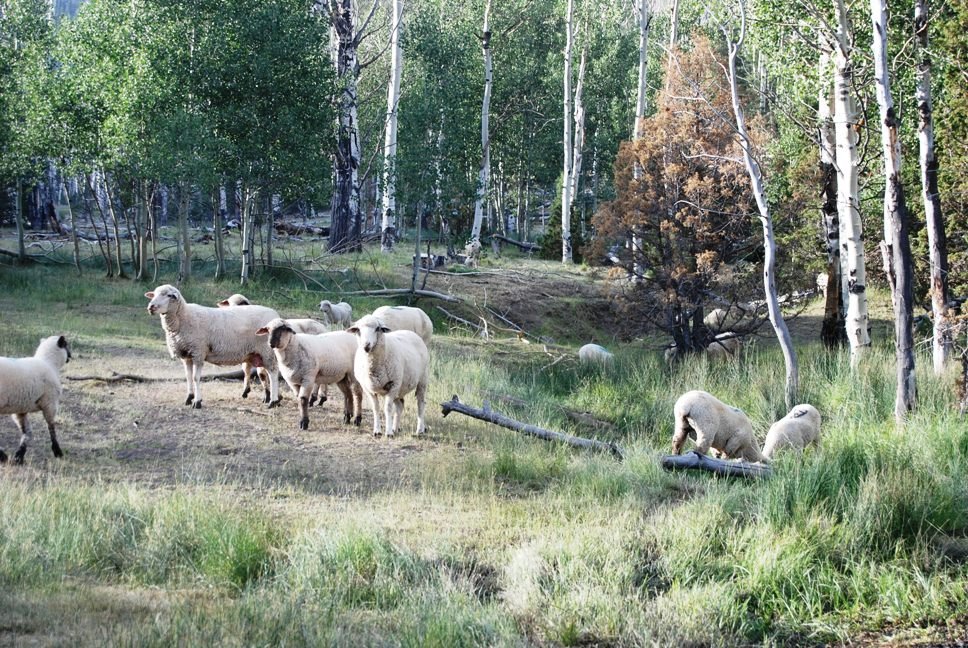
Sheep forging in an aspen grove on Cedar Mountain, 2008
12 years earlier, at the beach (and obviously going to church) with my grandparents and my uncle. I must have been about one and have no memory of this trip..
From the time I was twelve till I started working at the age of sixteen, I spent at least two weeks every summer with my grandparents. These lazy summer days were spent doing odd chores around their house and yard, racing bicycles with the kids next door, and occasional going with my grandmother to visit relatives, dead and alive. Some were living and others were dead. She felt I should know where all my ancestors were buried.
Every afternoon, my granddad would come home a little after five. Getting out of his truck, he’d yell, “Ready to go fishing?” Grandma had dinner ready. As soon as we finished, the two of us could take off to a lake, a beaver dam, or some farm pond where we’d fish till either a cloud blew up or the light had drained from the sky. Then we’d head home. Out back, under the floodlights by the porch, we’d clean our catch. Often, the next day, my grandma would fry up a mess of them for our dinner.
It was wonderful to fish with my granddad, but he wasn’t much of a talker when fishing. Instead, he allowed me to have a bit of independence and freedom, as he’d go one direction and send me off the other. I valued the freedom, but now wonder if the real reason was my granddad’s belief that fish could hear you talking. To fish, one needed to be quiet.
On this one evening, we fished in a rather large pond downhill from a house that belonged to people my granddaddy knew. They were not home. We drove around the house and my granddad parked his truck by the dam. With his fly rod, which is now one of my prize possessions, he fished one side of the lake. I crossed the dam and fished the other. I used a spinning rod and a Rebel, a top floating lure that when pulled fast would dive to about a foot under the surface and wiggle in a way that sometimes drove bass crazy.
After a few minutes of casting and coming up without a strike, I heard the muffled cry of a woman calling for help. I looked, but didn’t see anyone. The voice seemed to come from behind my grandfather, yet he didn’t seem fazed. When the cry came again, I shouted at my grandfather. He waved, said it was okay and that I was disturbing the fish. Well, it certainly didn’t sound okay and if someone was in peril, that should take precedence over fishing. When the cry came a third time, I knew someone was in trouble.
I dropped my rod. Checking to make sure my Kabar knife was safely stowed in its sheath on my belt, as I ran as fast as I could around the dam and up the hill. I kept yelling for my grandfather to join me., I couldn’t believe his hearing had gotten so bad, yet granddad didn’t budge. Instead, he yelled, “Come back here.” But I kept running. In my mind I had an image of saving some beautiful damsel in distress. I topped the hill, near the house, and started looking around frantically.
There was no woman in peril. Instead, there was peacock. Its feathers were displayed like the NBC logo. I didn’t think much about it, except that it was strange. Peacocks are not native to the Sandhills of North Carolina. After a few minutes of looking around and seeing nothing, I walked back down the hill toward my granddad. About halfway down, the cry came again. I turned and saw the peacock up on top of the hill emitting that high pitched cry and heard my granddad laugh behind me. Feeling a bit foolish, I went back to my fishing.
It’d have to wait for another day before I could make my debut as the new Lone Ranger.
Click here for another memoir piece of fishing with my grandfather.