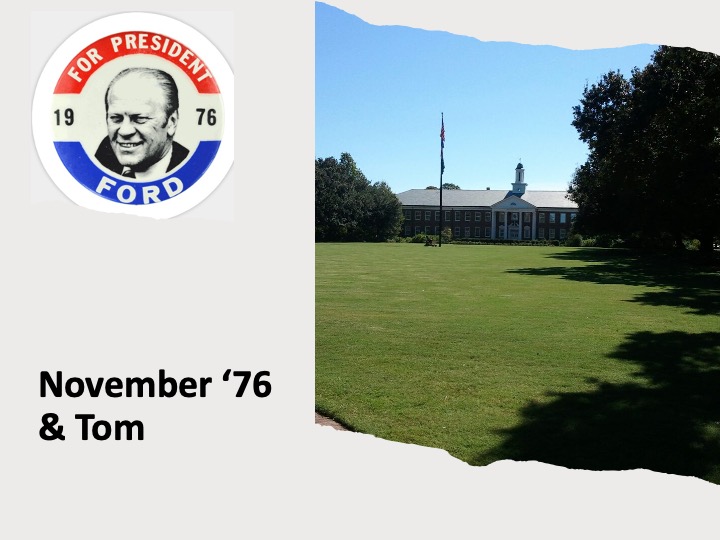
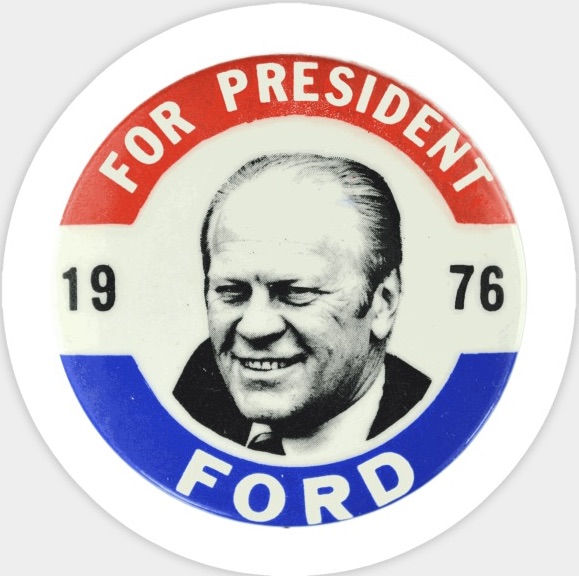
On the second of November, Election Day, Tom and I met in the cafeteria at the University of North Carolina at Wilmington. Normally I rushed from school to the bakery for the second shift, but since it was Tuesday, I was off. At the bakery, those in production worked Sundays and Mondays, then Wednesdays, Thursdays, and Fridays. In my spare time that fall, between classes and work, I had volunteered for the Ford Campaign for President. Tom, whom I knew since 1973, when we both starting to work at Wilson’s Supermarket on the same day, also volunteered. Often on Tuesdays, we would be working a phone bank or putting up signs. But now Election Day was here. It was time to rest.
We talked about the election. While I had worked for Ford, I wasn’t opposed to Carter being President. I had even heard him speak on campus during my freshman year in college. There’s not been many election since that I could say that I admired both candidates. Although in different precincts, both Tom and I voted early that morning. It was our first time going to the polls, and sadly, for Tom, his last.
While eating, Tom shared with me that he was going back to the eye doctor that afternoon. His eyes had been bothering him, and they couldn’t seem to get his thick glasses adjusted. I had no idea this would be the last time I would see him alive. After all, I no longer worked with him at Wilson’s Supermarket, nor did we have classes together.
Tom, however, had a class with my fiancé. She had complained to me a few weeks earlier about Tom, how he often sat by her and tried to talk to her in a psychology class. Thinking he was weird, with his thick glasses, the red splotches on his skin, and the way he often twitched his head when talking, she felt he made it hard for her to make friends within her field of psychology. She wanted me to tell him to leave her alone. I refused. We had a bad argument. I started to break up with her. Had I done so, it would have saved me much heartache a few years later. But I didn’t. Before the topic came up again, Tom was struggling to live.
A few days after that lunch, I received a call from Billy, another friend, who told me that Tom was in the hospital and had a brain tumor. His eye doctor realized something else was wrong and sent him to another physician. Billy and I went to see him at the hospital, but were not allowed in. I later learned they performed the surgery, and the physicians realized it was more complicated than expected. They closed him up and brought in a team from Duke to help with the surgery, but Tom didn’t survive.
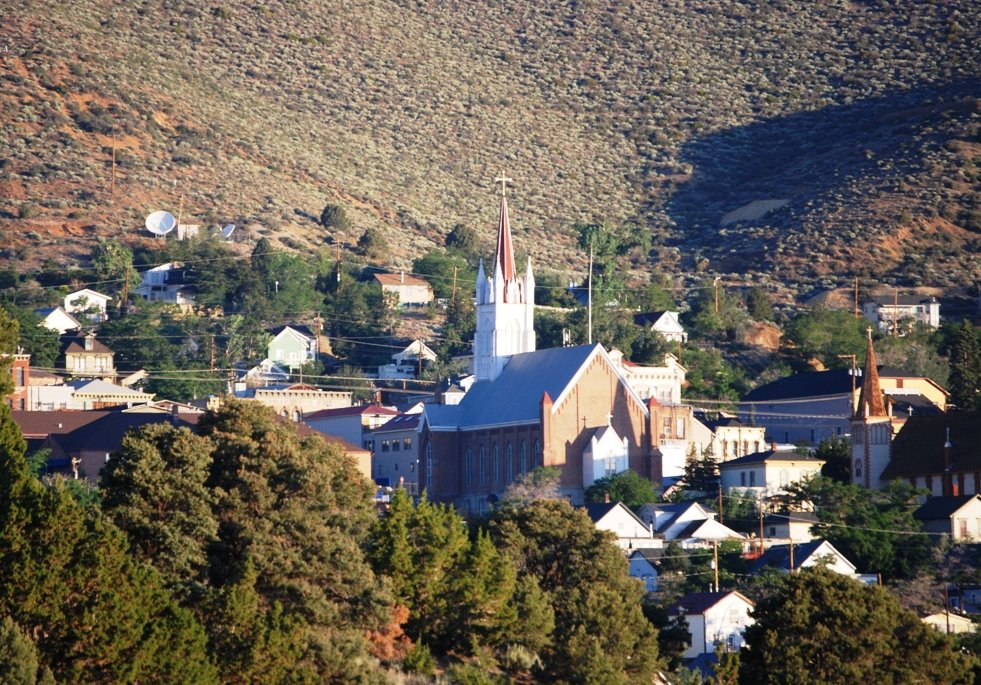
Several of us who had worked with Tom at Wilsons attended the funeral. The service was held at the Catholic Church on Wrightsville Beach. It seemed odd, but this was the second time I had been in a Catholic Church. Both times had been for a funeral and at the same church. The first funeral was three years earlier, for an another high school friend. In an odd sort of way, Tom was the glue that held several of us together. After we said our goodbyes that afternoon, I would never see the two of them again.
Tom and I started at Wilson’s Supermarket on the same day. Being the new kids in the store, we became friends. And during my time there, Tom generally followed me. When I became the leader of the Saturday night mop crew and had an opening, I invited Tom. He would later take my place running the mop crew. I taught him how to use a cash register, how to handle price changes, and to order cigarettes. Billy started working at Wilsons a few months after us, and he was the first to leave as he graduated in 1974.
While Tom went to a different school than Billy and me, we often hung out and got into mischief after work.
One night, Tom was riding with Billy, and I was following. We headed south on South College. When we got to where the road split off with Shipyard Boulevard, across from Hoggard High School, we took the right as the road became a four lane. I gunned it and moved to pass Billy. We were on a curve with a medium between us and the opposing traffic. The curve limited my sight. Soon, a car in the wrong lane was coming straight toward me. I swung over, trusting I was ahead of Billy. I barely missed the approaching car. Thankfully Billy, sensing the danger, hit his brakes. Billy later said that Thomas screamed something about me dying and grabbed his arms while he was trying to slow down and move onto the shoulder to give me room. Certainly, had I hit this car head-on, I probably wouldn’t have walked away.
I remember going with Tom to a meeting for Ford volunteers that fall. The county chairperson, some big-shot doctor in town, kept calling on Thomas thinking he had a question whenever he twitched his head. Finally, the doctor asked him what was wrong. Tom said he was okay, but I knew the question hurt him. When I told my mother about this exchange, she was furious. “That man is a doctor; he should have know that Tom has a medical condition and not have shamed him.” Sadly, at the time, none of us knew the severity of his condition.
I don’t know if Tom ever got his driver licenses. He either rode his bicycle or his older brothers gave him a lift. The two of us discussed taking our bikes up to the Outer Banks and riding and camping along the beach, but sadly we never got around to it. Leaving his funeral, I felt a tinge of guilt for not working harder to have made it happen.
After the funeral, one of his brothers confided in me that Tom’s twitches were a part of his condition which led to his brain tumor. He knew that anytime such a tumor, such as the one that claimed his life, was a possibility. But Tom never sought pity; he just wanted to be included as one of us. I look back over these 47 years and think of all that he missed, and yet I’m glad to have had a few years of friendship with him.
###
Sadly, I have no photos of Tom. One day I will check out New Hanover High School yearbooks for 1974-1976 and see if I can find a photo.
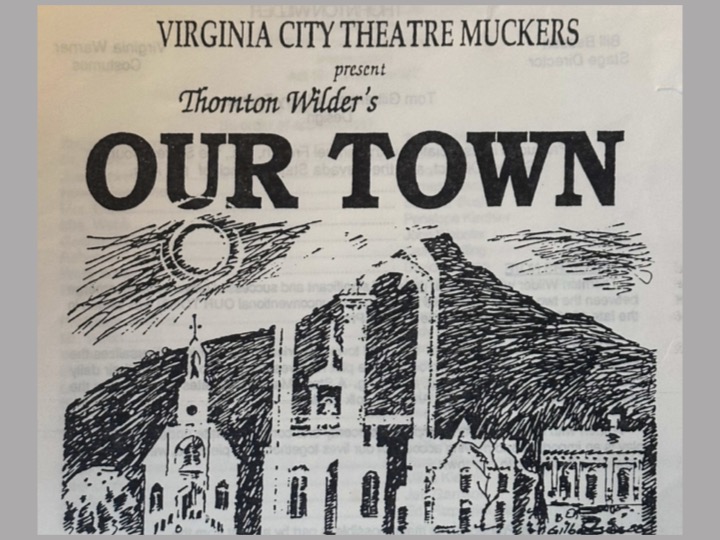
The year before I left my job with the Boy Scouts and headed to seminary, I wrote out five-year goals. One goal was to be act in a play. I have always enjoyed the theater and wanted to experience acting firsthand. I got my chance when I moved to Virginia City in September 1988. A week or two after arriving on the Comstock, I saw an advertisement for tryouts for a play which would include students and adults.
I asked some of the church folks about the Mucker’s Theater Group and received mixed feelings. For years, they had used the church for their performances. But there had been some bad blood between the two organizations. They were supposed to clean up the church on Saturday nigh, returning the sanctuary to a state where worship could be held the next day. A few years before, when the theater group left the church chancel looking like a bar after a fright on Sunday morning, the church threw the group out.
In the hope of removing some of the bad blood between the theater and the church, as well as meeting a personal goals, I showed up at the tryouts. I was offered the role of Joe Stoddard, the town’s undertaker. My presence in the play brought many of the church members back to the theater.
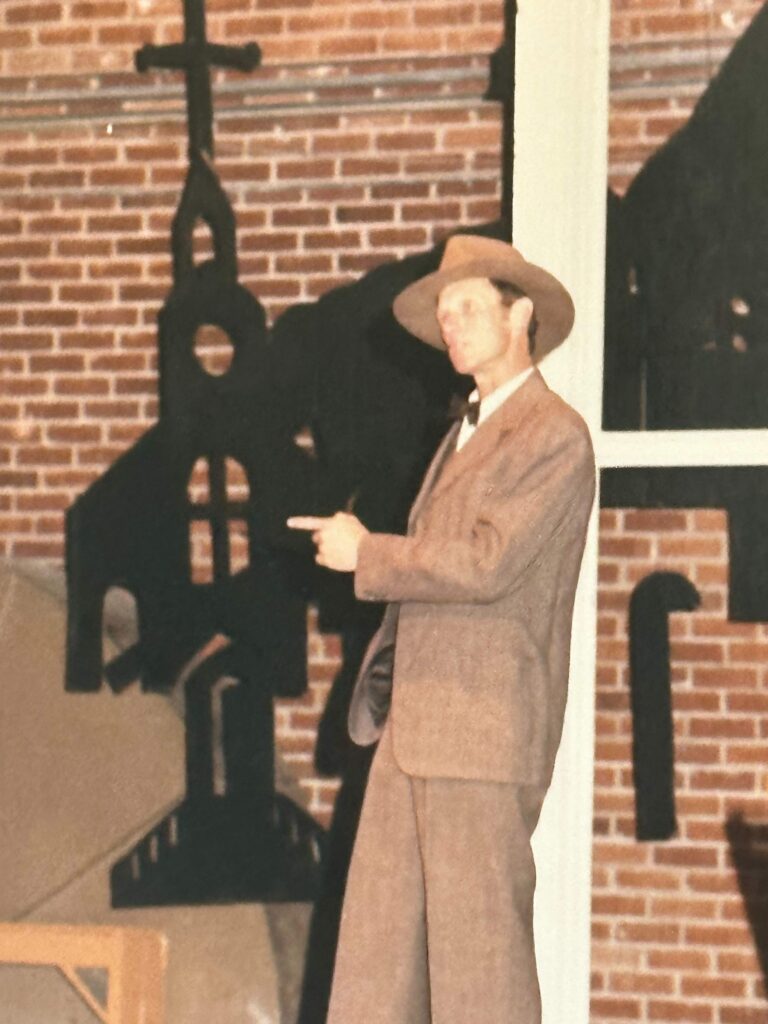
Tommy, the “Stage Manager”
We began practicing in September. It was still warm and daylight when practice began, but as they continued, the weather became cooler, and daylight decreased. Our production ran from Thursday through Saturday evenings, November 10-12. By then, the zephyrs blew and we experienced a few snow flurries.
For a town with only 700 residents, we played to pack houses. Almost everyone attended, not just from the town but from down in the valley. By the third night, we were feeling pretty good about the attendance and the play itself. This set the scene for one of my favorite memories of my time in Virginia City which occurred on the last night of the play.
“You know, we’re missing the Flapper tonight,” I confided to Penny and Christy as we waited backstage for the curtain to rise for the closing night.” I hoped someone might be interested after the play and cast party. Since this play had a cast that included elementary school students, the planned party only involved cake and punch.
“We don’t have to miss it,” Christy said as she lowered her voice. “Let’s slip out after our scene in Act 1. We don’t have to be back until the 3rd Act.
“Should we?” Penny asked.
Christy and I smiled.
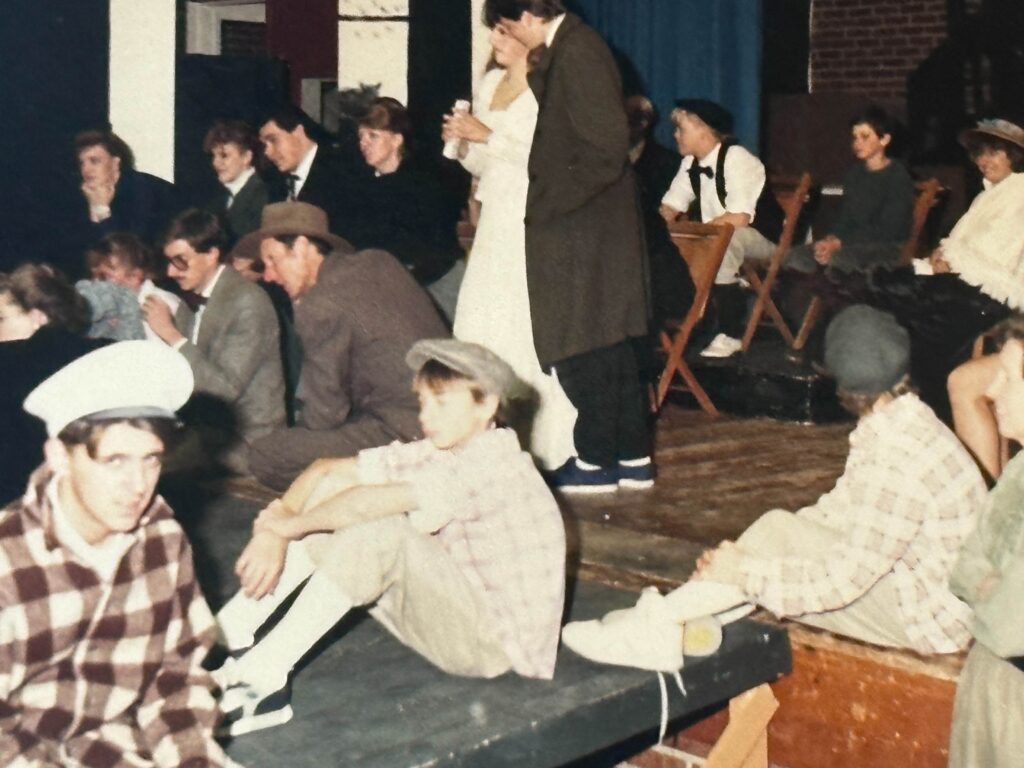
The three of us had minor parts in the play that involved the entire community. With a high school that fourteen graduates in its senior class, everyone had to be involved. Penny and Christy were both teachers. The school janitor had the leading role as the stage manager. Emily and George Gibbs, two other leading characters, were high school students. Bill, the director was a halftime teacher and a halftime state employee for the purpose of fostering the arts in rural parts of the state.
Twenty minutes after the play began, we slipped out from behind the gym that also served as the auditorium for the Virginia City School on D Street. The night was cold. As we climbed the steep steps up to C Street, we giggled as we began to breathe heavily. Our warm breath appeared as smoke that filled the air. We crossed an abandoned C Street on the south end of the business district this time at night, and headed north up the boardwalk. After we crossed Dayton Street, where there were still bars opened, a few cars were parked along the road. When we arrived at the Silver Stope, the bar which hosted the party, Christy took hold of one of my arms, Penny grabbed the other.
“We’ve come all the way from Grover’s Corner,” we shouted, making a grand entrance. All three of us had minor parts in the play, but we enjoyed hamming it up for the bar patrons. Most of the patrons dressed as if they were visiting a New York Speakeasy during the 1920s. Almost all of them had seen the play earlier in the week warmly welcomed us to the party.
Of course, we weren’t dressed as flappers. New Englanders didn’t have time for such nonsense. Christy and Penny played the wives of farmers and wore calico dresses. As Joe Stoddard, the town undertaker, I sported black jacket and a stovepipe hat, which had probably been left-over from some school play about Abraham Lincoln. With my costume, I could have just as easily played the role of a well-to-do 19th Century Mormon polygamist taking my wives out for a drink.
While most of the bar’s patrons dressed like flappers, one person stood out. Murray Mack was on the piano, wearing his usual evening attire for a night on the Comstock, a rather loud 1970s era polyester leisure suit. Murray, who repaired glass during the daytime, would dress up at night and was well-known for his gift of pounding out ragtime on the piano. Tonight, he had moved up a decade to play jazz.
On the floor in the middle of the bar sat an antique claw-footed bathtub filled with a pink liquid. We were handed three clear-glass cups which must have come from someone’s punch bowl set and were encouraged to imbibe. We all scooped a cupful of the concoction. It was awful. I didn’t ask for the recipe, but I assumed it consisted of 190 proof Everclear, or maybe it was kerosene, mixed with powdered Kool-Aid. After my first sip, I looked to find a place to ditch my drink. Seeing no plants in need of watering, I excused myself and took my cup into the bathroom.
Moments later, I returned with an empty cup. The bartender came from behind the bar to snap of photo of us with a Polaroid camera. This photo enshrined us on the bulletin board by the door. Having just emptied my cup, I felt bad dipping it back into the drink. But they insisted I have some of the so-called gin in my cup, so I reluctantly dipped it back into the tub. It was more of the thought of dipping a used cup into the juice that bothered me for that tub contained enough alcohol to have killed any depictable germ residing on my cup.
With my cup nearly pouring over, the three of us stood behind the tub and raised our cups for a toast to the Virginia City Mucker’s production of “Our Town.” He snapped a photo. We asked the bartender if he would snap another, so we could present the director evidence of what some of his adult cast were doing between their scenes. He did. After visiting with folks for a few minutes, we placed our cups on the bar and headed back to the high school. I noticed, like me, neither Penny nor Christy had finished their drinks.
We were back in time for the final act. As undertaker, I had to see to it that Emily Gibbs was buried one final time. Penny, who played her mother, sobbed throughout the scene. Christy, ignoring her blocking instructions and her lines, stepped in front of Penny to console her grieving friend.
“It’ll be okay,” Christy whispered, patting Penny on the back. “We can go to my house afterwards and have a decent drink.”
This was the Mucker’s second time producing “Our Town.” The first production was 31 years earlier, in 1957, in which Bob Del Carlo, who was sheriff for Storey County when I was on the Comstock, played the lead as the Stage Manager.
For much of the church’s history, the theater and the saloon would have been off-limits for Presbyterian ministers serving the Comstock. In the 19th Century, the church was often at odds with the theater and alcohol was a terrible social problem. Church members were discouraged from frequenting the theater or inbibing. Yet, the theater and saloon thrived during the days of bonanza.
We met at an afternoon gathering of the Presbytery of Lake Michigan, held in the old meeting house styled sanctuary of the First Presbyterian Church of Richland. I don’t remember the date. It must have been around 2009. I sat in the balcony, having come prepared with a book. Not seeing anything too important on the agenda, I planned to pass the hours reading. I knew the usual suspects would speak on every issue. Feeling my voice wasn’t really needed to add to the debate, I began reading. I don’t even remember the book, but it had something to do with 19th Century church history.
Jack sat in the same pew, but there was a gap between us. Catching the book title, he slid over and quietly asked about it. Soon, we were whispering back and forth, discussing Charles Hodge, the great 19th theologian at Princeton Theological Seminary. Jack had written his dissertation on Hodge. That was a beginning of our friendship.
Jack had just retired from Princeton Theological Seminary, where he’d spent the previous fifteen years teaching. Before that, he taught few years at Yale Divinity School and before that at Hope College in Holland, Michigan. He’d also served as pastor of several churches in the Pittsburgh area and Westminster Presbyterian in Grand Rapids. We met several times for breakfast. In 2010, I hired Jack to lead a session retreat for the church I served in Hastings, Michigan. In 2011, I hired him again to help run our stewardship program.
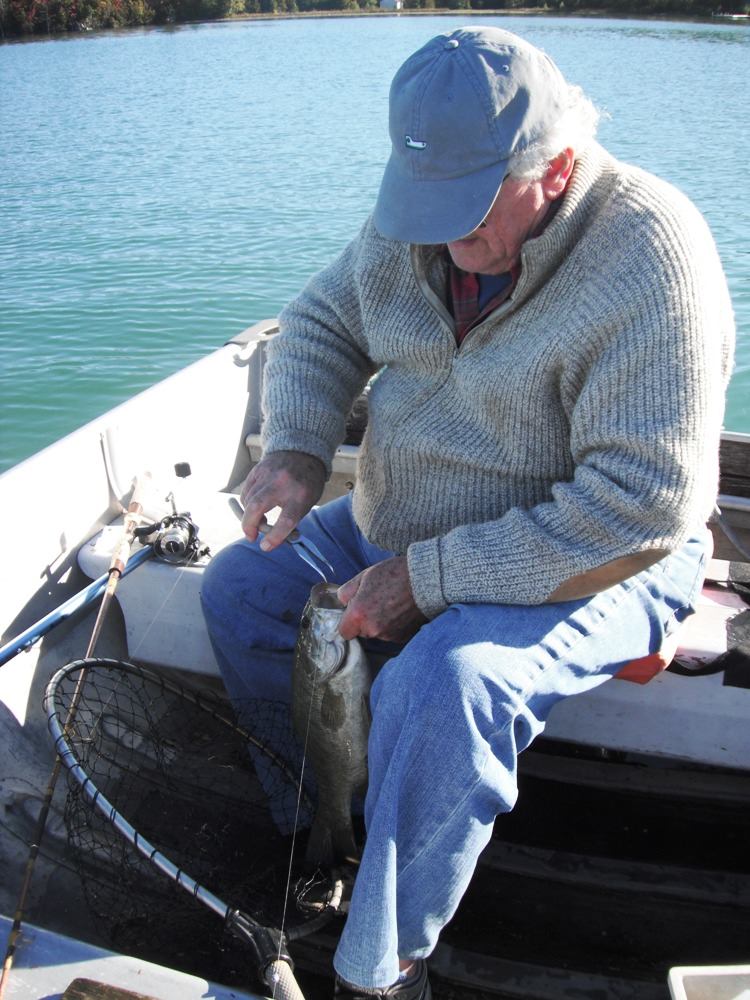
This smallmouth bass grew into an 8 pounder by happy hour!
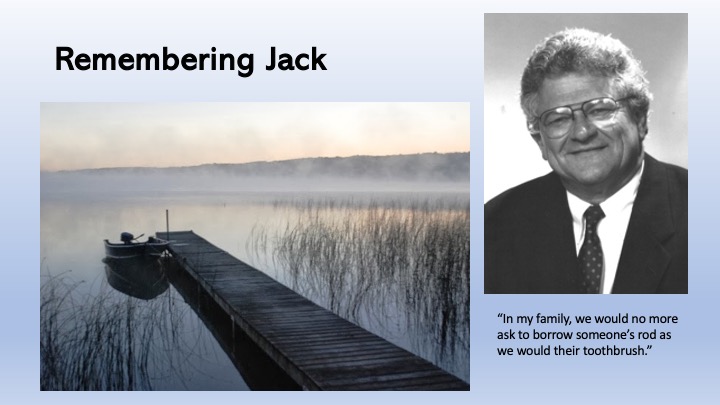
At some point, it may have been at that Presbytery meeting, Jack and I began to discuss his favorite topic, fishing. Over the next few years, Jack and I made several trips to the northern part of the lower peninsula of Michigan where he had a cabin which he and his sons had built back in the 60s. When I asked what I needed to bring on the trip, he told me to bring my rod. “In my family,” Jack informed me, “we would no more ask to borrow someone’s rod as we would their toothbrush.” I packed both.
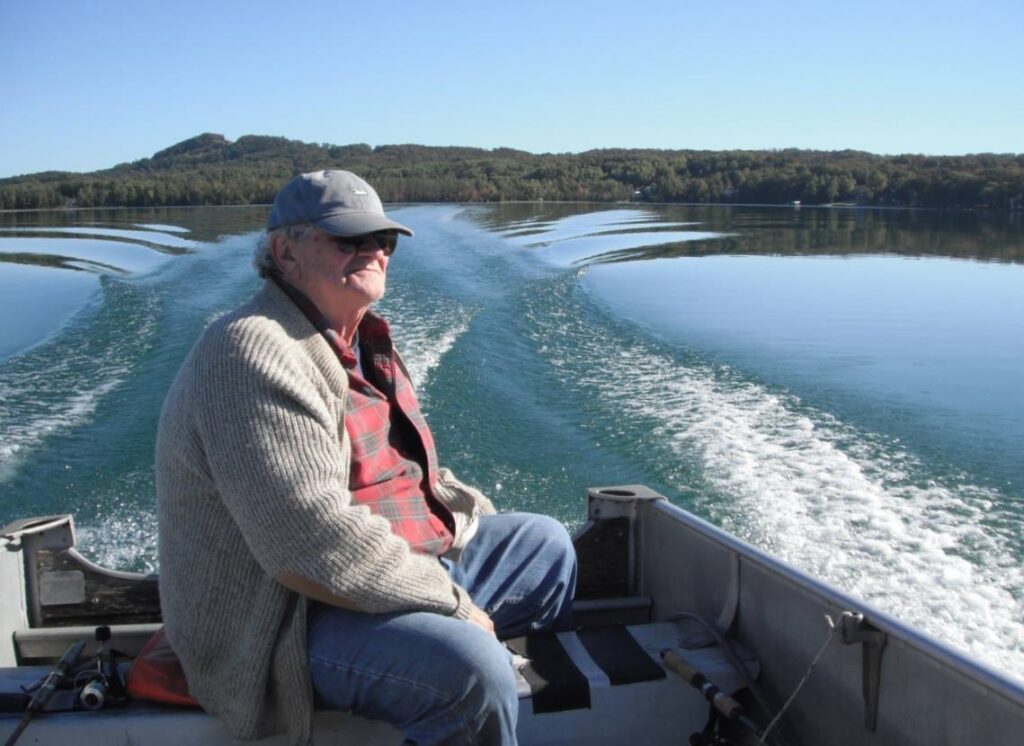
Jack’s cabin was a simple A frame, set a hundred or so feet from the shore of Lime Lake, which is not far from Sleeping Bear National Seashore. I also went on a fishing trip with him to the Pere Marquette River, but by then his health declined. He could no longer get into the water to fish with a flying rod. While I waded out a bit to fish, I ended up spending most of my time fishing from the bank, where Jack sat in a chair and made an occasional cast. We didn’t catch anything. On the trips to Lime Lake, we caught a lot of smallmouths using rubber worms and a spinning rod.
Jack swore he caught the largest fish on this day
Jack had his traditions. On these trips up north, we’d stop and grab coffee in Cadillac. The next stop was a country store in Maple City that had a little bit of everything, including a meat market which made sausage. We’d pick up a few pounds for our breakfasts. Each trip always included a stop at the Carlson Fish Market off the docks in Leland for some smoked white fish and pate.
Days at the cabin were relaxed. Breakfast was generally eggs, sausage, and toast. Before we ate, he’d pull out his old leather-bound copy of John Baillie’s A Diary of Private Prayer. Baillie, a Scottish pastor from early in the 20th Century, had two prayers, a morning and evening prayer, for each day of the month. At breakfast, one of us would read the morning prayer. After eating, we’d fish in his aluminum boat. It was always catch-and-release. We’d come in off the water for lunch and maybe take a short nap before heading back out on the water.
We generally stopped fishing around 4:30. When we got back to the cabin, we’d have some crackers and pate or smoked whitefish, with a wee dram of scotch. One of us would read Baillie’s evening prayer for the day. Baillie and Scotch were appropriate for Jack,. He proclaimed his last name was how Stewart was supposed to be spelled. The other Stuarts were highfalutin Francophile Scots. After this Scottish ritual, we’d head out to one of the many restaurants and pubs in the area for dinner.
As we fished, as well we drove around the region, or sat around after dark, nursing one more drink, we’d talk. Topics were numerous: theology, travel, world affairs, politics, what we’ve been reading, and some more theology. One particular concern for Jack was ecclesiology, which Jack felt was the weak link in the Reformed Tradition. But our talks weren’t always serious. We always told jokes. Jack could find a way to intersperse a joke into any conversation.
Jack was raised south of Pittsburgh, near Uniontown, Pennsylvania. I think his father was a coal miner and his family was of modest means. Jack earned a scholarship to Westminster College in New Wilmington, PA. While in college, he became friends with Bruce Thielemann, who later became a very popular preacher at 1stPresbyterian Church in Pittsburgh (click here for some of Thielemann’s sermons). Sharing my remembrance of hearing Thielemann preach in the seminary chapel when I was a student tickled Jack. Thielemann died in 1994 and Jack spoke at his funeral.
After college, Jack and Bruce attended seminary in Pittsburgh. His class was one of the first for Pittsburgh Theological Seminary, which was formed with the merger of Xenia and Western Theological Seminary (Xenia was the seminary for the United Presbyterian Church of North America and Western was a Seminary for the Presbyterian Church, USA The two denominations united in 1959).
While at seminary, he became a friend of Robert Kelly and Jack Rogers. Twenty-seven years later, Kelly was one of my New Testament professors when I was in seminary. Rogers spoke at my seminary graduation and was the moderator of the 2001 General Assembly of which I was a commissioner. The four were mentored by John Gerstner. Jack appreciated Gerstner’s guidance, but could not abide by his rigid conservatism. Jack told me about him meeting Gerstner years after seminary in which his old professor told him how he and his friends were a disappointment because none of them had joined in his battles.
After I left Michigan, Jack and I would occasionally exchange emails or talk by phone. Often, when I was in the area, I would stay with him and his wife, Maureen. On at least two occasions, I was there on a Sunday and would worship with them at the Church of the Servant, which is located near the campus of Calvin University. At home, before meals, he’d offer grace using the opening words of Psalm 103.
Bless the Lord, O my soul, and all that is within me, bless his holy name.
I last saw Jack in October 2022. I was at at Calvin for a Foundation for Reformed Theology seminar. On a free evening, I drove over to his home for dinner. I knewJack wasn’t doing well. Still, it was a shocked a few weeks ago when Marueen emailed me that Jack had been in the hospital and was coming home under hospice care. Thankfully, I was able to talk to Jack two weeks ago. On Sunday, I received an email informing me of his death.
I will miss his jokes and stories. Both the true stories, along with the tales about a fish which must have grown by pounds between catching it and telling about it.
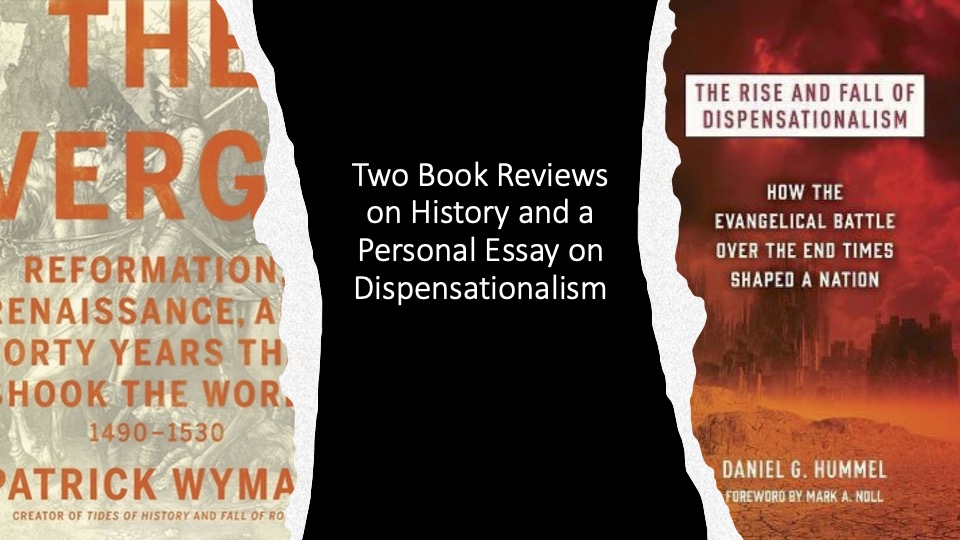
Daniel G. Hummel, The Rise and Fall of Dispensationalism: How the Evangelical Battle Over the End Times Shaped a Nation
(Grand Rapids, MI: Eerdmans, 2023), 382 pages including a glossary, biographic essay, and index. The text includes a handful of charts and prints.
A broad definition: Dispensationalism is a belief that God works differently at different periods of time (dispensations) to reach humanity in different ages (dispensations). The doctrine rose from the teachings of John Nelson Darby in the 1830s, an Irish pastor who founded the Plymouth Brethren sect. However, the term Dispensationalism wasn’t coined until the 1930s. Dispensationalists believe we are nearing the final age and that before the end comes, the church will be raptured out of the world. When this happens, the world will enter a period of tribulation. The theology became more popular through the writings of Hal Lindsay and the “Left Behind” series.
My experience with dispensationalism
I read Hal Lindsay’s The Late Great Planet Earth in high school. While Lindsay didn’t provide a date for the world’s demise, he certainly hinted it would be in the 1980s (I graduated from high school in 1975). I felt we were living in the last days. But we’re still here! Things weren’t moving toward the end, just yet. I slowly understood that the future is not ours to know. Jesus makes this clear when he said no one knows the date or the hour of his return.
The concept of the rapture, which is behind such theology, seems far-fetched. The idea that God is going to yank the church out of the world before things go to hell in a handbasket (pretribulation premillennialism), saving the church from the horrors to come. This idea, which is rather recent in the history of the church, became even more problematic as I became more aware of suffering of Christians in the world. Such beliefs seemed just too comfortable for Christians in the Western World. But what does it say to Christians in the Sudan or Pakistan or North Korea or any of the other countries with persecution. The purpose of the rapture, according to most dispensationalists, is for God to give Israel one more chance at salvation.
Dispensational theology wasn’t a class I took in seminary. I have only one memory of a professor addressing it, Doug Hare, a New Testament scholar. Essentially, he said that if we don’t do proper exegesis on the text, and understand it from the culture it arose, it would be easy to create such fantasy interpretations of scripture.
In my own journey, dispensationalism was something that I felt I needed to study after I graduated from seminary. Part of this came from study of American religious history and reading George Marsden’s books on the history of fundamentalism and evangelism. Then I read Charles Ryrie’s Dispensationalism Today and John H. Gerstner’s Wrongly Dividing the Truth: A Critique of Dispensationalism.
By the time of the publications of the Left Behind series, I was convinced of the danger of such teachings and spoke about it. This caused me to lose a potential new member when I was in Utah. A man took offense at what I said about dispensationalism. I later learned he was a friend of Tim Lahaye, one of the authors of the Left Behind series. During this time, I started to write my own “dispensational parody novel.” My title, “Left Behind at Denny’s” seemed to capture the worse place I could think of being left at. . I only wrote a few pages before I decided it wasn’t worth my effort.
While I don’t accept dispensationalism and have often pointed to the Southern Presbyterian Church call of the movement as a heresy, I must give them credit for reminding us that Christ will return. Eschatology is important.
My review of Hummel’s book
While I had a broad concept as to what dispensationalism was about, Hummel’s work opened my eyes. It’s not a mono-cultural movement, but one with many diverse threads. While the movement’s beginning is related to John Nelson Darby, the Irish theologian in the 1830s, there are aspects (especially in America) that goes back further to a premillennialist view (Christ will return before the millennial) and to the Millerites (followers of William Miller, a Baptist pastor in the United States, who predicted Christ’s return in the 1840s). Blending into these threads are how the theology became adopted by different groups from mainline denominations, evangelicals, and Pentecostals. Hummel does an amazing job describing these various understandings of dispensationalism.
In the 19th Century, Darby made many trips to the United States. He found a receptive ear in the Great Lake region and with the evangelist Dwight Moody. This led to the first institution dedicated to the teaching, Moody Bible Institute. From the beginning, American dispensationalism differed from its British counterpart. Darby’s Brethren were separatists from the main Protestant bodies. In America, dispensationalists were at home in many denominations including Presbyterians, Baptists, Congregationalists, and to a lesser extent in Lutheran and Methodist traditions.
Dispensationalism had a regional component. At first, it was strongest in the northern and border states. Then, a separate group developed on the West Coast, with the organization of Biola (Bible Institute of Los Angeles). The movement was slow to take hold in the South, especially in the early years, but eventually did with the establishment of Dallas Theological Seminary, which became the hub of academic dispensationalism. Interestingly, dispensationalism was primarily a “white” Protestant phenomenon and failed to take deep roots within the African American churches.
The movement gained considerable support after the publication of the Scofield Reference Bible by Cyrus Scofield, a Congregational pastor from Texas. Scofield linked together passages in the Bible that supported dispensational teachings. His Bible was published by Oxford University Press. The popularity of his Bible allowed dispensationalism to influence those outside of their own circle.
While dispensationalist beliefs grew in the early decades of the 20th Century, there were critics. This was especially true among more conservative and even fundamentalist Protestants, especially those within the Reformed tradition. While these critics challenged dispensational hermeneutics, they were often on the same side with many of the social battles such as fighting against the teachings of Darwin or Communism.
Among all the many divisions within dispensationalism, Hummel divides dispensationalism into two broad eras. The dispensationalism of the first half of the 20th Century he labels Scholastic. Then, in the 60s and early 70s, with the publication of books like Hal Lindsey’s The Late Great Planet Earth, a more popular version of the movement rose. This popular version later gave rise to the Left Behind novels, which earned their authors a fortune and helped spread dispensational views. However, as dispensationalism became unmoored to its scholastic roots, it also began to decline as a movement, especially under the attack of groups such as the “new Calvinists.” Even Dallas Theological Seminary began to scale back its requirements for professors and students to affirm dispensationalism.
Dispensationalism had to change over time (when Christ had not yet returned to rapture the church). While most tended to hold to the teaching that the tribulation would be after the rapture, some suggested we are going through a “humanistic tribulation” that will precede the rapture. This allows them to explain the liberal shift in culture and why the church has not yet been raptured.
While Hummel does an excellent job tracing all these various threads of dispensationalism in America, he only briefly covers the role the theology had in “shaping a nation.”
Dispensationalists were involved in many of the social movements of the past half century, but often with others who were conservative in their theology. However, their biggest impact was toward our country’s support of Israel. Dispensationalists sees the state of Israel as the defining moment in history pointing to the end. Many believed there are two ways of salvation, through the free grace offered by Jesus through the church and through the Jewish faith who are still God’s people. On the positive side, such thought makes dispensationalism a ready critic of antisemitism. However, it also allows one to justify total support of Israel without questioning the nation’s policies. When you believe you are on God’s side, who can argue with you about the morality of your actions?
Another area where dispensationalism had an impact was the fear of the accumulation of power and one world government. To a dispensationalist, this was evidence of the approaching end, but it also allowed for many conspiracy theories to rise and find a home in churches teaching such doctrines.
The role of end-time beliefs in our government is dangerous. Not only is it no way to run a foreign policy (as with Israel), but it can also create other policy disasters. If you are sure the world is ending, why be concerned about the environment. After all, why not max out your credit cards? I hope Hummel’s research will continue to explore such issues.
Daniel Hummel grew up within the dispensational tradition. He currently works at Upper House, a Christian center located on the campus of the University of Wisconsin-Madison. His first book (which I haven’t read and may go deeper into the role the movement had on our foreign policy) is Covenant Brothers: Evangelicals, Jews, and U.S.-Israel Relations). I would recommend The Rise and Fall of Dispensationalism to those deeply interested in the history of American religion or who would like to understand dispensationalism more.
Patrick Wyman, The Verge: Reformation, Renaissance, and Forty Years that Shook the World
(Audible, 2021), read by the author, 11 hours and 33 minutes.
Wyman makes the case that the four decades from 1490 to 1530 set Europe (and the Americas) on the course to become the world’s center. Prior to these decades, no one would have bet on Europe. The Ottomans to the east, China, areas in India, and even some unknown kingdoms such as the Incas and Aztecs in the yet to be discovered Americas, all seemed to have superior cultures.
But that began to change in the 1490s. The not-yet united Spain repelled the last of the Muslim invaders who had occupied parts of the peninsula for centuries. Not only did Columbus sail to the Americas, but other explorers also sailed down the coast of Africa and on to India. This was soon followed by the Reformation, the defeat of the Ottoman armies at the gates of Vienna in Austria, and the establishment of larger European nation states. Several things gave rise to European power including credit, printing, and the advancement in the art of war. This was also a violent era and Wyman ends his story with the Holy Roman Empire under Charles V sacking Rome (which was one way to settle the debt owed to the soldiers).
I have read many books focusing on this period of history, but I can’t recall any of the books beginning with a detailed discussion of currency in use at the time. Most of my books focused foremost on the Reformation and perhaps the printing press. Wyman, however, spends much more time discussing finance and trade before he ever gets to Martin Luther. Credit becomes the means to expand the power of the state as well as to explore and to share ideas. Credit involves a trust that one will be repaid and can make a profit, which often led to the abuses of the era. When it came to being repaid, no one was overly concerned as to how the profit was made, whether from slave trade or plunder.
While Wyman concentrates on a few key leaders of the era (Christopher Columbus, Suleiman the Magnificent of the Ottomans, Charles V of Spain, and Martin Luther), he often tells his story through more common people such as a trader in England and a printer in Venice. Each chapter begins with what might be called “Creative Non-fiction” as he places the reader in the setting described, allowing us to experience first-hand what life was like in this era.
Having listened to this book, I am glad that the author was also the reader. As an experience podcaster, he made an excellent reader. I would recommend this book to anyone interested in this era of history and how the modern Western world came about.
During my first few months as the grocery store, I worked only three days a week: Thursday, Friday and Saturday. On school nights, I’d arrive at 4 PM and work till 8 or 9 PM. As things begin to slow down in the evening, Bert would begin to send some of us home for the night. It was always nice to get out a little early on Thursday, especially if I had homework. On Saturday, I’d work from late morning till early evening.
I don’t recall a lot about these early months working at Wilsons. Everyone I worked with, except for Tom, was older. During this time, I mostly worked up front, bagging groceries and carrying them out to the customer’s car. Such work doesn’t create a lot of memories. This was fine with me for you were often tipped for helping someone with their groceries.
Learning new tasks: bottle returns and bring trash
Occasionally, when it was slow, I’d be assigned another task like taking care of bottle returns. In the front of the store stood several large bins on wheels where we placed soft-drink bottles after customers redeemed for deposit. Whenever a bin would begin to fill, or when there was a lull in the action, Bert would assign one of us bag boys take the bins to the back of the store and separate the bottles into several large wooden bins, divided by brands. The distributors picked up the empties a couple times a week. Although this gave you a break from bagging, it was really a dirty job and the novelty of working in the back of the store soon wore off.
Another back-room job was running the incinerator. All paper trash, especially boxes, and some plastic wrappings that came from the meat market were burned. Late in the evening, as things slowed down, someone was sent back to handle the daily trash. I was neat to see the incinerator. A huge steel door opened with a switch. I would pack the cavity with debris. Once filled, you closed it and hit a button that shot out a gas flame. The metal, when you ran it for a long period, became red hot. It took only a few minutes of burning to consume everything. Then, machine was ready for another load. It seems odd today that we burned cardboard instead of recycling. As for the burning of plastic, that also seems less than environmentally friendly.
Learning new tasks: Marketing
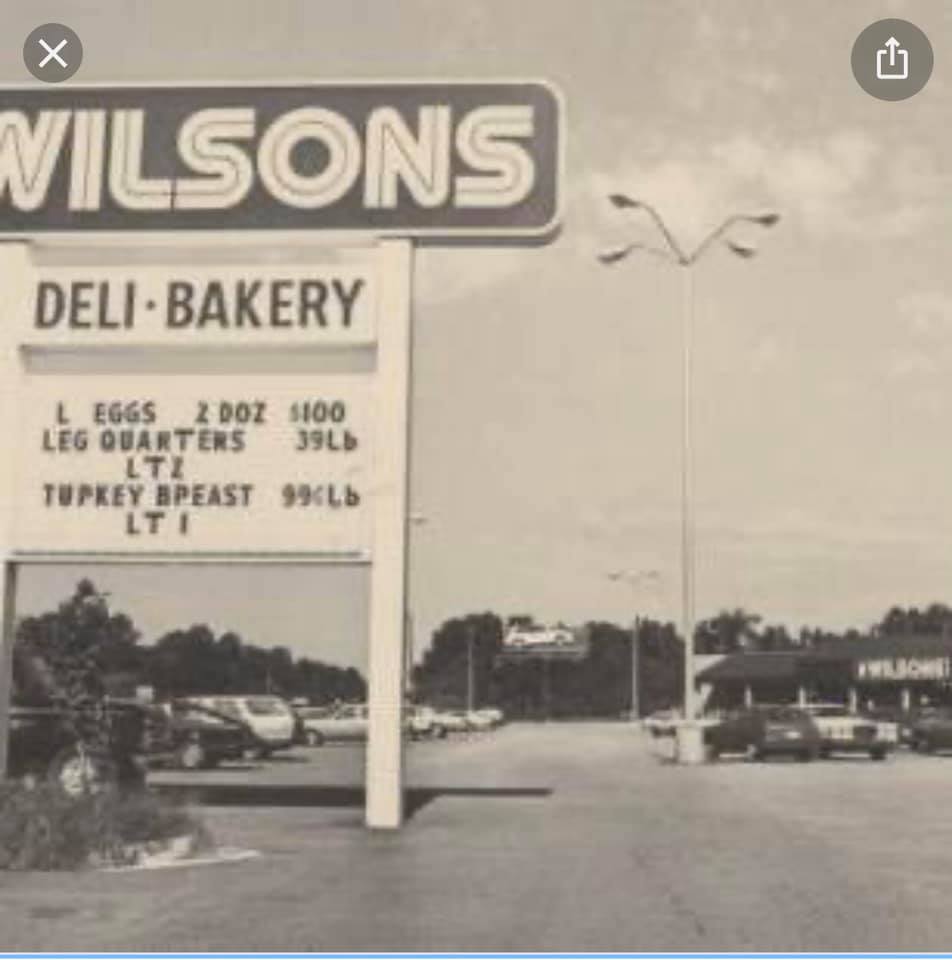
Another job which I slowly began to dip my toe into was marketing. At the time, the custom was for grocery stores to run weekly sales from Thursday to Wednesday. When my hours expanded and I began to work on Wednesdays, Bert would often ask me to help him hang large signs (3 feet wide and 8 feet long). These were taped onto the front widows and generally hung late Wednesday, an hour or so before closing. The signs advertised our weekly specials such as a five-pound bag of sugar for 59 cents, some cut of steak for 1.99 a pound, bananas for 10 cents a pound, baby food a dime a jar, five pounds of potatoes for 39 cents.
Also, late Wednesday, as we approached closing time, the job of changing the marquee out front would fall to one of the bagboys This was always a fun job, except for when it was raining or windy. We’d used a 12-foot-long mechanical hand to take off the old letters and put on the new ones.
No longer the new kid
As the weather warmed and school was done for the summer of 1973, there was a turn-over of personnel. Many of my colleagues graduated from high school and left for permanent jobs, college, or the military. As these guys and gals were replaced, I was no longer the new kid. Of these new employees, Tina was the most exciting. Tina was the first of the girls my age working at the store. Like Tom, she was a student from New Hangover High. I remember her with hard dark hair, olive colored skin and big dark eyes. For the next couple of years, we’d flirt back and forth. She was the only cashier younger than my mother who called me “honey.” But for some reason, I never got the nerve to ask her out and after a year or so I’d missed my opportunity as she was dating others.
Running a cash register
Late that summer, Bert trained me to run a cash register. It seemed a nice skill to have and it meant a small increase in my paycheck. I think I received a 20 cent and hour increase, but it was anactual decrease since cashiers never received tips. All the regular cashiers were women, just as all the bag boys were “boys.” But a few bag boys trained to take over a register if things got busy, or to allow those on the register to take a break and to fill in if there was an absence. Running a register on a rainy day was a blessing. On rainy days, being assigned to a cash register was a treat.
It’s hard to remember, but the store used mechanical cash registers back then. There were no scanners. These were heavy machines that had rows of numbers. A carton of cigarettes at the time cost $1.89 (this was North Carolina, after all!). Holding the item in one hand, I’d mash the 1 button on the third-to-the-left column. Then I hit the 8 button on the second and the 9 on the left-hand column. Soon, I could do this in one motion. I then rolled my hand to the right and with the side of my hand hit enter. The price would appear on the tape and show on the top of the machine. It became second nature. After a few weeks, I discovered that I was as fast as anyone except the older women who been there for years.
The mop crew
Another new job I found myself being assigned to was mopping. On weeknights, about 15 minutes before the doors locked, Bert would assign two of us the task. We’d go back and begin preparations. We had a large machine that put out a cleaning solution, scrubbed the floor and then vacuumed up the dirty solution. Behind the machine, the second person came behind with a mop to scrub the sides of the aisles and any missed areas. It’d take 30 or so minutes to cover the floor. .
Late in the summer of ’73, Bert asked if I’d be interested in working the Saturday night mop crew. For this, I had to get my parents’ permission since we worked well into Sunday morning. The store was closed on Sundays. My parents agreed and, for the rest of the time I was in high school, I didn’t have to worry about a Saturday night curfew and often came home at 4 or 5 on Sunday mornings. This was okay with my parents if I was up in time for church and provided me with more freedom that I should have had as a high school kid.
Saturday: mopping and waxing
On Saturday night, we’d not only mop the floor, but strip it of wax. As soon as the last of the customers were out, we’d take all the shopping carts out of the store and place them in the parking lot. Then the three of us (there were always three on Saturdays), would remove anything from the aisles and place them in the back room or up off the floor around the registers. With the floors cleared, except for the aisles themselves, we’d use chemicals in the machine and in the buckets to cut the wax off. Where the wax had built up, we’d scrap off the excess with metal scrapers attached to hoe handles. The floor had to be spotless and dry before waxing.
We’d had special mops and buckets for the wax, which came in 55-gallon oil drums. Using a mop, one of us would put a line of wax along the edge of each aisle, about two inches from the edge. Then the other two would come in and fill in the aisle with wax. The job required a steady swing of the mop to place the wax evenly on the floor. Then, after the wax had dried, we moved everything back out onto the floor and brought in the shopping carts and the store was ready to open on Monday morning. (If raining, we’d mop again the area where we brought the carts in, as it would be sloppy wet.)
There was lots of freedom with working on the mop crew. Bert and John, the assistant manager, rotated Saturday night duty. Whoever closed would lock us in the store after we’d taken the carts out. We were on our own till they came back, generally at 1 or 2 AM, after the clubs closed. They’d often have beer on their breath and on many occasions, Bert would often have a hot looking woman with him. Bert or John would then help us finish up and we’d leave for home an hour or so later.
Running the mop crew
A few weeks after starting to work on the mop crew, the other guys on the crew left and I found myself in charge. I even was able to pick my crew and asked Tom, and later Billy, to join me. I also quickly learned that it didn’t take six or seven hours to do the work. We’d normally complete our work by midnight. For a month or so, we spent an hour or two sleeping on the cash register belts as we wait for Bert or John to come back and open the doors so we could bring in the buggies before going home. Since we were still on the clock, those were some of the best hours I’d work.
I ran mop crew throughout my high school year, only missing the weeks I was away with the school’s debate team. . Bert, knowing that we were faster than others had been, would come back earlier and we started being out of the store between midnight and 1 AM. As I turned 18 during my senior year in high school, finishing out “early” allowed me to join Bert and others as we closed down night clubs.
Looking back 50 years
It doesn’t seem like it’s been fifty years since I started to work in the grocery for minimum wage ($1.60 an hour at the time). It’s been over 45 years since Tom’s death (I will write more about him at a later date). Bert died seven or eight years ago. I wasn’t able to make it to his funeral, but my younger brother who worked for him ten years after I did, was able to make it. I wonder what happened to John, Billy, and Tina.
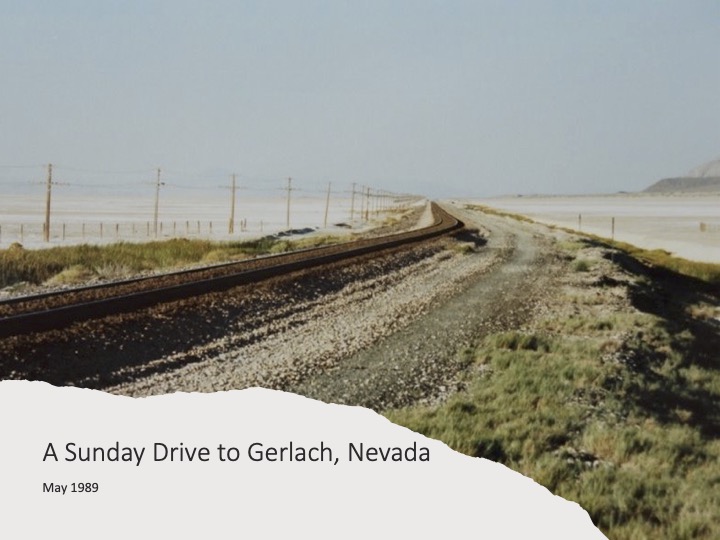
Gerlach and the Black Rock Desert have lost a lot of their appeal. Over the past couple of decades, tens of thousands of people head there every Labor Day. It’s the sight of the Burning Man Festival. This year, because of some rain, 70,000 people became struck in the mud outside of Gerlach. Here’s my adventure in the Black Rock Desert long before it became so famous. The photos are copies from slides.
The Appeal of the Black Rock Desert
I’m not sure what drew me to this dot on a map. Gerlach is a hundred and some miles north of Reno. I knew few people, even in Western Nevada, who’d been there. The only person I knew who had lived in the town was Norm and Missy. They’d lived and worked there before moving to Virginia City. Another attraction that drew me to this dot on the map were hot springs. I’ve taken road trips all over the Intermountain West in search of a good soak.
There was another reason I was interested in Gerlach. I’d watched their high school basketball team play that winter. The Virginia City Muckers creamed them. Our high school boys, used to playing in the thin air of 6300 feet, ran these lowlanders to death. Making it worse, the Gerlach team had only seven players. A couple of these guys were so uncoordinated that I felt sorry for them. I could have been a star on this team. By the end of the game, they only had five players left, and they were all on the court. Their best two players fouled out. The Muckers second string, guys who normally sat on the bench, played, and had no problem running up the score. For some reason I wanted to see this team’s town.
A Sunday drive
In the late spring of 1989, after preaching on Sunday (the service was at 9 AM), I was on the road by 10:30 AM. I drove to Reno and picked up Carolyn, a woman I was dating at the time. We ate a quick lunch and headed off. Taking I-80 east, out of Reno, we followed the Truckee River to Wadsworth, and then staying by the river, took Nevada 447 due north.
the Truckee River and Pyramid Lake
Pyramid Lake, Fall 1988
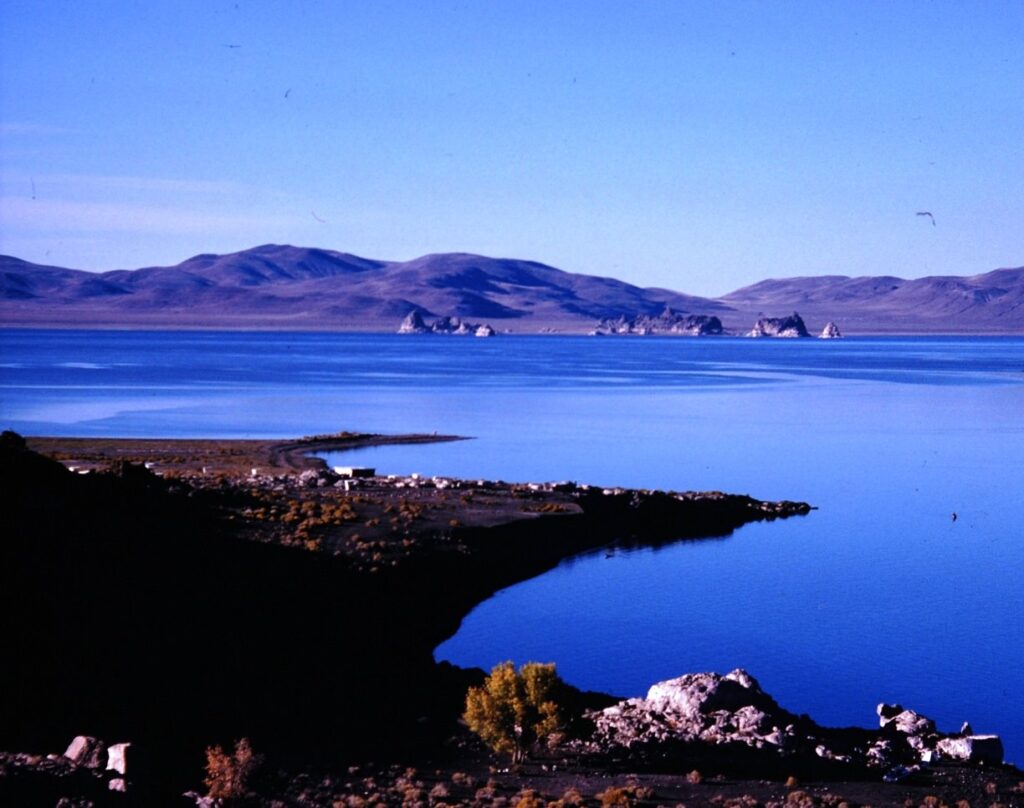
The road took us toward Nixon and the Pyramid Lake Indian Reservation. We stopped along the south end of the lake. It’s a barren looking body of water, essentially a retention pond. The pristine waters start out as snow in the Sierras. The snow melts into Lake Tahoe, and flows out of the north end of the lake. From there, the waters cascade down the Sierras. The river flows through downtown Truckee and Reno, and then through the River District of Storey County. In the 80s was home of the infamous Mustang Ranch, where there were no cattle, but prostitution was legal. At Wadsworth, the river turns north, and flows toward Pyramid Lake.
Over time, the hot desert sun evaporates the water in the lake. The high mineral content of the water when it reaches the lake leaves behind tufa formations as the lake level falls depending on the water level. Because the water is now so saline, there is little life around the lake.
Meeting Carolyn
I had met Carolyn the previous fall on another trip to this lake. A mutual friend invited us both out on an expedition in search of fall colors, which in the American West mostly comes from Aspen and Cottonwoods turning yellow. There would be pockets of cottonwoods in canyons, with bright yellow leaves flickering in the breeze, along with yellow rabbit brush mixed into the sage. The later, through beautiful, is the bane of allergy suffers. Aspen grows at a higher elevation. At one point, late in the day, when the light was soft and warm, Carolyn caught me taking her picture of her admiring the crescent moon hanging in the western sky. She smiled approvingly. We started seeing each other soon afterwards. Although nostalgic, our stop on the south shore of Pyramid Lake was brief, for we had another 80 miles to go to get to our destination, Gerlach.
Truly the Loneliness Road in America
In the 1950s, Life Magazine dubbed Highway 50 through Central Nevada as the “Loneliness Road in America.” It’s not. It’s not even the loneliness road in Nevada. Nevada 447, north of Nixon, is one of a dozen or so blacktopped roads in the state with a much lower traffic count. We saw only one car heading south as we drove north, and when we returned that evening, we saw no cars. There’s not a lot out here.
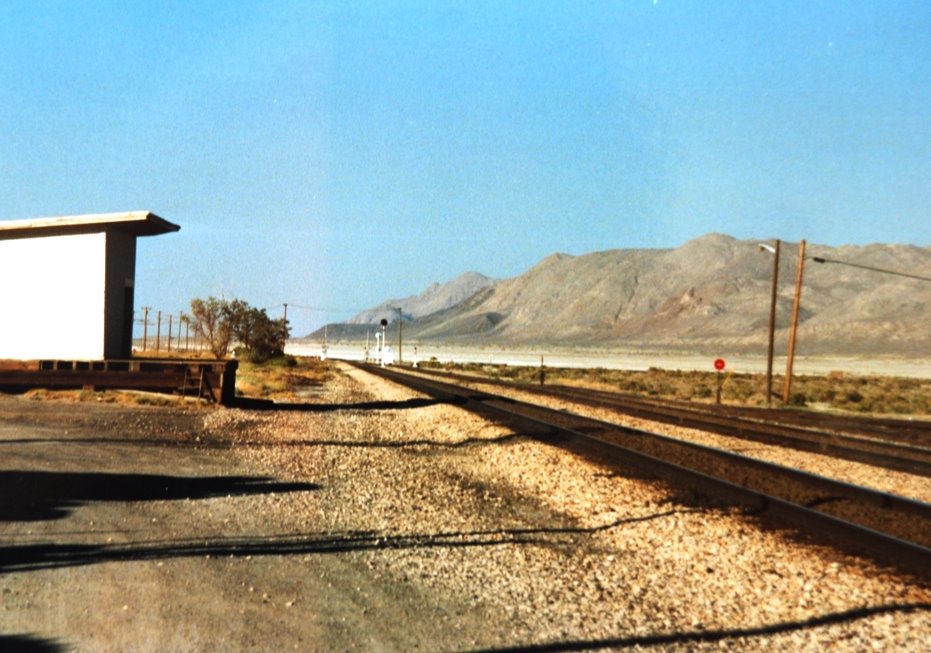
The west side of the road is the Piute Reservation; on the east side is Winnemucca Lake, which is dry. Along the way, we pass a couple of ranches and a few scattered cows. This harsh land takes 40 or more acres to support a cow. As the afternoon progresses, the wind begins blowing and at places it sounds like the car is being sandblasted. Five miles south of Gerlach is the only other town around, Empire. It’s a company owned town at the site of one of the nation’s largest gypsum mines and, besides the railroad, is a main source of employment in the region. A spur rail line hauls out cars of the powdery dust. Five or so miles north, along the Southern Pacific lines (the Feather River Route) is Gerlach.
the Town of Gerlach
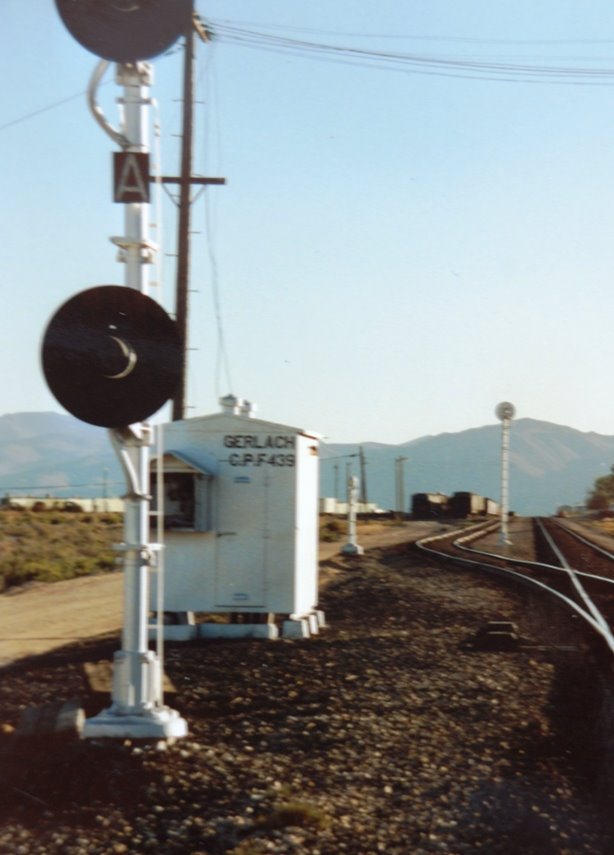
The town is small and sits on the edge of the Black Rock Desert which stretches northeast as far as one can see. We ask about the hot springs and learn they’re not currently open due to construction. A little disappointed, we walk around town and the rail yard and spent some time hiking beside the tracks out into the desert playa. The ground is barren, white, and chalky. Having seen it, I can understand why it became a quagmire after only a half inch of rain during this year’s Burning Man festival.
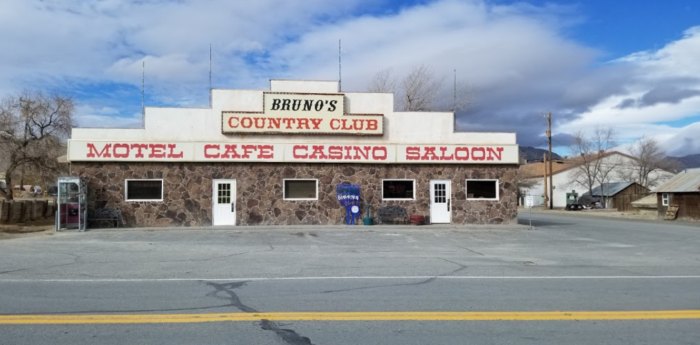
There’s one main establishment in Gerlach, Bruno’s Country Club. It’s a gas station, casino, restaurant, bar, and hotel. I laugh at it being called a Country Club, for there isn’t a blade of grass in sight and certainly no golf courses. If they decided to add a golf course, I assume it’d be like the one in Gabbs, Nevada, a nine-hole course played on clay. Although not a golfer, I image your ball would get nice long bounce on such a surface.
Photo from the internet
After our walk, we head to Bruno’s and enter the dining room that’s across from the casino. The casino isn’t much, just a handful of slot machines, along with a bar and maybe a table for cards. The establishment isn’t fancy, but we enjoy a home-style meal. The staff and the locals having Sunday dinner at Bruno’s are friendly. As tourist, we stick out, and they seem glad to see us and are curious as to what brought us to town. After dinner, the light of the day begins to fade as the sun sets. We take another walk around town. The air cools and the fierce wind of the afternoon has died down.
Heading home
After walking around, we get back in the car. There’s nothing more to do than to drive home through the night. The car’s headlights pierce the darkness of the black ribbon of highway. At a couple of places, I slow down as we drive through six-inch-high mounds of sand across the highway. These were deposited by the afternoon wind. The stars are bright. Overhead and to the Southwest, Orion sinks toward the western horizon, as does waxing new moon. I point it out to Carolyn. She reminds me of the crescent moon on the horizon on that first trip to Pyramid Lake. An hour later, the moon has set, and we’re left with the stars and a lonely strip of asphalt. It’s late when I drop Carolyn off at her home. It’s even later when I make it back up on the Comstock.
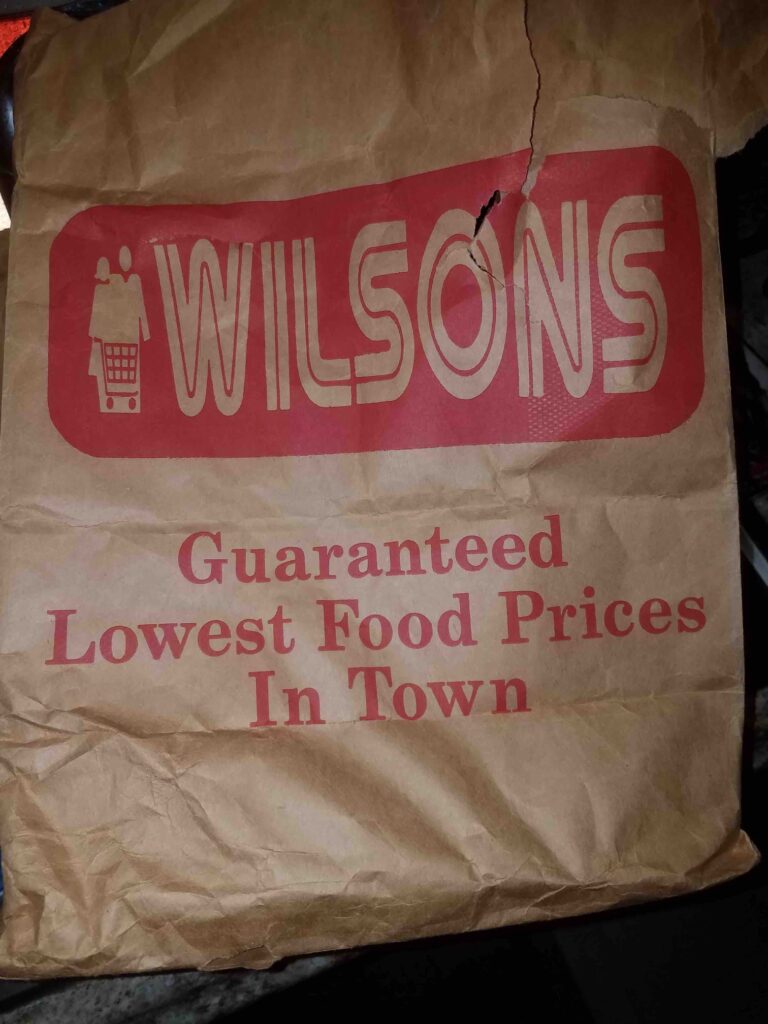
Bag posted on the Facebook Page, Hometown memories of Wilmington, NC
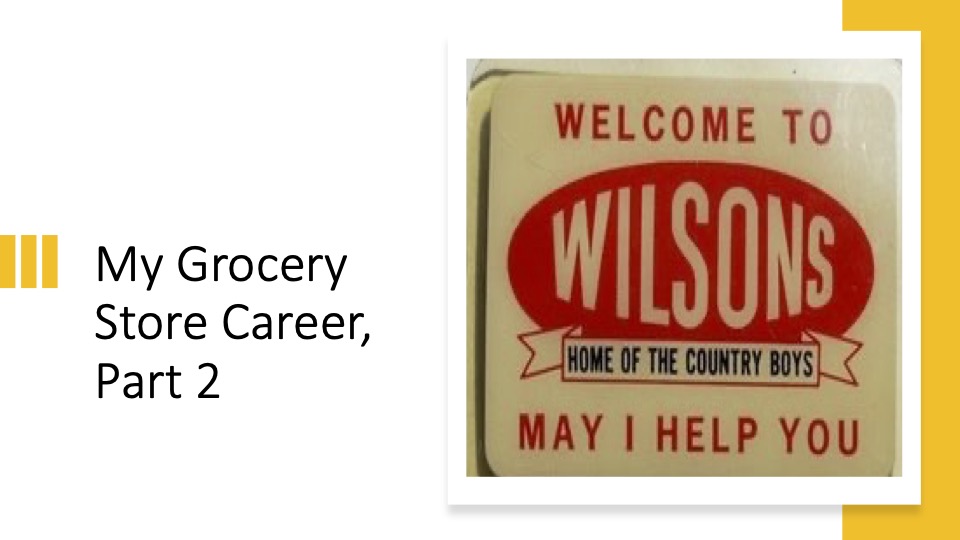
I became a Country Boy a few months after I turned sixteen. I’d gone with Mom to the Wilson’s Supermarket on Oleander Drive, the “home of the Country Boys.” Mom pointed out the manager. He stood in the front of the store, watching everything. Garnering courage, I walked over and asked him for a job.
“You have to be sixteen,” he said, obviously not thinking I was quite there. Admittedly, I was small for my age.
“But I am,” I responded, “I can show you my driver’s license?”
He looked at it and nodded his head in approval.
“You’ll need a social security card,” he said. “Can you work four or five hours on Thursday and Friday afternoons and eight hours on Saturday?”
“Yes Sir,” I said.
I had my first job. Of course, I had worked before but it was just mowing yards for neighbors or babysitting. But this was my first regular job, with a paycheck and deduction for taxes…
That next Thursday afternoon, with a tie around my neck, I reported to work. Two of us were to start our grocery careers that day. Tom, the other kid, was from New Hanover High School, popularly known by those of us who attended Hoggard High as “New Hang-over.” His bright red hair and his twitch in his neck when he talked caused lots of people to consider him weird, but he worked hard. Wilson’s Supermarket would his only job.
They trained us that first day to bag groceries. Bert, the manager who hired us, assigned each of us to a more experienced bagger. For an hour or two, we learned the fundamentals of bagging groceries. Don’t put can goods on top of bread or on cartons of eggs. If you have a lot of cans, double-up your bag for strength. This was the era of only paper bags, no plastic ones. You separate the cleansing supplies from the meat and produce.
We also learned if the cart was loaded down, we could jump up onto it and ride it out the door and through the lot, saving energy. Soon, we were on our own, taking out groceries and always saying, “Thank You, Ma’am,” as we slammed the trunk lid. Another lesson we’d later learned was to recognize the big tippers and hustle especially hard for them. This became a game for some, although Tom and I tried to give our best to everyone.
It now seems like a distant dream. In a way, I suppose, it was the beginning of the end. So far, I have never been without a job except for three months I took off to finish hiking the Appalachian Trail. I would have another four-month break for work, but it was a sabbatical, so I still had a job. But back in 1973, I had school along with 15 to 18 hours a week of work. As I found high school boring and wasn’t very motivated, having a job provided dignity.
I don’t know how many times I posted the week’s special on a similar sign. Photo from the Facebook page, Hometown Memories of Wilmington, NC
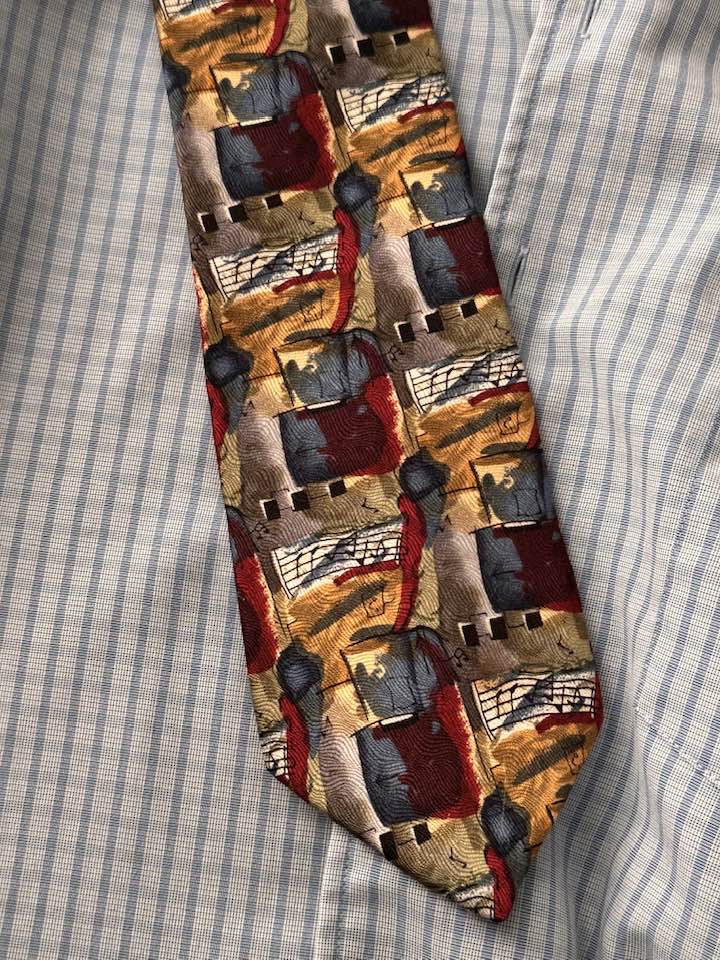
Each day, when I showed up for work, I’d put on a tie. It was expected of all of us “country boys.” While the ads might have had us looking like hillbillies, we were expected to be dressed properly. Beforehand, I’d only worn a ties on Sundays for church, an ideal I still maintain. But unlike most of the newcomers at the store, I didn’t wear a clip-on tie, which they sold on a rack at the end of one of the aisle. I think they were there mostly in case we forgot to bring a tie.
As a 16-year-old, I knew how to tie a Double Windsor. Back in the 70s, with ties wide enough to serve as bibs, tying a big knot like a Double Windsor was quite a feat. Before the week was out, I was teaching Tom and others how to tie one. When you’re a runt, it helps to have a skill. Tom and I began to hang out and became good friends. Six months after I left the store for good, during my second year of college, Tom died from a brain tumor.
Bert, our boss, served as a second father to both of us. Whenever I had problems, especially with girls, questions I’d never think about asking my own dad, I’d ask him. Looking back, I don’t know why? He was easy to talk to, but his martial record certainly left room for improvement. While I didn’t know it when I started, Bert was the father of a elementary school friend of mine, Nicky Pipkin. While Bert had his own troubles with relationships, he always gave me good advice.
I stayed at Wilsons through my first year of college doing a variety of jobs: bagging groceries, stocking the shelves at night, running a cashier, counting money, mopping and waxing the floors late on Saturday night and into the wee-morning hours of Sundays and, thanks to being a non-smoker, managing the cigarette aisle. The pay was never very good, but I enjoyed my time there. It’s rewarding and noble to serve people.
A version of this story appeared in a older blog of mine.
These days, when I need to wear a tie, I try to wear nice ones like this tie, designed by Jerry Garcia (of the Grateful Dead)
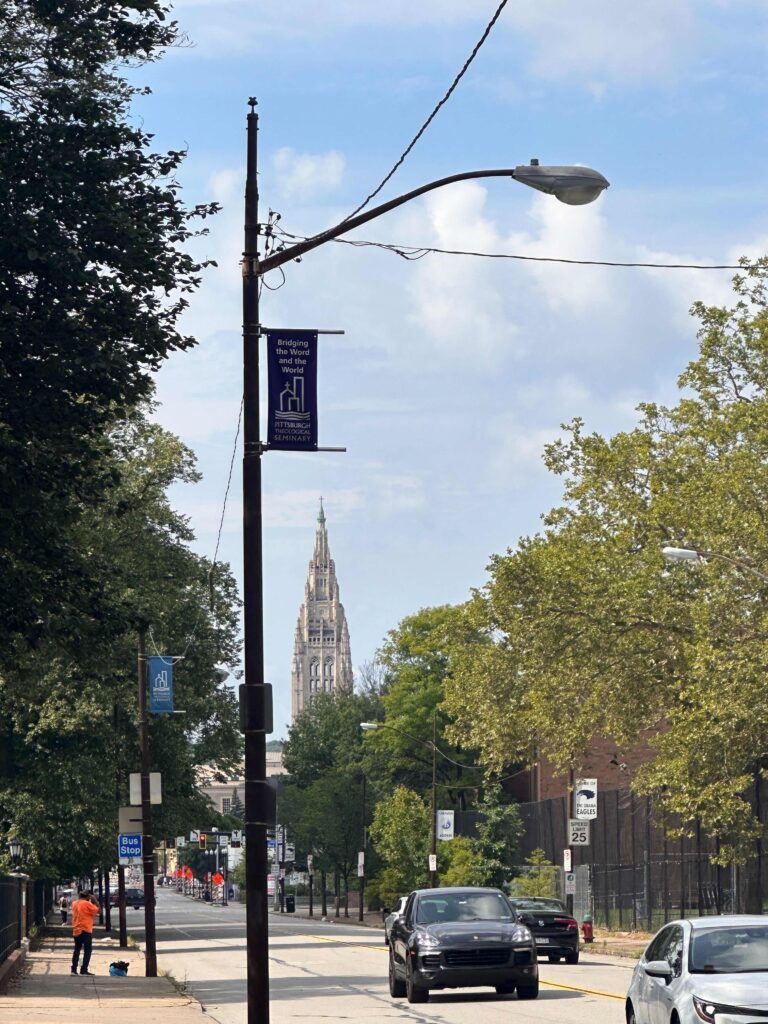
In front of the seminary, looking toward East Liberty Presbyterian Church
Have you noticed that I’ve been absent the past two weeks?
I’ve walked North Highland Avenue many times, but it’s been over 3 decades since I last made this trek. I pass the old homes lining the avenue, which have changed little since the 80s. At the corner of Bryant, I stop at Tazza D’Oro, a coffee shop, for breakfast. This wasn’t here before. The cafeteria at the seminary, where I am staying, is closed during the summer. Coffee and a breakfast sandwich cost me $16. Spending a few minutes reading Karl Barth while eating. I notice the crowd seems different. The people are much younger than those I remember being around these parts. No do I remember having such a meager breakfast at such a price.
The coffee shop is just around the corner from Dinos, a dive bar I frequented. In 1986, I could get a 12-ounce glass of IC Light (pronounced Icy Light in Pittsburghese). Their top shelf liquors were only $2, but sadly the establishment closed after the death of the bartender in 1989. Today, the storefront host the Kyoto Restaurant, an upscale looking Japanese establishment which won’t open until much later in the day.
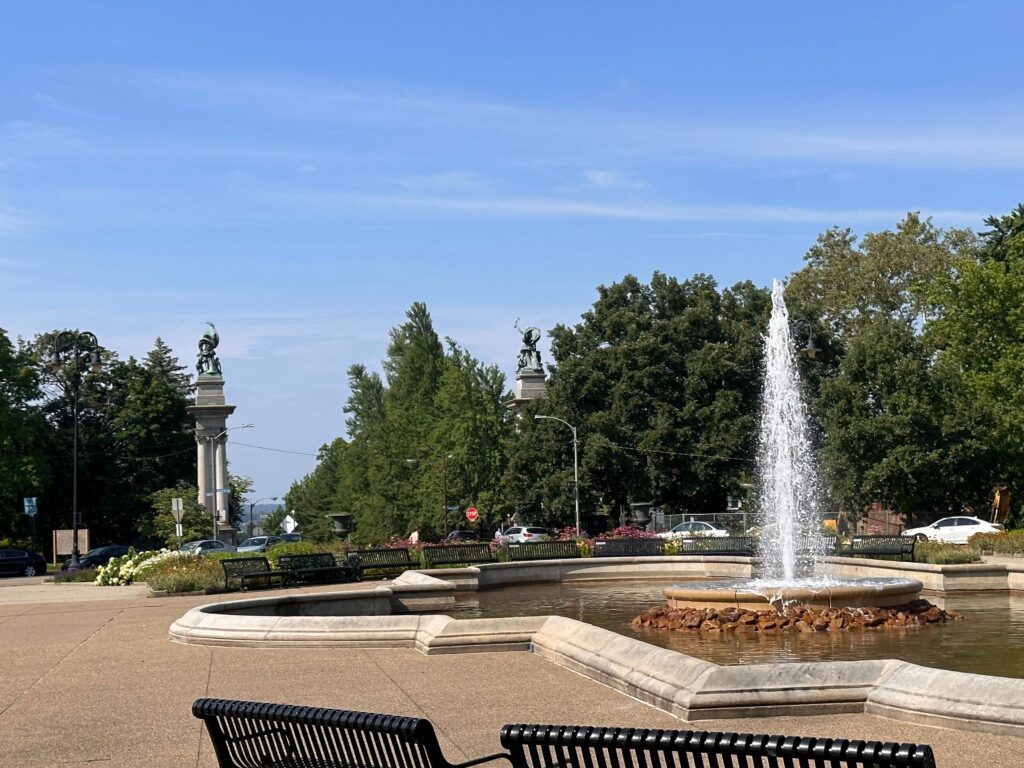
I continue walking north on Euclid Avenue, passing the ironic Azimuth Way, as I head toward Highland Park. The entrance is neat and clean with flowers blooming in the beds surrounding foundations. In the grass to the side, a yoga class is being held. I climb the steps leading to the walkway around the reservoir, a walk I took hundreds of time before. With a fast clip, I walk around the reservoir as I am meeting friends for lunch and need to shower as I have worked up a sweat thanks to the humidity. I head back to the seminary, having walked a little over 3 miles.
Entrance to Highland Park
After cleaning up, I drive the same route I just walked, and then work my way around the park and zoo to the Highland Park Bridge, where I cross the Allegheny River. The bridge is being worked on, which isn’t anything new. When my parents first visited me in Pittsburgh, the bridge had holes in which you could look down into the river. I took my parents over the bridge to Aspinwall for dinner and my mother insisted we not drive back across that bridge again. She also ordered me not to drive across it, which became a mute request for soon they’d closed the bridge in order to rebuild it.
I’m meeting for lunch two of my professors (Charles Partee and Don Gowan) and the former seminary’s Director of Placement, Jean Henderson. The three of them, who have all lost their spouses and are in their 80s and 90s, live in a large continuing care facility in Cranberry Township.
After lunch, I return to the seminary and in the late afternoon take a walk south of the Seminary, around East Liberty (pronounced s’berty in Pittsburghese). Back in the 80s, I used to occasionally help feed the homeless men at the shelter housed by the East Liberty Presbyterian Church. It was eye opening, as many of the men would come in and pour hydroperoxide on the needle marks on their arms to keep them from becoming infected. I seldom walked this direction by myself at night, and when I did, I left my wallet in my apartment and only took a few dollars as it wasn’t uncommon for someone to be mugged.
Today, East Liberty is undergoing renovation. The high-rise low-income apartments have been torn down and replaced by more appealing apartment-like buildings. The old Sears and the buildings around it have been razed and a new Home Depot now sits in the area. The old Giant Eagle, a grocery store, is now a Senior Center. I wonder where the young men who used to hang out around the pay phone, waiting to receive a call for a lift. While this was frowned on, especially by the taxi companies, in the age before cell phones and Uber, it was efficient and met a need within the community. I’m not sure what other services beyond transportation they supplied, but they hustled.
There’s a lot of work being done on the roads around East Liberty. I walk pass Eastminster and East Liberty Presbyterian. Both are grand churches. Eastminster has wonderful Tiffany windows, while East Liberty is the closest thing we Presbyterians have to a cathedral. There was an older church at the site that was torn down so this one could be rebuilt. It was funded by Richard Mellon, from the prominent Mellon family of Pittsburgh, who in addition to working at the family bank with his brother Andrew, headed Alcoa and was involved in other business in the region. His hope was to create jobs during the Depression, and he has left an amazing structure. Inside, he and his wife’s remains are parked in a small prayer chapel off the main nave. As the sanctuary is massive, the seminary uses it for graduation. I continue to walk South, across the sunken railroad tracks and the bus way which allows buses to take you downtown without traffic in minutes. Then I cross over into the Shadyside neighborhood. Only a few things seem familiar.
For dinner, I drive back across the Allegheny River, looking for another favorite dive bar where, in the 80s, one could get a plate of eight whole chicken wings (not the cut up kind) for three bucks. They were so hot that you also ate the celery with ranch dressing along with several beers to down it all. It’s not there and I end up eating at a new Thai Restaurant at Waterworks. I’m back in my room at the seminary before dark and spend the rest of the evening preparing for the week’s seminar.
The next morning, I head out to an old Eat’n Park in Etna, where I often ate breakfast on Sunday mornings as I north headed to Butler and the church where I worked at from 1986 to 1988. I’m sure most of the waitresses weren’t even born when I lived here. I found myself wondering what ever happened to Lydia, one of the regular waitresses in the 80s.
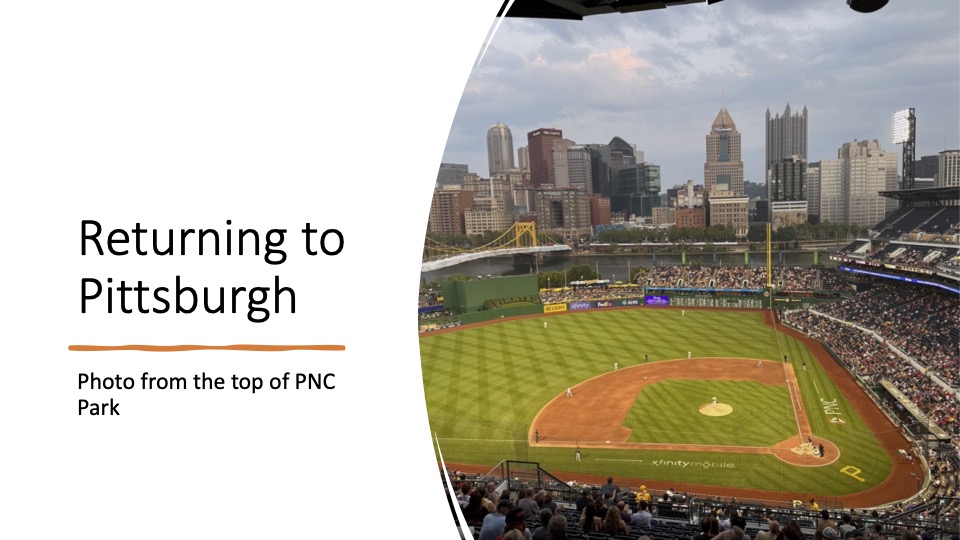
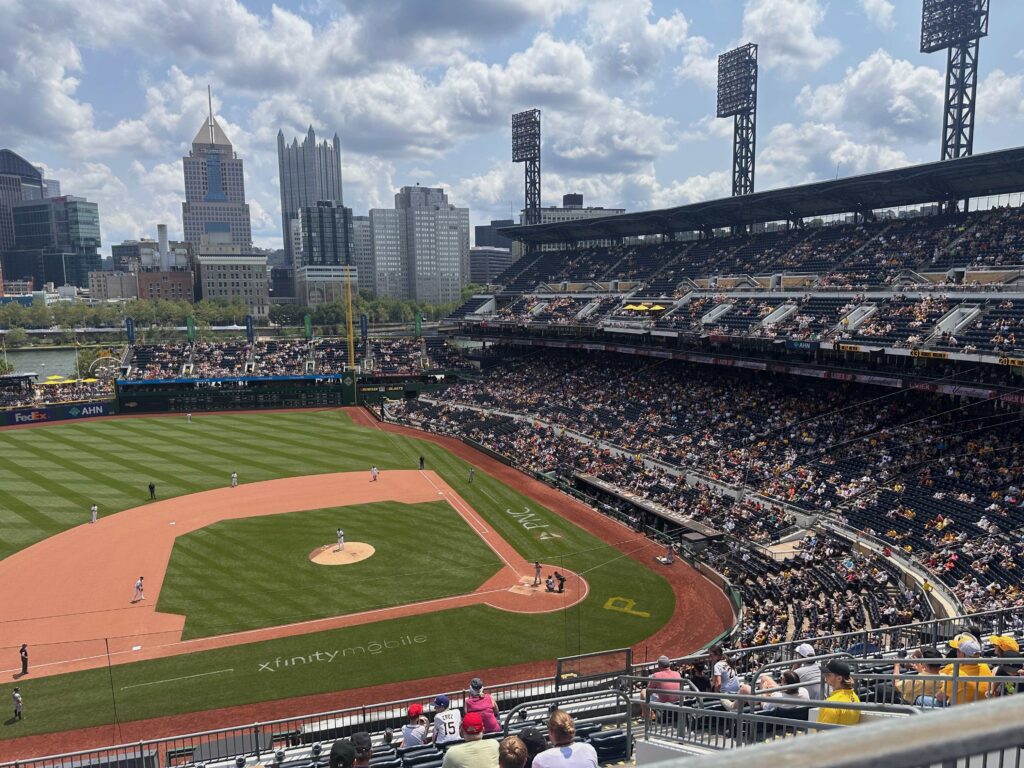
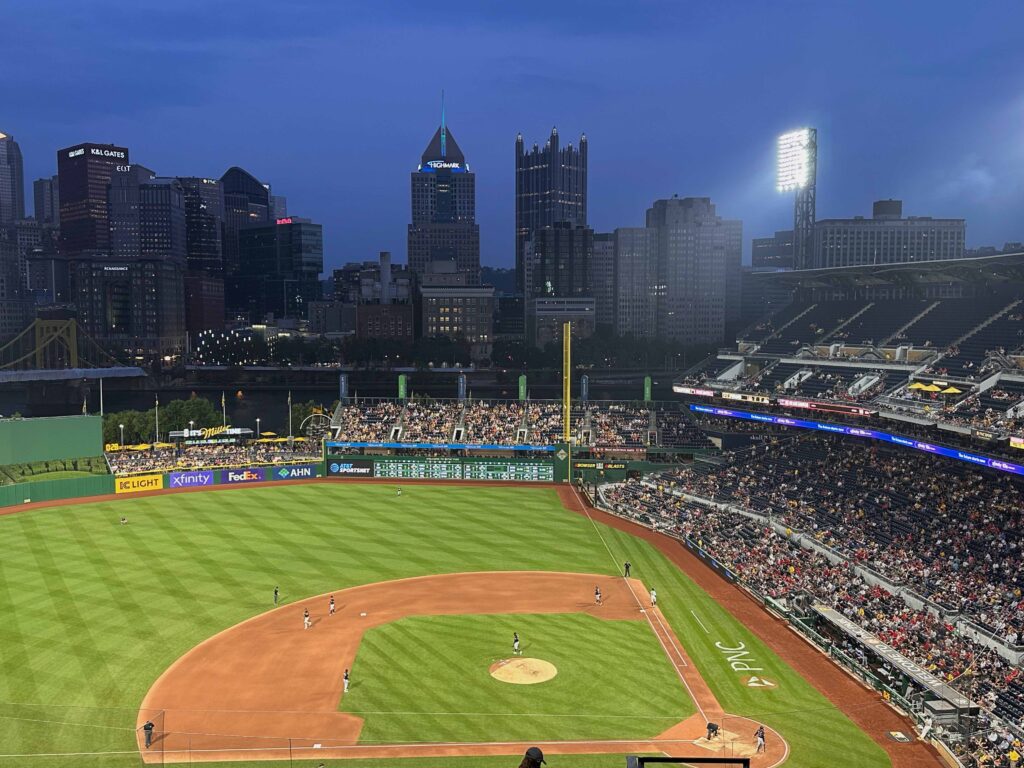
Then I head downtown. I’m meeting two former classmates at the Willie Stargel statue by the ballpark on the north side. Back in the day, I would walk across the Roberto Clemente Bridge, the first of the “Three Sisters” (identical yellow bridges that cross the Allegheny). As the Clemente Bridge is closed for reconstruction, I take an option that wasn’t available in the 80s. The subway has now been extended to the Northside. It travels under the Allegheny River and drops you off right beside the stadium. Of course, the stadium is also new and is much nicer than the old Three River Colosseum, where I saw many Pirate and a few Steeler games.
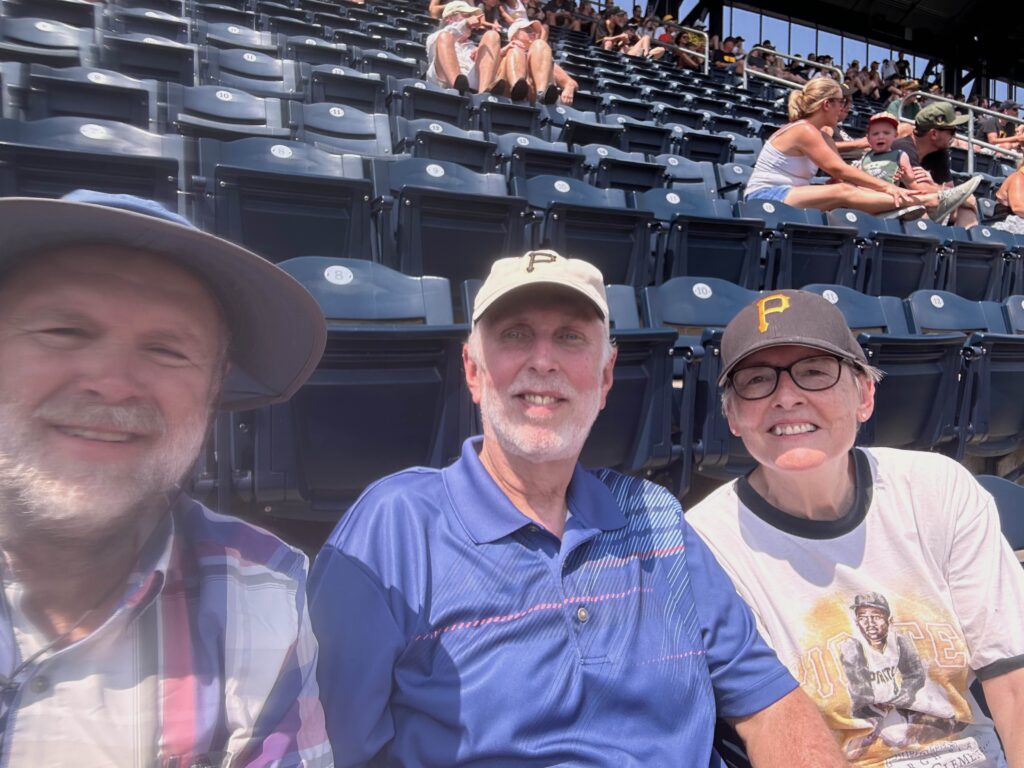
Me, Lee, and Lea
We meet at 11:30, buy tickets for seats up above the third base line. It’s a beautiful day, a little warm, but not terrible. The game is competitive and at the end of nine is tied. We go into an extra inning, but the Giants blow out the Pirates in the 10th. Afterwards, we plan to go to dinner with another classmate (who had to preach this morning and was unable to make the game). We meet at Bakery Square, which is near the seminary. In the 1980s, it was a large Nabisco Bakery, but today consists of restaurants, offices, apartment flats, and a fitness center. I would eat here three more times over the next four days, as I meet with a theology group from Monday through Thursday.
Sunday afternoon at PNC Park. This is a magnificent ballpark!
By the end of my second full day in Pittsburgh, I realize that most everything I knew about the city has changed, except for the work on the Highland Park Bridge and the Pirates losing. Our group would also go to a night game at PNC Park. The Pirates lost again, this time to the Cleveland Guardians.
A soft light glows outside in the darkness. It could be a dying street light, except there are no streetlights on this island. I check the time. It’s a little before 6 AM. Time to get up if I’m going to beat the tide change. I pull on my pants and crawl out of the hammock. Sliding into flip-flops, I stand and turn around to a beautiful view of the nearly full moon setting across the marsh to the west. Its light reflects off the ripples on the waters of the Brickhill River. I look at the shoreline. The tide is coming in strong. I’ll need to be on the water soon if I’m to make the fourteen miles back to the landing at Crooked River State Park without fighting the current.
Heading back to the mainland
In the dark with only the moonlight guiding me, I stuff my sleeping bag and hammock into their sacks and stow both into the holds of the kayak. I pack my stove and percolator. With not enough time for coffee, I skip it figuring I can pick up some later on my drive home. Dropping the food bag that’s hung from a branch, to keep it safe from raccoons, I take out a couple of granola bars and a pear for breakfast. I eat one of the bars while watching the moon set. What little light I enjoyed is gone with sunrise still 45 minutes away. Taking out a flashlight, I stow everything in the kayak and make a last tour of my campsite. Then I slide the kayak down the bank and into the water, crawl into the cockpit, and begin paddling.
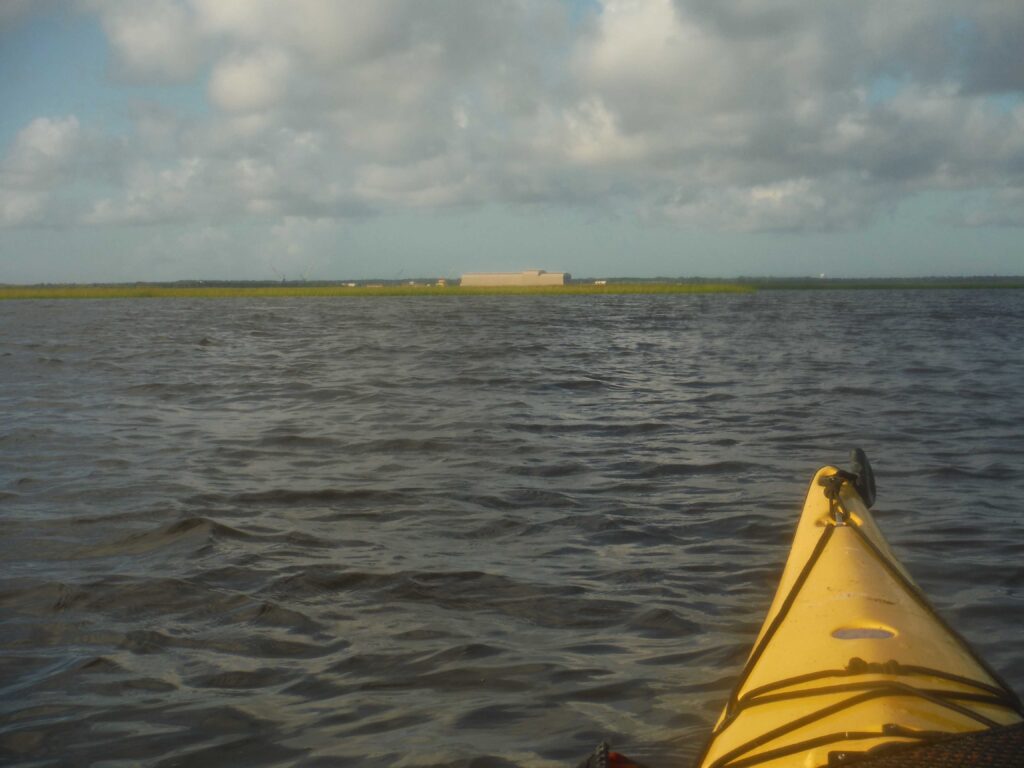
Distant sub base in morning light
In less than 30 minutes I’ve passed Table Point. When I paddled here two days earlier, the tide had turned by the time I arrived here and it took me 90 minutes of hard paddling to make it to the campsite. I’m making good time. I look behind me and catch the opening rays of the sun as it rises over Cumberland Island. I take out the pear and eat it, enjoying the splendor. When I resume paddling, I notice the large covered submarine dry-dock at the Kings Bay Naval Station. In the low light, it looks remarkably similar to Noah’s Ark, floating beyond the marsh grass that separates the Brickhill River from the Intracoastal Waterway. It’s ironic, I muse to myself, that each submarine carries almost as much destructive power as that ancient flood.
Travels to Cumberland
I have spent the last two nights camping on Cumberland Island National Seashore. This is my second trip to the island. The first trip, two years earlier, was to Sea Camp on the south end of the island. That site is served by a ferry from St. Mary’s. It’s close to the beach and has potable water, flush toilets and hot showers. We spent a lot of time soaking up rays on the beach, swimming in the surf, as well as exploring the ruins of Dungeness, a grand home built by Thomas Carnegie. It burned in the 1950s.
The Carnegie Influence on the Island
In the late 19th Century, Thomas Carnegie, the brother of Andrew, purchased much of the island and had a massive winter home built at the site of an earlier Dungeness mansion. Thomas Carnegie died as his mansion was being completed, but it was occupied by his wife Lucy. In time, as each of their children married, Lucy granted them land on the island and a stipend to build homes of their own.
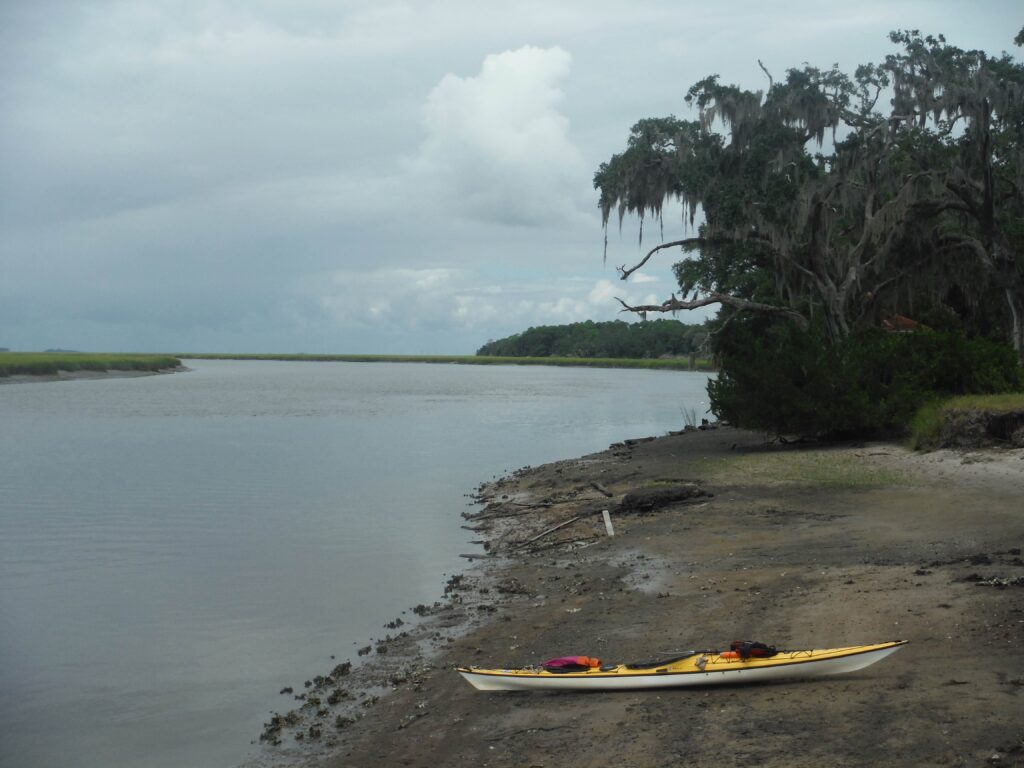
My kayak shortly after arriving at Brick Kiln River wilderness campsite
My campsite for the weekend was on a bluff along the Brickhill River. The wilderness site can hold six groups, but there are only three other campers the first night. These guys, students at Georgia Tech, had come over on the ferry and peddled bikes the ten miles along sandy two-track dirt roads to camp here. We chat for a bit and I learn they are planning on leaving early on Sunday in order to catch the 10:30 AM ferry to St. Marys.
The Paddle over and Plum Orchard
inside Plum Orchard
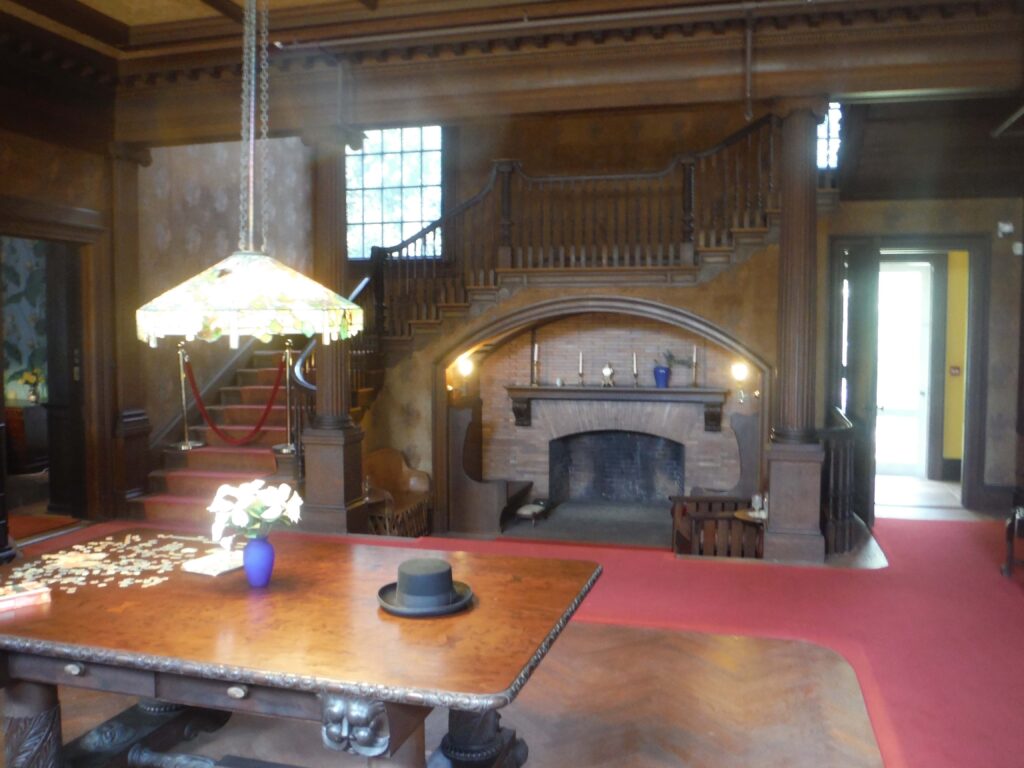
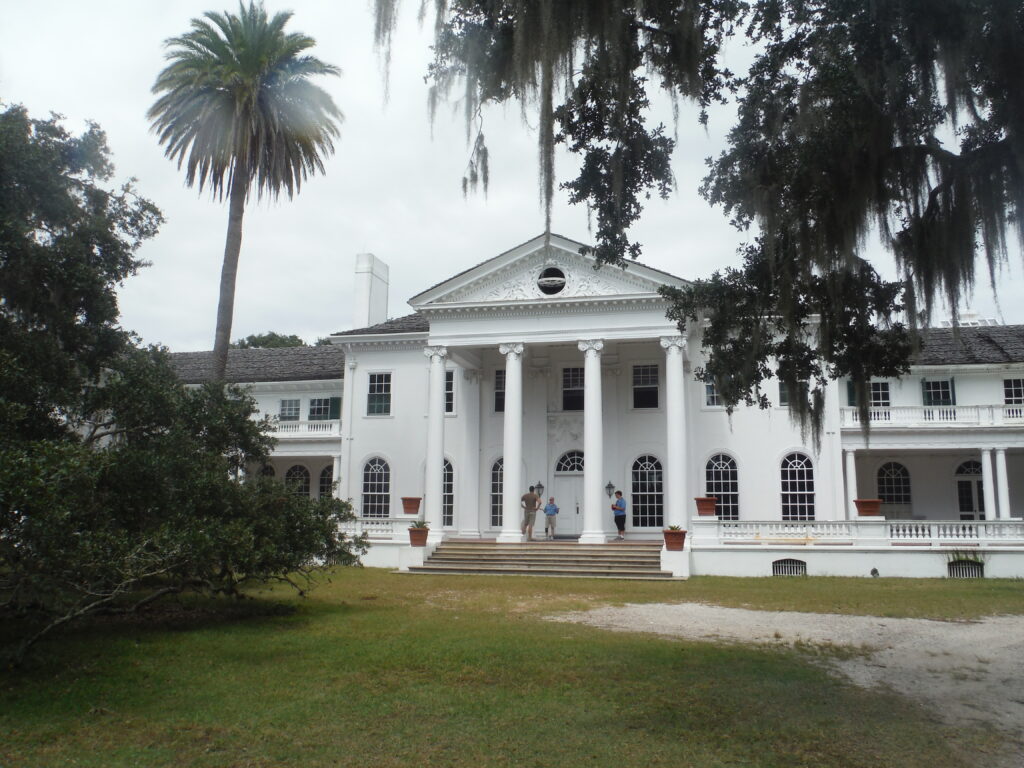
On Saturday, as I left Crooked River, paddling in the rain, my first stop was at Plum Orchard, one of these magnificent homes. Thankfully, by the time I arrived, the rain had stopped. This home, built by George and Margaret Thaw Carnegie, was the first of the island mansions constructed by the Carnegie children. The 24,000 square foot home was seasonally occupied until the 1960s with Thomas and Margaret’s granddaughter and husband being the last occupants. Today, the home is a part of Cumberland Island National Seashore and the National Park service offers tours. After eating lunch, I stuck around for a tour. It was well worth it, even if it meant the tide turned and my paddle to the campsite was more difficult. The home features a grand entryway, a formal dining room, modern bathrooms, an indoor squash tennis court, a women’s parlor and a men’s gun room that displays trophy heads of various animals bagged by the Carnegies. It is magnificent.
Plum Orchard
First Night
Fires are not allowed at this site, so after setting up my camp, I fire up my gas stove and use it to prepare chicken and rice for dinner. I watch the setting of the sun, sipping on bourbon, then retreat from the bugs into the security of my hammock where I read for an hour with the use of a flashlight. Then I turn it off and go to sleep.
As it was still warm in the evening, I left the fly off my hammock in order to receive the best breeze. But at 3 AM I wake to the rustling of palm leaves and distant thunder. The moon and stars are no longer visible. I quickly get up and position my fly over my hammock. The rain comes as I put in the last of the stakes into the ground. I crawl back into the hammock and fall asleep to the sound of rain.
I sleep in till nearly 7:00 AM on Sunday morning. Getting up in the dawn light, I perk coffee and boil hot water for oatmeal. I notice my neighbors have already left.
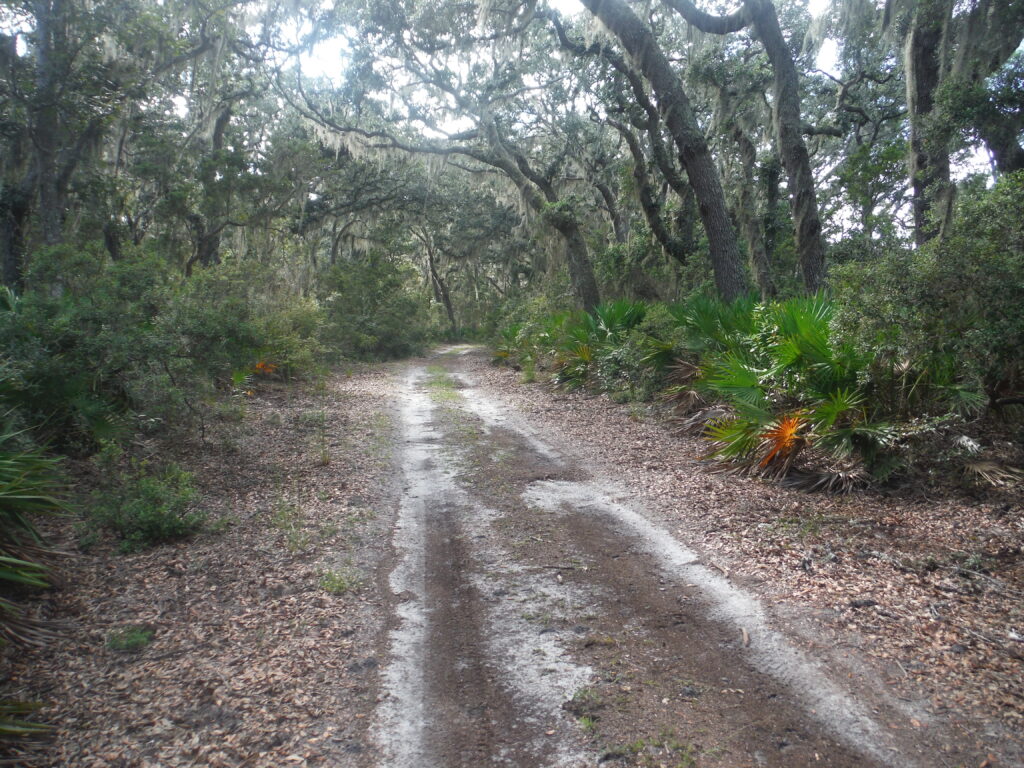
The two track that runs the length of the island
Sunday Morning Exploring
After breakfast, I set off on a hike to the old settlement on the northern end of the island, about four miles away. It’s warm and muggy, and I’m serenaded by insects, songbirds and a distant woodpecker providing the bass. About half way to the settlement, a shower passes by cooling me off. When I arrive at Terrapin Point, I stop for a few minutes on the high bluff overlooking what used to be the Cumberland Wharf. A large pod of dolphins feed in the shallows as a barge makes its way south along the Intracoastal Waterway. In the distance, I can see the Sidney Lanier Bridge from Brunswick to Jekyll Island.
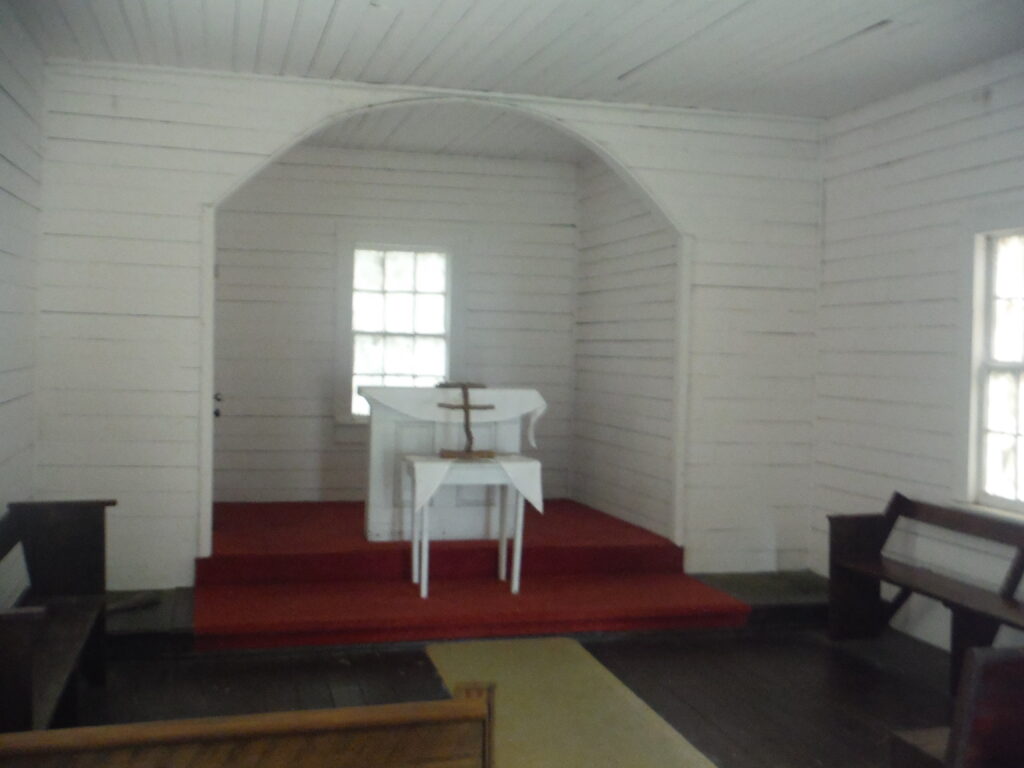
Inside the church
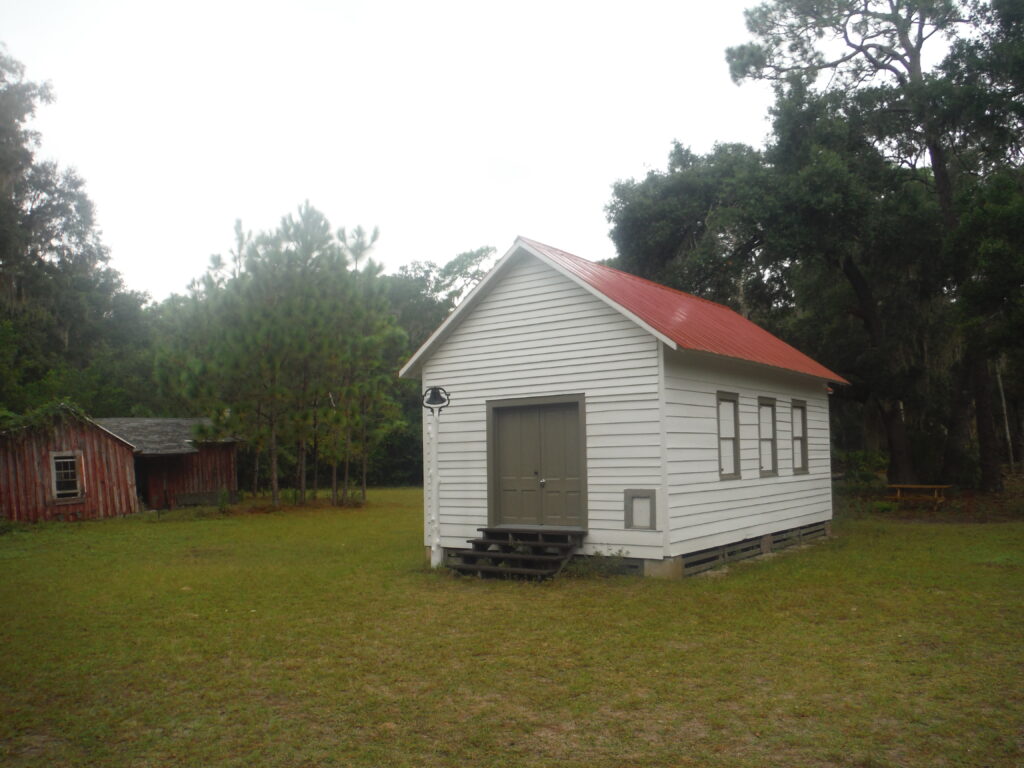
My hope was to be at the old First African Baptist Church by 10 AM, but I am a few minutes late. The cornerstone indicates that it was built in 1893, but I later learn that was when the first church was constructed out of logs. It was rebuilt out of timber in 1937. I step into the old building. It’s small, with only eight short pews. Taking out my smartphone, I am pleased to have a signal. I log into the streaming service of Skidaway Island Presbyterian Church in time to catch an excellent sermon by our Associate, Deanie Strength. As I listen, I think about those who in years past worshipped here and that it is good the gospel is again heard in these walls.
HIstory of the settlement
The residents of the Settlement were former slaves. They lived where they did to work for the hotel that used to sit on the north end of the island, as well as to work for the Carnegies who turned much of the island into their private winter playground. The community dwindled after the hotel closed, with a few people hanging on to work as servants in some of the islands homes. Today, the church and one home remains open by the National Park Service.
The church and a home left from when this was a community who worked in the homes and hotel on the island
In 1996, a hundred and three years after the church was first built on this site, it became the setting for the late John Kennedy Jr’s and Carolyn Bessette’s private wedding ceremony. Tragically, two years after their marriage, both were killed in a plane crash off Martha’s Vineyard.
After listening to church, I eat lunch and then hike back to the camp, taking the Terrapin Point and Brickhill Bluff trails. At times, from high bluffs, I’m afforded wonderful views of the marsh. Other parts of the trail move deeply into the woods of this maritime forest. I am amazed at the size of some of the longleaf pines. In addition to pines and live oaks, the most abundant trees, hickory and magnolias are also common. I scare up a few feral hogs that grunt as they run away, along with a wild turkey and an armadillo that makes all kinds of racket as it rushes through dense growth of saw palmetto.
A restful afternoon
It’s about two o’clock when I arrive back in my campsite. I rest for a few minutes, reading David Gressner’s Return of the Osprey. As I read, I notice an osprey hunting out over the Brickhill River. For the longest time, the bird never dives for a fish, but when it finally does, he misses. The bird comes up out of the water flapping, nothing in its talons. It shakes its wings as if to shake off his missed lunch. In reading this book I learn that mature birds generally catch their prey fifty percent or more of the time. That’s a pretty high percentage. Either my bird was having a bad day or it was young and just learning to dive for fish.
Beach scene
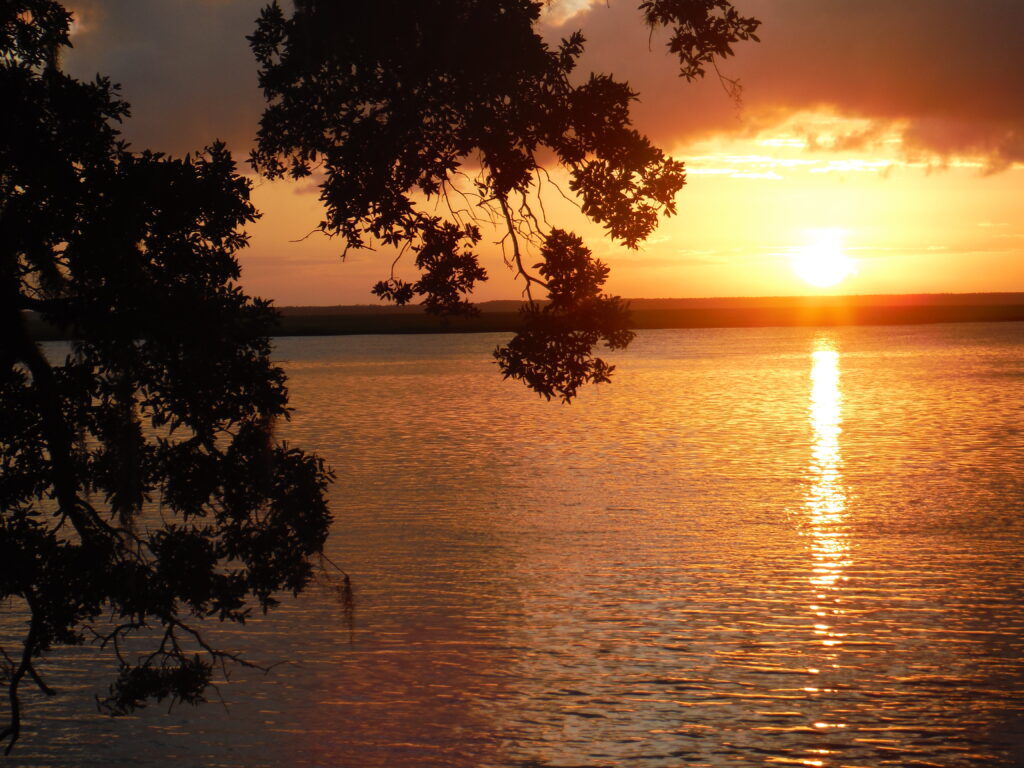
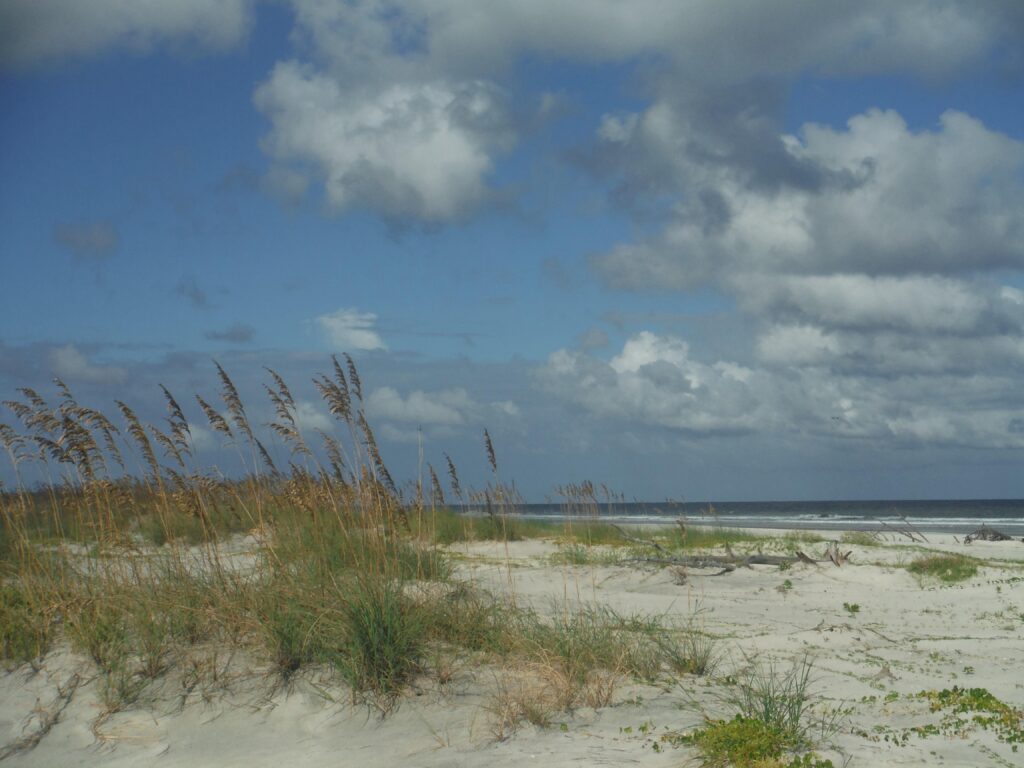
After resting, I take my chair, book, and some snacks, and hike the two miles out to the beach. Along the way, I pass several fresh water ponds. In one an alligator is sunning and as I walk by I catch sight of the tail of a large snake slithering down into the water. I spend nearly two hours on the beach enjoying the sound of the waves as I read and nap. At 5:30, I start back, wanting to be able to fix dinner and prepare for the evening before dark. Knowing it’s going to be a long paddle in the morning, I am in my hammock sleeping shortly after watching an amazing sunset.
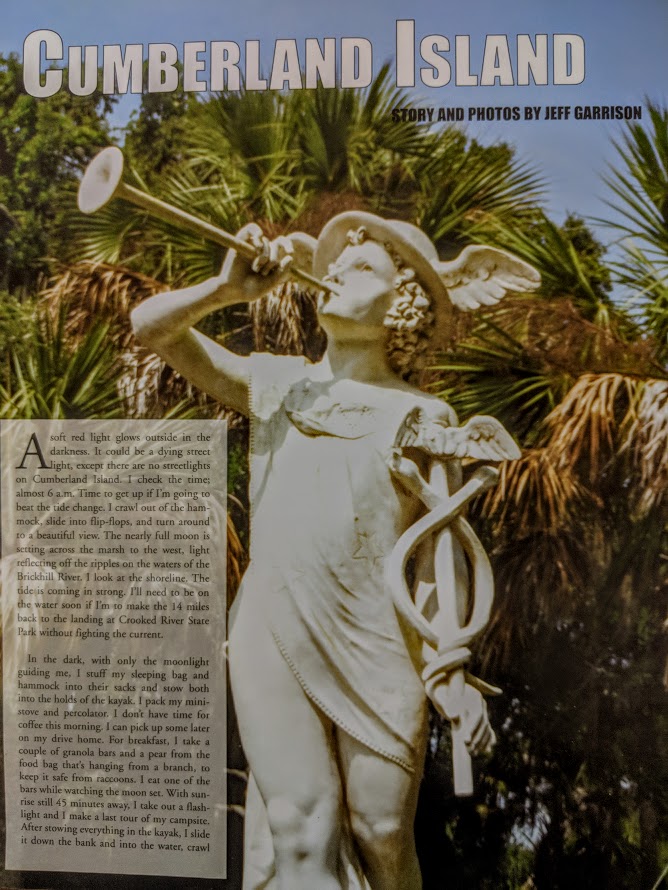
This slightly edited post originally appeared in The Skinnie, a magazine published on Skidaway Island, Georgia. The opening page of the article is to the right. When I wrote this article, I was the pastor of the Presbyterian Church on Skidaway.
For another kayak adventure of mine on Cape Lookout, click here.
Planning a trip to Cumberland Island
To visit Cumberland Island, camping sites (both in developed sites and wilderness locations) must be reserved through the National Park Service. Check out the Cumberland Island website at or call (912) 882-4336. Cumberland Island Ferry has the concessions for ferry transportation to and from the south end of the island. Their schedule varies depending on the season. Boats (motored and kayaks) can be launched from St. Mary’s or Crooked River State Park. If paddling, know the tides especially in the Crooked River where the tide currents can be faster than most people can paddle! There is also a rather pricy lodging available at the Greyfield Inn, a former Carnegie mansion. To stay there, the Inn arranges a shuttle from Amelia Island, Florida.
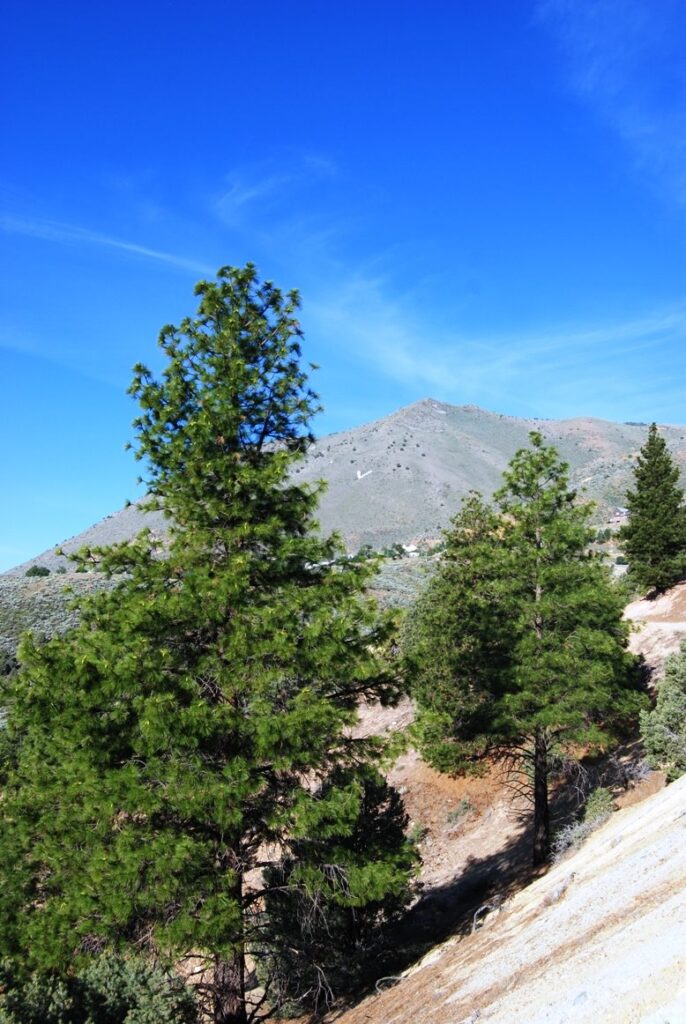
Mt. Davidson from the tailing piles of the North End mines.
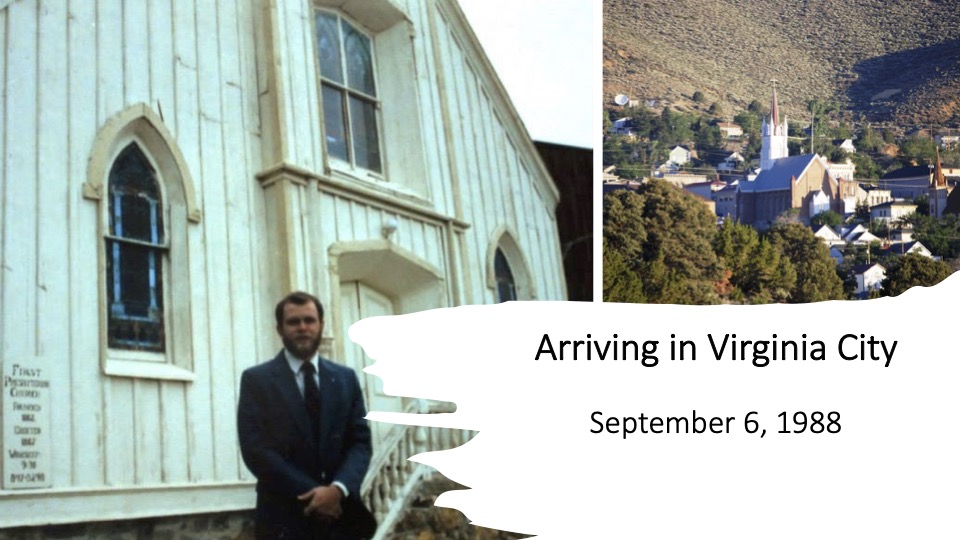
I pulled into Virginia City early in the afternoon. It was a Tuesday, the day after Labor Day, 1988, twenty-four hours after leaving Camp Sawtooth in Idaho. The summer had been idyllic, running a camp with plenty of time to hike in the mountains. Now I was heading again into uncharted territory.
The Drive from the Sawtooth Mountains to Virginia City
The previous afternoon, I’d driven from the camp to Elko on Highway 93. As I crossed the border, I was needing a place to relieve myself. However, I wasn’t sure about going into the casinos at Jackpot. I continued on, finally stopped in Elko, checking into a Motel 6. After diner, in the waning evening hours, I walked around the town watching trains run through and the sun set across the desert.
Up early the next day, I grabbed breakfast at McDonalds and hit the road. I drove west on Interstate 80, which parallels the Humboldt River across northern Nevada. Stopping for gas in Winnemucca, I noticed a tire was low. I added air and continued, but with an uneasy feeling. Earlier in the summer, I had read a book about pioneers traveling across the 40-mile desert, from the Humboldt Sink to the Washoe River. This was not a place I wanted to have a flat tire. I pulled over in Lovelock and checked the tire again. It was low and leaking. I’d picked up a nail. Thankfully in the center of the tire, so it wasn’t ruined. I found a garage who patched it in about fifteen minutes while I had lunch. Without losing much time, I was on my way.
At Fernley, having crossed with 40-mile desert without realizing it, I left the interstate and took Alterative 95 south to Silver Springs. There, I turned left on Highway 50, heading toward the Sierras. The country was barren and I felt isolated. Shortly before reaching Dayton, I looked up a canyon to the northwest and glimpsed the white “V” high on Mount Davidson, my destination. At Moundhouse, where at night one could see several long red neon lights advertising legal brothels, I turned north on Nevada 341. From there, it’s a steep grade up the mountain to Virginia City.
I drove through the waning town of Silver City and squeezed through Devil’s Gate. This was a crack in a ridge barely large enough for a highway. On both sides of the strip of asphalt were relics of the past. Old headframes for mines, abandon trucks, wooden shacks, and rusty hardware. In an open pit mine, I noticed the old tunnels honeycombing the exposed side of the mountain.
The next town was Gold Hill. From there, the road became extremely steep. I pushed the gas to the floor. My car creeped up the 13% grade that wound around a large open pit mind. Cresting at the Divide, the road dropped slightly. From here, it was known as “C Street, the main drag of Virginia City. After passing the old 4th Ward School, I pulled into a parking place in front of the old wooden church on the south end of town.
Arriving in town
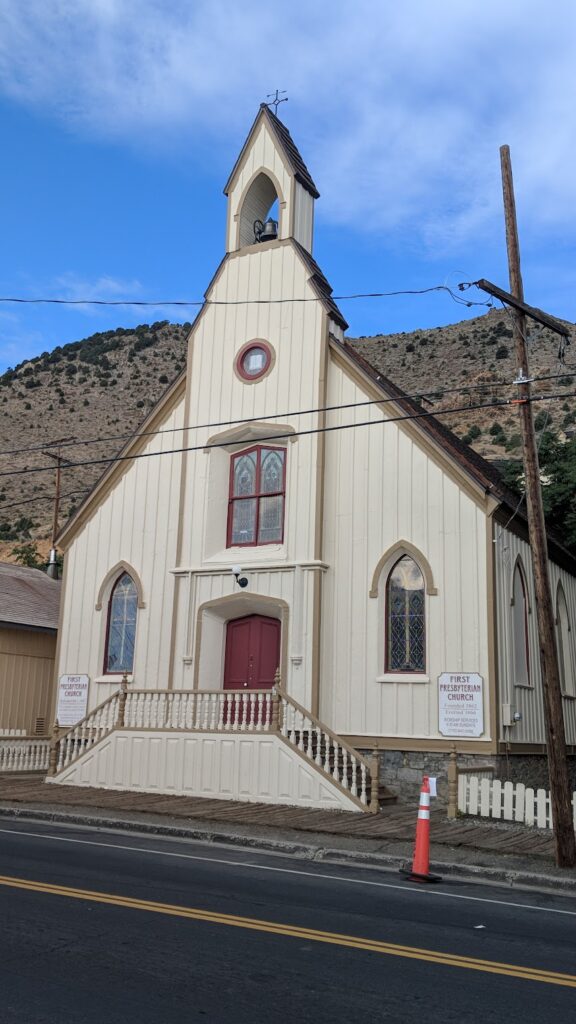
First Presbyterian Church in 2018
The doors were locked. I was hoping someone would be there, as volunteers tried to keep it open for tourists during the summer season. I looked carefully over the 120-year-old whitewashed building, wondering what I was getting myself into. Slowly I walked around the building. The vacant lots on each side were barren, except for a few hardy weeds attempting to defy the Nevada desert. Broken bottles, bits of rusty iron, and weathered, sun-bleached, chunks of wood, all remnants of an age past where hidden under the weeds.
Afterwards, I stood for a few minutes on the front porch, leaning on the rail, looking east, down Six Mile Canyon. It would become a familiar sight with Sugarloaf, the core of an ancient volcano rising the middle of the canyon. In the distance, a couple thousand feet lower, was an alkali desert simmering under the afternoon sun which I’d just traveled through on Highway 50.
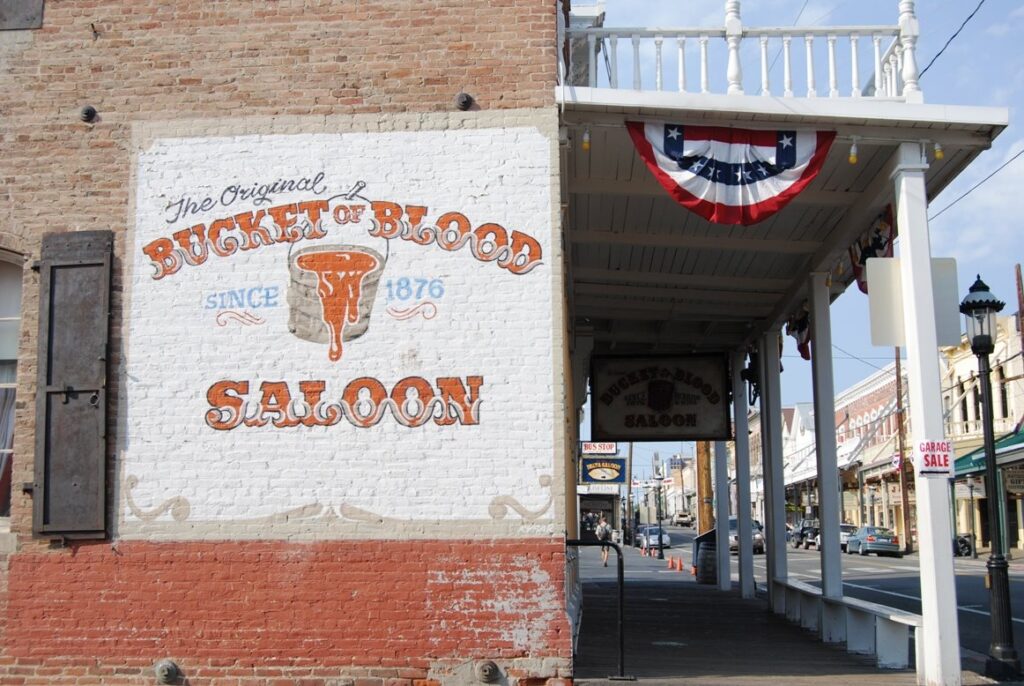
“Well, I better get on with it,” I thought, attempting to encourage myself to walk the boardwalk to the Bucket of Blood, a saloon where I had been told to pick up the keys. The sun was warm and although the peak of the tourist season was over, there were still quite a few sightseers on C Street, vying for the slot machines that stood just inside the doors of all the establishments adjacent to the boardwalk. The noise of the electronic bandits and the smell of the sausage dogs and spilt beer overwhelmed me. I lengthened my stride, sidestepping tourists, quickly covered the three blocks.
The “Bucket” in 2008
The Bucket, as it’s locally known, is a grand saloon. Except for slot machines, a 20th Century invention, it appeared little had changed since the last century when the mines produced broken men and millionaires. Chandeliers hung from the punched tin ceiling. The wooden bar was adorned with polished brass behind which hung a large mirror. Pictures of another era on the Comstock hung from the walls. I leaned against the bar and asked for Don McBride, the owner of the Bucket and husband of a member of the church.
“He’s not here,” the bartender said looking at me sideways as he washed glasses. “Are you Jeff?”
“Yeah, that’s me.”
“He told me to give you this,” as he handed me an envelope. I opened it. Onto the bar dropped a set of keys, one for the church, another for a house where I’d be staying, and a third for the post office box. There was a map, a church directory, and a sheet with names and phone numbers for people who might be of help. I returned to my car and drove to the house on B Street.
Settling in
Where I lived on B Street
The little house the church rented for student pastors, my home for a year, was nothing to write home about. I’d been here in April, staying with Laura and David Stellman, the previous year’s student pastors. I’d flown out for the weekend to check out the position. The house had two small bedrooms, each barely large enough for a full-size bed, along with a living room, kitchen, and bathroom which sported an antique iron tub. None of the floors were level, but this is true for most of the buildings in Virginia City,. Mines held up with rotting timbers honeycomb the ground underneath the city. The earth constantly settles and occasionally sinkholes develop.
I later learned the house had an interesting history, but for now it was comfortably furnished. There was a chair, couch, coffee table, and bookcase in the living room. There was also a television, but since I never signed up for cable, it remained unused. Both bedrooms had beds. I decided to live in the front bedroom, which had a single bed and enough room for a small desk and a dresser. The bathroom was off this bedroom, and it also had a small closet. It was warm and stuffy inside. Opening the windows, the regular afternoon breezes began to blow and it was soon comfortable.
On the Formica kitchen table was a note from the women of the church, welcoming me. They also had left a few groceries. In a box was a loaf of bread, peanut butter, jelly, cooking oil, and a few cans of soup. I looked inside the refrigerator and sure enough, there was a dozen eggs, a carton of milk, some orange juice, along with a six pack of beer and a bottle of wine.
I walked out to my car and started shuttling the suitcases and boxes that I’d lived out of at camp that summer. When the car was empty, I drove back down to the church. There in a corner of the small narthex were four fruit boxes of books I’d shipped via mail on book rate, along with two larger boxes that I’d shipped via train. Howard, one of the church’s elders and a school principal in Reno had picked them up for me at the Reno station. I’d shipped these boxes in late May, which now seemed a lifetime ago. Curious as to what I’d packed, I hauled them into the house where I began to unpack.
The books quickly filled the shelves. The big boxes contained stuff for the kitchen: utensils, a wok, a coffee maker, all wrapped in dish and bath towels. There was also a light for my desk, a small fan, winter clothes, a couple of blankets, a two sets of sheets, and a few framed photos to make the house look like home.
By six o’clock, everything was unpacked. I’d even hung the pictures. As I fixed a peanut butter sandwich for dinner, I noticed the house had cooled. The sheer curtains blew in the late afternoon breeze. The sun had long set behind Mount Davison which shadowed the town to the west. The evening appeared pleasant. I ate out on the front steps. I’d been in town nearly four hours and had yet talked to anyone except the bartender. Eating my sandwich and swishing it down with a bottle of beer, I read The Peace Pilgrim.
About halfway through my meal, a man who was obviously drunk and carrying a tutu, stopped by to introduce himself. Virgil Bucchianeri said he was the district attorney. I wasn’t sure whether to believe this man holding a lacy tutu, but he was friendly and wanted to welcome me to the town. He knew I was to be the pastor at the Presbyterian Church. “I’m Catholic,” he said, “but we all get along here.” He had to run, saying he had a rehearsal of a mountain man ballet at the Piper Opera House, which was just down the street beyond the courthouse. Well, I thought to myself, if I was to wear a tutu, I’d probably be drunk, too. I finished my sandwich and picked up my book and continued to read.
Meeting Victor
Victor
A little later, another guy walked over. Victor introduced himself and said he had been attending church since moving to Virginia City from Reno a few months earlier. He invited me to go with him down to the Union Brewery. I put my book up and dropped my plate into the sink. We then walked to the bar on the north end of C Street. I learned that Victor was a relatively new attorney in Reno. Although older than me, he had left behind an academic career for law school. He had been in practice for a little over a year, choosing Nevada because it was a state without a law school. He hoped meant there would be less competition.
A few minutes later we arrived at the Union Brewery. The bar was housed in an old storefront building along C Street. It was long and narrow, rather dark, with wooden floors and plastered walls filled with photographs, bumper stickers. An artificial tree dangled from the punched tin ceiling, decorated with bras patrons had tossed up onto the branches. The bar was decidedly local, with even a sign behind the cash register that read, “Have you been rude to a tourist today?”
The Union Brewery
We entered and took our places on stools in front of the bar. The bartender brought Victor a non-alcoholic imported beer that they kept on stock for him. Victor introduced me to Julie, telling her that I was the new Presbyterian preacher. She gave me a quizzical look and asked him if I was one of his jokes. Then she asked me what I’d have. When I asked what was on tap, I learned that they made their own beer. This was long before the brewpub concept that taken off. The only homebrew beer I’d had up to this point had been bad, but I decided to try it. She nodded, twisted around, filled up a glass and plopped it in front of me. It was dark with a foamy head.
One sip, and I fell in love with the beer as I’d already fallen for the ballerina-like bartender, with her golden curves and beautiful smile. Julie wore tight fitting jeans and a half-opened shirt. In the low light she seemed angelic, dancing around, keeping everyone glass full, laughing at the jokes, and smiling at the compliments. But up close, the wrinkles around her eyes betrayed her carefree ways.
I later learned she was married to Rick, the bar owner, who made the beer in the basement. I’d have to keep my admiration to myself. As for the beer, I would later learn it was like being in a relationship with someone suffering with bipolar tendencies. Some days are great, others less so as the quality of the beer varied, depending on Rick’s temperament and sobriety. Word would get around town to avoid the latest batch and I would switch to Sierra Nevada or Anchor Steam for a week or two.
We didn’t stay very long in the bar that night. We both nursed down one drink as we got to know each other, then headed back to our places on B Street. Victor had to be in the officer early the next morning and I was exhausted from traveling and unpacking. We said our goodbyes as Victor climbed the steps up to his apartment across from the courthouse. I walked south the half block to my new home where I fell into bed.
The Next Morning
I don’t remember anything else until early the next morning when light flooded the room. Sitting on the eastern flank of Mount Davidson, Virginia City catches the first rays of the sun and they all seemed to gather in my room that morning. Having spent the summer in a narrow north-south running canyon surrounded by tall mountains, I wasn’t used to seeing the sun until late morning. Getting up, I went for a walk. It was time to check out my new home.
Easter Sunrise Services (a part of this article recalls Easter Sunrise Service in Virginia City in 1989)
The Revivals of A. B. Earle (an academic paper published in American BaptistHistorical Society Quarterly, part of his revivals were in Virginia City in 1867)
Looking at Virginia City from Flowery Graveyard (Southeast of the town)