Advent 3: The Doubts of the Faithful

Jeff Garrison
Mayberry and Bluemont Churches
December 14, 2025
Matthew 11:2-15

Sermon recorded at Mayberry on Friday, December 12, 2025

At the beginning of worship:
The Chinese have a legend about a man who strayed into the Land of the Fools. In this new country he witnessed a strange sight. People fled in terror from a field at harvest. “A monster,” they yelled. Seeing nothing alarming, the man ventured into the field and discovered the object of everyone’s fear: an overgrown watermelon. 

The stranger offered to kill the monster. He walked into the field and bravely drew his knife and cut the melon from its vine. Lifting the object of their fear for all to see, he cut it in half. Then he dug out some of the center of the melon and ate it.

The people assumed if this man would eat a monster, he’d eat them too. They grabbed their pitchforks and torches crying, “He will kill and eat us, unless we get rid of him. They drove the man from town.

Later, a second man came into the Land of Fools and the same thing happened. But instead of offering to take care of the monster, this man listed to the people. He tiptoed away from the monster, respecting their fear. Slowly, he gained their confidence. He spent time in their homes teaching them. In time, they lost their fear of melons and even began to cultivate them.[1]

Which of these two visiting strangers acted the most like Jesus? 

Before reading the Scripture:
Last week I reminded you the lectionary, which I am preaching from for a few months, devotes two weeks during Advent to John the Baptist. In Matthew’s gospel, the first week is John’s ministry of preparation before Jesus began his ministry. The second week is devoted to a time near the end of John’s life. A few years have passed and John’s in prison. With a lot of time on his hands, he wonders if he got things right. He claimed Jesus to be the Messiah, the coming one, but now he’s not so sure.  

Even saints have doubts and it’s easy to become depressed when you lose control of your life and can do nothing to wait. We need to remember that we’re judged based on our faith, not our doubts, for if we are so sure of things, there would be no need for faith.

Read Matthew 11:2-15

As an unborn child, in his mother’s womb, John recognized the embryotic Jesus in Mary’s womb. We’re told John kicked with joy when Mary, Jesus’ mother, visited Elizabeth.[2]  

On the banks of the Jordan, where John prepared people for the coming of the Messiah, he spots Jesus from a distant and calls out to him. And when Jesus wants to be baptized, John questions the propriety of such an action. After all, he claims not to be worthy to untie his shoes.[3]

But things change. Reports of Jesus activity spreads across the land. It even reaches John, who sits rotting away in prison. With lots of time on his hands, his mind begins to wander. Is Jesus really the one?

As we saw last week, looking at Matthew 3, John expected the Messiah to come in a fury. He would raise his winnowing fork like a sword, ready to separate the chaff from the grain. John depicts a wicked world filled with snakes and sinners in need of repentance. John sees the Messiah’s job to clean up the Israelite’s act. I’m sure he hopes, like most Jews of the time, the Messiah will kick out the Romans and assumes leadership on David’s throne. But the reports out of Galilee depict a gentle man addressing the needs of the people. So, John sends some of his disciples to Jesus to find out if he’s the one. 

This question from John has caused problems for Biblical scholars and theologians for the last two thousand years. After all, those deemed holy shouldn’t have doubts, should they? Did John forget what he said about Jesus?[4] From Origen in the second century, to Augustine in the fourth, and on to Luther and Calvin in the 16thCentury, theologians have pondered this request. They assumed John knew who Jesus was. After all, John picked Jesus out of the crowd. In this understanding, the sending of his disciples to ask this question was to boost John’s disciples’ faith, not his.[5] But such an interpretation makes a lot of assumptions which are not in the text. 

Instead of theologians, maybe we should turn to poets. 

There lives more faith in honest doubt, 
Believe me, than in half the creeds.

The line comes from a poem by Alfred Lord Tennyson.[6] Faith lives in doubt, not certainty.

You know, John the Baptist was a strange bird. He spent most of his life out in the wilderness, away from the religious and government establishments and the centers of powers. Out there, on the Jordan River, John freely did his ministry. The powers in Jerusalem happily allowed John to continue his ranting if he dealt only with the sins of the common folk. But when John started talking about the sins of those in power, condemning Herod Antipas for marrying his brother’s wife, he went too far.[7]

Challenging the morals of leaders is dangerous. John ends up in prison. Soon, John will be executed. But now he waits, wondering… “Did I do the right thing?”

Like I said, John may have been like most Jews of his day who saw the Messiah as a militant leader pushing through his agenda and not withholding the use of the sword. Maybe he hoped Jesus would raise a band of men and free him from jail. So, we must wonder about Jesus less-than-direct answer to the question on his identity. Jesus tells John’s disciples to go back and tell them what they see: the blind see, the lame walk, the lepers are cleansed, the deaf hear and the dead raised… This list echoes a list from Isaiah and the teachings from Jesus’ Sermon on the Mount.[8]  

There’s something interesting thing to note in this list of things Jesus recites as proof as to his identity. Such a list, we assume, goes from minor to major miracles. Jesus starts off with the blind seeing, the lame walking and builds toward the dead being raised. But then, he talks about preaching to the poor. It seems the later would be easier than all the others, but Jesus places it in the place of prominence. Perhaps evangelizing the poor is more important than everything else.[9] This is something we, who make up the church, should ponder.

After John’s disciples leave, Jesus heaps praise on John to the crowd around him. He begins in his classic way of asking a rhetorical question. “What did you go out into the wilderness to see? A reed shaken by the wind, or a man in fancy clothes. The reed may be a reference to Herod Antipas, who had a palace on the Dead Sea and had coins printed with the image of reeds. If this is the case, Jesus’ metaphor of the reed may have contrasted the weak reeds of political leadership with John, the one who spoke truth to power.[10]

Jesus suggests John is a prophet, but even more than that as he represents Elijah. And don’t forget, Elijah spoke the truth to power as he addressed the sins of Ahab and Jezebel.

If you recall, instead of dying, a fiery chariot swept Elijah off his feet and whisked him away.[11] Many Jews, to this day, leave an empty seat at Passover for Elijah. Jesus suggests John’s role is like Elijah, preparing the way for the Messiah.

Probably the most difficult part of this passage to understand is verse 12. Our text reads, “From the days of John the Baptist until now, the kingdom of heaven has suffered violence, and violent people take it by force.” But the passage can also be translated as “From the days of John until now the kingdom of heaven has been coming violently.”[12]

This translation could be referring to the many violent revolutions occurring before and after Jesus’ life. The revolutionaries attempted to throw off Roman bondage and reinstitute a Jewish state. They finally succeeded in 66 AD, the year Herod’s temple was finally finished. But it was short-lived. The Romans returned in in 70 AD, defeating the Jews and destroying the temple. 

But violence wasn’t in Jesus’ plans, as he makes clear in his response to John’s question. Maybe John, sitting in prison, hoped Jesus would change his mind and pick up the sword, but Jesus sends back a message which focused on his mercy and kindness. 

As we wait during the season of Advent, we need to remember why Jesus came. The Prince of Peace, he avoided violence, even at the end by telling Peter to put away his sword.[13] He spent time connecting with people. Like the stranger in the Chinese legend I shared at the beginning of worship, he gently taught people what’s important. 

During Advent, we long for the cosmic Christ to return and do battle with the forces of evil, but we shouldn’t forget that our Lord’s greatest strength comes from his gentleness and his love. And as his followers, we’re to emulate his behavior as outlined in his reply to John. Amen.


[1] William R. White, Stories for the Journey (Minneapolis,  Augsburg Press, 1988), 107-108.

[2] Luke 1:41.

[3] Matthew 3:13-17. See also Luke 3:16-17 and John 1:29-30.

[4] Douglas R. A. Hare, Matthew: Interpretation, A Biblical Commentary for Teaching and Preaching (Louisville, KY: John Knox Press, 1992), 120.

[5] Frederick Dale Bruner, The Christbook: Matthew 1-12 (1987, Grand Rapids: Eerdmans, 2004), 506

[6] Alfred Lord Tennyson, In Memoriam, XCVI, as quoted by Malcom Guite, Waiting on the Word (London: Canterbury Press, 2015), 50.  

[7] Matthew 14:3-6

[8][8] Isaiah 61:1 and 35:5. Hare,121 and Bruner, 507.

[9] Bruner, 508.

[10] Hare, 122.

[11] 2 Kings 2:1-12.

[12] Robert H. Gundry, Matthew: A Commentary on his Literary and Theological Art, (Grand Rapids, MI: Eerdmans, 1982), 209.

[13] Matthew 26:52, Luke 22:49-50, and John 18:10-11. John’s gospel identifies the disciple who drew his sword as Peter. 

Advent 2: The Preaching of John the Baptist

title slide with photo of churches decorated for Christmas

Jeff Garrison
Mayberry & Bluemont Churches
Matthew 3:1-12

December 7, 2025

At the beginning of worship:

Two preachers on their day off, fished at a river by a road. Before sitting on the bank, where they watched their corks with hope a fish would be soon tugging, they posted a sign by the road. It read, “The end is near! Turn yourself around before it’s too late.” 

A few minutes later a car flew by. Seeing the sign and the preachers, the driver yelled out, “Keep your religion to yourselves, you fanatics.” He hit the gas, sending rocks flying and dust swirling as he rounded the curve. 

A moment later, braking tires crunched over the gravel. Then came a big splash. 

One of the preachers looked at the other and said, “Maybe we should have just written, ‘Bridge Out’?”

The lectionary, on the second and third Sundays of Advent, focus on John the Baptist. At a time, we’re getting excited about Christmas joy, we hear the rantings of a crazy prophet calling us to repentance. 

Before reading the scripture:

Why do we only find the story of Jesus’ birth in two of the gospels, while the story of John the Baptist preparing the way for the Messiah shows up in all four of the gospels? And all four gospels link back to Isaiah, that voice howling out in the wilderness.[1]Scripture demands we contend with the story of John the Baptist, even more so than the birth stories of our Savior. What are we being told here? How does the fire and brimstone preaching of John the Baptist prepare us for the loving message of Jesus? 

If we want to get to the good news, we must face the bad. Before we can accept a Savior, we must comprehend our own issues. We’re sinners. So, let’s listen to what John has to say to us. 

Read Matthew 3:1-12

I wonder about John’s message. It’s so harsh, maybe he should have toned down his words, like the two fishing pastors I told you about at the beginning of worship. Repeatedly, John talks of fire, and not the warming flames of a campfire, but the ominous fire like those recently experienced in Hong Kong where numerous high rises burned.[2] John’s dangerous fire consumes and purifies. 

“You brood of vipers,” John calls the religious leaders of the day. That doesn’t sound very loving, does it? Jesus would never say that, would he? Actually, Jesus’ does. Twice in Matthew’s gospel.[3] What does this phrase, which Matthew liked so much that he recalled it three times, mean? And how does this relate to a loving God? 

Law and gospel must go together. In scripture, law came at Sinai during the Exodus and the gospel came roughly1400 years later with the exemplary life, atoning death and glorious resurrection of Jesus. John is the last in a series of prophets who show our failure of abiding by the law as he calls us to clean up our acts. God is doing something new and marvelous. We need to be ready! All this talk about fire and calling people snakes catches their attention. It also catches our attention. We’re forced to examine our own failings so that we might repent and follow Jesus. 

Law and gospel, go together. To understand the story of scripture, we can’t just push off the “law” parts of the Bible and only focus on the gospel. The gospel makes no sense without the law. The gospel is about how God saves us from our failures, our sin. John provides those listening to his preaching with a choice. They can confess their sins and begin the process of repentance. Repentance means to turn around or to start in a new direction. They had to leave sin behind as they joyfully accept what new God activity within their midst. 

So, why does John call the religious teachers and leaders of the day a brood of vipers? That’s a harsh term. It conjures up nightmares, a den full of snakes, a place for Indiana Jones but not the rest of us. In the desert, you must be careful trying to find shade under a rock overhang or in a grotto or cave. Snakes tend to gather in such places to avoid the heat of the day. You might not want to mess with them. By using snakes as an illustration, John implies their words are poisonous. 

Consider this: both the leaders of the day and John took seriously the sins of the people. But the difference is that the leaders of the day taught that people must justify themselves before God through an elaborate system of sacrifices, whereas John twists the concern of sin around to where people confess their sins, so that they might be washed of them as symbolized in baptism.[4]

All this comes back to God doing something new. With John the Baptist, God paves the way for his Son to come on the scene and to teach people a new way to live and to be human. To prepare for something new, people must admit their own sinfulness and to realize they long for something better. Of course, if we don’t think we need to be better, there’s a warning here. Judgment for transgressing the law hangs over our heads. If we ignore our sinfulness, we die to the law? Or, we accept and confess our sinfulness and embrace the grace that Jesus’ offers? Those are our choices.

Advent is the time for us to prepare for the loving tenderness shown by Jesus. If God redeems this world, if God promises a new heaven and a new earth, we should want to be ready. But to receive God’s gift, we must leave the past behind. We must be willing to examine deep within our souls and to offer up all that’s not godly so that we might be both cleansed of our sin and have the room to accept Christ into our hearts. We must be willing to allow ourselves to be transformed into something new and better. For Advent is a time not only to remember that Christ came, but that he will come again. We must be ready.

Your assignment for this week (and every week) is to examine yourself, your words, your thoughts, your actions. What have you done that’s not been Christ-like? Have you harbored bitterness or showed unkindness or said things which twisted the truth or belittled another? We all do such things. But we need to bring our guilt to God. That’s what John encourages. Get rid of the darkness by bringing it to the light. 

We must not just prepare ourselves; we should prepare the church, which, in the final event of history, becomes the bride of Christ.[5]That means the church must confront all we’ve done that’s not holy, and there’s been a lot. From the crusades to the inquisition and witch-hunts, from the support of slavery and conquest to our tendency to huddle into crowds of similar people and turn our backs on the world for which Christ came and gave his life. The earthly church has not always been holy. 

We need to confess this! John’s call to the religious establishment of the day still holds. Are we willing to confess our shortcomings and to be open to what God is doing in the world? That means we must give up control, for this enterprise known as the church isn’t about us. It’s about God. It’s about us bringing glory to God as we serve as the hands and the feet of our Lord in the world. 

Is there joy in this passage? Yes, but we must get beyond the call to prepare, which John focuses on, and realize God’s activities which occur in the background. We trust in a God of resurrection. Even if the world destroys itself, God won’t let that be the final word. God wants to remake us. John’s role is to prepare us. Our role is to respond to John’s call to repentance so we might be open to what God is doing in our lives and in our fellowship. Confession and repentance may not be in favor in today’s secular world, but in the church, it’s where we begin. All of us need to take a deep look at ourselves and then turn to God and fall on our knees… Amen. 


[1] Isaiah 40:3-5. Frederick Dale Bruner, The Christbook, Matthew 1-12 (Grand Rapids: Eerdman, 2004), 88. 

[2] ttps://abcnews.go.com/International/death-toll-climbs-146-hong-kong-high-rise/story?id=127977217

[3] Matthew 12:34 and 23:33.

[4] Bruner, 89.  Bruner attributes this idea of a shift from justifying to accusing to Matthew Henry’s Commentary (1721).

[5] Revelation 21:2.

Advent 1: Be Prepared

Title slide with photos of Mayberry Church window decorated for Christmas and Bluemont Church outside decorated

Jeff Garrison
Mayberry and Bluemont Churches
November 30, 2025

Matthew 24:36-44

A crisis looms. The days grow shorter. Time is of the essence. There’s only four more weeks till Christmas. Sometime on Christmas Eve, if you haven’t gotten all your presents, the stores lock their doors—which for some stores is the only time the doors will be locked all year—and it will be too late. You’ll be left empty handed. 

A crisis looms. Sadly, for many people, Advent is about avoiding the crunch by shopping early. Of course, there are those of us who don’t shop early. We may be like Garrison Keillor’s family: “Sanctified Brethren” who didn’t shop early because they felt Christ’s return was imminent. It wouldn’t look right to have a bunch of presents around as if we weren’t expecting him to come so soon. 

Others of us don’t shop early for a myriad of reasons, but mainly procrastination. We get to spend Advent worrying about how to procure this year’s hot gifts for loved ones. 

Advent reminds us to be ready, but not for gifts. As Christmas focuses on Jesus’ first coming, we prepare ourselves for his return, whether in person or at the end of our lives. 

Before reading the scripture: 

For the next few months, I plan to preach from the Revised Common Lectionary. The gospel reading for today, the first Sunday of Advent, reminds us to be ready for Jesus’ coming. Four times in these verses from Matthew 24, we’re told that either the Son of Man or the Lord is coming. This passage warns us. Be prepared. But, this passage also reminds us of the futility of predicting his return. Instead, we’re to live with hope that while things may be rough, as Jesus outlined earlier in this chapter, it won’t last forever.[1]

Read Matthew 24:36-44

I love to be outside during the predawn hours of morning. All nature, at least all nature that’s not locked up in a house, anticipates dawn. In warmer months, birds sing while it’s still dark. If any of your neighbors have chickens, roosters crow. Deer and other animals make a last trip to their watering hole. Even in winter, when the air is the coldest in the predawn, you sense nature anticipating the dawning of a new day.

This is the end of the good fishing season along the coast of North Carolina. From early October through mid- December, fishing is at its best. Growing up there along the coast, we did a lot of camping on barrier islands during the fall. We’d fish late in the evening and then get up before sunrise. Crawling out of our sleeping bags, someone would light the lantern and stove. Soon, coffee perked as we pulled on clothes and waders. After quickly downing coffee and devouring a Little Debby’s oatmeal cookie or two, we gathered our rods and walked across the dunes to the edge of the surf.  

At first, the darkness required you to bait your hooks with a flashlight. Unable even to see your line, you casted blindly into the surf, set your line, and waited for a strike. Generally, it’d start slow. We watched the eastern sky grow brighter. One by one the stars disappeared. Sirius was the last to go, followed shortly by the planets Jupiter and Venus, if they happened to be in the morning sky. Slowly the eastern horizon became lighter, while we shivered. But we kept fishing. We knew the best time to catch a mess of fish was in those moments between night and day which Francis Scott Key labeled the “dawn’s early light.” We had to remain diligent. On mornings when bluefish or trout were running, your line would suddenly squeal, often occurring in the minutes right before the sun’s rays raced across the ocean.  

For some reason, the action slowed down as soon as the sun was fully up. Then it’d be all over and time to leisurely head back to camp for more coffee and to roast a fresh bluefish over the coals for breakfast.

The Apostle Paul said in his letter to Romans: “Salvation is nearer to us now than when we first became believers. The night is far-gone. Day is near. Let us lay aside the works of darkness and put on the armor of light.”[2] We need to be ready.  When fishing, if you weren’t ready, you’d miss the chance to catch the big one. The same is true with Christ’s return. We don’t want to miss the opportunity to be reunited with our Lord.

There are two things Jesus makes abundantly clear in this text. No one knows where he will return. When he does returns, many people will be so immersed in their own lives they’ll not be ready.

Jesus says his return will be like the days of Noah. People eat and drink and marry and so forth. In other words, they won’t pay attention to what’s happening around them until it’s too late. We might imagine all kinds of bad and evil things people were doing in Noah’s day. But that may not be the case. It sounds as if they just lived their lives. These things are not necessarily bad, unless it kept them from paying attention to God. 

Jesus doesn’t say the people in Noah’s day were any worse than they were during the first century or even today. Jesus isn’t referring to evil deeds here. The Bible doesn’t say we can’t or shouldn’t do these things. We must eat if we want to live. Scripture condemns gluttony but not eating. Drinking isn’t necessarily drunkenness, which is condemned. Marriage certainly isn’t adultery or lust, which is condemned.  

In this verse, Jesus parallels eating and drinking, marriage and giving in marriage in a way like how we might say fishing and hunting, or dining and dancing. He’s not saying they’re wrong. The exception is when people became so preoccupied with performing these tasks they’re not aware of what’s going on around them. They’re preoccupied with themselves! They are concerned for their own needs, their own lives and the lives of their families that they neglect their spiritual needs. They don’t prepare themselves for eternity.

Starting in verse forty, we have an image of two people in a field. One is taken; another left behind. Two women grind grain. One is taken; another left behind. Put this passage together with one from First Thessalonians and you can come up with a best-selling work of fiction, the Left Behind Series.[3] But instead of running off in that direction, we need to consider what Jesus is talking about here. 

The middle part of this passage, verses 40 to 42, is inserted between two short parables which serve as bookends. The first is about those in Noah’s day not being aware of what was happening. The second parable is about a homeowner who, if he knew when a thief was coming, would remain awake. Of course, you can’t stay awake all the time, so we prepare to stop the thief before he comes.  

This passage isn’t really about Jesus’ return. Hear me out. We’re given no foresight in these verses into how Jesus will show up. Instead, it’s a reminder of our need to prepare for his return. To put it in another context, we prepare to return home, for earth is not our true home. You know, we do a lot to prepare for the holidays. Baking, decorating, wrapping presents, and so forth. But what do we do to prepare ourselves for meeting our Creator?  What do we do to prepare ourselves for eternity? This passage reminds us that God has a claim on us. When we fail to take this claim seriously, we act foolish. For we don’t know when we must give an account of our lives. Jesus may return this today, or he may hold off another thousand years, we don’t know. As individuals, we may live to be a hundred or we may walk in front of a truck this afternoon, we don’t know. Therefore, it’s foolish to put off making things right with God.

Now let me address an issue that may arise in some of your minds. Just as this passage is more about preparing ourselves for meeting Jesus, whether he returns or when we die, likewise the passage isn’t about the hereafter. Don’t become, as the cliché goes, “so heavenly minded that you’re of no earthly good.” This isn’t Jesus’ intention. 

Such ideas run counter to the Sermon on the Mount recorded earlier in Matthew’s gospel. “Do not worry about your life, what you’ll drink or eat or wear… Consider the lilies of the field…  Don’t worry about tomorrow…  Today’s trouble is enough for today.”[4]Jesus encourages us not to worry about those things we can’t control. Since we can’t control when Jesus returns, we certainly shouldn’t worry about it. Instead, be prudent. Be prepared.  

We should take inventory of our lives. Where are we not reflecting God’s glory. We’re to confess our sins, we’re to repent and change our ways. We’re to forgive one another and restore relationships with our brothers and sisters. And we’re to accept the love God shows us through Jesus and live as his disciple. If we live in such a manner, there is no reason to worry.  

Don’t put off the important stuff. If you need to reconcile with God, do it now. Don’t let important things slide. That’s the message of Advent! Amen.


[1] See Matthew 24:1-28.  Frederick Dale Bruner, The Churchbook: Matthew 13-28 (1990, Grand Rapids, MI: Eerdmans, 2004), 522. 

[2] Romans 13:11-12.

[3] See 1 Thessalonians 4:13-17. “Taken away for salvation” is a better interpretation of rapture. Bruner, 526. 

[4] Matthew 6:19ff

[5] As referred to by M. Craig Barnes in Searching for Home: Spirituality for Restless Souls (Grand Rapids: Baker Books, 2003), 60.  See Dietrich Bonhoeffer, John Doberstein translator, Life Together (New York: Harper & Row, 1954), 26.

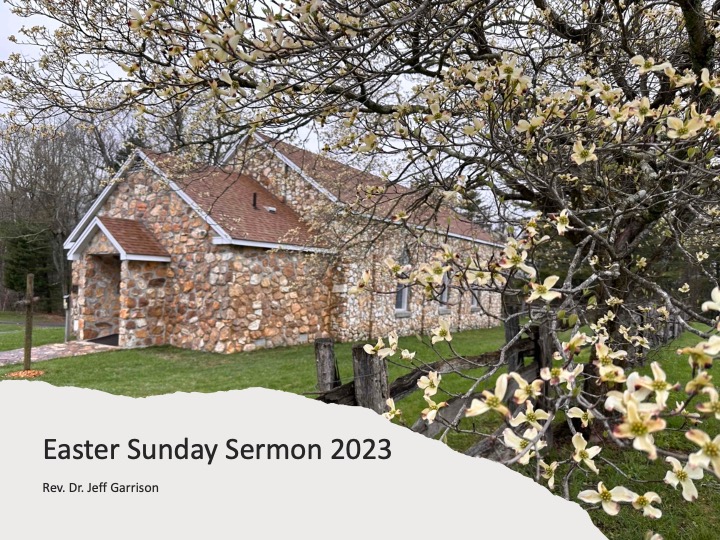
Easter Sunday 2023

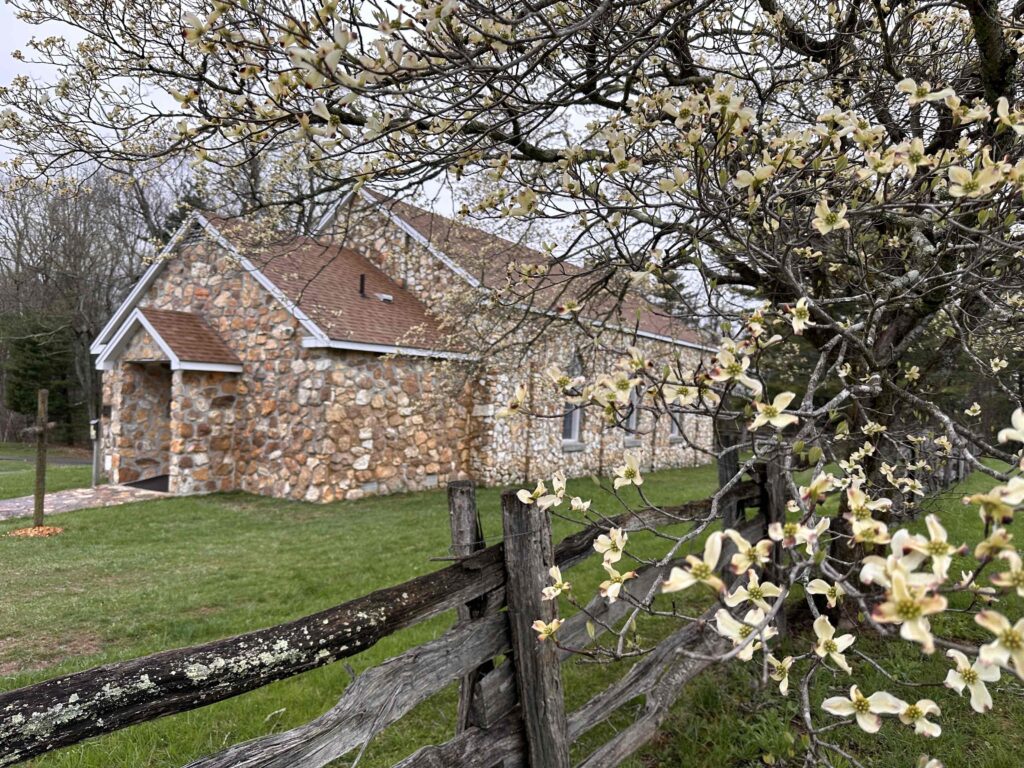
photo of dogwood in bloom in front of Bluemont Church

Jeff Garrison
Mayberry & Bluemont Churches

Easter Sunday, April 9, 2023
Matthew 28:1-15

At the beginning of worship:

The resurrection happened on the first of the week. It did not happen on the Sabbath, the holy day, but on what in the first century was a workday. Something new occurs. The Sabbath ends at sunset and before the sun rises, the women head to the tomb. God, in Jesus Christ, is resurrected and as Christians, we now hollow this day, the first day of the week, the day of resurrection.[1]

Before reading the Scripture:

We’re reading this morning from Matthew. We might think of this as the story of the resurrection, but that’s not right. None of the gospels tell us about the resurrection itself. Instead, we’re told of the encounters the women and disciples had with the resurrected Christ. The resurrection remains shrouded in mystery, for when the two Marys arrived at the tomb, Jesus was no longer there. Matthew always reminds us that from the beginning there was an effort to cover up what had happened. Listen.

Read Matthew 28:1-15

Once there was a man with a pet lamb. He fed it by hand and played with it every day. When hard times came, he was forced to take his pet lamb to the market to sell. Now there were three thieves who heard of the man’s plan and plotted to take it away from him in a clever way.

Early in the morning the man rose and put the lamb on his shoulder and began the journey to the market. As he traveled down the road, the first thief approached him and asked, “Why are you carrying that dog on your shoulder?” The man laughed, “This is not a dog, it’s my pet lamb and I am taking him to market.

After he walked a little farther the second thief crossed his path and said, “What a fine dog you have there. Where are you taking it?” Puzzled, the man took the lamb off his shoulders and looked carefully at it. “This is not a dog,” he said slowly. “It is a lamb, and I am taking it to market.”

Shortly before he reached the market the third thief met the man and said, “Sir, I don’t think they will allow you to take your dog into the market.” Completely confused, the man took his lamb off his shoulders and sat it on the ground. “If three people say that this is a dog, then surely it must be a dog,” he thought. He left the lamb behind and walked to the market. If he had bothered to look back, he would have seen the thieves picking up his lamb and running off with it.[2]

Are we like the man and the lamb?

Those of us who make up the Christian Church are often like the man with the lamb. We lose our focus by allowing other people’s opinions to shape our vision. To appease the world, some try to conform the gospel to science and popular opinion and end up not knowing what we believe.    

The gospel truth

The truth of the Christian faith is that God raised Jesus from the dead. It is not something we can prove. Paul himself, in the first century, admitted that it makes no sense outside of faith, that to non-believers it’s mere foolishness.[3] Our belief in the resurrection cannot be based on empirical evidence. The resurrection is about God’s power, but the story itself must be accepted on faith.  

Do people really know what we celebrate today? For some, the idea that Jesus laid in a tomb deader than a doornail and then raised from the dead is a scandal. It’s easier for them to believe the disciples stole the body. Or perhaps, today, it’s easier to believe in some silly bunny, a rabbit who should be the patron saint of dentists, bringing chocolates to the kids. 

What are we celebrating?

Or maybe Easter is about the rite of spring. As a child, we brought out our spring clothes on Easter. We took pictures of the family, generally in front of an azalea which bloomed in Eastern North Carolina this time of year. 

On Easter, girls once again could wear white shoes. They were allowed them to till Labor Day. Guys could wear lighter colored jackets. I’m not sure who the fashion police were back then, but many mothers lived in fear of them. 

Easter has become a holiday whom marketers embrace to sell candy, flowers, hams, and clothes. So, is it any wonder, according to a Gallup poll I heard many years ago, 25% of people in church on Easter Sunday don’t know what they were celebrating?  

Forgiveness and Hope: The Church’s gift to the world

Have we, followers of Jesus and members of his church become so lackadaisical that we no longer know what we are all about? Jesus Christ has given the Church two primary things to offer the world which no other organization has: FORGIVENESS AND HOPE. Forgiveness centers around the events on Good Friday, on Jesus’ death for our sin. As Peter wrote in his first epistle, “Christ bore our sins in his body on the cross that we might die from sin and live for righteousness.”[4]

Hope is based on the events of Easter morning itself, of the tomb being empty. It was there in those early morning hours the women and the disciples learned that God’s power is greater than all the powers of evil combined. God’s power extends over the grave. As Christ’s Church, we offer forgiveness and hope to the world, telling the gospel story repeatedly to each new generation.

The Two mary’s and the tomb

According to Matthew, the two Marys went to Jesus’ tomb early in the morning on the first day of the week. It was not yet dawn, but the Sabbath was over. But it was still dark. Anxiety, uncertainty, and fear lurk in the darkness. 

Did the women know what to expect at sunrise? It’s doubtful. Two of the other gospels tell us they planned to prepare Jesus’ body for its eternal rest, a required task.[5] Besides, psychologically, this ritual would help them put the death of Jesus behind them and allow them to get on with their lives.

Things happened quickly that morning. There’s an earthquake, then there’s an angel rolling back the stone. Ironically, the guards froze, as if they were dead. Matthew has fun here; the guards that are alive are as if they are dead, while the one who was supposed to be dead in the tomb is out and walking around.

The Earthquake and the coming of the end

Furthermore, the earthquake symbolizes the end of the old order. In Chapter 24, Jesus told the disciples there would be earthquakes before the end and we’ve now witnessed two earthquakes in three days![6] The end is upon us, having begun with the death and resurrection of Jesus. God’s kingdom replaces the older order.. We’re in the last days.[7]

The women are shocked with fear with not only the earthquake, but an angel descending from above and rolling away the stone covering the tomb. Notice, however, this isn’t the resurrection. The angel reassures them that Jesus has already risen and orders them to tell the disciples to meet him in Galilee. Think about this, the resurrection has already occurred. The stone rolled away just opens the tomb, its emptiness serving as evidence of the resurrection. 

Suddenly, the women’s lives are changed. They run and tell disciples, only to be surprised when Jesus appears to them. Jesus calls out to them, using a Greek word translated in most Bibles as “Greetings,” but a better translation might be “Rejoice!”[8] “Rejoice” conveys more feeling and power than “greetings” which is just a simple hello. Jesus’ words shock the women, and in awe, they kneel at his feet and worship him.

He gives the women the same instructions as the angel, with only one slight, but very important difference. “Do not be afraid,” he says, “go and tell my brothers that I will see them in Galilee.” No longer are Jesus’ followers just disciples, they are now his brothers.

Go! Run! Tell!

GO! TELL! RUN! These verbs used by Matthew create sense of movement and urgency to get the message out, to let the disciples know that God has raised Jesus Christ. The followers of Jesus had gone to bed on the Sabbath thinking that it was all over. Their friend Jesus had met his end on the cross. But on Easter morning, an open tomb shadows the cross and because of God’s love and action, the followers of Jesus once again have hope. 

GO! TELL! RUN! It’s imperative that the message gets out and is spread across the world. Jesus Christ is risen, today!

we accept the resurrection on faith

As I’ve indicated, we accept the resurrection on faith, not on empirical evidence. Obviously, Matthew is not interested in “proving” the resurrection. He tells the story from the eyes of two women, and you may remember that women in 1st century Palestine did not even have the right to testify in court. They would not have been considered creditable witnesses. The disciples were called to believe by faith. By faith they had left their former trades and followed Jesus and by faith they set out for Galilee to see the resurrected Lord. 

Like the disciples, we too are called to believe by faith. If we believe by faith, Jesus promises his presence and we will witness his glory.  

That first Easter began somewhat obscurely during the coolness of an early morning on the first day of the week. A few women, a disciple or two, and a few guards were all who experienced it and knew that something special had happened. 

Most everyone else in Jerusalem, as in the rest of the world, continue with their lives as if nothing happened. But soon the message spread. We are not told how the resurrection happens; only that it changed the disciples. It also has the power to change us.

GO! RUN! TELL! The urgency of those words still applies to you and me. Our troubled world needs to hear about God’s love and power. We may be hopeless like the disciples on that Holy Saturday. But because of God’s power, things can change. God is in control, and we see evidence of this when life is the darkest. Don’t believe the naysayers. Place your trust in a God who has power over the grave. It’s our only hope. Amen. 


[1]Frederick Dale Bruner, The Churchbook: Matthew 13-28), (Grand Rapids, MI: Eerdmans, 2004), 779-780.

[2] William R. White, Stories for the Journey (Minneapolis: Augsburg, 1988) 26-7.

[3] See I Corinthians 1:18-31.

[4] 1 Peter 2:24.                        

[5] The other gospels also include different women attending the grave, but they all include Mary Magdalene. Mark says they were to anoint the body (Mark 16:1; Luke says they came with prepared spices (Luke 24:1), John doesn’t mention spices and has Mary Magdalene coming to the tomb by herself.  

[6] Matthew 24:7. The first earthquake occurred during the crucifixion. See Matthew 27:51.

[7] See Bruner, 781-782.

[8] Douglas R. A. Hare, Matthew (Louisville: John Knox’s, 1993) p. 330.

Bluemont Church with blooming dogwood

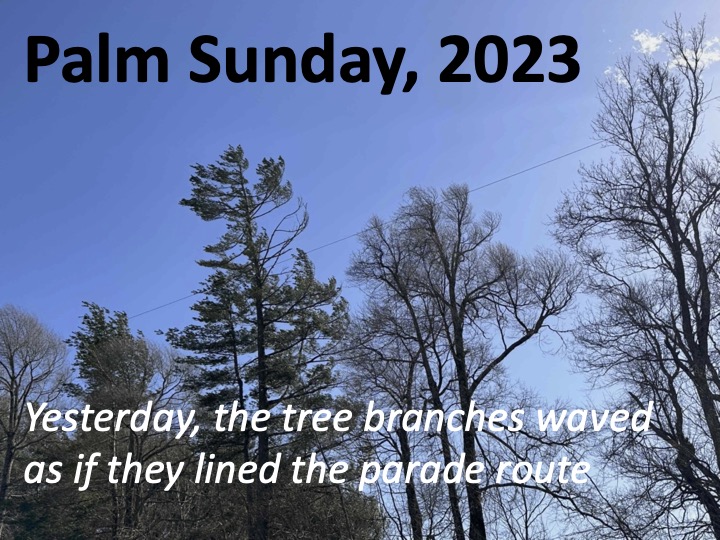
Palm Sunday, 2023

title slide, photo of trees blowing in wind

Jeff Garrison
Bluemont and Mayberry Churches
April 2, 2023
Matthew 21:1-12

Sermon recorded at Bluemont on March 31, 2023

At the beginning of worship:

Who is Jesus? And what does it mean to follow him? How would you answer these questions? What difference does the first question, who’s Jesus, make in our lives? How does it guide our attempts at following him? Ponder these questions as we worship. They were questions that was being asked the first Palm Sunday, too. 

Before the reading of Scripture

Last week, we’ve finished working through Peter’s first epistle. This week, as today is Palm Sunday, we’re looking into the gospel of Matthew. In the 19th Chapter, we’re told that Jesus leaves Galilee, heading to Jerusalem. A large crowd follows him.[1] He now arrives. All four of the gospels tell of Jesus’ entry into the city and each provides different insights. We refer to this day as Palm Sunday, but only one of the gospels, John’s, tells us the crowd waved palm branches.[2] Matthew just says they cut branches and spread them on the road. It appears to have been a joyful party, but as we know the joy of the day will quickly fade as the week wears on. 


Read Matthew 21:1-11

One Summer: America 1927

I have been listening to a book by Bill Bryson, titled One Summer: America 1927. It was an amazing summer in our nation. Babe Ruth was knocking the ball out of the park. He set a home run record for a season that stood until Roger Maris came along. President Calvin Coolidge, not known as a man of many words, made a sparse announcement when on vacation in South Dakota. He would not seek his party’s nomination for the Presidency in 1928. Also in South Dakota, workers were carving out the faces of Presidents on Mount Rushmore. Ford Motor Company shut down the manufacturing of Model Ts and retooled for the Model A. 

But probably the most exciting thing to happen in the summer of 1927 was the race to fly a plane from New York to Paris. The excitement focused on large planes with crews, but in came a lone pilot with backing from some businesses in St. Louis. Charles Lindberg, flying the Spirit of St. Louis, he won the prize. When he returned to America, he received, up to this point in history, the largest ticket-tape parade in New York City. Tons of paper was thrown out the windows along the parade route.[3]

Of course, looking back at 1927, it seemed so idyllic. As a nation, America was on the top of the world. Few people were aware that just around the corner the Great Depression would descend. And after that, there would be war unlike the world had ever seen.[4]We might draw a similar analogy to this day in Jerusalem in roughly 30 AD. Excited people shouted “Hosanna.” Everyone was excited. But darkness would descend and a few days later some of those same people would shout, “Crucify.”

Our text begins with Jesus and the crowd approaching the Holy City. Around the Mount of Olives, Jesus sends a couple of his disciples into a village ahead to procure an animal for him to ride into the city. We’re not told Jesus had all this worked out in advance. There’s a mystery here. How did Jesus know that there would be a donkey and a colt waiting? Was he somehow able to work it out in advance, without anyone knowing? In the days of walking, that seems unlikely. After all, he couldn’t call ahead. 

Or did Jesus employ his divine powers? We’re not told. The same goes with the response Jesus gives the disciples if they’re challenged for taking the animals. Tell them the master needs it. What farmer would lend out their beasts of burdens without collateral and with just the promise that this unseen master would return it?

If I’d been one of the disciples, I might have resisted. Why go into the unknown when you could return to a place you already been? Why take part in what feels like petty larceny? Of course, there were no Avis donkey rentals back then. But still, it seems strange. I’d prefer Jesus to tell me to go back to that place where we saw a donkey waiting by the road and where they knew the owner. But Jesus always calls us into an unknown future.[5]

I had this conversation with a parishioner this week about no knowing what’s next in our lives. It’s often scary if we pause long enough to think about our situations. We’re called to go forward, into new territory, trusting that Jesus, the good shepherd, travels with us. 

Matthew tells us that what happened fulfilled prophecy and then quotes from the Prophet Zechariah a passage about our king coming, humbled, and riding on a donkey.[6] The disciples are told in Matthew to bring two animals, a donkey and a colt. This has created some confusion. Did Jesus ride both animals, balancing up on the backs of each like some kind of circus performance? Maybe he even held the reigns in his teeth as he waved to the crowd? Probably not. Matthew also emphasizes the humility of Jesus’ entry into Jerusalem, and that would be showing off.[7] More likely, Jesus rode the donkey while the colt, perhaps not even weaned, tailed behind, staying close to his mom.[8]

We’re told the disciples put their cloaks on the donkey for Jesus to ride it. Donkeys are not normally ridden straddled, like a horse. Instead, the rider sits to the side of the beast. Other cloaks were spread on the path, along with tree branches. The crowd began together as they approached the city walls. As they are pilgrims coming for the Passover, they cry out the words from Psalm 118, “Hosanna to the Son of David! Blessed is the one who comes in the name of the Lord! Hosanna in the highest.”

Psalm 118 celebrates victory. God has given victory to the one coming into the city who then returns thanks for God’s steadfast love. God has taken the stone discarded by the builders and made it the cornerstone.[9] The Psalm captures the hope of the people that there be a new king on David’s throne, but in a way this Psalm seems out of place. While the Psalm celebrates victory,[10] Jesus heads to his death. And while his followers at this point don’t understand, Jesus knows.[11] The weight of this knowledge must have weighed heavy on his heart. They cheer Jesus on, a truth that should hang over us on Palm Sunday, for the crowd will soon turn on Jesus and demand he be crucified. 

But before that, they wonder, “Who is this?” This little parade seems to have really shaken Jerusalem. Our translation, in verse 10, said the whole city was in turmoil, but the word used in Greek for turmoil, is the Greek word from where get the word seismic. In other words, the city was shaken to the core, as if in an earthquake.[12]

This word is used only in three places in Matthew’s gospel. The first is when the Magi come to Jerusalem asking about the birth of the Messiah.[13] The people in the city were bothered. Why did they need a king when they had Herod. The second time is here. The word will be used once more, on the day we recall this Friday, during the crucifixion. That was when a real, not metaphorical seismic event happened. There was a real earthquake. At that time the temple curtain ripped into two halves while graves opened.[14]

So, the crowds ask who this Jesus is. I assume those with Jesus pointed out that he is a prophet from Nazareth. But, of course, Jesus is more than a prophet. In the week ahead, we’ll see that he’s also the Chief Priest, and the sacrifice. And then, we’ll learn of his defeat of death and that he is a king that is above all kings. But that’s to come. 

We’re left this Sunday with the question of the crowd. Who is this man we call Jesus? And if we believe he is the King as well as the Prophet and Priest, then how do we respond to him? Are we willing to go into the future where we have no control but can only trust him. For that’s what we’re called to do. Amen.  


[1] Matthew 19:1-2.

[2] John 12:13.

[3] Bill Bryson, One Summer: America 1927 (Random House, 2013).

[4] Bryson discusses a secret meeting by the head of the Federal Reserve along with banks in Great Britain, France, and Germany, whose decisions have been partly to blame for the worldwide Depression. 

[5] This idea came from MaryAnn McKibben Dana’s sermon on this passage on the website, “A Sermon for Every Sunday.   

[6] Zechariah 9:9.

[7] Mathew leaves out a piece of what Zechariah said. The prophet said, “triumphant and victorious is he, humble and riding on a donkey…” The “triumphant” part is missing in Matthew, as he emphasizes the humility of Jesus. See Frederick Dale Bruner, The Churchbook: Matthew 13-28 (Grand Rapids, MI: Eerdmans, 2004), 355.

[8]See Douglas R. A. Hare, Matthew: Interpretation, a Biblical Commentary for Teaching and Preaching (Louisville: John Knox Press, 1993), 238-239. 

[9] Psalm 118:22.

[10] Everything said in the Psalm “portrays the celebrant’s deliverance as the work of the Lord.” James L. Mays, Psalms: Interpretation, A Biblical Commentary for Teaching and Preaching, (Louisville, KY: John Knox Press, 1994), 377. 

[11] According to Matthew, at this point, Jesus has referred to his upcoming death three times, the last being in Matthew 20:17-19.

[12] Chelsey Harmon, “Matthew 21:1-11 Commentary. See https://cepreaching.org/commentary/2023-03-27/matthew-211-11-2   See also Bruner, 357. 

[13] Matthew 2:4.

[14] Matthew 27:51-52.

trees lining a road
The wind has blown hard for the past 24 hours.
Yesterday, the branches were waving as if they lined the parade route.

A shoot from a dead tree & the peaceful kingdom

Jeff Garrison
Bluemont and Mayberry Churches
December 4, 2022, Advent 2
Isaiah 11:1-10

At the beginning of worship: 

I can’t imagine what these mountains where we live looked like at the beginning of the 20th Century. In the mix of the trees were chestnuts, giants that grew straight. Chestnuts provided not only strong and rot-resistant wood for building, but they also gave an abundance of nuts. Our pioneer ancestors would gather them for eating. Furthermore, they were a cash crop that could be sold to supplement one’s livelihood. By the mid 1920s, long before any of us were here, they were gone. 

A fungus introduced in the United States in 1904, when some Asian chestnuts were brought to New York, spread into the American chestnut population. An estimate of 4 billion chestnuts trees died in the Appalachian Mountains alone. It is thought that one in every four hardwoods died. But still, in places, from old chestnut stumps, new growth sprouts. The sprout grows tall and straight. It looks promising. But before it matures, it too succumbs to the blight. Hopefully, one day, scientists can find a way for these trees to dominate the landscape once again.

A shoot for a stump

A shoot coming up from the roots of a dead tree is a sign of hope, as we’re going to see in text today. Advent is a season in which we are reminded that we live in a world that’s not our home. Our world is like a stump, in need of new life. We long for a better home, which will require God’s invention. God can do things that has mostly alluded scientist for the past 100 years—giving growth that continues from a stump that appears dead. As followers of Jesus, hold on to this hope. 

Before the reading of Scripture

Today, I’m going to read two passages of scripture for the sermon. The first is from Matthew’s gospel, in which we hear that madman John the Baptist rail against the people of his day. John knew something was happening and he wanted people to prepare by repenting and changing their ways. John speaks to our world today, and the need we have to prepare ourselves for God’s coming. I’m not going to say much about John in the sermon, but let’s hear his words and be reminded of the type of world in which we live. Are any of us fully content here? I hope not. I hope we long for a better world. 

We get a glimpse of this better world my second reading from Isaiah. We hear of a shoot growing from a stump and catch a vision of life as God intends. 

Read Matthew 3:1-12 and Isaiah 11:1-10

Edward Hicks

You know, sometimes artists appear to be in a rut. Think of Monet and his 250-some paintings of water lilies. Another such painter is Edward Hicks, a 19th Century Pennsylvanian artist whose favorite subject was “The Peaceful Kingdom.” Hicks painted an untold number of canvases that depict the scene we just heard from Isaiah. All the animals are at peace: predators and prey, along with children and snakes. The National Galley in Washington, DC have several of Hick’s paintings. If you are there, check them out. While you can look at his paintings in a book or on the internet, there is something about seeing it in person. 

Hicks’ mother died when he was 18 months old. Being unable to care for him, his father shipped him off to friends who raised him. Then he moved into a coach makers home, where he worked as an apprentice. He became known for his illustrations on the side of the horse drawn carriages he painted. This resulted in people asking him to paint furniture and signs. He was later given commissions for paintings to decorate walls. 

Depicting Biblical Scene

Hicks joined the Quaker Church. This created a tension with his art because Quakers were plain folk who shunned art for art’s sake. He then began to use art to interpret scripture, especially the peacefulness sought by Quakers. This is when he began his lifelong obsession with “The Peaceful Kingdom.”[1] I wonder if Monet and his waterlilies and Hicks and his peaceful kingdom were attempts to get it right. By painting the same scenes over and over, were they striving for perfection? It will take a lot of work to achieve such a kingdom. In fact, we can’t do it ourselves. Only God can bring such a kingdom about. 

The curse of Genesis 3 is remove

But just because we can’t, by ourselves, bring such a kingdom about, doesn’t mean we shouldn’t think about it. Instead, we should mediate upon it, and ponder how we might help demonstrate the kingdom to the world. In doing so, we instill hope. Our passage from Isaiah showsthat the curse of the fall, from Genesis 3, has been removed. In the curse, the woman’s and the serpent’s descendants are to be in constant battle. Humans stomp on snakes while they bite at our heels.[2]But in Isaiah, and in the paintings, a child is safe around a poisonous snake. 

Now, I know my mother thoughts of heaven would be a warm place without snakes. She was afraid of them and didn’t want us to have anything to do with them. But perhaps this idea of the child and the snake being together is an example of how, in heaven, we’ll get along even with our enemies. 

Animals living in harmony

Furthermore, in this scene, as I’ve said, we have the predator and the prey lying together. Woody Allen once quipped, “the day may come when the lion will lie down with the lamb, but the lamb won’t get much sleep.”[3] Like the child, the ancient enemies in this imagined world are no more. No longer do the weak have to be concerned about being consumed by the powerful. Predators and bullies and rouge nations are no more. Everyone looks out for everyone else. That’s the Christian hope. We won’t be able to do this on our own. We’ll have to depend upon God. Thankfully, we worship a God of miracles who sent his only Son into our world. And that child, born in Bethlehem, gives us a vision of the kingdom that is coming. 

Two parts to this reading from Isaiah

There are two parts our reading from Isaiah. I’ve discussed the second one first. But let’s go back to that shoot growing from a stump which reminds me of the chestnut tree. The stump of Jesse represents Israel at a time when it was united between the north and the south and it’s greatest king, David, the son of Jesse, ruled. By Isaiah’s time, David had long returned to the earth. His united kingdom had split and those in the northern half were about to be consumed by the Assyrians, the raging lions as they were known, which gives us a new insight into the tamed lions in the second half of this reading.[4]

But for Isaiah and his contemporaries, with David a distant memory, things didn’t look good. And soon, things would get worse. But our God is a God of justice and miracles. God can bring a sprout out of a dead stump and send a Son to save the world. 

The Almighty prepares the righteous king

God prepares the righteous king proclaimed by Isaiah with wisdom and knowledge and the fear of the Lord. He’s able to judge, not by sight or ear, but by righteousness, granting justice for the poor and oppressed. The lion that was Assyria will not always be on the prowl. The predators who bring danger, whether wild animals or unscrupulous business leaders or rouge nations, will be destroyed or tamed. And God’s king will rule fairly. But that’s still in the future. 

The hope of a new world

Today, we live in the world much like that which John the Baptist condemned. But it won’t always be this way. Jesus has come to save us from our sin. Jesus will come again to rule. We need to prepare ourselves for what God is doing and be ready. We need to do what we can to herald the new world that’s coming. Remember, the old saying, “it’s always darkest before the dawn.” Hold tight and trust in God. Jesus has come and will come again. Have hope, as we long for the day of peace promised in Isaiah. Amen. 


[1] For more about Hick’s and his paintings, see https://artandtheology.org/2016/12/06/the-peaceable-kingdoms-of-edward-hicks/  

[2] Genesis 3:15. See Otto Kaiser, Isaiah 1-12: A Commentary, John Bowden translator, (Philadelphia: Westminster, 1983), 260.

[3] See Scott Hoezee, “Isaiah 11:1-10” at https://cepreaching.org/commentary/2022-11-28/isaiah-111-10-3/

[4] Christopher R. Seitz, Isaiah 1-39, Interpretation: A Bible Commentary for Teaching and Preaching (Louisville: John Knox Press, 1993), 106.

The tree at the Garrison’s home

The Lord’s Prayer, Part 6: Temptation and Evil

Jeff Garrison
Bluemont and Mayberry Church
November 20, 2022
The Lord’s Prayer, Part 6

Sermon taped at Mayberry Church on Friday afternoon, November 18, 2022. Notice the late afternoon sun that at times blinds me!

At the beginning of worship: 

Two weeks ago, at Mayberry Church, we held a training event titled “Centered and Soaring.” This event was sponsored with partnership funds from the Presbytery of the Peaks. Those there were provided several “take-away ideas” to strengthen our discipleship as a follower of Jesus. One take-away was a Prayer Covenant. The idea is that we join with another individual to pray for each other for a specific time. Sometimes the prayers may be general, other times they may be more specific, as when we need help in a particular area. 

Jesus wants us to pray for each other

When Christians pray for one another, we’re doing what Jesus teaches in the Lord’s prayer. This is not a prayer about us as individuals. It’s about us in community. Consider the words: “Our Father, Give us, Forgive us, Lead us not, Save us…” There is no “Me” in the prayer. It’s all about community and for that reason, we need to be praying for one another.


This will be our six and final Sunday focusing on the Lord’s Prayer. I have never preached a series on Jesus’ prayer and in a way am sad that it’s coming to an end. There is so much more that I would like to say. This prayer is steeped in our tradition. As Matthew’s version of the prayer reminds us, we’re to use this prayer as a model or template for our own prayers. 

Lord’s prayer as a template

At the Presbytery meeting this past Thursday at Second Presbyterian in Roanoke, our moderator modelled this. She didn’t say she had written a prayer based on the Lord’s prayer, but as I listened, I could pick out the various petitions of the Jesus’ prayer. When you need to pray and are lost for words, you might consider the parts of the Lord’s prayer. And, to reiterate, if we find a lot of “Me’s” or “mine’s” in our prayers, we should compare how we pray to how Jesus teaches us to pray. 

Before the reading of Scripture:

While I didn’t watch Jeopardy this week (which is nothing new), I heard about it. One of the questions in a championship round had to do with which epistle of Paul’s had the most Old Testament references. According to Jeopardy, the right answer was Hebrews. I didn’t realize so many familiar with the Bible watched Jeopardy, for immediately Facebook and Twitter blew up with people pointing out Jeopardy’s mistakes. For nowhere does Hebrews tell us that Paul was the author and there are some who question labelling it an epistle as it’s more of a sermon than a letter. And finally, Romans appears to have more links to the Old Testament than Hebrews. They got it wrong on many levels.[1]Hold that thought, I’ll come back to it in a moment. 

Petitions in the Lord’s Prayer: A Bit of Jeopardy-like trivia

Today we’re looking at our last petition in the Lord’s Prayer: “lead us not into temptation but deliver us from evil.” I noted in one of my earlier sermons that while we tend to consider the prayer to have six petitions,[2] there are some who divide it into seven. To do this, they split the last petition into two separate parts, one on temptation and one on the evil one. You can find this in Luther’s Catechism[3] as well as the catechisms of the Catholic Church.[4]One of the reasons for making this prayer into seven petitions instead of six is that it seven is consider a perfect number.[5]

This kind of trivia might do you well if you find yourself on Jeopardy. Of course, you’ll have to guess which source their experts consulted as to if there are six or seven petitions in this prayer.

Read Matthew 6:9-13

I recently spent a lot of time with John Bunyan’s classic, Pilgrim’s Progress.[6] I had read parts of it before, but never spent much time studying the book until a theology group of which I am a member decided to study it. In preparation, not only did I read the book, I also read a commentary on it and also reviewed books on Puritanism which I had read decades ago. 

Popularity of Pilgrim’s Progress in 19th Century America

I had looked forward to delving into this work of Bunyan. I had known for some time that Pilgrim’s Progress was the second most popular book in the 19th Century for those moving into the American West. On wagon trains and clipper ships, the Bible was the number one book people had in their possessions. If they had a second book, unless you were Samuel Clemens, the book was most often Pilgrim’s Progress. Clemens, better known as Mark Twain, wrote a humorous piece about hauling a dictionary across the continent.[7]

Christian’s journey

Pilgrim’s Progress begins with the story of Christian, who becomes convicted the city in which he lives (aptly named “Destruction”) is about to be destroyed. No one wants to listen to him talk about what’s to happen. He’s mocked by friends and family. So, he decides to flee. He leaves on a pilgrimage to the Celestial City, to God’s kingdom. While he abandons his family, he begins his trip with two friends. But they quickly leave him. His travels are often solo or with just one companion, such as Faithful, who is martyred along the way… 

Obstacles to overcome

Christian must overcome many obstacles to reach God’s kingdom. In the second half of the book, Christian’s wife Christina and his children make their way to the city, following Christian’s example. Unlike Christian, who is often alone, they travel in a group and while they have their own trials, they make the journey with less trouble than their father, who has become an encouragement to other pilgrims. 

The reader of Pilgrim’s Progress comes away with the impression the Christian life is one of constant challenges and temptations. Nothing is easy about the pilgrim’s journey, but the hope of the eternal city keeps the pilgrim moving forward and making the right decisions. 

Pilgrim’s Progress and the ending petition

The ending of the Lord’s Prayer captures Pilgrim’s plight. “Lead us not into temptation but deliver us from evil.” The language here is stark. Deliver us could also be “snatch us”[8] as if we’re about to walk off a cliff. Metaphorically that’s what we’re about to do when evil confronts us. 

Early in his pilgrimage, Christian is caught in the Slough of Despond. In this prayer, temptation is the pit or slough where we find ourselves stuck when caught in sin. And the evil one is the power that draws us into the pit.[9]

Evil forces in the world

This prayer reminds us that there are forces in the world who challenge us and seek to keep us from faithfully following Jesus. And prayer challenges those powers. As Karl Barth, the great 20th Century theologian, said, “To clasp hands in prayer is the beginning of an uprising against the disorder of the world.”[10]

Prayer is where we start. Before we do anything else, we need to be sure we are on God’s side. This prayer helps us do because it refocuses us, away from our petty concerns, and toward God. Before we set out to save the world, which isn’t our job by the way, we should pray. We pray because we see dimly in this world,[11] and we need God to light or direct our way.

Subtle temptations

Temptations can be so subtle. Often temptations are good gifts but are not used in the manner intended. When anything moves between us and God, the good is tainted. And the evil one knows this, which is why he makes temptations seductive. So, we ask God to help us as we navigate this life. We only have glimpses of the holy, of God’s plan and glory. But we move forward, through the fog, in faith, praying and holding out to the hope we have in Jesus.

Lack of community

One of the things that struck me in my recent study of Pilgrim’s Progress was the lack of community.[12] Christian is often on his own. I’m afraid this aspect of Bunyan’s book has been detrimental on American Christianity. The book’s popularity in our early history tempted the church to deemphasize community over the individual. 

A theologian friend of mine has suggested the Achilles tendon of the Reformed Tradition is our lack of understanding of ecclesiology.[13] That is, by focusing on the individual, we don’t have a good understanding of the church and how it is to help us grow disciples. This over-emphasis on the individual may stretch back to the Puritans, of which John Bunyan was one. But in Scripture, as we see in this prayer, the focus is most often on the community. We need to regain a sense of how the Christian community works to draw us closer to Christ. 

Lord’s Prayer is based on community

The Lord’s prayer is not about the individual. It always pulls us from our individual concerns to the concerns of others. We don’t pray, “Save me,” but “Save us.” The community, the church, is to be there to help us when we falter along the way. While we look for God’s guidance as we are tempted or challenged by evil, we are also to be supported by other godly people. We have two hands and should hold God in one and God’s people in the other. 

It is interesting that Jesus’ begins his prayers with a focus on God as Father, and ends this prayer on a downer, talking about the evil or the “evil one.” We can give him a name, “Satan.” Perhaps this why a doxology is added onto the prayer. However, as we see, most Bibles don’t have this doxology. If you’ve worshipped in a Catholic Church you’ll know they don’t say it. I found this out the hard way when I was a student pastor and participating at a Thanksgiving service at St. Mary’s of the Mountain Catholic Church in Virginia City. I continued to pray, along with a handful of Presbyterians, while the rest of the congregation ended their prayer early.

Ending doxology

The doxology was found in texts dated to around the 10thCentury.[14] It’s found in the King James Version, but even then, it was known that this passage may not have been original. John Calvin admits such in his writings.[15] Today, as it is not found in any of the older manuscripts, translations leave out the doxology. However, thanks to the King James Version, the phrase has been adopted by us liturgically. After all, who wants to end a prayer with the focus on Satan?

Why might this doxology have been added? One suggestion is that the prayer ends so ruggedly so we might continue with our own prayers. This is kind of like how I write my pastoral prayers. Generally, on Sunday mornings, as I watch a new day emerge out of the darkness, I write a paragraph or two. Then, we when we come to the prayer, based on shared joys and concerns and how I’m feeling, I finish praying “off the cuff.” 

In favor of the doxology

Personally, I don’t think we should get rid of the doxology even though it’s not in scripture. Instead, it concludes this prayer in a “shout out” to Almighty God: thine is the kingdom, the power, and the glory.[16] But if you want to pray the prayer as it is found in the gospels, do so and tack your own prayers of praise at the end.

Conclusion

I hope you have learned something about prayer over the past six weeks. If I was to quickly summarize the highlights of this prayer of Jesus, I’d say it focuses us on God, on our necessities and the necessities of others, and to our need for God’s protection and the fellowship with other believers. Amen. 


[1] This is the example of one such article to come out of Jeopardy-gate: https://www.thegospelcoalition.org/article/jeopardy-paul-hebrews/

[2] Both the Heidelberg and Westminster Catechisms have six petitions. These are found in the Presbyterian Church USA, The Book of Confessions (Louisville, KY: Office of the General Assembly, 2018). The same is true for John Calvin, Institutes of the Christian Religion (1559, Ford Lewis Battles translation), III xx.

[3] Martin Luther, “Large Catechism,” Book of Concord: The Confessions of the Evangelical Lutheran Church (Philadelphia: Fortress Press, 1959), 433-435

[4] See https://www.usccb.org/sites/default/files/flipbooks/catechism/686/

[5] The Greek early Church fathers mostly divided the prayer into six (two sets of three, and Matthew often uses sets of three in his gospel). However, Augustine along with Lutherans and Catholics use the “perfect” seven sets. Fredrick Dale Bruner, The Christbook: Matthew 1-12 (Grand Rapids: Eerdman, 2004), 293.

[6] In addition to reading Pilgrim’s Progress and listening to it on Audible, I also read Robert Maguire, D.D., Commentary on John Bunyan’s “The Pilgrim’s Progress” (1863, Minneapolis, MN: Curiosmith, 2009).

[7] Mark Twain, Roughing It (1871: Berkeley, CA: University of California Press, 1993), 18-19.

[8] Bruner, 314

[9] Bruner, 314.

[10] As quoted by William H. Willimon and Stanley Hauerwas, Lord, Teach US: The Lord’s Prayer & the Christian Life (Nashville, TN: Abingdon, 1996), 109.

[11] 1 Corinthians 13:12.

[12] My other concern is the apparent lack of grace that is seen in Pilgrim’s Progress.

[13] Ecclesiology is the study of the church. Dr. Jack Stewart, formerly a professor at Princeton Theological Seminary, and I have discussed this several times.  As a scholar of Charles Hodge, Stewart points out that Hodge had planned but never completed a fourth volume of his systematic theology that would have been on ecclesiology. 

[14] Alister McGrath, In the Beginning: The Story of the King James Bible and How it Changed a Nation, a Language, and a Culture (New York: Anchor Books, 2001), 242, 244.

[15] Calvin, Institutes, III xx 47. 

[16] Willimon and Hauerwas, 98.

Early evenings, bare trees, and steely skies. Winter comes.

“Forgive our debts” The Lord’s Prayer, Part 5

Jeff Garrison
Bluemont and Mayberry Churches
November 13, 2022
The Lord’s Prayer, Part 5
Matthew 6:9-15, 18: 23-35

Sermon recorded on Friday, November 11, 2022, at Bluemont Presbyterian Church

At the beginning of worship:

I came across a quote this week that struck me. “The worst thing is not being wrong but being sure one is not wrong.”[1] Let that sink in. “Being sure we are not wrong.” Why is that so bad? Because we often fail to see or understand our sinfulness. It’s easy to see sin in others, but harder to see it in ourselves. But one day, we’ll all stand before God’s throne. And we will all stand in need of forgiveness. But we don’t like to forgive, do we? We’re going to talk about this today. 

Before reading today’s scripture

Today we’re looking at the fifth petition in the Lord’s Prayer. Forgive us our debts as we forgive our debtors. 

Debts or Trespasses

Historically, those of us in the Reformed Tradition, including Presbyterians, have always said debts and debtors. When I say the Lord’s Prayer at a funeral or an ecumenical gathering, I just quietly say debts knowing I’ll be drowned out by those who say trespasses. I am not sure why others—from Roman Catholics to most Protestants—say trespasses. 

In preparation for this sermon series, one of the books I read was by two Methodists, William Willimon and Stanley Hauerwas. I thought they might enlighten me, as the Methodists say trespasses. Instead, they admitted that while there is a long history of saying trespasses in the prayer, it’s not what’s in the Bible.[2] Maybe this is the one thing we get right.

If you look at almost all English translations of the Lord’s Prayer from the King James Version on, the Greek is translated as debts. Now, right after the prayer, as we’ll see, Jesus speaks of trespasses. But not in the prayer. In the prayer as recorded in Luke’s gospel, Jesus uses the words for sin and for debts.[3] I think there is a reason for the use of debts, for we are all in debt to God. 

Read Matthew 6:9-15 & 18:23-35

The Swamp Fox

I have been listening to John Oller’s, The Swamp Fox, an audible book this week.[4] The Swamp Fox was Francis Marion. A Revolutionary War hero from South Carolina, Marion did his best to be a thorn in the side of the British and Loyalists. This was especially true as Britain began its Southern Strategy in 1780, with the hopes of gathering loyalists and moving north to trap George Washington and his army. During this period, Marion destroyed British supply routes between the coast and the upland. As Cornwallis’ army moved north, it was ill prepared for what they would face and eventually they became trapped. Cornwallis surrendered at Yorktown, and the war ended. 

South Carolina during the Revolutionary Way

During the war, South Carolina had more engagements than any other colony and was the bloodiest theater. But in many ways, the Revolutionary War in South Carolina wasn’t so much a war against Britain, but a Civil War. While there were a few British regulars in South Carolina, much of the combat occurred between loyalists and patriots. At the time, these two groups were also known as the Torys and the Whigs. They were merciless toward the other. And sometimes, spats between neighbors determined which side one was on. 

When a patriot did something to his neighbor, his neighbor became a loyalist and fought for Britain. This also went the other way, too. The armies burned homes of their enemies, and often killed their prisoners. Marion supposedly detested such behavior and was willing to court-martial his own soldiers when they behaved in such a manner. But he had his hands full. Because of the animosity between groups, after the war, most loyalists migrated to Canada or back across the sea. 

South Carolina was not a good place in the Revolution

South Carolina would not have been a good place to live in the late 1770s and early 1780s. (I’m not sure it’s any better today, but I’ll leave it at that and not include more of my North Carolina bias). But I hope you can you see how the lack of forgiveness leads to chaos. The home of one side was burned, someone else burns a home of someone on the other side of the conflict. I think it was Gandhi (at least in the movie) who said, “An eye for an eye makes the whole world blind.” 

What’s So Amazing About Grace?

In his book What’s So Amazing about Grace, Philip Yancey says grace is the best gift the church has given the world. But two pages later, he also acknowledges that the church often communicates ungrace to the world.[5] When we in the church fail to grant forgiveness, we don’t appear graceful!

Physical needs before forgiveness

As we saw last week, Jesus, in the Lord’s Prayer, first takes care of our physical needs. “Give us our daily bread,” is the first petition that concerns us directly. Then, on its heels, Jesus addresses the human condition.[6] We are a sinful people. Not only do we need to eat, but we also need forgiveness. And we need to forgive others. It’s the only way we can break the cycle of vengeance that is too prevalent in our world today. 

Forgiveness is difficult

But face it, forgiveness is hard.[7] And it’s not very popular. Many churches forego prayers of confession, which I think is one of the most important prayers we have. After all, where else can we find forgiveness. It’s the one unique thing the church has to the offer the world. Lots of what the church does can be done by other groups, and in many cases, they can do it better. But Jesus gave the church the keys to the kingdom.[8] We have the right to proclaim the forgiveness of sin that can only come through Jesus Christ. No other group has that kind of gift that is so desperately needed in our world today.

We are debtors!

This prayer assumes we have debts. This may have come from an old concept where, when we sin, a notation is made into a ledger indicating the debt we now owe. And debts need to be repaid. It’s the only way the books can balance. Yet, we are all guilty. In other words, we are all debtors. As Paul writes, “All have sinned and fallen short of the glory of God.”[9] Our debt may be from that which we have done which is against God or against neighbor. And it may be that which we left undone but should have done. There’s a ledger book for us all and it’s filled with sins of commission and omission.

Forgiveness is not cheap

Sin is serious and forgiveness is not cheap. Jesus paid the price for our sin, enabling us to be forgiven. The only way we can be forgiven is for God to wipe out our debt.

Forgiveness with a caveat

But this forgiveness comes with a caveat. While we are forgiven by God through Christ, in our striving to be more “Christ-like,” we are to be forgiving others who have done wrong to us. We don’t do this to obtain forgiveness. Instead, we forgive graciously, knowing what God has done for us. When we act in this manner, we break that cycle of revenge that threatens to tear our world apart. First God forgives us, then we are to go and do likewise and forgive others. 

When we forgive someone who’s wronged us, it’s like throwing “a monkey wrench into the eternal wheel of retribution and revenge.”[10] But it’s the only way forward. As C. S. Lewis once said, “To be a Christian means to forgive the inexcusable, because God has forgiven the inexcusable in you.”[11]

Matthew 1

As we heard in our reading from Matthew 18, Jesus told a frightening parable about this. A man owed and obscene amount of money to his king. 10,000 talents. Each talent was worth 15 years of wages, so this man would never be able to pay unless he lived 150,000 years. We’re talking about a debt as great as what Elon Musk borrowed to buy Twitter. Now the king wants to clear his accounts. Unable to do so, the man and his family are to be sold into slavery. He begs his creditor, the king, for forgiveness. Surprisingly, the king relents and forgives. 

But the man who was forgiven such a great sum, was unwilling to forgive another who owed him 100 denarii, or the equivalent of 100 days of work. The one forgiven the obscene amount wasn’t willing to forgive the one who owed a fraction of what he owed. And the king in the story, who represents God, is furious when he learns about this ingratitude. We don’t want God furious at us, do we?

All of us need forgiveness and to be forgivin

We stand in need of forgiveness, but we must also be willing to forgive. Failing to forgive, the cycle of revenge will only grow and eventually lead to our destruction. The good news is that God forgives us. Accept this incredible gift and strive to let others also experience this gift. For when we forgive, we are displaying a central characteristic of a loving and gracious God. And may we do it all so that God will have the glory. Amen. 

c2022


[1] The quote is attributed to Paul Tournier, The Whole Person in a Broken World. It was posted on Twitter: https://twitter.com/Brian_Scoles/status/1590754738794270720

[2] William H. Willimon & Stanley Hauerwas, Lord, Teach Us: The Lord’s Prayer & the Christian Life (Nashville: Abingdon, 1996), 79. 

[3] Luke 10:4. 

[4] John Oller, The Swamp Fox: How Francis Marion Saved the American Revolution, Joe Barrett, narrator (2016).

[5] Philip Yancey, What’s So Amazing About Grace? (Grand Rapids, MI: Zondervan, 1996), 30, 32. 

[6] Frederick Dale Bruner, The Christbook: Matthew 1-12 (Grand Rapids, MI: Eerdmans, 2004), 309. 

[7] While I didn’t want to go down this path in this sermon, one of the problems I have with dispensationalism is that some theologians who hold such beliefs see the difficult teachings of Jesus in the Sermon of the Mount applying not to the present but to a future dispensation. This concept makes the commands in Jesus’ sermon easier for us to “ignore” in the present age because they are too hard, instead of seeing them as a goal which we may not successfully reach, but should still attempt.  See John H. Gerstner, Wrongly Dividing the Word of Truth: A Critique of Dispensationalism (1991) or Bruner, 310.

[8] Matthew 16:19. 

[9] Romans 3:23.

[10] Willimon and Hauerwas, 84. 

[11] This quote was quoted in What’s So Amazing about Grace?  See Yancey, 64. 

Saturday evening, looking toward the Buffalo at sunset

“Give us this day our daily bread.” The Lord’s Prayer, Part 4

Jeff Garrison
Bluemont and Mayberry Churches
November 6, 2022
The Lord’s Prayer, Part 4
Matthew 6:7-13 and 4:3-4

Sermon recorded at Mayberry Church on Friday, November 4, 2022

At the beginning of worship:

We don’t like to be dependent on anyone other than ourselves or perhaps our spouses. It’s the American way. Pull yourselves up by our bootstraps, be independent. But there’s a problem with such thinking. It runs counter to the gospel of Jesus Christ. In all things, we are dependent on the providence of a loving God. And we live in an economy that demands we depend on others. Could you make your own car or build your own road? But today, I want us to consider God’s providence.

We owe where we are in life to God. Think about it, we could have just as easily been born in Ethiopia or Ukraine. We could have been born with a birth defect or learning disability, contracted a terrible disease at an early age, had horrific parents, or been run over by a truck. Some of you may have experienced such, but even then, God sticks with us. If God was not present, where would we be? When we consider the blessings received in this life, most of us should be humbled. Look for the blessings you have and be grateful.

Before the reading of scripture:

As we continue to look at Lord’s Prayer, let me say a little more about this prayer as it appears in Matthew’s gospel. First, the prayer is almost exactly in the center of Jesus’ Sermon on the Mount. If you look at this sermon in the Greek, which runs three chapters in the gospel, there are 116 lines before the prayer and 114 after it.

Throughout his ministry, Jesus said a lot about prayer. Prayer is central to Jesus’ teachings. 

Jesus begins this prayer saying, “So you should pray like this.” For some reason, the New Revised Standard Version (along with some others), leave out the “You,” but in the Greek, Matthew emphasizes it. Jesus says his followers are to pray like this (this is the You in this sentence). We’re not to pray like those in other faith traditions. Nor is prayer just about putting in an order for stuff. We are to pray like Jesus.

A second point is that this prayer is given as a model. It’s not the law. We don’t have to pray these words, exactly. Instead, this prayer becomes a template for our prayers. “You should pray likethis.”[1]

The fourth petition

Today, we’re looking at the fourth petition of this prayer. Remember, the Lord’s prayer can be divided into two equal parts. The first three petitions praise God and reorients us toward God. The second three petitions are about our needs. The first is for our daily bread. Jesus is interested in our well-being. We ask for bread even before forgiveness, which indicates the importance of our physical health. The word bread, in how it is used here, implies more than something made with wheat (which should be good news for any of you who may be gluten intolerant). 

While the word translated as bread literally means food, here it probably also refers to all we need to survive. And note, we ask for bread, not cake. We can be thankful when we’re given cake but should be satisfied with bread. We ask God to provide the basics, day in and day out.[2]

 I am again reading the prayer from Matthew’s gospel along with a short passage from Jesus’ temptation in the wilderness in Matthew 4. 

Read Matthew 6:9-13 and 4:3-4.

My work in a baker

I’ve shared with you before that I spent five years working in a wholesale bakery. I started there as a summer job, between my freshman and sophomore years of college. And I stayed on for a while. You know, there are plenty of jokes about working in the bakery. People say such things as “you must be rolling in the dough,” which isn’t the case literally or figuratively. 

The bakery industry involves tough work in a difficult business climate. Because bread goes bad fast, it must arrive fresh in the stores almost every day.[3] Once I became a supervisor, I was on call always unless I was on vacation.

Daily bread and the wholesale bakery

Give us our daily bread, we pray. This took on a whole new meaning when daily bread was being shipped out in a dozen tractor trailers each evening. Or, as happened once, when we ran out of flour, we kept looking down the railroad tracks for the train bringing the hopper car full of flour, that was a day late. Even in modern times, there is no guarantee of daily bread.

The bakery was never idle more than one day at a time. Starting around midnight on Saturday night and going through late afternoon Sunday, we’d bake what was shipped out late Sunday afternoon and evening. Smaller trucks took the bread to stores where it was fresh on the shelves early Monday morning. The plant was shut down on Tuesday and Saturday, which was when our deep cleaning occurred. And if you had a breakdown, you worked until you got the product out because if it wasn’t on the shelves, the customer would buy another brand. 

Short shelf life for things on earth

This prayer, “give us our daily bread,” reminds us that things on earth have a short shelf-life. There is some debate over this petition as to if we’re asking for heavenly bread (as in the banquet in God’s kingdom) or bread to sustain our bodies on earth. Both are important, but I go with the later. If we don’t have food, we die. Surely, we are to store up our treasures in heaven, as Jesus recommends. Jesus acknowledges that there is a danger of accumulating even solid things on earth, which over time will rust away, or be consumed by moths, or stolen.[4]

But Jesus also realizes that we need to eat. That’s why he fed the multitudes, a miracle found in all four of the gospels.[5] And it’s also why the church’s mission from the beginning has been to feed people.  

Jesus, the “Bread from Heaven” also fed peopl

Yes, Jesus says he’s the “bread of life,” which we find in John’s gospel.[6] But Jesus never says that we don’t need anything else. He fed the 5,000 because they were hungry. But Jesus didn’t want people to depend on him for just physical bread when he could give so much more. 

When Jesus was tempted in the wilderness to turn a stone into bread, as we heard in our readings, he said one doesn’t not live by bread alone. Notice, he didn’t say, one does not live by bread! It goes without saying that we need food and the necessities of life. 

Such gifts we ask daily from God; otherwise, by hoarding, we may begin to think that we’re in charge of our abundance and see no need for God. We’d be like the guy in the parable who wanted to build larger barns, only to die before he could enjoy their benefits.[7]

Communal aspects of bread

Yet, no one wants stale bread. And moldy bread isn’t good for us. Of course, today there are options such as freezing bread and pulling it out when needed, but that wasn’t the case in Jesus’ day.[8] Bread was baked daily. Bread is also an example of a communal dependance on one another.[9] Also notice, we pray for “OUR bread,” not “MY bread.” 

The baker depends on the farmer to grow the grain. Grain is hauled a great distance, even in Biblical times. Think of Joseph’s brothers taking grain from Egypt back to Canaan to feed their families.[10] Before the baker can use the grain, a miller grounds it into flour. And the flour needs to be used soon or bugs begin to grow in it. If the baker in Jesus’ day was in a city, he’d have to have hire someone to bring him firewood for the oven. 

Bread, something we take for granted, requires a whole village. Few people can do all it takes to prepare bread, and if we could do all it takes, from growing grain to grinding, to kneading and preparing fires for baking, we’d have no time to do anything else.

Luther’s interpretation of this petition

In his catechism, the Protestant Reformer Martin Luther said that when we pray for our ‘daily bread,’ we are asking for everything necessary to have and enjoy our bread. Luther has a good point here. At the same time, Luther continues, we ask for protection from everything which would interfere with us enjoying our bread.[11]

In his little book, A Simple Way to Pray, which Luther wrote for his barber, he includes a prayer based on this petition which thanks God for blessing our temporal and physical lives. Then Luther strangely continues, “Graciously grant us blessed peace. Protect us against war and disorder. Grant our dear emperor fortune and success against his enemies…”[12]

War and bread prices

It may seem strange to pray for peace when praying for our daily bread, but perhaps, if you’ve been following world news, you’ll understand. Bread, even in ancient days, wasn’t something people took for granted. In Jesus’ day, much of the grain that fed Rome came from North Africa. War has a way of disturbing transportation arteries, making wheat and other food stuff more and more expensive. 

We’re seeing this now with Russia’s invasion of Ukraine. Ukraine is one of the world’s breadbaskets. A large percentage of the world’s grain and vegetable oil, especially in the poorer regions of African and the populated cities of Asia, come from Ukraine. If all a sudden the world lost 42% of its sunflower oil, 16% of its maize, 10% of its barley, and 9% of its wheat, which is the share of these products supplied by Ukraine in 2019, people will suffer.[13]Grain is a commodity. Producers sell commodities where they can get the highest price. Therefore, a war thousands of miles away affects prices in our grocery stores. 

Conclusion

So, after reorienting our lives toward God, we ask God to care for us. We don’t pray to be indulged with goods or supplied with rich foods. Instead, we ask, day by day, for what we need to get by so we might enjoy this good world in which God allows us to live. And, as this prayer reminds us, we don’t pray, “give me” but “give us.” We want everyone to have enough that their stomachs might be satisfied. This prayer not only orients us on God; it also focuses us on the needs of our neighbors.

I hope you see this petition in a new way. First, we’re not just asking for our own needs, but for everyone’s need. Second, we ask this prayer daily, for we continue to need to be reoriented toward a gracious God from whom all good things flow.  Amen. 


[1] Frederick Dale Bruner, The Christbook: Matthew 1-12 (Grand Rapids: Eerdmans, 2004), 292-293.

[2] Bruner, 306-308. For a detailed discussion of the word used for bread, see James R. Edwards, The Gospel According to Luke (Grand Rapids, MI: Eerdmans, 2015), 334-335. 

[3] When I worked in the bakery (1976-81) bread only stayed on the shelves three days. After a week, it would often mold. Today, it appears that bakers are using better preservatives than were available then, as a loaf of bread often last two weeks in our house.

[4] Matthew 6:19-21.

[5] Matthew 14:12-21, Mark 6:30-44, Luke 9:10-17, and John 6:1-15.

[6] John 6:35. John 6:35-59 discusses the crowd’s desire for more bread, but Jesus had already fed them when they were hungry and now wants them to seek not just temporal benefits but spiritual benefits of believing in him. 

[7] Luke 12:16-21.

[8] When I was working in the bakery in the late 1970s and early 80s, flash freezing was just coming into use. Unlike slow freezing, flash freezing keeps the dream from losing taste while frozen and when it thaws it is still fresh. I’m sure this is used even more today in the industry. 

[9] William H. Willimon & Stanley Hauerwas, Lord, Teach Us: The Lord’s Prayer & the Christian Life (Nashville: Abingdon, 1996), 76.

[10] Genesis 42.

[11] Martin Luther, “Larger Catechism,” The Book of Concord (Philadelphia: Fortress Press, 1959), 430.

[12] Martin Luther, A Simple Way to Pray (Louisville, KY: W/JKP, 2000), 25. 

[13] Figures from the BBC, “How Much Grain Has Been Shipped from Ukraine?”, November 3, 2022.

Photo taken on Wednesday, November 2, at Rocky Knob. Our leaves are going fast!

The Lord’s Prayer, Part 3: Thy Will Be Done

Jeff Garrison
Bluemont and Mayberry Churches
October 30, 2022
The Lord’s Prayer, Part 3, “Thy will be done”
Matthew 6:9-13, 26:36-46

The sermon was recorded in worship at Bluemont today (Sunday, October 30, 2022)

Before reading the scripture:

We continue to explore the Lord’s Prayer today, as we look at the third petition. As I suggested over the past two weeks, this prayer begins by reorienting us toward God. The first three petitions all focus on God, not us. 

The Lord’s Prayer and the Ten Commandments

These petitions parallel the first table of the law. The first four commandments—which deal with not making or worshipping idols, not misusing God’s name, and keeping the Sabbath—all focus on our relationship with God.[1] Likewise, the second half of the prayer focus on our needs roughly parallel the second half of the Ten Commandments. 

Calvin on the Lord’s Prayer

John Calvin, in writing about this prayer, notes that the beginning reminds us to keep God’s glory before our eyes. We’re not to look for advantages for ourselves. Instead, we want God’s Spirit to govern our hearts and teach us to love the things that please God.[2]

Again, I will read the prayer from Matthew’s gospel, followed by the passage of Jesus praying in Gethsemane on the night of his betrayal.

Read Matthew 6:9-13 and Matthew 23:36-46

Friendly bantering and contempt

I have friends who are college football fans. Those in the SEC can be a little fanatical. Yesterday, the University of Georgia and the University of Florida met on the gridiron. All this week my Twitter feed has been clogged with their back-and-forth banter about the big game. Now it’s all over and I can get back to looking at pictures of nature and dogs. And congratulations to the Georgia Bulldogs. 

But now I’m starting to see similar bantering between Astros and Phillies fans as the World Series kicks off. It never ends. We are so sure of our side, which can be fun when it’s just a game… but when we take things too seriously and start demonizing others in real life, seeing our opinions as Gods and theirs as Satanic, we’ve crossed a line. In such cases, we develop an unhealthy case of contempt for others, which can be even more harmful to us than to those we perceive as enemies.[3]

Lincoln’s Second Inauguration 

Dawn broke on March 4, 1865 with rain and storms. Early in the afternoon, dressed in a Brooks Brothers suit (a company which until a few days ago I didn’t realize existed back then), Abraham Lincoln stepped out of the porch of the unfinished capitol to deliver his second inaugural address.[4] It was a short speech, especially for inaugural addresses, but one peppered with theological and Biblical references. 

This brief speech by a President who never joined a church is considered the most theological of all presidential inaugural addresses. In roughly 700 words, Lincoln tries to frame an understanding to what the country had endured in the Civil War while offering a vision for a better future.

A little over half-way through, he said: “Both read the same Bible and pray to the same God, and each invokes His aid against the other.” Sound familiar? We gotta be careful in claiming God to be on our side.

Lincoln continues, hinting at his own convictions: “It may seem strange that any men should dare to ask a just God’s assistance in wringing their bread from the sweat of other men’s faces, but let us judge not, that we be not judged. The prayers of both could not be answered. That of neither has been answered fully. The Almighty has His own purposes.” 

God’s will may be different

The Almighty has His own purposes… Ponder these words… Then Lincoln continues: 

“Fondly do we hope, fervently do we pray, that this mighty scourge of war may speedily pass away… Yet, if God wills that it continues until all the wealth piled by the bondsman’s two hundred and fifty years of unrequited toil shall be sunk, and until every drop of blood drawn with the lash shall be paid by another drawn with the sword, as was said three thousand years ago, so still it must be said ‘the judgments of the Lord are true and righteous altogether.’”

Lincoln then offered a vision for a hopeful future as he closed and as the sun broke through the clouds: “With malice toward none, with charity for all, with firmness in the right as God gives us to see the right, let us strive on to finish the work we are in, to bind up the nation’s wounds, to care for him who shall have borne the battle and for his widow and his orphan, to do all which may achieve and cherish a just and lasting peace among ourselves and with all nations.”[5]

Humble Abe

Honest Abe. He may have been the last of the honest politicians. While he felt he was on the right side, he was not going to second guess God. He always allowed for the possibility that in some things he would be wrong. When he first entered politics, his moniker was “Humble Abe,” and he lived up to it. 

“Your will be done” is not a natural prayer

“Your will be done on earth as in heaven…” we’re taught to pray. Like Lincoln admitting that he may not be completely right, I don’t think praying for God’s will be done is a natural prayer. We seem to think we know what is right and what should be done. But do we? Are we willing to so surrender to God that we give up our own beliefs and desires? We must be taught to pray this prayer. Otherwise, our prayers will only focus on our wants and needs. 

Jesus in the Garden of Gethsemane praying

In the Garden of Gethsemane, we witness the humanity of Jesus as he prays, “My Father, if it is possible, let this cup pass from me.” The cup is a metaphor for death. Think of the agony facing our Savior. He’s leaving behind his disciples who are unable to support him in his time of need. He knows that as the sun rises in the morning he’ll face the worse sort of torture, punishment, and eventually death. 

Matthew doesn’t show us a Jesus heroically marching to his death. Jesus in the garden depicts a normal man. He’s full of fear and anxiety.[6] No one would want to endure what Jesus faced. But Jesus ends his prayer with a humble acknowledgement, “yet, not what I want but what you want.” “Thy will be done.”

A bold prayer

Praying as Jesus taught, as one of my professors said in a commentary on this passage, “can be costly when a serious decision is being contemplated.”[7] Are we so bold? Are we willing to accept God’s will and to seek it in our lives? If we believe God is with us, we can endure anything, but that requires faith. 

Martin Luther, the great Reformer, understood us to pray in the first petition for pure teaching. In the second petition, we seek trust in this teaching. And in the third petition, we ask for perseverance to carry out God’s will.[8]

The “postscript” to the first half of the prayer

The first “table” of the prayer, focuses on God, ends with a postscript. This can grammatically be applied to all the first three petitions. “As on earth as in heaven” goes for the hallowing of God’s name, the fulfillment of God’s kingdom, and God’s will being done. Think of it this way: all three petitions are already done in heaven. We don’t ask to be snatched up from earth, but for what’s happening in heaven to come to earth.

Nor in praying this prayer, do we ask God to help us do these things. While implied, we leave it up to God to determine how. We ask God, by whatever means God determines, to fulfill these three requests.[9]

I’ve already alluded to in this series,[10] heaven and earth are to be brought together. This happens at the end of Revelation.[11] We pray for it to be fulfilled.

Conclusion

In this prayer, we trust that God is good and will give us what we need. In praying this petition, the focus is on God and not us. Instead of demanding what we want from God, we position or reorient ourselves to accept and to do God’s will in our lives. Amen.


[1] Exodus 20:1-17 or Deuteronomy 5:1-22

[2] John Calvin, Institutes of the Christian Religion (1559, Ford Lewis Battles’ translation), III.xx.43.

[3] For a study on the impact of contempt, see Arthur C. Brooks, Love your Enemies: How Decent People Can Save America from the Culture of Contempt (HarperRow, 2019). For my review on this book, see https://fromarockyhillside.com/2019/04/love-your-enemies/.   

[4] For the weather and the “Brooks Brother’s coat, see the prologue in John Meachan, And There was Light: Abraham Lincoln and the American Struggle (New York: Random House, 2022), xxiv.

[5] For a detailed exegesis of this speech, see Ronald C. White, Lincoln’s Greatest Speech: The Second Inaugural (New York: Simon and Schuster, 2002).

[6] Douglas R. A. Hare, Matthew: Interpretation, a Biblical Commentary for Teaching and Preaching (Louisville: John Knox Press, 1993), 300-301.

[7] Hare, 302. 

[8] Frederick Dale Bruner, The Christbook, Matthew 1-12, (Grand Rapids, MI: Eerdmans, 2004), 304. 

[9] Ibid, 304-5.

[10] See https://fromarockyhillside.com/2022/10/the-lords-prayer-thy-will-be-done/

[11] Revelation 20 & 21.

Mayberry Church Road at the intersection of Maple Swamp Road, October 25, 2022