
 Jeff Garrison
Skidaway Island Presbyterian Church
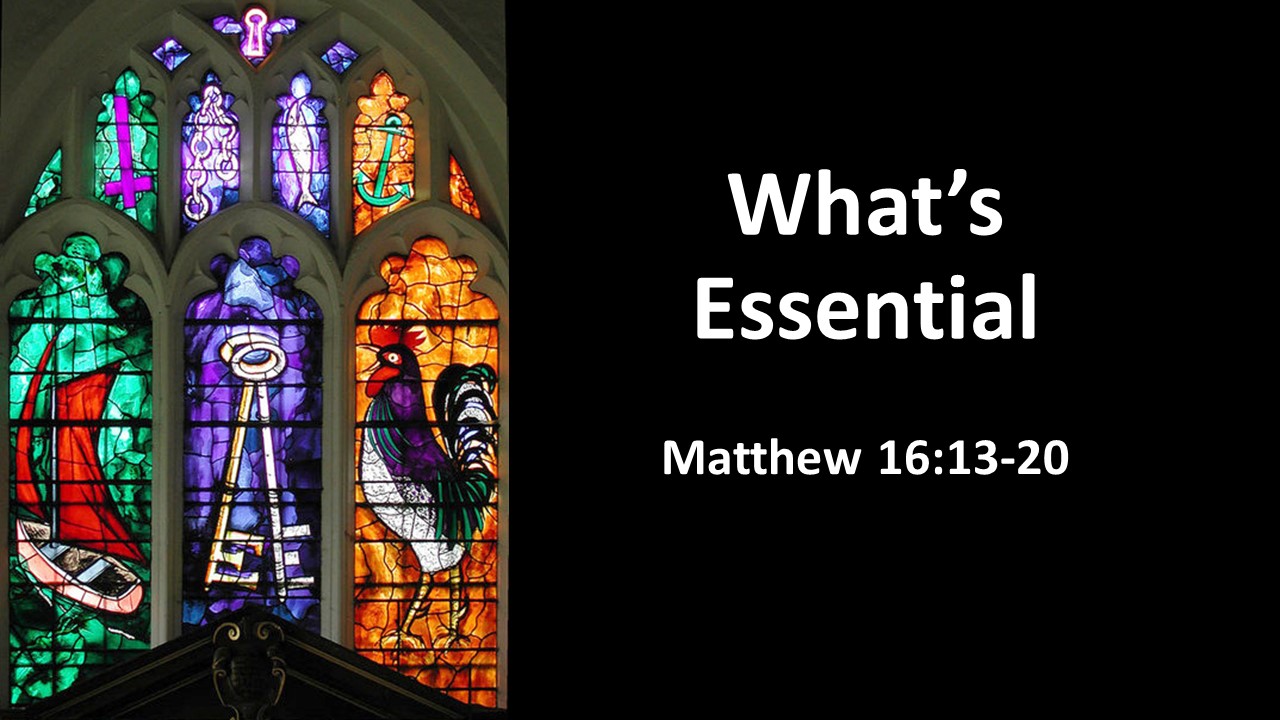
Matthew 16:13-20
August 23, 2020
Click here for the worship service. Advance to 15:30 to begin watching the scripture and the sermon.
At the Beginning of Worship
What does it take for us to be true to our calling as Christians? What are the most important activities that makes us a church? There are two, which are outlined in the second half of the 16th chapter of Matthew’s gospel: confessing Jesus as the Messiah and following Jesus, even to the cross. At times like this when society is semi-closed due to the pandemic, these two essentials remain. Are we still doing them? Today, is my first sermon from this part of Matthew 16, and we’ll look at the first requirement, confessing Jesus as the Messiah.
The Message (after reading Matthew 16:13-20)
After a long illness, a woman died and arrived at the Gates of Heaven. “How do I get in?” she asked.
“You have to spell a word”, Saint Peter told her.
“Which word?”
“Love.”
“L-O-V-E,” the woman spelled out and the gate swung open and she entered.
About three years later, Saint Peter needed a day off and asked the woman to watch the Gates of Heaven for him. Guarding the gate, she was shocked when her husband arrived. “How have you been,” she asked.
“Oh, I’ve been doing pretty well since you died,” he said. “I married the beautiful young nurse who took care of you while you were ill. And then I won the lottery. I sold the little house we lived in and bought a big mansion. My wife and I traveled all around the world. We were on vacation and I went water skiing today. I fell, the ski hit my head, and here I am. How do I get in?”
“You just have to spell a word”, she said.
“What’s the word?” he asked.
“Czechoslovakia.”
You may be wondering what this has to do with our text today. Well, there’s a weak link. You see, the idea of Peter being heaven’s gatekeeper comes from this passage, where he’s presented the keys and given the power to open doors. These jokes have been told for a long time. One source suggests that St. Peter at the gate jokes have been around since the 14th century and were originally used to tempt monks to break their vows of silence.[1] Although their context comes from our morning passage in Matthew, we have to realize that the jokes have little relevance into how one is admitted into heaven.
Let me tell another. A devout Presbyterian woman arrived at the Pearly Gate. Peter asked her why she should be admitted and she acknowledged that she really didn’t deserve being let into heaven, but that God was gracious and had ordained her for salvation in Jesus Christ. She staked her future on that promise. Peter nodded affirming. As the swung the gate open, the woman brought out a casserole. “Just in case grace wasn’t enough,” she said, offering it to Peter.” We like to hedge our bets, don’t we?
Now, let me assure you, getting into heaven isn’t what this passage is about. This passage is about who is Jesus. Jesus and the disciples have been together for sometime at this point. They’ve travelled together, teaching and healing and taking care of people and proclaiming the kingdom. Its only now, after they’ve extensively invested themselves into this man named Jesus, that he forces them to deal with his identity.
The setting for today’s passage is in the region of Caesarea Philippi. You are probably wondering what that has to do with anything. It’s important! This city was on Israel’s northwestern border. Before Jesus’ birth, Herod the Great built a magnificent marble temple there in honor of Caesar. His son, Philip, enlarged the city and renamed it Caesarea in honor of Caesar Augustus. But there were other Caesareas around, such as the one over on the coast. Philip, a politician, liked to see his name in print, so the city became known as Caesarea Philippi. It honored both Caesar and Philip.[2] This is the important part. It’s here, in this city devoted to the worship of the Emperor, that Jesus asks the disciple who they think he is. Deep down, there is a political statement being made here. If Caesar is Lord, then who is Jesus? Or vice versa. It’s interesting, that while Jesus took the disciples into pagan lands, from what we know, he never said anything derogatory about the paganism. We should learn from him. But by focusing on his identity and mission at a place where Caesar was worshipped as God on earth, Jesus challenges earthly powers.[3]
Jesus first asks the disciples what people are saying about him. “Oh, some people think you’re John the Baptist, raised from the grave, or Elijah, or Jeremiah, or one of the other prophets.” This first question was a teaser, for then Jesus goes to the heart of the matter. He asks a question we must all answer, “But who do you say that I am?”
Ultimately, it all comes down to this question, doesn’t it? I can see why people believed Jesus to be a prophet, for he had done great things. Most people like Jesus, even those who are outside the church. He’s known as a good and kind man who was a good teacher. I recently had someone tell me that she doesn’t consider herself a Christian anymore, but she loves Jesus. I wasn’t sure what to make of that. The book They Like Jesus But Not the Church, points out how most people in our country like Jesus and how the church is often a barrier from people getting to know Jesus better. That hurts, but some churches are so overzealous with a desire to save (which is the Spirit’s work, not ours), that all they do is to encourage people to accept Jesus when people don’t even know who they’re talking about. Jesus has invested a significant portion of his time with the disciples before he hits them with this question, “Who do you say that I am?” Likewise, we need to invest time discovering who Jesus is and talking to others about who he is before we try to encourage them to join up and become a follower of the Savior. We plant the seed, God brings about the harvest.
When Jesus asks the disciples who they say he is, Peter responds: “You are the Messiah, the Son of the Living God.” Peter nails it. This is no weak response. There are no qualifying phrases. He doesn’t say, I think you’re the Messiah,” or “You appear to be the Messiah.” Peter is direct and his confession is the foundation of the church. “Jesus is the Messiah!” Peter is staking out what he believes, even though as we will see next week, he doesn’t really understand the implications of what he has said. But that’s okay, for as Jesus informs us, Peter wasn’t speaking on his own; his confession is coming from God. Then Jesus called Peter the son of Jonah, which is an interesting and paradoxical reference. First, Peter caught fish, a big fish caught Jonah. In addition, Jonah isn’t exactly a model for he ran from God, just as Peter ran after Jesus’ arrest. Another and maybe a more important parallel is that Jonah was a prophet to Gentiles, and that’s the direction the church will take under Peter’s leadership.
Peter is important. Jesus says, “You are a rock and on this rock I will build MY church.” There has been plenty of controversy over this passage. The Roman Catholic Church sees it as the beginning of papal succession, that the rock refers to Peter as the pope. We Protestants question this idea. Yes, Peter plays an important role in the establishment of the church, but the church leadership throughout history isn’t from Peter as an individual, but is invested within the body of the church.[4]
More importantly than the rock concept is the emphasis that Jesus places on “my church.” It’s clear, the church doesn’t belong to Peter or to the disciples as a whole, nor does it belong to us. The church belongs to Jesus Christ. He’s the one who gives the church life and its power. Certainly, as a body we can do great things. We’ve even been given the keys to the kingdom![5] But our abilities aren’t due to who we are, but to whom we worship. Even death cannot stop the church, which is the meaning of the “gates of hell or Hades shall not prevail.” In Jesus’ day, Hades was a place for the dead, but death has no power which Jesus will demonstrate with the resurrection. The church is to have one focus: Jesus Christ. It’s his name we lift up in praise, it’s his example we lift up as a model for our lives, it’s his power we rely upon when we don’t have the strength to do what we need to be doing. We depend upon Jesus.
While we are totally dependent on Jesus, we are still valuable and endowed with responsibility. The church is given great power, including the power to loosen or bind sins, or the power to forgive sins and to withhold forgiveness.[6] That’s an awesome power. We should accept it with humble reverence for Jesus doesn’t give it for us to use for our sake or to abuse for our benefit, but for us to use to help others become more Christ-like.
Our passage ends with Jesus telling the disciples to keep a secret about his identity. We may find this strange. Wouldn’t Jesus want everyone to know? Certainly, when we get to the end of Matthew’s gospel, Jesus sends out the disciples to all nations with the command to baptize and to make more disciples.[7] That commandment, known as the Great Commission, is for all believers. But here, before the resurrection, we must guess as to why Jesus wants the disciples to keep this secret. Perhaps it is because he knows that they do not yet fully understand the implications of Peter’s confession. Maybe Jesus is afraid they’ll mix in their own incorrect ideas and political opinions and muddle the message.[8] We don’t know for sure why Jesus wants them to be quiet at this point, but certainly, after the resurrection, Jesus is forceful in his command that we go out into the world and share his love.
Now it’s back to us? Who do we say Jesus is? Our first goal, as a follower of this man from Galilee, is to understand him. As I pointed out earlier, Jesus didn’t spring this question on the disciples the first day they were together. The disciples have spent a significant amount of time with him, maybe nearly three years at this point. To be able to answer that question, we must pick up this book (the Bible) and read about him. We must study the gospels. We must take our questions to him in prayer. And as we come to know him more fully, we need to begin to question our lives and see where we fail to live to his standard, and to be honest to Jesus in prayer as we repent. And finally, as we learn more about him, we need to share our knowledge with others, so that they too may know him.
You know, in this time with things slowed down because of the pandemic, now is a perfect time to work on your relationship with Jesus. Read one (or all) of the gospels. Write down for yourself your questions and who you think Jesus is and what he means to you. Having such a foundation will help you articulate your faith when it’s important. It’s a good investment in your eternal future. After all, what are you going to say to St. Peter at the Pearly Gates? Being prepared is better than bringing along a casserole. Amen.
©2020
[1] In searching for jokes, I came across this sermon which had the jokes I’ve used (I’ve altered them a bit) along with the suggestion as for the jokes origin: http://geoffreythebold.blogspot.com/2005/09/fabled-pearly-gates-joke.html
[2] John Kutsko, “Caesarea Philippi,” Anchor Bible Dictionary Vol. 1 A-C, David Noel Freedman, editor (New York: Doubleday, 1992), 803.
[3] To learn more about the political reference here and why Caesarea Philippi matters, she Scott Hoezee’s take on this passage: https://cep.calvinseminary.edu/sermon-starters/proper-16a-2/?type=the_lectionary_gospel
[4] Bruner, 127-130 and 135-137 and Douglas Hare, Matthew: Interpretation, a commentary for preaching and teaching (Louisville: John Knox Press, 1993), 191. Bruner, in an in-depth discussion on Peter’s role later in his commentary quotes another commentator who tries to bridge the “hyper-Catholic” and “hyper-Protestant views of Peter and summarizes him as “a man with a unique role in salvation-history… his faith is the mans by which God brings a new people into being.” Bruner, 137.
[5] Although in this passage, Jesus refers to Peter as the one with the keys and the ability to bind and loosen, later in Matthew’s gospel he speaks of all the disciples (and the church) being given this power. See Matthew 18:18.
[6] Historically, the words “loosen” and “bind” have been understood in two ways. Doctrinally, they refer to the ability to loosen (or open) through teaching the way of Jesus and their binding is a warning of the consequences of not hearing and abiding in the word. Secondly, these words have a disciplinary meaning. The church has the right to bind disobedient believers, and to loosen the bindings of those who are repentant. Bruner, 132.
[7] Matthew 28:19.
[8] Burner, 137-138, makes this point.
 David Lee, Mine Tailings (Boulder, UT: Five Sisters Press, 2019), 79 pages.






 James H. Cone, (Marynoll, NY: Orbis Books, 2011), 202 pages including notes and an index.
 Jeff Garrison
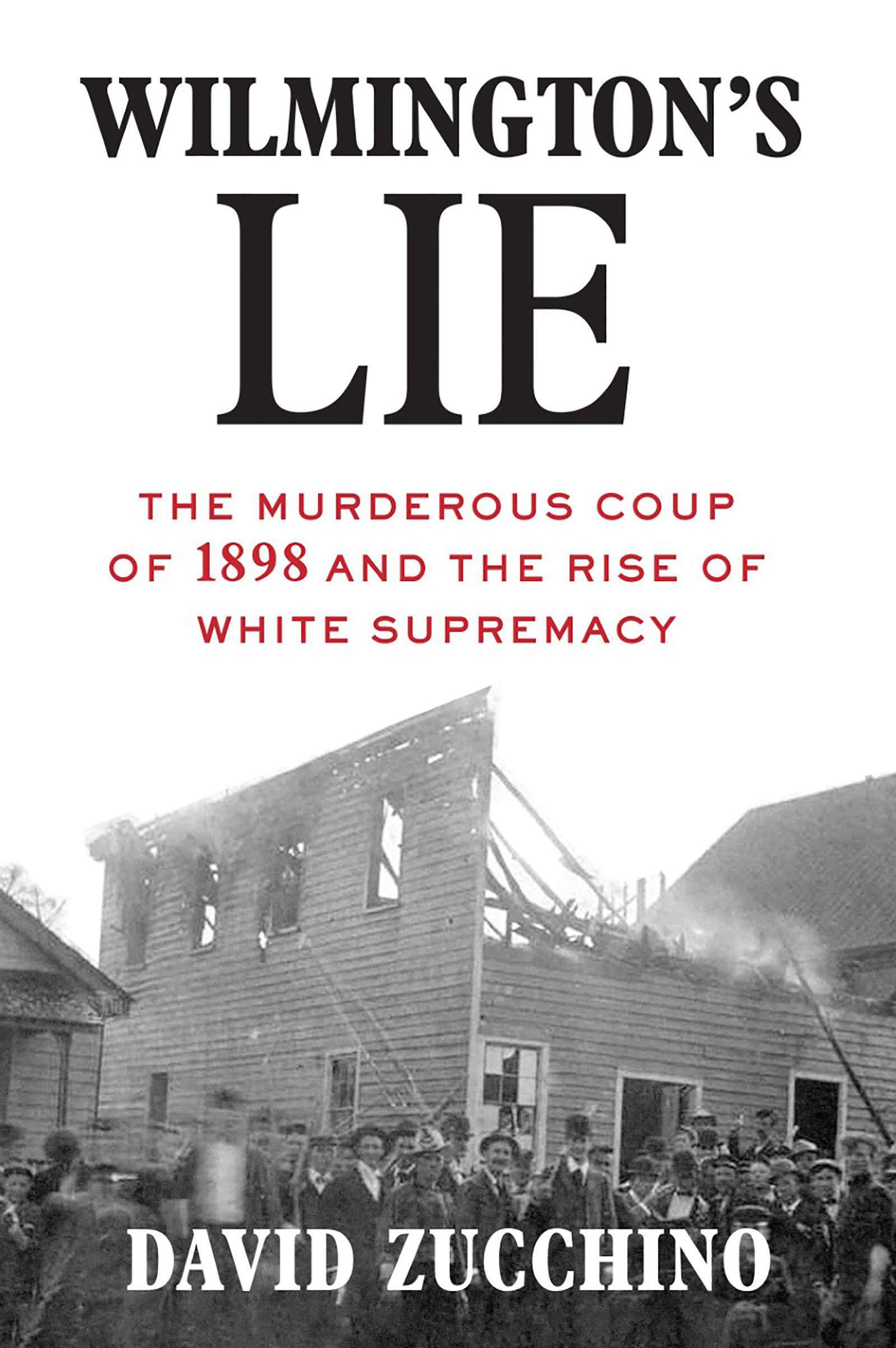 David Zucchino, Wilmington’s Lie: The Murderous Coup of 1898 and the Rise of White Supremacy (New York: Atlantic Monthly Press, 2020), 426 pages including notes, bibliography, and index along with 12 additional pages of prints.
 Jeff Garrison