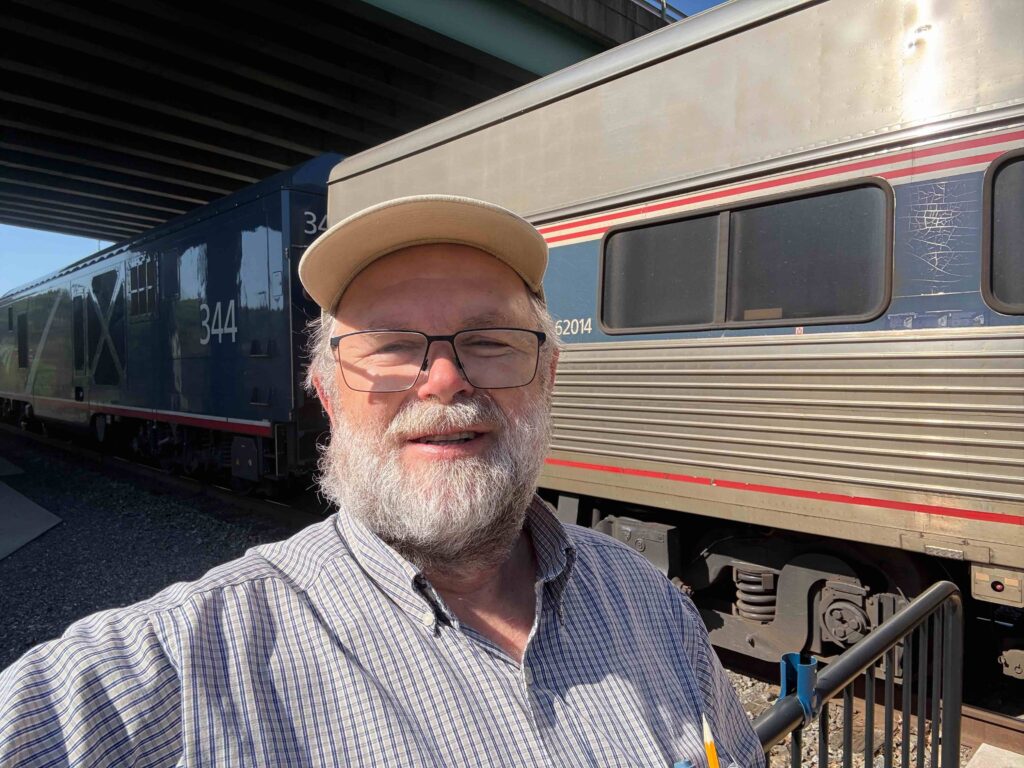
On Tuesday morning, April 14, after filing an extension for my taxes, I boarded the northbound Crescent, in Danville, Virginia. At Union Station in Washington, DC, I had long enough a break to eat before catching another train bound for Chicago. My destination was South Bend, Indiana, a city I arrived in a little before 8 AM on Wednesday. I had planned to get a sleeper. When I first looked at this trip, I could have done each leg for about 400 dollars, but after the debacle of airlines and unpaid TSA agents, train travel became more popular. Two weeks later the cost for a sleeper on each leg jumped to 900 dollars (over $1800 total) and I decided I could travel coach.
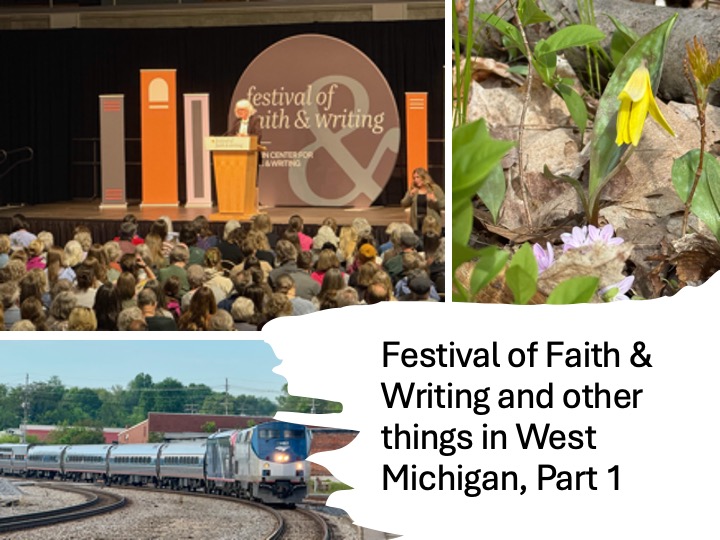
I have attended the Festival of Faith and Writing many times. It’s held every even year and Calvin brings in around 60 authors. They don’t have to be Christian, although most are. The one requirement is that the authors write seriously about faith. As with the other years, this year didn’t disappoint. As before, there those authors I wanted to hear and meet. In addition, there were other authors I didn’t know, whom I heard and are now interested in reading their works.
The festival opened with its first plenary speaker, Laurie Halse Anderson, who writes historical fiction for young adults. I was not familiar with her work, but she has won the Nobel Prize in Children’s literature. She has written some interesting books around the American Revolution. Her success, she credits, is with doing the research of a non-fiction writer to assure her stories are factual. She also focuses on the “ordinary.” Instead of writing about Washington or Franklin, she tries to bring in the common people, especially women, children, and minorities. Through their eyes, she shows how they perceive the events of the day. She also talked about how writing one book leads to another. Having written about the Revolutionary War, she became interested in a Yellow Fever epidemic in Philadelphia a few years later, which resulted in Fever 1793. I plan to read that book.
In addition to four plenary speakers, the Festival offers numerous concurrent sessions throughout the three-day period. The first afternoon, I attended a conversation by two young adult writers (Kate Albus and Dana VanderLugt) discussing the craft of writing fiction and how it can be used to draw younger readers into the past.
Next, I attended a presentation by Carrie Fountain titled “About a Million Blessings a Day.” Fountain is a poet who sets out every morning to write a poem. She acknowledges, most are not very good, but she feels the need to get something on paper and overtime has a collection of material with which to work. I enjoyed listening to the poems she recited and came away with an autographed copy of her book of poetry, The Life. Fountain charmed me by asking where I was from when I was having her book signed. She then complementing me on the sound of my voice. The next day a guy I was talking to during a break stopped me in mid-sentence to ask if I read Audible books. I thought he meant listening and I said I generally have one going all the time. Then he said, I don’t mean listening, I mean reading, you have the ideal voice. I laughed and said it would be ideal until I butchered the punctuation of some word.
That night, the plenary speaker was Robin Wall Kimmer. The title of her talk “The Serviceberry: Abundance and Reciprocity in the Natural World” is also the title of her latest book which I read and reviewed (link above) in January. Of all those authors in attendance, Kimmerer was the one I really wanted to hear. She’s both a scientist and a Native American and draws on both in her books, of which I have read all three. I read Gathering Moss in 2021 and Braiding Sweetgrass (her most popular) in 2024. While Kimmerer titled her talk after her book, it wasn’t a recap of writing. Instead, she presented a thesis around what the writer can do to help heal the world. Her first rule: always begin with gratitude. She encourages writers to help people know their place on earth. For nature writers, she suggests we celebrate the living world, foster kinship, incite wonder, inform, sound the alarm on danger to the planet, seek justice, and defend wild places. She also peppered her talk with startling statistics such as the average American child can identity only 10 plants but knows around 100 cooperate logos.
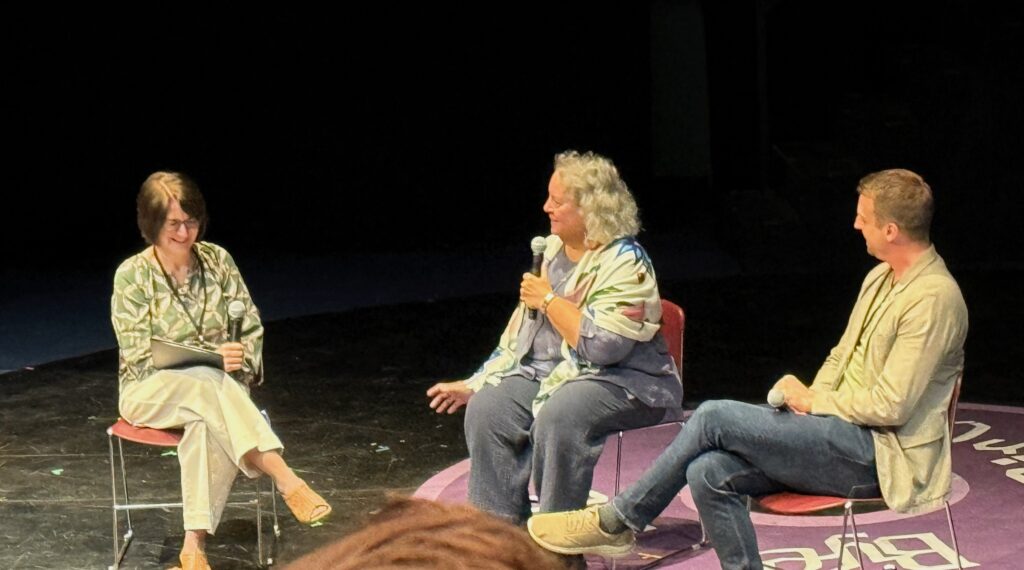
Kimmerer also spoke of the danger of linguistic materialism, moral exclusion, and how the colonial experiences around the world have damaged native languages which were more earth based. Of all the presenters over the three days, I took far more notes (4 whole pages) on Kimmerer’s talk. Most other talks I only took a single page of notes. After her talk, I checked into my hotel and then walked over to a nearby Olive Garden where I had dinner with a former colleague. MaryMartha served with me when I was the pastor in Hastings (2004-2014), serving as the church’s adult ministry coordinator. Several years ago, when her husband Larry began to decline in health, they moved to a continuing care center on the southside of Grand Rapids. Larry has since died. I enjoyed our late dinner and talk, but was ready to crash when I got back into my room.
To read Part 2, click here.
(look for part 2 in a couple weeks)
I don’t know any of the speakers/authors you mentioned this time. I’ve listened to enough audiobooks now that I feel a narrator can make or break a book for me. It has to be the right accent/voice for the right book. I usually read your sermons rather than watching your videos, so I don’t know your voice well enough to know how I’d feel about you narrating …. other than it would need to be a southern book! I’ve heard enough to know I like your accent!
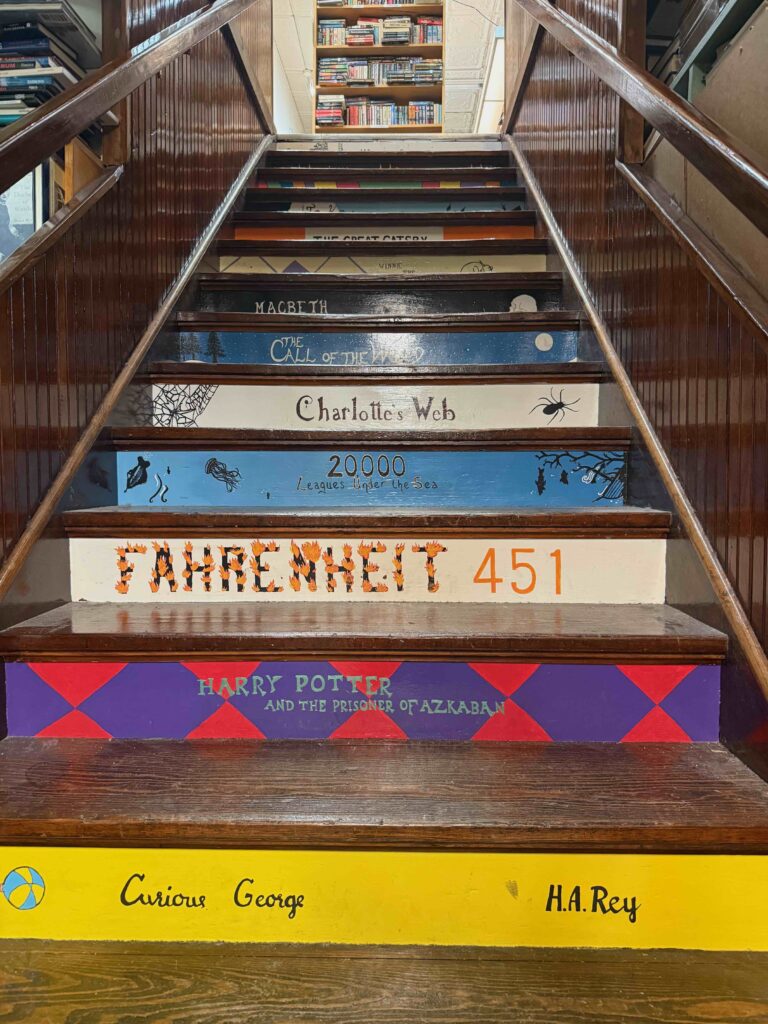
Great steps in the bookstore!
I was totally taken back by the suggestion that I should be a narrator of books. And, while I also listen to a lot of book on audio, I can’t imagine sitting in a sound booth reading. I think that would be akin to spending time in hell.
Hello Jeff, what an interesting read, your travels and thoughts and the experiences you have are such a delight to read, and yes especially when you mention places in Michigan where I grew up, and my father’s cousin and his with and child lived in Kalamazoo. The storms do seem to be getting worse in places these days, because I remember my winters there being so much gentler than say here in Minnesota! Enjoy your week ahead and full spring for us all!
Thanks for stopping by, Karen. I was shocked to see that tornado damage (and to know I was on a train when it happened). Michigan’s winters were gentler because the lake moderates the temperatures. The last winter I lived in Michigan, the lakes almost all froze and we got a lot of negative temperature readings and went a week with temperatures not making it into double digits.
It’s been too long since I’ve gone to a good conference, Jeff! It sounds like you had a great time. The picture of you looks great. Have a good week!
The picture looks okay but I’m amazed at how much whiter my beard has become since that portrait was painted!
Reading is an obsession too, and I’m glad you do so much of both!! I enjoy your stories, Jeff.
Also, I bet I’d like the wing shack and the bookstore.
That bookstore is amazing! And the wing shack was good, but I didn’t eat wings, but had a burger.
Thanks, Judy.
Love your archives and your writing…..✍️. Enjoy reading your journal of life.
Thanks, Gary, for following along.
I love a great bookstore. Nice picture of you.
Thanks. This is am amazing bookstore that I have visited a few times when I was living in Michigan.
So much in this post sparked my interest, Jeff. The train from DC to South Bend. I would love to take that. My kids live around DC, my sis in Marion IN. That could work… No problems traveling alone?
The speaker at your conference–not sure what linguistic materialism is, but I like language topics. I’d like to read more about colonial experiences around the world that have damaged earth-based native languages. Not sure what that means, would like to unpack it. Suggestions for an introduction?
I need to go back and look at my notes on what she said about linguistic materialism. The colonial destruction of native cultures (including languages) can be found in a lot of places. Native languages (like Hebrew) are more earth-focused.
The train is a nice ride, probably nicer going from Chicago to DC because you go through the mountains in the daytime. Much of this line parallels the bike trail my brother and I rode last May. https://fromarockyhillside.com/2025/05/22/pittsburgh-to-washington-bicycle-ride-part-1/
Writting is a great hobby 🙂
It is and can be more than a hobby–maybe an obsession.