
Order of the Arrow Tap Out

Order of the Arrow tappet
Camp Tom Upchurch patch

Wednesday night campfire at Camp Tom Upchurch in Hope Mills was the highlight of the week. Families gathered with their scouts. On this night, my grandparents had driven over from Pinehurst, which was a lot closer than my parents coming up from Wilmington. Grandma brought a picnic dinner consisting of fried chicken, rolls, potato salad, fresh tomatoes, deviled eggs, and a jug of ice tea. We all devoured the food which was a welcome relief from that they served in the dining hall.

About an hour before dark, a bugle called us to the campfire circle. We sat on wooden benches, the scouts in front, each troop sitting together, with family members sitting behind. The campfire circle was really a semi-circle which faced the lake, with two fire pits between the benches and the water. The air was still, warm and humid, when we arrived. Mosquitoes buzzed and, in the distance, we could hear the roll of thunder. Or maybe it was artillery from Fort Bragg, which wasn’t far away. Be prepared was our motto and we all carried ponchos and had doused ourselves with some deet-ladened insect repellant. 

As soon as everyone found a seat, a staff member dressed as an Indian warrior from the Plains called down the fire. Arrows flew into each pit, igniting the wood. It seemed a miracle, but it really as the church camp song goes, “it only takes a spark to get a fire going.”  This is especially true when the wood has been soaked with some kind of petroleum products. With the fires burned brightly as we sang songs, watched corny skits and listened to stories. As the light drained from the sky, a chorus of frogs threatened to drown us out. When it was finally dark, the mood became somber, and we sang the song of the voyageurs. 

Our paddles keen and bright, flashing like silver; swift as the wild goose flight, dip, dip, and swing.
Dip, dip, and swing them back, flashing like silver; swift as the wild goose flight, dip, dip and swing.

Repeatedly, we sang the song, each time softer. Soon, we whispered the words and could hear fish jump in lily pads near the water’s edge. We started another round and then he appeared. In the middle of the lake the chief stood in a canoe, his arms folded across his chest, a full bonnet of feathers surrounding his head and hanging down his back. A lantern sitting in the bottom of the canoe illuminated him as two other scouts, dressed as braves, paddled quietly. We watched in awe. The canoe beached and several other staff members, dressed as Native Americans, joined the canoe at the show to help the chief out of the boat. 

A distant drum began to beat as the warriors danced around the dying flames. Then the Chief joined in, dancing across the front and then up into the benches where he crossed back and forth in front of the sitting scouts, just inches away. We sat, entranced. When he came to me, he stopped, turned, slapped my shoulders, and then lifted me up. Before I comprehended what was happening, happening, one of the braves whisked me to the front. He had me stand by the fire, with my arms crossed over my chest. Several other scouts soon joined me. After a while, the Chief led us away as the campfire closed with the singing of the scout vespers.

Softly falls the light of day, as our campfire fades away. Silently each Scout should ask, “Have I done my daily task? Have I kept my honor bright? Can I guiltless sleep tonight? Have I done and have I dared, everything to be prepared?”

I had just been tapped out for the Order of the Arrow, the brotherhood of honored campers. That night, the Chief told us we’d been elected by our peers to be a part of this elite fellowship, but before we would be welcomed into the group, we’d have to pass an ordeal scheduled later in the summer. I was excited, yet nervous about what I’d have to endure. I’d heard about the ordeals: a night alone in the woods, a day of little food, hard work and silence.

When he told us we could go back to our troops, I set out to find my grandparents. I could tell they were proud of me. Granddaddy asked me to walk with them to their car and once we got there, I spied on the floorboard of the back seat, one each side of the drive train hump, two watermelons. Granddaddy gave me one and he took the other and we walked over to our troop site. My grandma carried a butcher knife and a saltshaker. She cut up the melons on a picnic table in the center of our campsite, sprinkled salt on them, and gave everyone a thick wedge. I sure the watermelons came from Coy McKenzie’s farm. Coy was grandma’s nephew. In addition to growing and curing some of the best bright-leaf tobacco in the county, he was well-known for his watermelon patch.

Klahican Lodge Order of the Arrow patch

Jesus’ temptations

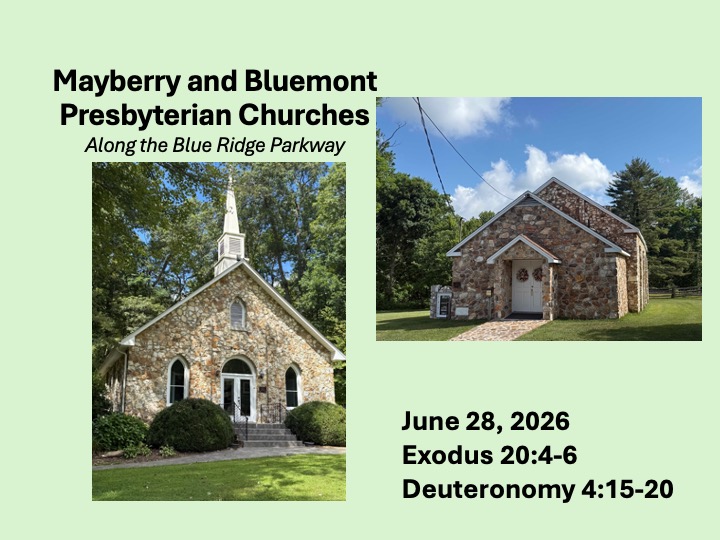
title slide with photo of two rock churches

Jeff Garrison
Mayberry & Bluemont Churches
January 18, 2026
Matthew 4:1-11

Sermon recorded at Blumont on Friday, January 16, 2026.

At the beginning of worship:
There is a story from the Jewish rabbinical tradition of a rabbi who enters his classroom one day. The students are abuzz, taking excitedly. 

“What’s up?” the rabbi asks. 

“Rabbi, we’re afraid the Evil One is pursuing us,” one of the students confessed.

“Don’t worry,” the wise old rabbi replied. “You haven’t gotten high enough yet for him to pursue you. For the time being, you’re still pursuing him.”[1]

It may that way for us. As humans, we don’t need the Devil to encourage us to stray. We do it enough on our own. We try to use the Devil as a scapegoat, as Flip Wilson used to say, “The Devil made me do it.” But don’t forget, we’re still responsible! 

Before reading the Scripture:

Last week we learned about Jesus’ baptism. Those around Jesus heard that voice from the Father, “This is my Son with whom I am well pleased.” But before Jesus can begin his ministry, the Spirit which descended upon Jesus at baptism, leads him into the wilderness for a time of preparation and testing. However, the testing isn’t done by the Spirit, but by the Devil. 

This is a difficult passage to apply to our lives. While Jesus is tested as a human being, he’s not like the students in the rabbi’s class. He knows his position and his purpose. The Devil also knows Jesus’ identity. The tests Jesus faces are on a different level that those we face. In a manner, these tests help clarify the meaning of Jesus’ baptism and him being the beloved of God the Father.[2] Yet, from Jesus’ tests, we can learn.

Let me say something about temptation. The devil is the great deceiver. The word comes from the verb “to split off.”[3] The Devil tries to split us off from God by deception. Again, we’re still responsible. Thankfully, there is also forgiveness. 

We also will learn something about Scripture from this passage. We’ll see that even the devil can quote scripture. It’s not enough for us to cite scripture. Used improperly, God’s word result in evil. This passage stands as a warning. Quoting a bible verse or two doesn’t make us a saint. We must be able to place it in context of the entirety of scripture. 

Read Matthew 4:1-11

Holy things fill our passage.[4] Bread, the staff of life, we use in worship during communion. Throughout Scripture, the sharing of bread is a sign of hospitality. The temple in Jerusalem is a place where for centuries the Hebrew people gathered to worship God. And then we have a mountain peak which provides view over much of the earth. All these things are good, when used in the right manner. But we can also employ good things in the wrong way. 

In Jesus’ temptation, we witness the pious tempted. Even the people who strive to lead holy lives face temptation. No one gets a free pass, whether the Son of God, or poor sinners like all the rest of us. But our text implies the higher up the ladder we go, the more temptation we face. Or, at least, our temptations may become more sophisticated.  

Considering this text, should we be surprised so many religious leaders, especially those in positions of power and prestige, fall from grace? When we think we are important, it’s easy to lose our humility. Then, we find ourselves in a dangerous situation. When we think we’re so important that God needs us or that God will protect us regardless, along comes Satan suggesting, “Go ahead, let’s see.”

Power and prestige are always a double-edged sword. If used properly, they can be the source of great good for others. But if used only for our benefit, they become the source of our downfall. At one time, we drilled phrases like “Pride cometh before the fall,” into the minds of young students. But such truths are seldom heard today. 

Instead, we try to instill pride in our children. And while there is nothing wrong with pride in the right things, we must reclaim humility as an important Christian trait. For pride can also have negative repercussions. 

Excess pride causes us to think too much of ourselves. Examples abound: top athletics desiring to be best, and experiment with performance enhancing drugs. Politicians slipping into the belief only their ideas are right and will do anything to achieve them. Soon, they abuse their positions and act as if the law doesn’t apply to them. Business leaders driven to be successful become less than honest and end up cheating their customers, employees, and shareholders. Temptations abound.

Let’s consider Jesus’ temptations. The first sounds harmless enough. Jesus hasn’t eaten in 40 days, so he’s famished. As God, he has the power to turn stones into bread. And Jesus’ stomach growls with hunger. The Devil hits Jesus where he’s weak. But to lean upon his divine power would diminish the power of Jesus being God in the flesh. So, he refuses and reminds the Devil that to sustain life, we need more than bread. 


Next, we’re taken to the temple. Here, Jesus could put on a fantastic display, throwing himself off the tall spire and have angels save him before he crashes onto the stone pavement. Just think about it; everyone who watches will be amazed and ready to sign up as a disciple. Here, the Devil hits Jesus with an idea to jumpstart his ministry. 

The Devil challenges Jesus with his belief in Scripture. He says essentially, “Jesus, right here in Psalm 91, it says angels wait to catch you. Do you believe this?” But our faith isn’t about putting on a show. It’s about remaining faithful to God. Again, Jesus denounces the Devil by quoting scripture to refute the devil’s scripture. We’re not to test God.

The final temptation has Jesus high on a mountain where Jesus can observe all the kingdoms of the earth. “It’s all yours,” the Devil says, “if only you worship me.” Of course, we might question if the Devil really has the right to give the world. Or is he trying to sell the Brooklyn Bridge to the unaware? Regardless, Jesus, had enough, and tells Satan to take a hike. 

In time, Jesus will claim the world as his own, but he wants his subjects to willfully accept him, not to force obedience. Jesus won’t worship anything other than the God the Father. Nor should we.

What might we learn from this passage which we can apply to our lives?  Let me suggest three take aways: concerning scripture, manipulating God, and forgiveness. 

In his book, Life Together, Dietrich Bonhoeffer discusses how we’re to live within a Christian community. When discussing scripture, Bonhoeffer notes how many people only focus on a handful of verses and how this habit shouldn’t replace the reading of scriptures. He writes:

The verse for the day is still not the Holy Scriptures which will remain throughout all time until the Last Day. Holy Scripture is more than a watchword. It is more than “light for today.” It is God’s revealed Word for all times. Holy Scripture does not consist of individual passages; it is a unit and is intended to be used as such.[5]

Scripture is important, but as the Devil shows, if we pick and choose verses to suit our needs, we may very well misuse God’s word. We must approach Scripture with the right attitude. We must also draw on the entirety of God’s word, not just those verses which further our own ideas or suggest that our wants are in line with God’s will. 

As Jesus shows in his rejecting of the Devil’s ideas, we should not attempt to force God to act in a particular way. Although many of us try, we can’t manipulate God. Instead, we should be thankful for what God does and ask from God only what we really need. And we should trust that God the Father wants the best for us, as we see at the end of the passage when angels nurse Jesus.

Along the same vein, we should avoid making a spectacle out of our faith. Being showy or flashy is not godly. God wants us humble and gracious, not flashy and obnoxious. Our words should be soft and faithful, not loud and showy. 

My third point focuses on forgiveness. While we should strive to be like Jesus, we also know we’re not perfect. Jesus withstood temptation, but we won’t always do that. As Paul says, “all have sinned and fallen short of God’s glory.”[6] When we fail and succumb to temptation, instead of beating ourselves up, we should be like the Prodigal son, running home to his father confessing his sins.[7] We should run to God the Father, confess our sins, and trust in God’s grace as displayed in Jesus Christ.

While few of us would pass the test Jesus endured, all of us are loved and through Christ, if we repent, are worthy of forgiveness. When it comes to temptation, the final word isn’t endurance, but forgiveness. Amen. 


[1] Slightly modified from the Crassid and found in Soul Food: Stories to Nourish the Spirit and the Heart,” Jack Kornfield and Christina Feldman, editors (San Francisco: HarpersSanFrancisco, 1991), 239. 

[2] Douglas R. A. Hare, Matthew: Interpretation, A Biblical Commentary for Teaching and Preaching (Louisville, KY: John Knox Press, 1993), 23. 

[3] Frederick Dale Bruner, The Christbook: Matthew 1-12 (1992, Grand Rapids, MI: Eerdmans, 2004),119.

[4] Bruner, 128.

[5] Dietrich Bonhoeffer, Life Together: A Discussion of Christian Fellowship (New York: Harper & Row, 1954), 50-51. 

[6] Romans 3:23. See also Romans 3:9-12. 

[7] Luke 15:11-32, especially verses 17-18.

Memories of a Foster Daddy

photo of young girl and one of her and her foster dad.

I started reading Frances Liardet’s novel, We Must Be Brave, this week. It’s about a woman who falls in love with a lost girl whom she cares for during the chaos following the German bombing of Southampton, England during World War 2. The story reminded me of something I experienced and wrote about over 30 years ago, before our other kids came along. At the time, I had the article approved by the social worker, making sure I wasn’t breaking any rules or leaking confidential information,, then submitted it for publication. A magazine accepted the piece for publication, but then they closed down the presses before it was published. So, it sat in my files. This evening I dusted it off and presented it here.

MEMORIES OF A FOSTER DADDY

photo of Becky
Becky, photos are copies (this was before digital)

The first of September 1994, one of the saddest days of my life. 

I waved good-bye to Becky for the final time as the social worker’s car backed down our driveway. But the sadness didn’t take away the joy of the previous six months as I experienced how precious life seen through the eyes of a toddler can be. Becky taught me the importance for adults to spend time with children, caring for them and helping them to discover the world. From Becky, I learned a lesson which everyone needs to experience firsthand. Children need responsible adults in their lives and, as adults, we need children in our lives if we are to experience life to its fullness. Perhaps that is why Jesus was so insistent on the disciples allowing children to come to him (Mark 10:13).

Becky was just a little over a year old when she came to live with us. At first, she seemed so small and fragile. The previous month, she lived in a shelter for children and came complete with a cold. She struggled to go to sleep in a strange place while hacking and coughing. My wife and I took turns holding her, patting her back and saying, “it’s okay,” while praying she would eventually fall asleep. After regaining her health, Becky still had a hard time going to bed. Only then, it had to do with her fear of missing out on something exciting. She was at the age where she wanted to experience all that life had to offer.

Church was a new experience for Becky. On that first Sunday, she seemed stunned to hear my voice from the pulpit and started to run down the aisle. My wife caught her after a couple of steps, and we introduced our foster child to the congregation. Becky came with only a few clothes, mostly worn hand-me-downs. Before her first church service, my wife brought her a lacy pink dress. Becky looked stunning in that dress and she knew it. After worship, she came to me expecting to be held. Acting shy, with her arms tightly hugging my neck, she charmed everyone during fellowship hour.  Soon, however, she lost her shyness and became the terror of the fellowship hour, running around like a wild cookie monster. No one seemed to mind, everyone loved her.

During our time together, Becky and I developed a special relationship. She would get up in the mornings with me, and we would eat oatmeal together.

This was so long ago I was skinny and had hair!

On the days my wife had to work, I would take her to church with me. Even though the nursery with all its neat toys was next to my study, Becky would insist on playing with my books. She would take them off the shelf, rearrange them on the floor, and then put them back in another location.  Sometimes she would demand that I read to her.  I think she found Augustine as boring as I once did. At other times, I would take Becky visiting. I know my parishioners were glad to see us coming, and I’m sure they were just as glad to see us go. Having an energetic toddler along assured me that a short pastoral visit wouldn’t take up the whole afternoon.

In a way Becky became my guardian angel. Taking the suggestion of Family Services, we didn’t teach Becky to refer to us as mother and father. Instead, we allowed it to happen naturally, and Becky quickly took to calling me “da-da.” Becky showed concern for her daddy when my wife dropped me off on a backroad for an overnight backpacking trip. According to my wife, when Becky realized I was not in the car, she panicked and cried “ah-da-da” all the way home. In addition to looking out for me, I found myself looking forward to coming home early so that I could spend time playing with her. Having her around made life less stressful.

at the table

From the beginning, my wife and I made it a point to include Becky in our prayers at mealtime. With her sitting in a highchair between us, we would each take one of her hands and say grace. At first, Becky was not at all cooperative with what must have seemed to her a strange ritual. Instead, she was ready to eat as soon as her food was placed on her plate. Having just come from a children’s shelter, Becky learned not to wait too long when food was available and would stuff herself with whatever placed in front of her.

However, as the months passed, Becky calmed down at the table. She waited for us to sit down while holding out her hands in anticipation of the prayer. Before she left, she had added to word “amen” to her vocabulary and would boldly proclaim it at the end of the prayer.

Although Becky was a foster child, we held out hope that we would be able to adopt her. Becky’s case worker assured us it was unlikely she would be allowed to return to her original family.  Our dreams were shattered when another family member decided to accept custody. We were given two weeks notice, two weeks to say goodbye to her and our dreams, before the social worker moved Becky to her new home.

Running in the backyard

On our last full day together, we took a picnic and went up onto Cedar Mountain. Becky seemed so happy. No longer a fragile sickly little child, she had blossomed into a healthy toddler. She ran around enthusiastically, only to occasionally stop and examine nature. While on that picnic, Becky collected several rocks and sticks and gave them to me for safe keeping. I still have those mementoes, in a small glass case, as a reminder of what a small child considers special in our world.

During the final week of Becky’s stay, I found myself drawn to the passage of her namesake in the Bible. I read and re-read the story of Rebecca in Genesis. I came to understand Rebecca had done all she could to prepare Isaac for life, but in the end, she had to let him go. With Esau out to kill Isaac, Rebecca could no longer protect him. Isaac fled and as far as we know Rebecca never again looked into the eyes of the son she loved so much. It suddenly dawned on me the pain that she must have felt, and the pain that parents everywhere feel when they lose a child.

The Apostle Paul reminds us of how some plant, and others water, but God gives the growth (1 Corinthians 3:6-9). In a way, my wife and I had an opportunity to water and nurture Becky. We cared for her, loved her, and allowed her to love us. But Becky didn’t belong to us, and in the end, we had to let go. We could only pray and trust God, the one who gives the growth, to watch over her.

A few weeks before Becky left us, a fierce thunderstorm in the middle of the night woke her up. I went into her room, picked her up out of the bed and held her. She quickly calmed down. With the thunder rumbling and lightning flashing, Becky started patting me on the back, saying, “it’s okay, it’s okay.” Among other things, she learned to trust and to love.  

I still get tears in my eyes when I think about her; however, I am thankful I had the opportunity to be her daddy, even if only briefly.

Becky had a serious side. At the groundbreaking for the new church facility, Summer 1994.

Why Did Jesus Insist on Baptism?

Title slide with winter photos of two churches

Jeff Garrison
Mayberry & Bluemont Churches
January 11, 2025
Matthew 3:13-17

Sermon recorded at Mayberry on Thursday, January 8, 2026

At the beginning of worship:
John Burgess, a professor at Pittsburgh Theological Seminary, wrote a book titled, After Baptism: The Shaping of Christian Life. I like the title, which implies the Christian life begins with Baptism. This was the case with Jesus, too. His baptism signals his movement toward ministry, as we’ll see this morning. Burgess says this about baptism:

Baptism is not a Christian Nobel Prize that recognizes our outstanding contributions to God or humankind. Rather, baptism declares that God has reached out to us, before we ever knew how to reach out to him or others. This God keeps reaching out to us despite our faults and failures… 

And he goes on to say: 

God calls us “Son” or “Daughter” and invites us to call him “Abba” [Father]. The triune God is a God who comes to those who are weak and helpless, and lifts them up… Every time the church baptizes a baby, it testifies to a God who knows how to bring life out of death, strength out of weakness, and something out of nothing.[1]

With a birth certificates, our parents gave us a name. At Baptism, we’re given a new name, “Child of God.” 

Today we’ll look at Jesus’ baptism and what that means for our Christian lives. 

Before reading the Scripture:

We looked at the ministry to John the Baptist during Advent,[2] but now we return to that ministry as we explore Jesus’ baptism. All four gospels tell of Jesus’ encounter with John, but from different perspectives. 

Mark’s gospel, as we saw two years ago when I begin preaching through that gospel, has a short account of Jesus’ baptism. Luke’s account is even shorter. In both cases, baptism is a more personal event for Jesus. Jesus is only the one, in Mark and Luke, who sees the heaven’s open and hears the Father’s voice. And the word is directed to Jesus, not to others. Baptism serves as Jesus’ call to begin his ministry. John’s gospel doesn’t even cover the baptism. Instead, the Baptizer points Jesus out of a crowd as the Lamb of God who takes away the sins of the world.”[3]

In Matthew’s gospel, we hear John resist Jesus’ request for baptism. And after the baptism, when the heavens open and God the Father speaks, it’s not just to Jesus but for all to hear.  

Read Matthew 3:13-17

As I said earlier, at the time of baptism, we’re given a new name. Yes, we still have our given names and our family names, but above all that, we’re identified as a “Child of God.” Baptism has been referred to as the initiation into the church. 

Which raises the question John asks. Why does Jesus seek baptism? It’s because the God who gives us a new name in baptism is also a God who desires to be with us. Jesus illustrates this through his life, death, and resurrection. 

Our text begins just after Matthew introduces John in the opening verses of Chapter 3. As one commentator noted, John expected a Sylvester Stallone-type to be the Messiah. The Messiah would baptize with “the Holy Spirit and fire,” and divide the wheat from the chaff, storing the wheat and burning the chaff. But instead of Rambo, it’s like Mr. Rogers showed up as the Messiah.[4] We witness the humility of Jesus as he insists on being baptized by John. 

Nevertheless, John recognizes Jesus as the Messiah. He insists that instead of him baptizing Jesus, Jesus should be baptizing him.

But Jesus insists, telling John to do it as this is a “way to fulfill all righteousness.” So, John agrees. 

We’re not given any information about how or even where along the Jordan the baptism occurred. 

Interestingly, John chose the Jordan River to conduct his preaching and baptisms. This is the river Joshua crossed with the Hebrew people as they entered the Promised Land. Perhaps John even had those desiring baptism to gather on the east bank, in what had been pagan territory, and step into the middle of the stream, where they were dunked into the waters, before climbing out on the west bank.[5]

Historically, the river marked a boundary between the old and the new, between the slavery of Egypt and the freedom of the Promised Land. And with Jesus baptism, the river symbolizes the crossing of another boundary. Jesus now begins his work as the Messiah. God’s kingdom has come close and those who enter the water and who follow Jesus will enter not just the Promised Land, but in the fulfillment of time, God’s kingdom.  

Matthew tells us that when Jesus came up from the water, the skies open. He saw God’s Spirit descending like a dove and a voice from heaven saying, “This is my Son, my beloved Son, with whom I am well pleased.” A dove represents the Spirit at Jesus’ baptism. John’s not completely wrong for he earlier says the Messiah will baptize with the Spirit and fire.[6] Fire is another symbol of the Spirit.

Here, at Jesus baptism, we have a reflection of all three persons of the Trinity. The Son is baptized as the Spirit descends and the Father speaks. Also, in Matthew, this voice is given for all to hear. The Father proclaims, “This is my Son,” unlike in Mark and Luke, where the voice says, “You are my Son,” addressing only Jesus. I prefer Matthew’s telling because he captures Jesus’ larger role as the one who came to offer hope to all the world. 

From the wisemen as we saw two weeks ago, to the sending of the disciples at the at end of Matthew’s gospel, Jesus’ message extends beyond those in Israel’s historic boundaries to all the world.[7]

Now let’s go back to John’s reluctance to baptize Jesus. John had preached a baptism of repentance. When we repent of our sins, it means we turn away from sin and strive to live a better life. John invited those at this point in their lives into the waters which symbolizes the washing away of all that’s dirty. With this background, John’s reluctance makes sense. Jesus, we proclaim, remained sinless. 

Obviously, for his own life, Jesus didn’t need to be baptized. But Jesus comes in the flesh to experience the human condition and on the cross, takes on the sins of the world. By accepting baptism, Jesus identifies with us. He shows how sin should no longer burden us, that we should be free to step out of bondage as represented by the east bank of the Jordan and into the new life of the Promised Kingdom as we climb up the west bank. 

Or, how in baptism as Paul illustrates, we go under the water which represents our dying to sin, and we come up out of the water into new life.[8]

While Jesus doesn’t need baptism to wipe away his sins, he seeks out the sacrament because it is a part of God’s plan for him to fully experience what it means to be human. Jesus wants to identify as one of us. Jesus’ baptism identifies his willingness to be obedient to the will of God. It ushers in a new chapter in his life as he now focuses on his public ministry.[9]

Today, as we recall Jesus’ baptism, we should also recall our own baptisms. Of course, many of us don’t remember our baptism. I was baptized on Easter Sunday in 1957, at the Culdee Presbyterian Church in Eastwood, North Carolina by the Rev. Thomas Young. I was about 3 months old, so I don’t remember it. But I have seen the pictures.

But it doesn’t matter that I don’t remember my baptism, for baptism is a sacrament which reminds us of what God has done for us long before any of us were here. It’s not the act of baptism itself that matters, for baptism only signifies the grace God has shown us in Jesus Christ. Instead, we focus on love of God who gave his life for ours, long before any of us where here. And this God, who came in the flesh for us, offers us forgiveness and new life. 

So, remember your baptism. It’s the sign of your salvation. The Reformer Martin Luther, who struggled with depression, when feeling down, would recite, “I am baptized, I am baptized.” He also supposedly remembered his baptism every morning when he washed his face.[10] It’s not a bad practice, for nothing we have is as important as what God has done for us. Baptism reminds us God has, for us, reversed the curse of death[11] and offers us new life. Amen.


[1] John P. Burgess, After Baptism Shaping the Christian Life (Louisville, KY: WJKP, 2005), 4-5.

[2] https://fromarockyhillside.com/2025/12/07/advent-2-the-preaching-of-john-the-baptist/

[3] Mark 1:9-11, Luke 3:21-22, and John 1:29-34. 

[4] Scott Hoezee, Commentary on Matthew 3:13-17, https://cepreaching.org/commentary/2020-01-06/matthew-313-17-2/. The Biblical reference I added is from Matthew 3:11b-12. 

[5] The idea of entering on one side and leaving on the other came from Chelsey Harmon’s commentary on the text.  https://cepreaching.org/commentary/2026-01-05/matthew-313-17-4/

[6] Matthew 3:11.

[7] Matthew 2:1-13 (see sermon) and Matthew 28:16-20. 

[8] Romans 6:3-4.

[9] Frederick Dale Bruner, The Christbook: Matthew 1-12 (1987, Grand Rapids, Eerdmans, 2004),102-103.

[10] https://www.goodsoillutheran.org/wp-content/uploads/2024/02/Remembering-Your-Baptism.pdf

[11] Gensis 3:19.

December Reviews and a 2025 Reading Recap

title slide with book covers

Stephen Starring Grant, Mailman: My Wild Ride Delivering the Mail in Appalachia and Finally Finding Home 

Book cover for "Mailman"

(New York: Simon & Schuster, 2024), 285 pages. 

At the beginning of the COVID pandemic in 2020, Steve Grant found himself without a job. At age 50, with a family to support and in need medical insurance for cancer treatment, he leaves behind his white-collar life and becomes a mailman. This book humorously recalls his training for and then delivering the mail. He did this for a year, after which he accepted a position like the one he held before the pandemic.  During this year, working with all types of people, he comes to appreciate the constitutional mandated role the Postal Service plays in America.

Grant grew up in Blacksburg, Virginia. His father, who would die before he finished the book, worked as a professor of engineering at Virginia Tech. Grants spends a lot of time discussing his parents, especially his father who had been his Boy Scout leader and introduced him to the outdoors. Before the pandemic, Grant mostly lived in major cities. But with young daughters, he decided to move his family back to Blacksburg, thinking it was the perfect place to raise children.  

At several places he discusses firearms. Grant grew up hunting and fishing and understand that many (if not most) of the people living in the rural areas around Blacksburg packed guns. His father had been shot but survived in the 2007 shooting at Virginia Tech. Grant, himself, had also been glazed by a bullet from a drive-by shooter while working on a project in Austin, Texas.  The Postal Service has strict laws and don’t allow guns on Post Office property, including their vehicles. Private vehicles which Grant and most rural carriers drive, is a gray area and at times Grant carried a gun, not on person but stuck between his seat.  

With the rhetoric around the election of 2020 and the role the Post Office played in delivering absentee, he felt himself in danger. Thankfully, he never had any problems but noted that there one postal worker in the nation did mishandle ballots. This was in New Jersey and the mail carrier, a Trump supporter, tried to avoid delivering ballots to those he suspected to be Biden supporters. 

While he may have overestimated the danger of transporting ballots, the Post Office is a dangerous job.  Today, it’s more dangerous than coal mining.  Only loggers, workers on oil wells, and garbage collectors have higher rate of on-the-job accidents. Seven out of every 100 employees experience some kind of injury each year.  From repetitive injuries to dog bites, to vehicle accidents to wasp swarms, mail carrying can be dangerous. 

As for the knowledge of one political leaning, Grant let his readers in on a not too secret fact. We think Santa Claus knows the naughty from the nice, but it’s really the mailman. They know what magazines you read, what sex toys you receive, and a lot of other stuff about each person along a mail route.  And while lots of stuff come in brown envelopes for conceal, the post office has a good idea of what’s inside. And occasionally things such as sex toys are not concealed. He told about the morning as all the mail carriers were sorting their mail, on oversized sex toy in a clear plastic bag appeared in a woman carrier’s delivery for the day. She lifted it up for everyone to see, bragging that she’d be delivering someone a good time. 

While Grant delivered the mail in 2020 and early 2021, the volume increased. By July 2020, they were surpassing the Christmas rush. Then, when Amazon and UPS got into an argument and the online retailer shipped everything through the Post Office, things got even busier. Most of this time, Grant just delivered packages, freeing the regular mail carriers to get the mail out.  Having come out of a corporate world and with an understanding of logistics, Grant made suggestions. He quickly learned no one was interested. The only interest they had in him was delivering mail. He learned his lesson.

While admitting the job was difficult, Grant also came to appreciate the role the Post Office plays in the American experience. The Post Office has a mandate to treat everyone the same, unlike other package delivery folks. While it is a bureaucracy, they try to treat their clients as citizens, not customers. And, as he reminds us repeatedly, they don’t receive money from Congress and are self-funded. 

Grant appreciated those who thanked him for delivering the mail. From a cookie or a cup of coffee to passing on old magazines, many people showed gratitude. Of course, there were others who blamed him for delayed packages. And then there are dogs. These best friends seem to be DNA-wired with a dislike of mail carriers. In training, they taught them how to defend themselves and were provided pepper spray. 

Reading this book, I gained empathy for the challenges of those who deliver our mail. I also appreciated Grant’s insights into the job and how, even though each carrier has different ideas and political points of view, they form a family and look out for one another. While some may bristle at some of Grant’s political views (he’s a liberal with a concealed carry permit), he strives to rise above politics and offer a vision for everyone to get along in a time of political chaos.  I recommend this book. 

Kiki Petrosino, White Blood: A Lyric of Virginia 

Cover for "White Blood"

(Louisville, KY: Sarabande Books, 2020), 107 pages

This delightful selection of poetry reflects on what it means to be mixed race in Virginia. Petrosino divides the poems into sections, some of which appear to be based on a DNA sample such as “What Your Results Mean: West Africa 28%” or “Northwestern Europe, 12%, or “North and East Africa, 5%. The two larger sections are based on places. Albermarle contains many poems about Thomas Jefferson’s home, Monticello. Some are set in the present, as the poet tours the home, and others look back to when it was a working plantation In Louisa, the poems are drawn from courthouse records and information of those long gone including free blacks during the time of slavery.  

Most of these poems I found easily accessible, except for three sets of poems whose titles are the DNA percentages. Each percentage section contains several pages consisting of words positioned randomly across a page. I have seen a few other such poems, but I just don’t understand them. Did she write these poems by taking a part of her DNA description and selecting words and deleting all the rest to make the poem?  

I decided to read these poems because the author will be a featured speaker at Calvin University’s Festival of Faith and Writing this year. Kiki Petrosino teaches poetry at the University of Virginia. I recommend her book for white readers to learn how those of mix race descendants must feel in a society which seems to focus too much on racial supremacy.  

Malcolm Guite, Waiting on the Word:  A Poem a Day for Advent, Christmas and Epiphany 

(Norwick, UK: Canterbury Press, 2015), 158 pages.

Guite is an Anglican priest and a poet who lives in England but has a large following around the country.  I was first introduced to him in 2022 at the HopeWords Writing Conference in Bluefield, West Virginia. At first, I wasn’t sure what to make of the man. His appearance reminded me of a hobbit who had groupies following him all around.  Since that time, I have read several of his works. I find him to be not just an engaging poet, but a scholar with a deep knowledge of poetry, the Bible, and language. I have also learned of others who appreciate his poetry such as Russell Moore, who comes out of a Southern Baptist tradition which is far from the formality of Anglicanism.

In this book, Guite offers a poem a day from the day of December through January 6, Epiphany.  While some of his poems are his own such as Refugees, which I recently used in a sermon, most are from other poets. These include both contemporary poets such as Scott Caird and Luci Shaw to more classical poets such as George Herbert, John Donne, John Keats, Christina Rossetti, Alfred Lord Tennyson, and John Milton. After each poem, Guite provides several pages of commentary in which he draws from his vast knowledge of poetry and Scripture to help make the poem more accessible. 

This is a perfect book to read and reread as a seasonal devotional. 

Andrew Ross Sorkin, 1929: Inside the Greatest Crash in Wall Street History and How It Shattered a Nation 

(Audiobook, 2025), 13 hours and 30 minutes. 

I listened to this book mostly while driving down to Harkers Island to fish with my uncle and siblings. Sorkin approaches the Wall Street crash of October 29, 1929 from the perspective of the major players on Wall Street, in banking and in the government. He also includes a few outside of financial circles such as Charlie Chapin and Winston Churchill, who was an invited guest to stock market in October 1929. 

I tried to reserve this book from the library but I’m behind several people and was not able to obtain a copy to review the names of the characters (of which their are many) within the book.

 The times were different. Before the 1920s, only a small percentage of Americans invested in the stock market. Then during the boom, bankers offered deals for more common people to invest, especially through buying stocks on a 10% margin. This worked fine as long as the stocks rose. As more people invested in a market, stocks rose beyond their value. But when the bubble began to bust and the stocks lost value, banks began to demand more money to meet the margin people had invested. And when people couldn’t make the margin payments, they lost as well as the banks. Soon, the market was in a freefall.

Lots of money was lost, but not everyone lost. Those who sensed the market was overvalued had shorted their stocks.  One man, already rich, made a huge fortune by betting against the market. He came home that day, with his wife having already moved their stuff into the servant’s quarters, thinking they could no longer afford their house. Then she learned his good fortune as he’d made 11 million the day of the crash. But he later lost his fortune as he continued to play the market like a casino. 

While I enjoyed listening to this book, I felt Sorkin could have tied together better what was happening in the world. Especially the issue of German repayments for the Great War, which he writes about in detail, but I felt he didn’t tie it to the general economic conditions of the world economy. Also mentioned but not in detail were the problems with tariffs. Instead, Sorkin captures the lives of bankers during this time of economic turmoil. The book primarily covers from the end of Coolidge’s through Hoover’s and early into Roosevelt’s presidency. 

2025 Reading Summary:

I completed 46 books in 2025, about the same number that I read in 2024. However, in 2024, I spent much of the summer bogged down in Augustine’s City of God. This year, I didn’t read any book with 1200 pages of small print, but I did read several serious histories and biographies. Here’s the breakdown and comparison to the past couple of years:

20212022202320242025
Total Read5453534546
Fiction84867
Poetry56135
History/
Biography
1317131221
Theology/
ministry
162215119
Essay/Short Stories83613
Humor41324
Nature6913103
Politics3351014
Memoirs101141410
Writing how-to22111
Women authors147161410
Read via Audible2020261922
Books reviewed3034393246

The numbers don’t add up because many books appear in multiple categories.  

2025 Recommendations

This year, I did a monthly recaps in which I reviewed all the books I completed in the previous month, so I won’t give you a yearly recap of all the books. Instead, here are some of my favorite books that I recommend:

Best fiction:  Delia Owens, Where the Crawdads Grow While this novel sometimes pushed believability, I really enjoyed it. Part of that comes from having grown up around the salt marsh in North Carolina. 

Most enjoyable read: Bernard DeVoto, The Hour: A Cocktail Manifesto This short book about the cocktail hour had me laughing throughout its pages. Who’d thought a western historian could be so sarcastic and funny? 

Best Theology: Malcolm Guite, Waiting on the Word (reviewed above). While not heavy theology, it was a pleasure to read and connect poems with scripture and theology. 

For understanding America: Timothy Egan, A Fever in the Heartland. Indiana in the 1920s was a hotbed for the Klan. Controlling the state government, they looked to expand nationally, but thankfully due to the sexual appetites of the leaders, they fell from grace. Racism and sexism are still with us today. 

For understanding the World: Alexander Vindman, The Folly of Realism. Vindman, whose family fled Ukraine when he was a child and who later became an army officer working in international relations, has a unique perspective for understanding the situation in Ukraine and how it relates to America.  

Reading summaries from other blog friends:

Bob’s Fiction

Bob’s Non-fiction

Kelly’s

Pace, Amore, Libri

AJ Sterkel

Jacqui

What do we do when we feel threatened?

title slide with photo of the two churches decorated for Christmas

Jeff Garrison
Mayberry and Bluemont Churches
January 4, 2026
Matthew 2:13-23

Sermon recorded at Bluemont on Friday, January 2, 2026

At the beginning of worship:

In his devotional, Waiting on a Word, which contains a poem a day along with reflections from Advent through Epiphany, Malcolm Guite ponders the sentimentalization of the Nativity. With houses “deluged in a cascade of cosy Christmas images, glittery frosted cards, and happy holy families who seem to be remarkably comfortable in strangely clean stables, we can lose track of the essential gospel truth: that the world into which God chose to be born for us was then, as now, fraught with danger and menace.”[1]Our readings this year in the gospel of Matthew serves as an antidote for becoming too sentimental. 

Reflecting on the Holy Family’s fleeing Bethlehem, Guite included one of his own poems, “Refugee.” 

We think of him as safe beneath the steeple,
Or cosy in a crib beside the font,
but he is with a million displaced people
On the long road of weariness and want.
For even as we sing our final carol
His family is up and on that road,
Fleeing the wrath of someone else’s quarrel,
Glancing behind and shouldering their load.
Whilst Herod rages still from his dark tower
Christ clings to Mary, fingers tightly curled,
The lambs are slaughtered by the men of power,
And death squads spread their curse across the world.
But every Herod dies, and comes alone
To stand before the Lamb upon the throne.[2]

Before reading the Scripture:

As we’ve seen over the past three Sundays, Matthew doesn’t spend much time with Jesus’ birth. Instead, he focuses on the wisemen, Herod’s reaction to the birth of the child, and the holy family’s flight into Egypt. Today, we’ll explore that flight and the horrific massacre of the innocent. 

There are three parts to our story. First, an angel tells Joseph in a dream to take the child and flee to Egypt to escape Herod’s plans. Then we have Herod ordering the killing. In the final section, Herod dies. Joseph is given the “all-clear” signal to move back to Israel. But all is not well, for Herod’s family lives on. Through it all, Matthew reminds his readers this took place to fulfill scripture. Matthew writes to those familiar with the Hebrew scriptures, and he wants them to see how God works so that the world might benefit from the realization of God’s promises. 

Read Matthew 2:13-23

This disturbing passage comes on the heels of the Christmas story. We celebrate the birth of the prince of peace, and then, all a sudden, we’re thrown back into the cruelty of the world. Herod, a pathetic character if ever there was one, feels threatened. A cornered tyrant, he does whatever it takes to maintain power and control, even if it means taking the lives of the innocent. Unfortunately, Herod is not an isolated example. 

A few years ago a political cartoon depicted a nativity scene, we’re all familiar with them. The person setting up the scene placed two toy tanks on each side. When questioned why, he said it through it made the scene look more realistic. 

In 2001, after the twin towers fell, a Palestinian bishop in Jerusalem, and we tend to forget many Palestinians are Christians, wrote in his Christmas message, “Herod the king was eager to protect his power… He thought violence was the only way to security. Our world has many Herod’s, who think they can protect their nations and interest by violence, or change the world using arms, or remain in power by killing others, and achieve security with the Cobra, the Apache, or the F16.”[3]

Although we shouldn’t justify Herod, we might understand how Herod felt when he discovered through the wisemen a new king was on his way. It troubled Herod. 

A few years ago, there was a commercial for the Wall Street Journal. A woman in a suit, obviously an executive, and a skater dude who worked in the mail room entered an elevator. There were two other men in suits in the back. As they rode up, the woman noticed the skater dude reading the Journal. Impressed, she told him they were hiring a new vice president of a particular operation and gave him her card as she got off the elevator. As the two men continued riding the elevator up, one looked like he’d seen a ghost. The other guy says, “Hey, isn’t that your position.” The news of the wisemen must have made Herod feel like that guy. 

Even though the baby in Bethlehem is a long way from being a threat, Herod’s paranoid gets the best of him. But this wasn’t the first time. He had one of his own sons killed. He also killed a wife and a brother-in-law, whom he considered threats. Emperor Augustus supposedly remarked it was safer to be Herod’s pig than his son. At least a pig stood a chance.[4]

Compounding Herod’s paranoia was his self-imposed isolation. He boxed himself off. Like Stalin, he killed all who threatened him, whether the threat was real or imagined. Kind of like Stalin who wasn’t Russian, but Georgian, Herod was only nominally Jewish.[5] Herod, like Stalin and many horrific figures in human history, didn’t have the best interest of his people at heart. They looked out for themselves. 

Herod didn’t seem to understand the faithful had been waiting for the Messiah for centuries. He hadn’t gone to the synagogue school to learn the prophecies, or if he did, he didn’t pay attention. He couldn’t comprehend the joy in the news of the wisemen. Herod wants to maintain his position of authority and doesn’t feel the need for God or anyone else, although he’d be in a heap of trouble without the Roman military. He’s an isolated man unable to rejoice at anything but his own doing. That’s why he is so troubled. 

With the news of the birth of a king, Herod feels as if a knife has been thrust into his back. And, when we find ourselves in some situations, our survival instincts kick in. If we’re not careful, we’ll make a bad situation even worse. 

The late Rabbi Edwin Friedman, a well-known psychologist and family counselor, wrote about how humans, when threaten, revert to a “reptilian mode of thinking.” He labeled such behavior as “reptilian regression.”[6]

If you think about it, reptiles are not playful. They don’t have a nurturing relationship. Many even eat their own. Their only concern is survival, and they will do whatever it takes to continue living. This survival instinct has been preprogramed into our brains. Generally, we operate at a higher level, but when really scared, we regress back to the “survival of the fittest” mentality. This happened to Herod. He hears of a new king and is so afraid of being overthrown, he orders the killing of the infants.

It’s hard to have sympathy for Herod, along with Hitler, Pol Pot, Stalin, Putin, and others throughout history who take evil to a new level. Yet, we must realize in our own small ways, we too act out of self-interest. 

Hopefully, none of us would stoop to murder. And when someone in our society stoops so low, they can be quickly stopped because we don’t have the power someone like Herod had in the first century. But we do act in other harmful ways. Sin remains close at hand, especially when we feel threatened. Satan always lurks nearby, ready to offer us a helping hand so we might protect our self-interest. 

Yet, even Herod is not absolute. He’s a pawn in a larger game of chess. He allows himself and his power to be used in a way to attempt the destruction of the one hope the world has to reconcile with God. 

Of course, this passage really isn’t about Herod. He’s just a minor character in a larger drama which takes place. 

The passage is really about God’s providence. It’s about God protecting and guiding his own Son so the world might be reconciled with the creator.  Using angels within dreams, God communicates the urgency for Joseph to take his wife and son and flee to Egypt. There, beyond the tentacles of Herod, Jesus remains safe.  And once Herod dies, Joseph learns it’ssafe to return to his homeland.

In our story this morning, Joseph has no choice but to trust God. He’s a refugee, one without status, with a wife and child to for whom to care. He’s all alone in the world and has only God to trust. Herod, on the other hand, can attempt to control his destiny and so he takes things into his own hands. And we see where that got him. Satan had a field day. 

We should use those times we feel betrayed as opportunities to deepen our trust in God, not as an occasion to strike back. During such times when we are torn in conflict, we should remember that vengeance belongs to God. Whenever we take God’s vengeance into our hands, innocent people get hurt. 

In his book, The Peacemaker A Biblical Guide to Resolving Personal Conflict, Ken Sande reminds his readers that whenever we experience conflict, which often arise from betrayal, we should look at it as an opportunity to glorify God.[7] We have a choice. We can show our love, respect, and trust in God. 

Through our actions, we can show others how we rest in God’s grace and peace. Or we can be like Herod and take matters into our own hands, and play second fiddle to the devil. 

Both Joseph and Herod felt betrayed. Joseph’s betrayal came from his government, one which did not look out for its people. Yet, he trusted God. Herod felt betrayed because an infant destined to be greater than he and all human kings. Instead of trusting God, Herod took matters into his own hands and became Satan’s pawn. There are many times in our lives in which we feel as if we’ve betrayed. How do we respond? Do we use such opportunities to learn to trust God’s providence, like Joseph? I hope so, for when we think about it, the alternative causes more destruction. Amen. 

Parts of this sermon was taken from a sermon I preached in December 2001.


[1] Malcolm Guite, Waiting on the Word: A Poem a Day for Advent, Christmas and Epiphany (Norwich, UK: Canterbury Press, 2015), 115.

[2] Guite, 115, “Refugee.” 

[3] Bishop Munib A. Younan, Christmas Message 2001, from the internet and used in a sermon of mine on December 30, 2001. 

[4] Kenneth E. Bailey, “Incarnation and the Slaughter of the Innocents,” The Presbyterian Outlook, 24-31 December 2001.

[5] I was reminded of Stalin’s similarities after reading Simon Sebag Montefiore, Stalin: The Court of the Red Tsar (New York: Knopf, 2004). 

[6] Edwin H. Friedman, Friedman Fables (New York: Guilford Press, 1990), 155. 

[7] Ken Sande, The Peacemaker: A Biblical Guide to Resolving Personal Conflict  (1990, Grand Rapids, MI: Baker Books, 1997). 

An End of the Year Letter

Title slide with photos from 2025

Dear Friends,

Chrismas tree
This year’s tree

I didn’t get out a Christmas letter in time, so this will have to suffice…

It’s the 29th of December as I begin writing this end of the year letter. This morning, I took down the 16-point Moravian Star which hangs on my front porch from the first week of Advent through Epiphany. I know it’s not yet Epiphany. But that punched tin star with dangling chain could easily become a weapon if it broke loose in the near hurricane force winds currently blowing outside. And the temperature has dropped significantly. It was 50 degrees when I got up this morning and at 9 PM, has dropped to 20 degrees F.  By early morning, it’ll be in the low teens.  Before I’m blown off this ridge, let me share a bit about the year coming to an end and the new one about to begin.  

Personally, 2025 has been good. I’m still in decent health and walk quite a bit each week. I still enjoying serving the two rock churches along the Blue Ridge Parkway. This year, I finished preaching through the gospel of Mark at Easter, then switched to Psalms as I picked out those I have yet to preach on in the past 37 years.  Then, in the fall I did a series on the Nicene Creed, as this year marks the 1700th year of the Council of Nicaea. Since Advent, I have been preaching from Matthew. This ministry has been a blessing.

I have become more involved in the community, serving on the Laurel Fork Community Board, Carroll County’s Litter Task Force, and helping once a month on the ministerial association’s food bank. And my garden produced enough tomatoes for sandwiches along with soups and salsas canned and stored in the pantry. Unlike 2024 when a groundhog ate my cucumbers, I got enough to make two batches of lime pickles. And stored in the basement are plenty of winter squash. 

In May, I set off with my brother on a bicycle trip from Pittsburgh to Washington, DC. The first of the trip was on the Great Allegheny Passage (GAP) and was lovely, even though we had rain! But once we hit Cumberland, MD, things fell apart. The rain caused flooding along the C&O Canal which was our route to Washington. The trail flooded and at places washed out. With my Achilles tendon hurting and more rain forecasted, we gave up. Hopefully, we can do the C&O part next year. 

 In June I spent some time in the Upper Peninsula of Michigan and took a four-day solo paddle around Drummond Island. This was a lot of fun, and I got some solo wilderness time in, but three nights wasn’t enough. Coming back from Michigan, I was able to spend time in Ohio’s Hocking Hills. 

In October, I attended my 50th high school reunion. Where did the time go? It doesn’t seem that long ago we dressed in blue caps and gowns and marched out onto the football field at Legion Stadium.

In early December, I spent five days with my brother, sister, and uncle, on Harkers Island, North Carolina. We fished off Cape Lookout. While we caught enough fish for a couple of dinners, that was about it.  But being there with siblings made it worthwhile.

My biggest complaint of the year is continual delays in construction. Don’t get me started. A garage started a year ago will hopefully be completed with doors at the end of January.

But I can’t complain too much. I knew from the time I first saw this place that we were buying a view. However, I never knew we’d be living in a construction zone for five years. Yet, I still love living here. 

In addition to the above grievance, I’m troubled about the direction our country and our world. But without going into politics, let me say that I’m getting old and probably on my way to becoming a curmudgeon. Despite Jesus’ command to love everyone, I find myself despising litterbugs and with no tolerance for jerks and bullies. I wish people were more responsible and would show concern for their neighbors and strangers.

While I’m far from perfect, it appears the lives of many who claim to follow Jesus miss key points of our Savior’s teachings. I know hypocrites have always abound, but why can the message be about love. And we could all be a bit humbler. After all, our hope in life and death isn’t in what we do, but what Jesus has done for us. While none of us, by ourselves, can end wars or solve poverty or racism, we can make things better for those around us and hopefully this will encourage others to join in and make the world better. And if enough join in, we just might make a difference. 

My reading this year seems heavy, but unlike 2024, I didn’t delve into a monumental 1200-page book of fine print like Augustine’s City of God. I read a lot of civil rights works. I finished Taylor Branch’s America in the King Years trilogy, Jon Meacham’s biography on John Lewis, Derwin Gray’s Healing Our Racial Divide, and Timothy Egan’s “Fever in the Heartland,” which is about the Klan in Indiana in the 1920s. Egan’s book is one all Americans should read as there are many parallels to the present. 

I also discovered a new “favorite” author, Leo Damrosch.  His book, The Club: Johnson, Boswell, and Friends Who Shaped an Age was wonderful. Can you imagine being in a “club” with people like Gibbons as he wrote The Decline and Fall of the Roman Empire? And then there was Adam Smith writing  The Wealth of Nations, and Edmund Burke, who would became the father of what, until late in the last century, we called conservativism. I also delved into Damrosch’s biography of a favorite satirist, Jonathan Swift.  By far the most entertaining (and short) book) I read was Bernard DeVoto’s The Hour: A Cocktail Manifesto. This year I reviewed all the books I read in my blog,.

My big news is that I am quickly moving toward retirement. I have always held out age 70 as the time to retire. God willing, I’ll reach that birthday in January 2027, so this will most likely be my last full year of ministry. Looking back, I feel very blessed. And I know there will be other opportunities for ministry even after I retire. They may not pay as well, but that’s okay (if there are few required meetings). Hopefully, when I retire, I will fill my time with writing, woodworking, gardening, paddling, hiking, amateur radio, and travel.  

In 2026, I plan to attend again attend the Festival of Faith and Writing at Calvin University. I also hope to do some paddling, head back to Michgan’s Upper Peninsula, and maybe make a trip out West. I still have sagebrush in skin. And hopefully we’ll soon be done with the construction work around the house and can start gardening more as well as take more naps in a hammock on warm days. And, while I have had many articles published over the years, I learned this fall that this Spring I will have my first poem published! 

As for the rest of the family… Donna continues as Communication Director for a presbytery and remains very involved on the board of Tri-Area Health Care. She has lately taken up watercolor painting. Caroline still works in the cork business and does incredible work with fabric. She made me a wonderful “Bear” quilt and spins her own yarn and has made most of her sweaters. Thomas and his family are now living in Las Vegas.

May God’s grace shine upon you in 2026. 

Blessings,
Jeff

Lessons from the Wisemen

title slide with photo of the two churches at Christmas

Jeff Garrison
Mayberry and Bluemont Churches
December 28, 2025
Matthew 2:1-12

Sermon recorded at Mayberry Church on Saturday, December 27, 2025

At the beginning of worship:

There has often been speculation about a fourth wiseman. Gary Larson’s “Far Side,” depicted him rejected at the manger because of his gift, a fruitcake. I happen to like a good fruitcake, so I don’t think that’s as funny as others. 

Henry van Dyke wrote a short story about a fourth wise man.[1]Artaban, like the other three wisemen, saw a star in the east. He, too, collected gifts, his being gems and pearls, and set out to meet the other wisemen for the journey to find the newborn king. Artaban’s compassion caused him to become sidetracked, which resulted in a longer journey. He barely began his trip when he came across a sick man. Unable to leave him in the road to die, he cared for him and then gave him a sapphire so he could buy medicine and care for himself. The other three are now way ahead of Artaban, but he continues. 

He arrives in Bethlehem around the time of Herod’s killing the innocent boys. He uses another precious stone to bribe the soldiers not to go into a home where a young boy lives. Artaban wonders if he’ll have any presents left when he reaches Jesus. He continues searching and helping those in need. He goes to Egypt as Jesus and his family heads to Nazareth. Artaban keeps looking for Jesus but is always too late. He searches for 33 years. 

Finally, he’s in Jerusalem. Jesus has been led out to Calvary, but even here he stops to help others. He pays the ramson for a slave. Now penniless, he feels he failed, only to meet the risen Christ, who thanks him for his kindness. “What you did for the least of these, you did to me,” Jesus said. Artaban achieved his goal without knowing it. 

Before the reading of Scripture:

As I’ve been doing since Advent, I’m following Matthew’s gospel.[2] Last Sunday, we heard Matthew’s rather brief reporting on Jesus’ birth. Now, we learn of those who are drawn to Jesus. Luke, in the passage we listened to on Christmas Eve, points to the shepherds. Matthew tells us of the coming of the wisemen. This passage, which brings foreigners to the baby Jesus, foreshadows the ending of Matthew’s gospel where Jesus sends the disciples with his message out to the ends of the earth. 

In his mammoth work, The Birth of the Messiah, the late Raymond Brown, a Roman Catholic New Testament scholar, tells about how after the Protestant Reformation, the Roman Church continued to lift up the tradition of the Magi while we in Protestant Churches focused more on the Shepherds.[3] While an interesting thought, we should remember Scriptures give equal weight to the shepherds and magi. Both are unlikely candidates to celebrate the birth of a King, just like Mary and Joseph, poor Jewish folk, are unlikely candidates to be the parents of Jesus. God works in mysterious ways.   

Read Matthew 2:1-12

There are several angles I could take to point out the truths contained in the story of the wise men. Let me highlight three and suggest how they apply to our lives:

1. The wise men make it a priority to seek out Jesus.

2. Finding Jesus, they respond giving gifts of thanksgiving, without expecting of anything in return. 

3. Having encountered Jesus, they know their loyalty is to a higher power and ignore the demands of King Herod.

Let’s look at each one. We don’t know why the wise men choose to follow a particular star. We don’t even know who these guys are. It’s generally assumed they’re from Persian. Some scholars suggest Zoroastrian priests who spent time studying the stars. God placed that star, or the conjunction of planets, or an unfamiliar comet, or a supernova, or whatever it was into the skies to catch their attention and to draw them to Judea.[4]

It’s obvious they are not Jewish; otherwise, they’d know to head to Bethlehem. But whoever they are, they knew something’s up and feel obliged to check it out. This meant taking a long journey to a distant land. It’s important to find Jesus, so they take the risk to seek him. 

Finding Jesus should be that important to us. Responding to Jesus’ call is the most important decision we will make. It should over-ride all our wants and desires. When we decide to seek Jesus out, like the wise men, we’re called on a journey of which we have little control. We’re no longer our own; we belong to our Lord.   

What might we learn from the wisemen’s search? They first head to Jerusalem, the holy city, a place of excitement. Herod’s palace and the temple are there. Pious people pack the street, carrying out the work of the temple. Pilgrims trek there to worship. 

It seems natural to assume Jerusalem would be the place for the birth of a king. But that’s not where they find Jesus! Instead, they’re led to a small dumpy town, five miles away. A poor suburb, inhabited with shepherds and goat herders, supplying meat and animals for the appetites and sacrifices of those in the capital. Flashy isn’t one of God’s traits. God humbled himself by coming to us as Jesus. We often find Jesus, in humble circumstances. To encounter Jesus, we must be humble. Being splashy or hanging out with the popular crowd isn’t a guarantee of Jesus’ presence. Jesus comes to those who humbly admit their needs for a Lord and Savior over their lives.

Now about giving. One of the most important lessons for a Christian to learn is that giving is as much a blessing as it is an obligation. And it’s not just giving money, although the Scriptures are clear the faithful should regularly give our resources for God’s work in the world. But we are also called to be generous with our time and abilities, helping not only the church but also one another. We feel good about ourselves when we give, especially when we give without expecting anything in return. 

Furthermore, when someone does something nice for us, we feel compelled to respond. We may do this simply by saying “thank you” or we may go out of our way to do something nice for the other person. We should also teach our children to be gracious. It’s an important trait for nothing is sadder than someone who is unable to give or acknowledge what someone did for them.

The story of the three wise men shows the importance of giving without being asked and without expecting anything in return. Think about it. A group of foreigners present gifts to a child they don’t know. 

Now let’s now examine our story closely: Contrary to the popular carol and the ubiquitous nativity scenes, we don’t know for sure that there were only three wisemen. Instead, we’re told that they were three gifts and so it’s natural to think of three bearers of the gifts, but they may have been more, that fourth wiseman suggested by Gary Larson and Henry van Dyke. 

Over the years a lot has been made about the three gifts. We naturally associate gold with kings. Fragrant substances, often imported from distant lands, seem fitting for royalty. Myrrh, used in the anointing oil for a priest, aligns with the Messiah, the “anointed one.” Frankincense, used with prayers in the temple, may imply Matthew saw the gift foretelling a time when the baby Jesus would be worshipped as God. However, this is speculation. The gifts may have just been those considered worthy of a King.[5]

The wise men know they need to worship something greater than themselves. They need to worship God who considers us so precious that he comes in the flesh. In coming, they fulfilled the passage from Isaiah, about the light of Israel arising and the nations and kings coming to see the glory. In fact, from the Isaiah passage, we get the transformation of the wise men into kings.[6]

In the Old Testament, light often symbolizes the presence of the Lord and salvation. Israel was to be a light to the nations because she had a special relationship with God. The coming of God in Jesus Christ fulfilled Israel’s ability to be that light to all people. The foreign Magi heralded the fulfillment of this prophecy by being the first to worship Jesus.

There is a saying that God cannot pour his blessings into a tight fist.[7] The wise men were able to be blessed because they came with open hands. But Herod, and the people of Jerusalem, afraid of this thing happening in Bethlehem, were tight fisted. And they missed the glory of Bethlehem.

The wise men express love to the baby Jesus. It was a gamble to go into a foreign land and search out a new king not born in the palace. They take their chances and are remembered today. At the same time, Herod and those in Jerusalem also had a chance to worship the newborn Messiah. But concerned with what they might lose, they lose the opportunity to worship God in the flesh. We remember them, but not for the same reasons. The wise men, who made gifts without expecting anything in return, remind us of our calling as Christians. We’ve been given a great gift. In return, and without expectations, we’re to be generous.   

Finally, consider the loyalty of the wise men to a higher authority. Tying the story of Herod together with the wise men provides us with a counterplot. We’re reminded that even though the Messiah has come, evil remains a seductive threat in the world. Herod’s false humility almost thwarts God’s plan as the wise men, at first, appear to believe his sincerity. The threat of evil is genuine. We can easily find ourselves looking for a Savior in all the wrong places.

Evil has as much power as we give it. Hitler would have never been able to take over Germany and do what he did without the support of others. Nor would any of the other horrific giants in history. They started as wolves in sheep clothing and because not enough people spoke up, soon enough, they carried out their reign of terror.

Of course, God’s Spirit helps the wise men discern Herod’s true intentions. The Magi find the child in Bethlehem, worship and give him gifts. When they leave, they take the bypass around Jerusalem. They remind us that our loyalty is first and foremost to God.[8] Although as Christians, we’re called to obey those in authority, our allegiance has limits. Our commitment to God always comes first.  

Three things to take home and ponder: Seek Jesus, give graciously, and remember that our loyalty to God trumps all human allegiances. Amen.


[1] William White, Stories for the Journey (Minneapolis Augsburg, 1988), 110-114.

[2] This is one of the areas the lectionary drives me crazy. It places the flight into Egypt and the killing of the innocent children around Bethlehem this week and the coming of the wisemen on Epiphany, to fall into the 12 days of Christmas. I prefer to preach continually through a passage (Lectio Continua) and so I’m following the Matthew passage on the birth which runs from Matthew 1:18 through chapter 2.  

[3] Raymond Brown, The Birth of the Messiah (New York: Doubleday, 1993), 197-198.

[4] Raymond Brown, 167-173, goes into detail about the origin of the wise men and the star.

[5] Douglas R. A. Hare, Matthew: Interpretation Commentary (Louisville: John Knox Press, 1993), 14.

[6] See Isaiah 6:1-6 (especially verse 3).  Also see Psalm 72:10-11.  Brown, 187-188, has a detailed account on how the wise men or Magi were transformed into “kings.” 

[7] John Guest, Beating Mediocrity: Six Habits of the Highly Effective Christian (Grand Rapids: Baker, 1993), 154.

[8] See Romans 13.

Christmas Eve 2025

title slide with photo of candles leading into sanctuary

Jeff Garrison
Christmas Eve 2025
Mayberry Presbyterian Church

The sermon was recorded the morning of Christmas Eve.

A few years before I moved up here on the Blue Ridge, I lived on an island outside of Savannah where you could have the Wall Street Journal delivered every morning before sunrise. One morning, a few days before Christmas, I picked up the Journal and began to scan the headlines. One title caught my attention. “The Salvation of the Napalm Girl.” 

I knew immediately who the article was about. She’d never sought fame, but her photo was captured on film when I was a Junior High student. I expect many of you may also remember the tragic photo of her, a young girl with her clothes burned off, running and screaming. It became an iconic image of the Vietnam War. Napalm burns and leaves the victim, if they survive, scarred for life. She became bitter. I read the article almost 50 years after the tragic events. She still requires treatment for her burns.

Her name is Ms Kim. A decade after the photo was snapped, when she was 19, she attended a small church in Vietnam on Christmas Eve. She heard the pastor deliver a Christmas message which would be familiar to us. Christmas is not about gifts carefully wrapped and placed under a tree. Christmas is about the gift of Jesus Christ; God wrapped in human flesh. A change came over her life and for the first time she experienced peace. 

The story we heard tonight for the umpteenth time has that kind of power, the power to change lives. And the story is about people every bit as overlooked as Ms Kim. 

Bethlehem wasn’t known as a thriving town. The village sat off the beaten path. It’d seen its better years as Jerusalem grew and became the place to be. When you entered the city limits, there might have been a commentative sign acknowledging their favorite son, David, who went on to be the King of Israel. 

There may have been some who still harbored ill feelings toward David. After all, he was the one who put Jerusalem on the map, which would soon eclipse Bethlehem. David positioned the Ark of the Covenant on the spot where Solomon would build the temple and the rest is history. Since those two, David and Solomon, almost a 1000 years earlier, Jerusalem prospered while Bethlehem slipped into obscurity.

Bethlehem was the type of town easily by-passed or driven through without taking a second glace. It might have had a blinking stoplight, or maybe not. It’d be like the towns we pass through when we get off the interstate and head down an old highway.

Bethlehem could have been a setting for an Edward Hopper painting. Hopper is mostly known for “Nighthawks,” a painting of an empty town at night with just a handful of lonely people hanging out in a diner. It’s often been parodied in art, with folks like James Dean, Marilyn Monroe, and Elvis Presley sitting at the counter. This sparse painting creates a sense that time has passed the town by. 

Or maybe the town could be a setting for a Tom Wait’s song—the scratchy roughness of his voice describing lonely and rejected people, struggling through life.

In many ways, Luke sets up Bethlehem by placing the birth of the Prince of Peace in a historical context. In Rome, we have Augustus, the nephew of Julius Caesar. Some twenty-five years earlier, he defeated his enemies, and the entire empire is now at peace. The glory of Rome far outshines Jerusalem and makes Bethlehem seem like a dot on a map. Yet, Caesar’s power reaches out to places like Bethlehem, even though he probably never even heard of the hamlet. And, of course, the peace Rome provides is conditional. It’s maintained at the sharp points of its Legion’s spears and swords. Those who would like to challenge the forced peace face the real possibility of crucifixion. Luke also tells us Quirinus is the governor of Syria, another Roman, a foreigner, who control events of the region.

Those rulers in high places dress in fancy robes, eat at elaborate banquets, and live in lavished palaces. They aren’t bothered by the inconvenience their decrees place on folks like Mary and Joseph. This couple is one of a million peons caught up in the clog of the empire’s machinery. If the empire says, jump, they ask how high. If the empire says go to their ancestral city, they pack their bags. It’s easy and a lot safer to blindly follow directions than to challenge the system. So, Mary and Joseph, along with others, pack their bags and head out into a world with no McDonalds and Holiday Inns at interchanges. For Mary and Joseph, they set off south, toward Bethlehem.

If there were anyone with even less joy than those who lived or stayed in Bethlehem, or those who made their way to their ancestorial home, it would be the shepherds. These sheepherders remained at the bottom of the economic ladder. They spend their time, especially at night, with their flocks grazing. The sheep are all they have. They must protect them. They can’t risk a wolf or lion eating one of their lambs. So, they camp out with the sheep, with a staff and rocks at hand to ward off intruders. They don’t even like going to town because people look down on them and complain that they smell.

You can’t get much more isolated than this—a couple who can’t find proper lodging in Bethlehem, with the wife who’s pregnant, and some shepherds watching their flocks at night. But their hopelessness quickly changes as Mary gives birth and places her baby in a manger. There is something about a baby, a newborn, which delights us. Perhaps it’s the hope a child represents. Or the child serves as an acknowledgement that we, as a specie, will live on. While birth is a special time for parents and grandparents. An infant child also has a way to melt the hearts of strangers. We smile and make funny faces and feel especially blessed if the mother allows us to hold the child for just a moment.

This child brings joy. Joy comes not just to the parents, but also to the angels. The angels share the joy with the shepherds. The shepherds want in on the act, so they leave their flocks and seek out the child. All heaven sings and shares the song with a handful of folks on earth. The shepherds also are let on the secret that, so far, only Mary and Elizabeth and their families share. This child, who is to be named Jesus. His name is the same as the Old Testament is translated as Joshua. Joshua saved the Hebrew people after Moses. Jesus saves the world. Soon, in a few generations, Jesus’ message will spread around the known world.

And for this night, the sleepy hamlet of Bethlehem, a stable is filled with joy. The darkness cannot hide the joy in the hearts of this young mother and father and the shepherds. Something changed. Yes, a child has been born. But more importantly, God is incarnate in this child. God comes in the flesh; in a way we can understand. God comes in a way to relate to all people, from lowly shepherds to the oppressed people living on the edge of an empire, and to all the world. This child, whose birth we celebrate, brings joy to the world.

And now, for this moment, although they don’t realize it, Bethlehem eclipses the important towns like Jerusalem and Rome. Truly, in God’s economy, the last will be first. 

Friends, as we light candles and recall this night in song, may you be filled with the joy of hope which comes from placing our trust in Jesus, who was born in stable. He would grow and teach and heal. The only crown he’d wear would be one of thorns as he was being mocked on his way to his execution. But death couldn’t hold him. His kingship continues. It survives all earthly kings. We continue to worship him long after the Caesars of the world have been forgotten. Amen.

Jesus’ Birth in Matthew: A New Beginning

title slide showing photos of the inside of Mayberry and outside of Bluemont, decorated for Christmas

Jeff Garrison
Bluemont and Mayberry Churches  
Matthew 1:18-25
December 21, 2025

Sermon recorded at Bluemont on Thursday, December 18, 2025

At the beginning of worship:

The holiday stands in contrast to the birth of the Prince of Peace, as we used to witness in the chaos of shopping. Today, it’s a little less hectic today as we do most of our shopping online… We’ve just pushed the chaos off onto postal and delivery workers.

Several years ago, a woman shopped in one of those big city department stores. A multi-floored building, with escalators and elevators to whisk you from floor to floor. One floor was devoted just to toys. Her four and six-year-old kids considered it heaven. The mother thought it another place. 

Her kids sang the “I want this” song repeatedly. Not the exactly the same as the “repeat the sounding joy,” we hear in “Joy to the World.” On every aisle they discovered a new “I gotta have” toy. 

Frazzled and about to come unglued, the lady finally paid for her purchases. She dragged the bags and her two kids to the elevator. The door opened. She and the kids and the presents squeezed in among everyone else. As the door closed, she let out a sigh of relief. Then she blurted, “Whoever started this whole Christmas thing should be strung up!” 

From the back of the elevator, a calm but a bit sarcastic voice responded, “Don’t worry, madam, we already crucified him.”[1]  

The Christmas story is all a part of a larger drama of God’s directing. Christmas celebrates God coming to us in a way we can understand. It’s a genesis, a new beginning. In that child born of Mary, a peaceful joy enters to the world. We can now experience forgiveness and to be reunited with God. There’s a link between Christmas, Good Friday and Easter. 

Before reading the Scripture:  

Surprises fill the Gospel of Matthew. It begins with a genealogy of Jesus. That seems innocent enough, but within the names, we find scandals. Four women appear, none of whom met the Jewish holiness standards. Two are foreigners, and there’s a prostitute, an adulterer, and one involved with her father-in-law…[2] Matthew drives home the point. God works in mysterious ways and can use anyone to further the kingdom. 

Following the genealogy, we learn of Jesus’ birth. While he’s given the name “Jesus,” he’s also given another name, Emmanuel, which means “God’s with us.” That’s the whole story of Jesus in a capsule. Let’s listen to the text. 

Read Matthew 1:18-25.

Christmas often doesn’t seem peaceful. Pressure builds as we strive to find the right gifts for our loved ones, or fix the perfect meal, or attend all the events and concerts and plays. 

Birth is always an exciting time, for when a child is born there is no telling what might come from his or her life. But for this child, the child Mary carries, there’s something even more special about him. He’s the Messiah. But not the Messiah folks expect. He’s not going to be a great military leader wiping our enemies. He’s not going to be a pretentious king sending decrees out from his throne in Jerusalem. A carpenter who later in his life, becomes teacher and a healer. Instead of providing earthly rewards, he erases the gap between us, citizens of earth, and God. He comes to save us from ourselves, from our sins, and from our failures at trying to be our own gods.  

God certainly chose a unique way to bring the Messiah into the world. Our text begins simply: “the birth of Jesus took place in this way.” Interestingly, the word for birth used here literally means “the genesis.”[3] With Jesus, there comes a genesis, a new beginning. If you look at the opening chapter of John’s gospel, you’ll see John drawing upon the images of creation as recorded in the first chapter of Genesis. Likewise, Matthew reminds us that this isn’t just an ordinary birth. God is starting anew. 

This is a new beginning, a genesis. In Romans 5, Paul makes this analogy, comparing the works of Adam, who brought death into the world, with the works of Christ, who brings new life.[4] With Christ, our history with the Almighty, with our Creator, a history marred since Adam, starts over.

This new beginning starts with a young woman, not yet married, yet pregnant. Her fiancé, we’re told, is a righteous man. It’s not easy to be an unwed mother today, but an unwed mother in the first century was in a real pickle. She didn’t have the social services we enjoy today to help such individuals and in a harsh religion which frowned on moral failure, such a woman had few options. She and her child would always be a social outcast. But Mary wasn’t just any woman with an out-of-wedlock pregnancy. She was carrying the Messiah… Yet, her situation is precarious considering the pivotal role she plays in salvation history.

As expecedt, this shocks her fiancé We’re told he planned to quickly dismiss Mary which may sound harsh, but not in the culture of that era. He could have gone public and humiliated Mary and, at the same time, made himself look righteous. Because Joseph would have been wronged yet so righteous, his sad eyes would have drawn women. They’d fall at his feet. But instead of boosting himself at Mary’s disgrace, he decides to quietly dismiss her. Joseph would now have to take the heat. It was an honorable thing to do, for he would protect Mary from crowds (after all, there might have been those willing to stone her).

From this story, we learn something about the true nature of righteousness. It’s not just doing what is right according to the laws or customs. It means taking on, at the expense of oneself, the guilt of another. Christ does this for the world. To a lesser but still significant manner, Joseph’s does this for Mary. It’s no longer Mary against the world, but Mary and Joseph and, of course, God. 

The glue holding this passage together is the Holy Spirit. A divine matchmaker, the Spirit impregnates Mary, bringing life into her womb and setting off this genesis, this new beginning. The Spirit also works on the other side of the equation, with Joseph, getting him to buy into the plan. Through a dream, an angel informs Joseph of Mary’s righteousness and God’s plan for the child she carries. When Joseph awakes, he decides not to dismiss Mary, but to go ahead with the wedding. They’ll marry and together raise this child and participate in God’s plan for reconciling himself to a fallen world. Joseph listened to God message in this dream. 

As I’ve shared before, when I was considering seminary, I had several dreams affirming my decision. I’m not sure I would have been as willing and ready to quit a job, sell a house, and move four states away had it not been for those dreams. In one, I found myself asking if it was worth it as I didn’t really think I was cut out for all this. But in this dream, I heard a very distinct voice saying, “Go ahead and go, and when you’re done, you’ll know what you’re to do.” Notice that I did not know where I was going or what it was that I’d be doing. I had to step out in faith, just as Joseph’s decision still required faith. But these dreams gave me the confidence I needed to pack up and head to seminary.  

Joseph’s dream shows us the importance of listening to God and when we listen to God and follow his path, we find peace. Let me clarify. I don’t think listening to God means trying to understand all our dreams. Often our dreams are a way our minds sort out stuff. Instead of investing large amounts of time trying to understand what our dreams tell us, we need prepare ourselves to hear God’s voice by studying Scripture, praying, and being open to hear God by whatever means the divine comes to us. 

God’s word can come many ways: in our sleep, through a thought we have while walking or driving, or in a conversation. It may be spoken through a sarcastic voice in the back of an elevator in a crowded department store. What’s important is that we know God’s word enough to make sure what we hear is from God. Notice in our account today how the angel of the dream reminds Joseph of the prophecies in Scripture. For him, that formed the assurance he needed to know God was behind this.

A second clarification needs to be made is about the meaning of peace. Obviously, if you read beyond the first chapter of Matthew, which we’ll do on the Sundays after Christmas Day, you’ll see that peace eludes Mary and Joseph. They flee as refugees to Egypt to escape Herod. The peace they had, in that little bundle of joy they protect, comes from knowing they’re doing God’s will. God’s Spirit guided them, providing the strength they desperately need. God’s peace doesn’t mean the absence of conflict, but the assurance of God’s presence. As the Psalmist reminds us, it’s the peace that overwhelms us even in the “shadows of death.”[5]   

This passage is about the work of the Holy Spirit, guiding and directing mere mortals, like you and me, to help bring in God’s kingdom. Life is like this. It’s not about us; it’s about God. As for us, today, we, too, need to be open to experiencing that prod from God to take the risk before us. We need to be prodded to step out in faith. God’s Spirit gives us new life. In our prayers, in our Bible Study, in our mediation time, in times of quietness which may only come when we’re asleep, we need to be open to hearing God’s invitation to participate with him in bringing about the kingdom. 

We learn in the first chapter of Matthew that God works through ordinary people. In It’s Up to Us. John Kasich writes, “Leadership comes in all shapes and sizes, but it almost always starts at home and grows from there.”[6] Well, sometimes, it starts in a manger. And it starts when we respond to God’s call, for God can do great things through us, sometimes frightening things, but almost always things we wouldn’t dreamed of doing on our own. 

When we hear God’s call and we answer, God gives us the peace to know that he’s with us and will guide us so that we might do whatever small part we’re called to do to bring about God’s kingdom. Joseph listened to God. Will we? Amen.  


[1] I have told this story several times. I read the story and modified it from one used in a sermon by Dr Clayton Cobb, St Peter’s by the Sea Presbyterian Church, Rancho Palos Verdes, CA.

[2] Tamar (Genesis 38), Rahab (Joshua 2), Ruth (the Moabite with her own book in the Bible) and Bathsheba (2 Samuel 11)

[3] Dale Brunner, The Christbook, Matthew 1-12 (1992, Grand Rapids, Eerdmans, 2004), 23.

[4] Romans 5:12-21

[5] Psalm 23.

[6] John Kasich, It’s Up to US: Ten Little Ways We Can Bring About Big Change (Hanover Square Press, 2019), 108.