A Journey of Faith: Country Roads Revival

Jeff Garrison
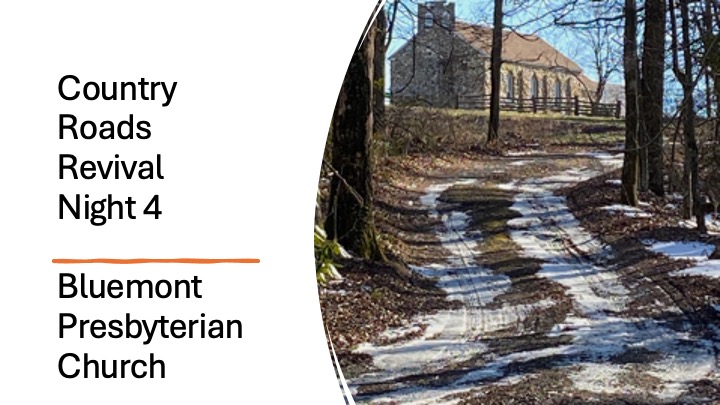
Revival at Bluemont Church
July 29, 2026
Genesis 12:1-9
The video contains most of the service. I cut out the last of the songs as it was not in public domain. One of the microphone’s battery died, but with the others you can still hear everything. The sermon starts at 30 minutes.

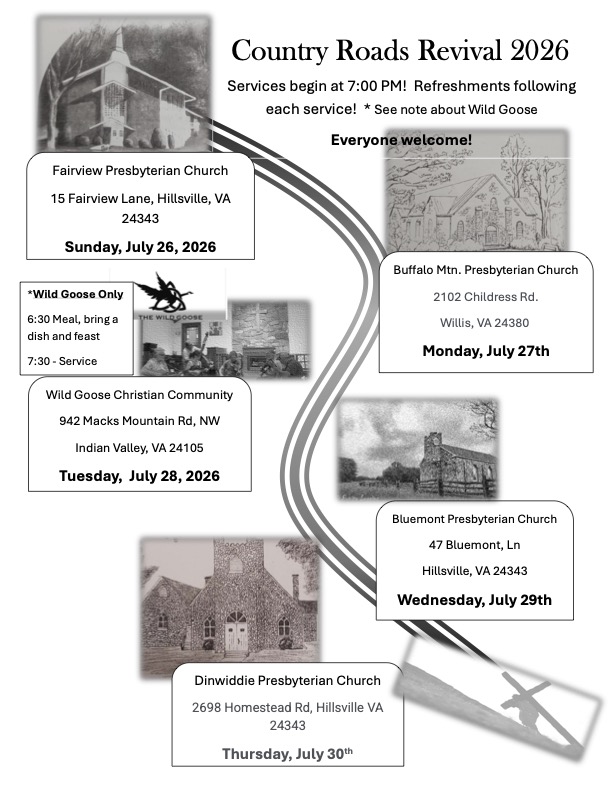
The last week of August, a number of the Presbyterian Churches in Carroll, Patrick, and Floyd Counties hold a revival. Each night is at a different church. This year, we began on Sunday night at Fairview in Hillsville, then to Buffalo Mountain, then to Wild Goose (the former Indian Valley Presbyterian Church), then to Bluemont (we rotate between Mayberry and Bluemont each year). We will end up at Dinwiddle Presbyterian on July 30th. This is my sermon for tonight’s worship service.

At the beginning of worship:

This is the fourth night of the Country Roads revival. We live in a wonderful place with lots of country roads, some maintained by VDOT, others just two tracks curving around the hills. As we travel to different churches in these parts, we’re on a journey. Tonight, I want us to think about the beginning of one of the great journeys of the Bible. But before we get there, let me encourage you to walk if you are able. It’s good for you. As you walk, listen to the birds, the wind, look for the unusual, and think about God. Any of you who know me know you can often find either early in the morning or late in the afternoon walking. Come join me. 


Augustine of Hippo, the great theologian of the church at the collapse of the Roman Empire, once said, “It is solved by walking.” We live in a confusing world and things seem to be running at rapid pace. We all need to spend more time slowing down, thinking deeply, and enjoying the creation God lends to us to during our lives. There’s no better way to do this than to go for a walk.

Before reading the Scripture

The first eleven chapters of Genesis are often referred to as a prehistory. We learn about Creation and God’s care of his creation. We also learn how the first humans messed things up. But God refuses to give us on us. Chapter 11, the last chapter of this prehistory, ends with another famous Biblical lists of ancestors. You can look back to chapter 11, starting with verse 10, you’ll see the list which begins with Noah’s oldest son, Shem, leading up to Abram, who’ll later be known as Abraham. And we’re told that Abram’s wife Sarai is barren. 

That little bit of knowledge in Chapter 11 makes what happen in Chapter 12 even more surprising. If Sarai can’t have children, she seems to be an unlikely candidate for the mother of a nation. But bareness is only a human problem. Yet, it’s an arena God delights in. God likes surprises. God delights in taking the difficult path to bring joy to his people. Let’s listen.

Read Genesis 12:1-9

I wonder how Abram heard God’s call? Unlike Moses, who saw a burning bush, Samuel who heard God call during the night, or Isaiah who received a vision, we’re not given any details as to how Abram heard God calling. But think about it, what would it take for a man, well established and long in years, to leave his extended family and head out into the wilderness for an undisclosed location? Can you imagine Abram, walking to the edge of Haram and looking westward and only seeing sand. “Did I hear correctly?” he might think.

One day a tourist ignored all the warning signs and barricades along the edge of the Grand Canyon. He got too close to the edge and it broke off, sending him falling. As he tumbled, he finally grabbed a clump of sagebrush growing out of the canyon’s wall and held on for dear life. Then he prayed like he never had prayed. “Let go and I’ll catch you, he heard God say. The man looked skyward and asked, “Anyone else up there?”

Abram had a similar decision. Looking out from Haran, he’s called to do something which would be a feat for a young man. But for a man of his age, it seems suicidal. Yet, he decides to answer the call

If you study the scriptures enough, you’ll see a pattern. God often refuses to take the easy way out. Over and over again, God chooses an unlikely candidate to carry out his work. Abram, an old man, asked to get on the road and to start a new nation. Moses, wanted for murder and yet God orders him back to Egypt to face Pharaoh. David, just a boy who accepts Goliath’s challenge. Mary, a young woman assigned a special task of giving birth to the Messiah. God uses the weak to do what the strong can only dream of. As Paul reminds the church in Corinth, “God’s foolishness is wiser than human wisdom, God’s weakness is stronger than human strength.”

The Bible teaches that when God is on our side (or more correctly, when we are on God’s side), great things are possible. But if you try to do things on your own, we run into problems.

If you follow the Abraham story in scripture, you’ll see what I mean. He lies about Sarai, his wife, saying she’s his sister, to Pharaoh. This got them both in trouble. And not believing in the promise, he takes his wife’s servant as a concubine to have a child, which creates all kinds of entanglements in his household. But if we trust God and allow God to work within our lives, there seems to be no limit to what we might accomplish. The church needs to be reminded of this truth repeatedly. We don’t know what the future holds, but we need to be willing to step out in faith, trusting God to be with us. 

Now let’s look at this passage at hand and see what we might learn. First, God, not Abram, is clearly the main actor in this story. God initiates the conversation. Throughout Abram’s saga, God remains the subject. This wandering off into the wilderness isn’t Abram’s idea; it’s a part of God’s plan. It’s like this with us when God begins to get a hold of us. We don’t know what might happen.

We should understand God comes to us before we can approach him. In the call of Abram, God institutes salvation history. Through Abram, God demonstrates a willingness to take the first step in reconciliation with humanity, a work completed in Jesus Christ.  

God tells Abram to cut himself off from the land, from his people, and from much of his family. That’s a pretty tall order. Abram’ abandons his roots. Telephones didn’t exist back then, nor did mail. No way to check up on things happening at home. ATMs and Western Union Stations where a family member could wire him cash if he’s a little short didn’t exist. When Abram heads off into the sunset, he can only depend on God. The normal clan connections which protected folks two millenniums before Christ no longer exist for Abram once Haran disappears beyond the horizon.

Although its risky to answer this call, a promise is also attached to it. Abram will be the father of a great nation. Yet, even here, God remains the main actor. God tells Abram he’ll be mightily blessed so that he might be a blessing for others. This remains true for us today. If God blesses us, we are to be a blessings to others. For too whom much is given, much is expected.

In addition to Abram promised blessings, a curse is placed on anyone who might harm him. God protects Abram. His enemies must contend not only with Abram, but also with God. Interestingly, from the way the sentence structure (the one who curses you), it sounds as if Abram will have many allies and only one enemy.

Abram answers the call. Taking his wife and nephew and, we can assume, a bunch of loaded camels hauling their possessions, they drive their sheep toward the land of Canaan, a land Abram’s father had planned to settle a generation earlier. They probably took the longer path, heading north following the rivers of the fertile crescent, then turning south along the coastline, instead of heading directly west, through an unforgiving desert. This fits with what the Scriptures say as Abram first stops at Shechem, in the north, then to Bethel, in the south, before moving further south, into the Negeb. 

Let’s explore two theological themes from this evening’s passage. The first is that of a journey. When Abram answered God’s call, he found himself on a journey, which can also be a metaphor of faith. Early Christians were referred to as those of “the Way.” 

We journey as disciples, as followers of Jesus. For some, the journey is real, to new locations, new lands, and new people.” To others, the journey is metaphorical. We stay put, but we are still called to grow in faith. As a follower of Jesus, we can’t be content with the status quo. We must always look to improve ourselves and our world. Following Jesus requires changes in our lives. We’re to strive to become godlier, more Christ-like. When we live in a world contaminated with sin, accepting the status quo isn’t an acceptable option. 

When Abram stops by the Oak of Moreh, God appears again and promises this land to his offspring. So Abram builds an altar out of thanksgiving, and does the same in Bethel. Abram, as he travels, witnesses to his God. Like Abram, we, on our journeys, should never stop giving God credit. For without God, we would not be able to do much of anything. 

Verse 6 contains the second theme to explore. The Canaanites occupy the land. This land, promised to Abram, isn’t yet his. Furthermore, there are those on the land who don’t worship like him. Think about this. Abram could have adopted the religious practices of the Canaanites, but in doing so would have turned his back on the one true living God. We, too, find ourselves journeying around people who belief in what seems to be a foreign God. Some anoint God as a way to bless their way of thinking. They forget, only God can truly anoint and we’re to be on God’s side, as opposed to bringing God to our way of thinking. Although Abram spends decades sojourning in lands with foreign gods, he never forgets the God who called him on the journey.

Like Abram, we often find ourselves living in a land where people do not believe in the God of the Scriptures. We live in a world where there are many competing ideals which vie for our attention.  And it may be harder to us than it was with Abram to recognize the idols of our day. Abram could point out to the fertility idols of the Canaanites which dotted the high places, but the idols of today are more subtle. We have the promise of economic security at whatever cost, the belief we’re better than others which manifests its ugly head with racism, or the abusive belief we deserve what we desire often at the expense of others. These all run counter to Scripture.

We need to remember that like Abram, we’re just passing through. We’re pilgrims. Ultimately, our home is with God, but until we leave this life behind, we must continue to walk in faith and to listen for God to speak to us through the scriptures and the good news of Jesus Christ. 

Let us pray:  Almighty God, you know every heart here this evening. As we bow in obedience, we pray for our spirit to convict those who need to know you. Open ears that all might hear you call and follow you. Guide us in your ways, especially when our travels take us through the unknown. Help us remain focused on our Lord Jesus Christ and not be tempted by the idolatry surrounding us. This we pray in the name of Jesus, the Good Shepherd, the one we follow. Amen.

Pentecost: Unity in Christ through the Spirit

Jeff Garrison
Mayberry and Bluemont Presbyterian Churches 
Genesis 11:1-11
June 5, 2022

Sermon recorded at Mayberry on June 3, 2022

Thoughts at the beginning of worship: 

Scripture teaches that our lives are grounded in God. Adam was a clump of clay until God breathe life into his lungs. Likewise, for the church, as an organization, would’ve been long dead had not God breathe the Spirit into the disciples on Pentecost. God keeps breathing the Spirit into the church. Today, I want you to understand that our hope is not in our efforts. We find hope in God who wants to partner with us in carrying out his mission in the world. That’s the message of Pentecost.

Before the reading of Scripture:

Worship in an Indonesian Pentecostal Church

I attended a 6 AM worship service when I was in Jakarta, Indonesia in 2011. Between Easter and Pentecost, this congregation hosted daily predawn worship services, praying that when Pentecost arrived there would be an outpouring of the Holy Spirit. Housed in a high-rise building, the congregation leases two floors. I thought this was unique until I learned the high-rise also housed two other churches as well as a mosque.  

We met in the children’s worship room, where we sat around on the floor while a small praise team led us in songs. The music began contemplative, soft, and reflective, but gradually became more energetic. They sang songs in a variety of languages including English and Dutch. That’s not unusual as Indonesia has more languages than any other country in the world. Interspersed with the music were passages of scripture. Of course, I couldn’t understand the readings, but Petra, the pastor who had invited me, whispered to me the passage so I could find the reading and follow along.  

Blended prayer

After about forty-five minutes of singing and scripture, they began to pray. Everyone, at once, prayed aloud. But this didn’t result in the chaos that you might think as the voices blended to create a unique and beautiful sound. A couple of people moved forward as Petra and the other leaders of the church gathered around them, laying their hands on the shoulders as they prayed. One of the women became excited and suddenly fell backwards, only to be caught and gently lowered to the floor. After about fifteen minutes of praying in all kinds of tongues, Pastor Petra pronounced a benediction. We moved to another room where we enjoyed Javanese coffee and nasi timbel (sweet rice wrapped in banana leaves).

Worship focuses on God

When we worship, God is our audience. We gather and we offer our hearts up to God and when we do so, we believe it pleases to the Almighty. If we think about worship in this manner, the experience of hearing all the various voices of prayer mingled together must be very pleasing to God.  For you see, we’re designed and created in a unique manner by a God who delights in diversity yet draws us together in unity in Jesus Christ. 

Pentecost and Babel

We heard earlier the passage from Acts, the story of the church’s birth. The coming together in Acts is often contrasted with the dispersing of humanity at Babel. Today, I want us to look at this passage from Genesis. It occurs at the end of what is known as the “prehistory” in Genesis. 

Genesis’ Prehistory

It’s hard to take this “prehistory” literally as there are contradictions within the text.[1] But the importance is in the stories, for they provide a foundational meaning to how we are to live with God. After the flood, it appears everyone stuck together and there is a general failure to populate the world, as everyone works together to “build a name for themselves.” After Babel, people go their separate ways. In the next chapter, we see God reaching out to Abram. And what is God’s promise to Abram?  God will bless him and make his name great![2] We have a great name, not because of what we do, but because of whose we are.  

Read Genesis 11:1-9

A Retelling of the Babel Story

God blessed them, and God said to them: ‘Be fruitful and multiply, and fill the earth.’  Genesis 1:28

Instead, the people of the earth joined together and in a singular band traveling across the face of the earth until they found a land of promise. There they settled.  It was a rich valley. As there were no stones, they made bricks with which they constructed a city that included a tower reaching high into the heavens. From what we know, this was the ultimate family reunion. Everyone was together, happy and secure.  

God’s visit

One day God came down to earth to visit. The Almighty investigated the first corner of the world and saw no one. So, God looked around the second corner and again saw no one, and neither did God find anybody in the third. This bothered the Creator. Something was wrong. Hadn’t he instructed the people to fill the earth? As God heads to the fourth corner of the world, he hears celebration. A party! God wonders why he wasn’t invited.  

There, in the middle of the city, a huge tower reaches into the sky. So big and high, the people are proud. But to the Creator, it’s not remarkable. In God’s eyes, it’s small, so small the Almighty must come closer to see it. 

God acts

God isn’t threatened by the tower but knows something must be done. Humans, it seems, are too big for their britches… No telling what these people might do next. So, God mixes up the languages. Soon the architects can’t communicate with the construction engineers. The bricklayers and the plumbers and the drywallers speak different tongues.  

Confusion reigns and people began to leave the city. They form new cities where everyone speaks the same language. “Now,” the Creator thinks, “people will learn to depend on me for their security and they will no longer need the protection provided by brick walls which erode away.”[3]

Is the story about a tower?

I retold the story of the Tower of Babel to clear up several hazy points. First, the tower plays a minor role in the story. But we must admit, there is something about towers that intrigue us. As a child, I loved building towers and continued that love as an adult with my own children. The best restaurants are often at the top of towering buildings. Cities like New York, Chicago, Tokyo, and Shanghai boast of their skyline. There’s something about towers. God never says they’re sinful. 

Or is the story about a city?

The story mostly focuses on the city.[4] We have this image of the people building a tower into the heavens so that they can storm heaven, but that vision comes from the active imagination fueled by Jack and the Beanstalk and renaissance artists. The text never gives us the idea an invasion of heaven is imminent or even contemplated. Instead, the tower serves as the unifying symbol for the residents. “We can do this,” they say to one another as they pat themselves on the back.

The humor in the story

If we pause to consider this story for a minute, you’ll see the humor. Imagine ancient people telling the story around the campfire. It brought smiles to their faces, but also taught an important lesson. The God of the Universe must come down from heaven to check on what we’re doing. This giant tower isn’t large enough to be seen from Outer Space! Of course, this doesn’t mean that God doesn’t know what’s happening on earth when he’s in heaven; instead, it is a statement of human inability.  

Sin in the story

Furthermore, the sin in the story isn’t the tower nor the city. The tower and the city are symbols of the people’s sin, as they think their accomplishment speaks well of their abilities. They are proud people who have failed to heed God’s command to fill the earth and have decided they can depend on each other for their needs. There is no need for God. The people in this city never mention God, from what we’re told. They’re going merrily on their way as if they are in control of their own destiny, which in the mind of God is arrogance. 

The division of people into various language groups isn’t just punishment. Instead, the people avoid the potential of a future calamity as God sees to it that the mandate set forth in Genesis is fulfilled.[5]God desires the world to be filled with different people. Diversity is celebrated within God’s kingdom. Unity doesn’t come from human effort but from a common need of all people to look to the Almighty for their security and to worship God for their blessings.  

Jesus Christ, the source of our unity

Unity comes in Jesus Christ who prayed on the night of his betrayal for his disciples’ unity.[6] In the coming of the Spirit on Pentecost, God brings believers into a church that may be split by language, nationality, style, and customs. However, we find unity because we worship the same Lord. 

Language at Pentecost and Babel

We should note a fine difference in the use of language between our stories. In Genesis, the emphasis is on what people can do by communicating together with each other. Such ability enables them to do things on their own without having to depend on God. In Acts, the emphasis isn’t on speaking in tongues (any more than the Genesis story is on the building of a tower), but on people hearing the gospel in their own unique language. These two passages, the scattering of people through language and the bringing together of people on Pentecost, go together. They show our God’s desire for a unity focused on Jesus Christ, not on our own wishes and desires.  

God uses the church to tell the story

On Pentecost, we celebrate the birth of the church, an institution that’s not perfect because God has entrusted it into our hands. Nonetheless, the church is the vehicle God chose to tell the story of his Son to a lost world. We’re a world, as that old song from the 60s goes, “on the eve of destruction.”[7]  

Meaning of Babel

Babel fell into ruin as the people dispersed, but that doesn’t mean that God is against cities or human achievements. The collective ability of humanity is vast as we see in this story. However, we must never forget our limitations and the fact that we need to depend upon the Lord in all things. The word “Babel” means the “gates of God.”[8] We later drew from this word babbling. (What some of you may think I’m doing).

However, far from being a gate of God, in this ancient city from what we know from the text, God wasn’t being considered. This led to their downfall, and it should serve as a reminder to us.  

Conclusion

Giving ourselves the right name isn’t enough; what’s important is how we relate to God. Are we trying to glorify ourselves, or do we live to glorify God? 

Another way to ask this question has to do with our motives. Are we trying to build a name for ourselves or are we content with the name God has given us? Do we give God the glory for our accomplishments, or do we claim them as our own? These questions need to be continuously asked for temptation always suggest we replace God with something else. That’s sinful. That’s idolatry. Amen. 


[1] In Chapter 11, all people live together but in Chapter 10, we learn of Noah’s children going their separate way and starting cities.  

[2] Genesis 11:4 and 12:2.  See Donald E. Gowan, Genesis 1-11: From Eden to Babel (Grand Rapids: Eerdmans, 1988), 118.

[3] For the foundation of this story, see Gowan, 115-120 and Walter Bruggemann, Genesis: Interpretations, a Bible Commentary for Teaching and Preaching (Atlanta: John Knox Press, 1982), 97-104..

[4] Gowan, 115. 

[5] See Bruggemann, 99-101

[6] John 17

[7] “Eve of Destruction” sung by Barry McGuire, 1965.

[8] Gerhard Von Rad, Genesis: The Old Testament Library (Philadelphia: Westminster Press,1972), 150.

These day lilies blowing yesterday beside the house have the color of Pentecost