
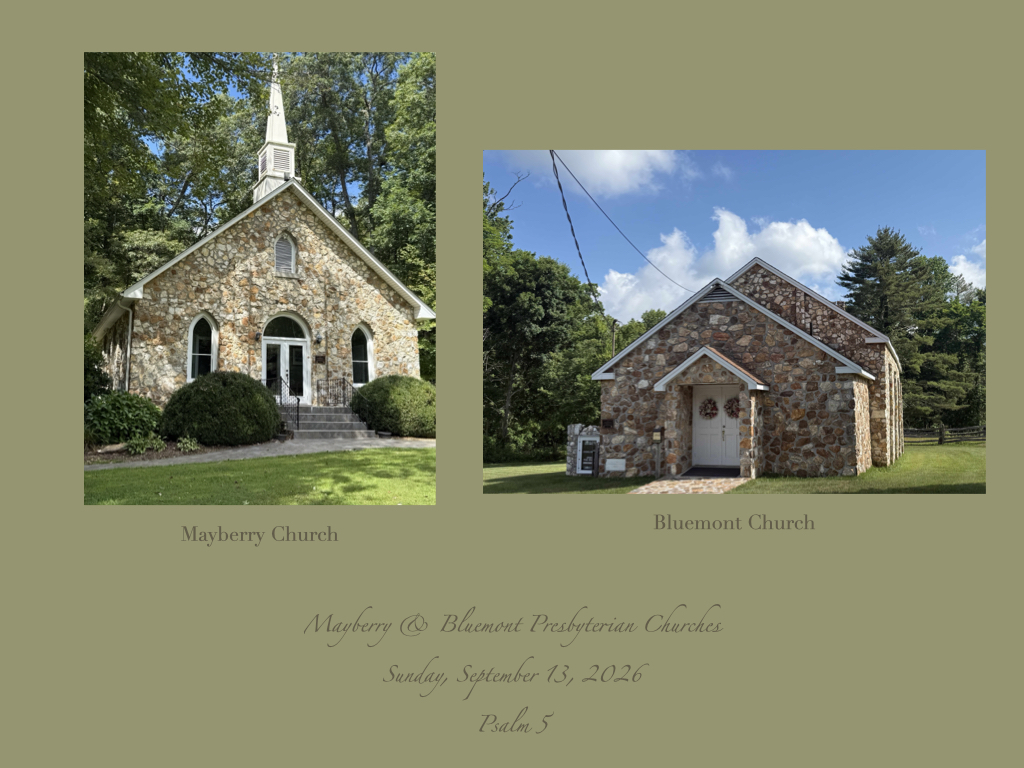
Jeff Garrison
Mayberry & Bluemont Churches
September 13, 2026
Psalm 5
At the beginning of worship:
Mozart’s greatest opera, Don Giovanni, tells the Don Juan story. Don Giovanni has three passions: food, drink, and women, especially women named Donna. He attempts affairs with Donna Elvira and Donna Anna. Through his attempt to seduce the latter, he’s challenge by her father. He kills him. At the end of the opera, the father returns as a statue from the graveyard, to claim Don Giovanni’s life. He’s urged to repent before it’s too late. To do so, he must renounce his life. He can’t do it and the opera ends with him being dragged by demons into hell. In his mind, the torments of hell are better than giving up what he enjoyed in life.
Hopefully, most of us don’t begin our theology with hell. If truth be told, we don’t want to think about hell. And, I suggest, spending too much time thinking about hell is dangerous. We’ve been too conditioned to think of hell by Dante and the like. But perhaps there is a reason for hell.
What would heaven be like for Donna Anna and Donna Elvira if Don Giovanni showed up? It seems to me it would be less than paradise. Some people’s presence, without great purification, would have the ability to destroy heaven. Actually, and this is important to remember and should keep us humble, we will all need some form of sanctification or purification to come face-to-face with God. And, as I’ll explore in today’s sermon, only by God’s grace will we arrive.
Before reading the text:
As I did during the fall of last year, I plan to mostly preach from the the Book of Psalms this season. I will use Psalms which I have not yet preached on over the past 40 years. I have preached on over half of the Psalter, but that still leaves me a lot from which to choose. Today, we’ll look at the 5th Psalm.
This is a personal lament. The Psalmist, and this is the third Psalm attributed to David, complains to God about people telling lies about him. He ask God to intervene on his behalf. But while this is a personal lament, the Psalm itself was proclaimed within the community at worship. We should remember the Psalms were Israel’s hymnal. They were sung and prayed in worship. And while this Psalm centers around the complaint of an individual, it ends incorporating the entire community.
As I preach through the Psalm, it could be helpful to keep your Bibles open and to follow along. Don’t just follow in the reading, but use it as a reference for my interpretation of the passage.
One more thing. This Psalm also nicely follows up to my sermon of a few weeks ago when I preached on the 9th Commandment: Thou shalt not bear false witness against thy neighbor.
Read Psalm 5:
Let me suggest from the beginning, the good news from this Psalm applies to one enduring slander, bullying, and deceit. It seems depressing, filled with judgment and consequences. But not if we understand the Psalm from the one bullied or facing slander and lies. The Psalm addresses the oppressed individual’s needs and offers hope for those who strive to live righteous lives.
I think many within our nation felt this way back on 911. Remember that day twenty-five years ago when it seemed our world fell apart. We knew we were attacked but didn’t understand why or what was happening. It was a scary time. This Psalm addresses such a time, especially within our personal lives.
Our Psalm begins with an appeal to God. We might also call it a Call to Worship, as we do when we gather on Sunday mornings. The Psalmist demands an audience with God. His, assuming David wrote this Psalm, troubles are so great that only God can help. Twice this Psalm demands God to listen. Such repetition emphasizes the demand. The sad words come as a sighing, a cry, a prayer, offered at worship in the morning. Of course, if David was the original author, some changes occurred to the Psalm as it appears the Psalm was adapted for use in the temple, which didn’t exist during David’s reigns. But let’s not dwell there.
We should focus instead on David’s anguish. He must have had a sleepless night. He worries about those who spread false rumors. Have you ever heard a rumor about something you supposedly did or said, and then had a hard time turning off the tape within your brain which plays the accusation over and over? That’s must be what’s happening within David’s mind as he worries about his reputation.
This psalm does not inform us of God’s reply. But the Psalmist obviously thinks God listens, for he continues into the second part of the prayer. Perhaps faith draws David forth, Starting in verse 4, he acknowledge God’s traits. God despises wickedness. Evil cannot exist in God’s presence.
This leads the Psalmist to assume those whose tell the destroying lies will not enjoy God’s presence. For the bloodthirsty and deceitful will never stand before the Lord. God is holy and those polluted will never find an audience with the Almighty.
A shift then occurs in verse 7. The Psalmist feels called into God’s presence. Notice, it’s not because of the Psalmist’s righteousness. Rather, the God who cares for the meek of the earth, invites the Psalmist in through God’s steadfast love. The Psalmist enters in awe, with head bowed, perhaps knowing he’s not worthy.
In the next verse, the Psalmist asks for supplication. “God, lead me through my enemies, make your path straight for me.” When we are in trouble, we may find ourselves with no one but God who can help. It’s also important we don’t try to take things in our hands. If we do so, we might make a bigger mess of things. Vengeance is mine says the Lord, a passage found in both the Old and New Testament. We are not to seek revenge, instead we’re to ask God to show us how to live into the future.
Next, in verses 9 and 10, comes the Psalmist complaint. Earlier, when he acknowledged God’s goodness, the Psalmist established God as one who despises wickedness. Now he brings before God those can’t stand before the Almighty. They lie and plan destruction. Their mouths are like open graves, they can flatter but can also kill. Standing them
before God, the Psalmist wants to assure they pay the price for their treachery. Yet, notice their fall isn’t because of God. Their own counsel tripped them up. Having rebelled against God, they find themselves cast out from God’s presence. As with Donna Anna in Mozart’s opera, the deceitful one must be banished before she can enjoy life.
With the concern of those who slander and make his life difficult off the Psalmist chest, we move to close the prayer. The Psalmist prays for the righteous within the community. While this is a personal lament, it also applies to the community of faith, those who seek refuge in God. The Psalmist asks for protection upon the community. May those who are innocent be covered with God’s favor.
The Psalmist, in a way, prays for God’s kingdom to be fulfilled. “They will be done, thy kingdom come,” we pray. Such a kingdom, according to the Beatitudes, consist of those who are poor in spirit. It also includes the meek, those who long for righteousness, who show mercy, who have pure hearts, who seek peace, and have been persecution for righteousness’ sake. The Psalmist fits within many of these traits.
We’re shown in this psalm how to take our troubles to God. We can bring God our concerns and seek out God protections when threatened.
But I want to address one other thing. It seems this song divides the world into the good and bad. However, we must be careful of such dual thinking. After all, as the Apostle Paul reminds us, we’ve all have sinned and fallen short of the Glory of God. In Romans 3, the Apostle Paul draws from this Psalm among others to indict all people of our sinfulness. Even David, to whom the Psalm is attributed, did things which did not please nor bring God glory. This was especially true with him setting up Uriah’s death so that he could cover up his adultery with Bathsheba.
So, if we’re all guilty, how can we come before God? We find the answer back in verse 7. We can only come before God by God’s steadfast love. That’s grace. God answers the prayers of those bullied in life, but God will also answer the prayers of the bully, if they repent of their behavior. But that’s the topic for another sermon.
So when you are beaten down by life, let’s take your troubles to God. And while we try to live and do what is right, we know we are not always so innocent. God will help us when we are bullied, as in the case of the Psalm. But we should also remember this: God looks out for those we bully. Amen.
Sources:
Alter, Robert, The Book of Psalms: A Translation with Commentary. New York: W. W. Norton, 2007.
Mast, Stan. “Psalm 5:1-8 Commentary for Sunday, June 12, 2016”
May, James L., Psalms: Interpretation, a Biblical Commentary for Teaching and Preaching.
Louisville: John Knox Press, 1994.
Weiser, Artur, The Psalms: A Commentary. 1959. Philadelphia, Westminster Press, 1962.
That was an interesting read through. I really dislike bullies.
God’s not particularly fond of them, either.
We are currently without a priest again, meaning some Sundays are just morning prayer. Today was one of those days, so I appreciated getting a sermon from you. I even followed along in my Bible! Thanks!
I’ve tried to encourage people to bring their own Bibles throughout my ministry, but most people still don’t do it. Sorry to hear you’re without a priest.