
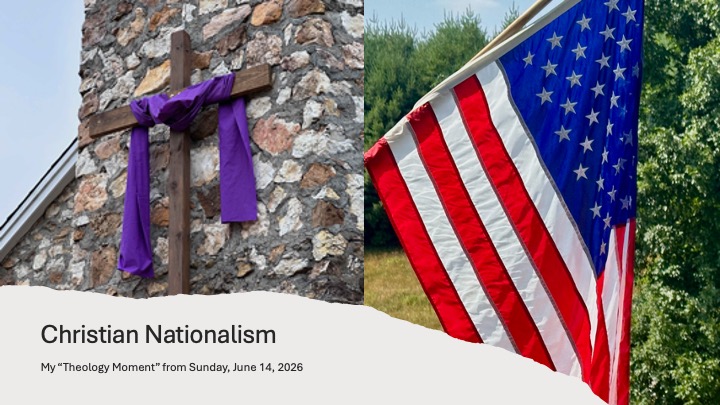
This year we have added a new item to worship titled “A Minute for Theology.” The congregation gets to ask me questions about theology or the church, and I try to provide a brief explanation. This past week, I tackled a couple questions on Christian Nationalism. What it is, they they’ve only recently heard of it, and if we’re a part of such a movement. Expanding from the notes I made, this is my answer.
My answer: Let me answer the last phrase of the question first. No, I do not consider us a part of the Christian Nationalist movement. Speaking for myself, I certainly don’t consider myself a Chrisitan Nationalist. Personally, I think the movement verges on heresy. I see it as an attempt to usurp the Christian faith for political agenda. The Christian faith is built upon a vision from Jesus to bring people of all nations and races together. As Paul writes, there is no longer Greek or Jew, slave or free, male or female, for we are all to be one in Christ Jesus.[1]
America has often held contrasting ideals. Think of the wonderful words of the Declaration of Independence about freedom and equality. Those elegant words were written by a slaveholder and signed by slaveholders.
In religion, there is the enlightenment belief which acknowledges the importance of religion. But the Founders of our nation shunned the European notion of a state religion. Enshrined in our Constitution is a clause that the government shall not infringe on our right to worship as we choose and there shall be a separation between church and state. The second ideal in contrast to the first comes from John’s gospel. In America, this became prominent during the First and Second Great Awakening. It’s that Jesus is the only way.[2] As a nation, we’ve tried to hold these two ideals in tension. But there have always been dissenters who insists they are right while other views have no value. Such people fail to show the grace a graceful God calls us to show to others.
Let me give you an example. Around the nation’s centennial in 1876, a movement arose to enshrine within the constitution an amendment declaring America as a Christian nation. It didn’t pass. While some Christians supported it, others saw the problem with the amendment and rose up in opposition.
As followers of Jesus, our ultimate loyalty is to always remains with him and not with a nation, which is a human construct. Nations come and go. This doesn’t mean we should not strive to be good citizens of the earthly nation in which we live. However, our first loyalty, our primary citizenship, is to God’s Kingdom. We’re still called to work hard within our nation so that it and the people within it may prosper. As Jeremiah told those in Jerusalem who were exiled to Babylon,” seek the welfare of the city in which you live.”[3]
Those who claim to be Christian Nationalist see our nation as exclusively Christian. Those who are not Christians are pushed to the side. To find support for such a ideal, they must go back to the Old Testament model of Israel as God’s chosen people. But such a nation ceased to exist in 587 BC, when Babylon defeated them and took many of them off into exile. After exile, the nation seldom lived independently but generally existed under the authority of foreign powers. Even modern Israel is not a nation as set forth by Moses and the prophets, but a secular construct. While we can learn from the Old Testament, there is nothing in the New Testament about Christians running the government. Instead, in places like Romans 13, you find a lot about us living under the government of a foreign power.
The New Covenant, established by Christ, expands this idea of the chosen people to include people of every nation and race. This goes back to God’s intention as all people are created in God’s image.[4] As followers of the man for Galilee, we must resist movements like Christian Nationalist who attempt to divide the world up into the chosen (their nation or those who believe like them) and all others.
While we are to work hard for our nation and those who live within it, we also live with a vision of a new kingdom,. This kingdom began with Jesus, And we’ll belong to this kingdom long after the nations of earth cease to exist.
Jimmy Hendrix said, “When the power of love overcomes the love of power, we will have peace.” That may be a little simplistic, but we also find truth here. The power of love is to what Jesus calls us. The love of power seems to me to be what Christian nationalist desire. Jesus warns us about desiring earthly power. That’s a key tenet of the Sermon on the Mount, from which I’ve recently preached 17 sermons. The state has the power of the sword. Jesus also told the disciples that those who live by the sword shall die by the sword.[5]
While the church shouldn’t take a prominent role in the government, as individual followers of Christ we should use our faith to make decisions at the ballot box. And if elected, by serving in the government. But even then, we are called to work for the benefit of all Americans regardless of their faith or lack of faith.. The idea our nation primary serves a particular religious sect goes against the founding principles of our country. And for Christians, it goes against the teachings of Jesus.
[1] Galatians 3:29.
[2] John 14:6.
[3] Jeremiah 29:7.
[4] Genesis 1:27.
[5]h Matthew 26:52.