Jeff Garrison
Revival at Bluemont Church
July 29, 2026
Genesis 12:1-9
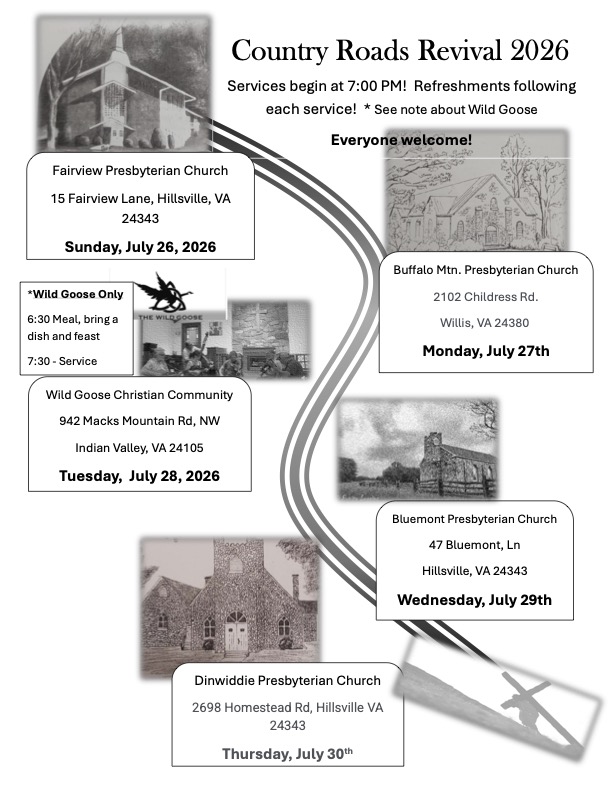
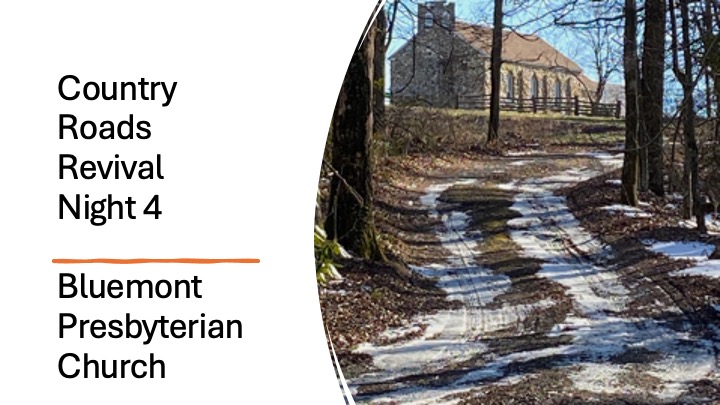
The last week of August, a number of the Presbyterian Churches in Carroll, Patrick, and Floyd Counties hold a revival. Each night is at a different church. This year, we began on Sunday night at Fairview in Hillsville, then to Buffalo Mountain, then to Wild Goose (the former Indian Valley Presbyterian Church), then to Bluemont (we rotate between Mayberry and Bluemont each year). We will end up at Dinwiddle Presbyterian on July 30th. This is my sermon for tonight’s worship service.
At the beginning of worship:
This is the fourth night of the Country Roads revival. We live in a wonderful place with lots of country roads, some maintained by VDOT, others just two tracks curving around the hills. As we travel to different churches in these parts, we’re on a journey. Tonight, I want us to think about the beginning of one of the great journeys of the Bible. But before we get there, let me encourage you to walk if you are able. It’s good for you. As you walk, listen to the birds, the wind, look for the unusual, and think about God. Any of you who know me know you can often find either early in the morning or late in the afternoon walking. Come join me.
Augustine of Hippo, the great theologian of the church at the collapse of the Roman Empire, once said, “It is solved by walking.” We live in a confusing world and things seem to be running at rapid pace. We all need to spend more time slowing down, thinking deeply, and enjoying the creation God lends to us to during our lives. There’s no better way to do this than to go for a walk.
Before reading the Scripture
The first eleven chapters of Genesis are often referred to as a prehistory. We learn about Creation and God’s care of his creation. We also learn how the first humans messed things up. But God refuses to give us on us. Chapter 11, the last chapter of this prehistory, ends with another famous Biblical lists of ancestors. You can look back to chapter 11, starting with verse 10, you’ll see the list which begins with Noah’s oldest son, Shem, leading up to Abram, who’ll later be known as Abraham. And we’re told that Abram’s wife Sarai is barren.
That little bit of knowledge in Chapter 11 makes what happen in Chapter 12 even more surprising. If Sarai can’t have children, she seems to be an unlikely candidate for the mother of a nation. But bareness is only a human problem. Yet, it’s an arena God delights in. God likes surprises. God delights in taking the difficult path to bring joy to his people. Let’s listen.
Read Genesis 12:1-9
I wonder how Abram heard God’s call? Unlike Moses, who saw a burning bush, Samuel who heard God call during the night, or Isaiah who received a vision, we’re not given any details as to how Abram heard God calling. But think about it, what would it take for a man, well established and long in years, to leave his extended family and head out into the wilderness for an undisclosed location? Can you imagine Abram, walking to the edge of Haram and looking westward and only seeing sand. “Did I hear correctly?” he might think.
One day a tourist ignored all the warning signs and barricades along the edge of the Grand Canyon. He got too close to the edge and it broke off, sending him falling. As he tumbled, he finally grabbed a clump of sagebrush growing out of the canyon’s wall and held on for dear life. Then he prayed like he never had prayed. “Let go and I’ll catch you, he heard God say. The man looked skyward and asked, “Anyone else up there?”
Abram had a similar decision. Looking out from Haran, he’s called to do something which would be a feat for a young man. But for a man of his age, it seems suicidal. Yet, he decides to answer the call
If you study the scriptures enough, you’ll see a pattern. God often refuses to take the easy way out. Over and over again, God chooses an unlikely candidate to carry out his work. Abram, an old man, asked to get on the road and to start a new nation. Moses, wanted for murder and yet God orders him back to Egypt to face Pharaoh. David, just a boy who accepts Goliath’s challenge. Mary, a young woman assigned a special task of giving birth to the Messiah. God uses the weak to do what the strong can only dream of. As Paul reminds the church in Corinth, “God’s foolishness is wiser than human wisdom, God’s weakness is stronger than human strength.”
The Bible teaches that when God is on our side (or more correctly, when we are on God’s side), great things are possible. But if you try to do things on your own, we run into problems.
If you follow the Abraham story in scripture, you’ll see what I mean. He lies about Sarai, his wife, saying she’s his sister, to Pharaoh. This got them both in trouble. And not believing in the promise, he takes his wife’s servant as a concubine to have a child, which creates all kinds of entanglements in his household. But if we trust God and allow God to work within our lives, there seems to be no limit to what we might accomplish. The church needs to be reminded of this truth repeatedly. We don’t know what the future holds, but we need to be willing to step out in faith, trusting God to be with us.
Now let’s look at this passage at hand and see what we might learn. First, God, not Abram, is clearly the main actor in this story. God initiates the conversation. Throughout Abram’s saga, God remains the subject. This wandering off into the wilderness isn’t Abram’s idea; it’s a part of God’s plan. It’s like this with us when God begins to get a hold of us. We don’t know what might happen.
We should understand God comes to us before we can approach him. In the call of Abram, God institutes salvation history. Through Abram, God demonstrates a willingness to take the first step in reconciliation with humanity, a work completed in Jesus Christ.
God tells Abram to cut himself off from the land, from his people, and from much of his family. That’s a pretty tall order. Abram’ abandons his roots. Telephones didn’t exist back then, nor did mail. No way to check up on things happening at home. ATMs and Western Union Stations where a family member could wire him cash if he’s a little short didn’t exist. When Abram heads off into the sunset, he can only depend on God. The normal clan connections which protected folks two millenniums before Christ no longer exist for Abram once Haran disappears beyond the horizon.
Although its risky to answer this call, a promise is also attached to it. Abram will be the father of a great nation. Yet, even here, God remains the main actor. God tells Abram he’ll be mightily blessed so that he might be a blessing for others. This remains true for us today. If God blesses us, we are to be a blessings to others. For too whom much is given, much is expected.
In addition to Abram promised blessings, a curse is placed on anyone who might harm him. God protects Abram. His enemies must contend not only with Abram, but also with God. Interestingly, from the way the sentence structure (the one who curses you), it sounds as if Abram will have many allies and only one enemy.
Abram answers the call. Taking his wife and nephew and, we can assume, a bunch of loaded camels hauling their possessions, they drive their sheep toward the land of Canaan, a land Abram’s father had planned to settle a generation earlier. They probably took the longer path, heading north following the rivers of the fertile crescent, then turning south along the coastline, instead of heading directly west, through an unforgiving desert. This fits with what the Scriptures say as Abram first stops at Shechem, in the north, then to Bethel, in the south, before moving further south, into the Negeb.
Let’s explore two theological themes from this evening’s passage. The first is that of a journey. When Abram answered God’s call, he found himself on a journey, which can also be a metaphor of faith. Early Christians were referred to as those of “the Way.”
We journey as disciples, as followers of Jesus. For some, the journey is real, to new locations, new lands, and new people.” To others, the journey is metaphorical. We stay put, but we are still called to grow in faith. As a follower of Jesus, we can’t be content with the status quo. We must always look to improve ourselves and our world. Following Jesus requires changes in our lives. We’re to strive to become godlier, more Christ-like. When we live in a world contaminated with sin, accepting the status quo isn’t an acceptable option.
When Abram stops by the Oak of Moreh, God appears again and promises this land to his offspring. So Abram builds an altar out of thanksgiving, and does the same in Bethel. Abram, as he travels, witnesses to his God. Like Abram, we, on our journeys, should never stop giving God credit. For without God, we would not be able to do much of anything.
Verse 6 contains the second theme to explore. The Canaanites occupy the land. This land, promised to Abram, isn’t yet his. Furthermore, there are those on the land who don’t worship like him. Think about this. Abram could have adopted the religious practices of the Canaanites, but in doing so would have turned his back on the one true living God. We, too, find ourselves journeying around people who belief in what seems to be a foreign God. Some anoint God as a way to bless their way of thinking. They forget, only God can truly anoint and we’re to be on God’s side, as opposed to bringing God to our way of thinking. Although Abram spends decades sojourning in lands with foreign gods, he never forgets the God who called him on the journey.
Like Abram, we often find ourselves living in a land where people do not believe in the God of the Scriptures. We live in a world where there are many competing ideals which vie for our attention. And it may be harder to us than it was with Abram to recognize the idols of our day. Abram could point out to the fertility idols of the Canaanites which dotted the high places, but the idols of today are more subtle. We have the promise of economic security at whatever cost, the belief we’re better than others which manifests its ugly head with racism, or the abusive belief we deserve what we desire often at the expense of others. These all run counter to Scripture.
We need to remember that like Abram, we’re just passing through. We’re pilgrims. Ultimately, our home is with God, but until we leave this life behind, we must continue to walk in faith and to listen for God to speak to us through the scriptures and the good news of Jesus Christ.
Let us pray: Almighty God, you know every heart here this evening. As we bow in obedience, we pray for our spirit to convict those who need to know you. Open ears that all might hear you call and follow you. Guide us in your ways, especially when our travels take us through the unknown. Help us remain focused on our Lord Jesus Christ and not be tempted by the idolatry surrounding us. This we pray in the name of Jesus, the Good Shepherd, the one we follow. Amen.