
Jeff Garrison
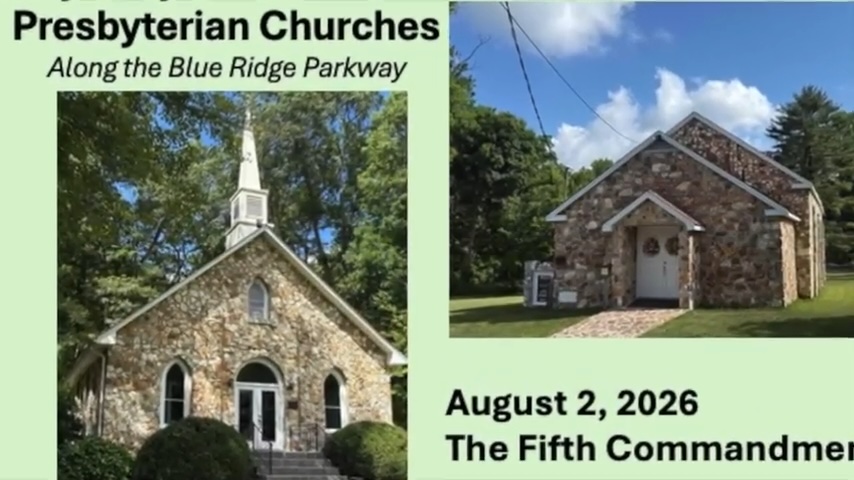
Mayberry and Bluemont Churches
August 2, 2026
Exodus 20:12 Ephesians 6:1-4
At the beginning of worship:
A man, his wife, and son, live together. The man’s elderly father’s health declined to where he could no longer take care of himself. To his wife’s dismay, her husband brings his father into their home.
The old father cannot eat without spilling and knocking his food all around the table. After a few days of this, the wife insists the man eat in the corner, not at the table. But he still knocked his food on the floor. One day, the wife decides if the man is just going to drop his food on the floor, he can eat it there. She finds a trough and puts his food in it and places on the floor. The old man doesn’t seem to notice his lack of dignity, he just lies down and eats like a dog, with his face in his food. This goes on for a few weeks.
Then, the parents notice their son building something which looks a lot like a trough to feed animals. They ask him about it. The boy proudly explains he made it from them, for when they are old and must eat from the floor.
“A child will lead them,” the good book says. The parents immediately came to their senses and realize they’re not honoring the husband’s father. The next meal they set a place him at the tablet.
Before reading the Scripture:
We traditionally divide the Ten Commandments into two tablets or tables. So far this summer, we’ve looked at the first tablet, commandments one through four. Each of these shows how we relate to God.
The second tablet deal with our relationships to the human family. The fifth commandment forms a bridge between the two. We are to honor our fathers and mothers, a commandment which closely parallels the first commandment.The first tells us to worship God alone, the one who gives us life. But likewise, our parents, those who play a significant role bringing us into this life, deserve honor. They’re not to be worshipped; we’re not ancestor worshippers. But they do have a special role to play in our birth and development. Our belly buttons remind us we didn’t come into this world on our own. Yes, God gives us life. But life comes through our parents. For this reason, they’re to be honored.
Read Exodus 20: 12 and Ephesians 6:1-4.
Our parents are important not only because it is through them that we receive the gift of life, but also because it is generally through them that we learn about Jesus and experience faith. Now, this is not always the case. At times a friend or a spouse or a colleague mentors us in faith. In such cases it’s like having two sets of parents, one that gives us life, another which offers us new life in Christ.
We can compare our life with Christ with our life with our parents. We start out totally dependent upon them—think about all that our parents did for us, starting with changing diapers and feeding us. As we grow, we began to do those things on our own, till one day we are freed from our parent’s control and must take responsibility for our own lives.
Likewise, we start out our Christian walk, totally dependent on Jesus, without even knowing why. But as we grow in faith, we find that he gives us more freedom as we learn how to apply our faith to our lives.
Honor your father and your mother, an enlightening commandment. In the Patriarchal world of the Old Testament, men ruled. And since it was also a tribal society, at the time God gave the commandments, the leader of the tribe was also given i allegiance.
But the Ten Commandments come along and suggest we honor, not only the father of the house, but also the mother. This is significant. Parents, both of them, are placed on a pedestal. The man is not set aside as the most important, but shares this position with the woman. Not only is the tribe important, but also the nuclear family. In fact, families become the building blocks of a stable society. And when families break down society become chaotic. Without the role model of good parents and with everyone striving to look out for themselves and no one else, the structure of society melts away.
I’m pretty sure it was Anne Lamott who said that “families are where we learn forgiveness.” That’s true. And I think we learn even more: we learn tolerance and acceptance. We learn what is important for society; life isn’t just about us. Living in a family, we learn it takes everyone to make it work. This, by the way, is also taught in the first commandment. “You shall have no other gods,” we’re told. We’re not to promote ourselves into the Trinity, as qualified as we might think we are. It’s not about me, it’s not about you. The first and the fifth commandment teach that we have first pay attention to what God wants and then to what our families need. We have to focus on something other than ourselves.
That said, it goes without saying that parents are also suppose to show respect to their children as Paul reminds us in the passage we read from Ephesians.
Honoring our parents is a generational thing. If we honor our parents and those who have come before us, for I think the commandment extends to not just our biological parents, we then teach our children to honor us and in so doing, we help build a stronger society.
For an example of just how destructive not honoring our parents can be, remember the chaos which ensued in Cambodia following the Khmer Rouge take over of that country in the mid-70s.
The Khmer Rouge taught people not to trust anyone who had been in authority, including parents. They encouraged children to rat out their parents for dangerous thoughts. This destroyed the traditionally strong sense of family and respecting elders which existed in a nation traditionally based upon the teachings of Confucius. The country quickly purged into darkness as the killing fields grew.
Instilling the importance of this commandment into our children’s psyche, we help stabilize society. And if that’s not reason enough, we should remember it’s our kids who get to choose our nursing homes. With this commandment, like many of the others, what goes around comes around.
Let’s face it; we owe our parents a great debt. They brought us into this world; they gave us life, they changed our diapers and fed us when we couldn’t take care of ourselves. Hopefully they showed us love. Therefore, we honor them. But there is more to the meaning of the commandment.
Throughout the history of the church, those interpreting the fifth commandment have always pointed in two directions. First, as I’ve already covered, we.honor our natural parents But on a secondary level the commandment is also seen as our requirement of honoring those to whom God has given authority. In other words, the civil authorities, those who lead us in government, are to be afforded the same respect.
Paul makes it clear in the thirteen chapter of Romans that we are to honor those in positions of authority. Now granted, some parents do not earn the right to be honored, and others abuse their position of authority. Since God allows them to be in positions over us, we honor them till what they do goes so far against God’s word that we must obey God who always deserves our loyalty.
John Calvin suggests we show homage to God when we are obedient to those in authority. Of course, we expect them to be godly and to do their best to govern justly and fairly. Otherwise, they violate both God’s and our trust. We do not have to obey them for our first allegiance always remains with God.
By the way, I hope you can see that there is a difference between honoring and obeying. Just because your mother is Ma Barker or your dad is Jesse James, you don’t have to go out and rob banks. But when or parents and those in positions of power are honorable and we submit ourselves to them, we learn what it means to submit ourselves to God’s will.
The fifth commandment also comes with a promise. If we honor those over us, if we respect and look up to our parents, God promises us a long life, a life in which things will go well for us.
This commandment, as a bridge between the two tables, sets the stage for all to come. For when we break any of the other commandments, we are not honoring our parents. I’m sure most of your mothers, at some point, indicated her embarrassment by something you’ve done? It’s old fashion guilt rising up which, if you think about it, has a stabilizing effect on society. Remember the family is the basic building block. The fifth commandment sets the stage for what’s to come. Strong families create healthy communities, so as we start this second table, look at how we can order society so as to strengthen it and to develop it into a place where all of us can safely grow in our faith in Jesus Christ.
Ask yourselves how you honor your parents? We’re not to worship them; we’re not even to follow them when they’re wrong. But our parents deserve our respect and when we give it, we help build a stronger and more godly community. Amen.
This sermon was edited from a sermon preached in July 2007 at First Presbyterian Church of Hastings, MI
My parents treated me and my brother really bad when we were kids. But I still helped my mom when she got older. My step mother won’t allow my brother and I to see our father now that he has dementia or we would still be in his life too. I see too many adult kids not talking to their parents.
I have read the memoirs of your childhood and find them heartbreaking. I am glad you were able to reconcile enough to help your mother as she aged. Not everyone has such grace.
So many factors in today’s world seem to have changed our relationships with our parents. Extended age (whether quality or not), children moving far away, etc. It’s rare to see multi-generation households. My paternal grandmother lived with us even after my father died. She moved in with one of her daughters shortly before my mother died (all before I left home), so I never had to deal with aging parents. It always grieves me to hear about elder abuse.
My maternal great-grandmother lived with us for a year, when I was around five. I wish then I had the ability to record the stories of her life which reached back to the 19th Century.