
Jeff Garrison
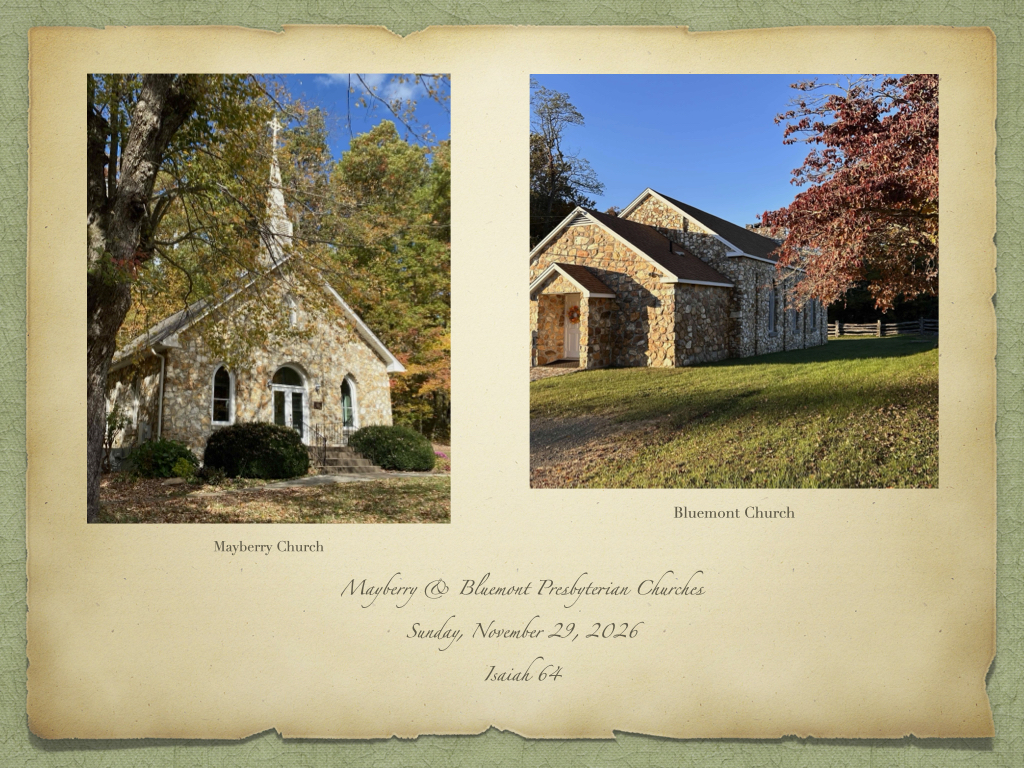
Mayberry & Bluemont Churches
November 29, 2026
Isaiah 64
At the beginning of worship:
In her book, Teaching a Stone to Talk, Annie Dillard, who died recently, wrote:
On the whole, I do not find Christians, outside of the catacombs, sufficiently sensible of conditions. Does anyone have the foggiest idea what sort of power we so blithely invoke? Or, as I suspect, does no one believe a word of it? The churches are children playing on the floor with their chemistry sets, making up a batch of TNT to kill a Sunday morning. It is madness to wear ladies’ hats and straw hats and velvet hats to church; we should all be wearing crash helmets. Ushers should issue life preservers and signal flares; they should lash us to our pews. For the sleeping god may wake someday and take offense, or the waking God may draw us out to where we can never return.
Today, we start Advent. It’s a time we recall the Hebrew people waiting for the Messiah just as we await his return. But desiring Christ to return, praying “Come, Lord Jesus, Come,” is dangerous, as Annie Dillard points out. We cannot control God. We can’t be sure God will be on our side, as we’ll see in our text this morning. Isaiah prays for God to break open the heavens and come down. But then he realizes human sinfulness isn’t just limited to his enemies. We, too, are sinful and its dangerous to come into God’s presence. Yet, there is no where else we can find eternal hope.
Before reading the text:
As we move into Advent, I will preach from lectionary passages. These relate to the seasonal themes of preparing ourselves for the coming of the Christ-child, which we celebrate on Christmas. So, I’m taking a breaking from focusing mostly on the Psalms, except that today as we look at a passage from Isaiah, we find it’s essentially a Psalm. It’s a lament, as Isaiah cries out for God to come among the people, to help Israel who struggles.
Often, scholars divide Isaiah into 3 parts. Part 1 (the first 39 verses) deal with Israel facing the Assyrians. Then, part 2 has God’s people as representative by Jerusalem, facing Babylon. The final part addresses the situation after the Babylonian exile, when those who returned to Jerusalem finds the city and the temple in ruins. But it’s also the most hopeful part, as Isaiah looks not only to the coming of the Messiah but also to God’s rule at the end of history.
In our passage today, we hear the cries of the people for God to break open the heavens and come down. Christmas recalls God’s incarnation, God coming to us with the birth of Christ. But instead of God arriving on the scene and punishing the enemies of Israel, Isaiah realizes sin isn’t confined to Israel’s enemies. Even Israel’s hands are dirty. So this lament then moves to confession. Confession is always appropriate, especially when we encounter the Holy God.
Read Isaiah 64
If you grew up in a family with siblings close to your age, you probably remember a time when one of them told you, “Just wait till Dad gets home.” Or maybe you threatened your siblings in such a manner. “Wait till Mom or Dad gets here.” It’s nice to have a higher power, like a parent, to be on your side. But what if you made such a threat and then when the parent arrives on the scene, instead of punishing your siblings, they realize you’re not so innocent. You then find yourself in hot water.
A similar thing happened to God’s people when Isaiah calls for God to tear open the heavens and come down. Isaiah knows God’s power, Such an encounter with God can be compared to an earthquake. He better put on his hardhat, as Annie Dillard suggests. Or maybe it’s like dry kindling perhaps soaked a bit with kerosene bursting into flames. Such a hot fire can quickly boil water, but also consumes whatever stands in its path.
In verse 3, we learn Isaiah longs for how the Hebrew people experienced the God in the Wilderness, a God whose presence was seen upon the mountain at Sinai. God saved them from Pharaoh’s army at the sea and provided water and manna and quail to eat while in the desert. But it seems, for Isaiah, God has been quiet of late. But had God quiet? What about God sending Cyrus to free the Hebrew children from exile? Maybe God hasn’t been heard of late, but certainly God was still active.
Yet, the prophet knows God’s greatness as we see in verse 4. There is only one God, who works for those who wait for him. Waiting…. Remember that before God led Israel through the Wilderness, God maintained silence for 400 years while the Hebrews waited and labored as slaves in Egypt. And God maintained silence between the promises of the Messiah and through the exile experience. It was over 500 years after the exile that the promise was fulfilled with he birth of Christ. We’re told to wait on God, but scripture also reminds us that sometimes the wait seems like forever.
Verse 5 serves as the pivot of this Psalm. Scholars debate whether the second half of this verse should read, “But you were angry and we sinned,” or “You were angry when we sinned.” The first implies the waiting became too much. The people assumed God was angry with them and they had nothing else to lose, so they went on sinning more. But the second reading, used in the Common English Bible translation, implies God’s anger arises from our sin. As someone in the men’s Bible study this week suggested, maybe both readings are right. For, as Paul reminds us, “all have sinned and fallen short of God’s glory.” Isaiah, it appears, would agree as he likens us to a filthy cloth. Here, the meaning implies a ritually impure bloody cloth.
Isaiah continues, reminding God that no one calls on his name because God face remains hidden. God, it appears to the prophet, punishes his people for their sin. But the prophet also reminds God of his position. Hidden or not, God remains their God. Using a metaphor we see throughout scripture, God is the potter. We, just as God created Adam from the dust of the earth, are metaphorically clay. As a potter, God can shape us however he so desires. Yet, as Isaiah pleas, don’t cut us off forever. God, consider this, we are your people.
Fleming Rutledge, one of my favorite preachers, posted this truth on Twitter this week. “ALL institutions, like ALL individuals, are prone to the deception of an Enemy power who seeks control of creation. No human institution is excepted.” Yet, as Isaiah also understands, without God, we’d be lost and unable to save ourselves. So we can’t hide our sin. Instead, we must depend upon God to help us get through our struggle with sin and our living within a sinful world.
The chapter closes with a description of Jerusalem after Babylon. The destroyed city is desolate. The temple exists no more. Everything is ruined. Isaiah wants God to look upon the people’s predicament and have mercy.
Abba Agathon, one of the ancient desert saints in early Christian era wrote, “Prayers is the hardest of all tasks. If we do not find it difficult, perhaps it is because we have not really started to pray.” Prayer exposes us to a holy God and if that doesn’t both humble us and helps us to see our own flaws, we are not doing it correctly.
Isaiah 64 reminds us of prayer’s hard work. By putting the hard work into prayer, we change ourselves. We go from wanting God to avenge God’s enemies (whom we consider to also be our enemies), to realizing God hates sin and we are sinners. As the saying from the comic strip Pogo goes, “We have met the enemy and he is us.” But we shouldn’t despair for we have a forgiving God who loves this world so much that he sent Jesus to redeem it. So we confess, we repent, and we live in hope. Amen.
Sources:
Dillard, Annie. Teaching a Stone to Talk: Expeditions and Encounters, New York: Harper Collins, 1982.
Hanson, Paul D.. Isaiah 40-66: Interpretation, a Bible Commentary for Teaching and Preaching. Louisville, John Knox Press, 1995.
Hoezee, Scott. “Commentary on Isaiah 64:1-9.
Jenista, Meg, “Isaiah 64:1-9.”
Labberton, Mark. The Dangerous Act of Worship: Living God’s Call to Justice. Downers Grove, IL: InterVarsity Press, 2007.
Mast, Stan. “Commentary on Isaiah 64:1-9”
Westermann, Claus. The Old Testament Library: Isaiah 40-66. Philadelphia, Westminster Press, 1969.
Wood, Ralph C.. Contending for the Faith: The Church’s Engagement with Culture.
Waco, TX: Baylor, 2003.