Merry Christmas everyone. Today was beautiful in South Georgia, a nice day for a walk with the dog, after opening present, playing a new board game (Ticket to Ride: Rails and Sails), and continually snacking on ham. For the past few days, we’ve experienced a deluge (6 inches of so of rain). But yesterday afternoon, the clouds dispersed in times for us to line the church driveway with luminaries for our evening service. Our sanctuary is most beautiful when decorated and filled with candles. Unfortunately, I’ve been fighting a head cold for the past week, but thankfully I was on an uptick yesterday, which made the evening much more pleasant. I will work tomorrow and then be on vacation for the rest of the year. But I do have a few more post. Below is my message for the candlelight service last night.

Christmas Eve Meditation 2019
Jeff Garrison
Bethlehem wasn’t a thriving town. It wasn’t the capital. It was off the beaten path. It’d seen its better years as Jerusalem grew and became the place to be. When you entered the city limits, there might have been a commentative sign acknowledging their favorite son, David, who went on to be the King of Israel. But I bet there were some who still harbored ill feelings toward David. He was the one who put Jerusalem on the map, positioning the Ark of the Covenant on the spot where Solomon would build the temple. Since those two, David and Solomon, almost a 1000 years earlier, Jerusalem prospered while Bethlehem slipped into a second-rate town.
Bethlehem was the type of town easily by-passed or driven through without taking a second glace. It might have had a blinking stoplight, or maybe not, like the towns we drive through when we get off the interstate.
Bethlehem could have been a setting for an Edward Hopper painting. He’s mostly known for “Nighthawks” a painting of an empty town at night with just a handful of lonely people hanging out in a diner. It’s often been parodied in art, with folks like James Dean and Marilyn Monroe sitting at counter. But all his paintings are sparsely populated, providing a sense that time has passed his urban landscapes by. Or maybe the town could be a setting for a Tom Wait’s song—the roughness of his voice describing lonely and rejected people, struggling through life.
In many ways, Luke sets up Bethlehem by placing the birth of the Prince of Peace in a historical context. In Rome, we have Augustus, the son of Julius Caesar. Some twenty-five years earlier, he had defeated all his enemies and the entire empire is now at peace. The glory of Rome far outshines even Jerusalem and makes Bethlehem seem like a dot on a map. Caesar has the power that can be felt in a place like Bethlehem, but he probably never even heard of the hamlet. And, of course, the peace Rome provides is conditional. This peace is maintained at the sharp points of its Legion’s spears and swords and, for those who would like to challenge the forced peace, the threat of crucifixion. Luke also tells us Quirinus is the governor of Syria.

Those rulers are in high places. They dress in fancy robes, eat at elaborate banquets, and live in lavished palaces. They aren’t bothered by the inconvenience their decrees place on folks like Mary and Joseph. This couple is one of a million peons caught up in the clog of the empire’s machinery. If the empire says, jump, they ask how high. If the empire says go to their ancestral city, they pack their bags. It’s easy and a lot safer to blindly follow directions than to challenge the system. So, Mary and Joseph, along with others, pack their bags and head out into a world with no McDonalds and Holiday Inns at interchanges. For Mary and Joseph, they head south, toward Bethlehem.
If there were anyone with even less joy than those who lived or stayed in Bethlehem, and those who are making their way to the home of their ancestors, ancestors who may not have lived there for generations, it would be the shepherds. The sheepherders are near the bottom of the economic ladder. They spend their time, especially at night, with their flocks out grazing. The sheep are all they have. They have to protect them. They can’t risk a wolf or lion eating one of their lambs. So, they camp out with the sheep, with a staff and rocks at hand to ward off any intruder. They don’t even like going to town because people look down on them and complain that they smell.
You can’t get much more isolated than this—a couple who can’t find proper lodging in Bethlehem, with the wife that’s pregnant, and some shepherds watching their flocks at night. But their hopelessness quickly changes as Mary gives birth and places her baby in a manger. There is something about a baby, a newborn, which delights us all. Perhaps it’s the hope that a child represents. Or the child serves as an acknowledgement that we, as a specie, will live on. While birth is a special time for parents and grandparents, an infant child has a way to melt the hearts of strangers who smile and make funny faces and feel blessed if the mother allows them to hold the child for just a moment.
This child that comes into this town and brings joy. Joy comes not just to the parents, but also to the angels. The angels share the joy with the shepherds. The shepherds want in on the act, so they leave their flocks and seek out the child. All heaven is singing and sharing the song with a handful of folks on earth. The shepherds also are let on the secret that, so far, only Mary and Elizabeth and their families share. This child, who is to be named Jesus, which is the same word that in the Old Testament is translated as Joshua, is coming to save the world. Soon, in a few generations, the song will spread around the known world.
And for this night, the sleepy hamlet of Bethlehem is filled with joy. The darkness cannot hide the joy in the hearts of this young mother and father and the shepherds. Something has changed. Yes, a child has been born. But more importantly, this child is the incarnation. God has come in the flesh, in a way that we can understand. God has come in a way to reach all people, from the lowly shepherds, to the oppressed people on the edge of the empire, to all the world. This child, whose birth we celebrate, has brought joy to the world.
Friends, as we light candles and recall that night in song, may you be filled with the joy of hope that comes from placing our trust in Jesus. Amen.
©2019

The holiday stands in contrast to the birth of the Prince of Peace, as it was with a woman shopping in one of those big city department stores. It was a multi-floored building, with escalators and elevators and an entire floor devoted to toys. To her four and six-year-olds, it seemed like heaven. The mother was reminded of another place. Her kids kept singing the “I want this” song over and over. On every aisle they discovered a new “I gotta have” toy. Frazzled and about to come unglued, the lady finally paid for her purchases. She dragged the bags and her two kids to the elevator. The door opened. She and the kids and the presents squeezed in. When the door closed, she let out a sigh of relief and blurted, “Whoever started this whole Christmas thing should be found, strung up and shot!” From the back of the elevator, a calm quiet voice responded, “Don’t worry, madam, we already crucified him.”


The glue that holds this passage together is the Holy Spirit. In a way, the Holy Spirit is like divine matchmaker. The Spirit impregnates Mary, bringing life into her womb and setting off this genesis, this new beginning. The Spirit also works on the other side of the equation, with Joseph, getting him to buy into the plan. Through the dream, Joseph is informed of Mary’s righteousness and of God’s plan for the child she carries. And when Joseph awakes, he decides not to dismiss Mary, but to go ahead with the wedding. They’ll marry and together raise this child and participate in God’s plan for reconciling himself to a fallen world. It’s a good thing Joseph listened to God in this dream.
Joseph’s dream shows us the importance of listening to God and when we listen to God and follow his path, we will often find peace. Let me clarify. I don’t think listening to God means trying to understand all the dreams of our sleep. Often our dreams are a way that our minds sort out stuff. Instead of investing large amounts of time trying to understand what our dreams are telling us, we need prepare ourselves to hear God’s voice by studying Scripture, by praying and by being open to hear God by whatever means he comes to us. God’s word can come many ways: in our sleep, through a thought we have while walking or driving, or in a conversation. What’s important is that we know God’s word enough to make sure what we hear is from God. Notice in our account today how Joseph is reminded of the prophecies in Scripture. For him, that was assurance God was behind this.

Earlier in the first chapter of Luke’s gospel, the angel Gabriel met Mary in Nazareth to give her the good news. However, I’m not sure that everyone saw this as good news. I am not even sure Mary saw it that way. After all, she was just a young woman. Tradition has it she was only 14 years old, and here’s this angel is talking about all of what this child she’s to carry will do. Mary wonders how it’s to happen and told that the Holy Spirit will fill her, and she’ll conceive. In addition, she’s told that her relative, the old barren Elizabeth, is also pregnant and will bear a son. God appears to be active with the oldest and the youngest.
“Girl, how’d you get yourself in this mess?” isn’t how Elizabeth greets Mary. Instead, she starts out praising Mary, wondering what she, Elizabeth, has done to deserve such a visit. She proclaims Mary as the most blessed of all women. Mary breaks out in song. She didn’t sing to Gabriel, at the heavenly encounter she had earlier. She sings when another person, one whom must have known as a kind older woman, confirms her status.
Mary is joyous, but not in the manner we think of joy. For us, joy is a child experiencing an ice cream cone for the first time or us witnessing the child’s wonder. Joy is a mother watching her son make a home run as a Little Leaguer. Joy is laugher at a good joke, the awe of a beautiful sunset without sand gnats, sitting around a fire telling stories when it’s not too cold, or the Pirates winning the World Series. All these things are great, but is this what joy really is? Or is it something deeper.
When Jesus was at table with his disciples on the night before his crucifixion, he instructs his disciples and then says he’s telling them all this so that his joy will be in them, and that their joy will be complete.
When Paul writes from prison to the Philippians, he tells them how he’s joyous when he prays for them and asks them to make his joy complete by being of the mind as Christ.
This is unabashed joy; joy regardless of the situation. All is not well in the world, then or now, but we as believers are called to see beyond the present and to have faith in what God’s doing. We are called to be joyous and to have hope and to share our hope with others. In the long arch of history the impeachment of a President, a rogue nation like North Korea having rockets and weapons of mass destruction, and the eruption of a volcano in New Zealand (or heaven help us, if one blew up in Bluffton) isn’t the final word. For we believe God has things under control and even if we screw everything up and blow the planet to smithereens, God will not let that be the final word.
So, we go back to that young woman, pregnant and not yet married, in a world without social safety nets. You can’t be much more vulnerable than Mary, standing before Elizabeth. Yet she breaks out in this beautiful song that focuses on what God is doing. Mary doesn’t speak of what God is doing for her, personally, except for having chosen her. She’s not thankful for a new house, or car, or clothes or a servant. Her lot is not joyful by most definitions. She has this son that runs away at the age of 12.


There were two preachers who, on their day off, enjoyed fishing. They were at a river next to a highway. Before sitting on the bank, where they’d watch their corks in the hope they’d be the tug of a fish on the line, they posted a sign. It read, “The end is near! Turn yourself around before it’s too late.”
I wonder about John’s message. It’s so harsh, maybe he should have toned down his words. Repeatedly, he talks of fire, and not the warming flames of a campfire, but the ominous fire like those recently experienced in California and Australia. “You brood of vipers,” he calls the religious leaders of the day. That doesn’t sound very loving, does it? Jesus would never say that, would he? Actually, he does; twice in Matthew’s gospel.
Law and gospel, they go together. To understand the story of scripture, we can’t just push off the “law” parts of the Bible and only focus on the gospel. The gospel makes no sense without the law. The gospel is about how God saves us from our failures, our sin. Those who listened to and were moved by John’s preaching were left with no choice but to confess their sins in order to begin the process of repentance, a word that means to turn around or to start in a new direction. They had to leave sin behind as they joyfully accept what God was doing in their midst.
But it all comes back to this. God is doing something new. With John the Baptist, God was paving the way for his Son to come on the scene and to teach people a new way to live and to be human. In order to prepare for something new, people must admit their own sinfulness and to realize that they long for something better. Of course, if we don’t think we need to be better, there’s a warning here. Judgment that comes from transgressing the law is a reality. So, do we ignore our sinfulness and die to the law? Or do we accept and confess our sinfulness and embrace the grace that Jesus’ offers? Those are our choices.
Advent is the time for us to prepare for the loving tenderness shown by Jesus. If God is redeeming this world, if God is promising a new heaven and a new earth, then we should want to be ready to receive this gift. But to receive the gift, we must leave the past behind. We have to be willing to examine deep within our souls and to offer up all that’s not godly so that we might be both cleansed of our sin and have the room to accept Christ into our hearts. We must be willing to allow ourselves to be transformed into something new and better. For Advent is a time not only to remember that Christ came, but that he will come again, and we must be ready.
We must not just prepare ourselves; we should prepare the church, which is, in the final events of history, to be the bride of Christ.
Is there loving joy in this passage that will lead to us “repeat the sounding joy”? Yes, there is, but we must get beyond the call to prepare, which John focuses on, and realize that God is doing a new thing. We trust in a God of resurrection. Even if the world destroys itself, God won’t let that be the final word. God wants to remake us. John’s role is to prepare us. Our role is to respond to John’s call to repentance so we might be open to what God is doing in our lives and in our fellowship. Confession and repentance may not in favor in today’s secular world, but in the church, it’s where we begin. All of us need to take a deep look at ourselves and then turn to God and fall on our knees… Amen.


I will always be indebted to the congregation in Virginia City, Nevada, a place where I first experienced ministry on my own as a student pastor for a year. The church on the Comstock, at least in the modern era, has always been small. But there was something about the fellowship of that group that made it an attractive place for all kinds of people. The people in the church worked hard together, keeping the church going, which was quite a task in a wooden building built in 1866. But they also worked hard to help one another. And they tried to help others, sending clothes to an orphanage in Mexico and collecting food for a pantry in Carson City.
The congregation Luke describes here near the beginning of the book of Acts wasn’t spectacular. It wouldn’t be considered particularly successful according to modern business practices. The fellowship didn’t include the leading folks of Jerusalem. Everyone was poor and marginalized. They didn’t have any glitzy advertising or even a fancy sign out front. After all, they tried to blend in and not stand out because there were those didn’t appreciate their message. But, despite all this, there was something magnetic about this community. They were generous and gracious. They were willing to help each other and to forgive others for the wrongs they’ve done because they’d experienced forgiveness in Jesus Christ. It was this magnetic appeal that drew folks to the church. Why else would someone risk persecutions and isolation by becoming a Christian?
I recently read an article on why we need to make a weekly commitment to attend church. I’ll post this article I my next e-news. It was written by a young widow who describes the church as “the sweetest fellowship this side of heaven.” Her husband died suddenly one night after having been taken to the hospital by an ambulance for shortness of breath. She was left with seven kids. Before leaving the hospital, she called a friend from church. By the time she was home, the friend was there to sit with her. Others came in to grieve, to bring meals, to help clean the house, fix broken appliances and cars, and to minister to and pray for her and her children. The church is not always perfect, she notes. At times, the church can be even cruel. But when we live up to our calling to reflect Jesus’ face to the world, we demonstrate what was described in our passage today. The church can be the sweetest fellowship this side of heaven.
Friends, today we receive our estimate of giving offerings for 2020, which is a sign of one half of that last question—how generous we are. We are encouraged to grow in generosity. As Vic Bell suggested last week, we’re to take a step toward being more generous, as we strive to become the church described in Acts. I pray that you will be generous and continue to take steps in this direction. But just as important as generosity is, don’t forget to be graciousness. On your walk with Christ, show grace to one another, just as God has been gracious with us. Realize what God has done and commit yourselves to do what? Say it after me… To be more being generous and gracious. Amen.


George Bailey had no idea he’d touched so many lives. Sometimes the “little things” we do are hard to see and don’t reach fruition until years later. But if we have our priorities right, we can plant such seeds that have the potential to make a difference in the world. That’s the implication from our passage from the Letter to Timothy. Let’s take this text apart and consider what we’re being told.
He suggests that the present won’t last forever. In God’s economy, gold and silver have little value. As Jesus says, we need to remember to store our treasures in heaven.
Paul, like Jesus, doesn’t condemn riches in and of themselves. Instead, he points out the dangers or the temptations that come with wealth. Those who are rich must be on guard for two temptations. John Calvin called them “pride and deceitful hope.”
Let’s explore these two items deeper: Riches can tempt us to act haughty. In other words, we are tempted to have a big ego, or to think more of ourselves than we should. The extreme example of this type of behavior in the movie “It’s a Wonderful Life” is Mr. Potter. He’s a Scrooge-like character that doesn’t experience the joyous conversion of Dicken’s Scrooge. Riches can be a barrier from the humility that’s needed in order to properly see ourselves in God’s kingdom. Augustine, in a sermon during the 4th Century, reflected on this passage saying riches isn’t the problem, it’s the disease which some get from riches which is pride.
In this week’s e-news that I sent out, I linked to an article about a small Lutheran Church in Minnesota. They were down to 20 members and had enough money to carry them for 18 months when a new pastor arrived. He told them his first Sunday, “You’re dead.” Then he asked, “Now what you are going to do?” The members of the church decided if they were to die, they’d do it well, so they began to seek ways to love and care for those around them. They made no demands on those they helped. They offered to do whatever they could to help people in their neighborhood. At first, they only had a few offers. But they kept on and as they continued, they picked up volunteers. Many of these people were not religious, but they liked the idea of church being supportive of the community.
When we look beyond ourselves, we realize there are three things we can do with money.
When we look out from ourselves, we should consider how we might make a difference with our money. Whether we can give large amounts or only a small amount, we need to see our giving as an investment in God’s kingdom. But we don’t do it only if we know we can make a difference, we do it because we know that our efforts will be joined with the giving of others and then that will be blessed by God’s Spirit. Giving is an act of faith. It’s like the message we heard from Dean Smith a few weeks ago, about how that annoying jingle of change in our pockets can be saved and when we add them with change from other pockets, we soon have enough to make a difference in the lives of the hungry. When the community comes together like this, we can make a difference in the world.
Next week is Consecration Sunday. We are asking for you to make an estimate of giving for 2020, to help the church do its budgeting. As you prepare yourself to make this estimate, I ask you to pray throughout the week for God to give you a vision. You can add this prayer to the prayer that you we’ve been asking you to make on behalf of the church. Ask God how you can make a difference in the world? Let us pray:


This passage is about us looking deeply and getting our priorities right. There are three connected proverbial thoughts here, which Jesus uses to encourage his listeners to evaluate their lives and to see where they are placing their trust. First, we’re not to trust worldly treasures for they have a way of disappearing. A fine wardrobe can be destroyed by moths, objects crafted out of metal can rust, and what’s to stop someone from stealing them when we’re not looking. Notice, however, Jesus doesn’t say that having nice things is bad. He just says we can’t trust them to always be there and that the problem with such niceties is that when we place too much trust in them, we risk not trusting God. Ultimately, our treasurers are going to fail us.
The second proverbial through is about a “healthy eye.” My father just had cataract surgery this week and was telling me on Friday about how bright the colors are now that his eye is healthier. But Jesus isn’t making a pitch for eye surgery. Jesus listeners would have known right away what he was talking about when he mentioned an unhealthy or evil eye. They understood that an evil eye referred to an envious, grudging or miserly spirit, while a good eye connotes a generous and compassionate attitude toward life. One of my professors from seminary, in his commentary on Matthew, says it’s as if Jesus’ says: “Just as a blind person’s life is darkened because of an eye malfunction, so the miser’s life is darkened by his failure to deal generously with others.”
The next statement by Jesus concerns serving two masters. A slave would be run ragged if he had to answer to two masters. Likewise, if we try to serve both God and money, we find ourselves with two masters and the latter, money, makes a harsh master. There can never be enough. We need to place our priorities in order. We need to stick with God.
It sounds too simple. “Store up your treasures in heaven; don’t worry about things here on earth.” Easier said than done, right? We all worry about having enough for tomorrow—and the day and the year and the decade that follows. We must admit that our prayers for daily bread seem unnecessary when we have a pantry full of food. When we have too much, it’s hard to depend upon God.
How might we learn not to store up our treasures here on earth? First, “Enjoy things, but don’t cherish them.” God created this world good and wants us to enjoy life and the blessings provided, but God gets angry when we see such blessings as being ours or being worthy of our worship. Second, “Share things joyfully, not reluctantly.” If it bugs you to share something you have with someone who needs it, you should then know that item has gotten a hold on you. It’s an earthly treasure, an idol. Finally, “Think as a pilgrim, not a settler.” “The world is not my home, I’m just passin’ thru,” the old gospel song goes.
Look inside yourself and use these thoughts to evaluate what you have: Enjoy, Share, and think like a pilgrim. A pilgrim is like a backpacker. Remember, you don’t want your pack to weigh you down. Amen.
The characters in “It’s a Wonderful Life” provide us with archetypes for the many different ways we relate to life and we handle money. The book that goes with this series, Integrating Money and Meaning, uses these archetypes to explore our spiritual relationship with money.
At our first forum on civility, Dr. Robert Pawlicki told of an incident when he was a psychiatrist and professor at a Medical School. A patient had gotten into an argument with a resident and he was called in by a nurse who was concerned the confrontation might become physical. Stepping between the two, he said to the patient, “You’re really angry, aren’t you?” By giving a name to what was happening and the emotions the patient showed, he opened a channel that helped the patient calm down. The situation de-escalated. This is good advice. Sometimes we need to go to the heart of the matter and, without increasing the confrontation, name the issue. But this is not what the Pharisees and the Herodians do in our morning text.
It’s hard to understand this passage without explanation. The Pharisees are plotting to entrap Jesus, we’re told. How does Jesus know this? We could say that because he’s God, but that explanation doesn’t uphold the human side of Jesus. Instead, I think Jesus knew something was up when he saw the Pharisees walking hand to hand with the supporters of Herod.
Jesus asks to see a coin. He has to be careful here. He doesn’t want the Pharisee’s to charge him with toting around an engraved image of the emperor. So Jesus has them to look at a coin they are carrying, and he asks them whose picture is on it…. They reply, “Caesar’s.” Jesus then tells them to give Caesar what is Caesar’s, and to give God what is God’s. The little band of tempters are astonished. Amazed and not knowing what to say, they leave…
The coin had an image on it, Caesar, therefore give it to him. But remember, we’re created by God, in the image of God. The coin belongs to Caesar, it has his image; our lives belong to God, they contain God’s image. Caesar may have a lien on our possessions, but God has a lien on our total being. God is calling us to dedicate our lives to himself. God, in Jesus Christ, is like those old recruiting posters found the post office, with Uncle Sam saying, “I want you.” And you, and you, and you (point at myself last).
What Jesus does here is demonstrate the delicate balance that exists in our use of money. Money is necessary. It’s what we trade for the necessities of life. But, as is taught in the book Integrating Money and Meaning, we need to understand the power of money. If we don’t understand its lure in our own lives, it can bring out the worst in us. There’s a shadow side to money that’s pointed out in scripture. “The love of money is the root of evil,” we read in the First Letter to Timothy.
Over my next four Sunday’s (we will skip next week with a guest preacher), we’ll look at how we spiritually relate to money. How do we balance things like paying taxes, buying what we need, and giving to God through the church? How much control does money have in our lives? What would we do if we experienced a windfall of money? Or what would you we do if suddenly your money was of no value? These are questions we should all be wrestling with as we come to understand, as Jesus taught, that money isn’t anything to fear. We’re not to fear money, but we’re warned that it contains power. If not understood, money can overtake our lives and become a dreadful master. Look back in your lives and ponder this question, “How do you spiritually relate to money?” “What kind of power does it play in your lives?”
I’d ridden my bicycle down to the marina to meet with some friends late Friday. It was after dark when I left. With a rather bright LED light on my handlebars, I wasn’t worried. But about halfway home something flew into my right ear. The bug dug down deep and as it fluttered its wings. I stopped. I’d always thought the saying, “a bug in your ear,” was a metaphor. Now I was shaking my head and pounding it, in an attempt to free the bug. I was going insane. I rode on home and about every 15 seconds the insect would have saved enough energy to flutter again for a few seconds. Coming into the house, I called out that I needed help. Donna, after checking with the Mayo Clinic website, warmed up some oil and poured it into my ear. It was supposed to flush the bug out, but it never came out. Eventually the bug stopped fluttering. I assumed it drowned. Yesterday morning (which is why I wasn’t in Bible Study), I went to urgent care. They were able to remove the bug. It was a big bug and counting its antenna was over an inch long. That may not sound big until you consider the size of your ear canal.
Professor James Cone, writing about the African American musical tradition, said that spirituals do not deny history. They don’t deny that there’s a lot wrong in our world. Instead, spirituals see history leading toward divine fulfillment.
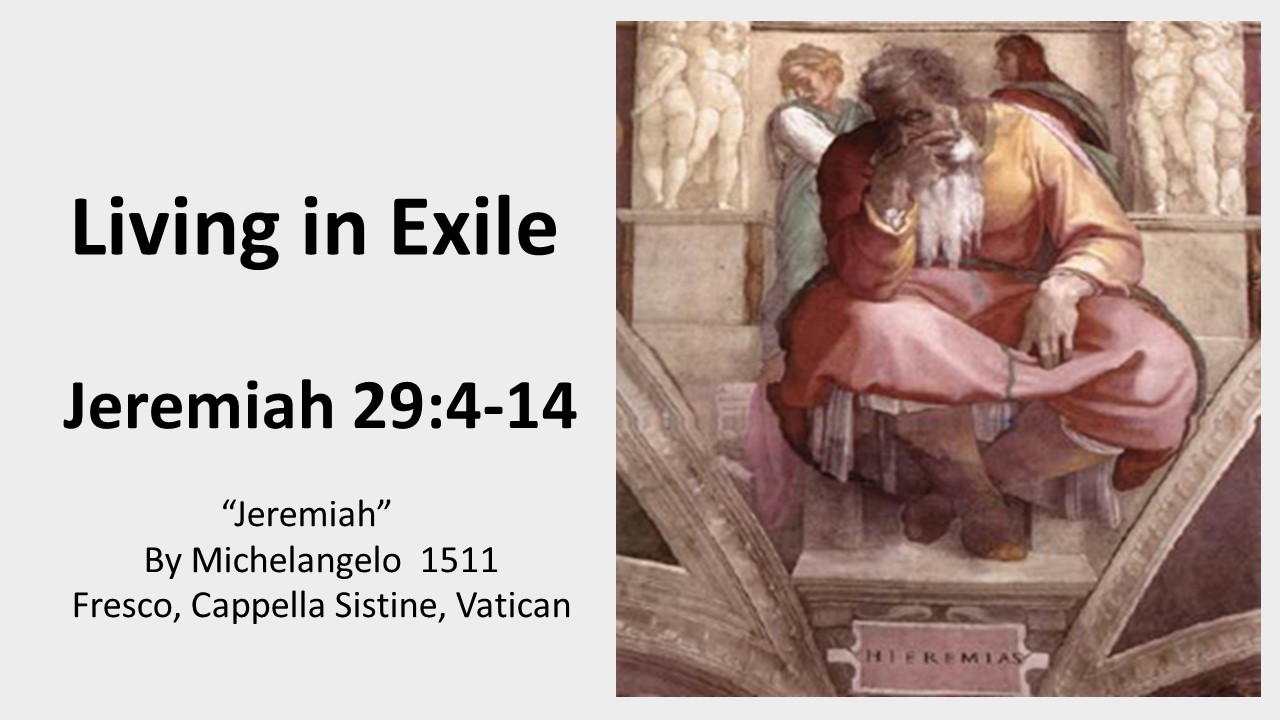
Let’s imagine ourselves in the 6th Century before the Common Era and join Jeremiah. Having left the city, the prophet walks alone, across what should be a grain field. With each step he kicks up dust. The immature stalks of grain, long dried under the desert sun, crunch under his feet. This should be the time of the harvest, but there are no men out swinging sickles nor women gathering sheaves. The grapes and the figs and the olives area also shrivel on the vine. The harvest has failed. There’s going to be hunger. And with Nebuchadnezzar’s army on the loose, there won’t be a chance to trade for food. Jeremiah’s heart is heavy. As he looks back toward the walls of the city, he cries. He images the bloated bellies of the young and the riots when there is no more bread in the market.
“We are not saved.” What painful words. It’s tough being a prophet, bearing the burdens of a people. Yet, as he cries, he hears something. A voice? Can it be God’s voice? “I’m disappointed. Why have they provoked me to anger with their images and foreign idols?” Yes, it’s God, speaking judgment on the Hebrew people.
Jesus told those in the synagogue in Nazareth that a prophet is never accepted in his hometown.
While Jeremiah was considered a traitor in his life, looking back we cannot help but to see that he was a true patriot. God’s people are not called to be loyal to a king or even to a nation. Our first loyalty always belongs to God and when we fail to put God first, we risk hardship, judgment, and perhaps even defeat. Do we have the faith and the perseverance of Jeremiah? Are their Jeremiahs in our society today? If so, do we listen? Or do we tune him or her out, or worse, mock and abuse?
You know, on the 22nd, we’re going to have our first community forum to discuss civility. If we want to build a better society, which is one of the goals of the church as we are to be a part of building God’s kingdom, we must listen to others. I hope you plan to attend and to tell others about the forum. Go to our church’s Facebook page and like the event and share it with others on your page. We have got to get our community and our nation on a new direction. We need to be about listening to all voices, even the voice of a Jeremiah, crying a fountain of tears. Only by listening to others who challenge us, like Jeremiah challenged Jerusalem, will we be able to build a better society.
Let’s go back to that day, some 2500 years ago, and join Jeremiah once more… The heat of the day is over when Jeremiah starts back toward the city. Having wrestled with God through lament, Jeremiah is more assured than ever of God. Ahead, the city David claimed his capital, is magnificently lighted by the setting sun. As the even breeze picks up, Jeremiah picks up his pace.
Jeff Garrison 
Beautiful pottery breaks. Today, during the sermon, hold on to the shard you’ve been given, and ponder God’s judgment. Think about what it means to be broken, unfixable. But don’t throw away the shard. When the service is over, take it over to Liston hall, where we’ll attempt to put it back together and see what kind of design Sue Jones created for us.
For the people of Jeremiah’s day, storm clouds are gathering. It’s not looking good. It’s kind of like that vision we get from the song “Ghost Riders in the Sky,” those wayward cowpokes who are eternally damned to chase the Devil’s herd. Storm clouds are always frightening. But let’s think about ourselves.
You know, we have blessed as a nation in that no foreign army has invaded us for over 200 years. The last was during the War of 1812. It’s been a century and a half since those of us who are from the South experienced the horrors of having towns and cities burned, armies destroyed, and people suffering. We can only image what it was like for the people in Savannah during that Civil War, hearing the distant bombardments of Fort Pulaski and Fort MaAllister, and then, in 1864, the rumors building fear as Sherman’s army approaches.
In this section of Jeremiah, the approaching Babylonian army is described as a hot wind blowing up a frightful dust cloud off the desert. This could be like the dust clouds off Africa that eventually turn into hurricanes that threaten our coastline. In the part I skipped, we hear how the rumors begin to filter down to Judah and Jerusalem, starting way to the north, above the Sea of Galilee, in the territories of Dan. We know a similar drill with hurricanes as they approach the Leeward Island and the Lesser Antilles and the Puerto Rico, Dominican Republic, Cuba, and the Bahamas as the storm makes its way across the South Atlantic. Sometimes these storms are like Jeremiah’s vision, bringing total destruction. Just as we hurt seeing the damage Dorian caused the Bahamas, we also worry what might happen to us if the storm doesn’t turn, Jeremiah is bothered by his vision. He can see it happening and cries out in anguish. But despite the heartache of what he sees, he faithfully proclaims God’s word.
The second part of my reading describes the aftermath. Destruction is total. Starting with verse 23, the poem recalls the “dismantling of creation.”
For Christians living in America, we may have a hard time relating to Jeremiah’s vision. But many Christians, those living around the globe in places where it’s dangerous to worship Jesus, recognize Jeremiah’s anguish as their own. For them, gathered around this table on World Communion Sunday, they are in danger. They know what it means to worship in fear, to experience the loss of jobs, of their homes and their land because of their faith. They know what it means to be locked up, to be tortured, and to watch loved ones be taken away and never return because of their faith. Christians are suffering in China, in Eritrea, in North Korea, in Iran and Iraq, in Syria and parts of India. We must stand by those who do not enjoy the freedom to worship as we enjoy it.
Remember, we have an insight Jeremiah didn’t have. We know about the resurrection, how the grave is not the end. Jeremiah knew that somehow God’s destruction wasn’t going to quite be total. We know that even if it appears total, as it does at death, as when we peer down into the grave, God is still God and the end is not the end.
The center of the gospel is the hope we have in the resurrection to eternal life. And for that reason, we can face those storm clouds. We can face the stampede of Satan’s herd and the cowboys running roughshod across the skies, and know that as bad as things are, there’s hope. We may feel like we’re just broken shards of pottery, but God has the power to make what’s broken new and whole. Believe in God. Hold on to such hope. Amen.