
Jeff Garrison
Skidaway Island Presbyterian Church
John 20:1-18
Easter Sunday, April 12, 2020
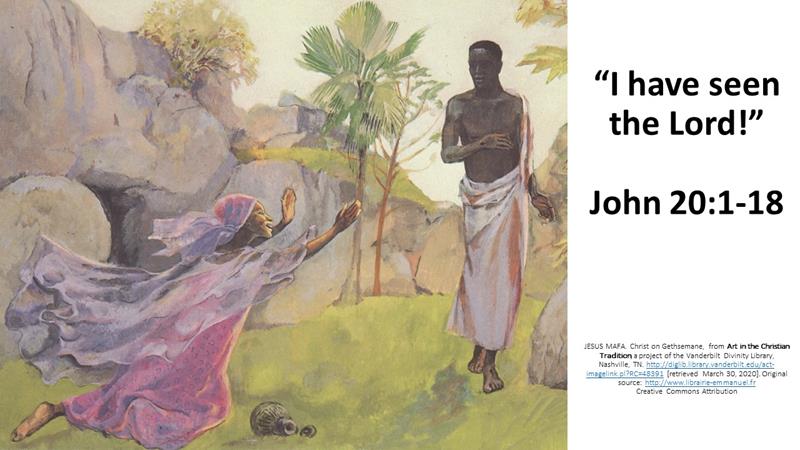
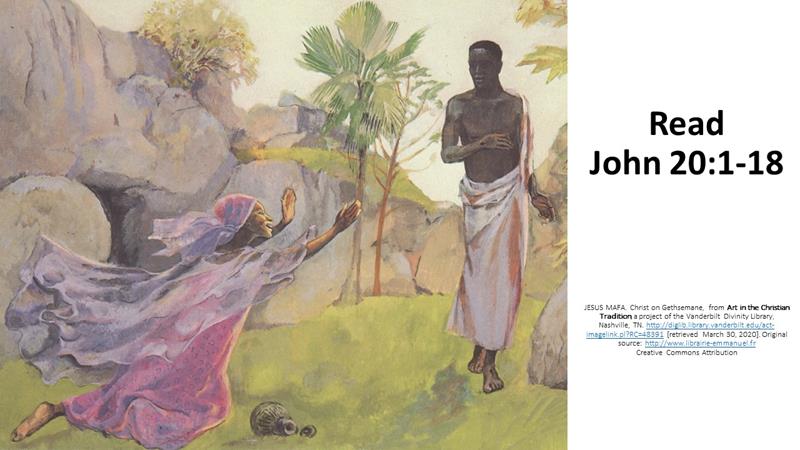
Throughout Lent, we have been looking at pieces of art from around the world as a way to get into the Scriptures for each Sunday. We’re going to continue this tradition through the Easter Season. Today, we are looking at another artwork from the country of Cameroon, as the artist imagines Jesus and Mary Magdalene looking like the people of that country. Let’s think for a moment about what Mary Magdalene is thinking up to this point in the story:
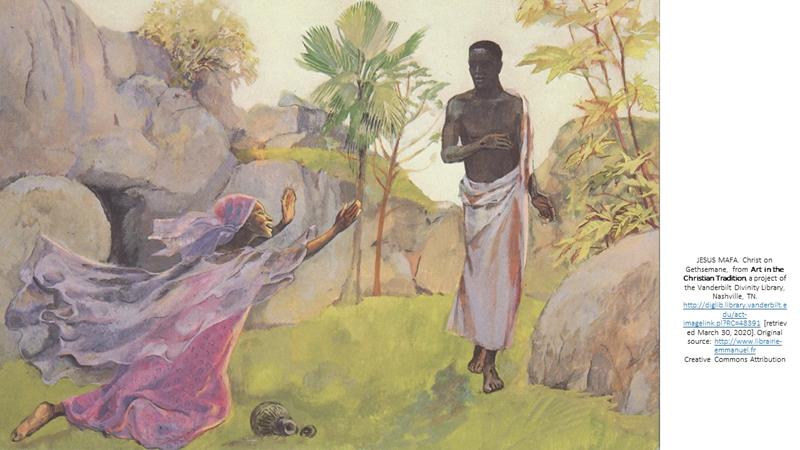 I’ve stuck by Jesus ever since I encountered him that day on the road, long before we came to Jerusalem, when he freed me of those seven demons that had tormented me.[1] I gave him what I had to support his ministry. I followed him from Galilee to Jerusalem. This past week has been overwhelming, from the glorious entry into Jerusalem, beginning with the waving of palm branches and the shouting of Hosanna. Whenever I could be close to Jesus and listen to his teachings, I was there. I heard him teach in the temple about giving to Caesar what was Caesar’s and giving to God what was God’s, and about the generosity of the poor woman with two coins, whom most ignored, but whom Jesus lifted up as an example of faith. I was there, in the background at the dinners, and I followed Jesus as he was led away like a criminal. How a man who had freed me of such evil could be considered a criminal and a threat to the nation, I’ll never understand. I watched in horror as he was beaten and mocked and then led to the hill of death, where they crucified him. I couldn’t believe what was happening.
I’ve had a hard time sleeping the last two nights. I kept wanting to be with him again, but I know he’s dead. When the birds began to sing in the predawn hours, I decided to get up and head to the tomb. I wasn’t prepared to find it empty, and Jesus’ body gone. I wondered where they had taken my Lord, and ran and told the disciples. Afterwards, as I was wandering around lost, I couldn’t believe my ears. He called me by name, “Mary.” Things are never going to be the same…[2]
Now let us listen to today’s lesson as I read from the 20th Chapter of John’s gospel.[3]
 We have spent all of Lent looking at the last week of Jesus’ earthly ministry: From the entry into Jerusalem on what we call Palm Sunday, to the teachings at the temple and the various dinners and then the betrayal that led to Jesus’ death. On Friday, we appeared to be the end of the story. Jesus is dead. His lifeless body is sealed in a tomb as the sun is going down on the day for preparing for the Sabbath. Everyone returns to their homes or where they’ve been staying. I’m sure Caiaphas, the chief priest, and Pilate, the Roman governor, along others in leadership positions are glad to be done with this rabble-rouser. They may have even rested well on the Sabbath. Others, like the disciples and those who had followed Jesus were troubled. But they, too, felt it was over. They saw Jesus’ limp body be taken from the cross. But, as we know, the story doesn’t end.
 John begins the 20th Chapter with several statements about time. It’s early. It’s the first day of the week. In the first chapter, John’s gospel has an echo of Genesis. Both start the same way, “In the beginning…” John takes that well-known phrase from the opening chapter of Scripture and applies it to Jesus. Jesus, the Word, was with God at the beginning of creation. God is doing something new. As in the seven days of Creation, when God created heaven and earth, we now have a new week. In the first week of Creation, God created humanity, the crown of creation, on day six. Now, on day six, God once again does his triumphant work, reconciling a sinful humanity with the divine through the sacrifice of God’s Son. That’s Good Friday. God rests on the seventh day, the Sabbath, our Saturday. And then, on the first day of the new week, in those early morning hours, God begins a new age.
 As Paul proclaims, Christ is the first fruit of those who died.[4] With the resurrection of Christ, God is beginning to do something new. N. T. Wright explains in his essay on John 20, the Easter story is more than just God putting a happy ending to a really bad week. Easter is the beginning of God’s new creation. The work of the Father in creation, and the work of the Son in redemption, are complete.[5] It’s now the eighth day. We’re in a new era.
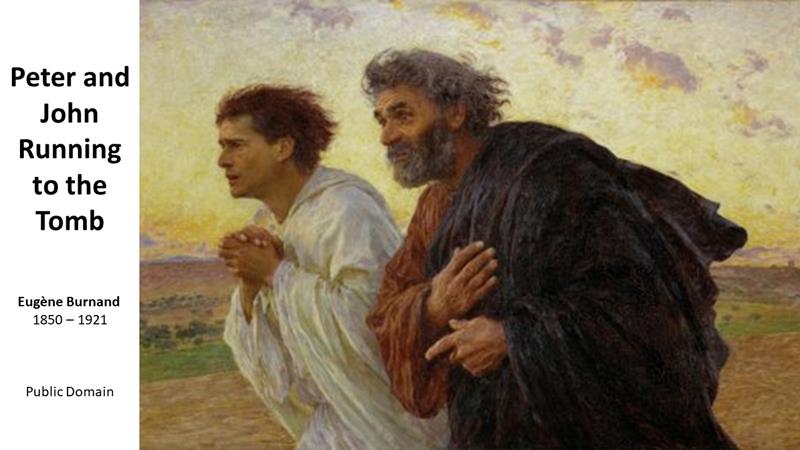 The reports of this new era start with a restless Mary Magdalene going to the tomb while it’s still dark and seeing that it’s open. Of course, her experience, as is ours, is that once you are dead, there’s no coming back. So she runs to tell the disciples. Two of them, Peter and probably John, race each other back to the gravesite.[6] And there they find an empty tomb, with the linen cloths that had wrapped Jesus’ body left behind. But none of them know what to think. In verse 8, we’re told that the faster disciple believed, but what did he believe? The next verse seems to indicate that he only believed the tomb was open, and that Mary’s report was factual. They did not understand that Jesus must rise from the dead. So instead of hanging around, they head back to bed.
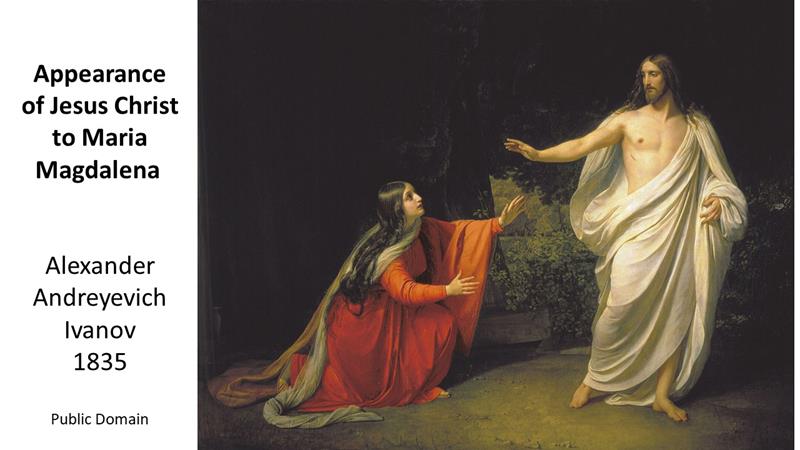 Mary hangs around. We get a sense of what she is thinking when she answers the angels who want to know why she’s crying. “They’ve taken away my Lord, and I don’t know where they laid him.” Mary Magdalene still believes that Jesus is dead. She assumes, because she can’t imagine otherwise, that some grave robber broke into the tomb and took the body away. In her mind, this is a terrible deed. It would be a terrible deed. You don’t mess with dead bodies. Even our military prosecutes soldiers who desecrate enemy dead. After all, once they are dead, they no longer pose a threat and are no longer enemies.[7]
Mary Magdalene, who has a front row seat at what God is doing, can’t imagine what’s happening. Even when she first sees Jesus, she assumes he’s the gardener. After all, dead men don’t walk around. She thinks the gardener may even be responsible for removing Jesus’ body. It’s only when Jesus calls her by name does she realizes that what has happened is more marvelous than she could ever imagine. John has already told us that the Good Shepherd knows his sheep by name.[8] And Jesus knew Mary, and when she hears her name, she recognizes him.
In Jesus’ post-resurrection appearances, he is always assigning his followers with a mission. Jesus assignment for Mary Magdalene is insightful. Go and tell my brothers…” he says. The disciples are elevated; instead of disciples, they’re now brothers, on equal terms with Jesus. Furthermore, Mary is lifted up into this family, for Jesus tells her that he’ll ascend to “my Father and your Father, my God and your God.” Having been called by name, Mary Magdalene is now a part of Jesus’ family.[9] She runs off to obey Jesus, going to the disciples and saying “I have seen the Lord!” Could there ever be a more wonderful proclamation? Their world would never be the same.
 This is an Easter unlike any we’ve experienced before. Instead of being together, wearing new clothes, bringing flowers to decorate the cross afterwards while kids hunt Easter eggs, we’re all separated as we strive to stop this virus that has unleashed death upon the earth. In some ways, we’re like the disciples, who were essentially hiding on that first Easter. Yes, Mary was out, as well as Peter and John for a short period, but once they saw Jesus’ body is gone, they head back to where the rest of the disciples are hiding. In fact, if you keep reading, you’ll see the disciples were not only hiding, they were behind locked doors.[10] But this time of isolation didn’t last for them, nor will it last forever for us. Sooner or later, things will go back to some kind of normality.
We will once again be able to gather and to enjoy each other’s presence. Yes, we’ll once again show off Easter bonnets and hunt eggs and flower a cross. But we won’t be able to go back to exactly the way things were, and that’s okay. This was true for the disciples, too. They didn’t go back to those carefree days of traveling around Galilee with Jesus. But that was okay, too, because they were experiencing something new and even better. They got to tell the world the good news.
 This is the meaning of this “great pause” we are living through right now.[11] In a way, we’re given a gift. We have the time we need to ponder what’s important in our lives. And if we can hold on to what’s important, what we value and cherish, our lives after things return to normal will be much richer. Friends, use this time, this gift, to grow closer to our Lord and to learn to depend upon him. And if we do that, we can be like Mary Magdalene, so when our Savior through the Holy Spirit calls us by name, we’ll be ready to answer. Amen.
©2020
[1] Luke 8:2
[2] Inspired by John 20 and an article on Mary Magdalene in Frederick Buechner, Peculiar Treasures: A Biblical Who’s Who (New York: Harper and Row, 1979), 101-103.
[3] In the worship service, the Reverend Deanie Strength will do the opening monologue of Mary Magdalene’s thoughts and read the Scriptures.
[4] 1 Corinthians 15:20
[5] N. T. Wright, Surprised by Scripture, (New York: HarperOne, 2014), 209.
[6] While John’s name is not given, it is generally assumed that he is the other disciple.
[7] For such rules from all nations including the United States, see https://ihl-databases.icrc.org/customary-ihl/eng/docs/v2_rul_rule113
[8] John 10:3.
[9] Frederick Dale Bruner, The Gospel of John: A Commentary (Grand Rapids, MI: Eerdmans, 2012), 1152 & 1154.
[10] John 20:19.
[11] The term “great pause” comes from Julio Vincent Gambuto, “Prepare for the Ultimate Gaslighting,” April 10, 2020, https://medium.com/@juliovincent/prepare-for-the-ultimate-gaslighting-6a8ce3f0a0e0.
 Jeff Garrison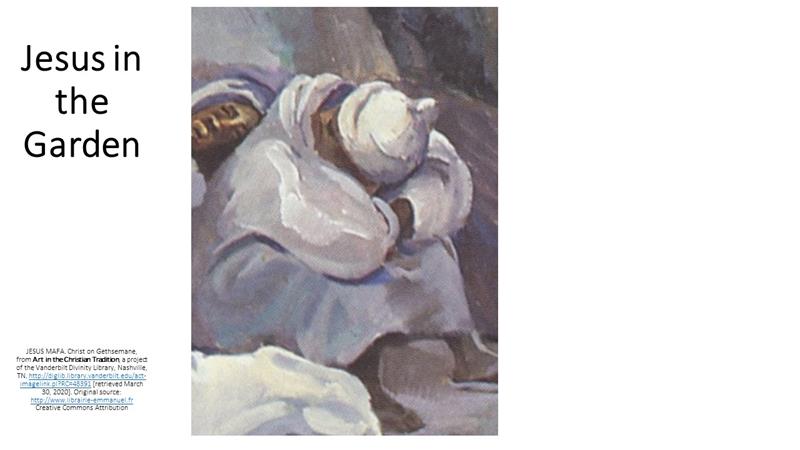
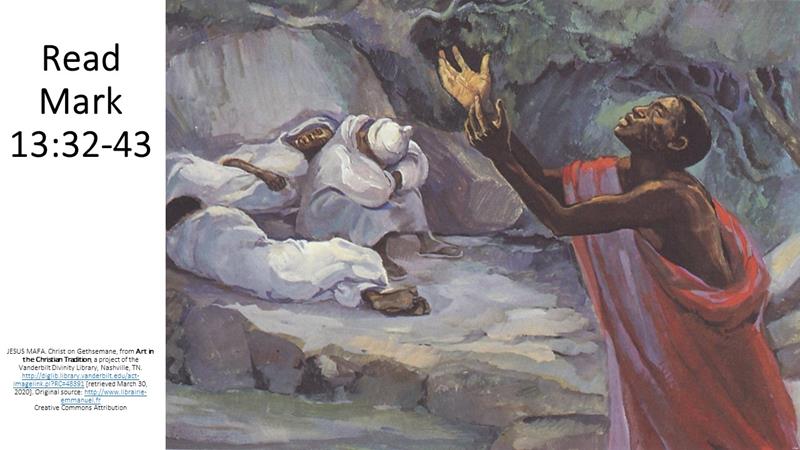
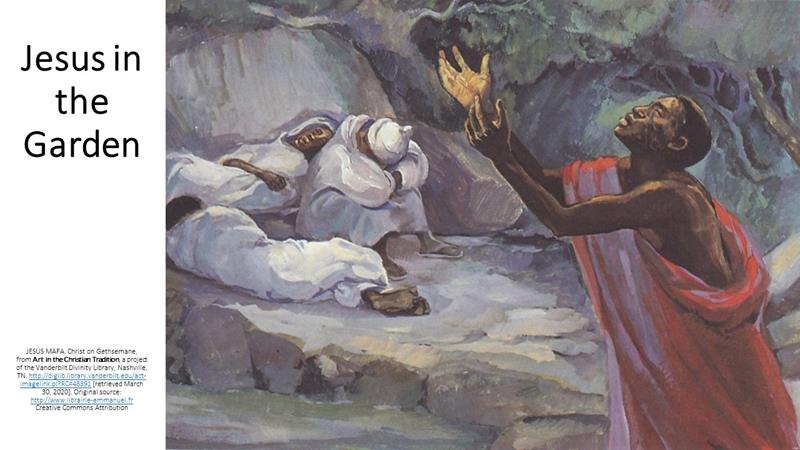
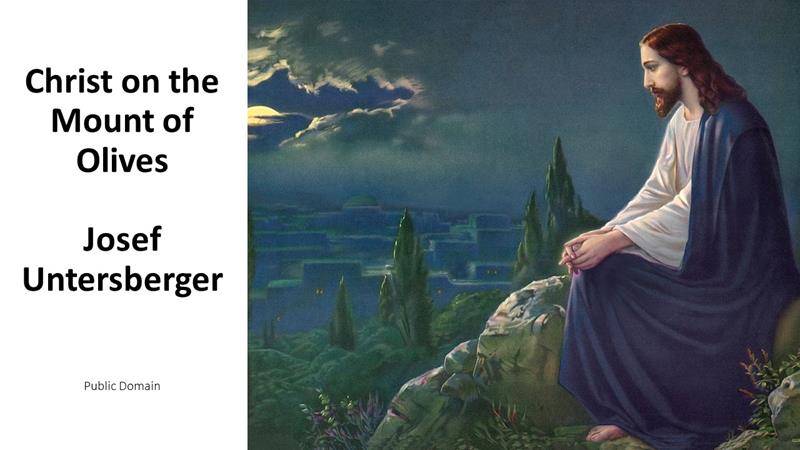 There are many paintings of Jesus praying in the garden in addition to this one from Cameroon. One of my favorites hung in the Session room in the congregation I served in Utah. I always felt it was an appropriate picture for a board room. Board rooms often have photos of the company founders, or the company president. Such paintings remind us of our heritage. Having Jesus in a church board room reminds us of who’s really in charge. It’s not the Session. Jesus Christ is the head of the church.
 Leaving the bulk of the disciples behind, Jesus takes the three disciples that consist of his inner-core and heads into a garden. For those steeped in Scripture, a garden recalls the perfect adobe of Adam and Eve, but also the temptation that occurred there.
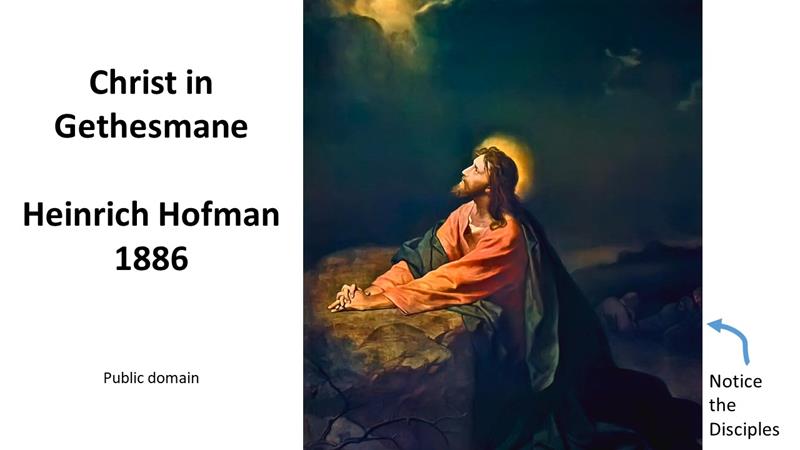 Jesus positions the three disciples close by. While he wants to be alone with the Father, he also wants to be close to friends. He asks them to stay awake. Yet, they immediately fall asleep. Was it the wine? Was it the exhausting schedule? Are they worried and depressed and the only way they can shut their brains off is through sleep? Jesus steps away and prays, then comes back to check on the disciples. He does this three times. Each time, they’re asleep. This compounds his troubles. He will have to go through the experience all alone. After his third trip back to the disciples, he arouses them and announces the arrival of the betrayer.
 What can we learn from this story? Let me suggest three things. First, to prepare ourselves for trouble, we need to take our concerns to God in prayer. Prayer is important even when we know the answer we’ll receive might be no.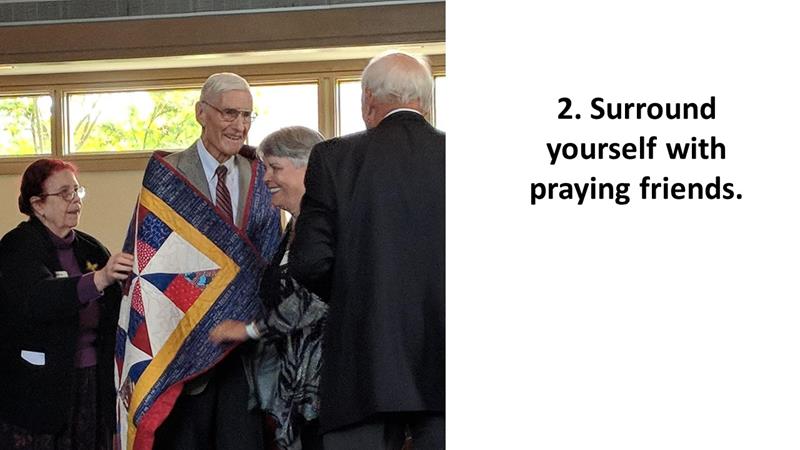
 A second thing we can learn from this story is that there is a benefit of being supported in prayer. While God will hear our prayers, there is something to be said about having others praying with us. Like they were in the garden, separated by some distance, and like us now dealing the COVID-19 and being separated by six feet, we need to remember that we don’t have to lay hands on one another for our prayer to be effective. We must be willing to ask or to be asked to pray. And when someone asks us to pray for them, we should consider it an honor and fulfill their request. It helps to be supported in our prayer.
 And finally, we learn that even when we fail come through (and we’re all human and won’t always do what we should), we should remember that God doesn’t abandon us for petty failures. Look at the disciples. None of them could keep their eyes open on this most important night of their lives, but Jesus didn’t throw them under the bus. Instead, he faithfully kept his promise and even though Peter would go on to deny him, Jesus would use him to build his church. In fact, these three—Peter, James and John—would all become major players in the church following the resurrection. So even if we fail, don’t lose hope. Keep going and trust that God is with you.
 Jeff Garrison
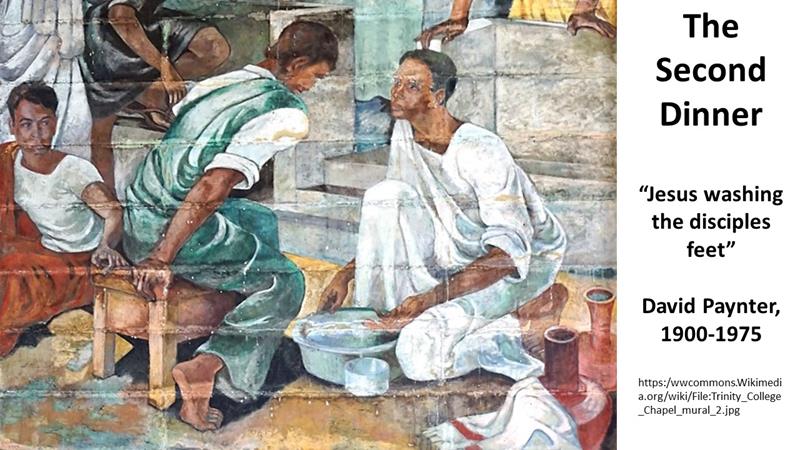
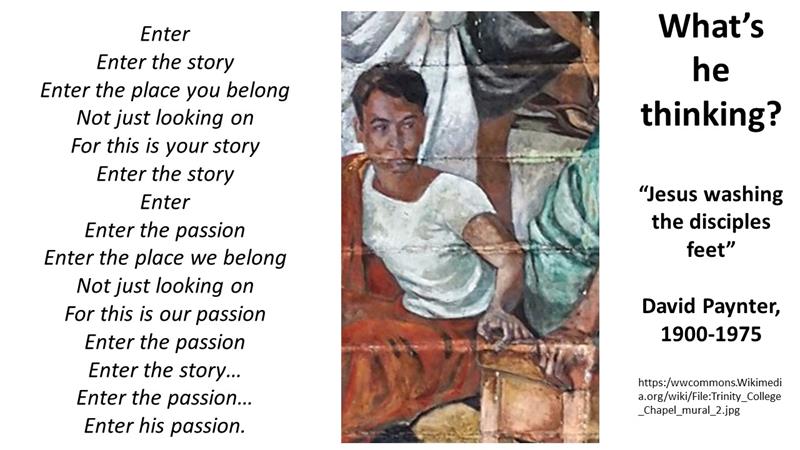 Jesus and the disciples have booked my master’s banquet hall. I have prepared everything according to their wishes and am ready with the water and basin as I always am. Years ago, my parents gave me to the owner as collateral for the debt they owed. But things did not go well for them, and the debt was never repaid. And so, I work to pay it off. Roman law says that someday I could be a freed person, but I will never again have the full rights in society. I’m marked as a slave for life. I keep my head down and do what the master asks because legally he has the right to punish me.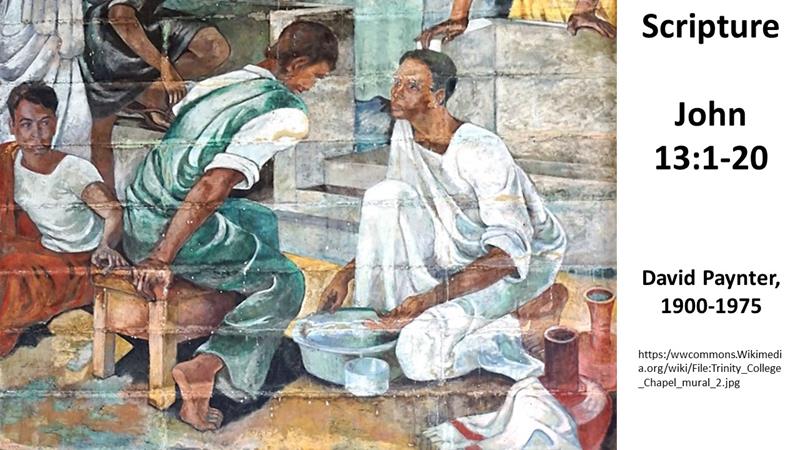
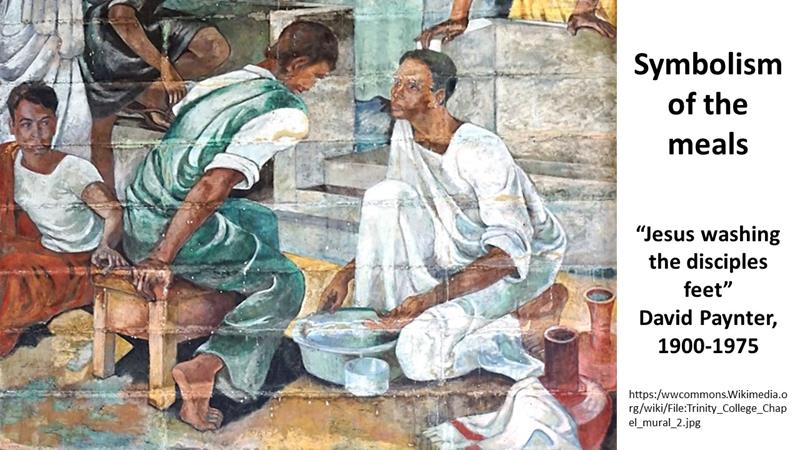 Last week we explored the first meal recorded during Jesus’ final week of earthly ministry. This is the dinner in Simon’s home interrupted by the woman with perfume anointing Jesus. Today, we’re looking at the second meal of this week. Of course, there weren’t just two meals eaten during these seven days. These are just the two recalled in the gospels. Both meals are rich with symbols. Last week, we could almost smell the expensive perfume being poured. This week, we have the bread and the wine, the foot washing, and the betrayal, all mixed in. We know this dinner as the “Last Supper” and there’s enough material here for two dozen sermons. I promise I won’t exhaust the passage.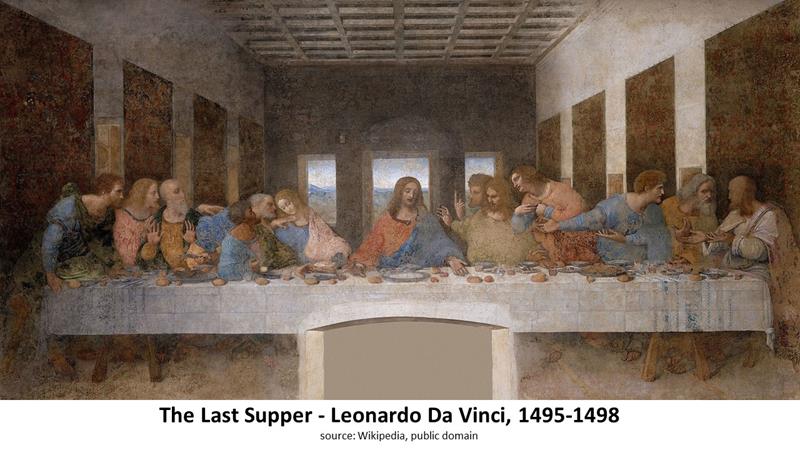
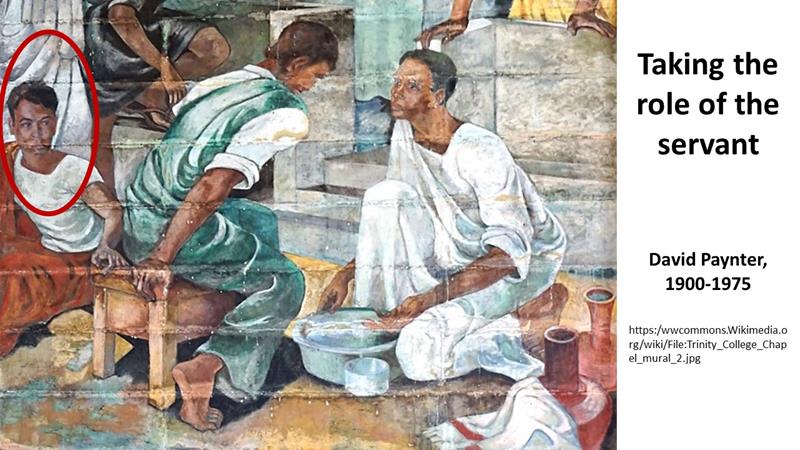
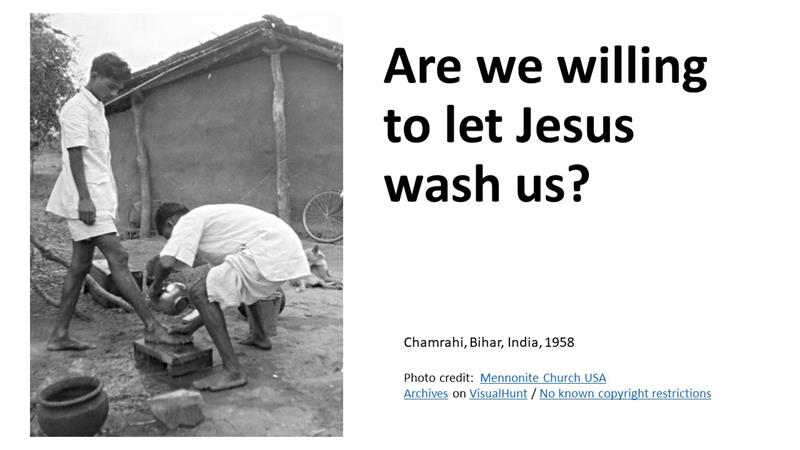
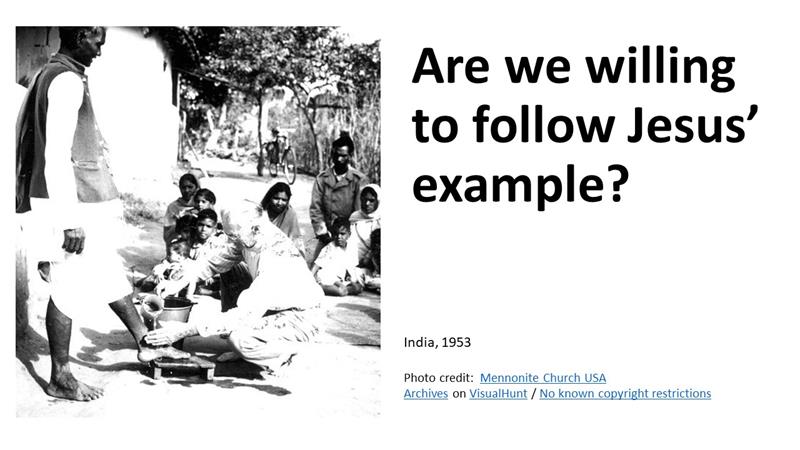 The second implication of the foot washing is ethical. “I’ve done this for you,” Jesus says, “so you need to do it to one another.” Jesus has shown us how to live our lives. We are called to live in mutual service, showing submission to one another, being willing to forgive when we are wronged, and having patience. All these traits, Jesus demonstrated. We too must learn from the Master. We must be willing to follow his example.
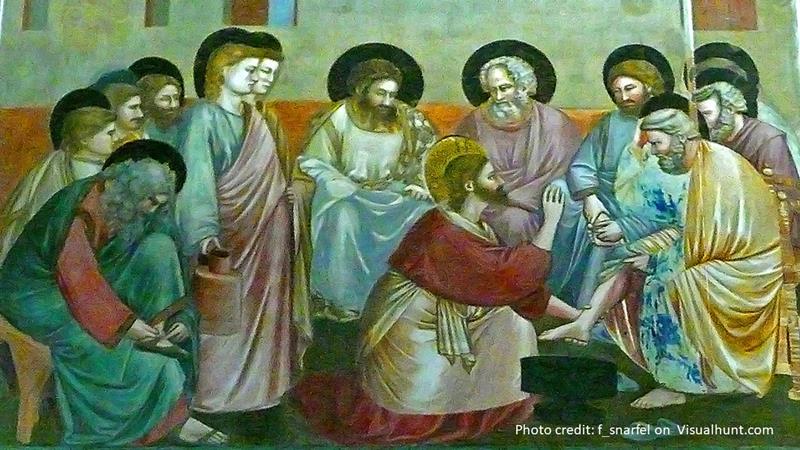 Jesus comes before us at the table, with a towel wrapped around his waist and a basin. He kneels. Do we let him wash our feet? And, if so, are we willing to humble ourselves and serve others in the manner that he has served us? These are questions we need to ask ourselves. Amen.
 Jeff Garrison
  None of us are happy with the way things are going in Jerusalem. It’s not just the political oppression. We’re troubled by the dire situation of the hungry, the poor, the sick, and the disturbed. The Roman’s don’t’ care about them? At least we try. Every penny we scrape up we try to pass on to those who need it. Before Jesus arrived for dinner, some of us were also wondering if we should save some money in case we needed to hide out in the not-too-distant future.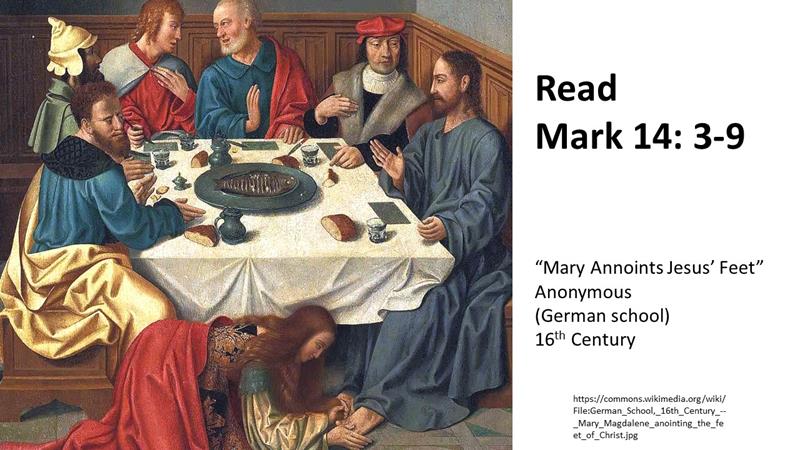
 There are two big meals highlighted in the final week of Jesus’ earthly ministry.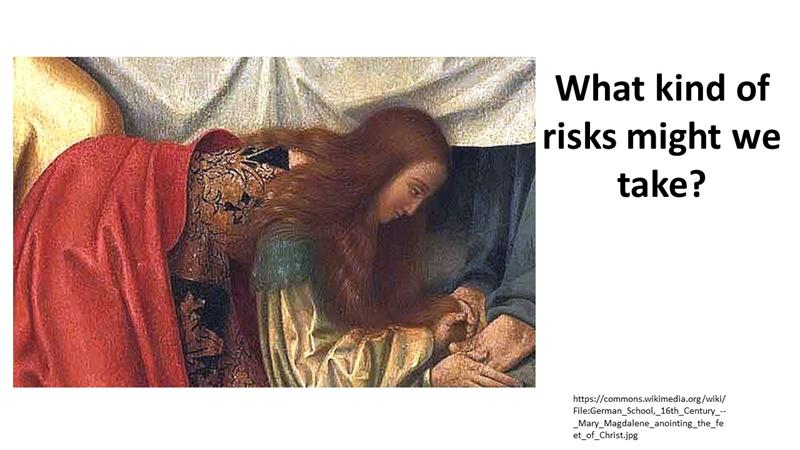
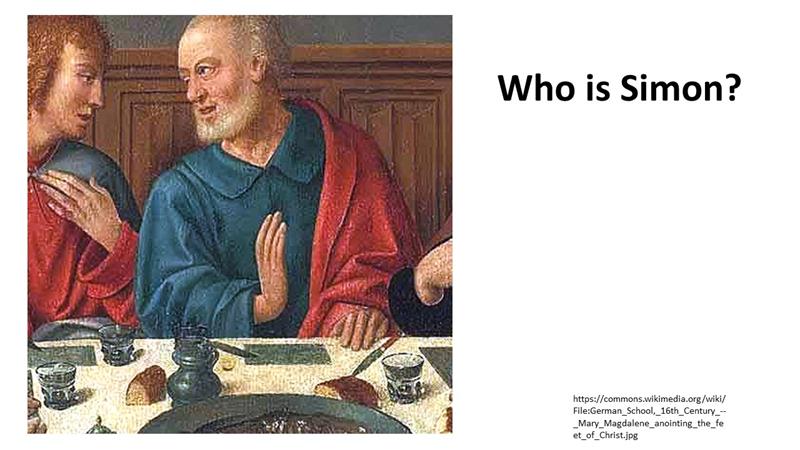
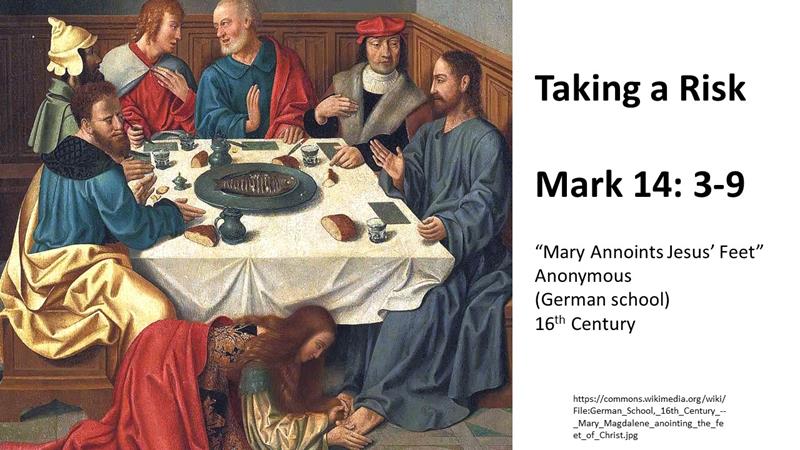
 Now consider the risks this woman takes. She shows up uninvited. She shocks the guests with her generosity. Ever give a gift and wonder and worry if it would be accepted? Her gift does upset those around the table. Why isn’t this money being given to the poor? They ask. Jesus’ protects her dignity, saying she’ll be remembered because of what she’s done. And Jesus doesn’t stop there. He goes on to say we’ll always have the poor, but he won’t be around long, at least not in person.
 In Matthew’s gospel, we’re told that helping the poor and needy, the sick and the prisoner, is the same as helping Christ,
 What can we do? We certainly can’t heal the world, just as the woman couldn’t keep Jesus off the cross. But what kind of risk might we take for Jesus? Things are changing so rapidly around us. It’s scary. But we need to remember, this is not the first time Christ’s church has witnessed pestilence. In the 14th Century, a large percentage of the population died from the plague, but at the same time Great Cathedrals were being built.
 This woman might be seen as a fool for Christ. She faced ridicule, but Jesus protected her dignity and honored her. Don’t be afraid to be a fool for Christ. For our Master will take care of us. Amen.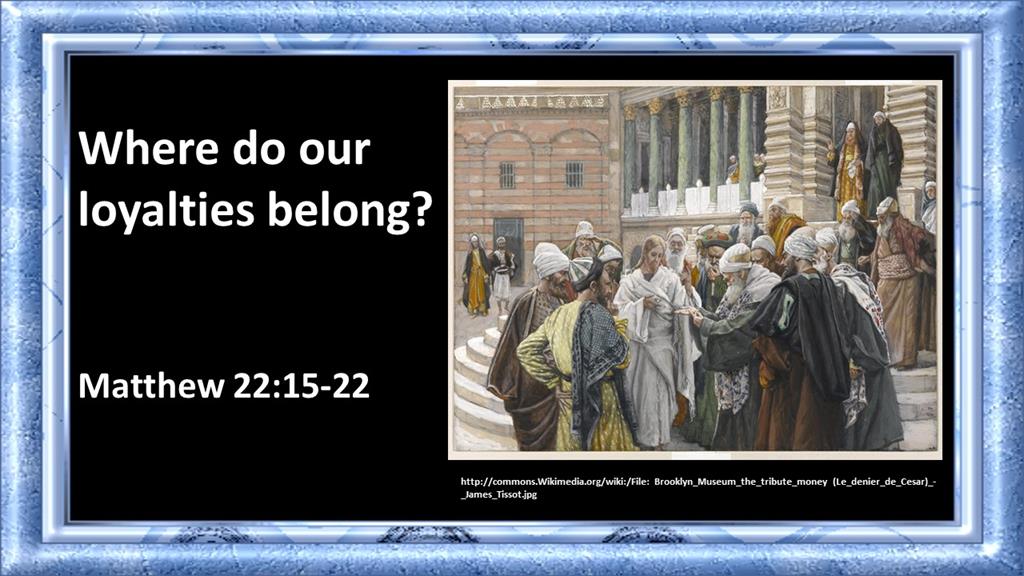
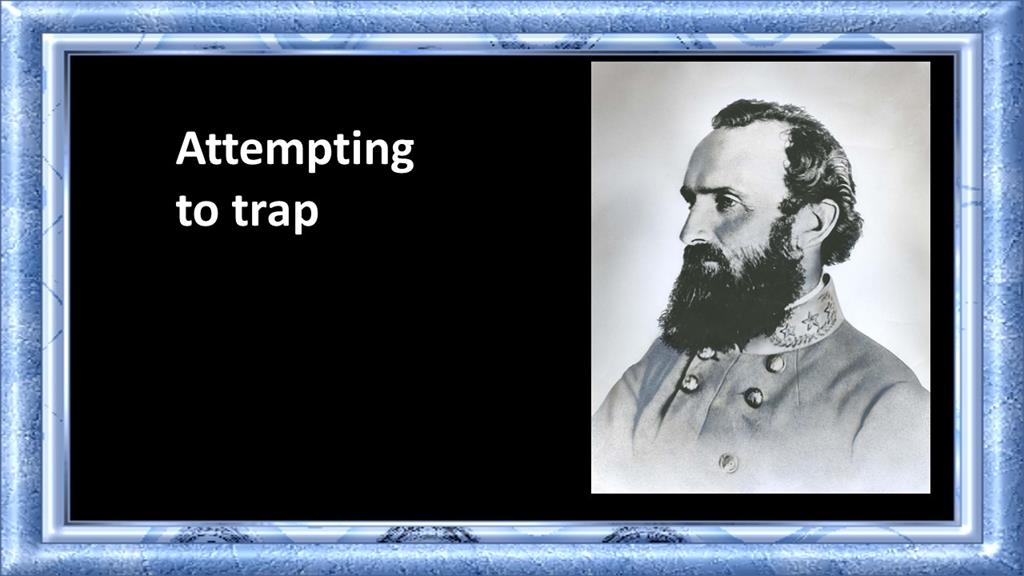 If you read the entirety of Matthew 22 (and with the extra time we may be having on hand as everything is being cancelled because of the Coronavirus, it’s not a bad idea), you’d witness a masterful campaign to trap Jesus. But Jesus isn’t so easy to catch. He’s kind of like Stonewall Jackson in the Valley Campaign in the spring of 1862. Jackson faced much larger armies who wanted to trap and do him in.
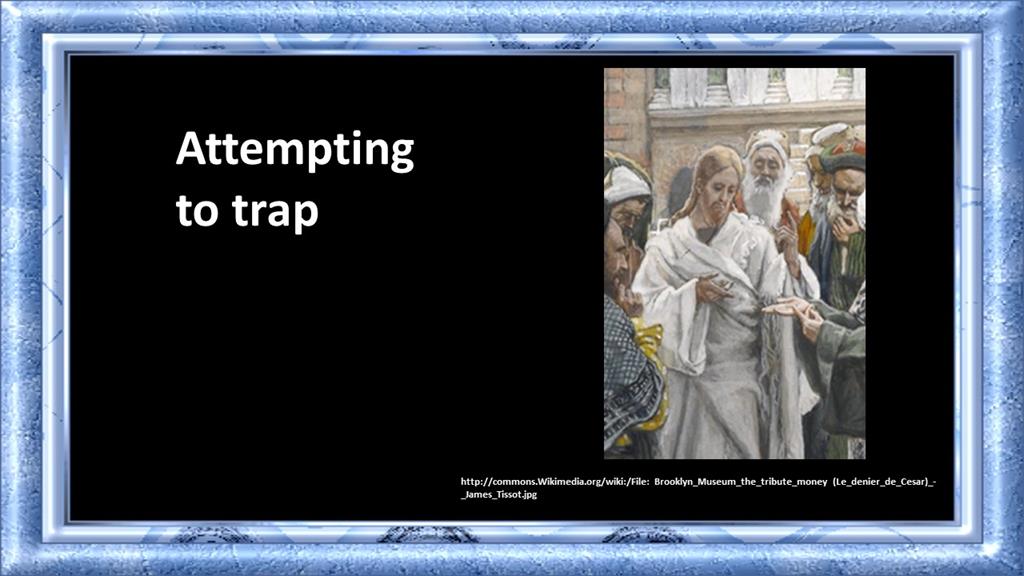 What’s happened is that unlikely groups join together to challenge Jesus. The old cliché, “politics make strange bedfellows,” rings true. Groups who wouldn’t normally give each other the time of day have come together to take on Jesus. They sense that Jesus is challenging the existing order. You have a few Herodians, who are Jews who believe they’re be better off cooperating with the Romans. They take their name from Herod, who had Jewish blood but worked for the Empire. And you have the Pharisees; a group of seriously committed religious leaders who believe in the resurrection. Theologically, they’re most like Jesus, but Jesus constantly challenges them and exposes their hypocrisy.
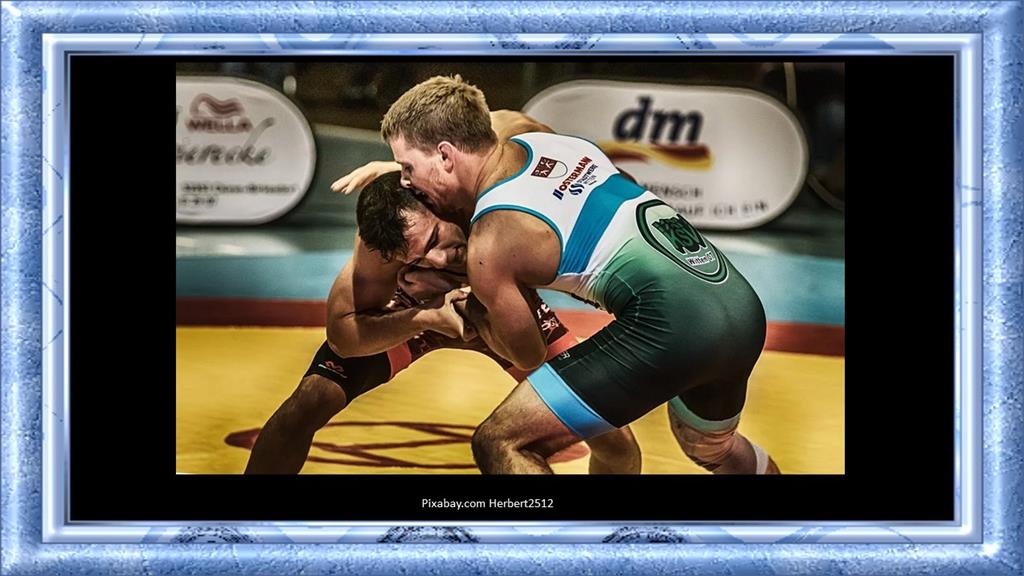 What we read this morning could be described as one movement in a tag-team wrestling match. The Herodians and the Pharisees team up on Jesus.
 So what is Jesus telling us in this passage? Do you remember those big posters that use to sit out in front of the Post Office and government buildings with Uncle Sam pointing his finger and saying: “I want you!” I believe we could easily surmise this text into a big poster of God saying: “I want you!”
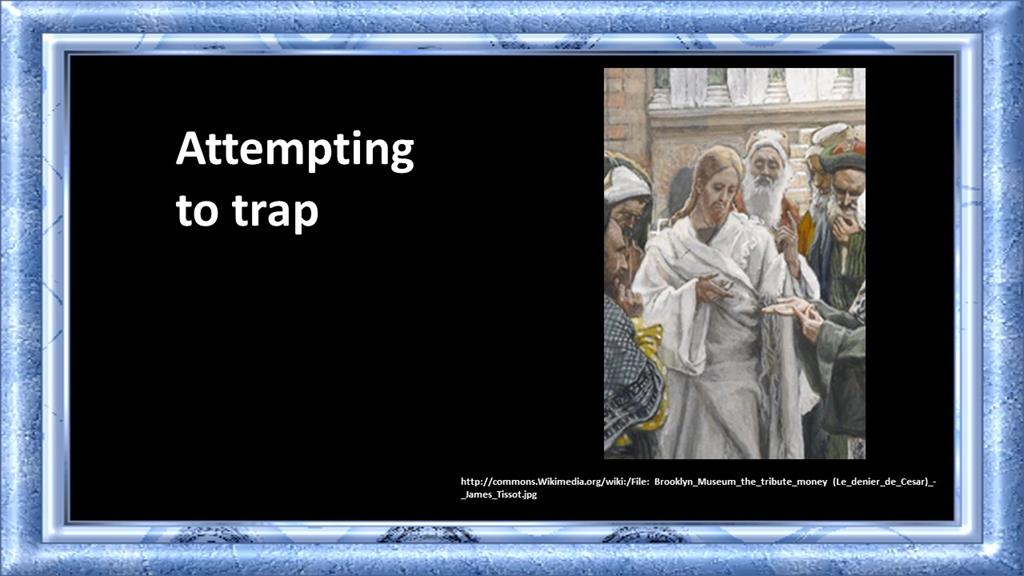 “Tell me,” they ask, “Is it lawful to pay taxes to the emperor, or not?” Jesus has to be careful. Last week you heard Deanie preach about the revolutionary act of Jesus cleaning the temple. Now they want Jesus to make a revolutionary statement against the civil authorities. If Jesus says they should not pay taxes, the Herodians could have him arrested for treason. But then, if he says to pay the taxes, the Pharisees can attack him for not being a patriotic Jew.
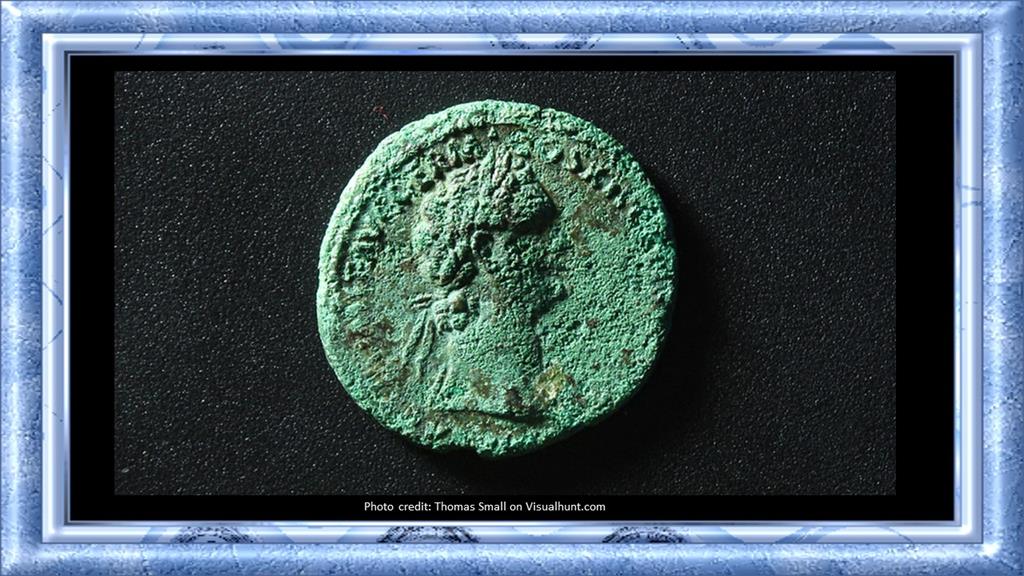 Jesus asks them for a coin. Unlike us, he didn’t have to worry about where that’s coin has been or picking up some a virus from its surface. However, Jesus still has to be careful. The disciples, we know, had a common purse and he could have gone there to fetch a coin, but then the Pharisees might have charged him with toting around an engraved image of the emperor.
 Give to God what is God’s. This phrase is often overlooked. We tend to get hung up on what is Caesar’s and what is ours. We get hung up on the petty details and we miss the important question. What does it mean for us to give ourselves to God?
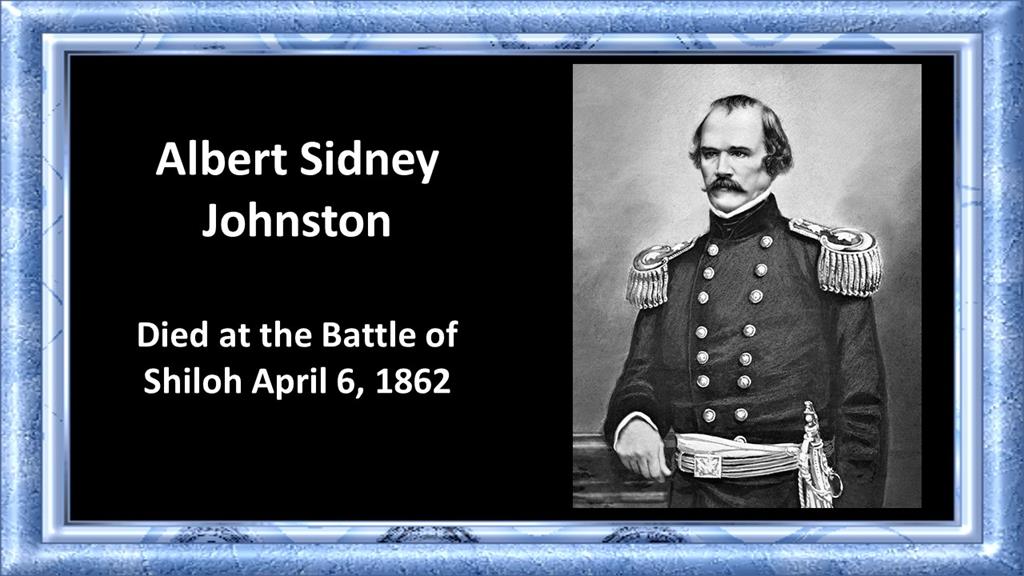 Earlier I mentioned Stonewall Jackson, whose biography I’m currently reading. But let me tell you two other Civil War stories, they’re both short, and demonstrate this point. At the Battle of Shiloh in the spring of 1862, Albert Sidney Johnson led the Confederate troops as they overwhelmed the Union forces near Pittsburg Landing along the Tennessee River. It was a bloody day and the Union lines were broken in places. During a lull in the first day of battle, Johnson, seeing a number of wounded Union soldiers in need, ordered his surgeon to set up an aid station and to tend to their needs. According to Shelby Foote in his novel about the battle, his surgeon, Dr. Yandell protested. Johnson cut him off saying “These men were our enemies a moment ago. They are our prisoners now. Take care of them.” A few minutes later, a stray bullet struck Johnson’s leg and without medical aid, he quickly bled to death.
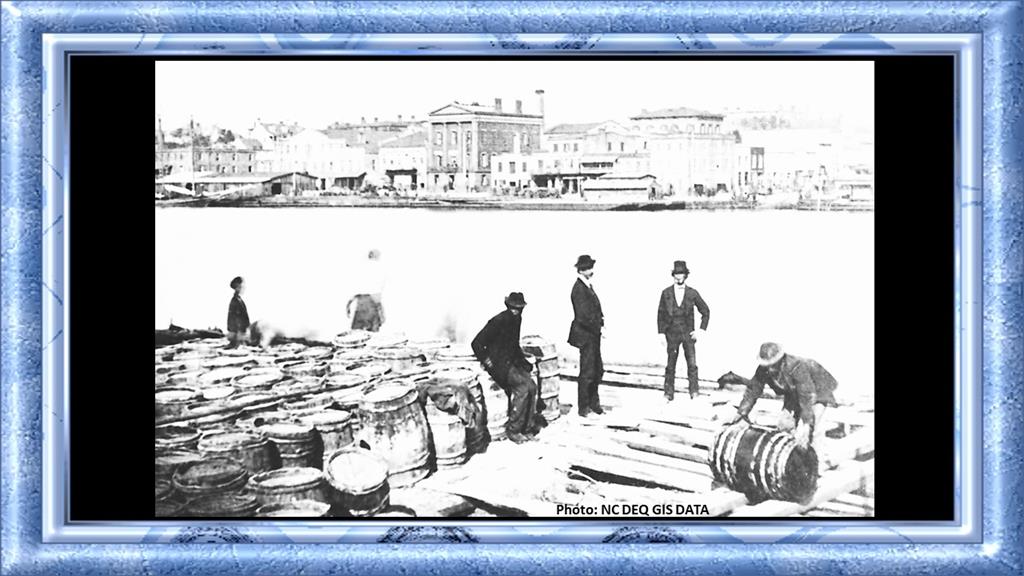 A second story comes from the city of Wilmington during the Civil War. In 1862, a blockade runner that had come in from the Caribbean brought Yellow Fever to the town. Those who could fled to the country, but several of the pastors and the leading citizens of the town stayed behind, feeling it was their Christian obligation to help out the victims. Over 400 people died of Yellow Fever that fall, including many of those who intentionally stayed to care for the dying.
 Give to God what is God’s, is the message here. So yes, we should pay our income tax. And when you write that check this April, we might remember that giving Caesar his due can be a lot easier than giving to God what is his. For our whole life belongs to God. But then, God’s given us life and in Jesus Christ has redeemed us to be his people. That’s a debt we can’t repay, nor is such repayment expected. As the old hymn goes, “Jesus paid it all.”
 Jeff Garrison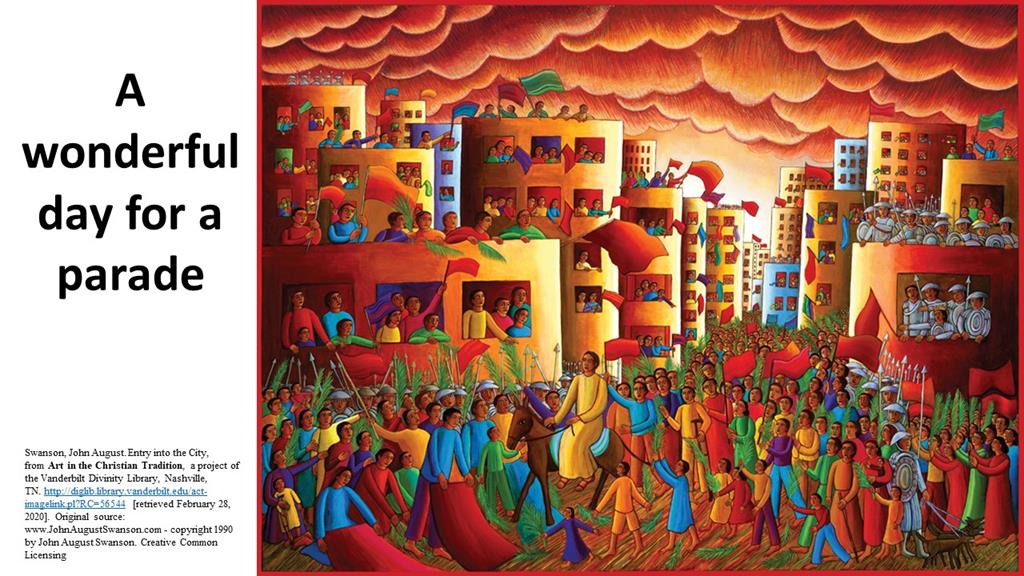
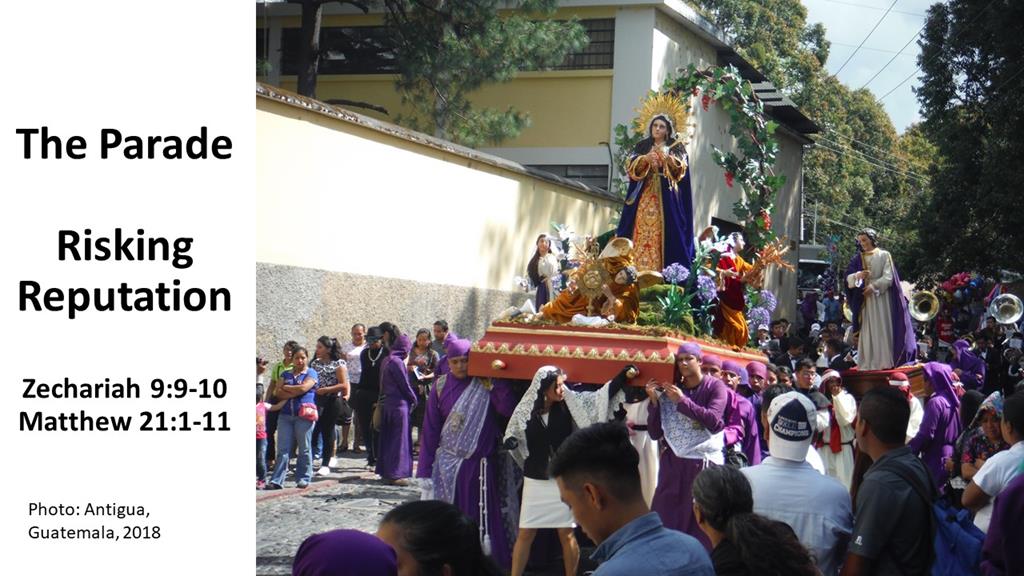
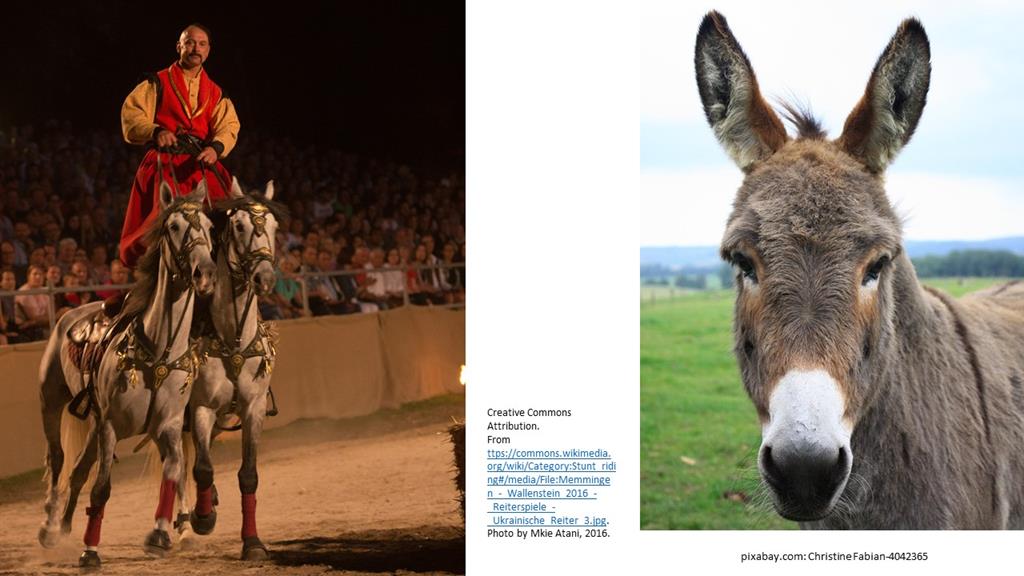 The disciples, without being asked, placed their cloaks on the animals as a saddle. Now, how Jesus rode two animals, as Matthew seems to suggest, we’re not told. We might image him, holding the reigns in his teeth, with a foot on each animal, like a circus rider taking a victory lap, but that’s probably not the case. Instead, he may have sat on the donkey, sidesaddle, as was the custom for riding such beasts, and had the colt follow along, staying close to its mother.
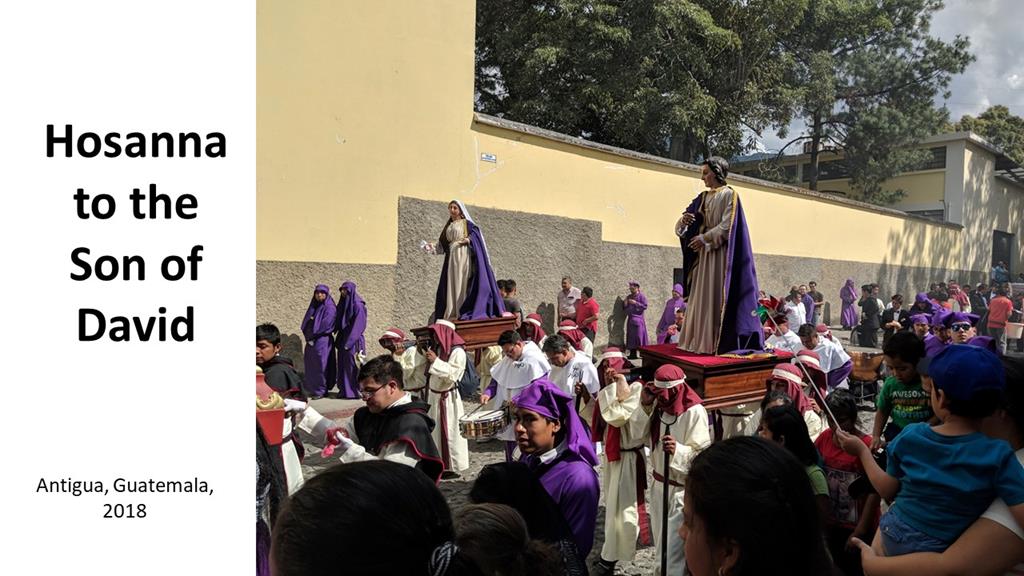 Quickly, as he and the disciples approach the city’s walls, excitement builds. Followers start placing their cloaks on the ground—in Sir Walter Raleigh’s fashion—as the procession begins. Someone brings in branches—we’re not told if they’re palms (the palms only appear in John’s gospel).
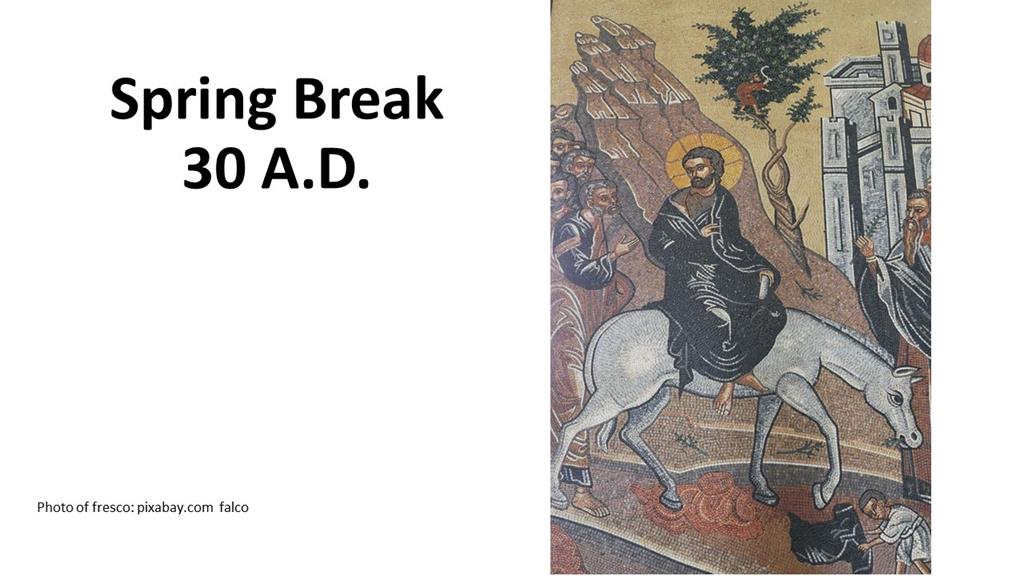 I image its mostly pilgrims making up the crowd. Many of them would have been from the small towns and villages in Galilee, who’ve come to Jerusalem to celebrate the Passover. This is Spring Break, 30 AD. Just like today, most everyone makes a trek south—but instead of Florida, they head to Jerusalem. For many of the pilgrims, this is the highlight of their life—being in Jerusalem for the holiday. It’s like us getting a chance to celebrate New Year’s Eve on Times’ Square, Mardi Gras in New Orleans, or Christmas at Grandma Moses’ farm. This is a once in a lifetime chance. And as they come to Jerusalem, they recall God’s great acts of salvation in the past, of how God freed the Hebrew people from Egyptian slavery and saved them from Pharaoh’s army. Reminiscing about God’s past activity opens them up to the possibility God will act again and restore Israel to her former glory. They’ve gathered in hope.
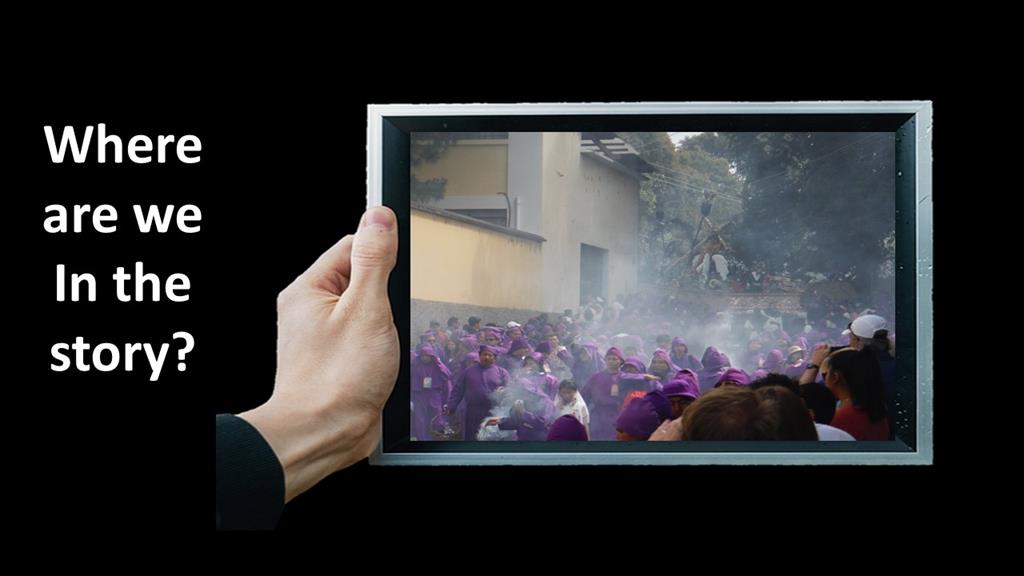 We’re left to wonder what our response would have been if we were there? Where would we be in this story? Would we have been in the crowds shouting “Hosanna?” And if so, would we’ve also been in the crowds shouting “Crucify?” For you see, it’s hard to separate the parade at the beginning of Holy Week, with the crucifixion that comes five days later.
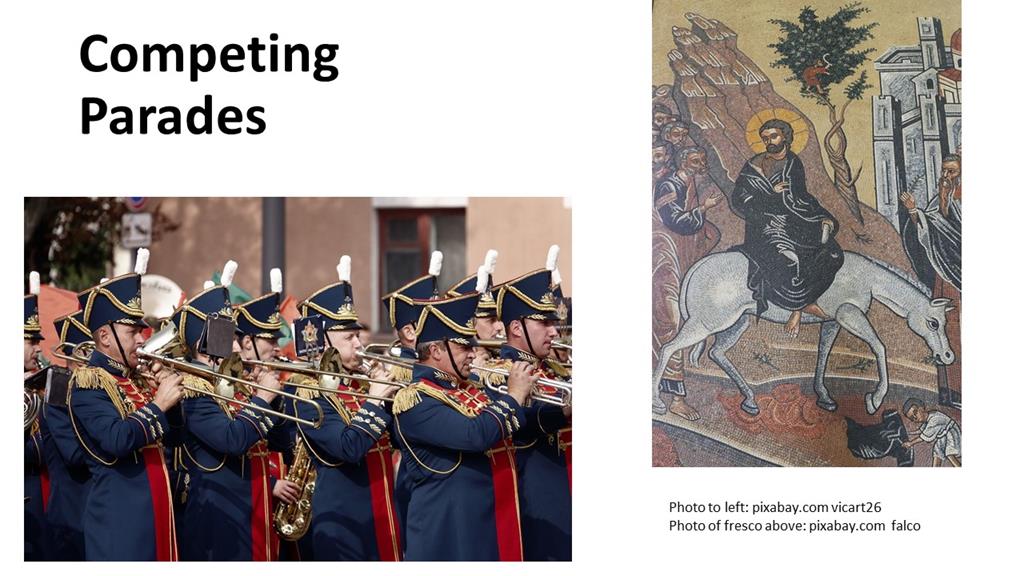 Jesus takes a risk with this parade. In this series we’re going to see repeatedly the risks Jesus and the disciples took during Holy Week. Here, with the parade, Jesus mocks politicians who entered Jerusalem with pomp and circumstance. As Jesus comes into Jerusalem, there were two other significant political figures either already in the city (or if not, they were soon to be there): Pilate, the Roman governor, and Herod, the Roman puppet king. There was probably a parade for them too, one involving fancy horses and soldiers with shiny brass and perhaps even a band. Pilate and Herod display the power of Empire; Jesus, humbly riding on a donkey, displays the power of a mysterious kingdom, one not of this world. Who do we follow? Are we lured by the fancy horses and war chariots of the kings and politicians? Or do we follow the man on a donkey.
 As we move through this season of Lent, we need to ponder what Jesus’ risked during Holy Week, and what we are willing to risk for the sake of the gospel.
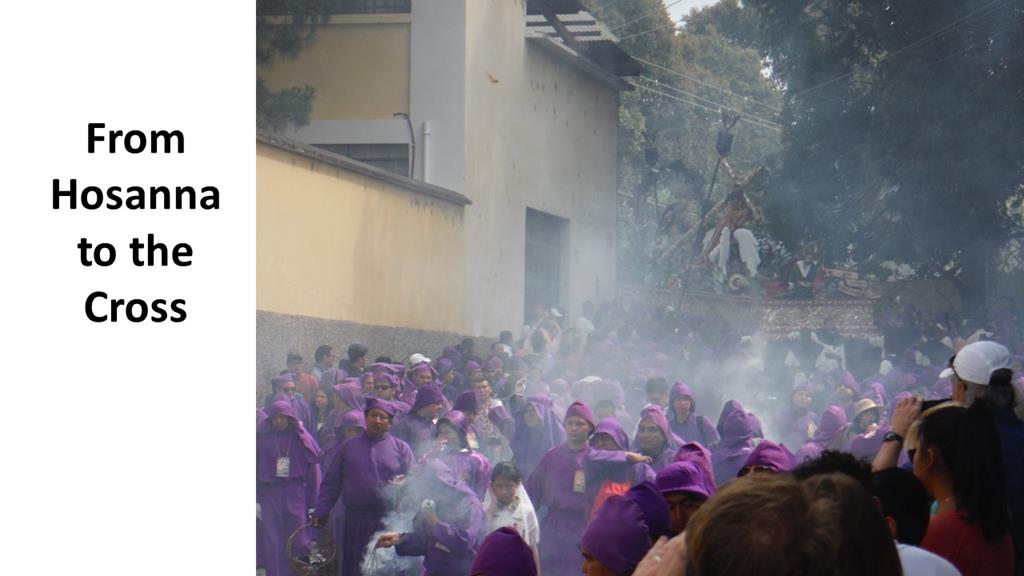 We hear the crowds… We are drawn toward Jesus… Will we just hang around for the fun of the parade, or will we take a risk and continue to follow him as his journey moves toward the cross upon which we’ll be called to sacrifice our wills and desires for his? Amen
 Jeff Garrison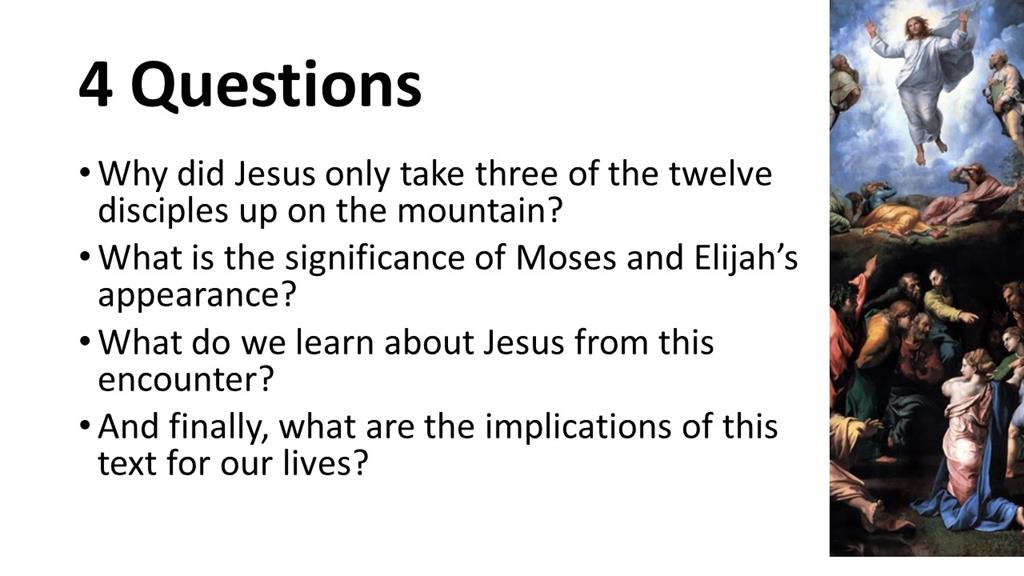
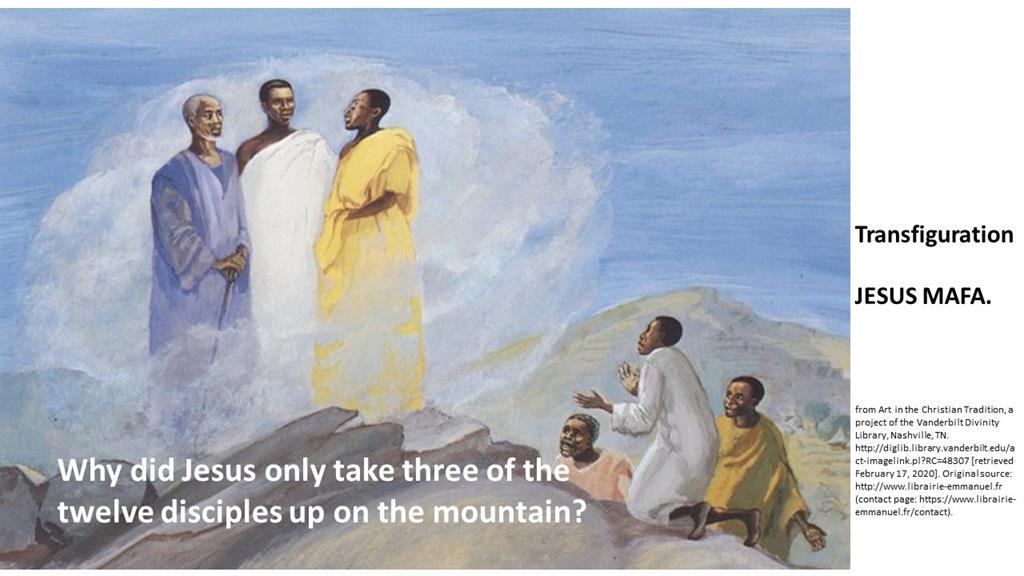
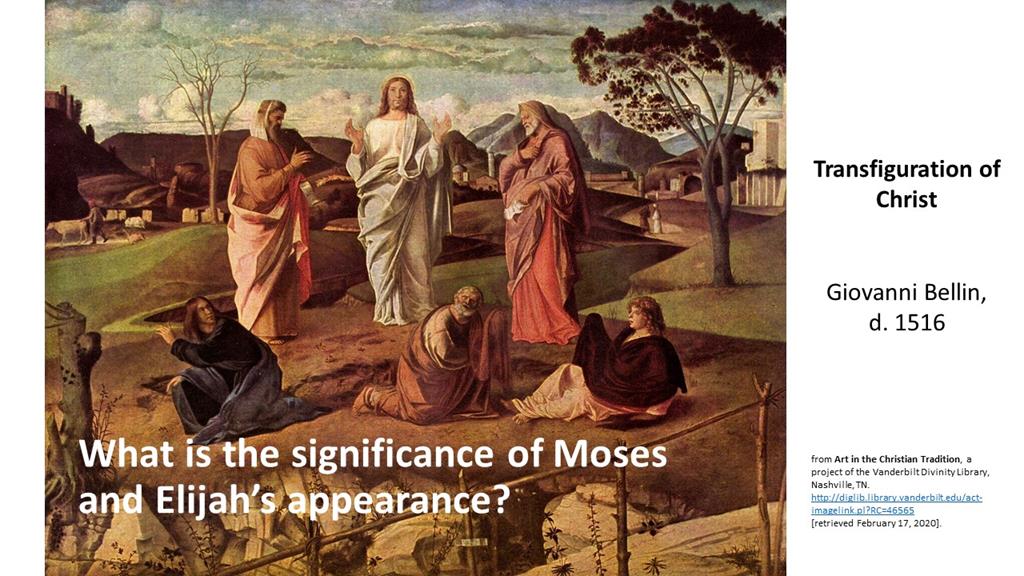
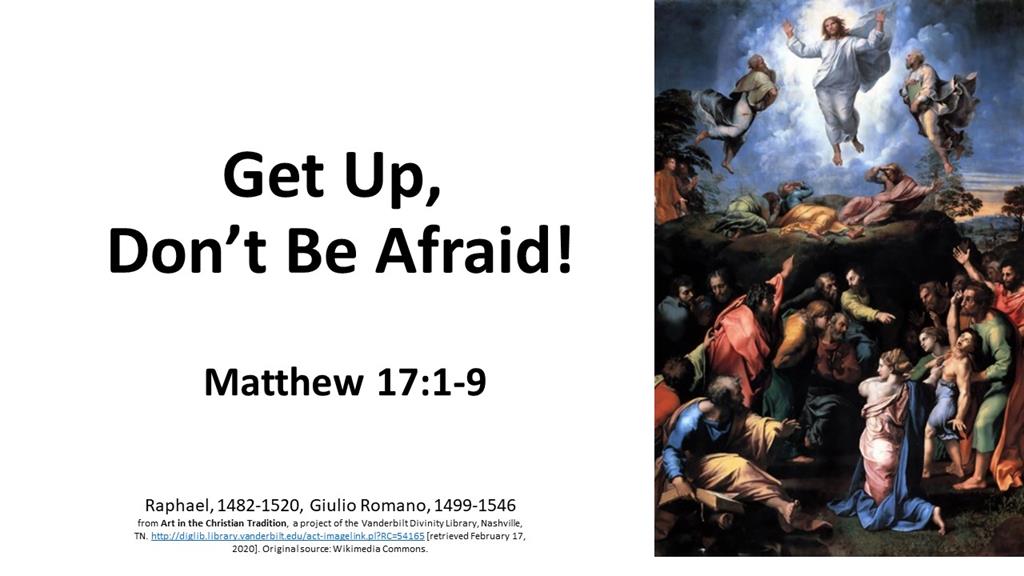
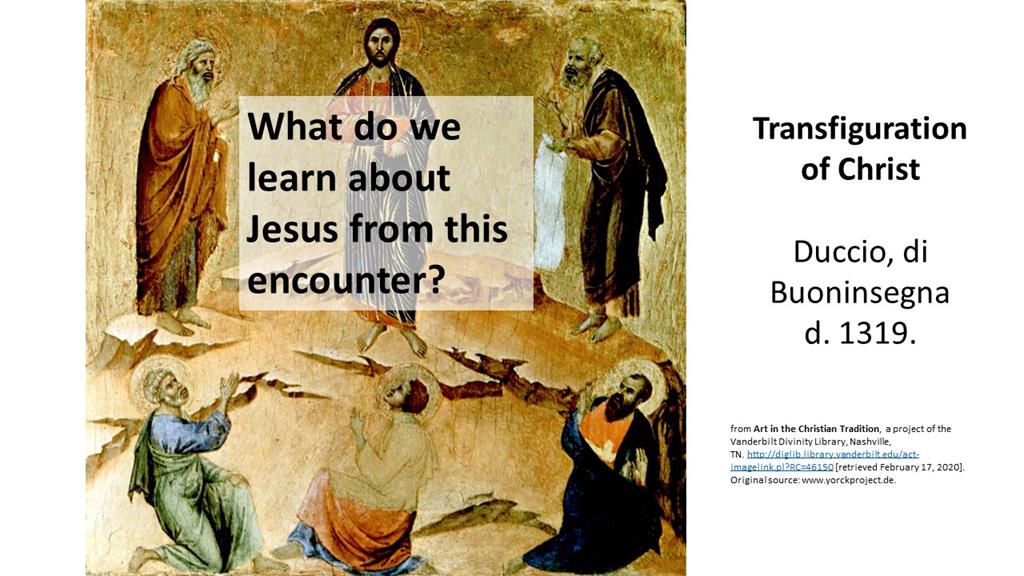 This all amazes the disciples and causes Peter to begin babble about building shelters, perhaps to prolong the event. But while Peter rambles, we’re told a bright cloud suddenly overshadowed them. Think about this, Jesus is already dazzling white, so this cloud must have been really amazing. And from the cloud, as it was at Jesus’ baptism, God speaks. “This is my Son, the Beloved; with him I am well pleased; listen to him.” The words are the same as at Jesus’ baptism except for the last three: “Listen to him.”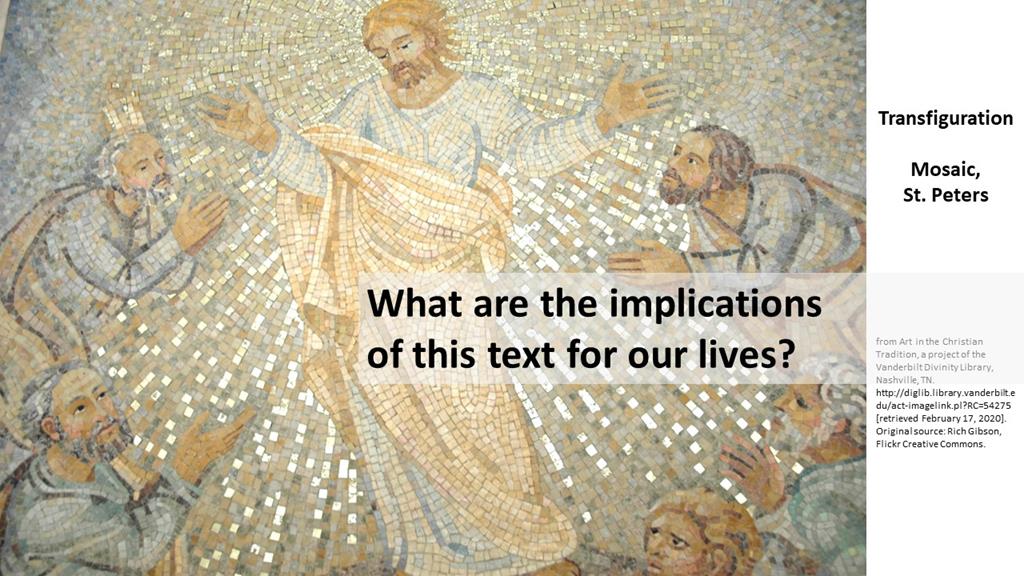
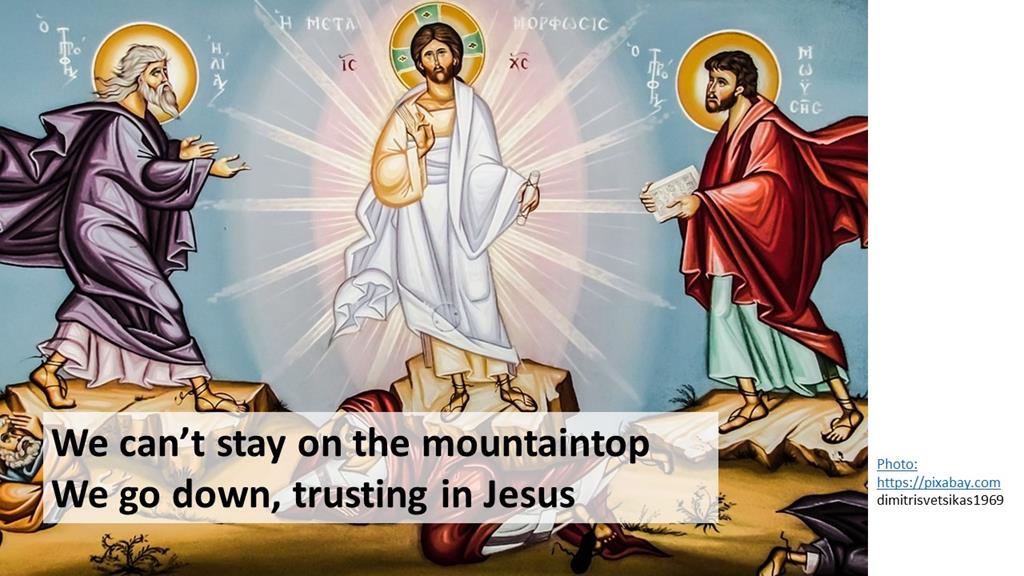
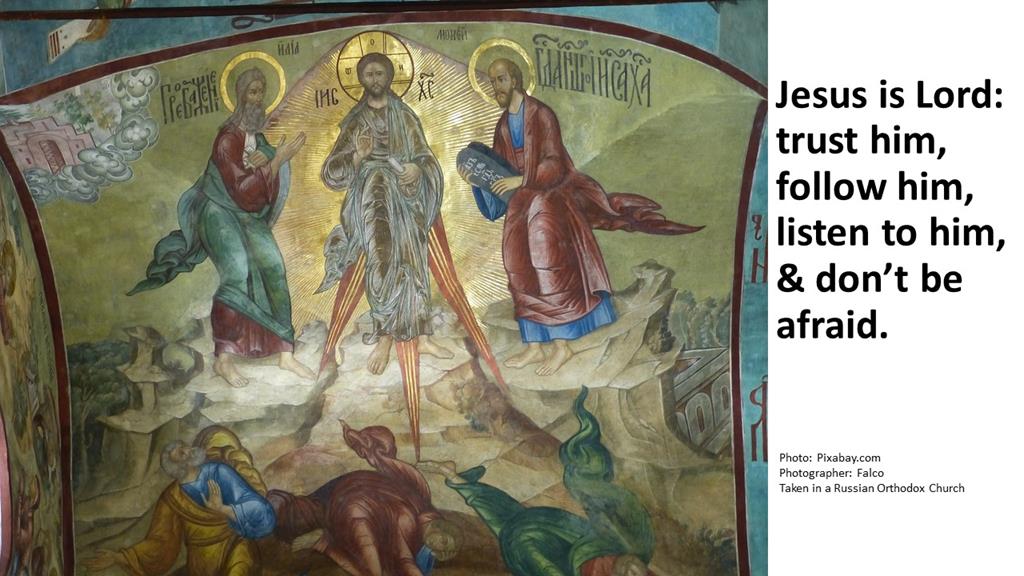 So what does the Transfiguration say to us today? Jesus is Lord, listen to him, obey him, trust him, follow him, and don’t be afraid. “Get up, don’t be afraid.” Good words for us to consider as we, as a congregation, prepare for our future. Amen.
 Jeff Garrison
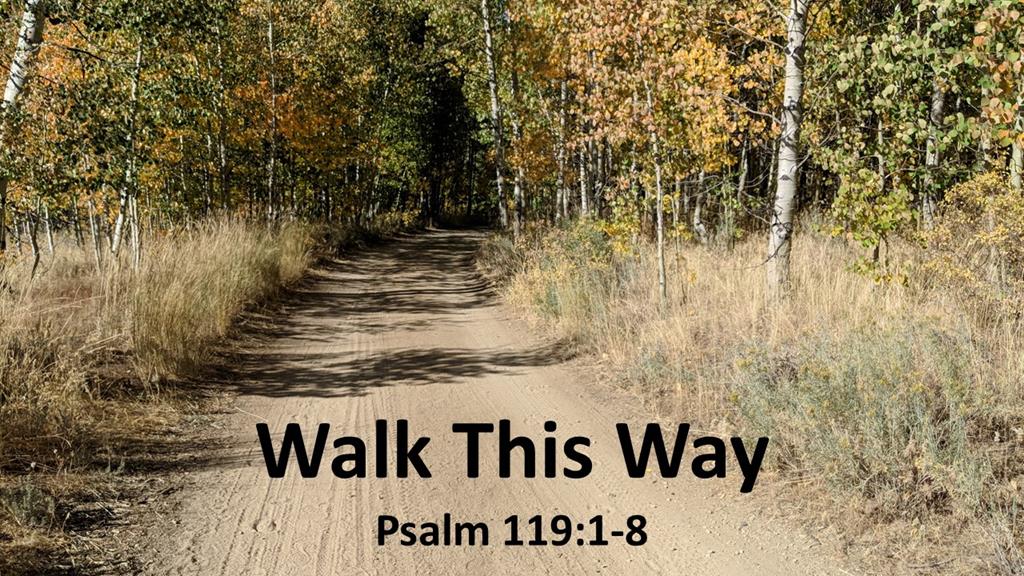
  Today, we’re looking at walking. In a way, the ability to walk is what makes us human. In Genesis, we have that beautiful image of God walking in the garden and wanting the man and woman to join the stroll.
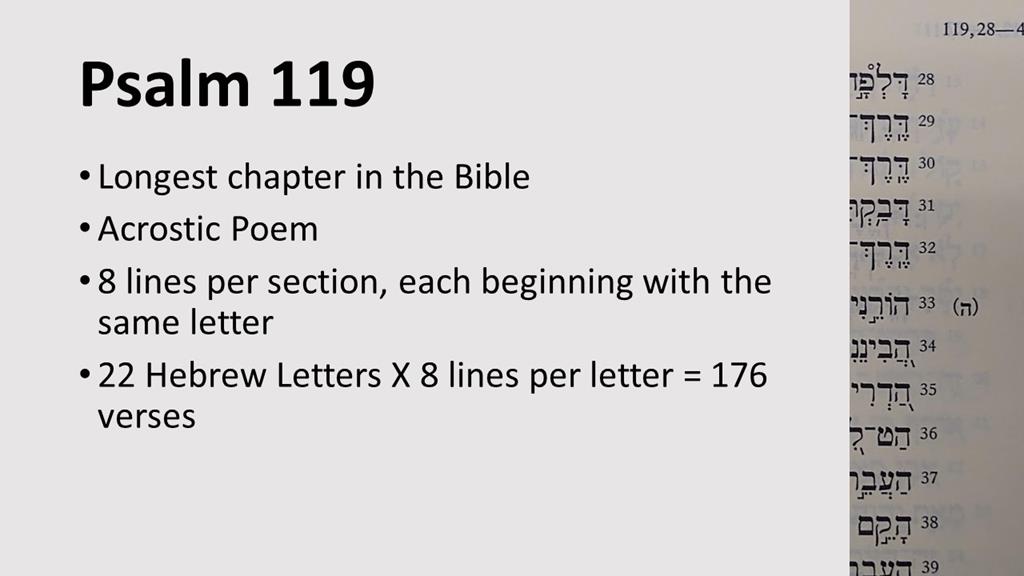 Before reading our last passage, from Psalm 119, let me share a bit about this mega-Psalm. You might know that this Psalm is the longest chapter in the Bible. There are 176 verses to the 119th Psalm. It’s way too much to preach on in one sermon! But it’s also a unique. I know you’ve heard me speak of acrostic Psalms… This is a type of poetry where every line begins with the next letter in the alphabet. In English, it would be like writing, “Apples are red, Berries are blue, Cats are cute… etc. Using an acrostic method helps in memorization. I’ll come back to this later in the sermon.


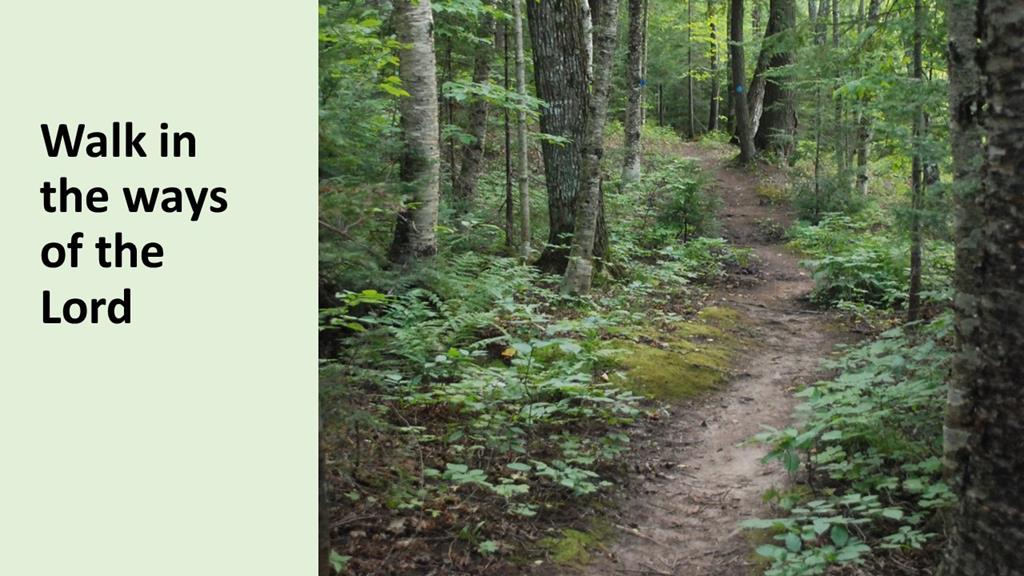 Of course, we’re not just to walk for walking sake, even though it is good for our physical being. Scripture tells us repeatedly to walk in the ways of the Lord. Psalm 119 is a meditation on God’s law. Throughout this passage, we’re encouraged to walk in the law, to walk in the ways of God, to let God’s law light the path for our feet.
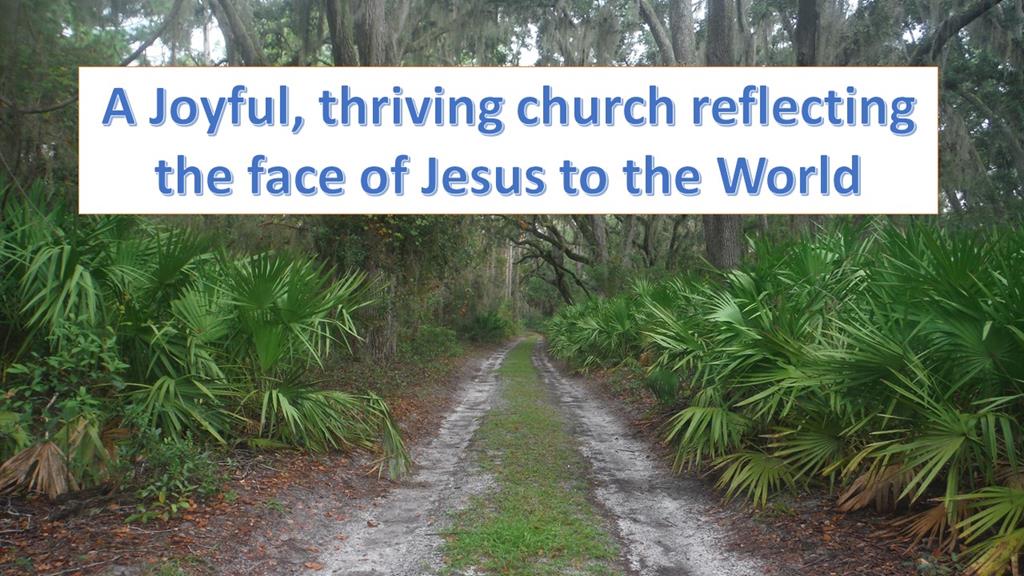 But I also want you to join in on another walk, one that will involve all the congregation. As you know, next Sunday we’re going to lay out a new Strategic Plan for our congregation. We want to be a “joyful, thriving church reflecting the face of Jesus to the world!” Our mission is to “Love God, Love our Neighbors, and to Change the world.” We have set up core values (using an acrostic formation-kind of like Psalm 119-that spells out WORSHIP). These core values demonstrate God’s love by Welcoming, Offering, Respecting, Serving, Helping, Investing, and Praying. All this is supported by four pillars, which we as a church need to walk within. These pillars will require each of us to commit ourselves to excellence, and we if bind ourselves on this journey together, we will live into our Vision and Mission.
 Jeff Garrison
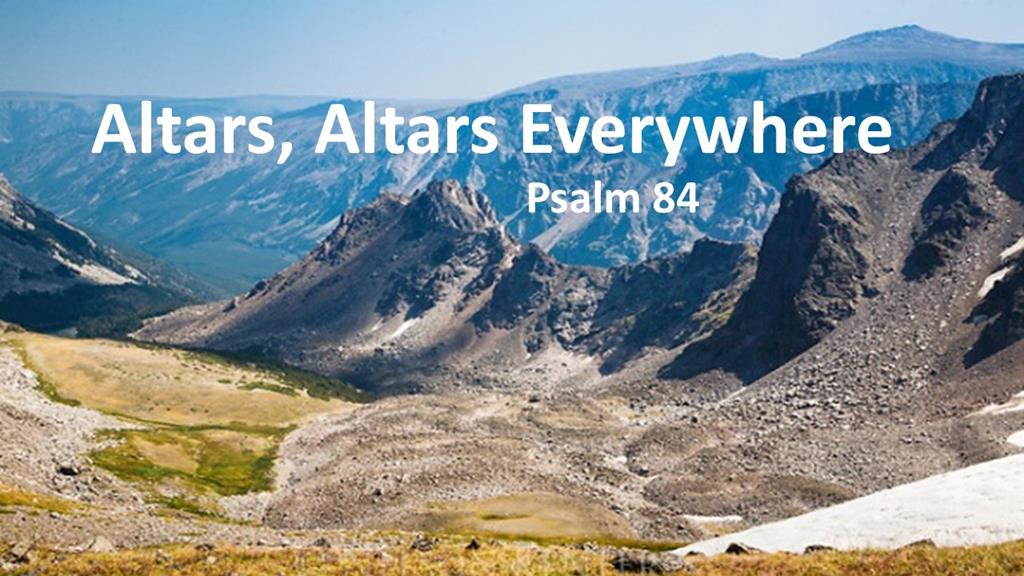
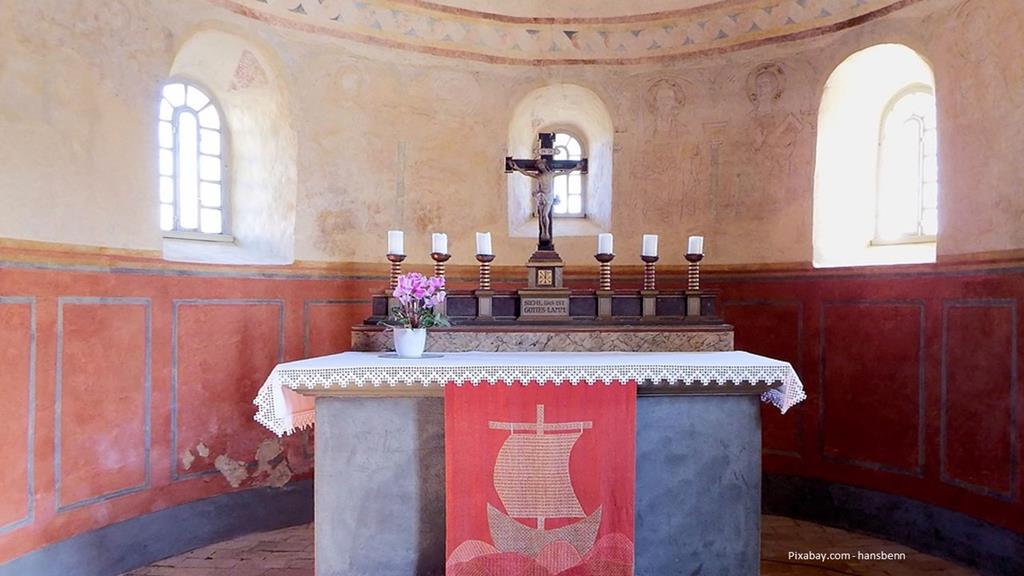 Today’s service is titled “Altars, Altars, Everywhere.” Let me point out that I’m using term “altar” for a place where we worship God. Biblically, an altar was a place for a sacrifice. The word comes to us from the Latin to describe a place where a sacrifice is made.
 Our text, Psalm 84, calls us to come into God’s dwelling place. Let me ask you what you think when you hear of such a place? Pearly gates and golden streets? Fluffy clouds inhabited by choirs of angels and accompanied by orchestras of strumming harps? Golden rays of sun highlighting a peaceful landscape?
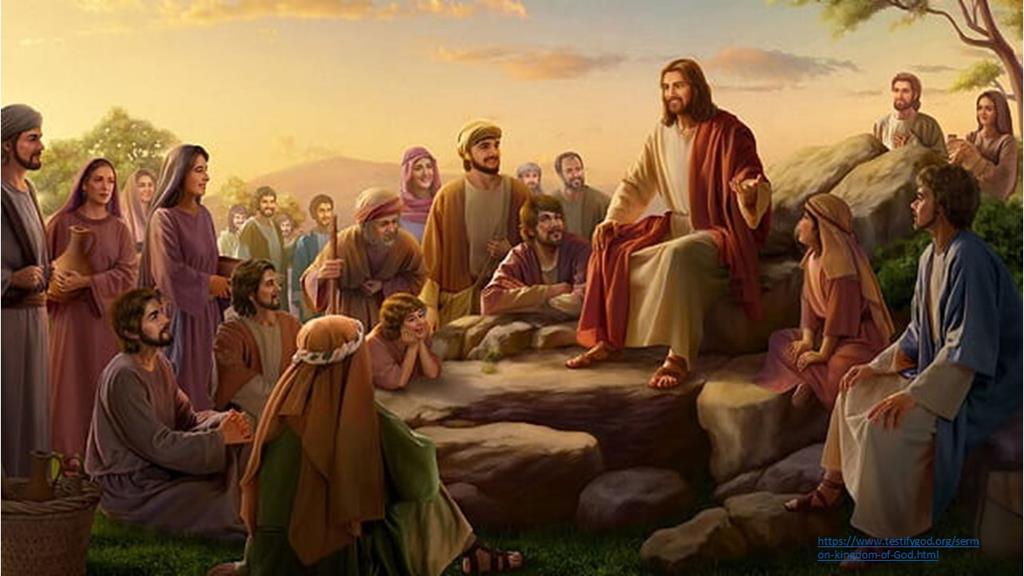 Another way of considering experiencing God’s dwelling place is to consider ourselves already there. After all, Jesus taught that the kingdom has come near.
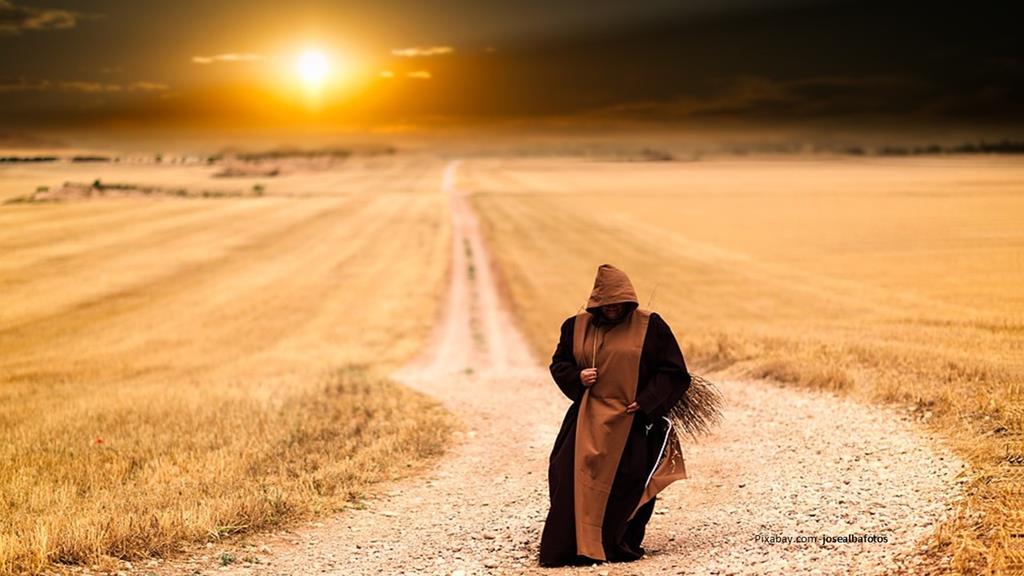 This is a crusader’s psalm. It’s one sung by pilgrims as they made their way from far off, perhaps even a foreign country, to the temple in Jerusalem.
 The Psalmist speaks as a pilgrim coming into sight of Mt. Zion, upon which sits the city of Jerusalem. And there in the middle of the city is the temple of God. “How lovely is your dwelling place, O Lord of hosts!” the Psalmist sings. Perhaps this is his first visit to the temple. He’s overcome with joy. Although singing, he’s almost faint from excitement. He observes the birds nesting high up along the roof and acknowledges the glory of God who takes care of all creation, from the greatest mammal to the smallest feathered friend.
 The Psalmist then turns his attention to the priests, those who work in the temple day in and day out. He ponders their happiness. This must be a great job, he thinks.
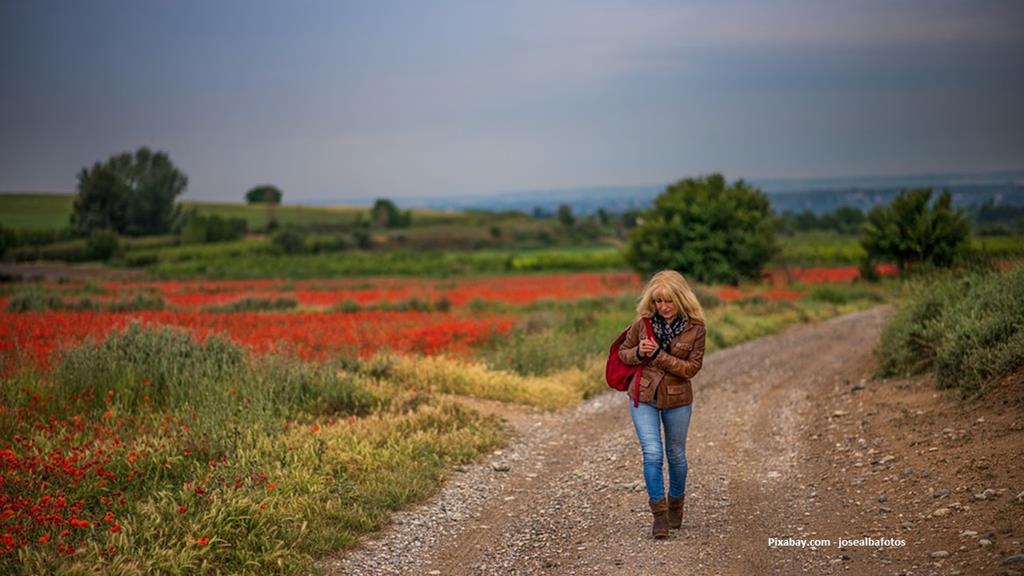 But then he realizes that he, too, is blessed by God. We see this in verse five, “Happy are those whose strength is in you, in whose heart are the highways of Zion. In other words, he and those who have travelled the road to Zion, the road to Jerusalem, can be glad that God has given them the strength needed for the journey. Then, in the next verse, he recalls his journey through the Valley of Baca, the unknown valley of tears he had to traverse in order to get to Jerusalem. Even that desolate land is blessed by God. A miracle is witnessed as the dry summer heat is replaced with cool rains leaving behind pools of water from which the pilgrim can quench his thirst. Notice, that as the Psalmist sings, he realizes God’s presence is all around, not just at the temple.
 Acknowledging God’s providence in his life, the Psalmist prays in verse 9 and 10 for God’s continual blessings upon those who seek to worship. In verse 11, he shifts to metaphorical language, conceding that a day in the temple is better than a thousand elsewhere, even while acknowledging God’s gifts and goodness extends far from the walls of the temple. God is both the sun, the giver of life for the earth, but also the shield, the one who protects us from the sun when it becomes overbearing in the desert. God is the source of all good, or as John Calvin liked to infer, “God is the fountain from which every good gift flow.”
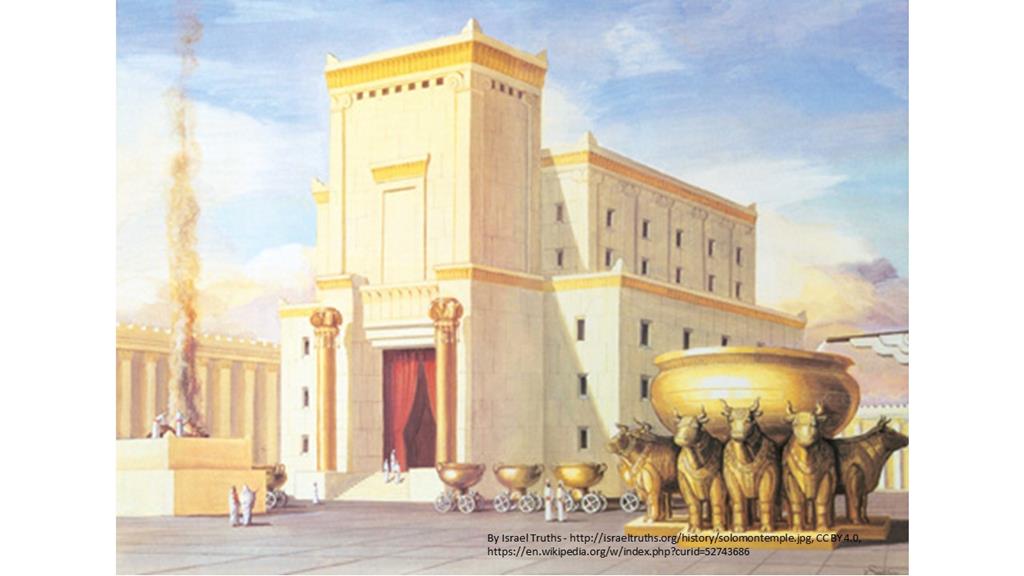 What does Psalm 84 teach us about worship? While the ultimate worship experience for the Psalmist was the temple, Solomon’s temple hasn’t existed for over 2,500 years. It was destroyed by Babylon. But that’s fine for there are now places of worship all over the world, and hopefully whether it’s here or somewhere else, you will find a home to worship.
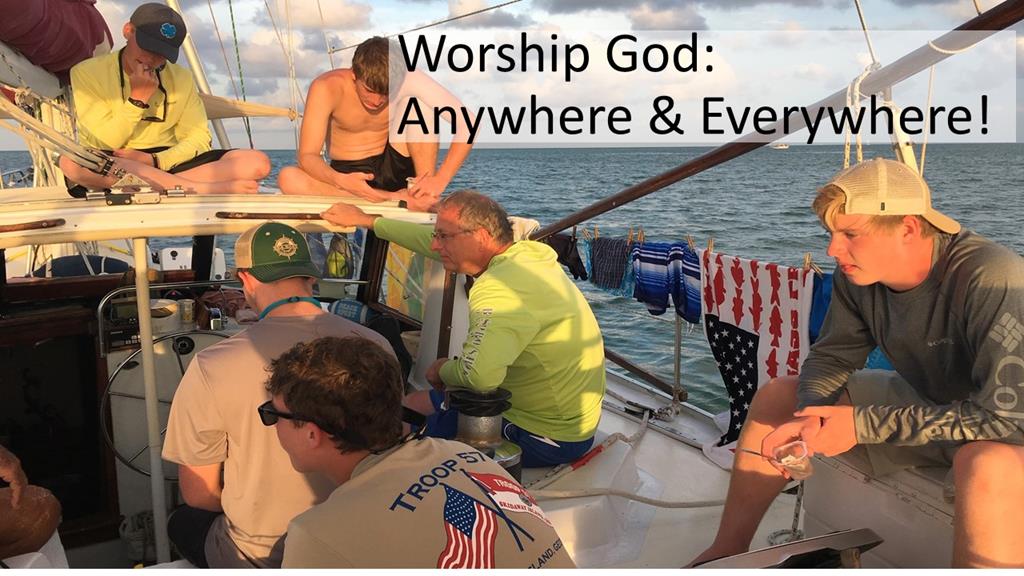 So, this week, stop frequently and meditate about being in God’s presence. You might even set up a special place to meditate and pray in your home, a reminder that God is with you. Think about bumping into God’s altars, for they are everywhere. Be on the lookout for them, and then give thanks to God for his faithfulness. Amen.
 The Scriptures we read today make it abundantly clear that God isn’t looking for heroes. God doesn’t require us to be “Super-Christians.” We don’t have to sacrifice everything we have in order to find favor with God. Instead, God is satisfied with us living a life which brings no harm to anyone and which honor righteousness. These teachings from the Old Testament can be somewhat summarized into Jesus’ command to love God and to love our neighbor as ourselves.
 The sixth chapter of Micah begins with a courtroom scene. God indicts Israel, asking her to come and plea her case against the mountains and the hills. Why the mountains and hills? Because they have been around for ages and have seen how God has shown mercy to Israel.
 In the third verse, God asks Israel a rhetorical question. “What have I done to you, in what ways have I wearied you?” The people of Israel have been ignoring God. God’s question is designed to grab their attention. Was God the reason for Israel disobedience? Probably not…
 In the sixth verse, Israel answers. Israel knows she has been disobedient and asks how she might come back before God. Shall it be with the best of sacrifices? Armloads of offerings, and a yearling calf? Or perhaps, like King David,
 The beauty of this passage is its simplicity. God is not expecting us to make a monumental effort in order to gain favor. God does not want religion to become such a burden that we harbor resentment in our hearts. Instead, God wants us to incorporate our faith into our lives so that God is glorified in all that we do…
 Think about what Berry is saying. When we look at the environmental crisis from a global level, it becomes unmanageable. Berry goes on to tell the students that instead of worrying about how to save the planet, they should concern themselves with the care of their own neighborhoods.
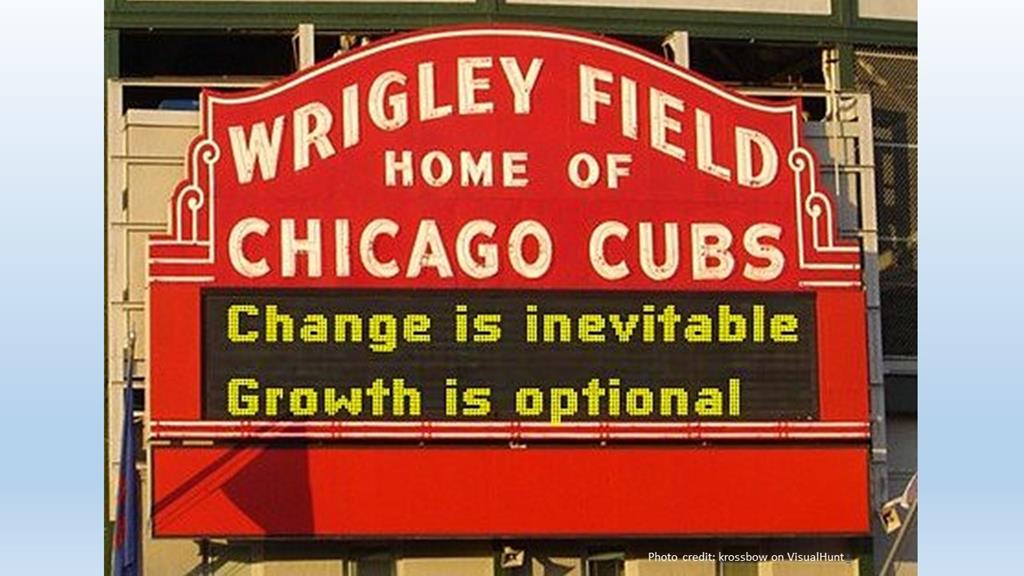 Let’s think of the implication of what Micah and Berry have to say to the discussion of the church in America in the 21st Century? We cannot deny-things are changing in our world. The shape of the church and society are undergoing radical restructuring. Our church and society seem helpless in stopping the violence and the brutality which we read about daily.
 One of the problems of the modern church, I believe, is that we’ve become practical atheist.
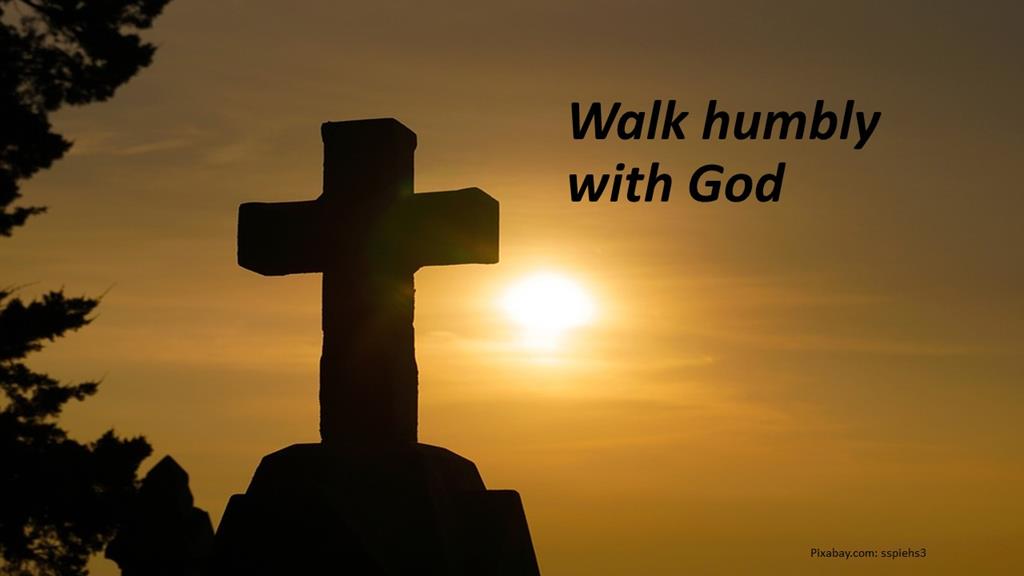 But the revitalization of our world is not going to happen because of what some individual or group does to drag along everyone else into their camp. Don’t get me wrong, I’m not saying we shouldn’t be involved in these issues. I’m just saying that, first and foremost, we should remain focused on Jesus Christ, or as Micah says in the New Revised Standard translation, “Walk humbly with our God.” We don’t need a giant to save the world. Jesus didn’t bless the superstars in the beatitudes.