Jeff Garrison
Skidaway Island Presbyterian Church
Mark 10:23-27
January 19, 2020
We’re looking at another tool to beat Spiritual Affective Disorder. We’ve talked about spending time reflecting on the light. We’ve looked at how music can lift our souls. Today we’re looking another sure-fired way to beat SAD (that’s Spiritual Affective Disorder). We can use humor and laughter. Too often we think of humor as inappropriate in churches. God is seen as some stern judge up in the sky, with piercing eyes and a frown, upset with all humanity. But God delights in humor. We can see it in creation. Why did God create the opossum? Or the anteater? Or the monkey? Or some of us?[1] We can also see it in scripture. In our Old Testament reading we hear of Sarah laughing at the possibility she, as an old lady, will give birth.[2] The story shows us God had the last laugh. God wants us to lighten up, to not take ourselves too seriously, and to trust him. We’ll see this in our New Testament reading, too. I’m reading Mark 10: 23-27, from the Message Translation.

Jim Johnson is a former pastor who now owns the Bull’n Bear Saloon in Red Lodge, Montana. On making this transition for the pulpit to behind the bar, he tells this joke: “Two guys walk into a bar and stop dead in their tracks. One thinks to himself, ‘Oh no, my preacher’s a bartender!’ The other thinks, ‘Oh no, my bartender’s a preacher!’”[3] This joke illustrates how humor is perceived different depending on your perspective. What one person finds as funny might not be funny to someone else, just as a preacher as a bartender gets different reactions from a bar patron and a parishioner.
 It may have been the same way with Jesus’ parable about the camel going through an eye of a needle. Just try to image how silly this word picture looks—a camel, one of the larger animals in that part of the world compared to such a small opening. This is funny, in a “Far Side” kind of fashion.
Imagine the disciples laughing as Jesus tells this story. Jesus had just encountered the rich man who wouldn’t follow Jesus because he had much to lose. The man went away sad. He just couldn’t risk giving up his stuff, but that’s another sermon. The disciples who witnessed this looks to Jesus for some reassurance for their salvation, and Jesus’ tells this story.
 For what we know, none of the disciples were rich, so it’s easy for them to laugh at the absurdity. Or maybe not. Maybe there were those who saw riches as a sign of God’s favor. Unfortunately, there are still some people like that, proclaiming a prosperity gospel. But this story undercuts the idea that wealth equals God’s favor. Now the disciples, whose bank accounts aren’t exactly overflowing, may have laughed at all the absurd image and at all those people with all that money who are doomed.
But then, one by one, they began to think. We’ll I’m not totally poor. I own a fishing boat, I own some robes and don’t go hungry, I have a house… Maybe I’m not rich by some standards, but at least I’m middle class. Does this mean me getting into heaven, would be more like a dog or a cat, instead of a camel, getting through an eye of a needle? I still don’t stand a chance. Their minds run wild. What kind of animal can get through the eye of a needle? Well, what about a worm or even an ant. But there’s two problems here. First, unless it’s a very small worm or ant, they’re not going to be getting through the eye of a needle. And secondly, is Jesus saying I must be so small that I can only be a microscopic worm or ant? Where does that put me?[4]
 The laughter begins to subside as they realize their predicament. They’re doomed. Frustrated, they ask Jesus, “Just who can be saved?” Jesus responds, telling them it’s impossible for humans, but nothing is impossible for God. Jesus uses humor to make this point, but we often have a hard time accepting it which is why people have tried to reinterpret this passage such as suggesting that Jesus wasn’t referring to a needle used for sewing, but that it was the name of a narrow gate through the city’s walls. I’ve heard that interpretation in sermons and think it displays our fear of the truth—that we’re not in control.[5]
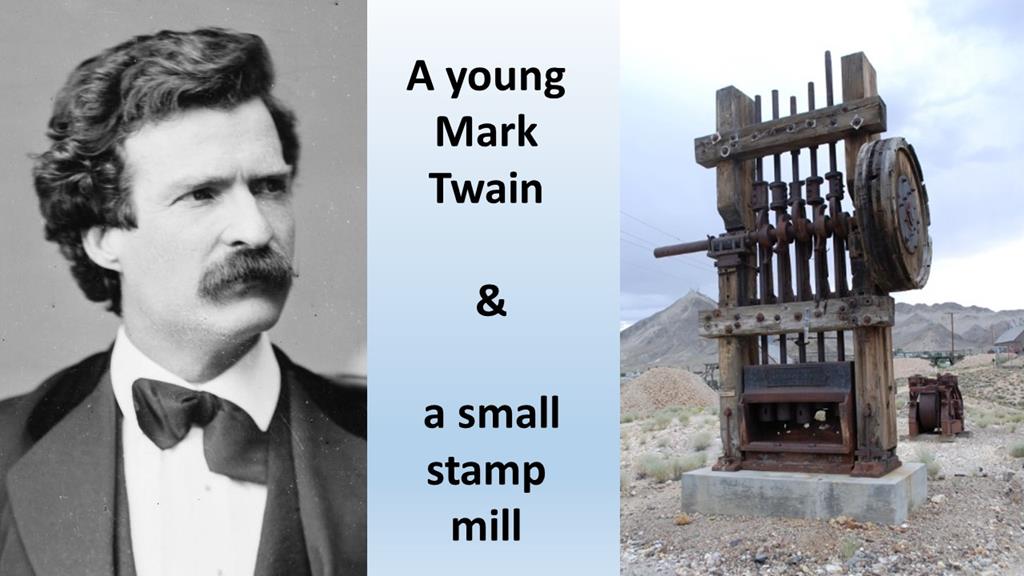 When you push an idea to the absurd, you get humor. Mark Twain knew this. He once wrote a letter from Virginia City, Nevada to his mother, telling on his brother for stealing some stamps from a local mill. According to Twain, his brother had slipped these into his pocket. Twain thought it was a perfect joke. His mom would get on his brother’s case, for she had no idea that the “stamps” in a stamp mill weigh 100s of pounds and were used to crush rock.[6] It’s absurd, which makes it funny and no way it could be factually true.

Bill Bryson is another humorous writer who is a master at expanding a truth to the point that it’s humorous. In his book, A Walk in the Woods, about hiking the Appalachian Trail, he does this with bears. Anyone who hikes a significant portion of the trail will probably see a bear, but Bryson makes it sound like bears are a constant threat and regularly snack on hikers. He did the same thing in his book, In a Sunburned Country, about his travels in Australia. Reading it, you’d wonder if most people in the land Down Under die from being bitten by snakes and spiders or eaten by crocodiles and sharks. He makes it sound like the country is trying to kill you, which some might think is true with their recent fires.
 Using exaggeration to be funny is a way of saying, “Lighten Up.” We don’t need to be so uptight about everything. No, we can’t save ourselves. But the good news is that with God all is possible. Where do we point our trust? In our stuff (which won’t fit through the needle’s eye) or in God? Of course, it’s easy for us to miss the joke. That’s partly because jokes don’t always translate across cultures. Furthermore, jokes are best told and not read.[7]
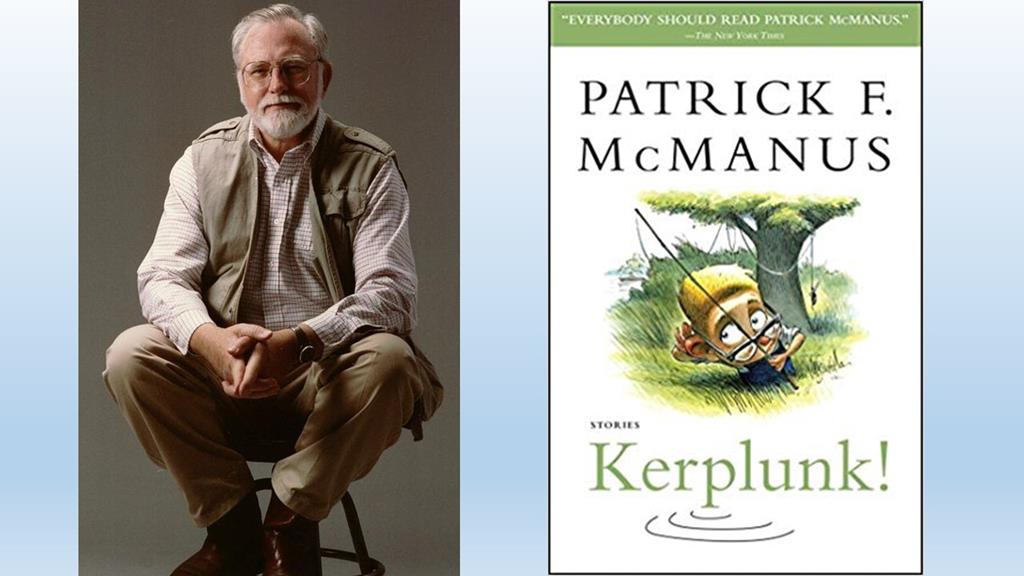 Another humorous writer I enjoy is the late Patrick McManus. He’s published a dozen or so books and wrote humorous columns for Outdoor Life and Field and Stream. While McManus used exaggeration for humor, he often reported on his own silliness and mistakes. The best jokes are those we make about ourselves and not others. The mess he found himself in while hunting or fishing can be chuckling, because many of us have been in similar situations. As he aged, McManus lamented how things change. The trails have become steeper and the oxygen in the mountains have decreased since his youth. We’ve experienced that, haven’t we?[8]
 One of the problems the church has in the world is that other people see us as taking ourselves too seriously. We carry heavy burdens and don’t trust God’s Spirit enough, it’s easy to get down and depressed. And then we don’t do a good job of reflecting Jesus’ face to the world.
In my blog, I recently posted a humorous piece about Communion. I was a little nervous about how it might be accepted but was comforted by the comments. One suggested that if such humor was used more often, they’d be more people in the pews on Sunday. Another woman, from Australia, who confessed to not having been raised religious, said the humor helped her understand.[9]
Jesus doesn’t want us to be uptight. Jesus wants us to have abundant life, beginning now, and that means we need to be joyous and to laugh more. Humor is good for us. It can be holy! We should, at the very least, be able to laugh at ourselves. It keeps us humbled. The great mid-20th Century Theologian Karl Barth once said that “laughter is the closest thing to the grace of God.”[10]

Think about children and how they laugh. They laugh at the silliest of things. We adults think we must be more serious. I wonder if, when Jesus said that if we want to enter the kingdom of God we must come like a child, he meant that we must come laughing like a child?[11] It’s something to ponder.
 Laughter is also good for us. Do you remember the movie, Patch Adams, where Robin Williams played a doctor who used laughter in treating patients? Do you recall how he got a children’s ward filled with kids suffering from cancer to laugh? And how the head nurse was mortified and ordered him out of the ward and told the kids to get back in the bed? The movie showed how we adults are too serious and that the world needs to lighten up and enjoy things.
 Laughter relaxes us. According to some studies it can heal us by boosting our immune system. In addition to lightening our hearts and reducing anger, laughter helps us to burn a few extra calories. It lowers our stress. And it makes us more pleasant to be around![12]
 So, this week I want you to take time to laugh. Read the comics or pick up a humorous book. Take an opportunity to laugh at yourself. If you come across a great joke, drop it in an email to me or to a friend. We all need laughter and we’d be a lot better off if we could laugh at ourselves, for our follies makes us realize how much we depend on God.
Let me close with a part of a poem titled, “The Rowing Endeth,” by Anne Sexton. She describes being in a rowboat making for the Island of God. I’ll begin reading as she steps ashore:
“On with it!” He says and thus
we squat on the rocks by the sea
and play—can it be true—
a game of poker.
He calls me.
I win because I hold a royal straight flush.
He wins because He holds five aces.
A wild card had been announced
but I had not heard it
being in such a state of awe
when He took out the cards and dealt.
As he plucks down His five aces
and I sit grinning at my royal flush,
He starts to laugh,
the laughter rolling like a hoop out of His mouth
and into mine,
and such laughter that He doubles right over me
laughing a Rejoice-Chorus at our two triumphs.
Then I laugh, the fish dock laughs,
the sea laughs. The Island laughs.
The Absurd laughs.[13]
Amen.
©2020
[1] This is an old preaching joke that I’ve heard attributed to Billy Sunday, among others.
[2] Genesis 18:9-15.
[3] https://billingsgazette.com/lifestyles/faith-and-values/religion/pastor-turned-bar-owner-writes-on-similarities-differences-between-bars/article_673abca0-5749-5a9e-981f-a0e6291c5421.html
[4] Jesus is challenging a false sense of security here. See William L. Lane, The New International Commentary on the New Testament: Gospel of Mark (Grand Rapids: Eerdmans, 1971), 369.
[5] As for debunking the theory of enlarging the eye of a needle to a gate, see Morna D. Hooker, The Gospel According to Saint Mark (Hendrickson Publishing 2nd Ed, 1997: London, A & C Black, 1991), 243.
[6] I’m pretty sure I am remembering this from when I read Twain’s published correspondence from Virginia City, NV. Twain often made fun of his brother, once saying his brother was “as happy as a martyr when the fire won’t burn.” See Philip Ashley Fanning, Mark Twain and Orion Clemens: Brothers, Partners, Strangers (Tuscaloosa, AL: University of Alabama Press, 2003), 151.
[7] See John L. Bell’s essay “Giggling for God” in 10 Things They Never Told Me About Jesus (Chicago: GIA Publishing, 2009), 126.
[8] Patrick F. McManus, Kerplunk (New York: Simon & Schuster, 2007), 104.
[9] http://skidawaypres.org/pastor/?p=3368
[10] https://www.spiritualityandpractice.com/practices/features/view/20120
[11] See Mark 10:14. See also Matthew 19:14 and Luke 18:16.
[12] See https://www.helpguide.org/articles/mental-health/laughter-is-the-best-medicine.htm
[13] Anne Sexton, The Awful Rowing Toward God (Boston: Houghton Mufflin, 1975) 85-86.



 Jeff Garrison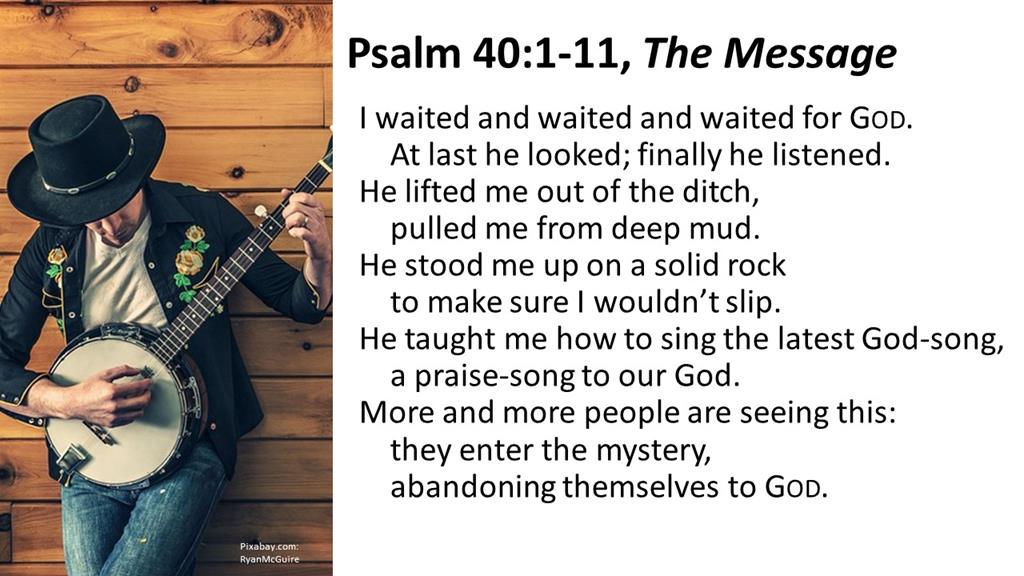
 There is something about music that can take us to a place and time in the past. Those in the advertising world have known this for a long time which is why they often use popular music in the background to help sell products. Movie producers are no different as they use music to put us into the mood they are trying to convey. I don’t think I’ll ever forget the sadness, yet hopefulness, brought about from watching the movie, “Platoon.” These feelings were intensified by Samuel Barber’s haunting score, “Adagio in Strings.” Or, on a more positive note, think of the upbeat tunes used in the Charlie Brown movies. How does those tunes make you feel?
 Music has a power to draw us back to specific places in time, which is why it’s often used in therapy for those battling Alzheimer’s or brain injuries. From my own life, there are songs that can take me back just by listening to them. The Beatles’ “Lucy in the Sky” takes me to my childhood bedroom, in a late December evening in 1968. I was listening to the radio I received for Christmas that year. Rod Stewart’s “Maggie May,” takes me back to a wet night camping at Fort Fisher. A friend and I listened to the radio while trying to endure wet sleeping bags. The Eagles’ “Hotel California,” takes me to another rainy night, when I was in college. With kayaks strapped to the top of my car, my brother and I drove to the North Carolina Mountains to paddle in rain swollen rivers. I had no idea then that I’d hear that song so many times over the next few decades that I would become sick of it. Every time I hear haunting voice of Enya, the Irish singer, I am taken back to a drive over Sonora Pass in the Sierras at sunset. I’m sure you have such experiences, too.
 The same can be said about church and music. Maybe there was a special Christmas Eve service in which you sang, “What Child is This? and are taken back to that time. Sometimes we’re taken back to sad memories such as a song sung at a funeral. “He Leadeth Me,” was a favorite hymn of my great-grandfather McKenzie. I don’t remember him singing it as I was only 12 when he died. But I do recall the pastor officiating at his service sharing this insight. Now, whenever I hear that hymn, I am reminded of my great-grandfather and that great cloud of witnesses that have led us to his place.
 Music has ancient roots. Archaeologists learned to discover cave art when exploring in France by singing. They discovered that caves with the most resonance for singing were also the places where they were more likely to discover cave paintings. Many anthropologists believe that music was first used as a way to strengthen community bonds, maybe even going back to the prehistoric cavemen.
 And music seems to exist beyond the human experience. There have been a lot of talk about coyotes on our island lately, but have you ever heard a pack of coyotes sing? It’s haunting yet beautiful. Each coyote has a slight variation to the song.
 Melody can change our disposition. Depending on the tune, it can make us sad or happy, reflective or energetic.
 Now, what does all this have to do with Psalm 40? Our text for this morning, the first half of this Psalm, is an offering of thanksgiving to God. The Psalmist, this one is attributed to David, begins by recalling how he waited patiently for God to hear his cry. In the second and third verses, we hear how God pulled him up from the muck, put him back on firm footing, and taught him a new song. The Psalmist is humble, acknowledging everything that has been done for him is a gift from a benevolent God.
 But let’s consider a moment the thought of God giving the Psalmist a new song. I like this idea: God as the great choirmaster, teaching us new music. In our early reading from Revelation, we heard about all the singing in heavenly courts.
 Starting with verse four, the Psalmist calls on all who have experienced God’s grace and mercy to join him. He invites others to turn away from false gods, to turn away from that which is worship in the world, and to focus on God’s wondrous deeds. So not only is the Psalmist given a new song, he now uses this song to witness to others, showing what God has done in the world. The Psalmist does what the redeemed are supposed to do, give credit to God for our salvation.
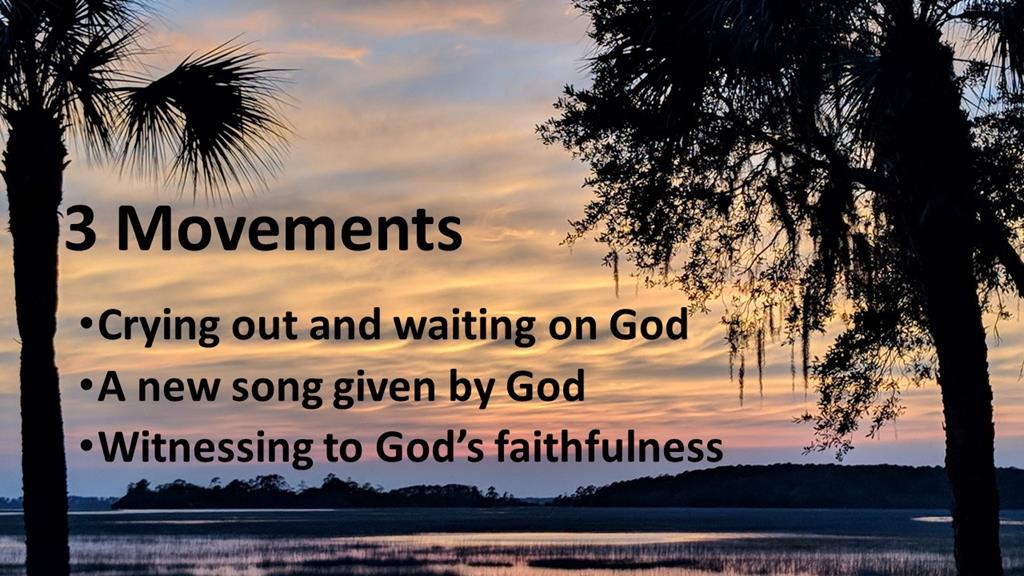 There are three important movements in this Psalm. The crying out and waiting on God to act, the new song that God provides, and our willingness to witness to God’s faithfulness. This is what the Christian life is to be about. We confess our hopelessness and helplessness to the one who can help. God hears our plea and responds gracefully. And then we tell (or better yet sing) of God’s good deeds as we witness of God’s goodness to a lost world.
 Let’s all be willing to sing new songs, songs that glorify and praise God, songs that lifts our hearts and prepare us to soar with joy. Amen
 Patrick F. McManus, Kerplunk! (New York: Simon & Schuster, 2007), 227 pages.
 David McCullough, The Pioneers: The Heroic Story of the Settlers Who Brought the American Ideal West (New York: Simon & Schuster, 2019), 331 pages, a few illustrations.
 James Clavell, Tai-Pan (1966, Blackstone Publishing, 2019), 885 pages (~34 hours on Audible).
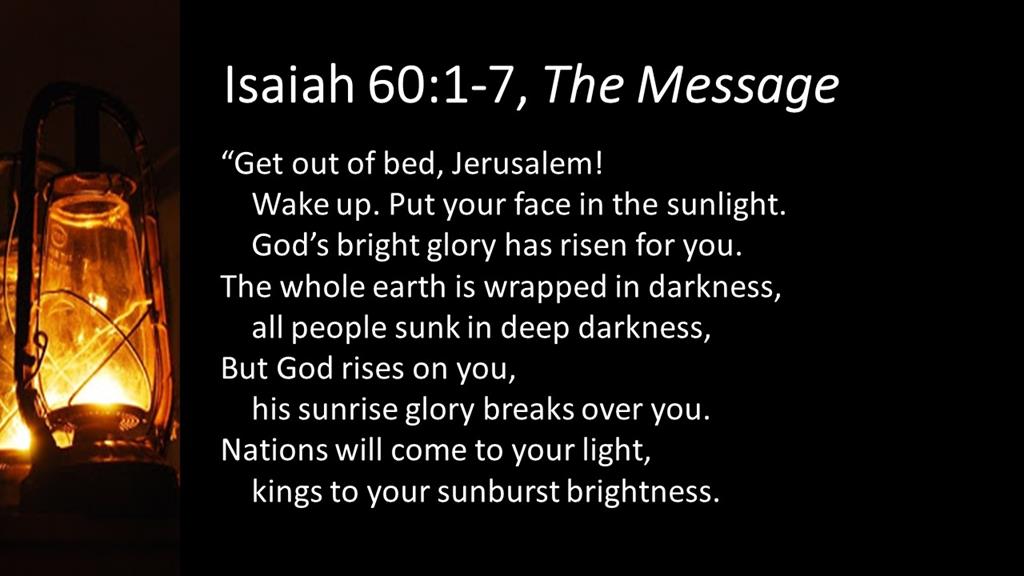
 I was blessed as a child to spend many days camping on an undeveloped beach, generally in the fall of the year when the bluefish were running. We’d crawl out of our sleeping bags while it was still dark and start a small fire on the beach to drive away the chill. You could only make out everyone’s shadows created by the light of the fire or lantern. Before the stars began to disappear and the sky lightened, we’d have a line in the water, baited with cut mullet. You’d cast the line out beyond the surf, hoping you were in a good spot. Gradually, the shades of black and gray would be replaced by color as we shivered in the chill and held our rods high, an index finger touching the line waiting for the signature bump of a fish.
 You know, the Prophet Isaiah had a lot of depressing things to say. He wrote about the fall of Israel and the coming exile for Jerusalem. War and destruction is at the forefront of his message, but occasionally Isaiah breaks out of the darkness. In Chapter 9, he writes, “The people who walked in darkness have seen a great light,”
 As Christians, we read these passages through the lens of Jesus, the light coming into the world as proclaimed in John’s gospel.
 Years ago I had the opportunity to spend a few days spelunking (or caving) in eastern West Virginia. It was an incredible experience. When you are below ground like that, there is no light at all. Turn off your light and you can’t even see your hand in front of your face. At one point, we gathered in a huge underground room. Our guide had us place our cameras on tripods and to open the shutters, then had us go around the room popping flashes. Each splash of light would illuminate a section of the wall and ceiling, which we didn’t see until after the film was processed (these were the old days, long before digital). By bringing light into this cave, we got to experience on film the incredible beauty of this huge underground chamber that was dotted with crystals.
 This is what we as Christians are to be doing, bringing light into the world. Yes, there are problems. There are evil people who do terrible things, like the Iranian general who was just killed. There are hateful people who want to wipe others off the face of the earth. There are dishonest people who will lie and cheat to get ahead. There are misguided people who create chaos and whom try to profit at the expense of others. We live with partisan hatred in our own country and under the threat of terrorist attacks, both domestic and foreign. The possibility of war is always on the horizon. But despite all that, as believers in the one who came into a troubled world as a child, the one who was willing to die for our sin, the one for whom the grave could not hold, we have hope. There is much that’s good and beautiful in the world which, like that wall inside a cave, only needs a little light to shine upon it. That’s our job, to point people to all that’s good in the world and to what God is doing through his son, Jesus Christ.
 As we enter a New Year, flip the switch and be the light of the world. Hold tight to the faith we have and share the hope that in Jesus Christ, God has things under control. The good news is that we’re not alone as this New Year begins. Remember the truth of the Psalmist, “Weeping may linger for the night, but joy comes with the morning.
 Caryn Green, Overland: Remembering Southeast Asia (Chicago, IL: Manitou & Cedar Press, 2018), 241 pages.



 The holiday stands in contrast to the birth of the Prince of Peace, as it was with a woman shopping in one of those big city department stores. It was a multi-floored building, with escalators and elevators and an entire floor devoted to toys. To her four and six-year-olds, it seemed like heaven. The mother was reminded of another place. Her kids kept singing the “I want this” song over and over. On every aisle they discovered a new “I gotta have” toy. Frazzled and about to come unglued, the lady finally paid for her purchases. She dragged the bags and her two kids to the elevator. The door opened. She and the kids and the presents squeezed in. When the door closed, she let out a sigh of relief and blurted, “Whoever started this whole Christmas thing should be found, strung up and shot!” From the back of the elevator, a calm quiet voice responded, “Don’t worry, madam, we already crucified him.”



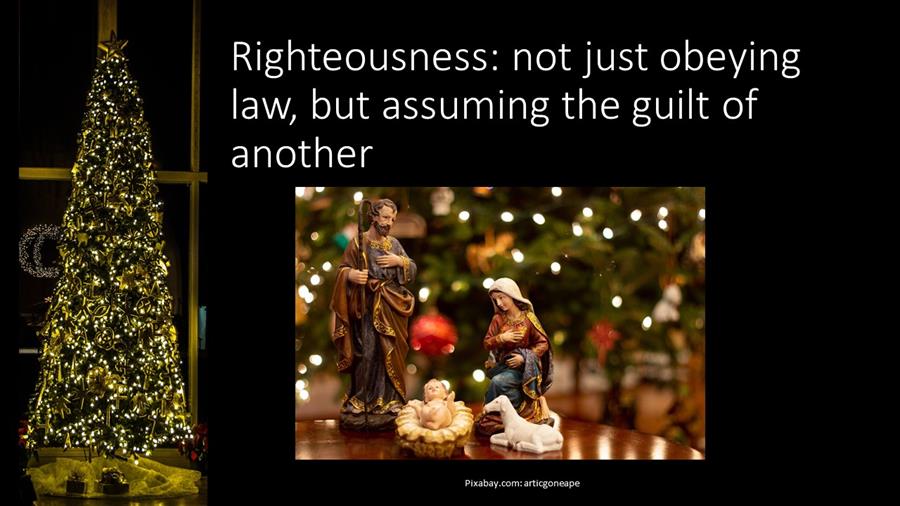
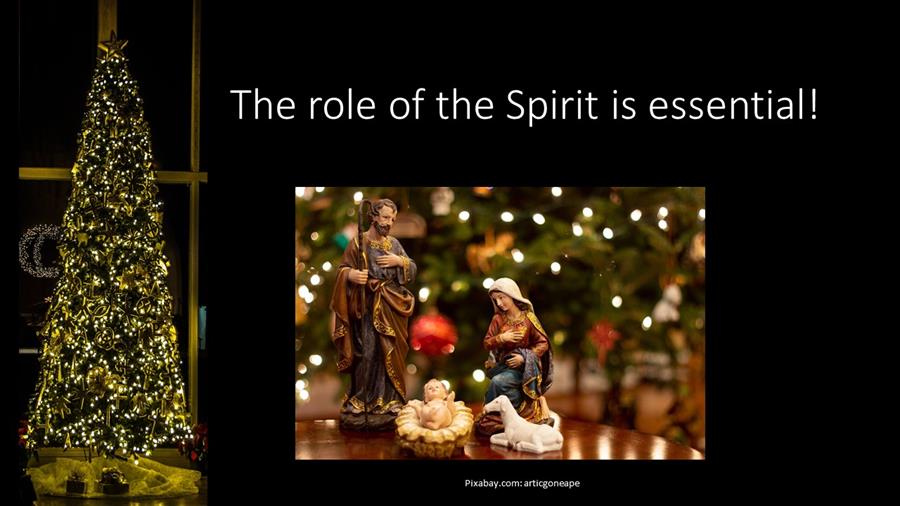 The glue that holds this passage together is the Holy Spirit. In a way, the Holy Spirit is like divine matchmaker. The Spirit impregnates Mary, bringing life into her womb and setting off this genesis, this new beginning. The Spirit also works on the other side of the equation, with Joseph, getting him to buy into the plan. Through the dream, Joseph is informed of Mary’s righteousness and of God’s plan for the child she carries. And when Joseph awakes, he decides not to dismiss Mary, but to go ahead with the wedding. They’ll marry and together raise this child and participate in God’s plan for reconciling himself to a fallen world. It’s a good thing Joseph listened to God in this dream.
 Joseph’s dream shows us the importance of listening to God and when we listen to God and follow his path, we will often find peace. Let me clarify. I don’t think listening to God means trying to understand all the dreams of our sleep. Often our dreams are a way that our minds sort out stuff. Instead of investing large amounts of time trying to understand what our dreams are telling us, we need prepare ourselves to hear God’s voice by studying Scripture, by praying and by being open to hear God by whatever means he comes to us. God’s word can come many ways: in our sleep, through a thought we have while walking or driving, or in a conversation. What’s important is that we know God’s word enough to make sure what we hear is from God. Notice in our account today how Joseph is reminded of the prophecies in Scripture. For him, that was assurance God was behind this.