Jesus, We Need You in the Boat

Jeff Garrison
Skidaway Island Presbyterian Church
Matthew 14:22-33
August 9, 2020

To watch the sermon, go to our YouTube page (linked here). The sermon begins at 16:30.


As you heard in Deanie’s wonderful sermon last week, it had been a tough day for Jesus and the disciples. Jesus had received the news that his cousin, who’d herald his coming, had been executed. Jesus and the disciples tried to get away, but the crowds caught up to them. Jesus stopped and spent the afternoon talking and healing. The crowds feasted on Jesus’ words, but the disciples knew that words would not fill an empty stomach. The twelve watched the sun drop in the western sky. In the age before fast food, there was no place to eat and they knew folk’s stomach’s would soon be growling. Worried, they interrupt Jesus and suggest he sends the crowds away so they can go into the villages and buy food. They are surprised to learn that Jesus expects them to feed the crowds. With Jesus’ help and a bit of fish and bread, everyone is fed and to drive home the point, there is enough food that each of the disciples left with a full basket. Then, as people are licking their fingers, Jesus has the disciples get into a boat to sail for a distant shore. He, himself, stays behind, saying he’ll catch up later, and disappears into the hills. Jesus still hasn’t dealt with the grief of John’s death. Like I said, it’s been a long tough day and it ain’t over yet.

Everyone else gets to goes home while the disciples row toward a distant shore. Then, in the darkness of night, something happens. Clouds move in, darkening the moon and clouds. The wind picks up and whitecaps begin to dot the lake. The disciples struggle with the oars as the waves rise. Normally at night, the sea calms as the air cools, unless there is a storm. And on this night, there’s a storm building. The disciples, which include four fishermen, panic. They struggle, hoping to keep the boat afloat long enough for the storm to abate. With the bow into the waves, some pull on the oars while others bail water.

The storm blows throughout the evening and into the early morning hours. The wind has put so much water into the air that everything is misty. It’s hard, in an era without navigation lighting, to make out the shoreline. So, they keep rowing, which is good advice, for you need momentum to push through the waves.  Keeping the oars in the water helps maintain the boat’s stability. This goes on for hours.  Imagine how exhausted they are when they see someone walking across the water toward them. It’s not surprising they think it’s a ghost. Even if you didn’t believe in ghosts, you’d reconsider. Or maybe, you’d think it’s the angel of death, coming to extract its toll. Exhausted and seeing such an apparition is enough to push you over the edge. But just when the disciples fear all is lost, they hear Jesus’ sweet Galilean voice. Jesus calls to them across the water; he’s coming to them in their hour of need.

Had the disciples had time to think theologically, they might not have been so shocked. After all, one of the first thing God does in creation is the calm the chaos of the waters and in the Exodus, God divides the waters so Israel can escape the wrath of the Egyptians.[1] In Psalm 77, God is portrayed as making his way across the mighty waters and in Job, we’re told of God trampling the waves.[2] God’s control extends even over the waters and if Jesus is Lord, it should be of no surprise that he walked out on the sea to rescue the disciples.

But the disciples are not clearly thinking this night. All they know is that they are in trouble and their friend Jesus is coming to bail ‘em out (I know, that’s a bad play on words). They are in need and here comes Jesus. The storm, it appears, rages until our Savior takes a seat in the boat, but even if it had continued, Jesus’ presence would have been enough. With Jesus there, their fears are calmed.

There’s a mini lesson in this for us. When we know someone in need or trouble, we often don’t act because we don’t feel we can do anything helpful. But being present is one way we can act. Just being presence with a person in need can help. Furthermore, when we are in need, it is comforting to know Jesus is with us. The comforting presence of our Savior is enough to calm our troubled souls. Just having a friend beside us in the boat is a blessing. We make more out of Peter getting out of the boat in this story, but it’s more important for us to understand the need to have Jesus in the boat. But let’s now consider Peter.

Peter is so excited that he wants to try Jesus’ stunt himself. Before he gets to the boat, Jesus says, “Okay, come on out.” Peter does. He walks on water. Think about it. This is an amazing feat. But the problem is that he thinks about what he’s doing. When Peter looks around and sees the waves and the water under his feet, he panics and immediately sinks. You know, in a couple of chapters, Jesus, in a play on Peter’s name, which comes from the Greek work, petra, or rock, proclaims that upon this rock he’ll build his church.[3] Its generally assumed that because Peter was a strong man from having spent a lifetime pulling nets that he received the name that means rock, but perhaps there’s some humor in all this. Ever heard of someone who “swam like a rock?” That’s Peter!

Can you image the disciples gathered around Peter and Jesus, snickering about Jesus building his church upon the rock—the rock that sank? But Peter wasn’t building the church alone. Peter had to have faith in the Almighty to step up into the leadership role after Jesus’ ascension. In a way, however, we’re all like Peter and sooner or later, we’ll all find ourselves in over our head and sinking and at that point we’ll need a lift, like the one Jesus gave Peter. Jesus will be present with us and will help us when we are in need.

In a way, we’re all like Peter, who was a man of human frailty. Peter often screwed up. He thought he could tell Jesus what not to do… “No, No, No, don’t go to Jerusalem to be crucified.”[4] And then later, when Jesus was arrested, Peter, perhaps Jesus’ closest disciple, denies knowing him.[5]  And here, he’s able to take a step or two on water, as long as he focuses on Jesus, but then sinks when he‘s distracted. We’re a lot like that as individuals and the church. There is a lot God can accomplish in us if we remain focused on Jesus. But when we stop focusing on Jesus, we get in trouble.

This is what most people focus on in this story. John Ortberg even wrote a book titled, If You Want to Walk on Water, You have to Get Out of the Boat. And that’s what we think this story is about: having that kind of faith in Jesus and focusing on him so that we can walk on water and not slip under the waves. But such an interpretation of this passage makes it into a moral story in which we feel guilty because none of have walked on water,[6] nor have we known anyone to walk on water except perhaps up north when the lakes are frozen. If this is only a story about stepping out in faith, we’d feel pretty bad because none of us is up to the task. So, let me suggest another interpretation.

There is good news even with Peter’s near drowning. When life begins to overwhelm us, as it appears to be doing these days as we worry about the pandemic and the economy and the upcoming election and everything else going on in the world, it is easy to be overwhelmed. It is easy to slip under the waves. But just as Jesus came into our lives when we first believed, he is also there when we get in over our heads. He’s there to help us turn our lives around. We can learn from our mistakes, which is a very thing for we have a forgiving God who is willing to help us when we depend on him and not on our own abilities.

You know, I image there was quite a bit of tension in that boat before Jesus stepped in. The twelve disciples were all afraid, but there may have even been some tension between the four fisherman and the rest of the disciples. The other eight, who were not seamen, were depending on the fishermen to know what to do. Why did they allow themselves to get into this dangerous predicament? But when Jesus comes aboard, they all calm down, as does the wind and waves. They know they’ll be alright. And as the wind dies and the waves cease, they do what we should do whenever God saves us. They worship Jesus. That’s the message we should take with us. Don’t worry about jumping overboard and trying to walk on water. Instead, let’s make sure we invite Jesus aboard our boats. For Jesus comes to save us and our response is to worship him. May it be so.


©2020


References:

Bruner, Frederick Dale, The Christbook: Matthew 1-12 (Grand Rapids, MI:
Eerdmans, 2004).

Hare, Douglas R. A., Matthew: Interpretation, A Commentary for Teaching and Preaching (Louisville: John Knox Press, 1992).

[1] Genesis 1:1-13 and Exodus 14.

[2] Psalm 77:16-20 and Job 9:8.

[3] Matthew 16:18.

[4] Matthew 16:21-24.

[5] Matthew 26:69-75.

[6] See Scott Hoezee, “Proper 14A (August 3, 2020), Matthew 14:22-33 at the Center for Excellence in Preaching website.

Kingdom Parables

Jeff Garrison
Skidaway Island Presbyterian Church
Matthew 13:31-33, 44-50
July 26, 2020

Click here. The entire service can be seen on Youtube. The service proper begins at 15:30 and the sermon begins at 28:00. 


At beginning of Worship:

Today, we’re finishing our look at Jesus’ parables in Matthew 13. Over the past two weeks, we’ve looked at larger parables, about farming. Today, Jesus rapidly fires off five parables about the kingdom that come from a variety of experiences. In these stories, we learn of God’s work and our need to respond with full commitment. Even when it doesn’t feel like it, when we are overwhelmed by the world, God is at work. When we discover God’s work, we need to join in. My question for us today, “Where do we see God at work and how should we respond?


After reading the scripture (Matthew 13:31-33, 44-50)

One purpose of a parable is to use simple things in which people can relate to tell a story that has profound implications. Jesus’ audience hasn’t seen Disneyworld or Las Vegas, which are at best cheap imitations of what God can do,[1] so instead of our Savior explaining God’s kingdom as some wonderful place, he tells stories. In a way, Jesus hops from one metaphor to another, telling them things they might know. They understand yeast and seeds, valuable treasures, and fishing. Like Jesus, let me tell a couple of stories.

When I was in seminary, I took a year off from my regular studies to take a test drive of pastoring. First Presbyterian Church in Virginia City, Nevada offered me a yearlong contract, as a student, to be their pastor. Up until this point in my life, I had never been to that part of the country. I’d been to the West Coast, to Los Angeles and to San Francisco. I’d even been to Yosemite, but I had never been in that vast sagebrush ocean known as the Great Basin. I was nervous. Nevada had gambling. “What kind of heathens gamble,” I wondered. Back in the mid-80s, you didn’t have casinos weren’t ubiquitous.

My second concern was it being the desert. I’d always been around water. I asked a member of their committee, who had lived in North Carolina, what Virginia City is like. He said I’d find it a lot like North Carolina, with the hills covered with pines. I knew he was teasing, but I needed to check it out. One weekend, I flew to Reno. It was night when I landed and in darkness, I was picked up and we drove up to the Virginia City, which is a couple thousand feet higher and on the back of a mountain range from Reno. The next morning, I couldn’t wait to see what kind of world I was in. I rushed to a window, opened the blinds, and looked out, and shook my head. Yes, there were pine trees alright, but the tallest of them might had been 12 feet high. Not much larger than the mustard tree in Jesus’ story. In time, I would come to know that these pinion pines, like the mustard bush, teams with life. Stellar jays, magpies, wrens, bluebirds, all kinds of small rodents and, in summer during the heat of the day, perhaps a great basin rattler. God takes care of them all, just as God took care of me. I soon got over my shock and set out exploring.

We are surprised by God’s kingdom. Who’d think that a little seed, be it a mustard or a pinion pine seed (which is great in pesto, by the way) could make such a difference?

The second image from my past is yeast. As you may remember, I spent five years working in a wholesale bakery, starting out while in college. You know, it doesn’t take a lot of yeast to make a lot of bread. Now, we used 50-pound bags of yeast, but we also received our flour in railcars. It’d take a couple of cars a week to supply our flour needs, during which time we’d go through a pallet or two of yeast. The thing about yeast is that once it’s mixed in, you have a hard time controlling it. The yeast takes over and the dough continues to expand until the yeast is killed in the baking process. When things go smoothly, the plant ran like clockwork. But occasionally, something happened, such as a jam in the oven. Suddenly everything stops, except the yeast. By the time things are fixed, the proof box is a mess cause all that dough kept growing and rising until it couldn’t rise anymore. Dough would be on everything. We’d have to take steam pressure cleaners and wash every rack in the proof box and all the pans. It was a mess. Thankfully, this didn’t happen often, but it happened enough that kept us humble.

“The Kingdom of Heaven is like yeast that a woman takes and mixes with flour until all of it was leavened.” Think about this.  Once she introduces the yeast, it’s out of her control. If there is something in the dough for the yeast to eat, it continues to grow.

What Jesus is telling us here is that the kingdom is dynamic. Once the gospel is introduced, it starts growing and there is no stopping it. Think about how fast the church is growing today in China, even as the Communist Party tries to stamp it out. The church is growing in Africa and in the former Soviet Union, in India and South America. But the Kingdom is not only out there, on the mission field. It is also here in our congregation and even right here inside each of us.

The Kingdom is like a bit of yeast that can transform flour into a voluminous loaf, or a seed that can grow into a tree. Think about this for a moment. There are just a few things a baker can do to enhance the yeast. You keep it at the right temperature, feed it with sugar, and so forth… Likewise there are things we can do to enhance the growth of a tree such as watering and fertilizing. But ultimately, the yeast and the seed are not our doing. Their success, as both parables attest, belong to the hands of the one who controls life. These parables point to God’s involvement, to God doing something in our world and in our individual lives which we, by ourselves, cannot achieve.

At a time like this, with the pandemic and violence in the streets, we may wonder where God is and what God is doing. These stories remind us that we might not see God showing up in major ways, for that’s not how God works. Jesus was born among the animals in the poor hamlet in a far corner of the empire. A tablespoon of yeast or the seed that you can barely see can bring about great change. The change God brings into the world, into the kingdom, may not make the headlines of the New York Times, the Savannah Morning News, or even the Skinnie. But it’s here, alive, and working.

Jesus addresses the parable of the mustard seed and of yeast to a crowd of people. He wants everyone to know that God was doing something exciting and new in the world. Jesus wants to make it clear to everyone that God’s spirit is available; that if they would just open themselves up to the Kingdom which he’s ushering in, God could do wonderful things through their lives. The promise set forth in these parables still apply today.

After addressing the crowd, Jesus and the disciples slip away into a house. There the disciples questioned him concerning the meaning of parables. This gives Jesus an opportunity to tell more parables. The kingdom of heaven is like treasure hidden in a field, the merchant finding a valuable pearl, or a net cast into the sea.

Let’s think about these parables in relationship to the first two parables told to the masses. In the first set, Jesus suggest God’s action. As with the yeast or mustard seed, God is doing something in the world that we as humans cannot do. God is forgiving and creating new beings out of the old. It’s all God’s doing. However, in the parable of the hidden treasure and the valuable pearl, Jesus suggests we also act. The one who buys a field or buys the pearl does so because they want desperately to obtain the treasure or pearl. It’s the same way with God’s kingdom. When we experience a just a taste of it, we’re going to want it so badly that we’ll give up whatever in order to have it. This is the Calvinist doctrine of irresistible grace. If we experience the kingdom, we’re going to make it the number one priority in our lives. We need that kind of passion for God! Such passion will strengthen the church and further God’s work in the world. Now, parables can only be taken so far. No, unlike the person finding the treasure, we can’t buy ourselves a spot in the kingdom. But believe this: if we could, we should be willing to pay top dollar.

Jesus concludes these parables with one comparing the kingdom with a net which catches fishes, but in the end the good fish are separated from the bad. This ending parable is, in many ways, different from the others. Instead of being directed at the crowd or the disciples, it seems to be intended for the church. The parable is also the only one of this group which talks about the Kingdom in the future. The others four emphasize the beginning of the kingdom, here and now. Furthermore, this parable is about judgement. The fish which do not measure up are thrown out. However, it would be wrong to interpret ourselves as the discriminating fishermen. That task belongs to God. The familiar ring, which Jesus has already instructed, comes to mind: “Judge not, lest ye be judged.”[2]

There you have it. Two parables about God growing the kingdom, two about the value of the kingdom, and a warning… You know, Jesus doesn’t give us a clear picture of heaven here or anywhere in the Bible. He doesn’t talk about it as a place.[3] In The Divine Conspiracy, Dallas Willard speaks of a kingdom as a place where one person’s influence determines what will happen.[4] This kingdom is where Jesus’ influence is a living presence. The kingdom of heaven is not someplace we strive to get to; instead, it’s something which starts inside each of us when we open our lives to God and invite Jesus in…. Amen.

©2020


Resources and References:

Bruner, Frederick Dale, The Christbook: Matthew 1-12 (Grand Rapids, MI:
Eerdmans, 2004).

Duffield, Jill, “Looking into the Lectionary,” The Presbyterian Outlook (Online edition, July 20, 2020).  https://pres-outlook.org/2020/07/8th-sunday-after-pentecost-july-26-2020/

Gundry, Robert H., Matthew: A Commentary on His Literary and Theological Art (Grand Rapids, MI: Eerdmans, 1982.

Hare, Douglas R. A., Matthew: Interpretation, A Commentary for Teaching and Preaching (Louisville: John Knox Press, 1992).

Hoezee, Scott, Proper 12A (July 20, 2020), from Calvin Theological Seminary’s “Center for Excellence in Preaching. https://cep.calvinseminary.edu/sermon-starters/proper-12a-2/?type=the_lectionary_gospel

[1] I’ve always been struck by Steve Wynn, one of the Las Vegas developers, often quoted (and blasphemous) quip about Vegas being how God would have done things if he had money.

[2][2] Matthew 7:1.

[3] In Revelation 21 & 22, John has a vision of a “new heaven and a new earth,” which is place, but Jesus keeps his kingdom talk to metaphors and ideas about what God can and is doing in the world.

[4] Dallas Willard, The Divine Conspiracy, as referred to by Scott Hoezee in his notes on this passage. See https://cep.calvinseminary.edu/sermon-starters/proper-12a-2/?type=the_lectionary_gospel

The Danger of Forcing Others to be Good

Jeff Garrison
Skidaway Island Presbyterian Church
July 19, 2020
Matthew 13:24-30, 36-43

 The worship service is available at Skidaway Island Presbyterian Church’s YouTube site. Click here. I began reading the scripture at 13:50 and the sermon begins at 16:50 and ends at 37:30.  

Opening of Worship: Nothing needs reforming as much as other people’s bad habits.” That’s probably Mark Twain’s most quoted saying. It rings true. It’s easy to see where someone else is wrong and to ignore our own blind spots. We want everyone but ourselves to clean up their act, forgetting the log in our own eyes.[1] Today, we’re looking at another parable from the 13th Chapter of Matthew. Like last week, it focuses on agriculture. This second “big field” parable is about the weeds growing within the wheat. We want everything to be pure, but at what cost? This morning, ask yourself if we really think we’re capable of being an honest judge?

###


I was gypped as a child. I don’t remember a sermon on this text. This scripture could have been added to the arsenal I used to make a case for not chopping weeds in the garden. I wasn’t a biblical literate child.

However, I am not sure this reason to not to pull weeds would have worked any better than when I told my siblings that the Bible said they should respect and obey me since I was their elder. Two things you can take away from this: using the Bible for our own self-fulfillment is dangerous, and the Bible is not a “how-to-farm” manual.[2]

Jesus tells this parable because he knows we’d like nothing more than to clean up other folk’s lives and when we attempt to do this, we often create a mess. If the church had paid a little more attention to this parable, we’d have had fewer headaches. Crusades, witch-hunts, inquisitions, and other quests for purity that have given the church black eyes and created massive suffering could have been avoided.

This parable is about the church.[3] We could easily place ourselves in the role of the farmhands who inform their boss of the problems going on in the back 40. “There are weeds in the wheat.” It’s a terrible thing… What should we do about it?

When I was in seminary and working for a church in Butler, Pennsylvania, I took the youth skiing one Saturday. The kids could invite friends. Ryan invited a friend who attended a very conservative church. In our group was another kid named David. This was back in the mid-80s. David was a “skater” and a problem child. On this particular day, it took him only an hour or so for the ski patrol, who had called him down a few times, to revoke his skiing privileges. David got to spend the rest of the day sitting in the lodge with a mother who didn’t ski, but volunteered to come along as a driver, to fix our lunch, and watch over our stuff. I’m not sure if she realized watching over our stuff including sitting on David.

After lunch, I spent some time skiing with Ryan and his friend. Riding up on a lift, this guy, filled with self-righteousness, asked me what kind of church we were to allow the likes of David to be in our midst. He assured me that his church would never allow David to go on their trips. My first thought was to get rid of the weeds and to throw this kid off the lift. But I came to my senses and tried to reason with him about how, if we’re here for anyone, we’re here for the David’s of the world. Then I mentioned about how Jesus seemed to prefer the company of sinners to those who are self-righteous. I began to take pride in my ability to rub his nose in Jesus’ words, until I realized I was no better than him.

You know, there have been times when I’ve wondered why someone was in church. Wouldn’t the church be a lot better if we didn’t have self-righteous folks like that kid on the lift? Wouldn’t it be better if there were no hypocrites giving us a bad name? Wouldn’t it be a lot better in here if we were all squeaky clean?  Probably not; if we were perfect, we wouldn’t need a Savior and we wouldn’t need the church. And if the church was that perfect, without the self-righteous, the hypocrites and those less than squeaky clean, most of us including myself would be out.

Let me suggest this… The farmhands’ question as to where these weeds came from is the same as us wondering why there is so much evil in the world.[4] Scripture doesn’t give us a good answer as to why there’s evil; instead we’re given a prescription of how to overcome it. Our righteousness is not from our efforts, but from Jesus Christ.

Martin Luther realized the church can’t be without evil people. Writing about the parable, he said: “Those fanatics who don’t want to tolerate any weeds end up with no wheat.”[5] This parable reminds us that we have to deal with the weeds and the wheat, the good and the bad. As much of a pain the weeds might be, they can make us stronger (as with a plant that must compete with other plants for nourishment and sun). Furthermore, the weeds serve as a constant reminder that we are not the ones who are in control.

God is in control. And there are many good reasons why God might not want to purify the church right away. First of all, God knows that any campaign to purify is going to create problems. The wheat, whose roots are not fully established, may be harmed when the workers try to pull out the weeds, just as good people are often harmed when someone becomes over zealous and instills a campaign of righteousness.

I’ve referred before to C. S. Lewis’ little book, The Screwtape Letters. It’s the fictional correspondence from Screwtape, an older and well-seasoned demon, to his nephew, Wormwood. Screwtape gives the younger demon advice as to how to win a soul over to the dark side.  Screwtape refers to Wormwood’s subject as a patient.  When Wormwood’s patient becomes a Christian, obviously a failure if you’re a demon, his uncle encourages patience:

One of our great allies at present is the church itself.  Do not misunderstand me. I do not mean the church as we see her spread out through all time and space and rooted in eternity, terrible as an army with banners… Fortunately, it is quite invisible to these humans. All your patient sees is the half-finished sham…

Screwtape goes on to point out that when Wormwood’s patient gets into the pews and looks around he’ll see “his neighbors whom he has hitherto avoided.” Then the demon could make his move.

Make his mind flit to and fro between an expression like ‘the body of Christ’ and the actual faces in the next pew. It matters very little what kind of people that next pew really contains… Provided that any of those neighbors sing out of tune, or have boots that squeak, or double chins, or odd clothes… Work hard, then, on the disappointment or anticlimax which is certainly coming to the patient.[6]

This parable reminds us that we have to be careful that our zeal for holiness doesn’t become corrupt and our love becomes hate. If that happens, we’re no better than those whose actions we deplore. Scripture is clear that God has an enemy in the world who would like nothing more than to turn us away from the truth. It’s not always wild and sinful living that cause us to fall; we can also become so consumed to rid our world of evil and we begin began to think we are so important that we ignore       The parable of the weeds reminds us that if our enemy is unable to keep the seeds from taking root, he will as one commentator on the passage observed, “Overwhelm us with a loathing of evil.” In other words, he’ll corrupt our love and use it against us.[7]

Of course, the farmer in the story is God. As the farmhands, we may think we can be in control, but as we find out here, the farmer is wise and wants to make sure that the crop is not harmed by our zealous efforts. Now, there is another underlying message here. We might want to ask why we have to suffer evil in this world… At times, it may even appear that there is a benefit for being bad, for being a weed. But this passage reminds us that sooner or later, everyone gets their due. The evil may seem to prosper in this world, but there’s judgment coming. When the harvest is ready, the weeds will be consumed. Judgment means there will be “weeping and gashing of teeth,” which is another way of saying it won’t be good for the weeds.[8]

What might this passage say to us? It encourages tolerance. As sinners, redeemed by Jesus Christ, we must be careful not to think too highly of ourselves or to be too quick to condemn others. The church isn’t going to always be perfect. In Martin Luther’s writings, he recalls this old saying: “Whenever God erects a house of prayer, the devil builds a chapel.”[9] Trying to destroy that chapel may result in terrible collateral damage.

The church on earth will never be pure, but that’s okay because God is not finished with us yet. If we as the church can be accepting of others in the manner of Jesus, we will draw others to us that may not, at first, look like they belong. But we’re not the one who judges. Instead, we give thanks for those in our midst and love them unconditionally in the same manner that we’ve been loved by our Father in heaven. So, before we go out and volunteer for a crusade or sign up as the Grand Inquisitor, think about what Jesus is telling us through this parable. As farmhands within the story, we’re not in control.

A second thing to consider is that sometimes we might look a lot like weeds and on those occasions, we’d like to experience a little grace (just like others would like a little grace from us). Grace is a powerful tool in this world of ours. A little grace will go a long way toward breaking down barriers and bringing people together. As followers of Jesus, as his farmhands, we need to be showing the world what grace looks like.

In his memoir, A Dresser of Sycamore Trees: The Finding of a Ministry, Garret Keizer tells of a time he’d stopped at a grocery store to pick up some bananas for an elderly friend he was going to visit. He was smug thinking of his good deed. But then, ahead of him in the check-out line was a woman who had a bunch of little purchases. She paid for them individually. He had no choice but to wait as she fumbled around with these little piles of money. Waiting, he began to resent the woman. As he followed her out of the store, having quickly paid for his bananas, he “shot her that look” that said, “You’re a jerk.” But then, he noticed her opening the door of a large van. On the side was a sign for a local nursing home. Before she drove away, she handed each of the residents who were inside the van, their packages.[10]

We gotta be careful. We just might pull the wheat up with the weeds.

Show some grace this week. People are pretty tense with all that’s going on in the world. It’s easy for us to get upset with “Them,” whoever “them” might be. When we are stressed, we can make bad judgment. So, let’s show patience and trust God to judge, while we do what good we can. Amen.


©2020

[1] See Matthew 7:3.

[2] “[T]his story is not about agriculture but instead it is about theology…  do not consult it for best agricultural practices!”  Scott Hoezee, “Proper 11A, July 13, 2020, https://cep.calvinseminary.edu/sermon-starters/proper-11a-2/?type=the_lectionary_gospel

[3] There have been debates as to whether this parable is about the world or the church, but the evidence and most scholars think this passage applies to the church. See Douglas Hare, Matthew: Interpretation (Louisville; John Knox Press, 1993), 155.

[4] F. Dale Brunner, The Churchbook: Matthew 13-28 (Grand Rapids: Eerdmans, 2004), 28.

[5] Martin Luther,  as quoted by Bruner, 30.

[6] C. S. Lewis The Screwtape Letters (1941, New York, Macmillan 1961), 12-13.

[7] Bruner, 27.

[8] Bruner, 45.

[9] Luther’s Works, 51:173-87, as quoted by Bruner, 27.

[10] Garret Keizer, A Dresser of Sycamore Trees: The Finding of a Ministry, as told by Jill Duffeld, “7th Sunday after Pentecost:  God Does the Sorting,” The Presbyterian Outlook (July 13, 2020, online edition)

Overabundant Harvests

Jeff Garrison
Skidaway Island Presbyterian Church
July 12, 2020
Matthew 13:1-9, 18-23


    A crowd gathers around Jesus. They press in, each trying to get closer to the mysterious storyteller, to touch the garment of the great healer. It’s an age before social distancing. Our Savior, to create breathing room, jumps into a boat and rows out a short distance from the shore. Then he turns toward the crowd and sees their tired faces: peasant farmers who toil to make ends meet, sun chapped fishermen who struggle day by day to provide for their families, young women whose bodies are already old from laboring in the fields. Jesus also sees the discouragement of disciples who’ve witnessed believers turn away. His heart goes out them. Knowing and understanding their disappointments, he tells a story:

 “Listen! A sower went out to sow.   And as he sowed, some seeds fell on the path, and the birds came and ate them up. Other seeds fell on rocky ground, where they did not have much soil, and they sprang up quickly, since they had no depth of soil. But when the sun rose, they were scorched; and since they had no root, they withered away.  Other seeds fell among thorns, and the thorns grew up and choked them. Other seeds fell on good soil and brought forth grain, some a hundredfold, some sixty, some thirty. Let anyone with ears listen!”

What does that mean, they began to ask themselves? Many are farmers and none had experienced such abundance. What kind of harvest have you received from seeds you’ve sown?

You know, gardening is big this year. I had a hard time finding seeds and plants earlier in the spring when I was setting up my summer garden in my plot at Skidaway Farms. With the lockdown and the limited products available at the grocery store in the spring, it seemed many were returning to their roots. People are digging in the dirt, which is a good thing. And I’ve had a good year. Sadly, the tomatoes, cucumbers and squash are done in this heat—but I’m beginning to get my fill of okra, eggplant and peppers! There are a variety of items to tease my taste buds. And it’s good to work in the dirt.

A number of years ago, I asked a farmer about this parable. I wanted to know what a good harvest of oats—one of the grains of choice in Jesus’ era, would be today. I was told such a crop generally yields between seventy and hundred bushels per acre and that he might use 2 or 3 bushels planting that acre giving a yield of roughly thirty fold.[1] With all our technology and science, tractors and herbicides, a hundred fold still seems out of reach.

The discouraged farmers and disciples listen to Jesus’ message, but they’re confused. They identify with the difficulty of the sower whose seeds are eaten or fall along the path, but they cannot understand where a farmer could have found such good soil to produce a crop of even thirty fold, and certainly not sixty or a hundred fold.  Farmers in Palestine in the first century had it tough. On average, for every bushel of grain they planted they reaped only seven and a half bushels. If it was an exceptionally good harvest, they might gather ten bushels.[2]

Obviously, God would have to really bless the crop if one was to reap 30 or more bushels. And Jesus’ message is just that, the harvest, those in whom the gospel takes root is a blessing from God. As humans, we cannot produce such an effort. But God can and therefore, as farmers know, we do our part and then must be patient, waiting and expecting the best.

This parable is an analogy and it is dangerous to push the analogy too far and think that the seeds which fell in the good soil were lucky while those who fell in the poorer areas were just ill-fated. Such an interpretation would diminish our responsibility for our actions. Perhaps, because the analogy can be interpreted in such a way, Jesus explains the story:

“Hear then the parable of the sower. When anyone hears the word of the kingdom and does not understand it, the evil one comes and snatches away what is sown in the heart; this is what was sown on the path. As for what was sown on rocky ground, this is the one who hears the word and immediately receives it with joy; yet such a person has no root, but endures only for a while, and when trouble or persecution arises on account of the word, that person immediately falls away. As for what was sown among thorns, this is the one who hears the word, but the cares of the world and the lure of wealth choke the word, and it yields nothing. But as for what was sown on good soil, this is the one who hears the word and understands it, who indeed bears fruit and yields, in one case a hundredfold, in another sixty, and in another thirty.”

Jesus’ explanation emphasizes three dangers facing Christians in the world. Those who do not understand the gospel are quickly snatched away by the evil one just like the seeds on the hardened path are eaten by birds. To understand the gospel means more than an intellectual comprehension. To understand, in the Old Testament sense, implies a moral commitment as shown by the author of the 119th Psalm: “Give me understanding, that I may keep your law and observe it with my whole heart.”[3] The first seeds lost are those who do not seek to live within God’s word.

The second danger facing Christians is marginal belief. Like the plant which grows in rocky soil, the believer who is not firm in his or her faith might grow up quickly, promising to do great things, only to turn away when times are tough. We’ve seen it happen, haven’t we?  People who get all excited and join the church, then become disinterested, burned-out, or melt away when challenged. We need to carefully strengthen our faith in Jesus Christ, allowing ourselves to get a good root system started. Otherwise, in our immaturity, we’ll try to take on the world and end up overwhelmed and give up.

The third obstacle facing Christians are the temptations of the world. The seeds overwhelmed by the thorns are examples of those who are more attracted to worldly affairs than to the gospel. We cannot serve two masters, Jesus has already told us in Matthew’s gospel,[4] and those who focus on worldly concerns soon forget about the gospel. As Christians, we are to be concerned for the world because God’s love for the world, not because of our own desires. Sometimes we get this turned around and then end up working for what we want and not for what God would have us do.

But this passage is not about avoiding good or bad soil, which is something over which the seed has no control. Instead, it’s a parable about what God can do. Jesus tells of the good soil which produced upwards of hundred fold. I’ve already discussed how such a yield was impossible in Biblical times and unheard of today, so we must conclude that the good soil is even more blessed by God so that it can produce such results. It’s important to understand that a plant is not judged on how it looks while growing, but on the fruit it sustains. Note that both the seeds sown on rocky soil and among the briers grow at first… Often, as with the case of the plant in the rocky soil, such seeds sprout and grow fast, but produce no long-term harvest. Only the seed in the good soil produces a bountiful harvest.

Our purpose isn’t to be digging up the thorns. Instead, we’re to encourage growth and deep roots.[5] Jesus also emphasis this later in this chapter, which we’ll look at next week, with the parable of the weeds amongst the wheat.[6] Judgment belongs to God, we’re to encourage growth and trust in the Almighty.

You know, when I was a kid we always had a large garden. Even though we lived in suburban America, my mother still thought she was on the farm… Every year, it seemed, she was in a contest with her mother and mother-in-law to see who could can the most green beans. Continually, throughout my childhood, they competed and set new world records for the number of quarts of green beans they canned. Why our family needed 75 quarts of green beans was beyond my comprehension-then and now-especially since everyone else was also busy canning them. They couldn’t give them away so after being forced to snap the beans, the beans were forced on us kids all winter long. This was in the ‘60’s, a time when Nuclear War seemed like a real possibility. I assure you, the thought of the bomb wasn’t nearly as frightening as living in a cellar eating green beans out of old Mason Jars… Now you know why it is I don’t like green beans. As for the green bean casseroles, I’ll steal an onion ring off the top, if you’re not looking, and leave you the rest.

Green beans aside, it takes time to produce a good crop. In my garden at the community farm, where I refuse to plant green beans, I am constantly pulling weeds, fighting fire ants, and trying to scare away birds. None of us have Jack’s magic seeds, we can’t plant a seed and have it grow up overnight. If we want a good garden, we must take the time to tend to it. The Christian life is similar. We must nourish ourselves continually, being constantly on the lookout for that which keeps us from focusing on Christ. And when we nourish ourselves—by studying God’s word, praying, worshipping, keeping the Sabbath, striving to be generous, and to show grace to all—we open ourselves up to be used and transformed by God. And God can use us to sow more seeds in the world which, if nurtured, will lead to more transformations, which offers the world hope.

But remember this is a parable. Don’t despair, thinking you are in the wrong soil. Don’t give up if things don’t go the way you feel they should. It’s easy to get discouraged and depressed. Instead of us seeing ourselves as seeds, we should see ourselves as the one who sows the seed. Even though God has blessed us, and for this we should continually give thanks, when we look around our community and across the globe, we see many people who are in need and not being reached by any Church, people who don’t know the love and forgiveness of Jesus Christ.

You know, the disciples must have felt the same way as we do before Jesus told them this parable. After hearing his words, they realized God was with them.  Sure, there were many people who rejected Jesus’ words. Sure, there were those who seemed so eager to follow Jesus, but had no roots and quickly fell away. Sure, there were guys like the rich young ruler who wanted to follow Jesus, but just couldn’t let go of the world.[7] But there were also blind men who could see and those who had been lame were walking. The disciples must have understood what Paul would later say: “So neither the one who plants nor the one who waters is anything, but only God who gives the growth.”[8]

Jesus’ story encourages us not to give up. Keep sowing the grain. Even in face of meager results, be true to the gospel and continue to praise God and proclaim to the world that Jesus Christ is the way and the truth and the life.[9] For we never know when God might provide a harvest of a 100 fold! That’s our job. Even amid doubt and despair, even during a pandemic, we claim this world for God. We believe that God is working out things for the best, and we pray God will give us a harvest. So let’s do our part and sow the seeds of the gospel. When you can offer hope to someone, offer hope. When you can help someone, help them. Do it all in the love of Jesus and give him the credit. Amen

[1] Wayne Kent, Ellicottville, NY.

[2]Douglas Hare, Matthew: Interpretation, A Bible Commentary for Teaching and Preaching (Louisville: John Knox, 1992), 152-153.

[3] Psalm 119:34.

[4] Matthew 6:24.

[5] Brian McLaren, A Generous Orthodoxy, (Grand Rapids: Zondervan, 2004), 254-255.

[6] Matthew 13:24-30, 36-43.

[7] Luke 18:18-23.

[8] 1 Corinthians 3:7.

[9] John 14:6.

Let’s Join in the Fun

Jeff Garrison
Skidaway Island Presbyterian Church
July 5, 2020
Matthew 11:16-19

To watch this service, click here. To watch the sermon, fast forward to 20:00 minutes in the stream.


Opening of Worship:
          How many of you remember Calvin and Hobbes, the comic strip? I always identified with that kid. There was a time when Calvin was writing a self-help book. O Great, you might think, just world needs, another self-help book. But Calvin saw a fortune to be made, as he confides to Hobbes. His strategy is to convince people there’s something wrong with them. It’s rather easy, because advertising has already conditioned us to feel insecure about our weight, looks, social status, sex appeal, and so on… “Next, he’ll convince people that the problem is not their fault.” This, too, is easy because nobody wants to be responsible.

        Having prepared the way, Calvin feels he can sell folks on his expert advice and encouragement. He’s on to something. We long for satisfaction and we expect someone to show us where to find it.

But the answers are not so simple. For followers of Jesus, we must admit that we don’t have simple or easy answers for life’s problems. You know, the early church was known as “The Way.”[1] That was because they didn’t give out pat answers, instead they point to the only enteral truth they knew—Jesus Christ. The church was the way people learned about Christ and is the vehicle God uses to share the gospel to the world. Think about it…

Back to that comic strip, Calvin decides he’ll help people get over their addiction to self-help books. His book is titled, Shut Up and Stop Whining: How to Do Something With Your Life Besides Think About Yourself.”[2] Actually, there’s some truth in that title. Sometimes we are too serious. We need to lighten up. We need to learn to play and enjoy life. That’s the theme of my message on this 4th of July weekend: enjoy life and play!


Sermon (After Scripture Reading):
There was a congregational meeting in which the topic of money (or the lack thereof) came up. An elderly statesman of the church stood up and complained about the lack of commitment. “We need to be willing to pull our share; the Christian life is one of suffering and sacrifice.” He concluded his speech, pleading “We need members who are willing to pick up their cross.” Many nodded their heads in agreement, but there were a few who were uncomfortable. A younger woman stood timidly and challenged the older member with Jesus’ words: “I come so you might have life and have it abundantly.”

Do you feel the tension between these two positions? The older member demands sacrifice while the younger member wants to enjoy the life promised by our Savior. Both positions can be “proved” by scripture. Both are valid. We must live within the tension of the two.

This is a beautiful world God has created. We’ve been placed here to enjoy it. Think about all the good things we enjoy. We should relish life, each other, and our Lord. Life is a joyful dance and we should make the most of it. Of course, that doesn’t mean that we shouldn’t sacrifice, but there should be joy in our giving since God has given us so much.

Children, if given a half a chance, know how to enjoy life. Even in poverty, you see kids laughing. Have you ever watched a child act like they were mowing the yard when you were out sweating and pushing a mower? The child pushes their own Fisher-Price popcorn mower back and forth, just like you’re doing under the hot sun. Perhaps you remember being like this as a kid? I couldn’t wait until I was old enough to mow the yard. That desire lasted about three weeks after I was old enough to mow. At that point, I decided growing up wasn’t such a big deal.

Kids play games. It’s fun. Think about your childhood. You could be a real cowboy without having to shovel manure. You could be soldier without being shot at or a nurse without having to dump bedpans. Children have a wonderful view of the world. They enjoy acting like grown-ups, and that’s okay. The problem arises when it goes the other way.

The way children act like they are “grown-ups” sheds light onto this parable of Jesus. In the passage, Jesus refers to a game played by kids in a village marketplace. The kids act like adults at a wedding or at a funeral. If it’s to be a wedding, one child plays a flute and the rest dance together in a circle. Or, if they act out a funeral, they cry and pound on their breasts in mourning.

Jesus said that people of his generation were like children who refused to join the game. Imagine the marketplace. Sometimes, you know, children refuse to get involved. Maybe because they don’t know the other children, or they’ve been picked on. It’s a sad thing to see a child standing to the side watching other kids enjoying themselves. And yet, once these children get into the game, something magical happens. They forget their apprehensions and have a great time. Jesus tells us that those who refused to hear his call are like children who refuse to get involved. By not participating, they missed out on the fun. We adults can be like this when we take things too seriously.

Jesus goes on to say that John the Baptist, the guy who lived off insects in the wilderness and dressed like a “deadhead,” is rejected as being a demon. John lived a rigorous life and people don’t want to hear about that. Sin and repentance are never been popular topics. So along comes Jesus who enjoys life. Jesus, it appears, never turns down an invitation to a party… Think about the weddings and banquets Jesus attends. Jesus enjoys the company of people and the pleasures of food and drink. This leads some people to call Jesus a glutton and drunkard. And they criticized him for the friends he hung around: tax collectors like Matthew and other obvious sinners like the fallen woman who dried his feet with her hair. Talk about a way to develop a reputation. Imagine the gossip when word got around about that scene.

There is a “Catch-22” situation here. Folks reject John because he lives without comfort and they reject Jesus because he enjoys life. Most people of Jesus’ generation wanted nothing to do with either one. They are too busy in their own little worlds to join the dance. But Jesus invites us all to join him. He invites us to live and really experience life. Are we ready for it? Are we willing to cast away our doubts and our troubles and to enjoy what we have been given?

In Joseph Girzone’s parable of Jesus, titled Joshua, he writes:

Jesus came to earth to try to free people from the kind of regimented religion where people are threatened if they don’t obey rules and rituals… Jesus came to teach people that they are God’s children and, as God’s children, they are free, free to grow as human beings, to become beautiful people as God intended. That can’t be legislated. Jesus gave the apostles and the community as a support to provide help and guidance and consolation. Jesus did not envision bosses in the worldly sense. He wanted his apostles to guide and serve, not to dictate and legislate like those who govern this world.[3]

This passage encourages us to enjoy life—something we tend to do around Independence Day. We need to have fun, enjoy the summer. We should live that first beautiful statement in the Westminster Catechism, which defines our purpose as “enjoying God forever.” Horace Bushnell, a 19th Century American theologian wrote during the dark days of the Civil War, “Religion must be a form of play—a worship offered, a devotion paid, not for some ulterior end, but as being its own end and joy.”[4] Yes, we need to be concerned for sin, but not too concerned. Jesus came to free us up to live.

Now, let me talk a bit about sin. You know, there are basically two kinds. If you were present here in the sanctuary and I could ask you to name some sins, you might begin your list with the favorite sins of your neighbors: adultery, stealing, murder, greed, not wiping your feet before entering the house, forgetting an anniversary, and so on. But all sin can be grouped into two categories. The classical form of sin is that of pride which comes from our desire to be God. That’s Eve eating the fruit because the serpent told her she would have the knowledge of God. It’s the same sin we all commit when we live as if we are the ultimate authority. We’re all guilty.

The other kind of sin is the opposite. The first type of sin was trying to be God, the second type is not living up to our God-given potential. In other words, we do not become the person God created us to be. Not enjoying the life that God has given us falls into this category of sin. In the parable, this is the child who doesn’t join in the game the children are playing.

So, let’s all be playful and enjoy God. Don’t sit on the sidelines. Join in the dance. Enjoy life and live up to the potential God has given us. Doing so, we fulfill our purpose. Not only do we bring God glory, I expect we bring a smile to God’s face. Think about it, God, like a parent, smiling while watching his child play with others. Amen.

[1] Acts 9:2.

[2]“Calvin and Hobbes” this comic appeared on June 6, 1993.

[3]Joseph F. Girzone, Joshua: A Parable for Today (NY: Macmillan, 1987) pp. 73-4.

[4] Horace Bushnell, Work and Play; or, Literary Varieties (New York: Charles Scribner, 1861), 21-22. As quoted by Leonard Sweet, The Jesus Prescription for a Healthy Life (Abingdon, 1996), 52.

Trouble and Trust

Jeff Garrison
Skidaway Island Presbyterian Church
June 21, 2020
Matthew 10:16-33

Click here to watch the worship service. To just catch the sermon, fast forward to 20 minutes and 30 seconds.


How many of you are afraid? I wish I could see a show of hands. Most of us, I expect, have them raised. After all, we’re dealing with a pandemic, a struggling economy, the highest unemployment in ninety years, and renegade police officers involved in unjustified deaths leading to unrest in our cities. For those of us who are fathers, we worry about our children making it in this world. There’s a lot of reasons for fear, but what if I told you that we’re probably living in one of the safest times in history. Yes, COVID-19 is a threat, but look at the illnesses we don’t have to deal with these days: polio, smallpox, and a host of childhood diseases. Yes, there have been some police officers who have done bad things and there is unrest in some streets, but overall violence is down (and has been dropping for decades). And the economic issues have more to do with the struggle to supply what is needed and a drop in demand as people try to avoid the virus. In the long run, we may end up with a less vulnerable supply chain, which could be a good thing.

So why are we afraid? If we step back, we would see that fear often has little to do with risk. And often what we most fear isn’t what’s most likely to affect us. But fear sells. Fear is a basic instinct. It’s a primal reaction.[1] Because it’s such a gut reaction, fear is used in a way for someone else to make a profit on us. Crime’s up, so you better buy an alarm system or a gun. We fear rejection, so we use the right deodorant and toothpaste and drive the right car and wear clothes that are in style.

A dozen years ago, there was an eye-opening book published. Following Jesus in a Culture of Fear spends the first chapter discussing the “profit-making bias” that results in us being continually fearful. Sometimes even the church is guilty. Fear can be used to increase offerings or, as in the Left Behind Series, in an attempt to scare us into heaven.[2]

But what does our faith say about our fear? What does Scripture say to us about fear? You know, when an angel appears before people in the Bible, their first words are often something like “Fear not.”[3] “Yeah, right,” I’d think, “if it was me, I’d be shaking in my boots”. But think about it, there’s something to be said about having angels around and not fearing. We should rejoice. Their presence shows that the God of Creation is interested in us. God trying to connect to us is a comforting thought. If God cares enough to send an angel my way, instead of (let’s say) a lightning bolt, at least there’s a chance everything will be okay. We’re in good hands. This is the point Jesus is making in our text which could be titled, “Trouble and Trust.”[4] Yep, there’s going to be trouble. But we’re to trust God that, in the end, things will be okay.

Because God is the creator and has power over life and death, we’re to stand in awe… Others whom we encounter in this life may have half the power of God—the power to destroy—but God has the power to destroy and to create. If we’re on God’s side, there is nothing anyone else can do to us that God cannot undo. The resurrection is the ultimate act.

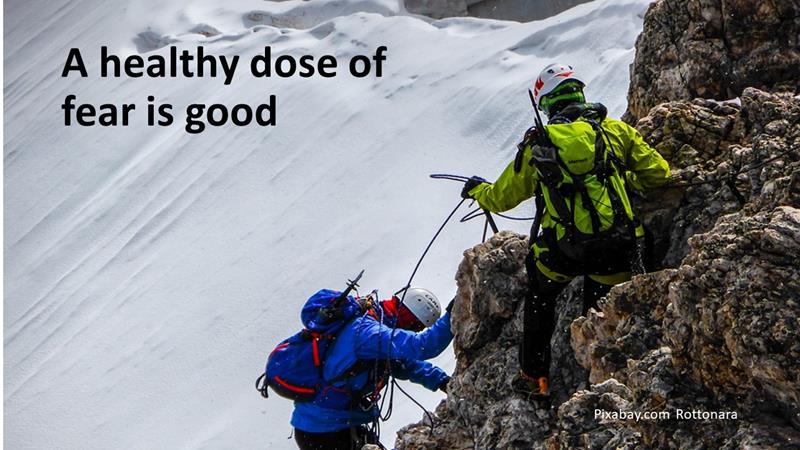
However, a healthy dose of fear is a good thing. Fear keeps us from taking foolish risks. Even the best rock climber will be fearful of clicking onto a frayed rope. You don’t want to tempt fate, or as Jesus said to the Devil during his temptation in the wilderness, “Do not put the Lord your God to the test.”[5] A healthy dose of fear can help us be safe, but too much fear becomes a problem because it leads us to inaction. And with 24-hour news, feeding us fear day and night, it’s amazing anyone gets anything done. The problem of too much fear is that it keeps us from taking risks, and if we don’t risk, we have no need of faith or trust.

In our passage for this morning, Jesus is preparing the disciples for the troubles they’ll face once he’s gone. There’ll be persecutions and lots of reasons for the disciples to be afraid. They’ll be hauled into court and flogged and betrayed and even face death. But Jesus doesn’t want them to be paralyzed into inactivity. Jesus is depending on this motley group of followers to spread the good news. He promises the Spirit will speak through them. The disciples must be willing to proclaim God’s word from the housetops. This is risky business.

In an Empire that will see the church as a threat, Jesus gives them reasons not to fear the powerful. First, at judgment, all things will be revealed. Martyrs can say, “I told you so.” But let’s face it, the promise our concerns will be addressed after the grave isn’t all that reassuring. So, then Jesus tells them not to fear those who will take their lives, but to fear God. After all, God has power over not just this life, but life after judgment. If you think about what Jesus is saying here, you’ll see because the disciples believe, they’re freed to do great things. They’re not afraid of death. All of us will die, but eventually many of them died at the hands of persecutors. Some, like Peter and Andrew, were crucified; Stephen was stoned; and Paul and John the Baptist literally lost their heads.

By refusing to be paralyzed by fear while trusting in God’s goodness, we can achieve more than we’ve ever imagined. Recall the Parable of the Talents.[6] The man who received only one talent and refused to take risk, because he was afraid of his master, is punished. Those who took risks are rewarded with even more talents. It’s that way with us. If we invest the talents God has given us, for godly purposes, God will bless our efforts. If we hoard our talents, we will be judged harshly.

“You’re to trust in God,” Jesus tells his audience, “whose concern extends even to the lowest sparrow.”  Jesus must have been an animal lover. This passage is filled with animals: sheep and wolves, serpents and doves, and sparrows.[7] Or maybe it’s the little things in creation that brings Jesus joy. Think about this, a sparrow at the temple in Jesus’ day could be purchased for next to nothing. If God is so concerned for the small parts of his creation, think of how much more concern God will show us, the pinnacle of his creation. To further emphasize God’s concern, we’re told that God has counted even the hairs on our heads (with some of our heads, God has an easier time).

In verse 32, Jesus returns to his rationale for us not being afraid. He doesn’t want us to become so scared that we slip into inactivity. That’s why he reminds us that our purpose is to be his ambassadors, shouting from the rooftops (at least, metaphorically). The warning here is that if we are unwilling to risk letting others know of our faith, we run an even greater risk that Jesus will not acknowledge us before the Father.

The gospel still puts people at danger. Yet Jesus calls us to take risks. “To those whom much is given, much is expected,” we’re told.[8] And we’ve been given a bounty, and if we fail to take a risk and use it in a worthy way, we’ll have something to fear when all is revealed! Furthermore, as Christians, we’re called to a higher standard. We’re to speak out when we see people being abused or being taken advantage of. We’re to call for justice and mercy and to stand up against those who bully and abuse. By keeping quiet, we may avoid the wrath of a boss or friends, but is that what Jesus want us to do? As we see in this passage, keeping quiet can cause us to run a greater risk: experiencing God’s wrath…

When Jesus is first in our lives, we will have the courage necessary to stand up to the powers in the world that challenge his authority. When he’s first in our lives, we can take the risk needed to expand his kingdom, for we know that we’re taking that risk with the God of Creation on our side.

Do not be afraid of anything earthly, we’re told. If we trust God, there is no reason for us to fear anything else. If we don’t trust and fear God, then everything may be feared. Amen.

©2020

[1] Scott Bader-Saye, Following Jesus in a Culture of Fear (Grand Rapids: Brazos Press, 2007), 16.

[2] Ibid.

[3] See Matthew 1:20; Luke 1:30 and 2:10.

[4] Frederick Dale Bruner, The Christbook: Matthew 1-12 (Grand Rapids: Eerdmans, 1994). 471-492.  Bruner divides this passage into trouble (Verses 16-23) and trust (verse 24-39).

[5] Matthew 4:7.

[6] Matthew 25:14-30.

[7] Bruner, 484-485.

[8] Luke 12:48.

The Harvest is Ready


Jeff Garrison
Skidaway Island Presbyterian Church
June 14, 2020
Matthew 9:35-10:15


You can watch this service on YouTube by clicking here. If you just want to hear the sermon, fast forward to 20:36.

We made Blood Mountain Shelter on our third day of hiking. Reuben and I had started at Springer Mountain in North Georgia. After resting a bit, we set out to fix dinner. By this point, we’d hiked 100s of miles together and formed a well-oiled team. I hauled water from the spring while Reuben got out the stove and started to assemble it. In a large gallon Ziploc bag, I poured the contents of instant pudding, powdered milk, and water. I kneaded the bag by hands till the lumps were gone and then walked back to the spring to place the bag in the cool water to set up. Reuben started boiling water as I opened soup packs for each of our cups. He started the noodles and we chatted and enjoyed a drink while they cooked.

About this time another hiker came to the shelter. Paul looked to be an old man, but he was much younger than I am now. He’d been on the trail for six days, covering the distance we’d covered in two and a half days. He’d gotten lost earlier this day which explained why we hadn’t meet him when we passed along the trail. His pack was heavy; his knees were killing him. He didn’t look like he was having fun. Paul plopped down and began to prepare his dinner as he watched us. Reuben poured the water from the noodles into the cups, so that we had soup. We mixed in the ingredients for mac and cheese, which we ate next, followed by pudding for dessert. As we ate dessert, we put another pot of water for tea and clean up. We used our tea bags to scrub out our bowls. Paul watched in amazement, we had only what we needed and nothing was wasted.

Paul was a schoolteacher from Oregon and planned to spend his summer hiking. He’d done a little camping in his life, but had never backpacked. Gathering what he thought he needed and had taken a flight to Georgia and was walking through the woods with a 70-plus pound pack on his back, twenty or twenty-five pounds more than what we were toting.

The next morning when we set out, Paul asked where we were going to camp for the night. For us, it was going to be an easy day, even though there wasn’t anything easy about the trail in Georgia. There’s little ridge line in the southern part of the Appalachians; although the hills aren’t tall, you are either going up or down. We gave him our destination, a campsite by a stream about 13 miles north. We said goodbye and thought that’d be the last we’d see of him. We were surprised later that day when he hobbled into camp. That night we went through our dinner routine again and Paul started asking more questions. Before the evening was done, Reuben and I had given him tips on hiking, on food, and most importantly dug through his pack and showed him how to lighten his load by a at least fifteen pounds. To our amazement, he was carrying a hatchet and a folding saw, yet had not built a single fire. It was too hot. He had a stove. Scalping, I assured him, was no longer in vogue, so the axe could go. He had extra clothes and cooking utensils and all sort of stuff that he could get by without. The following day, when we were met by friends for a food drop, we arranged for Paul’s extras to be mail home. With his load lighter, Paul began to enjoy hiking.

The ninth chapter of Matthew’s gospel ends with Jesus telling the disciples that the fields are ripe with the harvest, but the laborers are few. “Ask the Lord,” Jesus says, “to send laborers out into the harvest.” Mission begins in prayer. This plea is answered in the tenth chapter where the Master’s plan is set in place with Jesus commissioning the disciples to go out on their own and do the work of the kingdom. For the past five chapters, Jesus had been preparing the disciples. Now, their apprentice ends. They’ll get a chance to live out their call to be fishers of men and women (although Jesus’ shifted metaphors as they are sent as farmers reaping the harvest).

When Jesus sends the disciples, he insists they go light. No extra clothes, no extra gear, no extra food, and no extra cash. They go by themselves, taking only the blessing Jesus bestowed upon them. They are to learn first-hand that Jesus is sufficient—he has given them power over evil as well as the ability to bring healing to those who are sick and to bring to life those who are dead. Going out without possessions, they will be continually reminded that they are dependent upon God and the generosity of others. Furthermore, they would be continually reminded that they are working for Jesus.

Jesus advice to the disciples is to start in their own neighborhoods. The mission to the Gentiles will come later; they first must take the message to the Jones and Smiths who live down the street. As they travel, they’re to live modestly and with the people. They are to be gracious and content with what they’re offered. They’re to “be courteous.” They’re not out to bring judgment or to browbeat folks, they’re just to go about helping people and sharing with them the good news that the Savior has come. If they’re not welcomed, they’re not to make big deal about it, they’re just to move on to the next neighborhood, not taking it as a failure. They’re not to mope around showing disappointment.

There are many things we can learn about mission from this story. First, it’s interesting who Jesus has called. The twelve disciples are all ordinary folk, including as our text points out, the one who would betray Jesus. They are not going out on their own skills, but with Jesus’ blessings, which makes the difference.

Another thing we learn that the world isn’t how it should be. We know this is true. If there was any question about it, the last few months dispelled our doubts. But at this point in the First Century, Rome had beaten all its enemies, and those who thought world peace had come. Of course, Jesus sees problems. There are people suffering. Jesus is compassionate. He realizes the struggle many face, especially the poor and slaves. Many are battling demons and the powers of evil. Many are grief-filled, or hurting physically and emotionally. Jesus’ plan is to turn the world upside down, offering grace and hope that can only come from God.

We also learn here the importance of mission for the church. It’s essential. It’s our purpose. We’re not here just to praise God, although that’s important. We’re not just here to sooth folks concerns by proclaiming forgiveness through Jesus Christ, although that’s important. We’re not just here to provide a safe haven for Christians to gather and be in fellowship (when there’s no pandemic), although that’s important. The church is called onto the mission field. For a few of us, that means going to exotic places. As we see here, the mission field starts at our doorstep. Jesus first sends the disciples into their own neighborhoods, to their own people. It’s not that Jesus isn’t interested in other people, but first he wants to solidify his base. As we saw last week, Matthew ends his gospel with Jesus commissioning the disciples to go to the ends of the world. Mission starts locally but extends globally. As Christians and followers of Jesus, we can’t ignore either group. To say that we only do mission locally is just as much of a travesty as to say mission is only what we do for those who live across salt water.

A final truth I want us to consider is that mission involves more than just telling people about Jesus. You know, Reuben and I could have spent all day telling Paul about how much fun we had backpacking and it wouldn’t have made any difference. It was only by helping him go through his gear and showing him how to lighten his load were we able to help. It’s the same with our calling as disciples. We’re not to just share the good news; we’re to demonstrate godly values in our lives and to show others how it can make a difference. That famous saying attributed to Francis of Assisi, “preach the gospel, if necessary, use words,” comes to mind. As the 18th verse reads, “you’ve been treated generously, so live generously.” Doing is just as important as telling, as Jesus makes clear in this passage. He didn’t give the disciples golden words to woo people; he gave them the ability to minister, to heal, and to confront evil.

This is still our goal. Live simply and generously, ministering to the needs of others. In other words, let the love of Jesus flow from your hearts, and be gracious. These days, the world can use a little help. Let’s flood it with grace. Amen.


Works consulted:

Bruner, Frederick Dale, The Christbook: Matthew 1-12 (Grand Rapids, MI:
Eerdmans, 2004).

Gundry, Robert H., Matthew: A Commentary on His Literary and Theological Art (Grand Rapids, MI: Eerdmans, 1982.

Hare, Douglas R. A., Matthew: Interpretation, A Commentary for Teaching  and Preaching (Louisville: John Knox Press, 1992).

©2020  Jeff Garrison

Where do our loyalties belong?

Jeff Garrison
Skidaway Island Presbyterian Church
Matthew 22:15-22
March 15, 2020


        If you read the entirety of Matthew 22 (and with the extra time we may be having on hand as everything is being cancelled because of the Coronavirus, it’s not a bad idea), you’d witness a masterful campaign to trap Jesus. But Jesus isn’t so easy to catch. He’s kind of like Stonewall Jackson in the Valley Campaign in the spring of 1862. Jackson faced much larger armies who wanted to trap and do him in.[1] Similarly, with Jesus during Passion week, he’s confronted with a large number out to destroy him. But Jesus doesn’t fall in their traps. Jesus bewilders his enemies.

         What’s happened is that unlikely groups join together to challenge Jesus. The old cliché, “politics make strange bedfellows,” rings true. Groups who wouldn’t normally give each other the time of day have come together to take on Jesus. They sense that Jesus is challenging the existing order. You have a few Herodians, who are Jews who believe they’re be better off cooperating with the Romans. They take their name from Herod, who had Jewish blood but worked for the Empire. And you have the Pharisees; a group of seriously committed religious leaders who believe in the resurrection. Theologically, they’re most like Jesus, but Jesus constantly challenges them and exposes their hypocrisy.

        What we read this morning could be described as one movement in a tag-team wrestling match. The Herodians and the Pharisees team up on Jesus.[2] Once they are dismissed, in the next passage we have the Sadducees, the conservatives of the day, crawl up on the mat.[3] According to most translations, Jesus’ “silenced them,” but the original language is a bit harsher. A better translation would be that Jesus “muzzled” them.[4] Think of muzzling a dog!  Jesus is on a roll! But the Pharisee’s still come back for more.

    So what is Jesus telling us in this passage? Do you remember those big posters that use to sit out in front of the Post Office and government buildings with Uncle Sam pointing his finger and saying: “I want you!” I believe we could easily surmise this text into a big poster of God saying: “I want you!”

Let’s now look deeper into the passage. We’re told that the Pharisees are plotting to entrap Jesus. How does Jesus know this? We could say that because he was God he knew, but that explanation does not uphold the human side of Jesus. The human side of Jesus would have realized something was up when he saw the Pharisees and the supporters of Herod walking hand in hand.

These two unlikely groups approach Jesus. They try to butter him up a little by telling Jesus he’s sincere, he speaks the truth, and that he is impartial. This Jesus’ second clue. “For flattery is on their lips, but their heart is set on their gain,” we read in Ezekiel.[5] Most of us, I would expect, are smart enough to realize something fishy is up when those who have nothing to do with us began to butter us up. And that’s what happens here. With compliments, they try to catch Jesus off-guard before snapping the trap with their sixty-four thousand dollar question.

         “Tell me,” they ask, “Is it lawful to pay taxes to the emperor, or not?”  Jesus has to be careful. Last week you heard Deanie preach about the revolutionary act of Jesus cleaning the temple. Now they want Jesus to make a revolutionary statement against the civil authorities. If Jesus says they should not pay taxes, the Herodians could have him arrested for treason. But then, if he says to pay the taxes, the Pharisees can attack him for not being a patriotic Jew.[6] It’s almost a no-win situation.

          Jesus asks them for a coin. Unlike us, he didn’t have to worry about where that’s coin has been or picking up some a virus from its surface. However, Jesus still has to be careful. The disciples, we know, had a common purse and he could have gone there to fetch a coin, but then the Pharisees might have charged him with toting around an engraved image of the emperor.[7] So Jesus has them to look at a coin they are carrying, and he asks them whose picture is on it…. They reply, “Caesar’s.” Jesus then flips the coin back to them, saying give Caesar what is Caesar’s, and to give God what is God’s. The little band of tempters are astonished. They are amazed. They don’t know what to say, so they leave.

These men are amazed, but do they understand all that Jesus says? They hear “Give unto Caesar what is Caesar’s,” but do they hear “Give unto God what is God’s.” Do they understand what Jesus meant? Probably not for they continue their attempts to attack Jesus throughout this chapter. But let’s not worry about them. How about us? Do we hear what Jesus is saying? Back to that revised army poster of Uncle Sam saying, “I want you!” Jesus is saying, “God wants us!”

The coin had an image on it, Caesar’s, therefore give it to him. In Genesis, we’re told we’re created by God, in God’s image.[8] The coin belongs to Caesar, it bears his image; our lives belong to God, they contain God’s image.  Caesar may have a lien on our possessions while we’re on earth, but God has a lien on our total being—now and forever.  God is calling us to dedicate our lives. God, in Jesus Christ, is in that poster pointing, and saying, “I want you.

        Give to God what is God’s.  This phrase is often overlooked.  We tend to get hung up on what is Caesar’s and what is ours. We get hung up on the petty details and we miss the important question. What does it mean for us to give ourselves to God?

Sure, a part of devoting ourselves to God is about money, but it’s more than that. Money is only a start for God wants and expects much more from us. God wants us to trust him and then to do what we can to live in a manner that will further God’s work in the world. If we believe that we are owned by God and not Caesar, our lives should reflect such faith. If we believe that we belong to God, and are in God’s hands, we have nothing to fear, not even the Coronavirus. For regardless of what happens to us on this earth, God has us in his hand and is working out all things for good.[9] That may be hard to believe considering that panic that is going on around us, but it’s true. It’s why Christians for the past two thousand years have risked their lives and their well-being on behalf of others. Yes, we can give Caesar what is Caesars. But we can also take risk and do what is right and noble and good because we have trust in God.

         Earlier I mentioned Stonewall Jackson, whose biography I’m currently reading. But let me tell you two other Civil War stories, they’re both short, and demonstrate this point. At the Battle of Shiloh in the spring of 1862, Albert Sidney Johnson led the Confederate troops as they overwhelmed the Union forces near Pittsburg Landing along the Tennessee River. It was a bloody day and the Union lines were broken in places. During a lull in the first day of battle, Johnson, seeing a number of wounded Union soldiers in need, ordered his surgeon to set up an aid station and to tend to their needs. According to Shelby Foote in his novel about the battle, his surgeon, Dr. Yandell protested. Johnson cut him off saying “These men were our enemies a moment ago. They are our prisoners now. Take care of them.” A few minutes later, a stray bullet struck Johnson’s leg and without medical aid, he quickly bled to death.[10] To this day, there is debate as to whether or not Johnson’s death caused the tide of the battle to turn. But the tide did turn and General Grant became a national hero.

          A second story comes from the city of Wilmington during the Civil War. In 1862, a blockade runner that had come in from the Caribbean brought Yellow Fever to the town. Those who could fled to the country, but several of the pastors and the leading citizens of the town stayed behind, feeling it was their Christian obligation to help out the victims. Over 400 people died of Yellow Fever that fall, including many of those who intentionally stayed to care for the dying.[11]

Of course, with the current threat we face, we need to think about our response. We need to help when and where we can, but we also need to be wise enough not to become a carrier of the disease. So while mercy might call us to act boldly, it also might call us to isolate ourselves (especially if we’ve been recently travelling and could have potentially been exposed to the illness). Such isolation might help slow the spread of the disease and, with the phone and the internet, there are many other ways that we can read out to those for whom we care and love. The Christian faith calls us to be brave, after all we don’t belong to ourselves but to God. But it also calls us to be wise!

      Give to God what is God’s, is the message here. So yes, we should pay our income tax. And when you write that check this April, we might remember that giving Caesar his due can be a lot easier than giving to God what is his. For our whole life belongs to God. But then, God’s given us life and in Jesus Christ has redeemed us to be his people. That’s a debt we can’t repay, nor is such repayment expected. As the old hymn goes, “Jesus paid it all.”[12]  Amen.


©2020

[1] I have been reading S. C. Gwynne, Rebel Yell: The Violence, Passion, and Redemption of Stonewall Jackson (New York: Scribner, 2014).

[2] Matthew 22:15-22.

[3] Matthew 23-33

[4]  Frederick Dale Bruner, The Churchbook: Matthew 13-28 (Grand Rapids: Eerdmans, 2004), 410.

[5] Ezekiel 33:31b.

[6] Bruner, 397.

[7] Bruner, 398.

[8] Genesis 1:27.

[9] Romans 8:28.

[10] Shelby Foote, Shiloh (1952, New York: Vintage Books, 1991), 199.

[11] James Sprunt, Chronicles of the Cape Fear River, 1660-1916 (1919: Wilmington, NC: Dram Tree Books, 2005), 286-288.

[12] “Jesus Paid it All,” Elvira Hall (1865).

Peaceful Joy

Jeff Garrison
Skidaway Island Presbyterian Church
Matthew 1:18-25
December 22, 2019

The Isaiah scripture is also referenced in Matthew’s telling of the birth narrative.[1] Before I read it, let me tell you a bit about the opening of Matthew’s gospel. The Gospel of Matthew is filled with surprises. It begins with a genealogy of Jesus. That seems innocent enough, but within the names, we find scandals. There are four women mentioned, none of who seem to meet the Jewish holiness standards. Two are foreigners, and there’s a prostitute, an adulterer and one involved with her father-in-law…[2]  Matthew drives home the point that God works in mysterious ways and can use anyone to further the kingdom. Following the genealogy, we are told of Jesus’ birth and again, we find a scandal. A woman is pregnant and the man she’s to marry is not the father. Joseph, the man, is about ready throw in the towel, but then he has a dream. Let’s listen to the text. Read Matthew 1:18-25.

###

Christmas often doesn’t seem peaceful. Pressure can build as we strive to find the right gifts for our loved ones, or fix the perfect meal, or attend all the parties and concerts.

The holiday stands in contrast to the birth of the Prince of Peace, as it was with a woman shopping in one of those big city department stores. It was a multi-floored building, with escalators and elevators and an entire floor devoted to toys. To her four and six-year-olds, it seemed like heaven. The mother was reminded of another place. Her kids kept singing the “I want this” song over and over. On every aisle they discovered a new “I gotta have” toy. Frazzled and about to come unglued, the lady finally paid for her purchases. She dragged the bags and her two kids to the elevator. The door opened. She and the kids and the presents squeezed in. When the door closed, she let out a sigh of relief and blurted, “Whoever started this whole Christmas thing should be found, strung up and shot!” From the back of the elevator, a calm quiet voice responded, “Don’t worry, madam, we already crucified him.”[3]

That joke reminds us that the Christmas story is all a part of a larger drama in which God is directing. Christmas is a celebration of the God coming to us in a way we can understand. It’s a new genesis (which we’ll discuss in a bit). In that child born of Mary, a peaceful joy is offered to the world. We can now experience forgiveness and to be reunited with God. Christmas, Good Friday and Easter are all linked together.

Birth is always an exciting time, for when a child is born there is no telling what might come from his or her life. But for this child, the child Mary carries, there’s something even more special about him. He’s the Messiah. But he’s not the Messiah folks are expecting. He’s not going to be a great military leader wiping out enemies. He’s not going to be a pretentious king sending decrees out from his throne in Jerusalem. He’s going to be a carpenter and a teacher and a healer. Instead of providing earthly rewards, he’ll erase the gap between us, citizens of earth, and God. He comes to save us from ourselves, from our sins, and from our failures at trying to be our own gods.

God certainly chose a unique way to bring the Messiah into the world. Our text begins simply: “the birth of Jesus took place in this way.” Interestingly, the word for birth used here literally means “the genesis.”[4] With Jesus, there comes a genesis, a new beginning. If you look at the opening chapter of John’s gospel, you’ll see John drawing upon the images of creation as recorded in the first chapter of Genesis; likewise, Matthew reminds us that this isn’t just an ordinary birth. God is starting anew.

This is a new beginning, a genesis. In Romans 5, Paul makes this analogy, comparing the works of Adam, who brought death into the world, with the works of Christ, who brings new life.[5] With Christ, our history with the Almighty, with our Creator, a history marred since Adam, starts over.

This new beginning starts with a young pregnant woman, not yet married. Her fiancé, we’re told, is a righteous man. It’s not easy to be an unwed mother today, but an unwed mother in the first century was in a real pickle. She didn’t have the social services we enjoy today to help such individuals and in a harsh religion that frowned on moral failure, such a woman had few options. She and her child would always be a social outcast. But Mary wasn’t just any woman with an out-of-wedlock pregnancy. She was carrying the Messiah… Her situation is precarious considering the pivotal role she plays in salvation history.

As we would expect, her fiancé is also shocked. We’re told he planned to quickly dismiss Mary which may sound harsh, but not in the culture of that era. He could have gone public and humiliated Mary and, at the same time, made himself look righteous. Because Joseph would have been wronged yet so righteous, his sad eyes would have drawn women. They’d be falling at his feet. But instead of boosting himself at Mary’s disgrace, he decides to quietly dismiss her. Joseph would now have to take the heat. It was an honorable thing to do, for he would protect Mary from crowds (for there would have been those willing to stone her) and he himself would accept her shame. From this story, we learn something about the true nature of righteousness. It’s not just doing what is right according to the laws or customs. It also means taking on, at the expense of oneself, the guilt of another. Christ does this for the world, and to a lesser degree, Joseph was willing to do this for Mary.

The glue that holds this passage together is the Holy Spirit. In a way, the Holy Spirit is like divine matchmaker. The Spirit impregnates Mary, bringing life into her womb and setting off this genesis, this new beginning. The Spirit also works on the other side of the equation, with Joseph, getting him to buy into the plan. Through the dream, Joseph is informed of Mary’s righteousness and of God’s plan for the child she carries. And when Joseph awakes, he decides not to dismiss Mary, but to go ahead with the wedding. They’ll marry and together raise this child and participate in God’s plan for reconciling himself to a fallen world. It’s a good thing Joseph listened to God in this dream.

I’m may have told you before that when I was considering seminary, I had several dreams affirming my decision. I’m not sure I would have been as willing and ready to quit a job, sell a house, and move four states away had it not been for those dreams. In one, I found myself asking if it was worth it as I didn’t really think I was cut out for all this. But in this dream, I heard a very distinct voice saying, “Go ahead and go, and when you’re done, you’ll know what you’re to do.” Notice that I did not know where I was going or what it was that I’d be doing. I had to step out in faith, just as Joseph’s decision still required faith. But these dreams gave me the confidence I needed to pack up and head to seminary.

Joseph’s dream shows us the importance of listening to God and when we listen to God and follow his path, we will often find peace. Let me clarify. I don’t think listening to God means trying to understand all the dreams of our sleep. Often our dreams are a way that our minds sort out stuff. Instead of investing large amounts of time trying to understand what our dreams are telling us, we need prepare ourselves to hear God’s voice by studying Scripture, by praying and by being open to hear God by whatever means he comes to us. God’s word can come many ways: in our sleep, through a thought we have while walking or driving, or in a conversation. What’s important is that we know God’s word enough to make sure what we hear is from God. Notice in our account today how Joseph is reminded of the prophecies in Scripture.  For him, that was assurance God was behind this.

A second clarification needs to be made is about the meaning of peace. Obviously, if you read beyond the first chapter of Matthew, you’ll see that peace eludes Mary and Joseph as they flee as refugees to Egypt to escape Herod. The peace they had, in that little bundle of joy they protected, was knowing that they were fulfilling God’s will. God’s Spirit was with them, giving the strength they desperately needed. God’s peace doesn’t mean the absence of conflict, but the assurance of God’s presence. As the Psalmist reminds us, it’s the peace that overwhelms us even in the “shadows of death.”[6]

This passage is about the work of the Holy Spirit, guiding and directing mere mortals, like you and me, to help bring in God’s kingdom. Life is like that. It’s not about us; it’s about God. As for us, today, we, too, need to be open to experiencing that prod from God to take the risk before us. We need to be prodded to step out in faith.  God’s Spirit gives us new life. In our prayers, in our Bible Study, in our mediation time, in times of quietness which may only come when we’re asleep, we need to be open to hearing God’s invitation to participate with him in bringing about the kingdom.

We learn in the first chapter of Matthew that God works through ordinary people. I have recently been reading John Kasich’s book, It’s Up to Us. He writes, “Leadership comes in all shapes and sizes, but it almost always starts at home and grows from there.”[7] Well, sometimes, it starts in a manger. And it starts when we respond to God’s call, for God can do great things through us, things that are frightening and things we would never have dreamed of doing on our own. When we hear God’s call and we answer, God will give us the peace to know that he’s with us and will guide us that we might do whatever small part we’re called to do to bring about the peaceful kingdom. Amen.


©2019

[1] Isaiah 7:13-15 was our Old Testament Reading

[2] Tamar (Genesis 38), Rahab (Joshua 2), Ruth (the Moabite with her own book) and Bathsheba (2 Samuel 11)

[3] I have told this story several times. I read the story and modified it from one used got the story years ago from a sermon by Dr Clayton Cobb, St Peter’s by the Sea Presbyterian Church, Rancho Palos Verdes, CA.

[4] Dale Brunner, The Christbook, Matthew 1-12 (Grand Rapids, Eerdmans, 2004), 23.

[5] Romans 5:12-21

[6] Psalm 23.

[7] John Kasich, It’s Up to US: Ten Little Ways We Can Bring About Big Change (Hanover Square Press, 2019), 108.

Loving Joy and the Preaching of John the Baptist

Jeff Garrison 
Skidaway Island Presbyterian Church
Matthew 3:1-12
December 8, 2019


Our series, “Let Heaven and Nature Sing,” is all about joy. But this series is also based on traditional lectionary readings from scripture and today’s reading, on the second Sunday of Advent, includes the preaching of John the Baptist. How shall we bring joy out of this guy who today would be passed over as a desert lunatic? The background material for the series even suggest doing a cantata today and skipping the sermon based on this text. To me, that’s not fair to Scripture. We need to wrestle with what God is trying to tell us in his book.

Have you ever thought about this: Why do we only find the story of Jesus’ birth in two of the gospels: Matthew and Luke? And why do we find the story of John the Baptist preparing the way for the Messiah in all four of the gospels? And in all four gospels, there is the link back to Isaiah, of that voice howling out in the wilderness.[1] The story of John the Baptist is one with which Scripture demands that we contend. What are we being told here? How does the fire and brimstone preaching of John the Baptist prepare us for the loving message of Jesus?

If we want to get to the good news, we must face up to the bad. So, let’s listen to what John has to say to us. Read Matthew 3:1-12.

###

          There were two preachers who, on their day off, enjoyed fishing. They were at a river next to a highway. Before sitting on the bank, where they’d watch their corks in the hope they’d be the tug of a fish on the line, they posted a sign. It read, “The end is near! Turn yourself around before it’s too late.”

A few minutes later a car flew by.  Seeing the sign, the driver yelled out, “Keep your religion to yourself, you fanatics.” He then hit the gas, sending rocks flying and dust swirling as he headed around a curve.

Just a moment later, there was a screech from braking tires, followed by a big splash.

One of the preachers looked at the other and asked, “Do you think we should have, instead, put up a sign that said, ‘Bridge Out’?”

         I wonder about John’s message. It’s so harsh, maybe he should have toned down his words. Repeatedly, he talks of fire, and not the warming flames of a campfire, but the ominous fire like those recently experienced in California and Australia. “You brood of vipers,” he calls the religious leaders of the day. That doesn’t sound very loving, does it? Jesus would never say that, would he? Actually, he does; twice in Matthew’s gospel.[2] What does this phrase mean? And how does this relate to a loving God?

Law and gospel must go together. In scripture, law came at Sinai during the Exodus and the gospel came roughly 1400 years later with the exemplary life, atoning death and glorious resurrection of Jesus. John is the last in a series of prophets who show our failure of abiding by the law as he calls us to clean up our acts. God is doing something new and marvelous and we need to be ready! All this talk about fire and calling people snakes is a way to get our attention, to force us to examine our own failings so that we might repent and follow Jesus.

          Law and gospel, they go together. To understand the story of scripture, we can’t just push off the “law” parts of the Bible and only focus on the gospel. The gospel makes no sense without the law. The gospel is about how God saves us from our failures, our sin. Those who listened to and were moved by John’s preaching were left with no choice but to confess their sins in order to begin the process of repentance, a word that means to turn around or to start in a new direction. They had to leave sin behind as they joyfully accept what God was doing in their midst.

So, why does John call the religious teachers of the day a brood of vipers? It’s a pretty harsh term. For many people, it conjures up nightmares, a den full of snakes, a place for Indiana Jones but not the rest of us. In the desert, you must be careful when trying to find shade under a rock overhang or in a grotto or cave. Snakes tend to gather in such places to avoid the heat of the day and you don’t want to be messing with them. John implies their words are poisonous.

Consider this: both the leaders of the day and John took seriously the sins of the people. But the difference is that the leaders of the day taught that people must justify themselves before God through an elaborate system of sacrifices, whereas John twists the concern of sin around to where people must accuse themselves before God, confessing their sins, so that they might be washed of them as symbolized in baptism.[3]

        But it all comes back to this. God is doing something new. With John the Baptist, God was paving the way for his Son to come on the scene and to teach people a new way to live and to be human. In order to prepare for something new, people must admit their own sinfulness and to realize that they long for something better. Of course, if we don’t think we need to be better, there’s a warning here. Judgment that comes from transgressing the law is a reality. So, do we ignore our sinfulness and die to the law? Or do we accept and confess our sinfulness and embrace the grace that Jesus’ offers? Those are our choices.

          Advent is the time for us to prepare for the loving tenderness shown by Jesus. If God is redeeming this world, if God is promising a new heaven and a new earth, then we should want to be ready to receive this gift. But to receive the gift, we must leave the past behind. We have to be willing to examine deep within our souls and to offer up all that’s not godly so that we might be both cleansed of our sin and have the room to accept Christ into our hearts. We must be willing to allow ourselves to be transformed into something new and better. For Advent is a time not only to remember that Christ came, but that he will come again, and we must be ready.

Your assignment for this week is to examine yourself, your words, your thoughts, your actions. What have you done that’s not been Christ-like? Have you harbored bitterness or showed unkindness or said things that twisted the truth or belittled another? If so, bring it to God. Get rid of the darkness by bringing it to the light.

         We must not just prepare ourselves; we should prepare the church, which is, in the final events of history, to be the bride of Christ.[4] That means that the church must confront all it’s done that’s not been holy, and there’s been a lot. From the crusades to the inquisition and witch-hunts, from the support of slavery and conquest to our tendency to huddle into crowds of similar people and turn our backs on the world for which Christ came and gave his life. The earthly church has not always been holy. We need to confess this! John’s call to the religious establishment of the day still holds. Are we willing to confess our shortcomings and to be open to what God is doing in the world? That means we must give up control, for this enterprise known as the church isn’t about us. It’s about God. It’s about us bringing glory to God as we serve as the hands and the feet of our Lord in the world.

          Is there loving joy in this passage that will lead to us “repeat the sounding joy”? Yes, there is, but we must get beyond the call to prepare, which John focuses on, and realize that God is doing a new thing. We trust in a God of resurrection. Even if the world destroys itself, God won’t let that be the final word. God wants to remake us. John’s role is to prepare us. Our role is to respond to John’s call to repentance so we might be open to what God is doing in our lives and in our fellowship.  Confession and repentance may not in favor in today’s secular world, but in the church, it’s where we begin. All of us need to take a deep look at ourselves and then turn to God and fall on our knees… Amen.


©2019

[1] Isaiah 40:3-5. Frederick Dale Bruner, The Christbook, Matthew 1-12 (Grand Rapids: Eerdman, 2004), 88.

[2] Matthew 12:34 and 23:33.

[3] Bruner, 89.  Bruner attributes this idea of a shift from justifying to accusing to Matthew Henry’s Commentary (1721).

[4] Revelation 21:2.