
Jeff Garrison
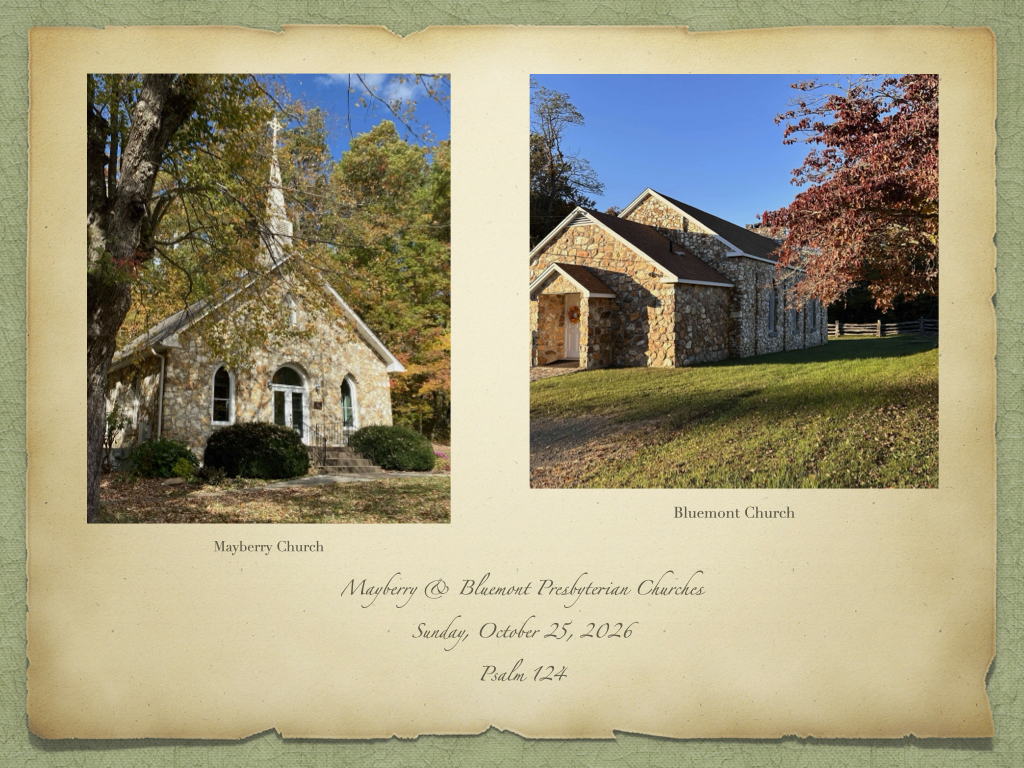
Bluemont & Mayberry Churches
October 25, 2026
Psalm 124
At the beginning of worship:
One of the commentaries which I read in preparation for today’s sermon mentioned “The War Prayer,” a short story by Mark Twain. Although familiar with the story, it has been decades since I read it, so I pulled it off my shelf. Twain describes the growing excitement as a nation prepares for war. Patriotism runs high. Everyone’s excited.
Interestingly, Twain published this piece in the first decade of the 20th Century, at a time when our nation wasn’t at war. It’d be another decade before the Great War and Twain died before it began. Perhaps he recalled the Civil War, for excitement flooded the South. And for a time, even Twain found himself caught up in the exuberance. But then, he thought better of it and headed west to avoid the war. Or maybe he thought of the Spanish American War, which he condemned as imperialistic. Either way, he makes some bold statements in this story. This part especially stood out. Listen:
It was indeed a glad and gracious time, and the half dozen rash spirits that ventured to disapprove of the war and cast a doubt upon its righteousness straightway got a stern and angry warning that for their personal safety’s sake, they quickly shrank out of sight and offended no more in that way.
Prophets always rain on parades. As followers of Jesus, there are times we should stand up for what is noble and to be brave. We stand out against the crowd as we proclaim his grace and good news despite opposition. We do so, not because we are strong. After all, we may find ourselves pushing against a great tide. By ourselves, we can’t do much to stem its flow.
But we are called to speak honestly, to strive for righteousness, and to grasp the truth. Sometimes we can be overwhelmed, but we are not to trust our own strength. We strive to do that which is right and honest and just, placing our hope in God’s hands. For in the end, the only power which matters belongs to God. If we attempt to lure God to our side, we got it all wrong. Instead, we must strive to be on God’s side.
Before reading the Scripture:
I’m continuing to preach through the Psalms I’ve not preached on before. Today we’ll look at Psalm 124. I’m surprised to see I had not preached upon this Psalm, for the eighth verse of this Psalm I incorporate into almost every funeral service of which I have officiated over the past forty years. I also refer to that verse in many sermons, for it capsulated our faith in the Almighty. “Our help is in the name of the Lord, who made heaven and earth.”
Last week, I introduced you to how we divide the book of Psalms into five books. But there are other divisions. Within book five, which contains our Psalm for today, we find another division. The Psalms of Ascent. These 15 Psalms are fairly short and were thought to have been recited or sung by pilgrims traveling to the temple in Jerusalem to worship. Another possibility is as the pilgrims climbed the 15 steps up to the temple, they would began by reciting Psalm 120 on the first step and each step there afterwards, they’d recite the next Psalm. Then, at the top, they recited Psalm 134. I’ve always liked how these Psalms are linked to pilgrimages, for in a way we’re pilgrims in this world, making our way as followers of Jesus to our true home with God in the next life.
Psalm 124, as we’ll see, was also designed to be used in worship. It begins with a clear “call-to-worship.” The reader calls for the congregation to join with him in proclaiming God’s goodness. Then the Psalm ends with a communal profession of faith.
John Calvin, in his liturgies used in both Strasbourg and Geneva, incorporated the closing line of the psalm at the beginning of his worship. This is a Psalm of Thanksgiving, where God’s people give thanks for having been saved from peril. This Psalm, written centuries before Christ, remind us of our sinfulness and that our salvation comes only from God’s grace.
Read Psalm 124
Two things become clear in this Psalm. First, as humans, our powers and abilities are limited. Second, God has no such limitations. We should trust, not our own powers, but the power of the Almighty.
This Psalm can be divided into three parts. Part 1, consists of the first five verses, recognizes how God helped to deliver his people in the past. But from what were they delivered?
Interestingly, the Psalm provides no hint of the context. From what did God save the people? Pharaoh’s army, the Philistines, the Assyrians, an extraterrestrial race? We don’t know and perhaps this is good. Not tying the Psalm to a particular historical event allows us to universally apply it to our situation. Instead of using actual events, the Psalm incorporates images, similes and metaphors, all which reflect the peril facing former pilgrims. The seriousness of the situation implies that without God’s help, they would have perished. They would have drowned, been swept away in a flood, pulled down by a torrent, or crushed by raging waters.
Desert people know the dangers of tight canyons when the hard sunbaked land receives rain. Did any of you see the video from Hurricane, Utah or Zion Canyon this weekend? If so, you know to what I refer. If caught in such a torrent, you’re gonna die.
But the Psalm doesn’t refer to natural disasters. Verse 2 makes this clear. The New Revised Standard Version, from which I read, translates this as “when our enemies attacked.” The King James Version and the New International Version refer to when men attacked. The word used here is “Adam,” like the first man but a word which also applies to all people.
Perhaps the best translation is The Message paraphrase which translate the word, Adam into “everyone.” “Everyone went against us.” In other words, as the imagery reflects, these overwhelmed pilgrims would be wiped off the map without God’s intervention.
In this first section, we have a negative view of people. Consider this: who makes up the enemy? People. People can become our enemies. And when they gang up on us, we can be overwhelmed. Second, we have limited abilities to protect ourselves, especially if everyone conspires against us. Left to our own abilities, we may cease to exist. Our inability comes from sinfulness (those who conspire against others, sin against them) and our frailty. We see both in this Psalm, the problem of multiple enemies and of human limitations.
The second part of the Psalm, verses 6 and 7, praises God for their deliverance. Here, the Psalm switches metaphors. Instead of near drownings, the pilgrims see themselves as a bird freed from a trap. The bird feared it would become the hunter’s dinner, but at the last moment, the trap springs, the snare breaks, and the bird flies safely away. Notice, again, its not the bird or the people saving themselves, but events which happen beyond their ability to control.
While the Psalm begins with a negative view of humanity, it provides a positive view of God which comes into clarity in the second and third parts of the Psalm. God has the ability to save. This Psalm looks back into history to make such a positive statement. The Psalmist does not look ahead and presume God will continue to be on their side. We can’t control God, we can only trust God by what we have experienced.
The first two parts lead to third section of the Psalm, a brief statement of faith… Our help is in the name of the Lord, who made heaven and earth. If you know the Psalms, you may realize this proclamation is similar to Psalm 121, where we get the line, “My help comes from the Lord, who made heaven and earth.” That Psalm is more of a personal song of salvation, where Psalm 124 focus on corporate salvation. God saves his people.
Psalm 124 is not a cry for going into battle with God at our side. Such an idea goes against God’s power and freedom. We don’t control God. Instead, Psalm 124 humbly recognizes our human limitation and our need to depend on our Creator God. Instead of God being on our side, we should strive to be on God’s side. Amen.
Sources:
Alter, Robert. The Book of Psalms: A Translation and Commentary, New York: Norton & Company, 2007.
Kvam, Kristen E. And Don E. Saliers, Psalms: Belief, a Theological Commentary on the Bible. Louisville, KY: WJKP, 2026.
Mays, James L., Psalms: Interpretation, a Biblical Commentary for Teaching and Preaching, Louisville, KY: John Knox Press, 1994.
Mast, Stan. “Commentary on Psalm 124.” Https://cepreaching.org/commentary/2017-08-21/psalm-124/
Twain, Mark. A Pen Warmed-u[ in Hell: Mark Twain in Protest. Frederick Anderson, editor. New York: Harper & Row, 1972.
Weiser, Artur. The Psalms: Old Testament Library. Herbert Hartwell, translator. Philadelphia, Westminster Press, 1962.